A Clinician's Guide to Scoring Beck Depression Inventory
Mar 22, 2026

Scoring the Beck Depression Inventory is a straightforward process: you simply add up the ratings for each of the 21 questions. The responses are rated from 0 to 3, giving you a total score that can range from 0 to 63. This final number is what turns a patient's subjective feelings into a solid, quantitative piece of data for clinical use.
Translating Patient Responses Into Clinical Data
The Beck Depression Inventory is so much more than just a questionnaire. Think of it as a vital instrument that helps us quantify a patient's personal experience with depression. Scoring isn't some clerical chore—it’s the crucial step where we translate subjective reports into an objective metric. That single number is what guides our treatment plans, helps us track progress, and builds a more complete clinical picture.
The modern version, the BDI-II, was updated back in 1996 to align perfectly with key diagnostic criteria. Its entire purpose is to give us a clear snapshot of a patient's symptoms over the past two weeks, making it an absolutely indispensable tool in clinical practice today.
The Power of a Single Number
Every time a patient completes a BDI-II, we get a critical data point. By adding up the scores from all 21 items, we get a total that directly correlates with established levels of depression severity. This simple act helps us move beyond vague descriptions and into the realm of data-informed care.
For example, a new patient might just say they're "feeling down." But after they complete the BDI-II and get a score of 25, we can reframe that vague feeling. Now, we have a score that falls into the 'moderate depression' range, giving us a clear, actionable starting point. This insight allows you to immediately begin discussing appropriate interventions, such as CBT or psychoeducation, tailored for moderate symptoms. To get a better sense of how this fits into the broader world of patient assessment, you can explore resources on general psychological testing.
The real value in scoring the Beck Depression Inventory is its power to standardise the measurement of a deeply personal experience. It creates a common language for clinicians to discuss a patient's status and track how effective our treatments really are.
Proven Reliability in Practice
The BDI's reliability is rock-solid, which is why it's such a trusted tool for clinicians everywhere. It's been a cornerstone of mental health assessment for decades. A 2018 study from UC San Francisco really drove this home, highlighting its sensitivity by finding that 42% of patients scored in the moderate to severe range.
With a robust test-retest reliability of r=0.93, we can be confident when using it to monitor changes over time. This level of consistency is everything. It ensures that a change in a patient's score reflects a genuine shift in their condition, not just a random fluctuation in the assessment itself. For example, if a patient's score drops from 30 to 22 over four weeks of therapy, you can confidently attribute that change to the treatment's effectiveness, giving you a clear signal to continue with the current plan. This objective data is the perfect complement to other evaluations, like the ones we cover in our guide to the complete mental state assessment.
A Practical Walkthrough of The Scoring Process
Alright, let's move from theory to the real world and walk through how to score a BDI-II form. This is more than just a simple math problem; it’s about knowing how to navigate the messy realities of patient-completed questionnaires.
The basic idea is straightforward. Each of the 21 items on the BDI-II is scored on a 0 to 3 scale. Your job is to add up the value for each response to get a single total score.
From Individual Items to a Total Score
Let's imagine you've just been handed a completed BDI-II from "Patient A." As you look over their responses, you'll see they've circled a number for each item, indicating how they've been feeling over the last couple of weeks.
You simply go down the list and add them up. Say Patient A circled a "1" for Sadness, a "2" for Pessimism, a "0" for Past Failure, and another "1" for Loss of Pleasure. You'd keep a running tally as you go through all 21 items.
The process is just simple addition. If their scores for the first five questions were 1, 2, 0, 1, and 3, you're already at a subtotal of 7. You’ll continue this all the way from the first item (Sadness) to the last (Loss of Interest in Sex). The final number you land on is the patient's total BDI-II score, which will fall somewhere between 0 and 63. This total score is what you'll use for all your clinical interpretation.
This flow, from what the patient reports to the clinical insight you can gain, is the whole point of the scoring process.
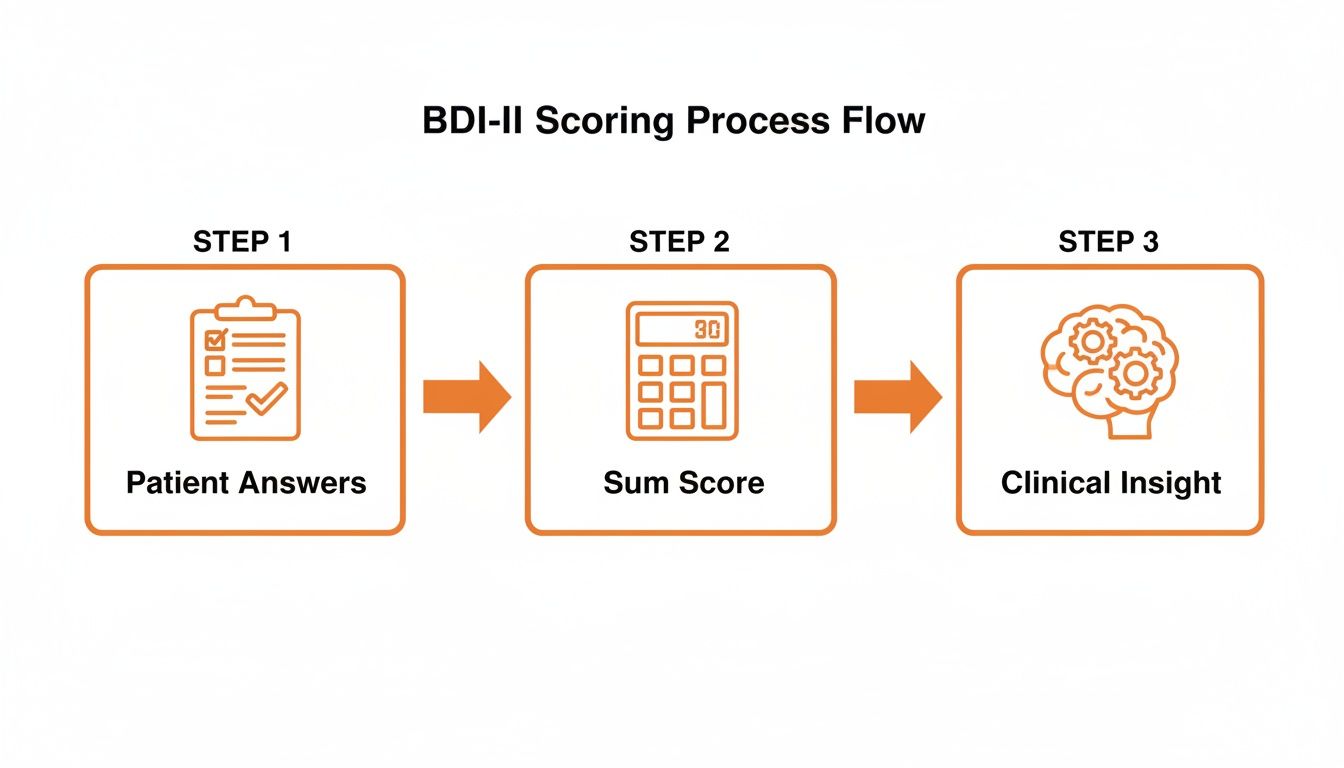
As you can see, scoring is the essential bridge that turns a patient's self-reported feelings into the objective data you need to do effective work.
Handling Ambiguous Responses
Now, what do you do when a patient circles two different responses for the same question? This happens more often than you'd think. The official protocol here is clear and designed to make sure we capture the highest level of distress.
When a patient selects two responses for one item, you must always use the higher value. For example, if your patient circles both "1" (I am sad some of the time) and "2" (I am sad all of the time) for the Sadness item, you record a "2" for that question.
This rule is in place to prevent us from underestimating a patient's symptoms. It ensures the score reflects the most severe experience they're reporting.
Let's go back to Patient A. Imagine after adding everything up, you got a total of 23. But on a final review, you spot that for item 16 (Changes in Sleeping Pattern), they circled both "1a" and "2b." Based on the rule, you have to take the higher score, which is 2. If you'd mistakenly put down a 1, you need to correct it.
This one small adjustment bumps their total score from 23 to 24. That single point can sometimes be enough to shift them into a different severity category. This is an actionable step: always double-check for multiple answers before finalizing a score to ensure your clinical interpretation is accurate. For a broader look at other valuable assessments, you can check out our guide on other mental health screening tools.
Interpreting BDI-II Scores With Clinical Cutoffs

Getting that final number from the Beck Depression Inventory is an important moment, but the score itself is just one piece of the puzzle. The real clinical skill lies in translating that number into a meaningful story that guides your treatment plan. Think of it less like a final diagnosis and more like a critical signpost pointing you in the right direction.
The established clinical cutoffs give us a solid framework to start from. These ranges help us categorize the severity of a person's self-reported symptoms, offering a standardized, evidence-based reference point.
0–13: Minimal Depression
14–19: Mild Depression
20–28: Moderate Depression
29–63: Severe Depression
These categories are your foundation. A score in the 'minimal' range might just reflect the normal ups and downs of life. But as that number climbs into the 'moderate' or 'severe' territory, it signals significant distress that's very likely impacting a client’s ability to function day-to-day. A practical action is to use these cutoffs to guide the intensity of care: a 'minimal' score might lead to watchful waiting, while a 'severe' score could prompt an immediate safety assessment and consideration of more intensive treatment options.
Beyond the Numbers: Context Is Everything
While these score ranges are indispensable, truly effective clinical work means looking far beyond the raw number. The context surrounding that score is just as telling as the number itself.
Let's imagine two different clients. Both score a 16 on the BDI-II, which lands squarely in the 'mild' depression range.
Client A is new to your practice. This is their first assessment, a baseline score. A 16 tells you that while their symptoms aren't overwhelming, they are present and disruptive enough to seek help. Your conversation will likely centre on early intervention, psychoeducation, and setting up a plan for monitoring.
Client B is someone you’ve been working with for a couple of months. They came in with an initial score of 35 ('severe'). Today’s score of 16 is a massive win, representing a huge drop in their symptom burden. The conversation here is completely different. It's about celebrating progress, figuring out what's working, and reinforcing their efforts.
A BDI-II score should always be a conversation starter, not a conclusion. It provides an objective measure that, when combined with your qualitative understanding of the patient's unique situation, creates a complete clinical picture.
This is why dynamic interpretation is so crucial. A 2020 study, for example, highlighted the BDI-II's value in broader screenings, finding that 38.5% of undergraduates scored in the mild to severe depression range. This showcases the tool's power in flagging at-risk individuals who may need support. You can read more about the research findings on the National Child Traumatic Stress Network.
Understanding the severity level is the first step, but it’s what you do with that information that counts. A score can also complement other assessments, like the ones we cover in our guide to the Perceived Stress Questionnaire. By integrating this data with your clinical expertise, you’re better equipped to make informed decisions, whether that means starting therapy, collaborating on medication adjustments, or simply providing reassurance and a path forward.
How To Handle Missing Data and Common Scoring Issues
In the real world, patient forms are never as neat and tidy as they are in textbooks. People get distracted, misunderstand a question, or just plain skip an item they don't want to answer. When you’re scoring the Beck Depression Inventory, these little gaps and errors can feel like a roadblock, but they don't have to invalidate the entire assessment.
Knowing how to navigate missing data is a fundamental skill that keeps your results reliable. Thankfully, the BDI-II has a clear, built-in method for handling these situations.
The main rule of thumb is that you can still get a valid score as long as the patient has filled out at least 19 of the 21 items. If they've left three or more questions blank, you can't score it. Your actionable insight here is to use the incomplete form as a conversation starter: ask the patient why those items were left blank, which can reveal important clinical information.
Calculating a Prorated Score
So, what do you do when a patient answers 19 or 20 items? You'll need to prorate the score. This is just a straightforward way of adjusting the final number to account for the one or two missing answers.
Here’s a practical walkthrough of how to do it:
First, get your subtotal. Add up the scores for all the questions the patient actually answered. Let's say they completed 20 items for a total score of 38.
Next, find the average. Divide that subtotal by the number of items they completed. In our example, that's 38 / 20 = 1.9.
Fill in the blanks. Now, add this average score to the subtotal for each missing item. Since one item was skipped, we add 1.9 to our total: 38 + 1.9 = 39.9.
Finally, round it off. Round the result to the nearest whole number to get the final score. Here, 39.9 rounds up to 40.
That prorated score of 40 is the number you’ll use for your clinical interpretation. This simple method ensures a few skipped questions don’t stop you from gaining valuable insight. We use similar adjustment techniques for other tools, which you can see in our guide to the MoCA exam scoring protocol.
Managing Notes and Contradictions
Sometimes, the issue isn't a blank space, but too much information. Patients might circle two numbers for the same question or add their own notes in the margins. These situations call for a bit of clinical judgment, but there are standard guidelines to follow.
If a client circles two different responses for a single item, the official protocol is to always use the higher score. This approach ensures you capture the greatest level of distress they're reporting, which helps prevent an underestimation of their symptoms.
Handwritten notes, on the other hand, are a different story. You don't score them, but you absolutely shouldn't ignore them. They are incredibly valuable qualitative data. A quick scribble like "only when I think about work" next to the 'Irritability' item provides crucial context that a number alone never could. Be sure to document these notes and bring them into your clinical conversation. The actionable step is to add a 'Patient Notes' section to your scoring summary to capture these valuable insights.
Integrating BDI-II Scores Into Your Clinical Workflow

Getting an accurate BDI-II score is a crucial technical step, but the real clinical magic happens next. A score isn't an endpoint; it's a powerful data point that should breathe life into every corner of your patient's care plan. The goal is to move that number off the scoresheet and weave it into a richer, more holistic patient narrative.
When we integrate a score effectively, it stops being just a number and becomes a catalyst for deeper understanding and much more targeted interventions.
Think of it this way: a final score of 27 (Moderate Depression) gives us a clear label, but it doesn't tell the whole story. The next move is to place that score into a structured template that marries the quantitative data with your qualitative insights.
Creating a Comprehensive Score Profile
One of the most practical things you can do is create a standardized note section for every BDI-II you administer. It’s a simple habit, but it pays dividends in consistency and makes it far easier to track changes over time.
A good, adaptable template for your clinical notes might look something like this:
Assessment Date: [Date of Administration]
BDI-II Total Score: [e.g., 27]
Severity Level: [e.g., Moderate Depression]
Key Symptom Drivers: Make a quick note of the items with the highest scores. For instance, "High scores on Item 17: Fatigability and Item 21: Loss of Interest." This gives you immediate targets for discussion and intervention.
Qualitative Observations: This is where you add the context. Note any relevant comments from the patient, like "Patient reports symptoms worsened after a recent job loss."
This method instantly turns a raw score into a multi-dimensional snapshot of what's going on. The insights you gain from scoring the BDI-II are vital for tailoring effective strategies, including comprehensive integrative depression treatment plans, and they give you a foundation for more meaningful conversations with your patient.
Connecting Mood and Cognition
Often, a high BDI-II score points toward challenges that go beyond mood. We know from experience that depressive symptoms frequently overlap with cognitive difficulties—especially in areas like concentration, decision-making, and executive function.
This is where integrating the BDI-II with other assessment tools becomes incredibly powerful.
By pairing the BDI-II with a cognitive assessment platform like Orange Neurosciences’ OrangeCheck, you start to build a much richer, more complete patient profile. Imagine your patient with a BDI-II score of 27 also shows objective deficits in executive function on their OrangeCheck results.
You now have two converging pieces of evidence. The BDI-II tells you how the patient feels, while the cognitive data shows how that feeling is impacting their functional capacity. This connection is the key to creating a truly precise and effective treatment plan.
This kind of tech-enabled, evidence-based workflow lets you move beyond just addressing mood. You can now bring in targeted cognitive exercises or strategies right alongside traditional therapeutic approaches, addressing the full spectrum of your patient’s experience.
This comprehensive approach is central to modern practice, something we explore further in our guide to complete mental health assessment. When you systematically integrate BDI-II scores, you elevate the tool from a simple screener to a cornerstone of your clinical work.
A Few Common BDI-II Questions from the Clinic
Whenever clinicians start using the BDI-II, a handful of questions about scoring and real-world application always seem to pop up. Getting these sorted out is crucial for using the tool ethically and effectively.
Let's walk through some of the most common questions I hear from colleagues. My hope is this will give you more confidence when you’re scoring the BDI-II and figuring out what the results mean for your day-to-day work.
What's the Big Difference Between Scoring the BDI and the BDI-II?
Mechanically, nothing. You’re still just adding up the scores (from 0-3) for all 21 items. Simple enough.
The real change, and it’s a big one, is in what the tool is actually measuring. The BDI-II was overhauled back in 1996 specifically to line up with the DSM-IV criteria for a Major Depressive Episode.
The key updates were:
New Items: Four items that were a bit outdated (Weight Loss, Body Image Change, Work Difficulty, Somatic Preoccupation) got swapped out for ones that are more central to depression: Agitation, Worthlessness, Concentration Difficulty, and Loss of Energy.
Longer Timeframe: The assessment window was stretched from the "past week" to the "past two weeks." This was a critical change to match the diagnostic timeframe used in the DSM.
So while the math feels the same, what you’re getting from the BDI-II is a far more current and clinically relevant snapshot of depressive symptoms.
Can I Use the BDI-II to Diagnose Depression?
In a word: no. Please remember this. The BDI-II is a screening tool, and a very good one, but it is not a diagnostic instrument on its own. A high score is a huge red flag that tells you a much deeper clinical evaluation is needed.
A BDI-II score is a critical piece of evidence, not the final verdict. Only a qualified clinician can make a formal diagnosis after a comprehensive evaluation, including a proper clinical interview and a full review of the current DSM criteria.
Here's an actionable insight: Think of the score like a vital sign. A high temperature makes you investigate further with more tests; it doesn’t automatically tell you the patient has the flu. A high BDI-II score is your cue to schedule a full diagnostic interview.
How Often Should I Re-Administer the BDI-II to Track Progress?
This really comes down to your specific clinical setting and the goals you have with your client. The main thing is to find a rhythm that makes sense and allows you to actually track meaningful change over time.
For most of us in outpatient therapy, a pretty standard and effective schedule is giving it at intake to get that all-important baseline, and then again every 4-6 weeks to see how treatment is landing.
If you’re in a more intensive setting like inpatient care, you might find weekly administration is warranted. Just be careful not to give it too often, like every day. At that point, you’re probably just measuring daily mood fluctuations instead of a stable shift in their core depressive symptoms.
Can I Give the BDI-II Verbally?
Yes, absolutely. This is a perfectly acceptable modification for clients who might struggle to complete the form themselves, maybe due to low literacy or a visual impairment. The key, however, is to do it right to protect the test's validity.
If you do administer it verbally, you have to read each question and all four of its possible answers aloud, exactly as they are written on the page. Don't try to rephrase, interpret, or explain what an item means. Just read it, and then you record the number of the response they choose.
And this is crucial: you must make a note in the client's file that the BDI-II was administered verbally. This documents the small deviation from the standard self-report format and is just good, ethical practice.
At Orange Neurosciences, we know that good data is the bedrock of effective care. Our AI-powered platform delivers quick, precise cognitive assessments that can work alongside tools like the BDI-II, helping you build a more complete picture of your client's brain health. To see how our tools can fit into your practice and give you deeper insights, visit us at https://orangeneurosciences.ca or email our team to discuss how you can integrate our platform.

Orange Neurosciences' Cognitive Skills Assessments (CSA) are intended as an aid for assessing the cognitive well-being of an individual. In a clinical setting, the CSA results (when interpreted by a qualified healthcare provider) may be used as an aid in determining whether further cognitive evaluation is needed. Orange Neurosciences' brain training programs are designed to promote and encourage overall cognitive health. Orange Neurosciences does not offer any medical diagnosis or treatment of any medical disease or condition. Orange Neurosciences products may also be used for research purposes for any range of cognition-related assessments. If used for research purposes, all use of the product must comply with the appropriate human subjects' procedures as they exist within the researcher's institution and will be the researcher's responsibility. All such human subject protections shall be under the provisions of all applicable sections of the Code of Federal Regulations.


© 2026 by Orange Neurosciences Corporation