Your Guide to Accurate MoCA Exam Scoring for Clinicians
Feb 26, 2026
The MoCA is scored on a simple 30-point scale, and while a score of 26 or higher is generally seen as falling within the normal range, that number is just the tip of the iceberg. It gives you a quick snapshot of a patient's cognitive health, but the real clinical gold is in understanding how each of those points adds up.
How to Interpret a MoCA Score
It's tempting to look at the total score as a final answer, but it’s really more of a high-resolution photograph of a patient's cognitive landscape. While some screeners provide a blurry, low-contrast image, the MoCA is designed to bring the subtle, often-missed details into sharp focus. This makes it an indispensable tool for spotting mild cognitive impairment (MCI).
The final number is just your starting point. The real story lies in the sub-scores—the individual point values from each section of the test. A patient might score a 24, but how they lost those six points is infinitely more telling than the total itself.
Practical Example: Imagine two patients both score 23. Patient A lost 3 points on delayed memory recall. Patient B lost 3 points on the clock-drawing task. Although their total scores are identical, your clinical pathway for each will be vastly different, one focusing on memory and the other on visuospatial/executive function.
To help you see the breakdown at a glance, here’s a quick reference table of the cognitive domains the MoCA assesses.
MoCA Scoring Domains at a Glance
Cognitive Domain | Task Example | Maximum Points |
|---|---|---|
Visuospatial/Executive | Draw a clock, copy a cube | 5 |
Naming | Identify a lion, rhino, camel | 3 |
Memory | Immediate and delayed word recall | 5 |
Attention | Repeat digits forwards and backwards | 6 |
Language | Repeat sentences, verbal fluency | 3 |
Abstraction | Identify the similarity between two items | 2 |
Orientation | State the date, place, city | 6 |
This table shows how the MoCA's 30 points are distributed, helping you quickly identify where a patient might be struggling. Each domain offers a unique window into their cognitive function.
Looking Beyond the Total Score
When you start analyzing the breakdown across these different domains, that simple number transforms into actionable clinical insight. Here are a few key areas and what they can tell you:
Executive Function: Tasks like the trail-making test and verbal fluency are great for assessing planning, mental flexibility, and self-regulation. A low score here could hint at challenges related to the frontal lobe.
Memory: The delayed recall task is a powerful indicator of short-term memory function. Difficulties here are often one of the earliest signs of a developing neurodegenerative condition.
Visuospatial Skills: Drawing a cube or a clock face isn't just about artistry; it reveals how a patient perceives and interacts with the space around them.
Attention and Concentration: Subtracting serial sevens or recalling a string of digits forward and backward directly measures a person's ability to focus and mentally juggle information.
A low total score tells you that there might be a problem. The sub-scores help you understand where that problem might be, guiding your next steps for a more targeted evaluation.
By looking for these patterns, you can pinpoint specific areas of weakness that need a closer look. It moves you away from a simple pass/fail mentality and toward a much more nuanced and clinically useful assessment. You can learn more about this approach in the broader context of what is cognitive assessment in our detailed guide.
A Step-by-Step Walkthrough of Scoring Each Task
Getting the MoCA scoring right is about more than just adding up numbers. It’s about applying the rules consistently for every single task. Knowing the fine details of what earns a point—and just as importantly, what doesn't—is what turns a simple screening into a reliable, clinically useful result.
Let's break down the scoring for each major section and point out some of the common hangups I see in practice.
Think of it as a simple, three-stage process. You administer the test, calculate the raw score, and then move on to the real work: clinical interpretation.
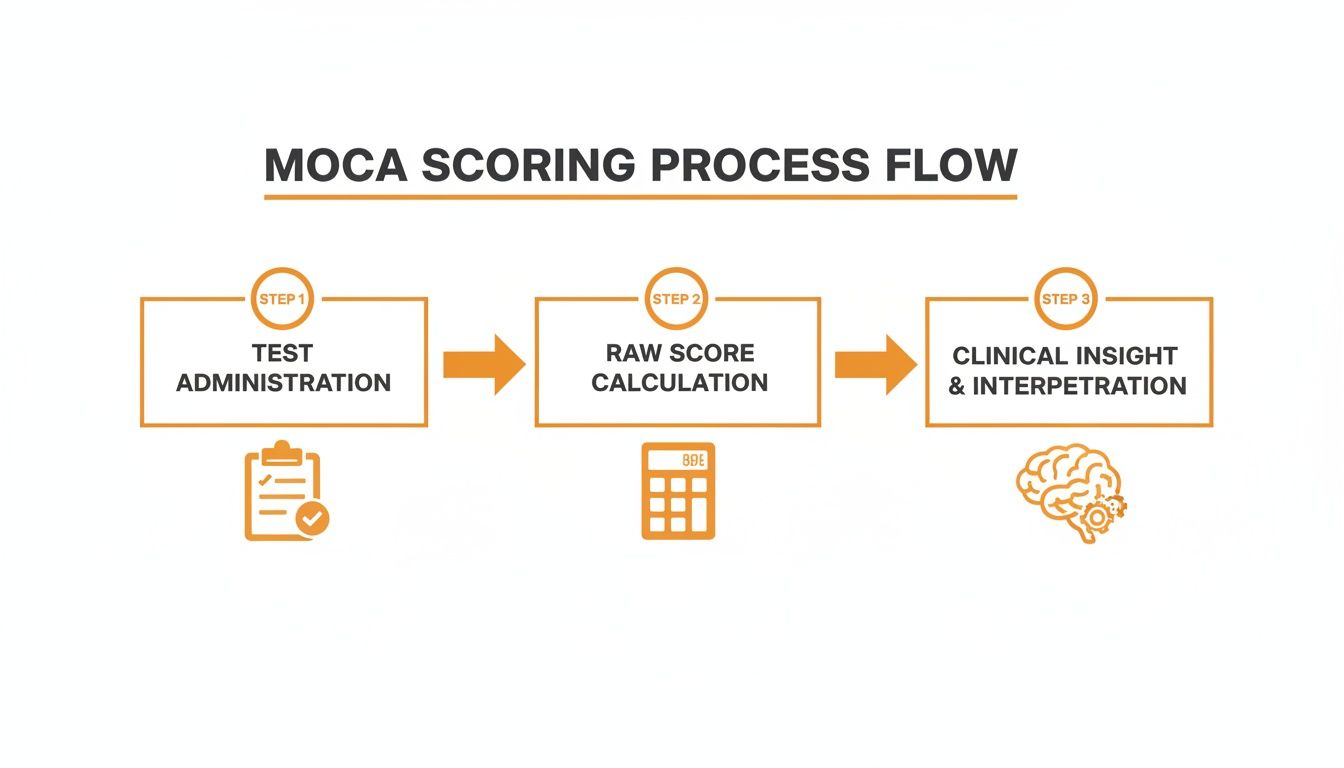
This visual is a great reminder that the score itself isn't the final destination. It's the critical middle step that bridges the assessment with actionable insights.
Visuospatial and Executive Function
This is an area where a bit of subjective judgment can creep in, so being precise is absolutely critical.
Cube Drawing (1 point): To get the point, the drawing must be three-dimensional. All lines have to be there, with no extras. The lines should also be relatively parallel and about the same length. A frequent mistake is giving a point for a flat, two-dimensional drawing; it has to show that 3D perspective.
Clock Drawing (3 points): This is a 3-part score, so you have to check each element. One point is for the contour (it must be a closed circle), one for the numbers (all 12 are present and in the right order), and one for the hands (showing 11:10, with the hour hand clearly shorter than the minute hand). It's easy for a patient to get points for the circle and numbers but lose one if the hands are the same length.
Naming and Memory
While the Naming task is pretty straightforward, the Memory section requires you to be very strict with your scoring.
Naming (3 points): This one's simple. One point for each correctly identified animal: lion, rhinoceros, and camel. No half-points.
Memory/Delayed Recall (5 points): The patient hears five words and is asked to repeat them back, first immediately and then again after a few minutes. Here's the key part:
The immediate recall trials are just for learning. No points are awarded here.
You only score the delayed recall at the end of the test. Give one point for each of the five words they remember without any cues.
A very common error is to award points for words that are recalled only after you give a cue. Remember: only spontaneous, uncued recall earns points for the final MoCA exam scoring. The cues are just there to gather extra qualitative info, not to boost the score.
Attention and Language
These tasks evaluate how well a patient can maintain focus, juggle information, and communicate clearly.
Digit Span (2 points): Simple enough. One point if they get the forward sequence correct, and another point for the backward sequence.
Vigilance (1 point): They get a point if they tap their hand on every single letter 'A' with zero or one error. If they make two or more mistakes (either missing an 'A' or tapping on a wrong letter), the score is zero.
Serial 7s (3 points): The scoring here is tiered. Three points are for four or five correct subtractions. Two points for two or three correct ones, and one point for just a single correct subtraction.
Sentence Repetition (2 points): Each sentence has to be repeated perfectly, word-for-word, to earn its point. Any mistake, no matter how small, means you can't award the point for that sentence.
Verbal Fluency (1 point): The patient has 60 seconds to name words that start with the letter 'F'. To get the point, they need to come up with 11 or more words.
If you want to dig deeper into the "how-to" of giving the test, our guide on MOCA assessment instructions is the perfect companion to this scoring overview.
How to Interpret Scores and Apply Clinical Cutoffs
A final score from the MoCA is just a number until you put it into a clinical context. It’s the first step in translating that number into something meaningful that can actually guide patient care and any further assessments.
Think of the cutoff scores as powerful guidelines, not rigid diagnoses. They simply help you categorise the level of cognitive function you observed, giving you a solid framework for your clinical judgment.
Understanding the Standard Scoring Tiers
The most widely accepted cutoff for the MoCA is a score of 26 out of 30. This benchmark is your primary tool for differentiating between individuals who are likely cognitively intact and those who might need a closer look.
Here’s a general breakdown of what the score ranges suggest:
26–30: Generally considered within the normal range for cognitive functioning.
18–25: Suggestive of mild cognitive impairment (MCI). A score here often triggers further investigation.
10–17: May indicate moderate cognitive impairment.
Below 10: Points toward severe cognitive impairment.
It’s absolutely critical to remember that these are just signposts. A score of 25 isn’t a definitive diagnosis of MCI, just as a score of 26 doesn't completely rule it out. Your own clinical observations and the patient’s history are essential pieces of the puzzle. You can explore the subtleties of this process in our guide on MoCA score interpretation.
The Critical Role of the Education Adjustment
One of the most important—and sometimes overlooked—steps in accurate MoCA scoring is the education adjustment. This simple correction is designed to improve fairness and prevent you from misinterpreting a score for someone with a different educational background.
For any individual with 12 years or less of formal education, you must add one point to their final total score. This adjustment should not push the score past the maximum of 30.
This rule isn't optional; it's a fundamental part of the standardized procedure. Forgetting to add this point can lead to a score that falsely suggests impairment, simply because the test’s tasks might be less familiar to someone with less formal schooling.
Practical Example: A patient with 11 years of education scores a raw 25. Forgetting the adjustment leaves them in the MCI-suggestive range. Applying the rule correctly adjusts their score to 26, placing them in the normal range. This single point can dramatically alter your clinical pathway, preventing unnecessary further testing and patient anxiety.
This adjustment is especially vital in Canadian provinces like British Columbia and Alberta, where you see a wide range of socioeconomic demographics. In fact, research shows just how effective the MoCA's cutoffs are in stroke rehabilitation, where one study found that 73% of MCI patients who scored normally on the MMSE were correctly identified by the MoCA. You can learn more about these crucial findings on MoCA scoring tiers.
Adjusting for Age and Cultural Considerations in Scoring
Scoring the MoCA isn't just about tallying points and checking them against a single cutoff number. True clinical wisdom comes from understanding the person behind the score. We have to look at their age, their education, and their cultural background to really make sense of the results.
A raw score is just a starting point. Without context, it's easy to fall into the trap of over-relying on that one number. Think about it: a score of 25 from a 65-year-old with a PhD is going to ring different alarm bells than the same score from an 85-year-old who left school after the eighth grade. Failing to account for these nuances can lead to needless worry or, worse, a missed chance for early intervention.
The Impact of Age on Normative Scores
It’s no secret that as we get older, some cognitive functions, especially things like processing speed, naturally slow down a bit. The MoCA is sensitive enough to pick up on these shifts, but the raw score itself doesn't distinguish between normal, age-related changes and something more serious.
This is where your clinical judgment is everything. Instead of just flagging any score below 26, take a closer look at the patient’s whole profile. For an older adult with a borderline score, dig into the pattern of their mistakes. Are the errors mostly in executive function? Or is their delayed recall the main issue? This detailed view helps separate what might be normal aging from the early signs of MCI.
Addressing Cultural and Racial Disparities
Here’s something we absolutely have to talk about: how the MoCA performs across different populations. The standard cutoffs were often developed and tested on groups that were predominantly White and highly educated. In a multicultural country like Canada, applying those same standards universally can lead to real problems and diagnostic mistakes.
Research from North American datasets, for example, shows a pretty significant gap. While the standard ≤26/30 cutoff correctly identifies 83.1% of White participants with MCI, its accuracy plummets for other groups. For Black participants with normal cognition, the specificity is only 40.5%, which means there's a huge risk of false positives.
To get a clearer picture of these disparities, take a look at the data below.
MoCA Performance by Demographic Group
Demographic Group | Sensitivity for MCI (at ≤26 cutoff) | Specificity for Normal (at ≤26 cutoff) | Average Score (SD) |
|---|---|---|---|
White | 83.1% | 66.8% | 24.3 (4.3) |
Black | 83.3% | 40.5% | 22.3 (4.4) |
As you can see, the average scores and the test's specificity vary quite a bit. To account for this, some studies suggest using adjusted cutoffs—for instance, a 22.5 cutoff for Black participants, whose average scores were about two points lower. You can explore the full details of these racial disparities in MoCA scoring accuracy.
Adopting a more flexible and informed approach to MoCA cutoffs is not just good practice—it's a step toward more equitable and accurate cognitive assessment for every patient you see.
To avoid misdiagnosing someone, you must consider their linguistic and cultural background. Some questions on the test might be culturally biased, affecting performance even if cognition is intact. For more on this, check out our guide on the language of assessment and its clinical implications. By weaving these factors into your interpretation, you turn the MoCA from a simple number into a truly patient-centred clinical tool.
Weaving MoCA Scores into Digital Health Platforms
The MoCA gives us a critical first look into a patient's cognitive health, but its real power is unlocked when you pair that initial score with modern digital tools. This is how you bridge the gap between a quick screening and a deep, data-driven cognitive assessment. It’s about turning a single number into a dynamic, actionable care pathway.
Imagine a patient scores low on the MoCA's executive function tasks. Instead of just noting the deficit, you can use that specific insight to guide a more targeted digital assessment. This is precisely where a platform like Orange Neurosciences becomes so valuable.

This kind of integrated approach moves you beyond a simple pass/fail score and helps you build a much richer, more detailed profile for each patient.
From Screening to Precision Assessment
A platform like OrangeCheck can take the qualitative observations from a MoCA and quantify them with objective, granular metrics. If a MoCA score hints at attention issues, a digital tool can precisely measure specific skills like processing speed or sustained attention.
This process doesn't just save valuable clinical time; it provides a much clearer picture for creating truly personalized therapy plans. It’s about transforming the moca exam scoring from a static data point into the first step of a technology-enhanced journey.
For healthcare professionals using these tools, the integration is key. Data shows that combining MoCA benchmarks with AI-driven profiles helps track declines in attention and memory much earlier. This has the potential to reduce misdiagnosis rates by 20-30% by allowing for highly personalized adjustments.
A Practical Example of Integrated Care
Let's walk through a common clinical scenario to see how this works in practice:
Initial Screening: A 72-year-old patient scores 24/30 on the MoCA. You notice they lost points mainly in delayed recall and the clock-drawing task.
Guided Digital Assessment: Based on these specific results, you initiate a targeted assessment on the Orange Neurosciences platform, zeroing in on memory and visuospatial tasks.
Objective Data: The platform delivers detailed metrics, revealing a significant deficit in visual memory but showing that processing speed is relatively intact.
Personalized Plan: This granular data allows you to build a therapy plan that specifically targets the identified weakness, rather than relying on a generic cognitive rehabilitation program.
As clinicians increasingly weave MoCA scores into broader digital health platforms, it's interesting to see parallels in other medical fields. Areas like medical training simulations and accuracy assessment also lean heavily on rigorous, objective data.
This shared emphasis on precision is a hallmark of modern healthcare. By adopting an integrated approach, you can enhance patient care, improve outcomes, and bring digital neuropsychiatry into your everyday practice. You can learn more about how the Orange Neurosciences’ solution makes this possible.
Common Questions About MoCA Exam Scoring
Even when you feel you have a good handle on the scoring, some questions pop up again and again in practice. Let's walk through some of the most common queries about MoCA exam scoring to clear up any confusion and help you apply the test with confidence.
What Is the Difference Between MoCA and MMSE Scoring?
The biggest difference comes down to sensitivity, especially for catching mild cognitive impairment (MCI). I like to think of the Mini-Mental State Examination (MMSE) as a wide-meshed net; it’s great for catching the bigger, more obvious cognitive problems. The MoCA, on the other hand, is a much finer net, designed specifically to pick up on the subtle, early signs of MCI.
How does it do this? The MoCA probes more complex cognitive areas. It includes tasks for executive function (like the trail-making test) and abstraction, which are often the first skills to show wear and tear when cognitive decline begins.
This is exactly why so many patients who score in the "normal" range on the MMSE will show clear deficits on the MoCA. While they’re both 30-point scales, the MoCA's tasks are just intentionally more demanding, making it a far better tool for early detection.
How Should I Score the MoCA for a Visually Impaired Patient?
This is a critical one. For any patient whose vision is impaired enough that they can't complete the visual tasks, you must use the official MoCA-Blind version. It’s really important not to just adapt the standard test on the fly, as that will completely invalidate the results.
The MoCA-Blind was created for exactly these situations. Here’s what you need to know:
It gets rid of all the visual tasks, like copying the cube and drawing the clock.
The test is scored out of a total of 22 points.
You then take that raw score and convert it to an equivalent score out of 30 using a standardized conversion table.
The one-point adjustment for individuals with 12 or fewer years of education still applies—just add it to the final, converted score.
Using the official MoCA-Blind ensures your assessment is valid and comparable to the standardized norms, giving you a reliable measure of the patient's non-visual cognitive abilities.
Can I Use the MoCA to Track Cognitive Changes Over Time?
Absolutely. The MoCA is an excellent tool for tracking a patient's cognitive function over months or years. The key, however, is to account for practice effects—where someone’s score improves just because they’re getting familiar with the test, not because their cognition has actually improved.
To avoid this trap, always use one of the alternate versions (like Version 7.2 or 7.3) for any follow-up assessments. This simple step helps ensure you're measuring a genuine cognitive change, not just a learned response.
As a rule of thumb, a drop of 2 to 4 points between assessments is generally considered a clinically meaningful change. This helps you separate normal score variability from a significant decline that might call for a change in the care plan.
When you start pairing these periodic MoCA scores with more granular data from a digital platform like Orange Neurosciences, you can build an incredibly rich, comprehensive picture of a patient's cognitive journey and their response to different interventions.
What Should I Document Besides the Final MoCA Score?
Just jotting down "MoCA: 23/30" in a patient’s file doesn't cut it. Good documentation tells a story and provides the context needed for high-quality, continuous care. For clinicians wanting to sharpen their skills here, it's also worth knowing how to properly log this kind of professional development, which is part of navigating AHPRA's CPD requirements.
Here’s a practical checklist for what your note should include:
The Final Score with Adjustments: Be crystal clear. For example, "Score of 22 + 1 point for education = 23/30."
Qualitative Summary of Performance: Describe how the patient lost points. Something like, "Patient struggled significantly with delayed recall, scoring 0/5, and had difficulty with the clock-drawing task."
Key Behavioural Observations: Note anything relevant you saw. Did they show signs of frustration, fatigue, or have a hard time understanding the instructions?
Your Clinical Interpretation: Pull it all together into a clinical impression. For instance, "Score is suggestive of MCI, particularly in the memory domain, warranting further neuropsychological evaluation."
This approach gives you—and any other provider who reads the chart—a much clearer and more clinically useful picture of what’s going on.
The journey from a simple screening tool to a powerful clinical asset begins with accurate scoring and thoughtful interpretation. By integrating these principles with advanced digital tools, you can transform patient outcomes. See how Orange Neurosciences can help you bring precise, data-driven cognitive care into your practice by exploring our solutions at https://orangeneurosciences.ca.
Orange Neurosciences' Cognitive Skills Assessments (CSA) are intended as an aid for assessing the cognitive well-being of an individual. In a clinical setting, the CSA results (when interpreted by a qualified healthcare provider) may be used as an aid in determining whether further cognitive evaluation is needed. Orange Neurosciences' brain training programs are designed to promote and encourage overall cognitive health. Orange Neurosciences does not offer any medical diagnosis or treatment of any medical disease or condition. Orange Neurosciences products may also be used for research purposes for any range of cognition-related assessments. If used for research purposes, all use of the product must comply with the appropriate human subjects' procedures as they exist within the researcher's institution and will be the researcher's responsibility. All such human subject protections shall be under the provisions of all applicable sections of the Code of Federal Regulations.


© 2026 by Orange Neurosciences Corporation