A Guide to the Perceived Stress Questionnaire
Nov 7, 2025
The Perceived Stress Questionnaire, better known by its common name, the Perceived Stress Scale (PSS-10), is a widely respected psychological tool for one simple reason: it measures how you feel about the stress in your life.
It's less of a clinical test and more of a personal 'stress thermometer.' It gives you a clear snapshot of how unpredictable, uncontrollable, and overloaded you've found your life over the past month. Taking it is an actionable first step towards understanding and managing your stress.
What Is the Perceived Stress Questionnaire

Think about how you'd describe your stress to a friend. You might use words like "overwhelmed" or "burnt out," but these are tough feelings to pin down and measure. That's where the Perceived Stress Questionnaire (PSQ) comes in. It translates those very real, subjective feelings into a score you can actually work with.
The questionnaire's power lies in its focus on your personal interpretation of events, because that's often what matters most.
Imagine two colleagues facing the exact same tight deadline. One might feel energized by the challenge, while the other feels completely panicked and overloaded. The PSQ is designed to capture your unique experience of that pressure, not just the pressure itself. This score becomes an actionable insight into your well-being.
The Purpose Behind the Questions
The PSQ doesn't get bogged down in the specifics, like whether you lost your job or moved to a new city. Instead, it hones in on your feelings and thoughts related to stress over the last 30 days. The questions are carefully crafted to probe the core elements of the stress experience:
Unpredictability: How often did you feel blindsided by events?
Lack of Control: How often did it feel like you couldn't get a handle on the important things in your life?
Overload: How often did you feel that difficulties were piling up so high you couldn't possibly overcome them?
By digging into these areas, the questionnaire paints a clear picture of your internal landscape. This kind of insight is the essential first step in any effective self-care plan or therapeutic strategy. It provides a crucial piece of the puzzle, much like a cognitive assessment helps map out other mental functions.
For a quick overview, here are the core attributes of the questionnaire.
Key Features of the Perceived Stress Questionnaire
Feature | Description |
|---|---|
Focus | Measures subjective perception of stress, not the number or type of stressful life events. |
Timeframe | Asks about feelings and thoughts during the last month, providing a recent snapshot. |
Core Concepts | Evaluates key stress indicators like feelings of unpredictability, lack of control, and overload. |
Format | A 10-item self-report questionnaire that is quick and straightforward to complete. |
Application | Used widely in both clinical and research settings to gauge stress levels and track changes over time. |
Outcome | Provides a numerical score that helps quantify an individual's personal experience of stress. |
This simple, focused design is what has made the PSQ a trusted tool for decades.
A Widely Trusted Tool
First developed back in 1983 by Cohen, Kamarch, and Mermelstein, the Perceived Stress Scale (PSS-10) has become one of the go-to instruments for measuring psychological stress. Its effectiveness has been proven time and again in countless research and clinical settings around the world.
This isn't just some dusty academic exercise; it's a practical instrument that fosters genuine self-awareness.
The real value of the Perceived Stress Questionnaire is that it shifts the focus from external stressors to your internal response. It helps you see not just what is happening to you, but how you are processing it.
Ultimately, understanding your perceived stress is the only way to start managing it effectively. This simple yet powerful tool gives you a baseline—a starting point from which you can track your progress, spot your triggers, and begin to build lasting resilience. It empowers you to move from a vague feeling of being "stressed out" to having a concrete understanding of your mental state.
The Science Behind Measuring Perceived Stress
A questionnaire might seem straightforward, but the trust experts place in the Perceived Stress Questionnaire (PSQ) is built on a solid scientific foundation. It’s not just a random list of questions; it's a carefully crafted tool designed to be both consistent and accurate.
To really get why it’s so credible, we need to talk about two key ideas: reliability and validity.
The Trustworthy Compass of Stress Measurement
Think about your bathroom scale. You step on it one morning, and it reads 75 kilograms. A minute later, it reads 75.1 kilograms. The third time, 74.9. That scale is showing reliability—it gives you pretty much the same result every time under the same conditions.
But what if that same scale was secretly measuring your height and just displaying it in kilograms? It would still be reliable, giving you the same number over and over, but it wouldn't be valid. Validity means the tool is actually measuring what it’s supposed to measure.
The PSQ nails both, which is why it’s a cornerstone in psychological assessment.
Ensuring Consistency and Accuracy
The PSQ has demonstrated high internal consistency. This simply means all the questions are pulling in the same direction, working together to measure the single concept of perceived stress. If someone agrees they often feel unable to control important things, they’re also likely to agree that they feel difficulties are piling up.
This harmony ensures the questionnaire is a focused instrument, not just a jumble of unrelated items. Its reliability also means that if you took the test on a Monday and again on a Tuesday (with no major life event in between), your scores would be remarkably similar.
A reliable and valid questionnaire is like a well-calibrated compass. It not only points in a consistent direction every time you look at it (reliability), but you can also trust that it's pointing true north (validity).
This dual strength is what makes the PSQ a trustworthy instrument. It’s not just spitting out random numbers; it’s providing meaningful data you can act on.
Capturing Your Personal Take on Stress
The real genius of the PSQ is how it aligns with modern stress theory. It was specifically built to measure cognitive appraisal—your personal interpretation of whether a situation is threatening or manageable. This is a huge deal, because stress isn't just about what happens to you; it's about how you perceive those events.
The questionnaire gets right to the heart of the matter by focusing on feelings of:
Unpredictability: A sense that you can't see challenges coming.
Uncontrollability: The feeling that you have no sway over outcomes.
Overload: The belief that life’s demands are bigger than your ability to cope.
These are the core ingredients of psychological stress. The PSQ’s validity gets another boost from studies that show a direct link between high scores and elevated levels of cortisol, the body's main stress hormone. This biological connection confirms the questionnaire is tapping into a real physiological state, not just abstract feelings.
This scientific rigour is what separates the PSQ from a quick online quiz. It's a validated instrument for understanding your mental landscape, much like the other professional cognitive assessments used to evaluate functions like memory and attention.
How to Use and Score the Questionnaire
Taking the Perceived Stress Questionnaire, especially the popular PSS-10 version, is surprisingly simple. The most important thing is to be honest with yourself and answer based on your feelings and thoughts over the last month.
This timeframe is key. It's not about a single bad day or how you felt last year, but a recent, relevant snapshot of your life.
Before you start, find a quiet spot where you won’t be interrupted. Give yourself a moment to genuinely reflect. Read each of the 10 questions and pick the answer that truly fits how often you've felt that way.
The response scale is the same for every question:
0 = Never
1 = Almost Never
2 = Sometimes
3 = Fairly Often
4 = Very Often
Remember, this isn't a test with right or wrong answers. You can't pass or fail. Think of it as a tool for self-awareness—your honesty is what gives the final score its power.
The Tricky Part: Reverse Scoring Explained
This is the one part that can trip people up, but it's much simpler than it sounds. The questionnaire cleverly mixes negatively and positively worded questions. The negative ones ask about feeling upset or overwhelmed, while the positive ones ask about feeling confident and in control.
To get an accurate picture of your stress level, we need all the questions pointing in the same direction. This means we have to "flip" the scores for the positive items, where a high number actually indicates low stress. This is called reverse-scoring.
With the PSS-10, you only need to do this for four specific questions: items 4, 5, 7, and 8.
Here’s the simple formula for reversing the score:
New Score = 4 – Your Original Score
Let's walk through an example to see it in action.
A Practical Scoring Example
Imagine you're on Question 4: "In the last month, how often have you felt confident about your ability to handle your personal problems?"
This is a positive statement. Feeling confident is the opposite of feeling stressed, right? Let's say you've been feeling pretty capable lately and answered "3" (Fairly Often). A high score of 3 here actually signals low stress in this part of your life.
To reverse-score it, you just plug it into the formula:
4 – 3 = 1
So, when you go to add up your total, you'll use the number 1 for this question instead of the 3 you originally circled. You'll do this for all four of those positive items.
Here’s a quick cheat sheet for how reverse-scoring works for items 4, 5, 7, and 8:
An original score of 0 becomes a 4.
An original score of 1 becomes a 3.
An original score of 2 stays a 2.
An original score of 3 becomes a 1.
An original score of 4 becomes a 0.
Once you’ve flipped the scores for questions 4, 5, 7, and 8, you're ready for the final step.
Calculating Your Final Score
Now for the easy part. Just add up the scores for all 10 questions, making sure to use your new, reversed scores for items 4, 5, 7, and 8.
Your total score will be a number between 0 and 40.
It's pretty intuitive from here: a higher score points to a higher level of perceived stress, while a lower score suggests you’ve been feeling more in control and less burdened by life's demands. This same principle of honest self-reporting leading to a useful score is found in other great tools, like the one we cover in our guide to the concussion symptom questionnaire.
The infographic below touches on the science that makes a questionnaire like this so trustworthy.
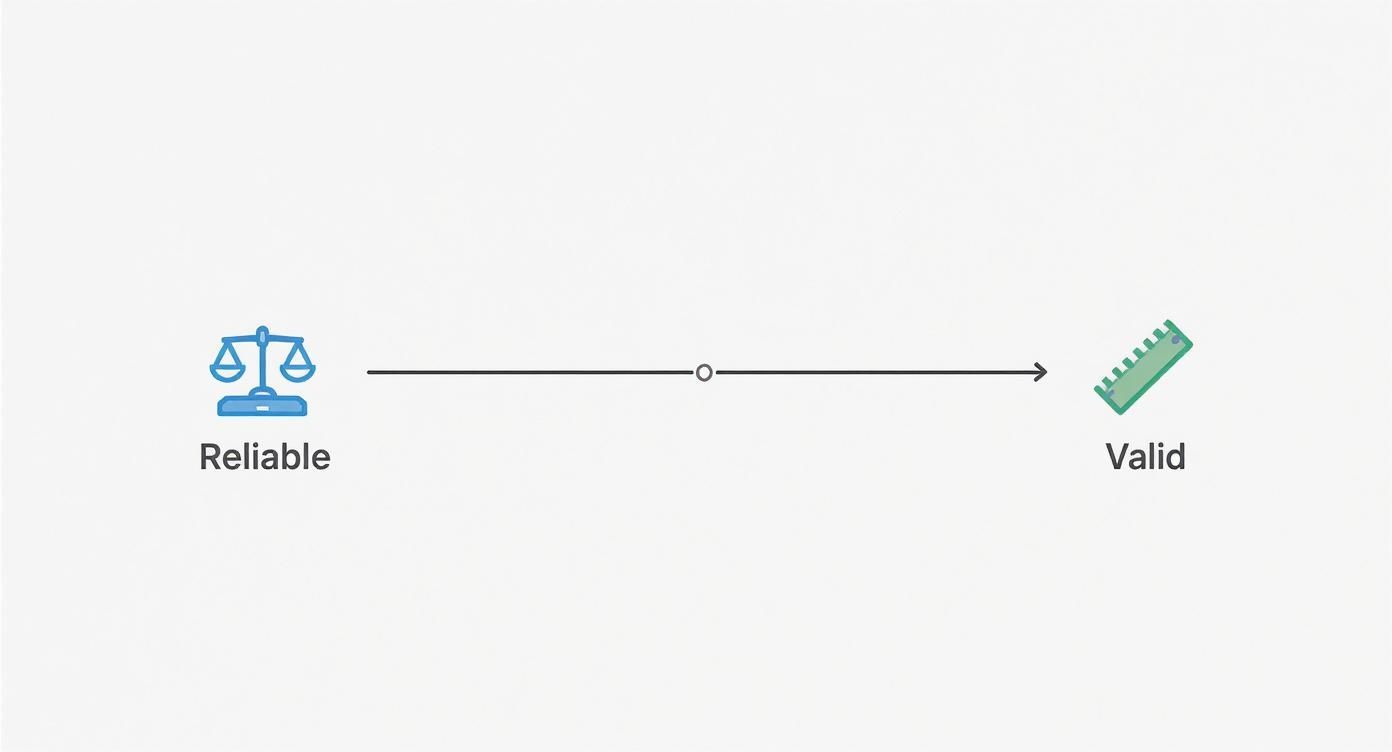
As the visual shows, a quality tool has to be reliable (giving consistent results) and valid (actually measuring what it claims to measure). By following these scoring steps, you can be confident that you’re getting a meaningful result.
So, What Does Your Perceived Stress Score Actually Mean?
You’ve finished the questionnaire and have a number staring back at you. That score is more than just a digit; it’s a powerful piece of self-awareness that can kickstart real, actionable change.
The trick is knowing what that number really represents. It’s not a diagnosis or some permanent label. Think of it more like a snapshot in time—a clear picture of your internal world over the last month.
Your score is basically a personal alert system. It shows you how much of your energy and coping resources are being spent just to manage life's daily grind. Now, let’s dig into what those numbers look like in the real world.
Understanding the Scoring Brackets
The total score from the PSS-10 can range anywhere from 0 to 40. To make sense of it all, scores are usually grouped into three main brackets. While these aren't rigid clinical categories, they give you a handy framework for figuring out where you stand right now.
Low Perceived Stress (Score 0-13): A score in this zone suggests you generally feel on top of things. You likely see daily hurdles as manageable and feel confident you have what it takes to handle whatever life throws at you. This isn’t to say your life is stress-free, but your perception of those stressors isn't overwhelming you.
Moderate Perceived Stress (Score 14-26): This is where most people land. A moderate score means you’re definitely feeling a significant amount of stress. You might feel swamped at times or struggle to keep up with all the demands on your plate, but for the most part, you're managing to stay afloat.
High Perceived Stress (Score 27-40): A score this high is a major signal flare. It suggests your personal coping reserves are stretched thin, and you often feel like life is unpredictable and spinning out of your control. It’s that constant feeling of trying to keep too many plates spinning at once, leaving you exhausted and perpetually overwhelmed.
Remember, context is everything. A score of 24 might be totally normal for someone going through a huge life event, like launching a new career. On the other hand, a score of 18 could be more of a red flag for someone with few external pressures who is still feeling a lot of internal turmoil.
Your score isn't a judgment on how well you handle life. It's a data point that shines a light on your internal experience, giving you a clear place to start taking better care of yourself.
This insight is the first, most crucial step toward making changes that matter.
Your Score Is a Starting Point, Not a Final Word
Seeing a high number on the PSS can be a bit jarring, but it’s so important to frame it the right way. This score isn't a crystal ball predicting your future, nor is it a measure of your worth. It is simply a reflection of right now.
Stress levels ebb and flow; that's just part of being human. A score you get during a relatively calm period will look worlds different from one you take in the middle of a high-stakes work project or a family emergency. The real power of this tool is using it as a cue to take action.
Let's consider a practical example: Sarah, a project manager, scores a 31. Instead of panicking, she sees it as an alarm bell. She realizes her workload has gotten out of hand and she hasn’t taken a single day off in months. That number prompts her to book a much-needed vacation and have a conversation with her boss about shifting some responsibilities. The score provided the actionable insight she needed.
Taking Actionable Next Steps
Your score is a call to action, giving you the power to move from simply being aware to proactively boosting your well-being. The higher your score, the more urgent that call becomes.
If your score is in the moderate to high range, consider these next steps:
Explore Stress Management Techniques: This is an immediate, practical move. Start bringing mindfulness exercises, deep-breathing practices, or regular physical activity into your routine. These can help regulate your body’s physical response to stress.
Reassess Your Priorities: A high score often means your life is out of balance. Step back and honestly look at where your energy is going. Are there commitments you can scale back? Boundaries you need to set at work or in your personal life?
Speak with a Professional: A high score is a perfectly good reason to reach out to a therapist or counsellor. They can offer proven tools, strategies, and the support you need to manage your stress and get to the root of what’s causing it.
Understanding your perceived stress is the first step toward getting a handle on it. To help you on this journey, sign up for our newsletter below to get weekly stress management tips and practical insights sent directly to your inbox.
The Questionnaire in the Real World
While figuring out your own score is a personal starting point, the Perceived Stress Questionnaire's real impact stretches far beyond a simple self-check. Its power truly shines when you see it in action—in clinics, corporate wellness programs, and research labs. This is where the questionnaire becomes more than just a quiz; it becomes a versatile tool that turns the vague feeling of being "stressed out" into a solid data point that can spark real change.
In a clinical setting, for instance, a therapist might use the PSS-10 during a first session to get a baseline. This gives them an objective starting point to see how a client is doing over time. Watching a score drop from a high-stress 29 down to a more moderate 19 after a few months of therapy isn't just encouraging—it's tangible proof that the coping strategies are actually working.
Beyond the Therapist's Office
Businesses are catching on, too, weaving the questionnaire into their corporate wellness initiatives. When administered anonymously, it gives leadership a surprisingly accurate snapshot of their workforce's well-being. If an entire department's average score is through the roof, it can be a red flag for deeper issues like unsustainable workloads or a toxic culture, giving management a reason to step in and make meaningful adjustments.
It’s just as useful in academic settings. University counsellors can use the tool to quietly identify students buckling under academic pressure. A high score can be the perfect, low-pressure way to start a conversation and connect a student with the right resources before they hit a wall.
A Case Study: Meet Alex the Project Manager
Let's walk through a practical example to see how this plays out. Meet Alex, a project manager at a fast-growing tech firm. He's been feeling on edge for months and sleeping poorly, but he keeps chalking it up to the demands of the job. It's just stress, right?
Then, his company rolls out a voluntary wellness program that includes the Perceived Stress Questionnaire each quarter. Alex takes it and gets a 32, landing him squarely in the high-stress zone. Seeing that number in black and white is a jolt. Suddenly, his constant feeling of being overwhelmed isn't just a feeling anymore—it's a concrete piece of data staring back at him.
This score becomes his actionable insight. He decides to chat with the company's wellness coach. Together, they pinpoint the main culprits: ridiculously tight deadlines and a never-ending stream of emails after 7 PM. Armed with this clarity, Alex's manager works with him to reset project timelines and sets a new "no emails after hours" rule for the team. Three months later, Alex takes the questionnaire again. His score? Down to 18. The tool didn't just measure his stress; it kickstarted a process that actively fixed the problem.
Tracking Progress and Shaping Care
The questionnaire is also a workhorse in medical research and public health. Researchers use it to grasp the immense psychological weight of living with a chronic illness. For example, there's a growing trend in California of using the Perceived Stress Scale to assess stress in people with conditions like fibromyalgia. A key 2021 study found that adults with fibromyalgia had significantly higher perceived stress levels, underscoring the powerful link between our physical and mental health. You can read the full study about perceived stress in adults with fibromyalgia.
The questionnaire’s real gift is its ability to make the invisible visible. It takes a private, internal struggle and turns it into a shared data point that can be understood, tracked, and acted upon by individuals, therapists, and entire organizations.
This power to quantify perception is what makes it such a potent force for good. Once you can measure something, you can start to manage it. After using the questionnaire to get a handle on your stress levels, the next logical step is to explore effective stress management strategies to protect your well-being.
The kind of ongoing stress measured by the questionnaire can also take a toll on our cognitive functions, affecting everything from mental clarity to problem-solving. Our guide on how to improve working memory offers some practical techniques to help push back against these effects. By translating subjective feelings into objective scores, the Perceived Stress Questionnaire clears a path toward better mental health in countless real-world situations.
The Link Between Perceived Stress and Your Health

A high score on the Perceived Stress Questionnaire is more than a number—it’s an early warning for your physical health. When you constantly feel like life’s demands are out of your control, your body’s “fight-or-flight” system can get stuck in the “on” position.
That constant state of high alert simply isn't sustainable. It floods your body with stress hormones like cortisol, which can do some real damage over time. Think of it like redlining a car’s engine for weeks straight. Sooner or later, parts are going to wear out.
The Biological Toll of Chronic Stress
When your stress response is always activated, it can throw nearly all of your body's processes out of whack. This sustained pressure puts you at a higher risk for a whole host of health problems that might seem unrelated at first, but are deeply connected to your mental state.
This is the very essence of the mind-body connection. Your perception of stress directly influences your biology, creating real, tangible physical outcomes.
Understanding this link is crucial. Managing your perceived stress isn't just about feeling better mentally; it's a fundamental part of long-term physical health maintenance. Your PSS score empowers you to take preventative action.
Some of the most significant health impacts include:
Weakened Immune System: Chronic stress can suppress your immune response, leaving you more vulnerable to common colds, infections, and other illnesses.
Cardiovascular Issues: Over time, elevated stress hormones contribute to high blood pressure, inflammation, and a greater risk of heart disease.
Sleep Disorders: A racing mind makes it incredibly difficult to get the deep, restorative rest you need. High perceived stress is a major predictor of sleep disturbances, including clinical insomnia.
The Stress-Sleep Connection
The relationship between stress and poor sleep is especially tight. When your brain is constantly sensing threats, your body stays vigilant, making quality sleep almost impossible.
A 2019 cross-sectional study in California drove this point home, finding a significant link between high perceived stress and the severity of insomnia. In fact, higher scores on a perceived stress questionnaire were a powerful predictor of who suffered from clinical insomnia.
Of course, knowing your score is just the first step. The real work begins with implementing evidence-based mental health self-care tips to start mitigating these health risks. Taking proactive steps to lower your stress can also pay dividends for your cognitive sharpness, which we cover in our guide on how to improve focus and concentration.
Common Questions About the Questionnaire
As you get to know the Perceived Stress Questionnaire, you'll probably have a few practical questions pop up. Getting those answered clearly will help you use the tool well and understand what your results are telling you. Let's dig into some of the most common ones.
Can I Diagnose Myself with This Questionnaire?
This is a really important one. The short answer is no, this questionnaire is not a diagnostic tool.
Think of it like a smoke detector in your house. It’s brilliant at letting you know there's smoke, but it can't tell you if it's a small kitchen mishap or a major fire. Likewise, this questionnaire can alert you to high levels of stress, but it can’t diagnose a condition like an anxiety disorder or tell you the root cause.
A high score is a fantastic signal that it’s time to chat with a doctor or a mental health professional. It gives you a solid piece of information to bring to that conversation, making it easier to explain what you've been feeling. Use it as a conversation starter, not a final verdict.
How Often Should I Take It?
Figuring out the right rhythm is key to making this tool helpful instead of just another thing to stress about. If you take it too often, like every single day, you might end up over-analyzing every little dip and spike.
A much better approach is to use it periodically to spot trends over time.
Taking the Perceived Stress Questionnaire once a month or every quarter can give you a really valuable perspective on how your stress levels are changing. This pace is particularly useful if you’re actively trying new stress-management techniques, because it helps you see if your efforts are actually making a difference.
For instance, if you decide to start a daily mindfulness practice, taking the questionnaire before you start and then again a month or two later can offer some objective feedback on its impact. This turns your results into actionable insights you can use to refine your well-being strategy.
Are There Other Versions Available?
Absolutely. While we've focused on the PSS-10 in this guide because it strikes a great balance between speed and detail, it’s not the only version out there. The questionnaire has been adapted over the years for different research and clinical needs.
The main variations you might come across are:
The PSS-14: This is the original, slightly longer version. It gives a more granular look at your perceived stress.
The PSS-4: A super-short, four-question version designed for situations where time is incredibly tight and you just need a quick snapshot.
Still, the PSS-10 is the most popular choice for general use. It manages to capture a reliable picture of your stress without feeling like a chore to complete—it really hits that sweet spot between depth and practicality.
Understanding your cognitive landscape is the first step toward improving it. At Orange Neurosciences, we provide precise cognitive assessments and targeted, evidence-based therapies to help you build a healthier, more resilient mind. Our tools offer objective data to guide care plans and track progress effectively. Learn more about how Orange Neurosciences can support your cognitive health journey.

Orange Neurosciences' Cognitive Skills Assessments (CSA) are intended as an aid for assessing the cognitive well-being of an individual. In a clinical setting, the CSA results (when interpreted by a qualified healthcare provider) may be used as an aid in determining whether further cognitive evaluation is needed. Orange Neurosciences' brain training programs are designed to promote and encourage overall cognitive health. Orange Neurosciences does not offer any medical diagnosis or treatment of any medical disease or condition. Orange Neurosciences products may also be used for research purposes for any range of cognition-related assessments. If used for research purposes, all use of the product must comply with the appropriate human subjects' procedures as they exist within the researcher's institution and will be the researcher's responsibility. All such human subject protections shall be under the provisions of all applicable sections of the Code of Federal Regulations.


© 2026 by Orange Neurosciences Corporation