A Practical Guide to Mental Health Assessment
Feb 22, 2026
A mental health assessment isn't just a single test or a quick questionnaire. Think of it as a comprehensive process that professionals use to get a full picture of a person's emotional, psychological, and social well-being. It's a structured way to gather information, pinpoint potential mental health conditions, and, most importantly, create an effective, personalized care plan.
This process is all about moving beyond guesswork to build a clear roadmap for treatment and support.
What Is a Mental Health Assessment and Why Does It Matter?
Imagine a mental health assessment as a detailed consultation for your mind, much like you'd get a physical check-up for your body. The main goal isn't simply to assign a label or a diagnosis. It’s to build a complete picture of what someone is truly experiencing.
This allows a clinician to understand the unique texture of a person's life—their specific strengths, their present challenges, and the severity of their symptoms. This structured, evidence-based approach is the foundation for any successful treatment, ensuring that the help offered is targeted, meaningful, and genuinely useful.
The Role of Assessments in Proactive Care
In the real world, a mental health assessment is a powerful tool for shifting from a reactive stance to a proactive one. It helps professionals get ahead of problems before they have a chance to grow.
Here are a couple of practical examples of what that looks like:
In Schools: A school counsellor might use an assessment to understand why a student's grades have suddenly plummeted. Instead of just guessing, the results could reveal underlying anxiety or attention issues that were flying under the radar. Actionable Insight: The school can now implement an Individualized Education Program (IEP) with specific accommodations, like extended time on tests, rather than simply punishing the student for poor performance.
In Geriatric Care: For an older adult, a specialist might use an assessment to carefully distinguish between the symptoms of depression and the early stages of cognitive decline. Getting this right is absolutely critical for providing the correct treatment and support for both the patient and their family. Actionable Insight: This distinction guides the care plan—prescribing an antidepressant and therapy for depression versus recommending memory-enhancing strategies and home safety modifications for cognitive decline.
Moving Beyond Guesswork
Without a formal assessment, mental health care can feel like trying to navigate a dense forest without a map. Clinicians might have to rely on subjective impressions alone, which can sometimes lead to a misdiagnosis or a treatment plan that just doesn't work. An evidence-based assessment, on the other hand, provides objective data that lights the way for clinical decisions.
A structured mental health assessment turns subjective experiences into objective data points. It empowers both the clinician and the individual with a clear understanding of the path forward. This clarity is the first step toward meaningful recovery and improved well-being.
Ultimately, this process ensures that every person receives care that is not only empathetic but also firmly grounded in reliable, scientific evidence. It’s about understanding the whole person, not just the symptoms they walk in with.
For those curious about how this process applies specifically to brain function and cognition, our detailed guide on what is neuropsychological assessment is a great next step. It all starts with a commitment to a thorough, compassionate evaluation.
The Core Components of a Comprehensive Assessment
Think of a thorough mental health assessment like a detective piecing together a complex case. You can't rely on just one piece of evidence; you need multiple sources to see the full picture. Each component of an assessment offers a unique angle on an individual's emotional, psychological, and social well-being. By weaving these different threads together, a clinician moves beyond a single data point to build a deep, accurate, and truly helpful understanding.
The entire process is designed to achieve three key goals, as illustrated below.
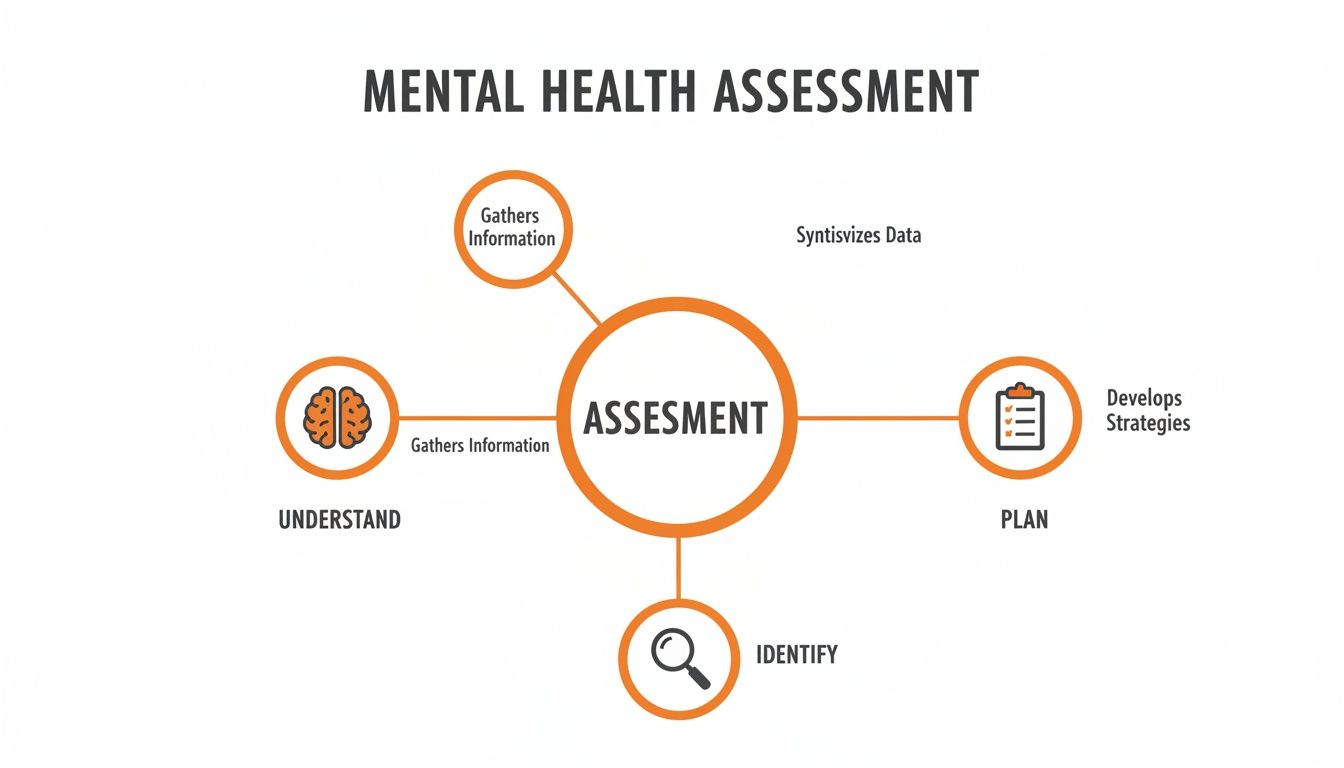
As you can see, the aim is to first understand a person's challenges, then identify the specific issues or conditions at play, and finally, plan a course of action that will actually make a difference.
To get there, clinicians rely on a few core methods. Each one gathers a different kind of information, and when combined, they create a comprehensive view of a person's mental state.
This table breaks down the main methods used during a mental health assessment.
Key Components in a Mental Health Assessment
Component | Purpose | Example Tools or Techniques |
|---|---|---|
Clinical Interview | To gather personal history, context, and subjective experiences through direct conversation. | Structured or semi-structured interviews, open-ended questions about family, work, and symptoms. |
Standardized Questionnaires | To objectively measure the presence and severity of specific symptoms using validated tools. | Beck Depression Inventory (BDI-II), Generalized Anxiety Disorder 7-item (GAD-7) scale. |
Cognitive Testing | To directly assess brain functions like memory, attention, and problem-solving skills through performance tasks. | Digit Span Test (for working memory), Trail Making Test (for executive function). |
Behavioural Observation | To note non-verbal cues and behaviours that provide insight into emotional and psychological states. | Observing body language, tone of voice, eye contact, and overall demeanour during the session. |
By using a combination of these methods, a clinician ensures no stone is left unturned. A low score on a questionnaire might contrast with observations of severe distress, prompting a deeper investigation that wouldn't happen otherwise.
Let's break down what each of these components looks like in practice.
The Clinical Interview
The journey almost always starts with a clinical interview. This is far more than a casual chat. It’s a purposeful, guided conversation designed to uncover a person's life story, their current struggles, and how they experience the world from their own perspective. The clinician will ask about everything from family history and social relationships to work performance and the specific symptoms that brought them in.
Practical Example: A therapist might ask, "Can you walk me through a time last week when you felt completely overwhelmed?" The answer provides rich, personal details that a checklist simply can't capture. It’s also where the foundation of trust and rapport is built, setting the stage for everything that follows.
Standardized Questionnaires and Rating Scales
Next up are standardized questionnaires and rating scales. These are the objective, evidence-based tools of the trade, designed to measure the presence and severity of specific symptoms. Think of them as a ruler for mental health symptoms, providing hard data that can be compared against established norms.
Some common examples you might encounter include:
The Beck Depression Inventory (BDI): A straightforward self-report tool where individuals rate the intensity of symptoms like sadness, guilt, and fatigue. A high score is a clear flag for a deeper look into depression.
The GAD-7 Scale: A quick screening tool used to measure the severity of generalized anxiety disorder. It asks how often someone has been bothered by things like uncontrollable worrying or feeling constantly on edge.
These instruments give clinicians a reliable snapshot of specific concerns, making the assessment process more efficient and grounded in data.
Performance-Based Cognitive Testing
Sometimes, understanding what’s going on requires a direct look at how the brain is functioning. That's where performance-based cognitive testing comes in. These are tasks designed to directly measure brain functions like memory, attention, and processing speed. Unlike questionnaires that rely on what a person says they feel, these tests assess what their brain can actually do.
Practical Example: A classic test is the digit span, where you’re asked to repeat back a sequence of numbers. It’s a simple but powerful way to get insights into working memory. Other tests might involve solving puzzles to evaluate executive function and problem-solving skills. To explore this area in more detail, check out our in-depth guide on the mental state assessment.
Behavioural Observation
The final piece of the puzzle is behavioural observation. This is where the clinician’s experience really shines, as they pay close attention to all the non-verbal cues—things like posture, tone of voice, eye contact, and general demeanour. These observations often speak volumes, revealing information the person might not even be aware of or able to put into words.
Practical Example: A client might insist they feel "fine" but do so while avoiding eye contact and speaking in a flat, monotone voice. A trained clinician would note this "flat affect" as a significant clue pointing toward potential emotional distress, prompting them to explore further.
By bringing these four core components together—the interview, the questionnaires, the cognitive tests, and keen observation—a clinician can create a truly well-rounded, accurate, and actionable mental health assessment.
How Professionals Choose the Right Assessment Tools
With a whole universe of mental health assessment tools out there, how does a clinician possibly decide which ones to use? It’s far from a random choice; it's a careful, deliberate strategy guided by the unique story of the individual sitting across from them. Think of it like a skilled craftsperson reaching into their toolkit—they don’t just grab any old hammer. They choose the specific instrument that's perfectly suited for the job at hand.
This decision-making is deeply personal. A professional will carefully consider a client's specific concerns, their age, their cultural background, and the core questions that need answering. This ensures the tools they pick are not only accurate but also genuinely relevant and fair.
Matching the Tool to the Individual's Needs
The first step is always to get to the "why." What's the primary concern we're trying to understand? A clinician might start with a broad-spectrum checklist to get a bird's-eye view of symptoms, but they'll switch to a highly specific screener to zero in on a particular condition.
Here’s how this plays out in the real world:
A client comes in talking about persistent worry and panic attacks. The clinician might reach for the GAD-7 (Generalized Anxiety Disorder 7-item scale). It's a quick, focused tool designed specifically to measure the severity of anxiety.
In a different scenario, a child struggling at school and with friendships might undergo a broader assessment. This could include a tool like the Conners Rating Scales to explore the possibility of ADHD and related behavioural patterns.
Context is absolutely everything. A developmental specialist assessing a toddler for autism will use a completely different set of observational and interactive tools than a neuropsychiatrist evaluating an adult who has survived a stroke. The stroke survivor’s assessment would likely lean on performance-based cognitive tests to measure things like memory, processing speed, and executive function. You can dive deeper into this in our comparison of cognitive assessments like the MoCA versus the MMSE.
Considering Age and Cultural Context
A person’s age and cultural background are also critical pieces of the puzzle. Most assessment tools are developed and tested for very specific age groups. A questionnaire built for an adult just won't be appropriate or reliable for a teenager—the language, the life experiences, and the developmental context are worlds apart.
The gold standard is always to use validated, evidence-based measures. This just means the tool has been scientifically tested and proven to be reliable and accurate for the specific population it's intended for. It’s what makes sure every assessment is both effective and equitable.
Cultural sensitivity is just as crucial. A good clinician has to consider whether a tool might have cultural biases that could throw off the results. For example, a question about social norms or family structures might be interpreted very differently from one culture to another, leading to a completely skewed understanding if it's not handled with care.
Addressing Systemic Challenges in Assessment
Choosing the right tool also means navigating some very real-world barriers. In many communities, simply getting access to mental health care is a huge obstacle. In California, for instance, a staggering 74% of low-income residents say cost is the main reason they can't get care.
This reality calls for precise, affordable assessment tools that can deliver reliable insights without breaking the bank. Sometimes, when professionals are digging into the root causes of certain challenges, an Intellectual Disability Gene Panel can also be vital for uncovering genetic factors that might contribute to cognitive impairment. You can learn more about these systemic issues by exploring the latest findings on mental health needs in San Mateo County.
By carefully weighing all these factors—the presenting problem, individual characteristics, and practical constraints—professionals can select the instruments that fit best. This thoughtful approach ensures the mental health assessment provides a clear, accurate, and actionable foundation for the next steps in a person's care journey.
Integrating Assessments into Your Clinical Workflow
A mental health assessment is most powerful when it becomes a living part of your practice, not just a one-off event. When you weave assessments into your clinical workflow, they stop being static reports and transform into dynamic tools that guide treatment, track progress, and genuinely improve outcomes. The key is to make this process feel practical and efficient—something that’s deeply connected to how you already deliver care.
This kind of integration builds a clear, objective foundation for your clinical work. It also empowers the people you work with by giving them visible markers of their progress, which can make all the difference in keeping them engaged in their own healing process.

Practical Applications Across Different Settings
How this looks in the real world will vary depending on your profession, but the core principle is always the same: using data to inform care. By embedding assessments into your standard procedures, you create a system for continuous improvement and personalized support.
Here are a few actionable examples of what this can look like:
For Therapists: An initial assessment creates a solid baseline of a client's symptoms and cognitive functions right at the start of therapy. Following up with periodic re-assessments every few months provides objective data to see what’s working and where you might need to adjust your approach.
For Educators: In a school setting, brief cognitive screens are fantastic for identifying students who might be at risk for learning or attention challenges. This allows for vital early intervention, connecting students with the right support long before they start to fall behind academically.
For Rehabilitation Centres: After a traumatic brain injury (TBI) or stroke, assessments are crucial. They can guide and personalize cognitive rehabilitation, helping therapists zoom in on specific areas like memory or executive function that need strengthening.
The Role of AI in Modern Assessment
This is where modern technology, especially AI-powered tools, can really make a difference. These platforms can automate the heavy lifting of data collection and analysis, delivering objective cognitive profiles in a matter of minutes. This frees up an incredible amount of time for clinicians, allowing you to focus less on administration and more on direct client care.
By automating the routine parts of assessment, technology empowers us to dedicate our expertise to what matters most: human connection, nuanced interpretation, and collaborative care planning. It bridges the gap between raw data and meaningful, actionable insights.
This efficiency isn't just a convenience; it's a direct response to a growing need. In California, for example, the youth mental health crisis has intensified, with nearly 1 in 3 adolescents now struggling with depression or anxiety. This alarming trend reveals a major treatment gap, where only about a third of affected youth received care. For healthcare providers, these statistics highlight the urgency of using rapid cognitive assessments to bridge gaps left by traditional evaluations. You can explore a comprehensive analysis of these mental health trends in California for 2024 to understand the full scope of the issue.
Reducing Delays and Improving Care
Ultimately, integrating mental health assessments into your workflow does more than just add data; it builds a more responsive and effective system of care. It helps cut down on diagnostic delays, minimizes the costs that come with prolonged or ineffective treatments, and provides a practical solution for today’s strained healthcare systems. It’s a systematic approach that helps ensure every individual gets timely, targeted, and evidence-based support.
To learn more about how digital tools are making this possible, check out our guide on completing a cognitive assessment online.
Ethical Considerations and Best Practices in Assessment
Any good mental health assessment has to be built on a foundation of trust and safety. To make sure every assessment is both helpful and respectful, professionals follow a strict set of ethical principles. These aren't just suggestions; they’re core responsibilities that protect the client and maintain the integrity of the whole process.
It all starts with informed consent. This is more than just a signature on a form. It’s about having a clear, simple conversation about the assessment’s purpose, what the process will look like, and any potential limitations. It’s about making sure the individual fully understands why they’re doing the assessment and what happens with the information before they agree to anything.
Safeguarding Client Privacy and Trust
Confidentiality and data privacy are the absolute cornerstones of ethical practice. Any information gathered during an assessment must be fiercely protected, especially when using digital tools and platforms. Sticking to strict regulations is non-negotiable, and a solid understanding of healthcare compliance is essential for any modern mental health professional.
This means following privacy laws that dictate how sensitive health information is collected, stored, and shared. When you work with a professional, your data has to be secure. To see exactly how we handle data and our commitment to client privacy, you can take a look at the Orange Neurosciences privacy policy.
Practicing Cultural Competence
A one-size-fits-all approach to assessment is not just ineffective—it's unethical. Cultural competence means using tools and interpreting results in a way that respects a client’s unique background, beliefs, and values.
Actionable Insight: A clinician assessing a recent immigrant should ask about cultural expressions of distress, which might differ from standard diagnostic criteria. For example, some cultures express emotional pain through physical symptoms. Failing to ask could lead to a misdiagnosis of a physical ailment instead of an underlying mood disorder.
This means being mindful of things like:
Language: Are the assessment tools available and given in the client's primary language?
Cultural Norms: How do different cultures talk about emotional distress or view mental health?
Lived Experiences: How has a person's social and cultural history shaped their perspective?
If we don't account for these differences, we risk biased results and serious misinterpretations. That would undermine the entire point of the assessment.
True ethical practice is about more than just following the rules. It’s about seeing the whole person—their culture, their experiences, and their humanity—and making sure the assessment process honours them every step of the way. This is how a clinical procedure becomes a compassionate, empowering experience.
Communicating Results with Clarity and Empathy
Finally, that ethical responsibility extends all the way to how the results are shared. The final step of any assessment should be a clear, collaborative conversation. It’s the professional’s job to translate complex data into feedback that clients and their families can actually understand and use.
This isn’t about handing over a score or a label. It's about explaining what the results mean in the real-world context of that person's life and figuring out the next steps together. This approach empowers people to become active participants in their own care, turning the findings from an assessment into a real roadmap for positive change.
Turning Assessment Results into Actionable Care Plans
A mental health assessment report isn't the final chapter; it’s the opening line of a new one. The real value of an assessment comes from turning its findings into a clear, effective strategy for improving well-being. This is where data meets real-world action, bridging the gap between clinical insights and tangible outcomes for individuals and their families.
The process kicks off by translating what can feel like complex assessment data into a straightforward care plan. Think of this plan as a roadmap, guiding every single decision that follows.

Building the Treatment Framework
A clinician uses the assessment results to build a highly personalized treatment framework. Gone are the days of a one-size-fits-all approach. Instead, every recommendation is carefully shaped by the individual's specific profile of strengths and challenges.
This framework typically includes:
Setting Measurable Goals: The goals need to be specific and trackable. For a student with attention deficits, a goal might be "complete homework assignments independently four out of five nights a week" rather than a vague "do better in school."
Choosing the Right Interventions: The data points the way to the most suitable interventions. A profile showing significant anxiety might lead to Cognitive Behavioural Therapy (CBT), while results indicating memory challenges could prompt specific cognitive rehabilitation exercises.
Coordinating Support: The plan also outlines who needs to be involved. This could mean coordinating with a school for an Individualized Education Program (IEP) or consulting with a psychiatrist about medication.
An actionable care plan transforms assessment findings from a static report into a dynamic guide. It empowers individuals and clinicians with a shared understanding of the goals and a clear path to achieving them.
Practical Example: If an assessment uncovers executive function difficulties in an adult after a concussion, the care plan might involve sessions with an occupational therapist. Their focus would be on developing new organizational strategies for work, such as using a digital calendar with reminders and breaking large projects into smaller, manageable tasks. The assessment provides the "why," and the plan provides the "how."
Advocating for Yourself and Your Family
These insights are also powerful tools for individuals and their families. Armed with objective data, you can advocate much more effectively for your needs, whether you're in a healthcare, educational, or workplace setting.
For parents, an assessment report provides concrete evidence to share with a school when requesting accommodations like extended time on tests. For adults, it can help explain to an employer why certain adjustments, like a quieter workspace, are needed to perform their job effectively.
In places like California, where the mental health system is growing but disparities remain, having reliable data is crucial. Post-pandemic, youth wellness ratings have been alarmingly low in some areas, highlighting the need for precise tools. Platforms like Orange Neurosciences deliver AI-driven cognitive assessments that yield actionable profiles in minutes, removing guesswork and helping track recovery. These tools enhance precision and support better brain health outcomes. To understand more about this landscape, you can review recent consumer perception survey findings from UCLA.
Ultimately, a well-executed care plan is the final, most important step of any mental health assessment. It’s what ensures the journey leads to meaningful and lasting change. To see how our platform can enhance your assessment process, visit our website to schedule a demonstration or contact us via email.
Your Questions About Mental Health Assessments, Answered
Stepping into the world of mental health can feel a bit like learning a new language. There are terms and processes that might seem confusing at first, but understanding them is the first step toward feeling empowered. Let's clear up some of the most common questions people have about mental health assessments.
How Long Does a Mental Health Assessment Take?
That really depends on what we're looking for. A quick screening for something specific, like anxiety, might only take around 30 minutes. But a deep dive, like a comprehensive neuropsychological evaluation for complex cognitive issues, could take several hours spread across a few different appointments.
The good news is that modern tools have made this whole process much more efficient. It's now possible for advanced platforms to map out a detailed cognitive profile—covering things like memory and attention—in under 30 minutes. This speed is a game-changer, giving clinicians the crucial data they need to make faster, more informed decisions about care.
Is an Assessment the Same as a Diagnosis?
This is a really common question, and it's an important distinction. They aren't the same thing.
Think of it this way: the assessment is the investigation. It's like a detective gathering clues, interviewing witnesses, and collecting all the evidence. The diagnosis is the conclusion the detective draws after looking at everything they've found.
An assessment is the journey of discovery; a diagnosis is the destination. The assessment provides the comprehensive data needed for a qualified professional to arrive at an accurate clinical conclusion.
So, the assessment involves all the interviews, questionnaires, and tests used to build a complete picture. The diagnosis is the specific clinical name for what's going on, like Major Depressive Disorder or Generalized Anxiety Disorder, which a professional assigns based on the assessment's findings.
Can a Mental Health Assessment Be Done Online?
Yes, absolutely. The rise of telehealth has made getting an evaluation more accessible than ever, and many key parts of an assessment work very well online.
A virtual assessment can easily include:
Clinical interviews held over secure video calls.
Standardized questionnaires that you can fill out digitally from home.
Performance-based cognitive tests delivered through a reliable online platform.
Practical Example: You might complete a depression screener on your own time and then jump on a video call with a therapist to talk through the results. A good clinician will always figure out the best approach for you—whether that’s remote, in-person, or a mix of both—based on your specific needs. It means that where you live is much less of a barrier to getting great care.
How Should I Prepare for a Mental Health Assessment?
Preparing for an assessment isn't like studying for a test. It’s more about getting yourself ready to have an open, honest conversation. The whole point is to give the clinician a clear window into your world so they can figure out the best way to help.
The best way to prepare is simple:
Get a good night's rest. Showing up to your appointment feeling as clear-headed as possible makes a big difference.
Be ready to be open. There are no right or wrong answers here. Your genuine experience is what matters most.
Jot down your concerns beforehand. It can be helpful to make a short list of the key symptoms, feelings, or situations you want to talk about. That way, you won't forget anything important in the moment.
At the end of the day, an assessment is a team effort designed to help you. Arriving rested and ready to share is the best way to make the experience a productive and positive one.
A thorough mental health assessment is the first step toward a clear and effective care plan. At Orange Neurosciences, we provide AI-powered, evidence-based tools that deliver rapid and precise cognitive profiles to guide clinicians. Learn how our platform can enhance your assessment process and lead to better outcomes by visiting us at https://orangeneurosciences.ca.
Orange Neurosciences' Cognitive Skills Assessments (CSA) are intended as an aid for assessing the cognitive well-being of an individual. In a clinical setting, the CSA results (when interpreted by a qualified healthcare provider) may be used as an aid in determining whether further cognitive evaluation is needed. Orange Neurosciences' brain training programs are designed to promote and encourage overall cognitive health. Orange Neurosciences does not offer any medical diagnosis or treatment of any medical disease or condition. Orange Neurosciences products may also be used for research purposes for any range of cognition-related assessments. If used for research purposes, all use of the product must comply with the appropriate human subjects' procedures as they exist within the researcher's institution and will be the researcher's responsibility. All such human subject protections shall be under the provisions of all applicable sections of the Code of Federal Regulations.


© 2026 by Orange Neurosciences Corporation