Mental Status Exam Template: A Practical Clinical Guide for 2026
Apr 1, 2026
As clinicians, the Mental Status Exam (MSE) is a cornerstone of our practice. It's the structured framework we use to observe and describe a patient's psychological functioning. A solid mental status exam template doesn't just ensure we're thorough; it provides a consistent language for tracking a patient's journey over time. This guide offers actionable insights and practical examples to help you master this essential tool.
Rethinking the Mental Status Exam for Modern Practice

While the MSE is fundamental, the traditional pen-and-paper approach can feel out of sync with the realities of modern healthcare. We're constantly balancing the need for a deep, nuanced understanding of our patients with the pressures of short appointments and heavy administrative loads.
This pressure-cooker environment often leads to inconsistencies. We've all seen it: one practitioner’s “mildly anxious” is another’s “agitated,” creating a subjective mess of data that's nearly impossible to track reliably. That static checklist we rely on can end up hiding more than it reveals about a patient's true state.
Overcoming Common Clinical Hurdles
To provide high-quality care, we must find a better way. The biggest roadblocks with old-school MSE templates are challenges we face daily:
Time Constraints: A truly comprehensive assessment takes time, a luxury most of us don't have. Actionable Insight: Prioritize the MSE components most relevant to the presenting problem. For a patient in crisis, focus on safety, thought content (suicidality), and perception first.
Subjectivity: Observations can vary wildly between clinicians, impacting diagnostic reliability. Actionable Insight: Anchor your observations in concrete behaviors. Instead of "anxious," write "wringing hands, tapping foot, and reports a feeling of dread."
Documentation Burden: Writing lengthy narrative notes is a huge time sink. Actionable Insight: Use a structured template with clear headings. This not only saves time but makes it easier for other providers to quickly find the information they need.
These problems are amplified in high-demand systems. Take California's mental health system, for example. In 2026, it served a staggering 639,889 clients, yet its penetration rate of 16.40 per 1,000 people was well below the national average. This isn't just a number; it highlights an urgent need for more efficient assessment tools where traditional methods buckle under paperwork and clinician shortages.
Embracing a Dynamic Approach
What if we stopped thinking of the MSE as a rigid document and started treating it as a dynamic tool? This shift in perspective opens up a world of possibilities, especially when we bring technology into the picture. AI-powered platforms can provide rapid, objective cognitive profiles that don't replace our clinical judgment but sharpen and supplement it. You can explore this concept further in our dedicated guide on the mental state assessment.
Actionable Insight: By combining your clinical expertise with objective data, you can transform the MSE from a one-off snapshot into a continuous, data-informed story. This provides a richer and more accurate picture of a patient's condition.
As you look for ways to make your workflow more manageable, tools like Intelligent Document Processing (IDP) can completely change how MSE data is managed. This isn’t about replacing clinicians; it’s about empowering us with better tools for a deeper, more accurate understanding of the human mind.
Your Comprehensive Mental Status Exam Template in Action
Let’s move from the textbook to the clinic. Knowing the components of a mental status exam is one thing; using it as a fluid, thinking guide is another. A great MSE isn't just about filling in boxes—it’s about weaving a narrative from your observations.
Each part of the exam is a thread in a larger story. What you notice about a person’s appearance gives you clues about their mood, which might then shed light on their thought content. Your job is to spot these connections and capture them in your notes.
Appearance and Behaviour
This is where you become a sharp observer. It’s the "show, don't tell" portion of your documentation. Instead of just writing "patient looked unkempt," paint a picture with your words.
Actionable Insight: Document specific, observable details. Is their hair matted? Are their clothes dirty or inappropriate for the season? These specifics speak volumes. For behavior, note eye contact, posture, and any distinct movements. Describing a client who is “wringing their hands, constantly shifting, and avoiding eye contact” provides solid, objective evidence of anxiety—far more powerful than the vague note, "patient seems nervous."
Practical Examples:
Young Adult with Anxiety: "A 24-year-old male, appears his stated age. He is dressed in clean, casual clothing appropriate for the weather. His behaviour is marked by psychomotor agitation; he is tapping his foot constantly and fidgeting with his hands. He maintains only fleeting eye contact throughout the interview."
Older Adult with Suspected Dementia: "A 78-year-old female, appears older than her stated age. She is dressed in mismatched clothes, with several buttons left undone. Her behaviour is cooperative, but her movements are slow. She has a stooped posture and a noticeable shuffling gait."
These descriptions immediately set the stage. The first paints a clear picture of restlessness, while the second points to potential challenges with self-care and motor skills.
Speech and Language
How a person talks can be as telling as what they say. When documenting speech, listen for its rate, rhythm, volume, and quantity. Is it pressured and rapid, as seen in mania? Or is it quiet and slow, suggesting depression?
Practical Example: Noting that "speech is pressured and tangential" is a classic, objective sign of a manic episode. Conversely, "speech is sparse, with long pauses and a monotonous tone" points toward a depressed mood or psychomotor slowing. This objective description is far more useful for diagnosis than a subjective label.
Mood and Affect
This is a classic distinction. Mood is what the patient tells you they feel (subjective). Affect is what you see (objective).
Actionable Insight: Start by asking directly but gently, like, "How have your spirits been lately?" Document their answer in their own words. Example: "Patient reports his mood has been 'down in the dumps' for the past month."
For affect, describe the emotional weather you observe:
Range: Is their expression full (normal), restricted, blunted, or flat?
Congruency: Does their expression match their stated mood?
Lability: Do their emotions shift rapidly and inexplicably?
A critical observation to watch for: A mismatch. For instance: "Patient reports feeling 'fantastic,' but his affect is flat, with minimal facial expression and a monotone voice." This single observation is a major clinical red flag and an actionable insight that demands further exploration.
Thought Process and Content
Thought process is how a person is thinking. Is it logical and linear? Or is it scattered and disorganized, like a "word salad"?
Thought content is what they are thinking about. Here you gently explore for delusions, obsessions, or thoughts of harm to self or others. These sensitive topics require a careful, direct approach. You can get a better handle on the nuances here by looking at resources on MMSE scoring and interpretation.
MSE Component Documentation Guide
This table provides standard phrasing and contrasts it with detailed examples of abnormal observations.
MSE Component | Standard Observation (Normal) | Example of Detailed Observation (Abnormal) |
|---|---|---|
Thought Process | "Logical and goal-directed." | "Thought process is circumstantial; patient provides excessive, unnecessary detail before eventually returning to the point." |
Thought Content | "No evidence of delusions or obsessions." | "Endorses paranoid delusions, stating 'the government is monitoring my thoughts through my television.'" |
Perception | "Denies auditory or visual hallucinations." | "Admits to auditory hallucinations, describing 'a man's voice whispering my name when no one is around.'" |
Insight & Judgment | "Insight and judgment appear good." | "Insight is poor; patient does not believe they have a mental illness and sees no need for treatment." |
Actionable Insight: Using a structured mental status exam template like this ensures you don't miss anything critical. It provides a solid framework for a comprehensive assessment. To get your hands on a downloadable and fillable version of this template for your own practice, visit our website and subscribe to our clinician newsletter for exclusive access to our resource library.
How to Sharpen Your MSE with Objective Data
A well-executed Mental Status Exam is built on our trained ability to observe. But that very strength—clinical observation—can also introduce subjectivity, especially in the ‘Cognition’ component. This can lead to variability between clinicians.
What if we could move past educated guesses and back up our observations with solid, measurable data?
This isn't about replacing your clinical judgment; it’s about making it sharper. Think of it this way: your observation tells you what is happening, but objective data can help you understand why and by how much.
From Subjective Impression to Specific Insight
Imagine you note "impaired concentration" because a patient struggles to follow your questions. That's a good observation, but it's general. What if you could put a number on it?
Actionable Insight: This is where platforms like Orange Neurosciences’ OrangeCheck can make a real difference. Instead of just writing "impaired concentration," you could run a quick, game-based assessment. In under 30 minutes, you’d get a report that quantifies your observation, perhaps revealing a specific deficit in sustained attention below the norm for your patient's age.
This changes the conversation. You’re no longer just saying the patient has trouble concentrating; you’re demonstrating a measurable cognitive deficit. This is powerful information that can shape your care plan and justify specific interventions.
The core observational components of the MSE provide the foundation for this deeper look.
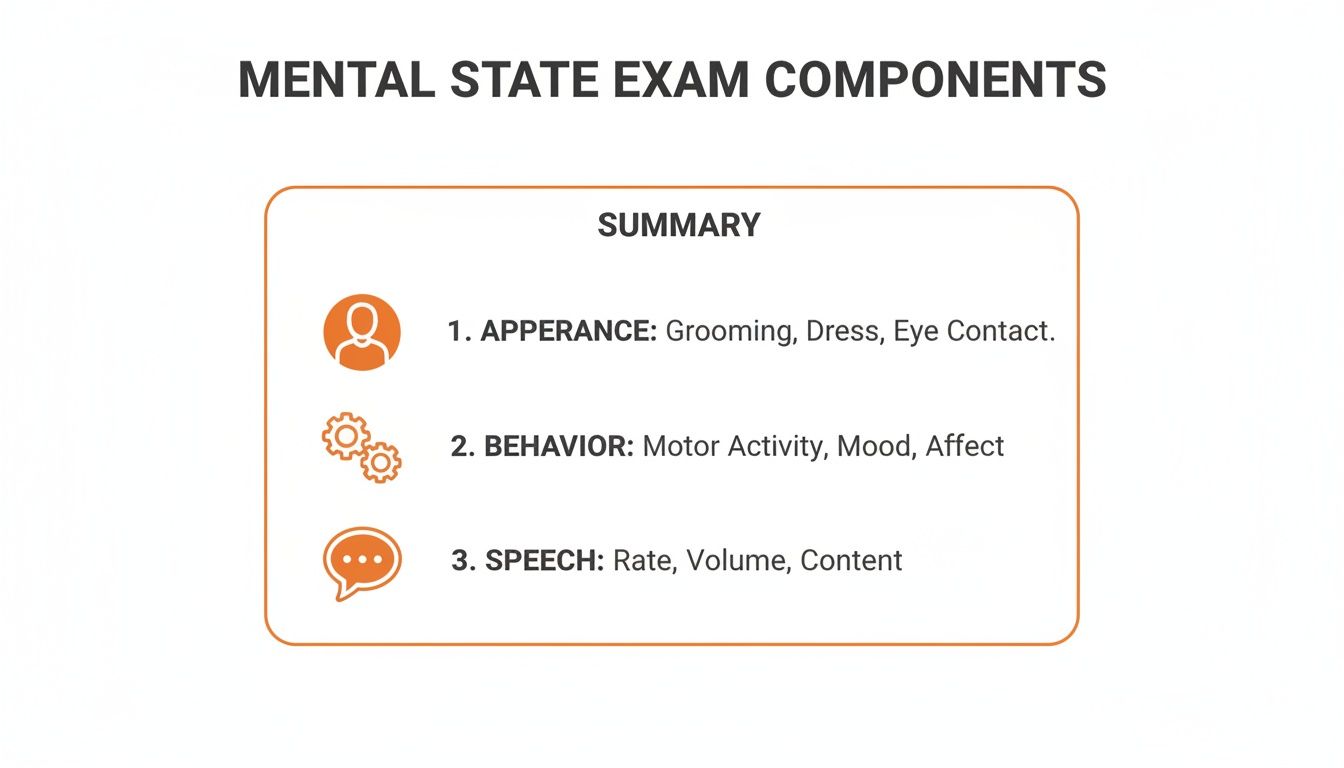
These pillars of the MSE—Appearance, Behaviour, and Speech—give us context. Adding objective cognitive data enhances the picture.
Building More Robust Care Plans
Integrating hard data provides several key advantages:
A Clear Baseline: Establish a quantitative starting point for cognitive function.
Tracking Progress Over Time: Re-assess to see if interventions are working.
Better Communication: Use concrete numbers to communicate a patient's status to other providers, caregivers, and the patients themselves.
Practical Example: For a patient with suspected early-stage dementia, supplementing your MSE with objective data is incredibly valuable. Your clinical observation of "word-finding difficulty" becomes more powerful when paired with a cognitive test result showing a specific decline in verbal fluency. Our guide to cognitive screening tests for dementia dives into tools that add this precision.
Ultimately, by marrying your skilled clinical observations with objective data, you create a more complete and defensible clinical picture, advocating for your patients' needs with compelling, evidence-based support.
Tailoring Your MSE for Different Patients and Settings
A mental status exam template is a starting point, not a rigid form. An effective MSE is a flexible tool you adapt to the unique person in front of you and the realities of your clinical setting.
Clinical assessment is an art. Your approach must be nimble, whether you’re in a chaotic emergency department, a quiet outpatient clinic, or a community centre. For clinicians in specialized mental health practices, tweaking the MSE isn't just a good idea; it's essential for a sharp diagnosis and a care plan that works.
Actionable Insight: The goal isn't to discard the MSE structure. It's about knowing when to probe deeper in some areas or adjust your language to truly connect with the patient.
Adapting for Different Populations
How you conduct an MSE should change depending on who you're assessing.
Pediatric Patients: Use age-appropriate language. Instead of "mood," ask, "Tell me about the saddest you've ever felt." Practical Example: Use play or drawing as assessment tools. Ask a child to draw their family; the drawing can provide a window into their thought content and affect when direct questions fall flat.
Geriatric Patients: Your MSE must lean more heavily into detailed cognitive screening to differentiate between normal aging, mild cognitive impairment, and dementia. Actionable Insight: Always check for sensory deficits—like hearing or vision loss—that can mimic cognitive problems. We explore this in our guide to a comprehensive geriatric assessment in Canada.
Acute Care Clients: In a crisis, your focus narrows instantly. Actionable Insight: Prioritize a rapid assessment for safety—risk of harm to self or others, psychosis, or severe disorganization. A full MSE isn't practical or necessary in those first critical moments.
The Impact of Setting on Assessment
The environment shapes the assessment. Hospital readmission data in California, where 2.3% of mental health patients are readmitted within 180 days, highlights the need for robust, tailored evaluations.
The stakes are higher for at-risk groups. In San Mateo County, for example, self-injury hospitalizations among adolescent girls shot up by 49.2%. A flexible MSE template is vital for identifying risk and preventing relapse in these dynamic crises.
By thoughtfully adapting your mental status exam, you transform it from a simple checklist into a responsive, powerful diagnostic tool.
Mastering Documentation to Protect Your Practice

How you document an MSE is as important as how you conduct it. Your notes are a clinical record, a legal document, a billing justification, and a roadmap for the patient's care team.
Getting documentation right—making it clear, defensible, and useful—is a non-negotiable skill. The art is in writing notes that are both concise and complete.
From Observation to Defensible Note
Your notes must tell a story another clinician can understand instantly. It’s the difference between writing "patient was uncooperative" and describing the specific behaviors.
Actionable Insight: A much stronger, more defensible note would read: "Patient refused to make eye contact, provided only one-word answers, and stated, 'I don't want to be here.'" This transforms a subjective opinion into an objective, factual record. It protects you and improves the quality of care, a fundamental part of maintaining excellent continuity of care.
Your MSE documentation should be a precise, factual narrative. Every observation you record should be concrete and descriptive, allowing any reader to arrive at the same general understanding of the patient's presentation.
Best Practices for MSE Documentation
Incorporate these habits into your workflow:
Use Direct Quotes: Capture the patient's own words, especially for mood, thought content, or perception. Practical Example: "Patient reported mood as 'a 2 out of 10'" is infinitely stronger than "Patient is depressed."
Be Specific and Objective: Avoid vague terms like "poor" or "good." Instead of "poor insight," document the evidence: "Patient denies having a mental illness and does not see the value in taking prescribed medication."
Maintain Neutral Language: Describe behaviors and statements factually, without layering on your own interpretation or emotional language.
Linking Documentation to Professional Success
For clinicians starting out, mastering documentation is tied to professional success. Strong assessment skills are at the heart of training.
Recent Board of Behavioral Sciences (BBS) data showed a 62% pass rate for LCSW licensure exams, while graduates from some top programs achieved a 77% pass rate on the California Law and Ethics exam. These numbers reflect competency in clinical tools like the mental status exam template, which are essential for passing exams and building a sustainable practice.
Turning your observations into a powerful clinical document is what makes an MSE truly effective.
Your Questions Answered: Practical Application of the MSE
When you start weaving the mental status exam into your daily practice, practical questions arise.
A big one is, "How much detail is too much detail?" Actionable Insight: Focus on painting a clear, objective picture for the next clinician. Instead of "dishevelled," provide the evidence: "wore a stained shirt and had uncombed hair." That's concrete and speaks for itself.
Then there's the dilemma: "What if a patient says they feel great, but my gut says otherwise?" Your role is to be an objective reporter of all data.
A Note on Clinical Practice: Document what the patient tells you, using their own words ("Patient reports mood is 'fantastic'"). Then, follow it with your objective observation ("However, affect was blunted, with a monotone voice and no spontaneous smiling."). That contrast isn't a contradiction—it's a clinically significant finding.
Clarifying Key Distinctions
It's common to get tangled up between thought process and thought content. Here's a simple way to separate them:
Thought Process (The How): The mechanics of their thinking. Is it linear and logical? Or does it get sidetracked (tangential) or take a scenic route (circumstantial)?
Thought Content (The What): What they are actually thinking about. Are they stuck on certain ideas (preoccupations), or are there themes suggesting delusions or obsessions?
Finally, "Do I need to fill out every section for every patient?" Absolutely not. Actionable Insight: Think of the mental status exam template as your clinical toolkit, not a rigid checklist. A quick ER assessment will zero in on safety and risk. A comprehensive initial evaluation will demand a deeper dive. Your clinical judgment is your best guide.
At Orange Neurosciences, we're passionate about giving clinicians like you tools that sharpen and support your expert observations. Our AI-powered platform delivers objective cognitive data that complements your MSE, helping you build more robust, evidence-based care plans for your patients. It’s time to move from pure observation to precise measurement. See how by visiting our website and requesting a demo today. Explore our solutions at https://orangeneurosciences.ca.

Orange Neurosciences' Cognitive Skills Assessments (CSA) are intended as an aid for assessing the cognitive well-being of an individual. In a clinical setting, the CSA results (when interpreted by a qualified healthcare provider) may be used as an aid in determining whether further cognitive evaluation is needed. Orange Neurosciences' brain training programs are designed to promote and encourage overall cognitive health. Orange Neurosciences does not offer any medical diagnosis or treatment of any medical disease or condition. Orange Neurosciences products may also be used for research purposes for any range of cognition-related assessments. If used for research purposes, all use of the product must comply with the appropriate human subjects' procedures as they exist within the researcher's institution and will be the researcher's responsibility. All such human subject protections shall be under the provisions of all applicable sections of the Code of Federal Regulations.


© 2026 by Orange Neurosciences Corporation