A Practical Guide to MMSE Scoring and Interpretation
Dec 4, 2025

The Mini-Mental State Examination (MMSE) score offers a critical, at-a-glance look into a person's cognitive function. At its core, MMSE scoring is a standardized 30-point method that probes key cognitive areas like memory, orientation, and language. A clinician's job is to take that raw score, compare it against established cut-offs, and then fine-tune the interpretation by adjusting for real-world factors like age and education.
This process provides actionable insights, helping you flag potential cognitive impairment that might otherwise go unnoticed.
What MMSE Scoring Reveals About Cognitive Health
It’s tempting to see the MMSE score as a final diagnosis, but that’s not its purpose. Think of it more like a sensitive barometer for cognitive change—it’s a foundational tool designed to quickly signal that something warrants a closer look. For any clinician, a deep understanding of its scoring and what it all means is the key to making confident next steps in patient care.
The exam systematically walks through several core cognitive domains, giving you a structured peek into a person's mental status. This provides an objective baseline you can come back to and track over time.
A Structured Look at Cognition
The MMSE gives a solid number, but its real value is in how it breaks down cognition. It provides a quantitative measure across different functions, which helps you start pinpointing specific areas of weakness.
Before we get into the weeds, let's look at the big picture. The table below breaks down the main cognitive areas the MMSE touches on and how many points each is worth. It's a handy cheat sheet for understanding where the final score comes from.
MMSE at a Glance Core Cognitive Domains and Scoring
Cognitive Domain | Maximum Score | What It Measures |
|---|---|---|
Orientation to Time and Place | 10 | Awareness of the current date, location, etc. |
Registration | 3 | Ability to immediately repeat three words. |
Attention and Calculation | 5 | Serial 7s or spelling "WORLD" backwards. |
Recall | 3 | Remembering the three words from earlier. |
Language and Praxis | 9 | Naming, repetition, following commands, writing, copying. |
This table shows it's not just one skill being tested. You get a quick, multi-faceted snapshot of a person's cognitive machinery, from basic orientation to more complex language and memory functions.
By breaking down cognition into these components, the MMSE provides more than just a single number. It offers a profile of a patient's cognitive strengths and weaknesses, guiding further investigation into the nature of any observed difficulties.
The Score as a Clinical Guidepost
That final number really is a clinical guidepost. It helps direct what comes next. A consistently high score in an older adult might be reassuring, but a sudden or steady drop could be the very first sign of a meaningful change. Catching these patterns is a huge part of identifying and managing https://www.orangeneurosciences.ca/guide/what-is-cognitive-decline in its earliest, most treatable stages.
Ultimately, the power of MMSE scoring lies in how it's used. It helps clinicians answer critical questions: Does this person need a referral for comprehensive neuropsychological testing? Or is "watchful waiting" with regular re-screening the right call for now?
Understanding how MMSE scores can shape these care decisions is vital, especially when you're considering approaches like person-centered dementia care, which absolutely depend on a deep understanding of an individual's cognitive state. The score is often the very first step on a diagnostic journey, giving you the foundational data needed for confident and effective clinical choices.
How to Accurately Score Each MMSE Item
Moving from theory to practice is where the rubber really hits the road in MMSE scoring. Even a small slip-up in how you score an item can throw off the final number, leading to a skewed clinical picture. Let's walk through how to score each of the 11 items with the precision needed for reliable, consistent results.
The whole process is a clear workflow: you assess the patient, score their answers, and then interpret that score within the bigger clinical context.
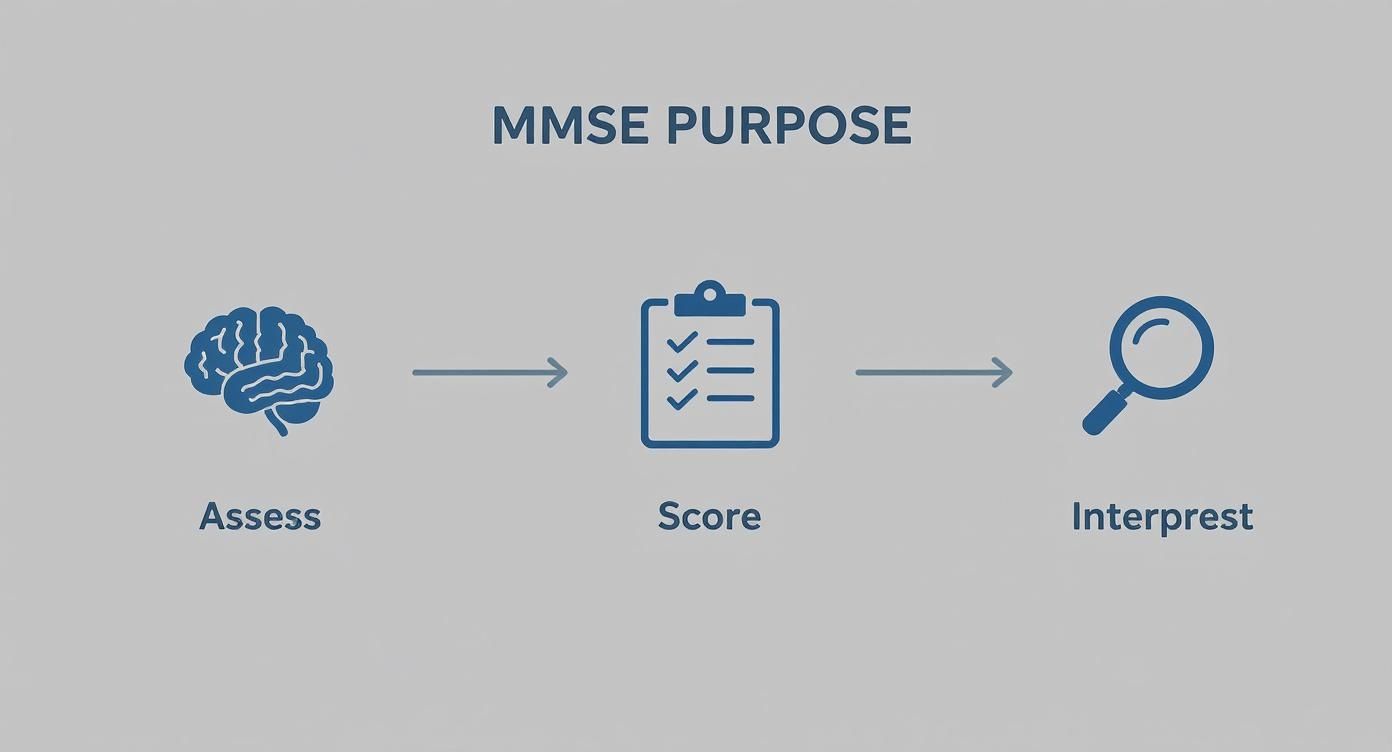
This visual really drives home that scoring is the critical bridge between gathering information and making sense of it. Getting this step right is everything. So, let’s break down exactly how to do that, piece by piece.
Scoring Orientation to Time and Place
This first section is a big one, worth a total of 10 points. It’s a foundational check on the person's awareness of their immediate surroundings and the flow of time.
Time (5 points): You'll award one point for each correct answer: year, season, date, day of the week, and month. Stick to the script here—even minor misses, like being off by one day on the date, are scored as incorrect to keep the test standardized.
Place (5 points): Similarly, give one point for each correct answer about their location: country, province, city/town, the name of the hospital or clinic, and the floor number. If you're not in a facility, a suitable alternative like "home" or the specific address is fine.
A practical example: Imagine a patient correctly names the year, month, and day but says it’s “fall” in early December. They would get 4 out of 5 points for orientation to time. Being consistent with these near-misses is absolutely key.
Registration and Immediate Recall
This task is worth 3 points and gives us a quick look at attention and the ability to grab hold of new information. You'll clearly and slowly name three unrelated objects (like "apple," "table," "penny") and ask the patient to repeat them back to you.
Score one point for each object they repeat correctly on that first try. The order they say them in doesn't matter. Make sure you write down exactly what they said, because you'll be asking for those words again later.
A crucial rule of thumb: before you move on, make sure the patient has actually heard and can repeat all three words. If they miss one, you can repeat the list up to three times, but you only score their first attempt for this section. This makes sure the information was actually registered for the recall task later.
Attention and Calculation
This section is worth 5 points and gives you two options: the "serial sevens" task or spelling "WORLD" backwards. The standard practice is to try serial sevens first. If they can't do it, you can offer the spelling task as an alternative.
Serial Sevens: The patient starts at 100 and subtracts 7 repeatedly. You score one point for each correct subtraction in the sequence (93, 86, 79, 72, 65). If someone makes a mistake but then correctly subtracts 7 from their wrong number, you only penalize that first error.
Spelling "WORLD" Backward: The patient spells "WORLD" in reverse (D-L-R-O-W). They get one point for each letter they place in the correct reverse position. So, if they say "D-L-O-R-W," they’d get 3 points because D, L, and W are in the right spots. Immediate self-corrections are usually accepted.
Delayed Recall and Language Tasks
This last group of items adds up to 12 points and looks at memory consolidation and a variety of language skills.
Delayed Recall (3 points)
Here, you simply ask the patient to recall the three objects from the registration task earlier. You give one point for each word they remember correctly. It's important not to give any clues or hints. This is a pure test of short-term memory.
Language Tasks (9 points)
This section is a mix of different tasks that probe various language abilities:
Naming (2 points): Show the patient two common objects, like a watch and a pencil, and ask them to name each one. One point for each correct name.
Repetition (1 point): Ask them to repeat the phrase, "No ifs, ands, or buts." They need to say it back perfectly to get the point. A little slurring is okay, but any added or missing words mean they don't get the point.
Three-Stage Command (3 points): Give a clear, three-step command like, "Take this paper in your right hand, fold it in half, and put it on the floor." You award one point for each part of the command they follow correctly.
Reading (1 point): Show the patient a paper with "CLOSE YOUR EYES" written on it. To get the point, they have to read it and do what it says. Just reading it out loud isn't enough.
Writing (1 point): Ask the patient to write any complete sentence. The key is that it must have a subject and a verb and make basic sense. You can overlook spelling or grammar mistakes as long as the sentence is coherent.
Copying (1 point): Have the patient copy a drawing of two intersecting pentagons. To earn the point, their drawing must have all ten angles (five for each shape) and the two intersection points.
While the MMSE is a fantastic screening tool for general cognitive function, some clinicians reach for other instruments when they suspect milder forms of impairment. For anyone interested, our guide on the Montreal Cognitive Assessment instructions explores a tool known for its higher sensitivity to subtle cognitive deficits.
By mastering the scoring details for each item, you can be confident that your MMSE results are precise and provide a solid foundation for your clinical interpretation.
Interpreting Scores and Applying Clinical Cut-Offs
Once you've tallied the final score, the real work begins. A raw MMSE score is just a number; its clinical power comes from understanding what that number actually suggests about your patient's cognitive health. It's all about translating that figure into an actionable insight to guide your next steps.
The most common way to start is by comparing the score to widely accepted clinical cut-offs. These ranges give us a shared language for classifying the potential severity of cognitive impairment.
Standard Scoring Ranges
While the exact thresholds can shift slightly depending on the clinical setting, there’s a generally accepted framework that helps put a score into context. Think of these as the first step in moving from a number to a clinical impression.
24–30 No Cognitive Impairment: Scores in this bracket are typically considered within normal limits. It’s unlikely the individual has significant cognitive deficits.
18–23 Mild Cognitive Impairment: This range can suggest the presence of mild cognitive issues. It’s a critical zone that often calls for closer monitoring or more sensitive testing.
12–17 Moderate Cognitive Impairment: Scores here usually point to a more significant level of cognitive difficulty, the kind that likely impacts daily functioning.
0–11 Severe Cognitive Impairment: This range signals substantial cognitive deficits, often seen in the later stages of dementia.
These ranges offer a solid starting point, but they are far from the whole story. Falling into the trap of a rigid, one-size-fits-all approach is a common pitfall that can lead straight to inaccurate conclusions.
Why a Single Cut-Off Is Never Enough
Simply relying on a standard cut-off like "below 24" is a problem because it completely ignores the rich diversity of human experience. Things like a person's age and how many years of schooling they've had can profoundly impact their baseline cognitive performance. This is where clinical judgment becomes absolutely essential.
A score must always be interpreted in the context of the individual. An MMSE score that is reassuring for one person could be a significant red flag for another, depending entirely on their personal history and demographic profile.
For example, an 85-year-old who only finished elementary school might score a 25, which seems normal. But what about a 65-year-old retired university professor who also scores a 25? For them, that could represent a significant drop from their expected baseline. The number is the same, but the clinical meaning is worlds apart.
The Art of Adjusting Your Interpretation
This is where you bridge the gap between scoring and diagnosis. You have to mentally adjust your interpretation based on the person sitting in front of you. While formal adjustment tables exist, the core principle is about establishing a personalized benchmark.
Actionable Insight Example:
Let’s look at two different people who both score 26 on the MMSE.
Patient A: A 78-year-old man with a university degree and a lifelong career as an accountant. For him, a score of 26 might be concerning. Given his high educational and occupational attainment, you'd expect a perfect or near-perfect score. Your Actionable Step: Refer him for more sensitive testing, such as the MoCA, to investigate subtle executive function or memory deficits.
Patient B: An 82-year-old woman with six years of formal education who worked in manual labour. For her, a score of 26 is likely a strong and reassuring result. It suggests her cognitive health is well-preserved for her age and educational background. Your Actionable Step: Schedule a follow-up screening in 6-12 months to monitor for any changes, but no immediate further testing is required.
This process of contextual interpretation is vital for distinguishing between normal aging and the early signs of something more serious. Learning how to tell the difference between mild cognitive impairment vs dementia often starts with this kind of nuanced analysis. The MMSE provides the initial data, but it’s your clinical reasoning that turns that data into an actionable insight, guiding whether the next step is watchful waiting or a referral for more comprehensive testing.
Adjusting Your Interpretation for Diverse Populations
Relying on a standard MMSE cut-off score without considering the person sitting in front of you is a bit like using a generic key for a specific lock. It often doesn’t fit, and you can end up with the wrong conclusion. A rigid, by-the-book interpretation can fail diverse populations, sometimes leading to the profound error of misdiagnosis.
To make sure your MMSE scoring and interpretation is both fair and clinically sound, you have to account for cultural, linguistic, and educational differences. This isn't just a matter of clinical best practice; it has very real consequences.
Language barriers, different cultural views on health, or a lower level of formal education can all artificially drag down an MMSE score. This can make a perfectly healthy individual appear cognitively impaired. The goal is to get beyond a one-size-fits-all mindset and toward a more personalised, culturally aware assessment.

The Real-World Impact of Culture and Education
The questions on the MMSE aren't universally intuitive. Something that seems simple in one cultural context might feel abstract or just plain confusing in another. For example, tasks like spelling "WORLD" backward or naming the current season can be heavily skewed by a person's formal schooling, not their actual cognitive ability.
This is where clinicians need to put on their detective hats. You have to look past the raw score and ask why a person answered the way they did. Was an error caused by a true cognitive slip, or was it the result of a language barrier or a different educational background? Getting this right is central to an equitable assessment.
A lower-than-expected MMSE score in a culturally or linguistically diverse individual shouldn't be the final word. Instead, it should be the starting point for a deeper, more context-aware investigation into their cognitive health.
A great example of this is the influence of demographics on screening within the African-Caribbean population in the UK. Research has pointed out that mean MMSE scores in older African-Caribbean adults are often lower than established UK norms by about 1–2 points. That's a gap big enough to completely change the clinical picture if you don't adjust for it.
The good news is that we don't have to guess. Normative data exists to help us make these crucial adjustments, turning a potentially biased score into a much more accurate one.
To avoid the serious pitfall of over-diagnosing cognitive impairment, it’s essential to adjust your thinking with a more flexible and informed approach. This means actively looking for population-specific data and always keeping the test's inherent biases in mind.
Adjusting MMSE Scores for Age and Education
We know that both age and education level can significantly influence MMSE performance. Lower educational attainment, in particular, is one of the most common reasons for a score to be artificially low. Clinicians often apply established adjustments to the raw score to get a more accurate picture.
Here’s a look at how these adjustments work in practice.
Demographic Adjustments for MMSE Score Interpretation
This table shows common adjustments to MMSE cut-off scores based on age and education levels, which helps improve diagnostic accuracy.
Demographic Factor | Typical Adjustment Guideline | Clinical Rationale |
|---|---|---|
Education | Add 1 point for individuals with less than a high school education. | Compensates for the test's bias toward literacy and formal schooling. Questions involving writing, spelling, and abstract concepts are heavily influenced by educational background. |
Age | Add 1 point for individuals over the age of 75 or 80. | Accounts for normal, age-related cognitive slowing that doesn't necessarily indicate a pathological process like dementia. |
Combined Factors | Some models use a regression-based formula to create a more precise adjustment based on both age and years of education. | Provides a more nuanced correction than a simple +1 point rule, reflecting the complex interplay between aging and educational experience on cognitive test performance. |
By applying these kinds of evidence-based adjustments, you're not "inflating" the score; you're correcting for known measurement biases. This simple step can be the difference between raising a false alarm and providing an accurate, reassuring assessment.
A Framework for Culturally Competent Interpretation
So, how do you put all this together in a busy clinic? It comes down to adopting a more dynamic and thoughtful framework for interpretation.
Here’s a practical way to approach it:
Gather a Detailed History: Before you even start the test, get the full story. How many years of formal schooling did they complete? Is English their second language? What is their cultural background?
Use Population-Specific Norms: Whenever you can, compare their score to data from their specific demographic group instead of a generic "normal" range. This gives you a much more relevant benchmark.
Analyze Error Patterns: Look at which questions they found difficult. Were the mistakes clustered in language-heavy tasks? Or on items that require abstract thinking linked to formal schooling? The pattern of errors can tell you a lot.
Consider Language Dominance: Running the test in a non-native language can have a huge impact. It's crucial to understand the role language plays, which you can read more about in our guide on the language of assessment.
By integrating these steps, you move from a rigid scoring process to a thoughtful clinical interpretation. This nuanced approach helps ensure that the MMSE scoring and interpretation provides a fair and accurate snapshot of an individual's cognitive health, no matter their background. This diligence is what separates a good screening from a potentially harmful misjudgment.
Common MMSE Pitfalls and When to Use Other Tools
While the Mini-Mental State Examination is a staple in any clinician's toolkit, it's certainly not a one-size-fits-all solution. A skilled practitioner knows not only how to administer the MMSE but, just as crucially, when its limitations demand a different tool. Understanding these pitfalls is the key to accurate and ethical MMSE scoring and interpretation.
One of its biggest drawbacks is a lack of sensitivity for picking up mild cognitive impairment (MCI). In fact, research shows the MMSE's sensitivity for MCI can be as low as 18%, which means it frequently misses the earliest, most subtle signs of cognitive change. This is particularly true for people with higher educational or professional backgrounds.
This is what we call a "ceiling effect." A retired engineer or a professor might score a perfect 30/30, even while they're privately struggling with minor issues in memory or planning. Their deep well of cognitive reserve can easily mask a budding deficit on this particular test, which could delay a vital diagnosis.
Frequent Administration and Scoring Errors
Beyond its built-in limitations, simple human errors during administration can easily throw off the results. Even experienced clinicians can fall into common traps that skew the final score and paint a misleading clinical picture.
Improper Cueing: Subtly helping a patient with an answer—like over-emphasizing a word during the repetition task—invalidates that part of the test.
Inconsistent Scoring: Sometimes accepting a near-miss (like a date that’s one day off) and other times not, completely undermines the test's standardization.
Rushing the Patient: Creating a stressful, hurried environment can spike anxiety and hurt performance, especially on tasks that rely on attention or have a timed component.
The reliability of an MMSE score is directly tied to the rigour of its administration. A score derived from a flawed process is not just inaccurate—it's misleading.
Knowing When to Pivot to the MoCA
This is exactly where knowing your full range of tools becomes so important. When you suspect a milder impairment or need to dig deeper into specific cognitive areas, it’s often time to switch gears. The Montreal Cognitive Assessment (MoCA) is frequently the better choice in these situations.
The main reason? The MoCA has a strong focus on executive function and more complex cognitive tasks. While the MMSE is great for checking orientation and basic memory, the MoCA includes items like the clock-drawing test and abstraction questions that the MMSE doesn't even touch.
Let's look at them side-by-side:
Feature | MMSE (Mini-Mental State Examination) | MoCA (Montreal Cognitive Assessment) |
|---|---|---|
Primary Strength | Screening for moderate-to-severe impairment. | Detecting mild cognitive impairment (MCI). |
Executive Function | Lacks specific tasks to assess this domain. | Includes several tasks targeting executive skills. |
Sensitivity to MCI | Lower (around 18-25%). | Higher (around 90-100%). |
Best Use Case | Monitoring established dementia; quick screens. | Early detection; assessing highly educated individuals. |
The takeaway here is pretty clear: if a patient comes in with subtle complaints, or if you have a hunch there are issues with planning and problem-solving, the MoCA is much more likely to give you a revealing and clinically useful result. For clinicians who want to explore this area further, our comprehensive guide offers a detailed look at how to test for executive dysfunction.
Ultimately, choosing the right tool for the job empowers you to move beyond a simple score and toward a truly insightful assessment.
Applying Your Knowledge with Clinical Case Studies
This is where theory hits the real world. Understanding the numbers and cutoffs is one thing, but applying that knowledge to actual people is what really matters. Walking through a few clinical vignettes helps bring the whole process to life.
You get to see how a raw score, a person's background, and your own clinical judgment all weave together to build a clear picture of someone's cognitive health.

These examples will take you from scoring individual items right through to deciding on the best next steps. It makes the entire framework much more tangible.
Case Study 1: The Retired Engineer
Let's start with Mr. Chen, a 68-year-old retired engineer with 16 years of education. His family has noticed some subtle memory lapses and that he's been struggling with multi-step projects he used to handle with ease.
MMSE Score Breakdown:
Orientation: 10/10
Registration: 3/3
Attention/Calculation: 4/5 (missed one serial 7)
Recall: 2/3 (forgot one word)
Language/Praxis: 9/9
Total Score: 28/30
On paper, a score of 28 looks fantastic. But for someone like Mr. Chen—highly educated, with a career built on complex problem-solving—we should expect a perfect or near-perfect score. Losing even single points on attention and recall is a potential red flag. It hints at early cognitive changes that his high cognitive reserve might be masking.
Clinical Impression: The score is high, but the type of errors (memory and attention) warrants a closer look. This is a classic example of a "ceiling effect," where the MMSE just isn't sensitive enough to catch the earliest signs of trouble in high-functioning individuals.
Next Steps: The best course of action is a referral for comprehensive neuropsychological testing. This would almost certainly include a more challenging screener like the MoCA to get a clearer picture.
Case Study 2: The Community Elder
Now, let's consider Mrs. Garcia. She's 82 years old with eight years of formal education. She’s a vibrant part of her community, but her family says she's been more forgetful lately.
MMSE Score Breakdown:
Orientation: 9/10 (missed the date)
Registration: 3/3
Attention/Calculation: 3/5 (struggled with serial 7s)
Recall: 2/3
Language/Praxis: 8/9 (could not write a complete sentence)
Total Score: 25/30
A raw score of 25 lands in the "mild cognitive impairment" range on many standard charts. But this is where adjustments are critical. Given her age and educational background, we need to correct the score. We can add one point for her age (>80) and another for her education (<12 years), which brings her adjusted score up to 27.
Clinical Impression: The adjusted score pulls her into the normal range for her demographic profile. Her errors, particularly with attention and writing, are more consistent with her educational background than with a significant new impairment.
Next Steps: For Mrs. Garcia, "watchful waiting" is a perfectly reasonable approach. Plan to re-administer the MMSE in 6-12 months to monitor for any changes.
Case Study 3: A Culturally Diverse Patient
Finally, meet Mr. Williams, a 75-year-old man who moved from Jamaica 50 years ago. His score is 19/30, which typically suggests mild-to-moderate impairment.
However, we need to consider his cultural background. The MMSE is widely used in the Caribbean, and specific research from Jamaica has helped refine its local interpretation. Studies there suggest using an 18-point threshold to differentiate levels of cognitive impairment in that population. You can explore the full research about these findings on cognitive factors in Jamaican older adults.
Clinical Impression: Mr. Williams's score of 19 is just above this culturally relevant cutoff. This context reframes our interpretation, suggesting a mild impairment rather than a moderate one.
Next Steps: It's crucial to refer him to a geriatric specialist with experience in cross-cultural assessment. This helps ensure an accurate diagnosis and avoids misinterpreting the score based on norms that don't apply to him.
Want to see how tools like OrangeCheck can streamline these assessments into your workflow? Discover how our platform supports data-driven clinical decisions.
MMSE Scoring Questions from the Clinic
Even when you know the basics of the MMSE, tricky situations pop up in real-world practice. Let's walk through some of the most common questions clinicians ask to help you sharpen your scoring and feel more confident in your interpretations.
What if a Patient Catches Their Own Mistake?
We see this all the time. A patient says the wrong day, but then immediately says, "No, wait, it's Tuesday." In these cases, you absolutely score the corrected answer.
This isn't just about getting the right answer; it's a fantastic clinical sign. It shows the patient is actively self-monitoring, which is a cognitive strength.
How Do You Score the Sentence Writing Task?
The only thing that matters here is whether they can create a complete, sensible sentence. To get the point, the sentence just needs a subject and a verb.
Don't get bogged down in spelling, grammar, or punctuation. A simple sentence like "the dog is big" gets full credit, even with mistakes. The goal is to see if they can formulate a coherent thought, not test their English class skills.
Can You Administer the MMSE to Someone with Vision Problems?
Yes, but you have to make a few important adjustments. For tasks that require sight, like reading "CLOSE YOUR EYES" or copying the intersecting pentagons, you need to adapt.
You can read the command out loud for them. For the drawing task, you simply note that it couldn't be completed due to the visual impairment. Documenting these modifications is key for accurate MMSE scoring and interpretation.
Is It Ever Okay to Repeat Questions or Instructions?
It depends on the task. For things like the three-stage command or spelling "WORLD" backward, you can repeat the instructions if it seems like they didn't quite catch them the first time.
But for memory items—like the three-word registration and recall—you can't. Repeating those words after the initial trial invalidates that part of the assessment. You're testing memory, not just their attention.
Juggling these scoring details while managing a busy clinic can be a real challenge. Digital tools like OrangeCheck from Orange Neurosciences can help by standardizing the administration and scoring process, making sure you get reliable data every single time. For more tips and updates on cognitive assessment, sign up for our newsletter below.
Ready to see how OrangeCheck can enhance your clinical workflow? Explore our platform to see how we support precise cognitive assessment.

Orange Neurosciences' Cognitive Skills Assessments (CSA) are intended as an aid for assessing the cognitive well-being of an individual. In a clinical setting, the CSA results (when interpreted by a qualified healthcare provider) may be used as an aid in determining whether further cognitive evaluation is needed. Orange Neurosciences' brain training programs are designed to promote and encourage overall cognitive health. Orange Neurosciences does not offer any medical diagnosis or treatment of any medical disease or condition. Orange Neurosciences products may also be used for research purposes for any range of cognition-related assessments. If used for research purposes, all use of the product must comply with the appropriate human subjects' procedures as they exist within the researcher's institution and will be the researcher's responsibility. All such human subject protections shall be under the provisions of all applicable sections of the Code of Federal Regulations.


© 2026 by Orange Neurosciences Corporation