Comprehensive Geriatric Assessment Canada: A Practical Guide
Jan 28, 2026
Think of a standard medical check-up as a quick snapshot of a patient's health. It’s useful, but it’s just one moment in time.
A Comprehensive Geriatric Assessment (CGA) in Canada, on the other hand, is the full-length documentary. It’s a deep dive that captures the complex, interconnected story of an older adult’s life and well-being. This is the gold standard for managing frailty and complex health issues in Canada's aging population, providing a clear, actionable roadmap for care.
Defining the Geriatric Assessment Approach
At its heart, a Comprehensive Geriatric Assessment (CGA) represents a fundamental shift in thinking. We move away from treating individual diseases in isolation and instead focus on understanding the entire person to boost their functional independence and overall quality of life.
It's a coordinated team effort to map out the intricate dance between a senior's physical health, cognitive function, social world, and psychological state.
Let’s take a practical example: an 80-year-old who has fallen twice recently. A typical appointment might zero in on the physical injury—the bruised hip or the sore wrist. A CGA, however, goes much, much deeper.
The assessment team starts asking why the falls are happening:
Medical: Could a new medication for blood pressure be causing dizziness upon standing? Is it poor vision or an undiagnosed case of vertigo?
Functional: Is the person having trouble with stairs or just getting out of a chair safely? Do they need a walker or cane?
Cognitive: Are there early signs of memory loss affecting judgment or coordination? This is a crucial piece of the puzzle. You can learn more about this specific evaluation in our guide on what is a cognitive assessment.
Socio-Environmental: Are there tripping hazards at home, like loose rugs or poor lighting in the hallway to the bathroom? Is the person living alone without enough support?
A Holistic and Coordinated Care Plan
By looking at all these connected pieces, the CGA reveals the whole story. The falls might be linked to taking too many medications (polypharmacy), made worse by social isolation that has led to weaker muscles. This holistic view is what makes the CGA so powerful. It moves beyond just writing a prescription to building a truly personalized and actionable care plan.
The real goal of a CGA isn't to just produce a diagnostic report. It's to create a living, breathing care plan that adapts to the patient's needs, packed with specific recommendations—from medication changes and physiotherapy referrals to connecting them with local community support services.
For our patient who has been falling, an actionable plan might involve a pharmacist reviewing their medications, an occupational therapist recommending a home safety check, and enrollment in a local strength and balance class. This collaborative approach tackles the root causes, not just the symptoms, empowering older adults to live more safely and independently.
This foundational understanding is essential for any clinician or caregiver who wants to provide the absolute best care for Canada's seniors. To see how our advanced tools can support the cognitive piece of these assessments, visit Orange Neurosciences and discover how we help clinicians get objective, actionable insights fast.
The Core Components of a Geriatric Assessment
A truly effective comprehensive geriatric assessment (CGA) in Canada is much more than a routine medical check-up. It's a deep, multidimensional investigation that pieces together the entire puzzle of an older adult's health. Think of it as five interconnected pillars, each one essential for supporting the whole structure of a person's well-being.
These pillars aren't just a checklist of separate issues; they actively influence one another. For instance, depression (psychological) can lead to poor appetite (medical), which causes muscle weakness and increases fall risk (functional). This creates complex challenges that demand a coordinated, thoughtful approach to solve.
The diagram below shows how the core physical, cognitive, and social components of a CGA interact to build a complete picture of a patient's health.
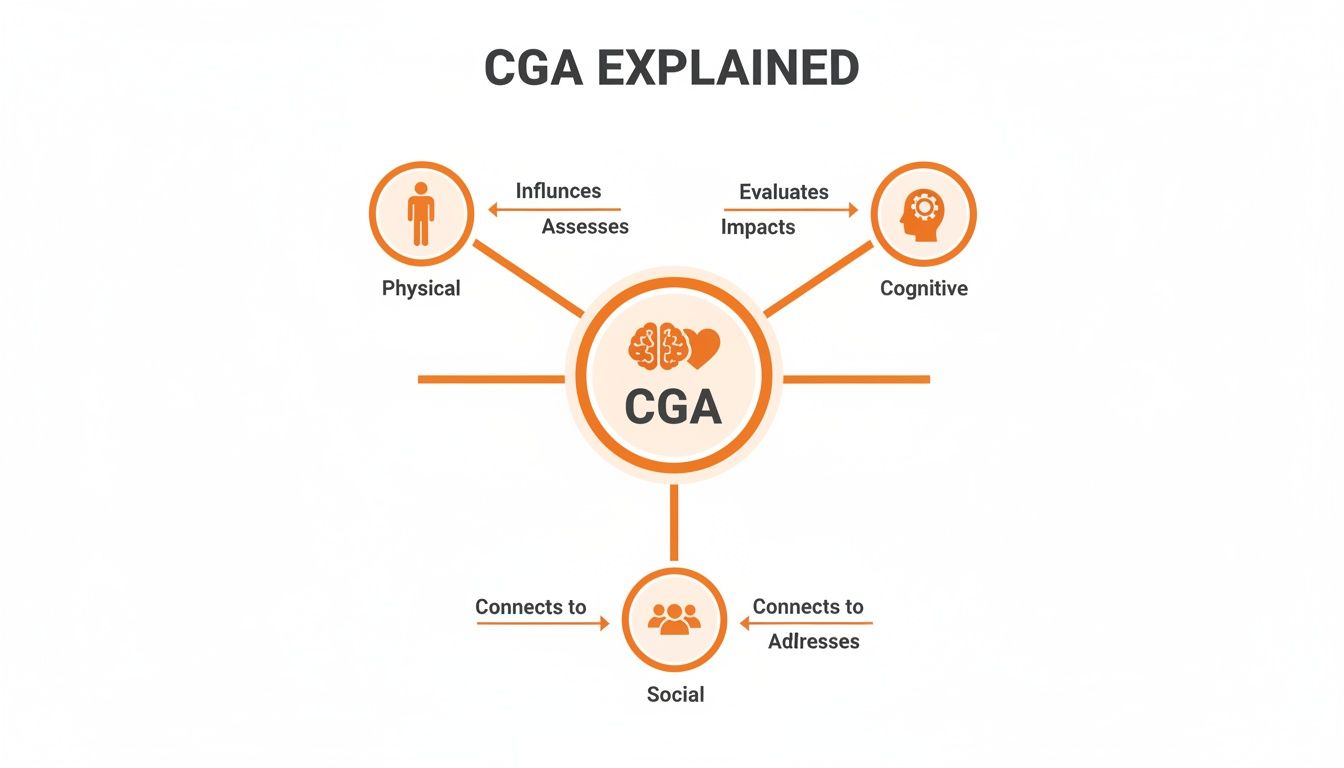
This really brings home that a CGA isn’t just a single event. It’s a process that weaves together multiple facets of a person’s life to guide a truly holistic and actionable care plan.
To understand this better, let's break down each of these core domains. The table below gives a quick overview of what gets looked at during a CGA.
Key Domains of a Comprehensive Geriatric Assessment (CGA)
Assessment Domain | Focus Area | Actionable Insights Gained |
|---|---|---|
Medical & Medication | Overall health, chronic conditions, polypharmacy, nutrition, and sensory function. | Are the current medications appropriate? Is the patient well-nourished? Are hearing or vision issues impacting safety? |
Functional | Ability to perform self-care and live independently. | Can the patient manage basic tasks like bathing and dressing? Can they handle cooking, finances, and medications? |
Cognitive | Memory, attention, and executive function. | Are there signs of memory loss, confusion, or delirium that need further investigation to inform safety planning? |
Psychological | Mood and emotional well-being. | Is the patient experiencing symptoms of depression or anxiety that affect their quality of life and motivation for care? |
Socio-Environmental | Living situation, support system, and home safety. | Is the home environment safe? Does the patient have family or friends to rely on for support, or do we need to connect them with community services? |
Each of these domains tells a crucial part of the story, and together they create a comprehensive roadmap for care.
Medical and Medication Review
The first pillar is a deep dive into the patient's medical history and current health. This goes far beyond just listing chronic conditions like diabetes or heart disease. It means taking a critical look at polypharmacy—the use of multiple medications. For example, a clinician might identify that a new sleeping pill is causing next-day grogginess, increasing the risk of a fall. This is an immediately actionable insight.
This domain also covers nutritional status, because a poor appetite or weight loss can be a red flag. And we can't forget sensory health; uncorrected hearing or vision loss isn’t just an inconvenience, it's a major risk factor for falls and social withdrawal.
Functional Evaluation
Next, the assessment zeroes in on function. This is all about the practical side of things: a person's ability to manage daily life on their own. We break this down into two key areas:
Activities of Daily Living (ADLs): These are the absolute essentials of self-care, like bathing, dressing, eating, and getting to the toilet.
Instrumental Activities of Daily Living (IADLs): These are the more complex tasks needed to live independently—things like managing money, cooking meals, shopping for groceries, and taking medications correctly.
A dip in either ADLs or IADLs is a clear signal that something's up, prompting a closer look at whether the cause is physical, cognitive, or a mix of both. An actionable insight here might be noticing a patient is no longer managing their finances, which could be an early sign of cognitive decline.
Cognitive Screening
The third pillar is an evaluation of cognitive health. This can be a sensitive area, but it's an essential part of the assessment, screening for changes in memory, attention, and problem-solving skills.
The goal here is to catch potential issues like mild cognitive impairment, dementia, or delirium—that sudden state of confusion often triggered by an illness. Finding these things early is absolutely key for planning ahead and keeping the patient safe. A practical example is identifying short-term memory loss that explains why a patient keeps missing medication doses, leading to a simple fix like a dosette box. For a more detailed look, you can learn more about the complete mental state assessment in our dedicated guide.
Psychological Health
A person’s mental and emotional well-being forms the fourth crucial pillar. This involves screening for common but often overlooked conditions like depression and anxiety.
Mood disorders can have a massive impact on an older adult's motivation, energy, and even their ability to engage with their own care plan. Identifying and addressing these issues is fundamental to improving their overall quality of life. For instance, recognizing that a recent widower's social withdrawal is due to depression can lead to a referral for grief counselling, a truly life-changing intervention.
Socio-Environmental Analysis
Finally, no assessment is complete without understanding the world the patient lives in. This fifth pillar looks at all the external factors that influence health.
A patient's home environment and social network are just as important as their medical chart. A safe home and strong support system can be the difference between thriving independently and facing repeated hospital admissions.
This means asking critical, practical questions. Who lives with the patient? Do they have a reliable support system? Is their home safe and free of fall hazards like poor lighting or loose rugs? Getting answers provides the real-world context needed to build a care plan that is both realistic and sustainable.
The Proven Impact of CGA in Canadian Healthcare
It's one thing to understand the moving parts of a Comprehensive Geriatric Assessment (CGA), but it's another thing entirely to see the real-world results it delivers right here in Canada. This isn't just another assessment; think of it as a strategic investment in proactive care that pays real dividends for patients, their families, and our healthcare system.
The evidence is overwhelming. When interdisciplinary teams adopt the CGA model, the benefits aren't just minor tweaks—they're substantial. This approach fundamentally shifts geriatric care away from a reactive cycle of crisis management and toward a proactive strategy that actually anticipates needs and prevents emergencies before they can even start.
This pivot has a direct, powerful effect on the metrics that matter most. Hospitals and clinics that put a formal comprehensive geriatric assessment in Canada into practice consistently see better outcomes. We're talking significant gains in both patient well-being and system efficiency.
Driving Better Patient Outcomes and System Efficiency
The true magic of a CGA is its power to head off the common crises that so often land older adults in the hospital. By catching risks like polypharmacy, poor nutrition, or fall hazards early, the care team can step in with effective interventions, keeping patients safer and healthier where they want to be—in their own homes.
This proactive stance directly translates into fewer trips to the hospital. For instance, the data shows that integrated care teams using CGAs can slash emergency department usage in remarkable ways.
A recent Canadian report from Geriatrics Ontario dropped a bombshell statistic: new service models built around the CGA led to a 49.5% reduction in emergency department visits among frail seniors. Even better, this model cut assessment timelines from a sluggish 11 weeks down to just three, getting help to people much, much faster.
That number alone tells a powerful story. The upfront time and resources a CGA requires are more than paid back through the long-term gains in health and system sustainability.
The Business Case for Proactive Geriatric Care
For any healthcare administrator or clinician on the ground, these outcomes make an undeniable business case for weaving CGAs into the fabric of care. The benefits create a positive feedback loop, strengthening the entire system from the inside out.
Here are just a few of the evidence-backed, actionable advantages:
Reduced Hospital Readmissions: By digging deep to address root causes, a CGA helps break the frustrating "revolving door" of discharge and readmission.
Shorter Lengths of Stay: When an older adult does need to be hospitalized, a CGA-informed approach means more efficient care and smarter, safer discharge planning.
Decreased Emergency Department Visits: As the data proves, actively managing geriatric syndromes keeps patients out of the ER, freeing up those critical resources.
Improved Functional Independence: At the end of the day, it's all about quality of life. CGAs are proven to help older adults maintain their independence for longer.
These results show that a CGA is far more than just a clinical tool—it's a cornerstone strategy for building a more sustainable and effective healthcare system. For leaders looking to advance brain health initiatives, learning how Orange Neurosciences is expanding digital brain health across Canada offers a glimpse into modernizing these care pathways. If you’re ready to see how our tools can support your CGA workflow with objective cognitive data, email our team or visit our website to request a demo.
How CGA is Delivered Across Canada
A Comprehensive Geriatric Assessment (CGA) isn't something that happens in just one type of clinic or a single location. In Canada, how it's delivered is as diverse as the older adults it's designed to help. The system is set up to meet people where they are, adapting to a wide range of healthcare settings.
Think of it as a mosaic of care. Every province and territory has its own unique mix of services, but they all share common goals. You'll find everything from specialized hospital units to mobile teams that bring expert care right into a patient’s home. Knowing where to look is the first step for clinicians and families trying to connect with the right support.

This section will give you a practical roadmap for navigating the different ways a comprehensive geriatric assessment in Canada is offered, helping you understand the landscape of care from coast to coast.
Common Settings for CGA Delivery
Geriatric services are strategically woven into the healthcare system to support older adults at different points in their journey. Whether someone is facing an acute health crisis or a more gradual change in their abilities, there’s likely a specialized service ready to step in.
Here are the main places you’ll find CGA services:
Inpatient Geriatric Units: Found within hospitals, these wards are specifically for older adults admitted with complex medical problems. A practical example is a senior admitted for pneumonia who is also experiencing delirium and has stopped eating.
Outpatient Clinics and Day Hospitals: These are perfect for individuals who are stable enough to live at home but need a deep-dive assessment. A patient might spend a full day at the hospital, moving between appointments with different specialists in a coordinated way.
Community Outreach Teams: These mobile teams bring the CGA directly to a person's home. This is an essential service for those with major mobility issues, like someone who is bed-bound or finds travel exhausting.
Telehealth and Virtual Care: This option has become increasingly vital, especially for Canadians in remote or rural areas. Virtual CGAs use video conferencing to connect patients with geriatric experts, breaking down geographical barriers to care.
The Interdisciplinary Dream Team
It doesn't matter where the CGA happens; its real power comes from its collaborative, team-based approach. It’s about bringing together a group of specialists who each look at the patient through their unique professional lens. The result is a truly 360-degree view of their health and well-being.
This "dream team" works together to craft a single, unified care plan. The exact makeup of the team can vary, but it usually includes:
Geriatrician: A medical doctor who specializes in the complex health needs of older adults and typically leads the assessment.
Geriatric Nurse: Handles medication management, provides patient and family education, and helps coordinate the entire care plan.
Physiotherapist: Assesses mobility, strength, and balance to reduce fall risk, often prescribing exercises and recommending mobility aids. For a deeper dive into rehabilitation, see our guide on occupational therapy in Canada.
Occupational Therapist: Looks at how well a patient can manage daily activities (like dressing, bathing, and cooking) and suggests home modifications or new strategies to maintain independence.
Social Worker: Focuses on the bigger picture, connecting patients and families with community resources, financial assistance, and vital caregiver support.
The Referral and Assessment Workflow
Getting a CGA usually starts with a referral. Most often, a family doctor or another specialist makes the referral when they see that a patient's situation has become too complex for a standard appointment to handle.
The referral is the starting point of a structured journey. It triggers a process where the team gathers information, conducts assessments, and collaborates to build a personalized roadmap for the patient's care.
Once the referral is accepted, the process generally unfolds like this:
Initial Triage: A nurse or team coordinator reviews the referral to make sure the service is the right fit.
Multidisciplinary Assessments: The patient then meets with the various team members. This might happen all in one day or over a series of appointments. Each specialist conducts their own focused evaluation.
Team Conference: This is where the magic happens. The entire team gets together to discuss their findings, share insights, and collectively hammer out an integrated care plan with clear, actionable recommendations.
Family Meeting & Plan Implementation: Finally, the team sits down with the patient and their family to walk them through the findings and the proposed care plan. This meeting ensures everyone is on the same page and committed to the goals ahead.
This careful process guarantees the final plan isn't just a list of medical instructions, but a practical strategy that fits into the patient’s real life. For teams looking to make this workflow even more efficient, incorporating advanced tools for the cognitive assessment piece can provide rapid, objective data. Visit Orange Neurosciences to see how our platform can support your team.
Challenges and Innovations in Geriatric Assessment
While the Comprehensive Geriatric Assessment (CGA) is celebrated as the gold standard for senior care in Canada, putting it into practice across the country is another story entirely. Real-world hurdles, from a shortage of specialists to siloed healthcare systems, are slowing things down. It’s a classic case of knowing what works but struggling to deliver it.
Thankfully, this is where innovation steps in. New approaches and technologies are starting to bridge those gaps, making sure more of our older adults get the holistic care they deserve.
The single biggest obstacle is a critical lack of specialists. We simply don’t have enough geriatric experts to meet the growing demand. This isn't just an inconvenience; it's a bottleneck that can delay or completely prevent seniors from getting the thorough assessments they need.
In fact, the numbers are pretty stark. In 2019, Canada had only 376 practicing geriatricians. Projections show that by 2030, we’ll be facing a national deficit of over 500 full-time equivalent (FTE) geriatricians. That’s a staggering 61.2% shortfall. If you want to dive deeper, a study on the Canadian geriatrician workforce lays out the full scale of the crisis. This data makes it crystal clear: we need practical solutions that can help us do more with the experts we have.
Overcoming Systemic Obstacles
Beyond the workforce crunch, there are other systemic barriers that make implementing a CGA in Canada a real challenge. These are the day-to-day frustrations that clinicians and administrators know all too well.
System Fragmentation: Our healthcare system often feels like a collection of separate islands. Hospitals, primary care clinics, and home care services operate in their own silos, making it incredibly tough to coordinate the seamless, team-based care a CGA demands.
Inconsistent Funding: How geriatric care is funded varies wildly from one province and territory to the next. This patchwork approach makes it difficult to secure the stable, long-term funding needed to support interdisciplinary teams.
Time Constraints: A proper CGA takes time. It’s a deep dive, not a quick check-up. In a fee-for-service world, that time isn't always compensated properly, which can unintentionally discourage clinicians from undertaking these vital assessments.
Getting a CGA program off the ground often means finding dedicated funding. Knowing how to find and apply for grants for senior citizens can be the key to securing the resources needed to build and sustain these essential services.
Harnessing Technology to Augment Clinical Capacity
This is where the story starts to change. The goal isn’t to replace clinicians—it’s to supercharge them with tools that amplify their expertise and impact. Technology is a powerful ally, helping to make high-quality geriatric care more efficient, scalable, and accessible.
Think of it this way: a geriatrician is like a highly trained pilot. Technology gives them an advanced cockpit. It automates routine checks and displays critical data in real-time, freeing them up to focus on the most complex part of the job: flying the plane. In the same way, digital tools can streamline parts of the CGA, letting our experts concentrate on complex decision-making and connecting with their patients.
The strategic use of technology can transform the CGA process from a resource-intensive bottleneck into a more efficient, scalable, and data-driven model of care. It empowers the entire team to work at the top of their scope.
For instance, AI-powered platforms can now deliver objective cognitive data in under 30 minutes. This allows every member of the interdisciplinary team—from nurses to occupational therapists—to gather reliable baseline metrics quickly and easily. This simple change can slash diagnostic wait times and create a consistent, objective way to track a patient’s progress.
This gives the entire team solid data to back up their clinical judgment, leading to faster, more confident, and actionable care plans. For any forward-thinking healthcare leader, adopting these tools is no longer a "nice-to-have"—it's essential for delivering high-quality, efficient geriatric care at scale. To learn how Orange Neurosciences can help equip your team with these capabilities, visit our website or email us to request a personalized demo.
Your Questions About Geriatric Assessments, Answered
Navigating senior healthcare can feel like a maze. But getting a handle on the Comprehensive Geriatric Assessment (CGA) can make a world of difference for clinicians, older adults, and their families. Here are some straightforward answers to the questions we hear most often about the CGA process in Canada.
Who Is the Ideal Candidate for a Geriatric Assessment?
The best candidate for a comprehensive geriatric assessment in Canada isn't just any older adult. It’s typically someone over 65 dealing with a tangle of interconnected health issues—not just one single chronic illness.
Picture this practical example: an 82-year-old woman was just in the hospital after a fall. She also has diabetes, takes eight different medications, and lives alone. Her situation is complex, with medical, functional, and social layers all intertwined. She's the perfect candidate. A CGA is designed for people whose health and independence could be dramatically improved with a coordinated, actionable care plan that sees the whole person, not just the symptoms.
What Standardized Assessment Tools Are Commonly Used?
Clinicians across Canada have a trusted toolkit of validated instruments they use to gather objective data during a CGA. These tools create a common language for the whole care team and help everyone track changes over time.
The specific mix of tools often depends on the clinic and the patient's unique needs, but you'll almost always see a few key players:
Cognitive Screening: The Montreal Cognitive Assessment (MoCA) is a go-to for screening for changes in memory and thinking. For a deeper dive, check out our guide on the differences between the MoCA vs MMSE.
Functional Ability: The Katz Index is great for measuring independence in Activities of Daily Living (ADLs)—things like bathing and dressing. The Lawton Scale then looks at Instrumental Activities of Daily Living (IADLs), such as managing finances or preparing a meal.
Mood Assessment: To spot signs of depression that could be impacting well-being, the Geriatric Depression Scale (GDS) is a widely used screening tool.
Mobility and Fall Risk: The Timed Up and Go (TUG) test is a wonderfully simple but powerful way to assess a person's mobility and their risk of falling in the future.
These aren't just forms to fill out. They are essential for turning clinical observations into hard data, which is the bedrock of any truly evidence-based, actionable care plan.
How Can Technology Streamline the Assessment Process?
Technology is a huge ally in making the CGA process more efficient and accessible. It’s helping clinical teams stretch their limited resources further, which is critical given Canada's shortage of geriatric specialists.
Telehealth platforms, for example, have become a lifeline, connecting geriatric experts with patients in rural or remote communities and knocking down geographical barriers. In the clinic itself, Electronic Health Records (EHRs) give every team member instant access to the same up-to-date patient information, making collaboration seamless.
Specialized digital tools can dramatically speed up key parts of the assessment. AI-powered platforms can generate a rapid, objective cognitive profile, feeding vital data back to the care team much faster so they can make well-informed decisions without frustrating delays.
The goal isn't to replace a clinician's judgment, but to supercharge it. By automating data collection for certain domains, technology frees up clinicians to focus on what they do best: complex problem-solving and building a trusting relationship with the patient and their family.
What Is the Main Outcome of a CGA?
The single most important outcome of a CGA isn't a thick file of reports—it's a living, breathing, person-centred care plan. This plan is built with the patient and their family, not for them, ensuring it reflects what truly matters to them.
This document is packed with specific, actionable recommendations. For a patient who has been falling, the plan might include:
Medication Changes: A pharmacist reviews their prescriptions to stop a sedative that could be causing dizziness.
Physiotherapy Referrals: They get a prescription for a targeted strength and balance program to improve stability.
Home Safety Modifications: An occupational therapist suggests installing grab bars in the bathroom and removing tripping hazards like loose rugs.
Community Resource Connections: A social worker connects them with a local Meals on Wheels service to make sure they're getting proper nutrition.
And it doesn't stop there. The plan includes scheduled follow-ups to track progress and tweak the approach as needed. It creates a continuous loop of assessment, intervention, and support, all with the goal of maximizing independence and quality of life. When a CGA uncovers significant health challenges, it's also common for individuals and their families to look into financial support options. This guide offers A Practical Guide to Long Term Disability in Canada.
At Orange Neurosciences, we equip clinicians with advanced tools to gather objective cognitive data quickly and accurately. Our AI-powered platform supports your CGA workflow, paving the way for faster, better-informed care plans. See how we can help your team by visiting https://orangeneurosciences.ca or emailing us today to get started.

Orange Neurosciences' Cognitive Skills Assessments (CSA) are intended as an aid for assessing the cognitive well-being of an individual. In a clinical setting, the CSA results (when interpreted by a qualified healthcare provider) may be used as an aid in determining whether further cognitive evaluation is needed. Orange Neurosciences' brain training programs are designed to promote and encourage overall cognitive health. Orange Neurosciences does not offer any medical diagnosis or treatment of any medical disease or condition. Orange Neurosciences products may also be used for research purposes for any range of cognition-related assessments. If used for research purposes, all use of the product must comply with the appropriate human subjects' procedures as they exist within the researcher's institution and will be the researcher's responsibility. All such human subject protections shall be under the provisions of all applicable sections of the Code of Federal Regulations.


© 2026 by Orange Neurosciences Corporation