Recognizing the Early Signs of Dementia for Caregivers
Mar 14, 2026
It's completely normal to feel a pang of worry when a loved one occasionally misplaces their keys or forgets a name. But the early signs of dementia are different. We're not talking about a once-in-a-while slip-up, but a more concerning pattern of change, like forgetting what keys are for in the first place, or not recognizing a friend they've known for decades.
Grasping this distinction is the very first step toward getting them the right support, right when it matters most. This guide offers practical examples and actionable insights to help you identify these signs and take the next steps. For more resources, visit our website or subscribe to our newsletter for continued support.
Distinguishing Normal Aging From Early Dementia
As we get older, we all experience minor memory hiccups. I often think of the brain as a well-used, slightly overstuffed filing cabinet. Sometimes, it just takes a bit longer to pull out the right file—that name on the tip of your tongue or a specific date. That’s a normal part of the aging process.
Dementia, on the other hand, is more like the filing cabinet itself becoming damaged. It’s not just that it takes longer to find a file; the information itself might get lost, scrambled, or filed so incorrectly that it's impossible to access. This is what leads to the kind of changes that consistently get in the way of daily life.
The Key Difference Is Impact
The most crucial distinction comes down to the impact these changes have on a person's ability to live and function independently. Forgetting where you parked your car in a busy lot is one thing. Forgetting how to operate the car is something else entirely.
Here's a practical example:
Normal Aging: Your father might need you to remind him about a doctor's appointment.
Potential Early Dementia: Your father might miss that appointment altogether, even with multiple reminders on the calendar and a phone call, because the very concept of the appointment has become hard for him to hold onto.
For a closer look at this, our guide on the differences between mild cognitive impairment vs. dementia can be really helpful.
The core issue isn't an occasional lapse. It's a persistent, downward pattern that interferes with daily routines, personal safety, and sound decision-making. Your actionable insight here is to start a simple log to track these patterns, which will be invaluable for a doctor.
Comparing Normal Aging with Potential Early Dementia Signs
To help you see these patterns more clearly, we’ve put together a simple, side-by-side comparison. Think of this table as a practical tool for making sense of the changes you might be observing in a loved one.
This table offers a side-by-side look at common age-related changes versus cognitive and behavioral patterns that may signal early dementia, helping you spot the differences.
Cognitive Area | Typical Age-Related Change | Potential Early Dementia Sign & Actionable Example |
|---|---|---|
Memory | Occasionally forgetting names or appointments but remembering them later. | Memory loss that disrupts daily life, such as asking for the same information repeatedly. Example: Asking if the grandkids are coming over three times in one hour. |
Problem-Solving | Making an occasional error when balancing a chequing account. | Trouble following familiar multi-step tasks, like a recipe or paying monthly bills. Example: A lifelong baker now can't follow a simple cookie recipe they've used for years. |
Daily Tasks | Sometimes needing help with the settings on a microwave or to record a TV show. | Difficulty completing familiar tasks, like driving to a known location or managing a budget. Example: Getting lost on the way to the local grocery store they've visited for 20 years. |
Language | Sometimes having trouble finding the right word (a "tip-of-the-tongue" moment). | Frequent problems finding words or substituting unusual words, making speech hard to understand. Example: Calling a watch a "hand-clock." |
Judgment | Making a bad decision once in a while, like neglecting to change the car's oil. | Consistently poor judgment, such as giving large amounts of money to telemarketers. Example: Donating a significant sum to a TV scam they would have previously recognized. |
Seeing these differences laid out can help clarify whether a particular behaviour is a minor blip or part of a larger pattern that warrants a conversation with a healthcare professional.
Cognitive Red Flags You Should Never Ignore
We all have those moments—forgetting where we left our keys or why we walked into a room. While minor memory slips are a normal part of getting older, some cognitive red flags are different. These aren't just occasional blips; they’re consistent patterns that start to get in the way of daily life, hinting that something more serious might be happening inside the brain.
Learning to spot these specific changes is one of the most powerful things we can do for early intervention.
One of the most telling signs is a distinct change in short-term memory. This isn't about forgetting a minor detail from a story. It’s about struggling to remember a conversation you had just this morning or asking the same question over and over, with no memory of having asked it before. For example, they might ask you what time their appointment is, you tell them, and ten minutes later they ask again, with no recollection of the first conversation. It’s the difference between forgetting a piece of the experience and forgetting the entire experience ever happened.
Difficulty With Language and Words
Another key cognitive flag is a persistent, frustrating struggle to find the right words. We all have times when a word is on the "tip of our tongue," but for someone in the early stages of dementia, this becomes a frequent battle. The problem isn't just about speed; it's as if the brain's access to the word has been blocked.
This can show up in a few common ways:
Substituting incorrect words: Calling a "watch" a "hand-clock" or describing a "toothbrush" as a "thing for my teeth."
Using vague language: Relying heavily on words like "thing" or "that stuff" because specific nouns just won't come.
Losing the thread of conversation: Pausing for long, awkward stretches while searching for a word, making it tough for others to follow along.
Actionable insight: If you notice this happening, don't rush to fill in the word for them. Patiently wait and see if they can find it. Note how often it occurs. This observation provides a clearer picture of the issue than simply saying "they have trouble with words."
This can be incredibly isolating. A person who was once articulate and outgoing might start to withdraw from social situations, simply to avoid the embarrassment of not being able to express themselves. It’s a sign that deserves our gentle and careful attention.
Impaired Judgment and Decision-Making
Perhaps one of the most worrying early signs is a noticeable decline in judgment. This is where cognitive changes start to have serious, real-world consequences, as the brain's executive functions—the skills that govern planning, organization, and sound reasoning—begin to falter.
This isn't about making one bad decision. It’s a consistent pattern of poor choices that feels completely out of character for the person.
Practical Examples of Impaired Judgment:
Unusual Financial Choices: A previously frugal person might suddenly start giving large sums of money away or fall for obvious phone scams.
Neglect of Personal Grooming: Someone who was always well-kept may stop bathing, wear the same stained clothes for days, or seem unkempt without even realizing it.
Inappropriate Social Behaviour: Making comments or telling jokes that are uncharacteristic and socially out of place for the situation.
These examples highlight how cognitive decline can directly threaten a person's safety and well-being. In Orange County, for instance, an estimated 164,000 residents are affected by dementia or mild cognitive impairment (MCI), making it a microcosm of California's wider cognitive health challenge. Your action: If you see these signs, consider gentle interventions like offering to help review bills or suggesting a joint trip to the bank. This can help protect them while you seek professional advice.
The challenge is that these changes often start subtly. A single odd choice is easy to write off. But when you see a consistent pattern emerge, it’s a clear signal to seek a professional opinion. To get a better feel for objective evaluation methods, you can check out our guide on using the SAGE test for dementia.
Behavioral And Psychological Changes to Watch For
When we think of dementia, memory loss is usually the first thing that comes to mind. But the earliest signs often have nothing to do with memory. Instead, they show up as surprising and sometimes dramatic shifts in behaviour, personality, and mood.
For families, these changes can be deeply confusing and upsetting. It can feel like the person you love is becoming someone else entirely.
The first step is to understand that these are symptoms of a disease, not deliberate choices. Seeing these shifts as part of the illness, just like a memory lapse, allows us to respond with empathy and figure out the right way to get help.
Shifts in Mood and Personality
One of the most common, yet frequently missed, early signs is a real change in someone's core personality. This isn't just having a bad day or a grumpy week; it’s a persistent shift that feels out of character and doesn't have an obvious reason.
Someone who was always laid-back might suddenly become irritable, agitated, or fly off the handle over minor frustrations. On the other hand, a person who was once the life of the party might seem flat, disengaged, or emotionally blank.
What this might look like in real life:
A normally patient grandmother now gets angry when her grandchildren are too loud.
A husband who used to enjoy social gatherings now seems anxious and withdrawn at parties.
A friendly neighbour becomes uncharacteristically suspicious or fearful of others.
Actionable Insight: If you start noticing patterns like these, keep a simple log. Just jot down the behaviour, the time of day, and what was happening around them (e.g., "7 PM, TV news was on, became very agitated"). This kind of information gives a doctor invaluable context during an evaluation.
The Emergence of Apathy and Withdrawal
Apathy—that loss of motivation and interest in almost everything—is a major behavioural symptom in many types of dementia. It’s so much more than boredom or feeling uninspired. It’s a deep lack of initiative to do anything, even the things they once loved.
This can easily be mistaken for depression, but there's a key difference. While a person with depression often feels a profound sadness, someone experiencing apathy may seem more emotionally empty or just indifferent.
Apathy isn’t laziness. It’s a symptom of brain changes. Actionable step: Instead of asking a broad question like, "What do you want to do today?", try initiating a simple, single-step activity. For example, say, "Let's walk to the mailbox together," or put on their favorite music. This removes the burden of decision-making.
This loss of interest naturally leads to pulling away from social life. The person who lived for their weekly card game might suddenly start refusing to go. The avid walker may start spending the entire day in a chair. They might stop calling friends or family, not because they're angry, but because the effort to connect just feels too overwhelming and unrewarding.
New Suspicion and Paranoia
This is perhaps one of the most difficult behavioural signs for families to handle. As a person’s memory and ability to reason fade, the world can become a very confusing and scary place. To try and make sense of it all, the brain can invent "explanations" that sound paranoid to the rest of us.
These fears often show up as specific, repeated accusations.
Accusations of theft: "Someone stole my wallet," when it’s simply been misplaced.
Believing others are against them: Thinking neighbours are plotting something or that a caregiver is trying to poison their food.
Delusions about reality: Insisting a spouse who passed away years ago is still alive, or that they need to get ready for a job they retired from long ago.
Actionable insight: Respond to the feeling behind the fear with reassurance, rather than arguing about the facts. Trying to use logic to correct them often backfires. Instead, validate their emotion ("It sounds like you're really worried about your wallet") and then gently try to redirect their attention to a favorite activity or a cup of tea.
Keeping track of these behavioural and psychological shifts is one of the most practical, powerful things you can do. These patterns provide critical clues for healthcare providers. For more resources and support, our team at Orange Neurosciences is here to help. Explore our site or subscribe to our newsletter for actionable advice delivered to your inbox.
When Daily Tasks Become Difficult
While cognitive and behavioural shifts are deeply concerning, some of the most concrete early signs of dementia show up when everyday activities suddenly become a major challenge. This is the point where the quiet changes happening inside the brain spill over into a person's ability to live independently.
To understand this decline, it's helpful to separate daily tasks into two distinct groups. Spotting which group is affected provides an actionable clue about the stage of decline and the kind of support needed.
The First Functional Red Flags
The earliest issues tend to pop up with what we call Instrumental Activities of Daily Living (IADLs). Think of these as the more complex, multi-step tasks required to manage a household and live independently in the community—things that demand planning, organization, and quick thinking.
When cognitive skills like memory and executive function begin to weaken, these are the first dominoes to fall.
Trouble with finances: Example: A person who has balanced a budget for decades might suddenly forget to pay bills, make simple errors in their chequing account, or feel completely overwhelmed by tax forms.
Difficulty following a familiar recipe: Example: A once-talented home cook might start leaving out key ingredients, losing their place, or frequently burning meals.
Getting disoriented while driving: Example: Even a trip through a familiar neighbourhood can become a confusing ordeal. They might miss well-known turns, get lost on the way to the grocery store, or struggle to judge distances and react to traffic.
Actionable insight: These aren't just memory lapses; they represent a breakdown in executing routines. The person often knows what they're supposed to do but can't figure out how. Your role is not to take over, but to simplify. For instance, you could pre-measure ingredients for a recipe or create a simple, one-page bill-paying checklist.
Imagine a lifelong gardener who suddenly can't recall the right order for planting. They might put seeds in the ground without preparing the soil first or forget to water the new seedlings. It’s this kind of disruption to a deeply ingrained skill that points to a much deeper cognitive issue.
From Complex to Basic Activities
As dementia progresses, these difficulties often expand to more fundamental self-care routines, known as Activities of Daily Living (ADLs). These are the basic tasks we all do to care for our bodies each day. While major struggles with ADLs usually signal a more advanced stage of decline, you can learn more about the key differences between ADLs and IADLs in our detailed guide.
Although significant problems with ADLs show up later, small, early difficulties can be a warning. For example, a person may begin to have trouble picking out clothes that are appropriate for the weather or take an unusually long time to get dressed and ready for the day.
Catching these functional changes early is vital. California is grappling with a huge rise in Alzheimer's disease, with more than 719,700 residents currently affected. The human cost is just as stark, with a 282.7% increase in Alzheimer's-related deaths between 2000 and 2021. This data, detailed in a UCLA Health Policy report, underscores why spotting early signs is so critical.
By identifying these difficulties early, you can adapt the home environment, simplify routines, and preserve a person's safety and independence for as long as possible. For more practical strategies and support, subscribe to our email list at Orange Neurosciences.
Your Action Plan for Suspected Early Dementia
Seeing these signs in someone you care about can be deeply unsettling. It’s easy to let worry take over, but the best way to move forward is to channel that concern into a clear, focused plan. A vague feeling that "Mom seems off" is almost impossible for a doctor to work with. But a collection of specific examples? That’s something they can use.
Step 1: Document Your Observations
Before you do anything else, take a week or two to become a careful observer. This isn't about being a detective; it's about gathering objective facts that will paint a clear picture for a clinician. Your notes will be the single most powerful tool you bring to that first visit.
A simple notebook or a note-taking app on your phone is perfect for this. For every instance that gives you pause, capture three key things:
What happened? Be as concrete as possible. Instead of "she was confused," describe the scene: "She tried to pay for groceries with her library card and became agitated."
When did it happen? Jot down the date and time. This can help reveal patterns—maybe late afternoons are consistently a struggle.
What was the context? Was she tired? Stressed? In an unfamiliar, noisy restaurant? This context is crucial.
This infographic helps visualize how tasks we take for granted vary in difficulty. It can help you pinpoint exactly where the struggles are happening.
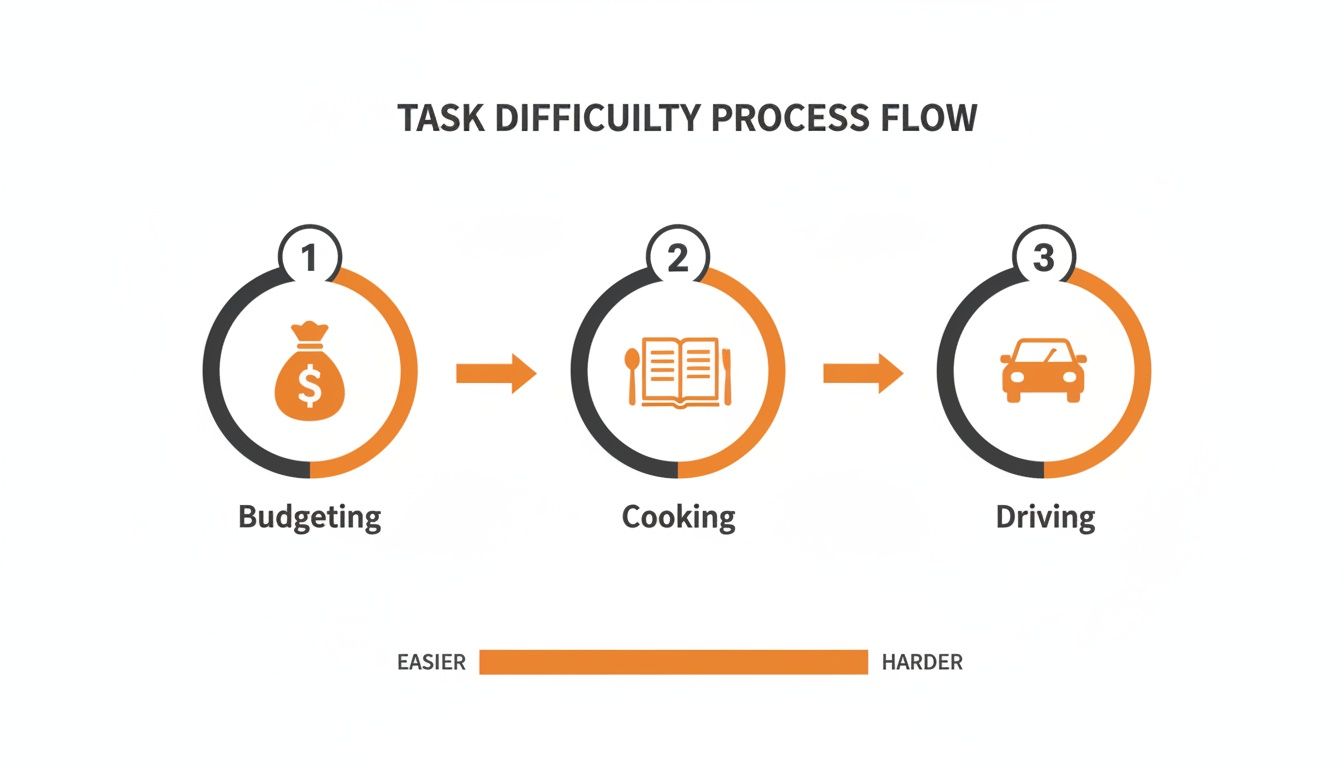
As you can see, complex tasks like budgeting or driving—the ones that rely heavily on executive function—are often where the first functional signs of dementia emerge. Your notes can capture this perfectly.
Step 2: Schedule and Prepare for a Doctor's Visit
With your detailed notes in hand, book an appointment with a primary care physician. This first visit is an essential screening step to rule out other treatable conditions that can mimic dementia, from vitamin deficiencies to medication side effects.
Actionable Insight: When you call the clinic, say, "We'd like to book a longer appointment to discuss some recent cognitive and behavioural changes." This ensures you'll have enough time and won't feel rushed.
Prepare for this appointment like you would for an important meeting. Organize your notes, list all medications and supplements, and write down your top questions ahead of time. This ensures you make the most of every minute.
This is also a good time to start thinking about practical legal preparations, such as understanding Power of Attorney essentials, to ensure future care needs are met.
Step 3: Introduce Objective Cognitive Screening
Your personal observations are powerful, but pairing them with objective data makes your case even stronger. This is where modern cognitive screening tools can be incredibly helpful in your conversation with the doctor.
Tools like Orange Neurosciences’ OrangeCheck provide a fast, evidence-based snapshot of cognitive function. Now, it's critical to understand that this is not a diagnostic tool. It absolutely cannot tell you if someone has dementia.
What it can do is provide a valuable baseline measurement of key cognitive domains. Think of it like a blood pressure reading at a check-up; it gives the doctor objective data to help determine if a full workup is warranted. You can learn more in our guide to cognitive screening tests for dementia.
This approach helps transform your subjective concerns into a more complete, data-informed picture for the clinical team, empowering a more productive conversation. Visit our website to see how these tools can support your journey.
Common Questions About Early Dementia Signs
When you first notice something might be off with a loved one, a wave of questions is bound to follow. Figuring out what to do next can feel overwhelming. This is where we can help, by offering clear, practical answers and actionable insights.
What Is the Difference Between Mild Cognitive Impairment and Early Dementia?
This is one of the most critical distinctions. Think of Mild Cognitive Impairment (MCI) as a middle ground. It's a noticeable dip in memory or thinking that's more than typical aging, but it’s not yet severe enough to derail someone's independence.
Practical example: Someone with MCI might often forget appointments but can still manage their finances and personal care. The challenges are concerning, but they haven't crossed the line into preventing them from living their day-to-day life.
Early-stage dementia, on the other hand, is defined by crossing that very line. The cognitive decline becomes significant enough to interfere with everyday activities. For example, a person might not just forget appointments but also get lost driving on familiar streets or find it impossible to keep up with a conversation.
The key difference is the impact on daily functioning. While not everyone with MCI develops dementia, it's a major risk factor, making early assessment essential.
Can Stress or Other Health Issues Mimic Dementia?
Yes, absolutely—and this is why a doctor's visit is non-negotiable. A whole host of completely treatable conditions can create symptoms that look alarmingly like early dementia. You should never try to diagnose this on your own.
Common culprits that can cause "brain fog" or memory problems include:
Nutritional Deficiencies: A lack of Vitamin B12 is a well-known cause.
Thyroid Problems: Both an underactive and overactive thyroid can disrupt brain function.
Infections: A urinary tract infection (UTI), especially in older adults, can trigger sudden confusion.
Medication Side Effects: A new prescription can easily lead to dementia-like symptoms.
Actionable Insight: Before the doctor's appointment, make a complete list of every single medication, vitamin, and supplement your loved one takes. This is one of the first things a doctor will review to rule out these other causes.
What Should I Do if My Loved One Refuses to See a Doctor?
This is an incredibly common—and difficult—situation, often rooted in fear or denial. A confrontational approach rarely works. Arguing will likely make them dig their heels in even more.
Actionable Strategy: Focus on a specific, solvable problem. Instead of saying, "I think you have dementia," try a gentler approach like, "I've noticed you seem to be having more trouble with your balance lately, and I'm worried you might fall. Let's just get it checked out to be safe."
By framing the visit around a less threatening issue like balance, hearing, or just reviewing their medications, you open a door that might otherwise have been slammed shut. If they still refuse, try bringing another trusted family member or friend into the conversation.
How Can I Best Prepare for a Doctor's Visit?
To get the most out of any appointment, you need to go in prepared. Your organized observations give the doctor invaluable clues. Think of yourself as a detective gathering evidence.
Here’s a practical checklist to guide you:
Bring Your Notes: Compile your log of specific examples—what happened, when it happened, and the context.
List All Medications: This means everything—prescriptions, over-the-counter drugs, vitamins, and any herbal supplements.
Document Their Medical History: Note any major illnesses, surgeries, or ongoing conditions.
Prepare Your Questions: Write down your biggest concerns ahead of time so you don't forget anything.
This preparation helps the doctor see the full picture. For more information on assessment methods, our guide on finding an online test for dementia offers additional insights.
Navigating the early signs of dementia is a journey that requires patience, observation, and action. If you're a clinician or caregiver looking for reliable data to inform your next steps, Orange Neurosciences provides evidence-based cognitive assessment tools to help create a clearer picture of cognitive health. Explore our platform at https://orangeneurosciences.ca or subscribe to our newsletter for ongoing, actionable advice to support your work.

Orange Neurosciences' Cognitive Skills Assessments (CSA) are intended as an aid for assessing the cognitive well-being of an individual. In a clinical setting, the CSA results (when interpreted by a qualified healthcare provider) may be used as an aid in determining whether further cognitive evaluation is needed. Orange Neurosciences' brain training programs are designed to promote and encourage overall cognitive health. Orange Neurosciences does not offer any medical diagnosis or treatment of any medical disease or condition. Orange Neurosciences products may also be used for research purposes for any range of cognition-related assessments. If used for research purposes, all use of the product must comply with the appropriate human subjects' procedures as they exist within the researcher's institution and will be the researcher's responsibility. All such human subject protections shall be under the provisions of all applicable sections of the Code of Federal Regulations.


© 2026 by Orange Neurosciences Corporation