A Guide to the Sage Test for Dementia Screening
Mar 6, 2026
The SAGE test for dementia is a straightforward, self-administered screening tool anyone can use to check for early signs of memory and thinking problems. It’s a simple, pen-and-paper exam you can take right at your kitchen table, giving you a quick snapshot of your brain health that you can then discuss with your doctor.
Why Early Dementia Screening Matters
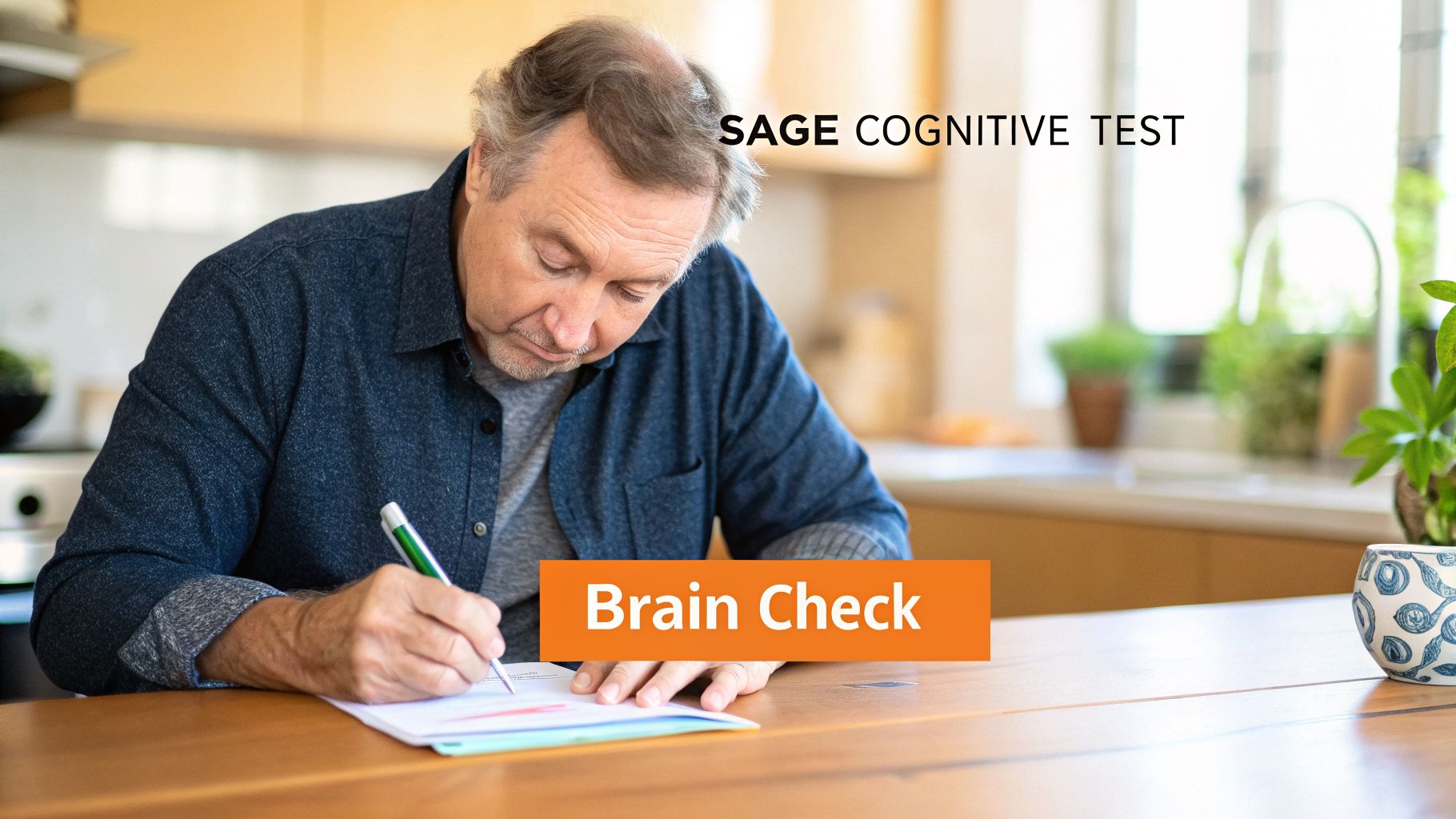
It’s all too easy to brush off small memory slips—misplacing keys again, forgetting a familiar name—as just a normal part of getting older. But sometimes, these little moments can be the first whispers of a deeper cognitive change. This is where the Self-Administered Gerocognitive Exam, or SAGE test, comes in as an accessible first step toward proactively managing your brain health.
Developed at The Ohio State University, this free assessment helps pinpoint subtle thinking issues that might otherwise fly under the radar. It's a powerful way to catch the initial signs of conditions like Mild Cognitive Impairment (MCI) or the earliest stages of dementia. You can learn more about the crucial differences between these conditions in our guide on https://www.orangeneurosciences.ca/guide/mild-cognitive-impairment-vs-dementia.
The 'Check Engine' Light For Your Brain
A great way to think about the SAGE test is as a 'check engine' light for your brain. When that light pops on in your car, it doesn’t spell out the exact problem. It just tells you it's time to see a mechanic. The SAGE test works in much the same way; it doesn't give you a diagnosis.
Instead, it offers a clear, objective signal that it’s time to consult a healthcare professional. It transforms vague concerns into actionable data, empowering you and your family to take control of your cognitive wellness.
This simple step helps remove the guesswork and anxiety that often go hand-in-hand with noticing cognitive changes. Rather than worrying in silence, you now have a concrete starting point for a productive conversation with your doctor.
Taking Proactive Steps With SAGE
Using a tool like the SAGE test is an act of empowerment. To really grasp why early detection is so critical, it’s helpful to get familiar with the 10 early signs of memory loss. When you know what to look for, you can better appreciate the value of a screening tool like SAGE.
By taking this simple test once a year, you can build a personal baseline and keep an eye on your cognitive health over time. For example, if your score is 19 this year and 18 next year, that stability is reassuring. But if it drops to 16, that's a clear, actionable signal to discuss with your doctor. This proactive approach is key for early intervention and effective long-term planning, setting the stage for a more informed and controlled health journey.
How the SAGE Test Works and What It Measures
The SAGE test is brilliantly straightforward by design. It's a simple pen-and-paper exam you can complete on your own in about 15 to 20 minutes, without any help. Think of it less like a scary medical test and more like a focused brain puzzle. Its goal is to give you a quick, clear snapshot of your cognitive health.
Its main job is to check several key areas of brain function all at once. In doing so, it can catch subtle changes that you might not even notice in your day-to-day life. The SAGE test provides a structured way to turn vague worries into concrete information that you can then discuss with your doctor.
Key Cognitive Areas the SAGE Test Assesses
Don't mistake the SAGE test for a simple memory quiz. It's a well-rounded tool that looks at a wide range of cognitive skills. Every question is carefully designed to probe a specific mental function, which is how it builds such a complete picture of your brain's performance.
Here are the main areas the SAGE test digs into, with practical examples:
Orientation: This is all about your awareness of your place in time. For example, a question might simply ask you to write down the current date, month, and year.
Language Skills: This covers your ability to name things and your verbal fluency. You might be asked to identify pictures of common objects or, as an actionable task, to list as many animals as you can in one minute.
Visuospatial Abilities: This area looks at how well you can understand and organise visual information. The classic example is the clock-drawing task, where you have to draw a clock, put in all the numbers, and set the hands to a specific time, like ten past eleven.
Executive Function: This is your brain's command centre, handling things like problem-solving, planning, and reasoning. A task might involve a simple math problem or a question that asks you to find a similarity between two items (like, "How are a watch and a ruler similar?").
Memory: The test looks at both your ability to recall information immediately and after a delay. For instance, you could be asked to remember a short list of words, then recall them later in the test after you've worked on other questions.
To get a better sense of how these different skills are measured in a professional setting, you can read our overview of other clinical cognitive assessments.
Why Are There Different Versions of the Test?
One of the cleverest parts of the SAGE test is that it comes in four different, interchangeable versions. This isn't just to keep things interesting; it's essential for getting accurate results over time. If you took the exact same test every single year, you'd naturally start to remember the answers. This is called a "practice effect," and it would make the results less reliable.
By having four different but equally challenging forms, the SAGE test makes sure each screening is a true measure of your cognitive function—not just your memory of the test itself. This is what allows for dependable tracking of any changes over the years.
This approach gives your doctor a much clearer picture of whether your cognitive abilities are holding steady or if there's a trend that needs a closer look.

Actionable Insight: Download one of the four versions from the official Ohio State University website. Take it this week, and then set a calendar reminder to take a different version one year from now. This creates an easy, repeatable system for monitoring your brain health.
A Practical Guide to Taking and Scoring the SAGE Test
Taking the SAGE test for dementia is a simple, proactive step anyone can take right in the comfort of their own home. The process itself is very straightforward, but a few key details will make sure the results are as helpful as possible when you bring them to your doctor.
Think of it as preparing a clear snapshot of your current cognitive health.
First, you'll need to download and print one of the four available SAGE test forms. Once you have it in hand, find a quiet, well-lit space where you can focus without any interruptions for about 15 to 20 minutes. To get a true picture of your abilities, it's really important that you complete the test entirely on your own, without any help from friends or family.
How to Complete the Test
Completing the SAGE test isn't about getting a perfect score—it's simply about doing your best. There's no time limit, so you can work at a pace that feels comfortable for you. The questions involve tasks like drawing, naming items, solving basic problems, and doing simple math.
Here’s a quick, actionable guide to get started:
Set the Scene: Get comfortable at a table or desk. For example, sit in your kitchen after breakfast when the house is quiet. Make sure the TV is off and your phone is on silent.
Work Through It: Start from the beginning and answer each question to the best of your ability. If you find yourself stuck on a question, just move on to the next one.
Be Honest: Remember, the goal is to capture a genuine snapshot of your cognitive function right now. Don't look up answers or ask for hints.
Once you’ve finished all four pages, your part is done. But the next step is the most important one, and it requires a professional.
Why a Doctor Must Score Your SAGE Test
This is a point we can't stress enough: you cannot and should not score the SAGE test yourself. While it’s designed to be self-administered, it is absolutely not self-scored. Proper interpretation requires clinical judgment and a deep understanding of cognitive health that only a qualified healthcare professional brings to the table.
Your doctor will look beyond just the final number. They’ll factor in your age, education level, and overall health to understand what the results truly mean for you. Trying to score it at home can easily lead to needless anxiety or a false sense of security.
The real value of the SAGE test is unlocked when it becomes a conversation starter with your physician. It turns your own observations and concerns into an objective piece of data, paving the way for a more productive and informed discussion about your brain health.
Understanding the SAGE Scoring System
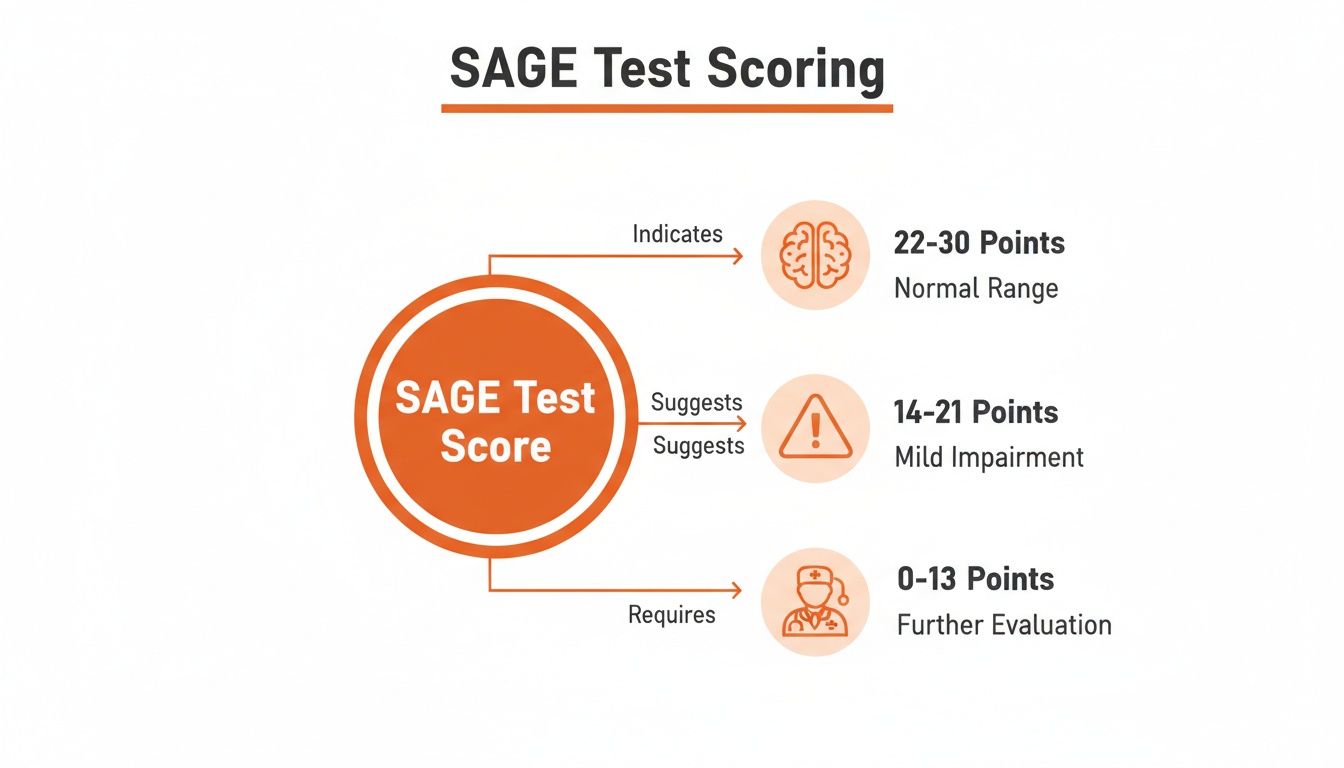
When your doctor scores your completed test, they'll tally up a total out of a possible 22 points. This score helps them place your cognitive function into one of three general categories. It's helpful to think of these scores not as a final diagnosis, but as guideposts pointing you toward the right next steps.
For a clearer picture of how SAGE scores relate to other common cognitive tools, you can check out our detailed guide on MMSE scoring and interpretation.
Below is a table that breaks down what the scores generally mean.
SAGE Test Score Interpretation Guide
Score Range (out of 22) | General Interpretation | Recommended Next Step (Actionable Insight) |
|---|---|---|
17–22 | Likely Normal Cognitive Function: Your score is within the typical range. | Action: Schedule your next annual check-up and plan to take a different version of the SAGE test a week before your appointment. |
15–16 | Possible Mild Cognitive Impairment (MCI): Your score may suggest early, subtle changes. | Action: Book an appointment with your doctor specifically to discuss these results. Bring the completed test with you. |
14 or below | Potential for a More Significant Issue: This score indicates a higher likelihood of a cognitive problem. | Action: Call your doctor's office immediately to schedule a comprehensive evaluation. This is a priority. |
Ultimately, the most important action you can take after finishing the test is to book that appointment. Bringing your completed SAGE form to your physician is the bridge from screening to understanding, empowering both of you to make informed decisions.
When it comes to screening for cognitive changes, three names usually come up: the SAGE test, the Mini-Mental State Examination (MMSE), and the Montreal Cognitive Assessment (MoCA). They all measure cognitive function, but they're built for very different purposes. Knowing which is which is key for anyone looking to monitor brain health.
The biggest difference boils down to one simple question: who takes the test? The SAGE test for dementia was specifically created so you can take it yourself. This is a huge advantage. It means you can complete it in a familiar, comfortable place like your kitchen table, which often helps lower any anxiety and makes it easier to take that first proactive step.
On the other hand, both the MMSE and the MoCA must be given by a trained healthcare professional. This means they're strictly for clinical settings, like a doctor's office, a memory clinic, or a hospital. Right away, this puts SAGE in a category of its own as a uniquely accessible tool.
The Home Monitor vs. The In-Clinic Test
Here's a practical analogy to understand the difference:
The SAGE test is like having a blood pressure cuff at home. It’s an easy-to-use tool that gives you a quick snapshot. You can use it for routine monitoring and bring the results to your doctor. The MMSE and MoCA are more like the detailed EKG and stress tests a specialist runs in the clinic after your home readings suggest something might be off.
SAGE results are really meant to help guide what comes next, clarifying if everything looks fine or if it’s time to book an appointment for a more formal evaluation.
Where Do the MMSE and MoCA Fit In?
While SAGE is a fantastic starting point, the MMSE and MoCA are the gold-standard tools clinicians turn to for in-office assessments. The MMSE is one of the oldest and most recognized screeners in the world. It’s quick—taking only about 5 to 10 minutes—and gives a general overview of a person's cognitive status.
The MoCA, however, is widely seen as being more sensitive, particularly when it comes to detecting Mild Cognitive Impairment (MCI). It digs a bit deeper across a wider range of cognitive skills, designed to catch subtle issues that the MMSE might not pick up. We have a much more detailed comparison in our guide to MoCA vs MMSE.
Key Differences at a Glance
This table helps lay out the core distinctions and shows why each test has a specific role to play in the journey of cognitive assessment.
Feature | SAGE Test | MMSE (Mini-Mental State Exam) | MoCA (Montreal Cognitive Assessment) |
|---|---|---|---|
Administration | Self-administered (at home) | Clinician-administered (in-clinic) | Clinician-administered (in-clinic) |
Primary Use | Initial, proactive screening | General cognitive screening | Sensitive screening for MCI |
Accessibility | Free, online, no appointment needed | Requires a clinical appointment | Requires a clinical appointment |
Actionable Insight | Empowers you to monitor health from home and start a doctor conversation. | Provides a baseline score in a clinical setting. | Offers a more detailed clinical analysis to guide further testing. |
Ultimately, the best test is the one that fits the immediate need. If you want a simple, proactive way to keep an eye on your brain health from home, SAGE is an excellent choice. But for clinicians who need to follow up on a concern with a formal assessment, the MMSE or MoCA are the trusted tools of the trade.
What Happens After Taking the SAGE Test
Finishing the SAGE test is a fantastic first move, but what you do next is what really counts. When you bring the completed test to your doctor, that score isn't a diagnosis—not by a long shot.
Think of it more like an important clue. It gives your physician a clear, objective place to start a much deeper conversation about your cognitive health. This is where the real work begins.
The First Step: A Comprehensive Clinical Evaluation
If your score on the SAGE test for dementia points to potential cognitive changes—usually a score of 16 or lower—your doctor won't just stop there. They'll kick off a full evaluation to get a complete picture of your health. The goal is to rule out other conditions that might be masquerading as cognitive impairment.
This evaluation is pretty thorough and typically includes:
A Detailed Patient History: Actionable Tip: Before your appointment, jot down specific examples of memory lapses, like "I forgot my neighbor's name last Tuesday" or "I struggled to follow the plot of my favorite TV show."
A Full Physical and Neurological Exam: This helps spot any other health problems that could be playing a role in your cognitive symptoms.
Standard Lab Work: Simple blood tests are a must. They can reveal issues like a vitamin B12 deficiency, thyroid problems, or even infections, all of which can mess with memory and thinking.
Neuroimaging Scans: Sometimes, an MRI or CT scan of the brain is needed to look for structural changes, evidence of a stroke, or other abnormalities.
The Power of Serial Testing: Tracking Changes Over Time
One of the most effective ways to use the SAGE test isn't as a one-off assessment, but as a tool for ongoing monitoring. We call this serial testing, where a person takes the SAGE test every year to establish their own personal cognitive baseline.
It’s just like tracking your blood pressure or cholesterol levels over the years. A single reading gives you a snapshot, but seeing the numbers over time shows you the trend.
For example: If a patient scores 18 one year and 17 the next, that's stable. But if the next year they score 15, that drop of two points is a major red flag for a clinician, even if 15 is only "possible MCI." This subtle downward shift can be the earliest warning sign, prompting a closer look long before a more obvious problem surfaces.
This method of consistent, data-driven check-ins is the cornerstone of proactive brain health. It offers objective proof that can help guide timely interventions and future care planning. In communities facing a high dementia burden, this kind of proactive screening is absolutely essential.
For instance, Orange County is facing an acute dementia crisis. Recent estimates show that over 164,000 people there are living with dementia or mild cognitive impairment. This local reality underscores the urgent need for accessible tools like the SAGE test to help with early detection. You can learn more about this pressing issue in this report on Orange County's dementia statistics.
Connecting Screening to Personalized Care
Ready to take control of your cognitive health journey? The SAGE test provides the "what," but you need the "what next." That's where targeted tools come in. By turning a subjective worry ("I feel like my memory is slipping") into objective data, the SAGE test takes the guesswork out of managing cognitive health.
This information becomes the solid ground on which more advanced tools can build, delivering the precision needed for effective, personalized support. The next step is to transform these insights into action. Visit our website to see how Orange Neurosciences provides the data-driven assessments and targeted tools you need to move from screening to strengthening your brain health.
Beyond Screening: Taking Action for Your Brain Health

Taking a tool like the SAGE test for dementia is a fantastic first step in taking charge of your cognitive health. But the real work begins after you get your score. This isn't the end of the journey; it’s the beginning of a new, proactive chapter.
Think of your SAGE score as the "you are here" marker on a map of your brain health. Now, you get to decide which path to take forward.
Building a Brain-Healthy Lifestyle
So, how do you move from simply screening to actively caring for your brain? It comes down to weaving specific, science-backed habits into your daily life.
Here are a few powerful, actionable places to start:
Get Moving Consistently: Practical Example: Park at the far end of the grocery store lot, take the stairs instead of the elevator, or go for a 20-minute walk after dinner. Aim for at least 150 minutes of moderate exercise weekly.
Eat for Your Brain: Practical Example: Add a handful of spinach to your eggs, swap a sugary snack for a handful of walnuts and blueberries, and try to eat fish like salmon twice a week.
Stay Social: Practical Example: Schedule a weekly coffee date with a friend, join a local book club, or volunteer for a cause you care about.
Challenge Your Mind: Practical Example: Instead of watching TV, spend 15 minutes learning a new language on an app, doing a Sudoku puzzle, or watching a documentary on a topic you know nothing about.
Engaging in these kinds of supportive habits is key. This can even include exploring practical memory care activities that are specifically designed to support and stimulate the mind.
From Screening to Strengthening with Orange Neurosciences
Lifestyle changes are the foundation, but modern technology allows us to be much more precise. The SAGE test is great for flagging a potential issue. At Orange Neurosciences, we provide the tools to address those issues head-on.
Our platform is the logical next step. It’s one thing to know a cognitive area might be weak; it's another to know exactly why and what to do about it. Our advanced digital solutions, OrangeCheck and ReadON, do just that—they pinpoint the specific nature of the weakness and deliver personalized therapy to strengthen it.
This is the difference between knowing there's an issue and having a targeted plan to fix it. Our AI-driven platform creates a personalized program of engaging, game-based exercises designed to build strength in the very cognitive areas the SAGE test screens.
Ready to move from screening to strengthening? For a deeper dive into effective strategies, check out our guide on how to improve cognitive function. To see exactly how our platform can provide you with data-driven insights and targeted therapy, visit our website today.
Getting to Grips with the SAGE Test: Your Questions Answered
It's completely normal to have questions when you first come across a health tool like the SAGE test. Let's walk through some of the most common ones we hear, with actionable advice.
Can I Score the SAGE Test Myself?
No, and this is probably the most important point to understand. While you can easily take the test on your own from the comfort of your home, it absolutely must be scored and interpreted by a qualified healthcare professional.
Actionable Insight: Once you finish the test, don't try to guess your score. Instead, put the completed papers in an envelope and label it "For Doctor's Appointment." Call and schedule your appointment that same day so the momentum isn't lost.
Does a Low SAGE Score Mean I Have Dementia?
Let me be clear: absolutely not. A low score on the SAGE test is not a diagnosis of dementia. It’s crucial to see SAGE for what it is—a screening tool, not a final verdict.
Think of it like a smoke alarm. The alarm doesn't mean the house is burning down, but it does signal that you need to check for a fire. A low score is simply an alert that a more thorough evaluation by an expert is a good idea. It’s the beginning of a conversation with your doctor, not the end of one.
Many other things can impact a score, from vitamin deficiencies and medication side effects to stress or a bad night's sleep.
How Often Should I Take the SAGE Test?
For many older adults, or anyone with concerns about their cognitive health, doctors often suggest taking the SAGE test about once a year. This helps establish a personal baseline, allowing you and your doctor to track your cognitive function over time.
Actionable Insight: Pick a memorable date each year, like your birthday or the first day of spring, as your "annual brain health check-in day." Put a recurring event in your calendar to download and take a new version of the SAGE test. This turns a one-time action into a sustainable habit.
Ready to move from initial screening to a more detailed understanding of your cognitive profile? Orange Neurosciences offers advanced, AI-powered tools that provide precise cognitive assessments and personalized, game-based therapy. Visit https://orangeneurosciences.ca to discover how our platform can help you take the next step in strengthening your brain health.

Orange Neurosciences' Cognitive Skills Assessments (CSA) are intended as an aid for assessing the cognitive well-being of an individual. In a clinical setting, the CSA results (when interpreted by a qualified healthcare provider) may be used as an aid in determining whether further cognitive evaluation is needed. Orange Neurosciences' brain training programs are designed to promote and encourage overall cognitive health. Orange Neurosciences does not offer any medical diagnosis or treatment of any medical disease or condition. Orange Neurosciences products may also be used for research purposes for any range of cognition-related assessments. If used for research purposes, all use of the product must comply with the appropriate human subjects' procedures as they exist within the researcher's institution and will be the researcher's responsibility. All such human subject protections shall be under the provisions of all applicable sections of the Code of Federal Regulations.


© 2026 by Orange Neurosciences Corporation