Mild Cognitive Impairment vs Dementia: Key Differences and Actionable Steps
Nov 5, 2025
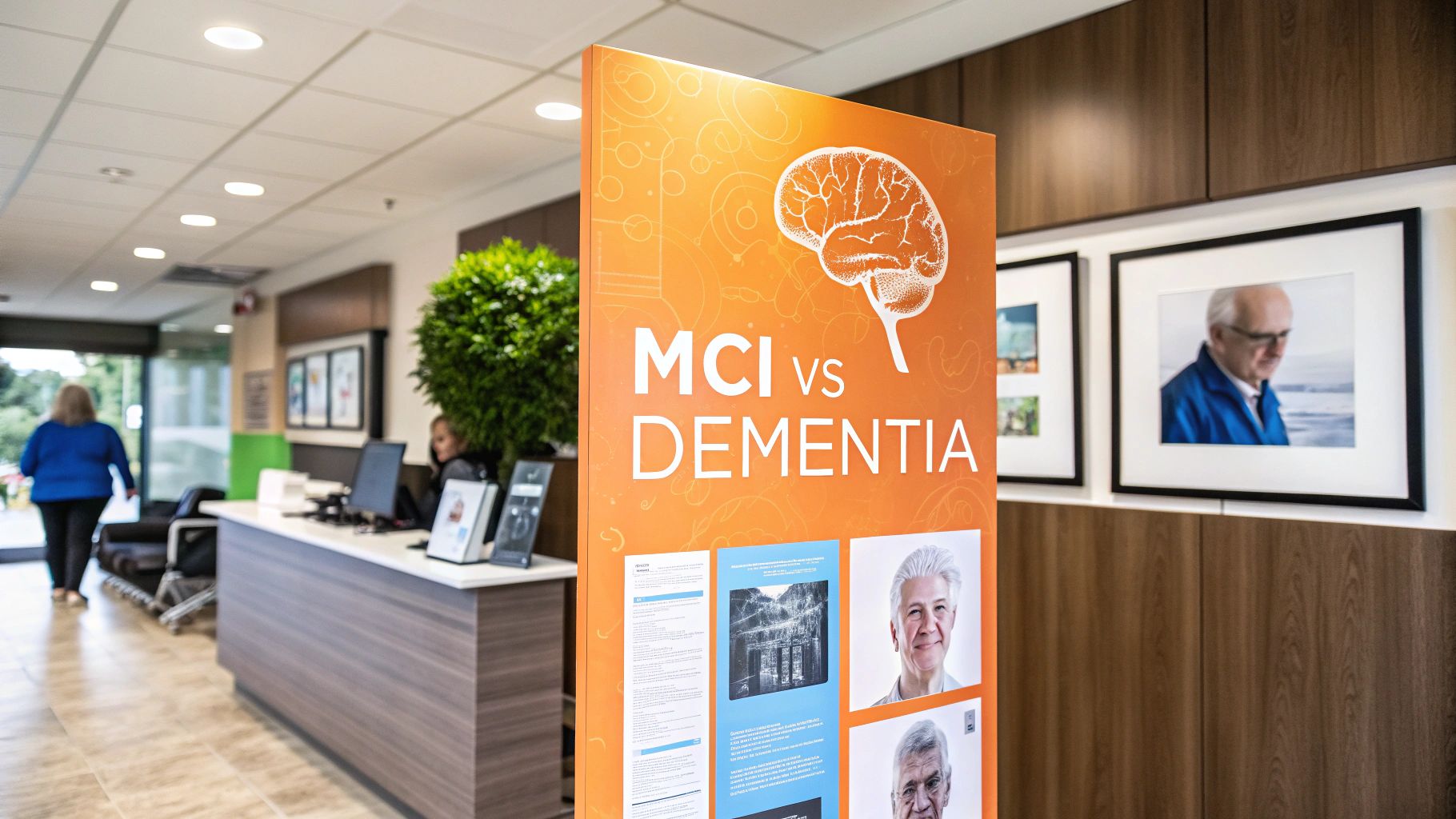
The real line in the sand between Mild Cognitive Impairment (MCI) and dementia boils down to one crucial thing: daily independence. Someone with MCI will notice cognitive changes, absolutely, but they can still manage their day-to-day life. For example, they might forget a friend's name during a conversation but remember it later. Dementia, on the other hand, marks a decline so significant that this independence starts to slip away, like being unable to follow a simple recipe they've used for years.
Understanding the Core Differences at a Glance
It’s easy to get confused. Both MCI and dementia involve shifts in thinking and memory, which can make them hard to tell apart at first glance. But the true differentiator is how much these changes impact a person's ability to live autonomously. Getting this distinction right is the first step toward understanding what might be early signs of what is cognitive decline and finding the right path forward.
Think of Mild Cognitive Impairment as a middle ground—somewhere between the normal forgetfulness that comes with age and a more serious cognitive loss. A person with MCI might forget the details of a conversation they just had but will probably remember it later if you give them a little prompt. A practical example is forgetting an appointment but remembering it when a reminder pops up on their phone. They can still manage their finances, drive, and live on their own, even if those tasks feel a bit more demanding than they used to.
Dementia is a different story. It’s a broad term for a collection of symptoms stemming from various underlying diseases, like Alzheimer’s. A person with dementia might not just forget the details of that conversation; they might not remember it ever happened, no matter the cues. Their cognitive struggles become severe enough to compromise their safety and ability to handle daily essentials. For instance, they might struggle to get dressed appropriately for the weather or forget to pay bills entirely, leading to serious consequences.
Quick Comparison MCI vs Dementia
To make it clearer, here’s a straightforward, side-by-side look at the key differences. This table gives a quick snapshot before we dive deeper into each aspect.
Feature | Mild Cognitive Impairment (MCI) | Dementia |
|---|---|---|
Daily Functioning | Independent with daily activities; may need help with complex tasks but basic self-care is fine. | Impaired daily functioning; requires assistance with basic activities like dressing, eating, or meds. |
Memory | Forgets appointments or recent events but often remembers later or with prompts. | Significant memory loss, especially for recent events; may forget names of close family. |
Progression | May remain stable for years, improve, or progress to dementia. It is a major risk factor. | A progressive decline in cognitive function that worsens over time, leading to greater dependence. |
Recognizing these distinctions is the first, most important step toward getting the right support. MCI is a major precursor to dementia, and its prevalence is a growing concern for cognitive health in older adults.
Recent studies show that roughly 15% to 22% of adults in the United States experience MCI. Of those individuals, about 10% to 15% go on to develop Alzheimer's disease each year, which really underscores why catching it early is so critical.
Defining the Two Stages of Cognitive Change
To really get to the heart of the difference between mild cognitive impairment and dementia, we need to look at each condition in a real-world context. They aren’t the same thing, but rather two distinct points along a spectrum of cognitive health. Knowing where one ends and the other begins is the key to getting the right help at the right time.
What Is Mild Cognitive Impairment?
Think of Mild Cognitive Impairment (MCI) as the space between the normal, age-related forgetfulness we all experience and the more serious decline of dementia. It's a noticeable shift in someone's thinking abilities, but it doesn't take away their ability to live independently.
For instance, someone with MCI might struggle to find the right word in a conversation. They might pause and feel frustrated, but they can still follow along and contribute. Or maybe they forget an appointment, but a quick reminder brings it back to mind.
The crucial point here is that while thinking and memory tasks get harder, the person can still manage their day-to-day life. They can still cook their meals, drive, handle their finances, and enjoy their social life, even if it all takes a bit more effort than it used to.
What Is Dementia?
On the other hand, dementia isn't one single disease. It’s a broad term for a collection of symptoms severe enough to strip away a person's independence. These symptoms are driven by underlying diseases that damage the brain, with Alzheimer's being the most common culprit.
Here, the changes are no longer small stumbles; they're significant roadblocks. A person with dementia might not just struggle for a word—they may lose the entire thread of a conversation. Forgetting an appointment isn't a simple lapse; they might not remember making it at all. A practical example is finding it impossible to navigate a familiar grocery store or forgetting how to use the coffee maker.
This distinction is vital for understanding how cognitive decline unfolds. Data from California nursing homes in 2014 revealed that while 40.7% of residents had mild or no cognitive issues, 23% had moderate impairment, and a staggering 36.3% had severe impairment or dementia. This tells us a huge number of older adults are navigating these changes, many starting in that MCI phase.
The defining feature of dementia is the loss of functional independence. As the condition advances, people need more and more help with basic daily activities, such as:
Getting dressed and grooming
Preparing meals and eating
Managing their medications and finances
Staying safe in their own home
This steady loss of autonomy is the clearest clinical difference between mild cognitive impairment and dementia. A proper diagnosis involves a deep dive into cognitive function, often using specific assessment tools. To get a better sense of how this works, you can explore our detailed guide on the Montreal Cognitive Assessment instructions, a key tool in these evaluations.
Ultimately, if MCI is a "yellow light"—a warning sign—then dementia is the "red light." It signals that brain changes have begun to fundamentally alter a person's ability to navigate the world on their own. Recognizing that difference is the first step toward the right diagnosis, support, and care plan.
Comparing the Day-to-Day Impact
Knowing the clinical definitions is a good start, but what really matters is seeing how mild cognitive impairment versus dementia shows up in daily life. This is where the distinction becomes crystal clear. The real difference is the degree to which these cognitive shifts start to interfere with a person’s independence.
Let's walk through what these impacts look like in tangible, real-world situations. This breakdown should help you recognize the subtle—but critical—signs, whether you're noticing them in yourself or a loved one.
Memory Lapses and Recall Ability
Memory is usually the first thing people notice, but the type of memory lapse is what separates MCI from dementia. It’s not just about forgetting something; it’s about whether that memory can ever be found again.
Someone with Mild Cognitive Impairment (MCI) might forget a recent chat or where they left their keys. But with a gentle prompt—like, "Remember when we talked about the grandkids' soccer game yesterday?"—the memory often clicks back into place. The information is still in there; it's just harder to access.
In stark contrast, a person with dementia may have no recollection of the conversation ever happening, even with cues. They might not just misplace their keys but temporarily forget what the keys are even for. The memory isn't just difficult to retrieve; it might be gone for good. This can lead to forgetting the names of immediate family or major life events.
The crucial difference here is retrievability. With MCI, you can often jog the memory with a reminder. With dementia, those memories may be permanently lost, creating significant blanks in their recent history.
Daily Functioning and Independence
This is where the line between MCI and dementia is drawn most clearly. A person's ability to handle everyday life is the true test of their functional independence.
A person with MCI can typically manage their basic self-care—dressing, eating, personal hygiene—without any help. They can live on their own. The struggle begins with more complex tasks, what we call instrumental activities of daily living (IADLs).
Financial Management: Maybe they make a few mistakes balancing a chequebook or find online banking suddenly confusing. An actionable tip is to set up automatic bill payments to reduce the mental load.
Complex Planning: Trying to organize a multi-step event, like a family dinner, can feel completely overwhelming. A practical solution is to use a simplified checklist or ask a family member to help coordinate.
Medication Schedules: They might need a pill organizer or daily reminders to stay on schedule. Using a smartphone app with alarms can be a great support tool.
For someone living with dementia, the challenges move from these complex tasks to the absolute basics. As the condition advances, they need more and more help with fundamental activities of daily living (ADLs). This could mean needing help getting dressed, picking out clothes for the weather, or even remembering to eat. This growing reliance on others for basic survival is what truly signals the shift from MCI to dementia.
Language and Communication Nuances
Communication difficulties also show up in different ways. In MCI, language problems are usually subtle. They're frustrating for the person experiencing them but don't typically derail a whole conversation.
Someone with MCI might have trouble finding the right word—that classic "tip-of-the-tongue" feeling. They might pause for a moment but can usually get their thought out or find another way to say it. They can still follow along and take part in detailed conversations.
With dementia, the breakdown in communication is much more profound. A person might not just forget words but lose their train of thought completely, stopping mid-sentence with no idea what they were talking about. For example, they might start telling a story about their childhood and suddenly switch to talking about the weather without realizing it. They might even use nonsensical words or have a hard time understanding what's being said to them, which often leads to frustration and social withdrawal.
Judgment and Decision-Making
Finally, the ability to make sound judgments is a key cognitive function that helps differentiate MCI from dementia. Impaired judgment can lead to serious safety issues.
With MCI, judgment in everyday scenarios is usually fine. They can still spot a phone scam or know better than to share personal information with a stranger online. Their decision-making might be a bit slower, but their reasoning is still fundamentally sound.
In dementia, poor judgment becomes a major red flag. This can look like:
Making strange financial choices, like giving away large amounts of money to a telemarketer.
Ignoring personal safety by wandering off or leaving the stove on.
Losing social filters and making inappropriate comments in public.
This decline in judgment is a clear sign that the cognitive changes are now interfering with a person's ability to navigate the world safely. Recognizing these patterns is the first step toward finding the right support.
How Doctors Determine a Diagnosis
Telling the difference between mild cognitive impairment and dementia isn't as simple as checking off a few boxes on a form. Instead, doctors conduct a thorough investigation, piecing together a complete picture of a person's cognitive health. This careful, comprehensive approach is the only way to arrive at an accurate diagnosis, which then guides the most effective management plan. The entire process is designed to be systematic, ruling out other possibilities before landing on a conclusion.
The journey almost always starts with a detailed conversation. Doctors will sit down with the individual and their family to build a timeline of the changes they've noticed. They'll ask for specific examples of memory lapses, struggles with problem-solving, or any new difficulties with daily tasks. Hearing from loved ones is especially valuable, as they often pick up on subtle shifts that the person themselves might overlook or downplay.
Initial Cognitive Screening Tools
After the initial chat, a healthcare provider will usually pull out a cognitive screening tool. It's important to remember these aren't diagnostic tests themselves; they're quick assessments designed to spot red flags that signal a deeper look is needed. One of the most common is the MoCA (Montreal Cognitive Assessment), a brief test that touches on different cognitive areas.
The MoCA measures several key functions, including:
Attention and concentration: Can the person stay focused on a task?
Executive functions: How well can they plan and make decisions?
Memory: Are they able to recall a short list of words after a few minutes?
Language skills: Can they name common objects and repeat complex sentences?
Visuospatial abilities: Can they copy a drawing of a cube or draw a clock?
A lower-than-expected score is a strong suggestion that more detailed testing is the next logical step. To get a better feel for the various assessment tools doctors might use, resources like The Dementia Test can offer more context on what to expect during an evaluation.
Deeper Neuropsychological Testing
If those first screenings point to a problem, the next step is often a referral for neuropsychological testing. This is a much more in-depth evaluation run by a specialist and can take several hours to complete. The goal is to create a detailed profile of a person's cognitive strengths and weaknesses, helping to pinpoint the exact nature of the impairment.
This deep dive is crucial. It’s what helps clinicians tell the difference between MCI, early-stage dementia, and other conditions that can look very similar, such as depression or anxiety. For a clearer picture of this process, our guide on what is cognitive assessment offers a complete overview.
Ruling Out Reversible Causes
A critical piece of the diagnostic puzzle for both MCI and dementia is eliminating other medical issues that could be causing the cognitive symptoms. Many things can create a "brain fog" or memory problems that are completely reversible once the real cause is treated.
A core principle in cognitive diagnosis is to first search for what is treatable. Symptoms that look like MCI or dementia can sometimes be caused by vitamin deficiencies, infections, or medication side effects.
To check for these reversible causes, doctors will order a series of tests:
Lab Work: Blood tests are used to check for vitamin B12 deficiencies, thyroid problems, kidney or liver issues, and hidden infections.
Brain Imaging: Scans like an MRI or CT can help spot other potential culprits for cognitive decline, such as a tumour, evidence of a stroke, or a buildup of fluid on the brain.
This infographic helps visualize the core difference between how MCI impacts daily planning versus how dementia affects fundamental cognitive processing.
The image drives home the point that while MCI might complicate tasks, dementia fundamentally alters how the brain functions, fragmenting core abilities. It’s only after this thorough process of interviews, testing, and ruling out other conditions that a doctor can confidently make a diagnosis and recommend the best next steps for managing cognitive health.
Navigating Progression And Management Strategies
A diagnosis of either mild cognitive impairment (MCI) or dementia isn’t the end of the road—it’s the start of a proactive journey. But the paths forward for each are quite different, with distinct goals for maintaining quality of life and cognitive health. Knowing what these strategies look like is the first step toward feeling empowered and in control.
It's so important to remember that an MCI diagnosis is not a guarantee of dementia. While many people with MCI do progress, research shows a significant number remain stable for years. Some even see their symptoms improve, especially if a reversible cause like a vitamin deficiency or medication side effect was behind it.
Proactive Management For Mild Cognitive Impairment
With MCI, the name of the game is risk reduction and optimizing brain health. We’re not so much treating symptoms as we are building a lifestyle that bolsters cognitive resilience. The focus is squarely on actionable, preventative strategies that can potentially delay, or even prevent, a progression to dementia.
This almost always involves a multi-faceted approach to wellness.
Adopting the MIND Diet: This isn't just a trendy diet; it combines the best of the Mediterranean and DASH diets, zeroing in on foods that support brain health. A practical first step is to add a handful of berries to your breakfast and a side of leafy greens to your dinner each day.
Engaging in Regular Physical Activity: Getting your body moving improves blood flow to the brain and has been clearly linked to a lower risk of cognitive decline. The common recommendation is 150 minutes of moderate-intensity exercise each week. Start with a brisk 20-minute walk each day.
Stimulating the Mind: An active brain is a resilient brain. This could mean learning a new instrument, tackling a new language, doing puzzles, or picking up a hobby that really makes you think. An actionable insight is to dedicate 15 minutes a day to a brain-training app or a crossword puzzle.
The core idea behind managing MCI is empowerment. By focusing on things you can actually change—your diet, exercise habits, and how you engage your mind and social circles—you can take an active role in protecting your brain health for the long haul.
These proactive steps can be supercharged with more structured support. Exploring evidence-based cognitive therapies can provide targeted training to help strengthen specific cognitive functions, adding another powerful layer to your MCI management plan.
Comprehensive Care For Dementia
Once a diagnosis shifts to dementia, the management strategy broadens quite a bit. Those healthy lifestyle factors that are key for MCI are still incredibly important, but now the picture expands to include medical interventions, safety measures, and building a robust support system for both the individual and their caregivers. The goal shifts from prevention to managing symptoms and preserving function and independence for as long as possible.
Medications often come into play. Some drugs can temporarily help with cognitive symptoms like memory loss, while others are used to manage behavioural changes like anxiety or agitation that can accompany the condition.
Making the home safer becomes a top priority. Small changes can make a world of difference in preventing accidents and helping a person maintain their independence.
Installing grab bars in washrooms.
Getting rid of trip hazards like loose rugs.
Using automated shut-off devices for the stove.
Making sure the home is well-lit everywhere.
As dementia progresses, the need for a strong support network just gets bigger. This means rallying family, friends, and professional caregivers. Support groups can be an invaluable outlet, offering both emotional solidarity and practical advice for everyone involved. Planning for the future also becomes a critical conversation.
When cognitive decline becomes more pronounced, families often have to think about legal protections. It's wise to start learning about the complexities of establishing guardianship for individuals with Alzheimer’s and dementia to make sure a loved one's well-being and finances are secure. Thinking ahead allows families to make these tough decisions together, reducing stress down the road. Ultimately, managing dementia is a team effort, centered on compassionate care that adapts as a person's needs change.
When and Where to Seek Professional Guidance
It can be overwhelming to know when to seek help for cognitive changes, but taking that first step is a crucial part of protecting your brain health. Trying to figure out what's normal aging versus a more serious issue like mild cognitive impairment or dementia isn't something you should do alone—it truly requires professional insight. If you or someone you care about is dealing with persistent changes, it’s time to act.
So, when is the right time to book that appointment? Certain warning signs are clear signals that it's time to have a conversation with a doctor. These aren't just the occasional memory slips we all have; they are patterns that begin to get in the way of daily life.
Key Warning Signs to Watch For
It's time to consult a healthcare provider if you notice:
Memory loss that disrupts daily life: This isn't just misplacing keys. It's forgetting recently learned information, missing important dates, or asking the same questions over and over. A practical example is a parent calling to ask for the time of a family dinner multiple times in one day.
New challenges with problem-solving: You might see struggles with following a familiar recipe, managing a monthly budget, or concentrating on tasks that used to be straightforward.
Difficulty completing familiar tasks: This could mean finding it hard to drive to a well-known location, remembering the rules of a favourite game, or managing assignments at work.
Withdrawal from social activities: A noticeable pullback from hobbies, social events, or family get-togethers, often because of feeling overwhelmed or embarrassed by cognitive changes.
A proactive approach is your best defense. Consulting a doctor early doesn’t just provide answers; it opens the door to management strategies that can preserve cognitive function and improve quality of life.
Your Next Steps
Once you've decided to get help, a little preparation goes a long way. Start by documenting the specific changes you've noticed. Write down when they started and how often they're happening. This information gives your doctor a clear, detailed history to work with. To support you on this journey, our dedicated team of healthcare providers has developed resources to guide you through the process.
To help you organise your thoughts and observations for a productive doctor's visit, download our free cognitive health checklist from our website. This tool is designed to make sure you cover all the essential points during your consultation. While you're there, sign up for our newsletter for ongoing, expert-backed tips on maintaining your brain health. We are here to empower you with trusted resources.
Common Questions Answered
When you're trying to understand the line between mild cognitive impairment and dementia, a lot of questions come to mind. Let's tackle some of the most common ones to bring a bit more clarity for you and your family.
Can Mild Cognitive Impairment Be Reversed Or Improved?
Yes, in some situations, it absolutely can. This is especially true when the cognitive hiccups are a side effect of another treatable condition.
For instance, if MCI symptoms are traced back to a vitamin B12 deficiency, depression, thyroid issues, or even a reaction to medication, treating that root cause can often bring cognitive function back to normal. Simple but powerful lifestyle adjustments—like a better diet, consistent exercise, and quality sleep—can also make a real difference, sometimes stabilizing or even improving symptoms.
What's The Biggest Difference A Family Member Might Notice?
The one thing that will stand out most to a family member is the impact on daily independence. Someone with MCI might be more forgetful or take a bit longer to manage complex things like finances, but they can still manage their day-to-day life. For example, they might need you to help set up online bill pay, but once it's set up, they can manage.
With early dementia, however, you'll see a shift from simple frustration to a real need for help with routine activities. It could be forgetting how to operate the microwave, needing prompts for getting dressed, or making poor judgment calls that put their safety at risk. That's the clear signal that things have moved beyond forgetfulness and into functional decline.
The most telling sign of the shift from MCI to early dementia is when cognitive lapses begin to compromise a person's ability to live safely and independently, moving beyond simple forgetfulness into a pattern of functional decline.
How Do Lifestyle Factors Like Stress And Sleep Impact Symptoms?
Lifestyle factors play a huge role. Things like chronic stress and poor sleep can either mimic or significantly worsen the signs of both MCI and dementia.
When you're constantly stressed, your brain gets flooded with cortisol, a hormone that can directly interfere with memory and clear thinking. Likewise, when you don't get enough deep sleep, your brain misses its chance to clear out toxins, including the amyloid plaques linked to Alzheimer's disease. An actionable tip is to establish a relaxing bedtime routine, like reading a book or listening to calm music, to improve sleep quality. For someone with MCI, this can reduce "brain fog," while for a person with dementia, it can lessen confusion.
Can A Person Have Both Conditions At The Same Time?
It's less about having both at once and more about a potential progression. MCI is often seen as a transitional stage that can lead to dementia, but a person is diagnosed with one or the other, not both simultaneously. The diagnosis all comes down to the severity of symptoms and how much they impact a person's ability to live independently.
Think of it as a spectrum. A person is diagnosed with MCI when they have a noticeable cognitive decline but can still handle their daily life. If those symptoms progress to the point where they can no longer live safely on their own, the diagnosis would be updated to dementia.
At Orange Neurosciences, we focus on creating precise cognitive assessment tools that give clinicians the objective data they need to understand brain health. Our AI-powered platform is designed to help spot cognitive changes early, paving the way for better-informed care plans. Find out more about our solutions.

Orange Neurosciences' Cognitive Skills Assessments (CSA) are intended as an aid for assessing the cognitive well-being of an individual. In a clinical setting, the CSA results (when interpreted by a qualified healthcare provider) may be used as an aid in determining whether further cognitive evaluation is needed. Orange Neurosciences' brain training programs are designed to promote and encourage overall cognitive health. Orange Neurosciences does not offer any medical diagnosis or treatment of any medical disease or condition. Orange Neurosciences products may also be used for research purposes for any range of cognition-related assessments. If used for research purposes, all use of the product must comply with the appropriate human subjects' procedures as they exist within the researcher's institution and will be the researcher's responsibility. All such human subject protections shall be under the provisions of all applicable sections of the Code of Federal Regulations.


© 2026 by Orange Neurosciences Corporation