A Guide to Taking an Online Test for Dementia
Feb 19, 2026
If you're starting to worry about changes in your memory, an online test for dementia can feel like a good, accessible place to start. Let’s be clear: it is not a diagnosis. Think of it more like using a home blood pressure cuff before a doctor's visit—it gives you some initial information to bring to the conversation and helps you take the first step.
Your First Step in Understanding Cognitive Health

It can be unsettling when you notice little shifts in your memory or thinking. Maybe you're misplacing your keys more than usual or find yourself searching for a familiar name in the middle of a story. It’s moments like these that often lead people to look for answers, and an online test for dementia is a common starting point.
Taking this first step is about moving from a place of worry to a place of action. It arms you with real data, helping to turn vague fears into specific points you can discuss with your doctor. It’s like preparing notes for an important meeting; you’re not making the final decision, but you're getting all the information together for a much more productive talk.
A Starting Point Not a Conclusion
The whole point of these online tools is to screen for potential cognitive changes, not to hand you a life-altering diagnosis. They simply offer a structured way to look at different aspects of how your brain is performing.
For instance, a test might tell you a short story and ask you to recall a few key details minutes later. It's a simple exercise, but it provides a quick snapshot of your short-term memory. This gives you a foundation, helping you frame your concerns in a way a doctor can properly investigate. For more background, you might find our guide on what is cognitive assessment useful.
An online assessment offers a baseline—a private, low-stress way to check in on your cognitive health. The results provide a foundation for a more informed and confident conversation with your healthcare provider.
The growing popularity of these digital tools is part of a much larger trend. In North America, for example, the market for cognitive assessment now holds about 40% of the global market share. This growth, fueled by our advanced healthcare infrastructure and comfort with technology, shows just how much people want accessible ways to keep an eye on their brain health. You can learn more about the cognitive assessment market growth and its drivers.
What an Online Dementia Test Actually Measures
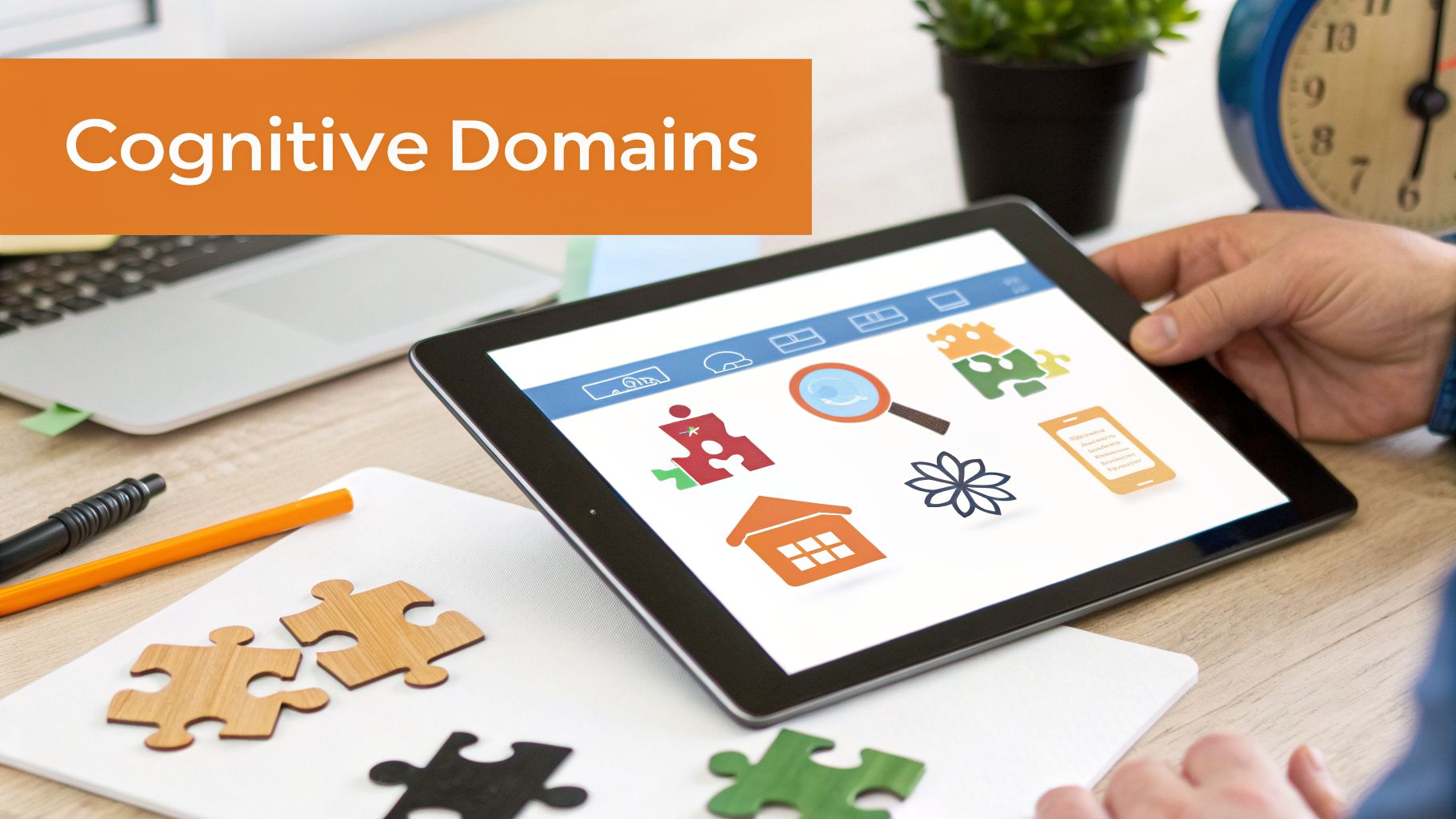
When you take an online dementia test, it’s not just asking you a bunch of random trivia questions. These tools are cleverly designed to look "under the hood" and probe specific areas of your brain's performance.
Think of your brain's different abilities as a team of specialists, each with a very specific job. In the clinical world, we call these job functions cognitive domains. An online screening tool is really just a series of mini-challenges, each one built to see how well a specific specialist on your team is doing its job.
By assessing these different domains, the test starts to build a preliminary picture of your cognitive strengths and weaknesses.
Exploring Key Cognitive Domains
While different tests have their own unique flair, most are built to evaluate a core set of mental functions. You might find yourself doing tasks that feel like simple games or puzzles, but don't be fooled—each one has a very specific purpose. They target key domains to see how efficiently your brain is processing information.
Here are a few of the most common domains these online tests will look at, along with practical examples of how they might show up in your daily life:
Memory: This is much more than just remembering things from the past. It includes your ability to learn new information (learning and recall) and hold details in your mind for a short time (short-term memory). A practical example is being unable to recall what you ate for breakfast this morning, or needing someone to repeat their name just seconds after they’ve introduced themselves.
Executive Function: This is your brain's project manager. It handles planning, problem-solving, and juggling multiple tasks at once. A real-world example of this is struggling to follow a simple recipe or finding it difficult to manage your monthly bills. A test might measure this by asking you to connect a series of numbers and letters in a specific alternating pattern.
Attention and Concentration: This domain covers your ability to zero in on a task while tuning out distractions. For instance, being able to follow a conversation in a noisy restaurant requires sustained attention. If you find yourself unable to finish a newspaper article without your mind wandering, that's a practical sign of a potential issue.
These tests provide a structured, objective way to observe mental processes that can otherwise be hard to pinpoint. They translate subtle, real-world difficulties into measurable data points, offering a clearer starting point for a clinical conversation.
From Puzzles to Performance Data
Other important cognitive areas often pop up in these assessments, too. Things like language skills (like finding the right word when you need it), visuospatial ability (judging distances or recognising shapes), and processing speed (how quickly you can understand and react to what's in front of you) are also critical. Every puzzle, question, or game you encounter is a carefully chosen instrument.
For instance, a task asking you to identify a simple line drawing of an animal measures both your language skills (naming it) and your visual recognition. Another task that asks you to compare two similar but slightly different patterns is testing your attention to detail and processing speed.
This approach offers a much more nuanced look than some traditional paper-based assessments. We dive deeper into this topic in our guide comparing the MoCA vs MMSE cognitive tests.
Ultimately, the goal is to convert your performance on these tasks into a number. This score isn't a diagnosis; it’s an indicator. It gives you and your doctor a baseline understanding of which cognitive areas might need a closer look.
When you start searching for an "online test for dementia," you'll quickly realize it's a crowded field. The options range from simple checklists to sophisticated, game-like experiences, and it’s crucial to understand that not all are built for the same purpose.
Think of it like checking your physical fitness. A quick online quiz asking about your activity levels can give you a general idea, but a fitness watch that tracks your heart rate, sleep patterns, and steps provides much more detailed, objective data. Online cognitive tests work in a similar way—some offer a quick snapshot, while others provide a deep dive.
This variety is by design. The right tool for someone with a passing concern is very different from what a clinician needs to gather detailed data for a patient's file.
Self-Administered Questionnaires
The most straightforward type of online test you'll find is a self-administered questionnaire. Many of these are simply digital versions of classic pen-and-paper tests that have been used for years, like the Self-Administered Gerocognitive Exam (SAGE).
These tests typically guide you through a series of questions or simple tasks on your own. A classic example is the clock-drawing test, which is surprisingly effective at assessing visuospatial skills and executive function. You might be asked to draw a clock face showing a specific time, like "ten past eleven." To see what this simple task can reveal, you can learn more from our detailed guide on tests for dementia like clock drawing.
Format: Digital forms, checklists, and simple interactive tasks.
Purpose: To offer a quick, preliminary check of your cognitive function.
Best For: Individuals who want a basic, private screening to help decide if their concerns are worth discussing with a doctor.
Gamified Cognitive Assessments
A more modern and engaging approach comes in the form of gamified assessments. These platforms use interactive, game-like challenges to measure specific cognitive abilities like memory, attention, and processing speed.
Instead of filling out a form, you might find yourself playing a game that requires you to tap on specific shapes as they appear or remember a sequence of flashing lights. This format often feels less like a test and more like a brain-training exercise, which can make the experience far less intimidating. When looking at these tools, it's important to know what you're getting; for example, this helpful guide to an online ADHD test explains the key differences between a simple screener and a comprehensive diagnostic tool.
Gamified tests turn cognitive measurement into an interactive experience. They capture nuanced data on reaction times and accuracy that static questionnaires often miss, providing a richer, more dynamic snapshot of brain health.
Clinician-Administered and Monitored Platforms
At the most advanced end of the spectrum are platforms built specifically for clinical use, like the tools we develop here at Orange Neurosciences. These aren't just one-off tests. They are comprehensive systems that clinicians use to establish a baseline, monitor cognitive changes over time, and gather the kind of objective data needed to inform a full clinical evaluation.
These platforms offer a level of detail that goes far beyond a basic screener. They measure multiple cognitive domains with scientific precision and generate in-depth reports that help healthcare professionals make better, more informed decisions. This is what bridges the critical gap between a simple online screening and a formal medical diagnosis.
Comparison of Online Cognitive Screening Tools
To help you see the differences at a glance, here’s a quick comparison of the common types of online dementia tests. Understanding their format, purpose, and who they’re best for can help you choose the right path.
Test Type | Typical Format | What It Measures | Best For |
|---|---|---|---|
Self-Administered Questionnaires | Digital forms, checklists, drawing tasks | General cognitive status, memory, visuospatial skills | Individuals wanting a quick, private initial screening. |
Gamified Cognitive Assessments | Interactive games and puzzles | Specific cognitive domains (attention, memory, processing speed) | Users looking for an engaging way to track cognitive skills. |
Clinician-Administered Platforms | Supervised, comprehensive assessments | Multiple cognitive domains with high precision and objective data | Healthcare professionals needing data for evaluation and monitoring. |
Ultimately, the right tool depends entirely on your goal. A simple questionnaire can be a reasonable first step for a personal check-in. But if you need reliable data that can contribute to a meaningful conversation with your doctor, a more robust, scientifically validated platform is essential.
Understanding the Accuracy and Limitations
When you take an online test for dementia, it's so important to have a realistic perspective on what the results actually mean. These tools are fantastic for flagging early changes and giving you a concrete starting point for a conversation with your doctor. They are not, however, a substitute for a professional medical diagnosis.
A good way to think about it is to compare an online test to a smoke detector. It’s designed to alert you to a potential problem, but it can't tell you the source or the size of the fire. For that, you need a professional firefighter—or in this case, a qualified healthcare provider who can conduct a thorough, in-person evaluation.
What Can Affect Your Score
It’s also crucial to realise that your score on any given day can be swayed by all sorts of temporary factors. A single result is just a snapshot in time, not the whole movie. Just like your blood pressure can spike from stress or a strong coffee, your cognitive performance can dip for reasons that have absolutely nothing to do with long-term brain health.
Several outside factors can easily impact your performance:
Poor Sleep: A restless night can seriously mess with your focus and memory the next day.
Stress or Anxiety: Feeling worried or overwhelmed makes it incredibly difficult to concentrate on the test's tasks.
Medication: Certain medications, even common over-the-counter ones, can cause temporary brain fog.
Technical Issues: A slow computer or an unstable internet connection can throw off your timing and drag down your score.
An online test for dementia is a screening tool, not a diagnostic one. Its real purpose is to flag potential concerns that deserve a closer look, giving you a valuable piece of data to bring to your doctor.
This is where understanding the different types of online tests comes in handy. They range from simple questionnaires to professional-grade assessments, each serving a different purpose.
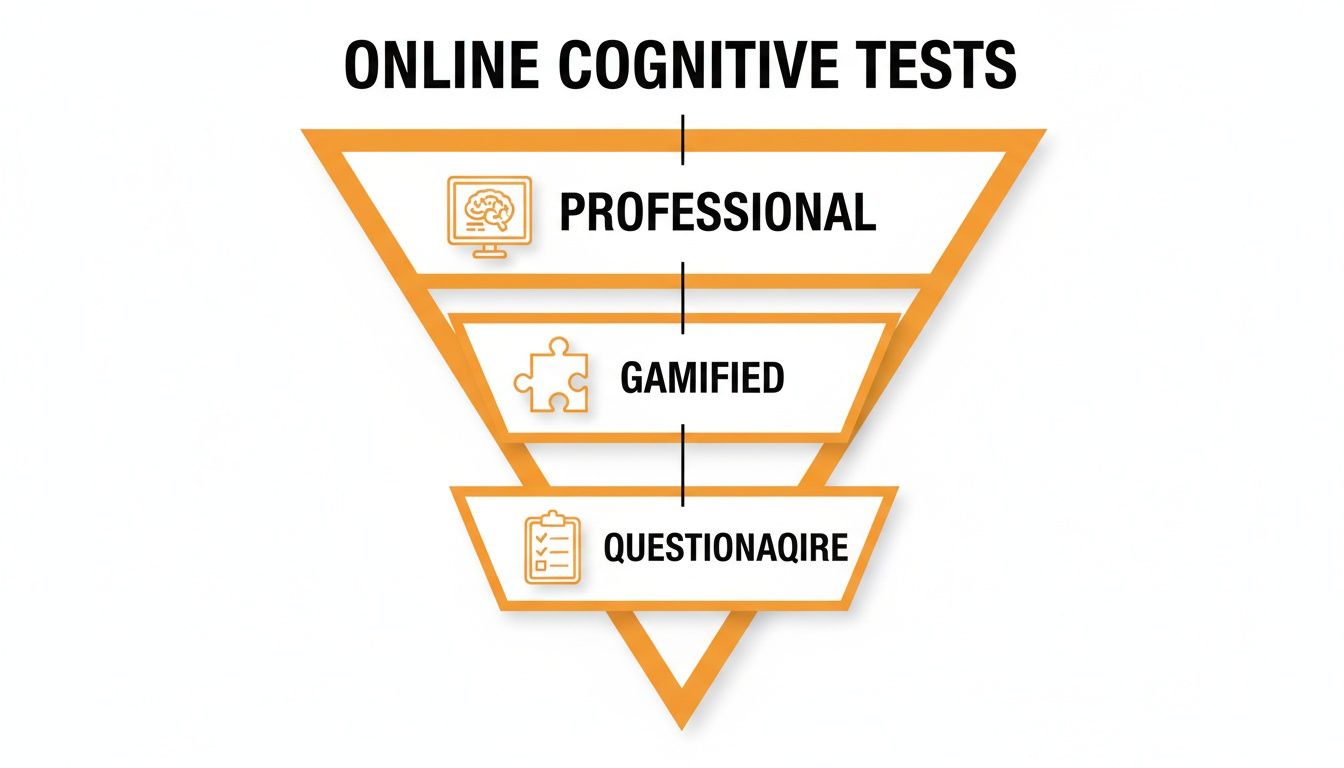
The key takeaway here is that as you move up the ladder from basic quizzes to professional platforms, the level of scientific rigour and detail increases dramatically.
A Starting Point, Not a Conclusion
Because of all these variables, it’s best to view your results as a signal, not a final verdict. If your score is concerning, it doesn't automatically mean you have dementia. It simply means it's time to gather more information and talk to a professional.
Think of it like seeing a warning light on your car's dashboard. You wouldn't ignore it, but you also wouldn't start ordering a new engine based on that light alone. You’d take it to a mechanic for a proper diagnostic check. In the same way, a concerning online test result is your cue to schedule an appointment with your doctor for a comprehensive assessment.
To get a better handle on how these tools are validated, you can learn more about the reliability and retest consistency of cognitive screening tools.
How to Interpret Your Results and What to Do Next
So, you’ve completed an online test for dementia. Looking at your results can feel like a punch to the gut, especially if the score isn't what you hoped for. Before you let your mind race, take a moment and a deep breath.
A concerning score is not a diagnosis. It’s simply a signal—a reason to start a conversation with your doctor.
Think of your results as a single piece of a much larger puzzle. It's an important piece, for sure, but it can’t show you the whole picture on its own. The key is to use this information to create a clear, actionable plan that moves you forward, turning uncertainty into purposeful action.
Your Three-Step Action Plan
A proactive approach can make all the difference when you bring up cognitive health with a professional. Instead of stewing in anxiety, you can channel that energy into preparing for a truly productive conversation. Here’s a simple, step-by-step plan to guide you.
Preserve Your Results: This is the easiest first step. Save, screenshot, or print out a copy of your test results. Having a physical or digital copy ensures you have a tangible record to bring to your appointment, making it much easier to point to specific scores or sections that worried you.
Schedule a Doctor’s Appointment: Don't put it off. Let the results be the nudge you need to book an appointment with your family doctor or a geriatric specialist. When you call, just explain that you've done a cognitive screening and you'd like to discuss the results and your concerns.
Prepare for Your Visit: This is where you can have the biggest impact. Your doctor will find your real-world experiences even more valuable than a test score. Before you go, take some time to jot down specific examples of memory lapses or thinking challenges you've noticed.
A test score tells a doctor what might be happening, but your personal examples tell them how it's affecting your daily life. This context is essential for an accurate assessment and a meaningful care plan.
For instance, instead of just saying, "I'm more forgetful," be specific. "I've gotten lost twice while driving to the grocery store this month," or "I frequently struggle to find the right words in conversations with friends." Details make the difference.
Moving Toward a Clinical Evaluation
Your family doctor will use your notes and test results as a launchpad for a deeper conversation. For a more thorough evaluation, they might refer you to a specialist who uses advanced platforms to gather objective, detailed data.
This is where the healthcare industry is heading. In fact, the market for clinical trial cognitive assessments now commands 34.2% of the market share as providers seek out tools with greater precision. You can learn more about the rise of digital cognitive assessment platforms in clinical settings.
These clinical-grade tools, like the ones we’ve developed at Orange Neurosciences, provide the kind of reliable data needed for a comprehensive assessment. They bridge the gap between a preliminary online screening and a formal medical evaluation. Visit our website to see how our platform empowers doctors to make faster, better-informed decisions.
Vetting the Privacy and Security of Online Health Tools
Sharing sensitive health details online takes a massive leap of faith. When you sit down for an online dementia test, you're doing more than just solving a few puzzles; you're creating a digital footprint of your cognitive health. That's why it's absolutely critical to understand how that information is being protected.
Think of a website's privacy policy as its legal handshake with you. A trustworthy platform won't hide the details in fine print. It will clearly explain how it collects, uses, and stores your personal information. Before you start any online health assessment, taking a few minutes to review the provider's Privacy Policy is one of the most important steps you can take.
What to Look For
Figuring out if a platform is secure doesn't have to feel like a technical deep dive. You're basically looking for a few key signs that separate a professional-grade tool from a casual consumer app.
A reliable service will always have these fundamentals in place:
Data Encryption: This is a deal-breaker. Encryption is like a digital lockbox, scrambling your information so that only authorized people can ever access it.
Anonymity Options: Many professional tools go a step further by anonymizing data. This means they strip away your personal identity from your test results, adding a powerful layer of privacy.
Clear Usage Statements: The policy should say, in no uncertain terms, that your data won't be sold to other companies without your explicit permission.
Professional-grade cognitive assessment tools are built for clinical environments and operate under strict data protection rules. Unlike a lot of consumer apps, their job is to provide secure, reliable data for healthcare decisions—not to sell you products.
This distinction is everything. Clinical tools are designed with security at their very core because they're built to handle protected health information.
For a real-world example of what these commitments look like in practice, you can read our detailed Orange Neurosciences privacy policy. Choosing a platform that puts these standards first is the best way to ensure your sensitive health data gets the respect and protection it deserves.
Common Questions About Online Dementia Screening
We've put together answers to some of the most common questions people have when they're thinking about using an online test for dementia. These straightforward answers should clear things up and address any practical worries you might have.
Can an Online Test Actually Diagnose Dementia?
No, and this is a really important distinction. An online test for dementia is a screening tool, not a diagnostic one. Its job is to flag potential cognitive issues that need a closer look from a qualified healthcare provider.
Think of it like a smoke detector—it gives you an early warning that something might be wrong, but it doesn't tell you the cause of the fire. Only a doctor can give you a formal diagnosis after a full work-up, which usually involves clinical exams, blood tests, and sometimes brain imaging.
How Often Should I Take an Online Cognitive Test?
If you're worried about your cognitive health, taking a test to get a baseline reading is a smart first step. From there, checking in every 6 to 12 months can help you and your doctor spot any changes over time.
But let's be clear: if you get a result that worries you, don't wait to re-test. The most important thing is to talk to your doctor right away. Consistent monitoring should always be done in partnership with your healthcare provider.
What Should I Bring to My Doctor After Taking a Test?
Bringing a printout of the results is helpful, but what’s even more powerful is bringing a list of specific, real-life examples of what’s concerning you. Giving your doctor that context is invaluable.
It's one thing to say, "I'm getting forgetful." It's another thing entirely to provide concrete examples. Try something like, "I've gotten lost driving to the grocery store twice this month," or "I'm really struggling to find the right words when I'm talking to people." This kind of practical information paints a much clearer picture for your doctor of how these changes are impacting your day-to-day life.
At Orange Neurosciences, our mission is to equip clinicians with sophisticated, evidence-based tools that support truly comprehensive cognitive assessments. Our platform provides the objective data healthcare providers need to make faster, more confident decisions. To see how our technology fits into clinical workflows and to explore solutions for healthcare professionals, visit our website at https://orangeneurosciences.ca.
Orange Neurosciences' Cognitive Skills Assessments (CSA) are intended as an aid for assessing the cognitive well-being of an individual. In a clinical setting, the CSA results (when interpreted by a qualified healthcare provider) may be used as an aid in determining whether further cognitive evaluation is needed. Orange Neurosciences' brain training programs are designed to promote and encourage overall cognitive health. Orange Neurosciences does not offer any medical diagnosis or treatment of any medical disease or condition. Orange Neurosciences products may also be used for research purposes for any range of cognition-related assessments. If used for research purposes, all use of the product must comply with the appropriate human subjects' procedures as they exist within the researcher's institution and will be the researcher's responsibility. All such human subject protections shall be under the provisions of all applicable sections of the Code of Federal Regulations.


© 2026 by Orange Neurosciences Corporation