Adaptive Behavior Assessment System 3: Ultimate Guide for 2026
Mar 31, 2026
The Adaptive Behavior Assessment System 3 (ABAS-3) is one of the most trusted tools we have for understanding a person's practical, everyday skills. Think of it as a real-world skills report card. It doesn't measure abstract knowledge or potential, but what an individual can actually do to navigate their daily life.
This isn't an IQ test. Instead, the ABAS-3 zeroes in on functional abilities, giving us a clear picture of someone's independence. It provides actionable insights that clinicians, educators, and parents can use to build effective support plans.
What Is the Adaptive Behavior Assessment System 3?

So, how do we actually measure how well someone gets through their day? The adaptive behavior assessment system 3 gives us a structured and reliable way to do just that. It evaluates the entire collection of skills we all rely on to care for ourselves, connect with others, and handle the world around us.
What’s truly remarkable about the ABAS-3 is its scope. It’s not just for kids; it can be used for anyone from birth all the way to 89 years old. This incredible range makes it a vital tool across the whole lifespan, from tracking early developmental milestones in a toddler to supporting a senior’s ability to live independently.
To give you a quick overview, here are the core components of the ABAS-3.
ABAS-3 at a Glance
Feature | Description |
|---|---|
Purpose | Measures practical, everyday functional skills (adaptive behaviours). |
Age Range | Birth to 89 years. |
Core Focus | What a person can do, not what they know. |
Key Areas | Conceptual, Social, and Practical skill domains. |
Administration | Rating forms completed by parents, teachers, caregivers, or the individual. |
Application | Used for diagnosis, intervention planning, and progress monitoring. |
This table just scratches the surface, but it highlights how the ABAS-3 provides a comprehensive, actionable look at an individual's day-to-day abilities.
A Focus on Functional Skills
It’s so important to understand the difference between the ABAS-3 and a cognitive test. An IQ test might tell you if someone can solve a complex puzzle, but the ABAS-3 tells you if they can apply skills in the real world. It's the difference between knowing the rules of the road and actually driving a car safely. The ABAS-3 is all about the driving.
These functional skills are neatly organized into three fundamental areas that are crucial for personal independence. We explore these skills in much more depth in our guide on the differences between ADLs and IADLs.
The core purpose of the ABAS-3 is to capture a holistic view of an individual's functional capabilities. It helps answer the question: "How effectively does this person manage the practical demands of daily living?"
Why the ABAS-3 Is Important
For clinicians, educators, and therapists, the ABAS-3 is indispensable. The data it generates is used for several critical, actionable functions:
Diagnosis and Eligibility: The assessment is a cornerstone for diagnosing developmental delays and intellectual disabilities. Its scores are often the key to determining if someone qualifies for special education, social security benefits, or other support services. For example, a low score in the Practical domain can provide the evidence needed to secure occupational therapy services through a school district.
Intervention Planning: By pinpointing specific strengths and weaknesses, the ABAS-3 gives us a clear roadmap. If a child struggles with social skills, the results show us exactly which ones need the most attention—like taking turns in conversation versus understanding personal space—allowing for truly targeted interventions.
Progress Monitoring: We can use the ABAS-3 over time to see if our support plans are working. It provides concrete evidence of progress, helping us adjust our strategies to ensure the best possible outcomes.
Especially in the context of a comprehensive adult autism assessment, the ABAS-3 provides a clear, evidence-based picture of an individual's functional abilities. Ultimately, it empowers professionals and families to give the right support where it’s needed most, fostering greater independence and a better quality of life.
Understanding the Three Core Skill Domains
When we want to understand how someone navigates their world, we can't just look at their skills in one big lump. The adaptive behavior assessment system 3 is powerful because it doesn't do that. It smartly breaks down abilities into three core domains, giving us a much clearer, more practical picture of a person's independence.
Think of these domains as the three legs of a stool. If one is shaky, it affects the stability of the whole thing. Getting a handle on each one is crucial for seeing the whole person, not just a test score.
Conceptual Skills
This first domain is all about "thinking in action." It’s how we use our brainpower—the abstract, academic stuff—to solve real-world problems. These are the cognitive tools we pull from our toolbox every single day.
For example, this domain looks at:
Communication: More than just talking. It’s about understanding others and getting your own thoughts and needs across clearly. Practical example: A child telling a parent "My stomach hurts" instead of just crying.
Functional Academics: Using reading, writing, and math in daily life. Practical example: An adult using a banking app to check their balance or following a written recipe.
Self-Direction: The ability to make your own choices, set simple goals, and take the initiative without constant prompting. Practical example: A teenager deciding to start their homework without being told.
In a child, strong conceptual skills might look like them being able to tell you they feel sick and point to where it hurts. For an adult, it could be managing a personal budget or using a calendar to stay on top of appointments.
Social Skills
Next up are the social skills. This domain dives into our ability to connect with other people, build relationships, and get along in a social world. It’s all about how we read the room and interact with those around us.
The Social domain evaluates an individual’s ability to engage in appropriate social interactions, make and keep friends, and demonstrate social responsibility. It measures how effectively they read and respond to social cues.
Practical example: A teenager showing empathy for a friend who’s having a bad day by listening and offering support. Or an employee understanding it's better to wait until after a stressful meeting to ask their boss for a day off. This area also covers leisure skills, like playing games cooperatively or joining clubs, which are so vital for building a sense of community and personal well-being.
Practical Skills
Finally, we have the practical domain. This covers the hands-on, day-to-day skills needed for self-care and managing our environment. These are the most tangible abilities tied to personal independence.
Key areas here include:
Personal Care: Basic but essential skills like bathing, getting dressed, and personal hygiene. Practical example: A child remembering to brush their teeth every morning and night.
Home/School Living: Things like doing chores, making a simple snack, or keeping a work area organised. Practical example: A young adult being able to do their own laundry.
Community Use: Using public transport, shopping for what you need, and moving through public spaces safely. Practical example: Safely crossing the street at a crosswalk or paying for groceries.
Health and Safety: Knowing what’s dangerous, following safety rules, and understanding what to do in an emergency. Practical example: Knowing not to touch a hot stove or who to call in an emergency.
For a young child, this might be as simple as putting on their own coat. For an older adult, it could mean safely using kitchen appliances or booking their own doctor's appointments. These skills truly form the bedrock of self-sufficiency. You can learn more about how these skills connect to broader cognitive abilities in our guide on what cognitive function is.
A 360-Degree View
One of the real strengths of the ABAS-3 is that it doesn't rely on a single source of information. It gathers perspectives from multiple people in the individual's life—parents, teachers, caregivers, and even the person themselves when appropriate. This creates a full, 360-degree view of how someone functions across different settings like home, school, and the community.
While the core structure of the ABAS-3 is well-documented, specific regional adoption rates are not always publicly available, even from primary sources. For more details on the system's official framework, you can explore information about the ABAS-3 from Pearson Assessments. By weaving these different viewpoints together, clinicians can spot crucial patterns and inconsistencies, which is the key to an accurate diagnosis and a support plan that actually works.
To see how these domains translate into practical, effective care plans, get in touch with our team by visiting our website. We can show you how digital assessment tools can work alongside the ABAS-3 to give you even more precise and actionable insights.
Administering and Scoring the ABAS-3 Accurately
Getting reliable results from the adaptive behavior assessment system 3 hinges on one thing: careful administration. It’s not just about ticking boxes. The goal is to gather data that paints a true, actionable picture of an individual’s abilities in their daily life.
It all starts with picking the right people to provide the ratings. You need informants who genuinely know the individual across different settings—think a parent for home life and a teacher for the school environment. It's just as crucial to select the correct ABAS-3 form based on the person's age and the rater's relationship to them.
Setting the Stage for Accurate Ratings
Once you've found your raters, you can't just hand them a form and hope for the best. Your job is to make sure they know exactly what's being asked. A little bit of upfront guidance goes a long way in preventing confusion that can skew the results.
The ABAS-3 looks at three core areas of day-to-day functioning: the Conceptual, Social, and Practical domains.
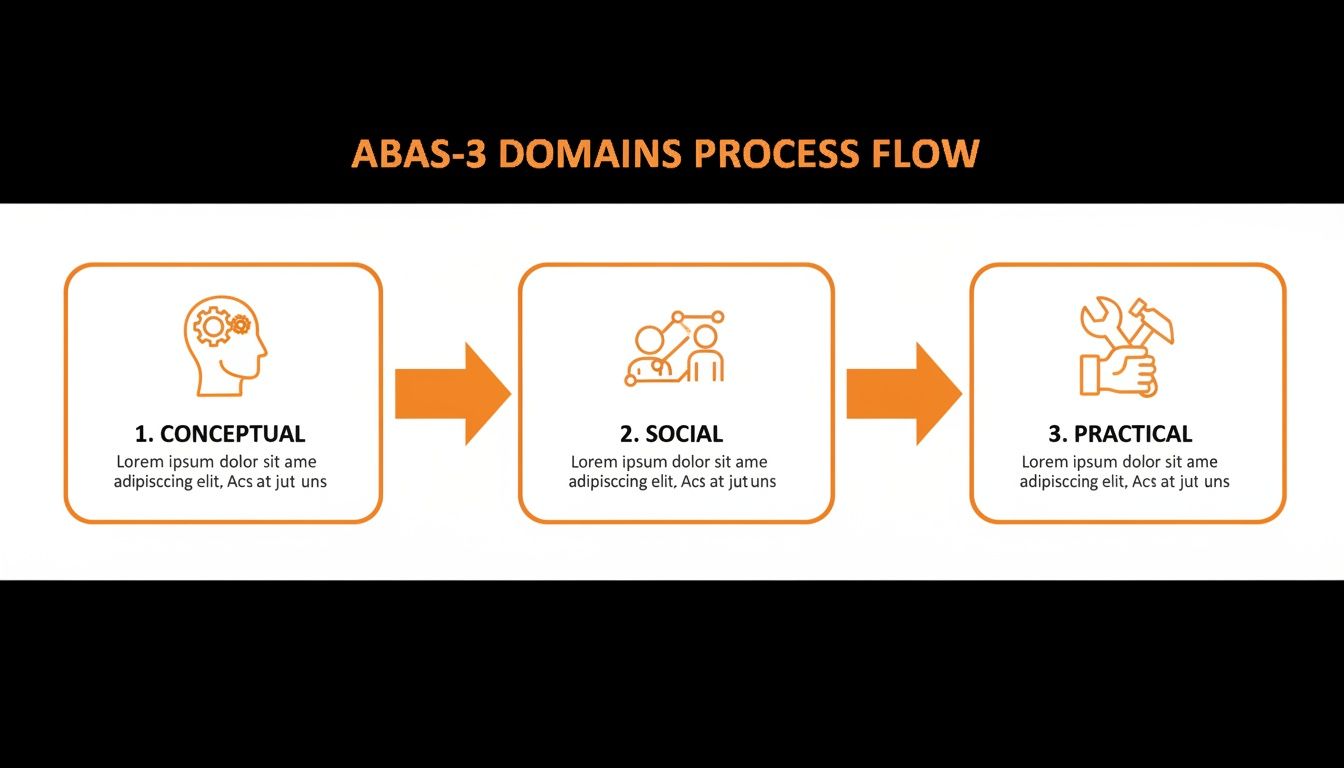
These three distinct yet interconnected areas come together to give you a complete picture of an individual's functional skills.
Take a few minutes to walk your raters through the scoring options, because the nuances matter.
Is Not Able: The person cannot perform the skill, even with help.
Is Able, But Never or Rarely Does: This is a key distinction. The ability is there, but for whatever reason, it isn't used.
Is Able and Sometimes Does: The skill shows up, but it's inconsistent.
Is Able and Always or Almost Always Does: The skill is a solid, reliable part of their routine.
A practical example makes all the difference. For an item like "Uses a fork to eat," clarify that if a child knows how to use a fork but still eats with their hands most of the time, the rating should be "Is Able and Sometimes Does." This clear direction eliminates guesswork and drastically improves the quality of the data.
From Raw Scores to Meaningful Insights
With the completed forms in hand, it's time to score. This can feel a bit technical, but it helps to think of it like baking a cake. The initial raw scores—the simple sum of the item ratings—are just your ingredients. On their own, they don't tell you much.
The conversion from raw scores to scaled and composite scores is where the magic happens. This process compares the individual's performance to a normative sample, turning isolated data points into a meaningful, interpretable profile of strengths and needs.
The next step is converting those raw scores into scaled scores and composite scores using the tables in the ABAS-3 manual. This is like following the recipe. These final scores put the person's performance into context by comparing them to their peers. A scaled score might reveal how they measure up in a specific area like "Self-Care," while a composite score gives you that big-picture view for the overall "Practical" domain. This actionable insight shows you exactly where to focus your intervention efforts.
This conversion is what makes standardized testing so powerful, and it's built on principles that ensure scores are dependable. To learn more, check out our guide on test-retest reliability. By following the scoring procedures in the manual to the letter, you ensure your results are a solid foundation for clinical judgments and effective intervention plans.
Translating ABAS-3 Scores into Meaningful Insights
Getting the adaptive behavior assessment system 3 (ABAS-3) score report isn’t the finish line; it's the starting block. The real art of clinical practice begins when we look past the raw numbers and start to piece together the story of an individual's life. It's about turning data points into a narrative that points the way toward truly effective support.
A common pitfall is fixating on the overall General Adaptive Composite (GAC) score. It’s an important number, but the richest, most actionable insights are buried deeper. A thoughtful analysis means digging into the patterns across the Conceptual, Social, and Practical domains, and even further into the specific skill areas.
This is how you move from a broad overview to a focused map of specific strengths and challenges—the key to crafting interventions that actually make a difference.
Moving from Scores to a Story
Picture the score report as a map of a person's functional world. The GAC gives you the general coordinates, but the domain and skill area scores show you the specific roads, bridges, and tricky intersections. It's the discrepancies between these scores that often tell the most compelling stories.
A wide gap between a high Conceptual score and a low Social score isn’t just data; it's a narrative. It paints a picture of someone who might grasp complex ideas with ease but struggles to navigate the equally complex world of human interaction. This is an actionable insight, telling you to focus support on social skills rather than academics.
Spotting these patterns is where the magic happens. Does the person shine in academic-style skills but stumble when it comes to daily self-care? Are they incredibly capable with practical, hands-on tasks but find social situations completely overwhelming? These aren't just numbers; they are clues, pointing directly to where support is needed most. While this granular data is invaluable, it's worth noting that specific regional statistics can sometimes be hard to find in broad research. For more context on the ABAS-3's application, you can find additional information on the assessment system here.
A Practical Case Study
Let's make this real. Meet Leo, a 10-year-old boy. He’s bright, a star in school subjects like math and science. But his parents and teachers are worried. He has a hard time making friends and is prone to emotional outbursts.
An ABAS-3 assessment reveals a fascinating pattern:
Conceptual Domain: High scores, especially in Functional Academics. No surprise; it matches his strong performance in school.
Practical Domain: Average scores. He's managing, but with some weaknesses in his self-care routines.
Social Domain: Significantly low scores across the board, particularly in skills like "Social Engagement" and "Understanding Social Cues."
This profile doesn't just confirm what his parents see; it clarifies it with actionable data. Leo's cognitive abilities are a strength, but he has a profound, measurable deficit in the social sphere. The data screams that interventions should focus on building social competence and emotional regulation, not on more academic tutoring. For instance, an actionable goal could be working on initiating a conversation with a peer once a day. This kind of deep-dive analysis is also a critical component in the assessment of learning disabilities and related conditions.
This specific pattern—high conceptual skills paired with significant social challenges—is one we often see in individuals with Autism Spectrum Disorder (ASD). In a comprehensive diagnostic evaluation, the ABAS-3 results become a vital piece of the puzzle.
By weaving the ABAS-3 data together with other information, an actionable plan takes shape. The goal is no longer abstract. It’s about helping Leo use his intellectual gifts to learn the social rules that simply don't come naturally to him.
If you’re ready to see how this level of detailed insight can inform your own practice, contact us through our website. We can show you how to pair powerful tools like the ABAS-3 with digital cognitive assessments to build truly personalized and effective care plans.
Building Actionable Intervention Plans from ABAS-3 Results
The real power of the adaptive behavior assessment system 3 isn't in the diagnosis, but in the real-world change it sparks. Think of an ABAS-3 report as less of a verdict and more of a detailed roadmap. This is where we shift from assessment to action.
The ABAS-3 gives us the specific coordinates we need to build targeted support, nurture independence, and improve someone's quality of life.
From Skill Gaps to SMART Goals
The first step is to zoom in on the specific skill deficits the ABAS-3 report has highlighted. A low score in the "Practical" domain is a starting point, but we need to dig deeper. Is the challenge with household chores, personal safety, or community navigation? Pinpointing the exact skill lets us move from a vague concern to a clear, actionable target.
Once you have that target, frame it as a SMART goal—one that is Specific, Measurable, Achievable, Relevant, and Time-bound. This structure cuts through ambiguity and gives everyone a clear benchmark for success.
Practical Domain Goal Example
Let's say a report flags a deficit in the Practical domain around household tasks for a teenager.
Specific: The teen will independently follow a three-step visual schedule to set the table for dinner each evening.
Measurable: Success is completing the task with 90% accuracy, needing no more than one verbal prompt per evening.
Achievable: The task is broken down into simple steps, and a visual aid provides support.
Relevant: This skill directly helps them participate in family routines and builds independence.
Time-bound: We will aim to achieve this consistently for two consecutive weeks.
Suddenly, a "weakness" becomes a clear, actionable objective that a therapist, teacher, or parent can work on.
Building a Collaborative Intervention Strategy
An effective plan is never built in a silo. It needs the collective wisdom of clinicians, educators, family members, and whenever possible, the individual themselves. Each person brings a unique perspective on how skills show up in different settings.
For highly focused interventions, particularly around communication and daily living, looking into dedicated ABA therapy services can provide critical, specialized support. These programs often use the same goal-setting principles to build functional skills one step at a time.
The most successful intervention plans are co-created. They reflect not only the assessment data but also the priorities and values of the individual and their family, ensuring that the goals pursued are truly meaningful.
As you build the plan together, keep these points in mind for an actionable strategy:
Prioritize Skills: You can't tackle everything at once. Pick one or two high-impact skills that will make the biggest difference. Practical example: For a child with multiple challenges, focus first on a key safety skill like "holding a parent's hand in a parking lot."
Identify Strengths: How can you use their strengths to support their needs? If they’re a strong visual learner, lean into checklists, visual schedules, and video modelling.
Select Strategies: Brainstorm the actual teaching methods. Will you use role-playing for social skills? A task analysis for practical ones?
Monitor Progress: How will you know if it's working? Decide on a tracking method, whether it's a simple checklist, daily data collection, or weekly observations.
This collaborative process ensures everyone is pulling in the same direction. You can see more on how different fields approach this in our guide to assessments in occupational therapy.
To supercharge your intervention planning, see how Orange Neurosciences can help. Our platform complements the ABAS-3 by digging into the "why" behind skill deficits. Contact our team today via our website to learn how to integrate our tools and build a better path to success.
Why Pair the ABAS-3 with Digital Cognitive Tools?
The adaptive behavior assessment system 3 (ABAS-3) is fantastic at giving us the ‘what’—it expertly pinpoints where a person is struggling with daily functional skills. But to create truly effective, actionable support, we need to dig deeper and find out why these struggles are happening. That’s where modern digital tools come in.
Traditional assessments, while valuable, have their limits. They can be time-consuming and often offer a single snapshot of ability. They tell us that a problem exists in a broad area without revealing the specific cognitive gears that are grinding underneath.
Going From 'What' to 'Why' with Actionable Data
This is precisely where digital platforms, like those from Orange Neurosciences, can be a game-changer. Imagine you have an ABAS-3 report flagging a major deficit in the ‘Conceptual’ domain. That’s your ‘what.’
But why is the person having a hard time? Is it because a slow processing speed makes it difficult to keep up with instructions? Or perhaps a working memory issue means they can’t hold onto multiple steps in their head? A good digital cognitive assessment can give you those precise answers.
When you combine a functional assessment like the ABAS-3 with a targeted cognitive assessment, you move from observation to genuine insight. You’re connecting the behavior to its root cause—the foundation for truly data-driven care and actionable interventions.
For example, a tool like OrangeCheck can quickly measure the specific cognitive functions that feed into that broad conceptual deficit. In just a few minutes, you can get objective data on:
Working Memory: The ability to hold and work with information.
Processing Speed: How quickly a person can take in and respond to information.
Attention Control: The capacity to stay focused and filter out distractions.
A Practical Example of Actionable Insights
Think about a student whose ABAS-3 results show a weakness in the "Social" domain, particularly in following the rules of a game with friends. The old-school approach might just be to prescribe more social skills training.
But what if you add a quick digital assessment? You might discover the student has a significant processing speed deficit. Suddenly, the problem isn’t a lack of social desire; they literally can't process the fast-paced, shifting rules of the game quickly enough to keep up.
That single insight changes everything. The intervention plan becomes actionable and targeted. Instead of just "more practice," you can now implement strategies that accommodate this processing speed issue. Practical actions could include: suggesting games with simpler rules, using visual aids to explain steps, or giving them a moment to process before starting. This is what leads to better outcomes.
Building Dynamic and Personalized Care Plans
By weaving together functional and cognitive data, your entire clinical workflow becomes more effective. It opens the door to continuous progress monitoring—not just of the adaptive behaviour, but of the underlying cognitive skills that support it. This kind of information is invaluable. For more details on the ABAS-3 itself, you can find in-depth information directly from PAR, Inc.
When you integrate these tools, you stop relying on static reports and start building a living understanding of an individual’s needs. This allows you to create care plans that are not just personalized, but that can also adapt as the person’s cognitive profile changes.
Ready to see how this modern approach could elevate your own practice? Reach out to the team at Orange Neurosciences today via our website or email. We can show you how our digital tools can help you unlock deeper insights and achieve better results.
Answering Your Questions About the ABAS-3
Given its widespread use, the Adaptive Behavior Assessment System, 3rd Edition (ABAS-3) often brings up questions. Whether you're a clinician, educator, or parent, getting clear answers is the first step to using this powerful tool effectively. Let's clear up some of the most common questions.
Is the ABAS-3 an IQ Test?
No, and this is a critical distinction. An IQ test measures cognitive potential—things like reasoning and abstract thought. The ABAS-3, on the other hand, is all about adaptive behaviour. It looks at the practical, everyday skills a person actually uses to get by in the real world.
Practical example: A brilliant professor might have a genius-level IQ (high cognition) but struggles to manage their schedule, pay bills on time, or maintain friendships (low adaptive skills). The ABAS-3 zeroes in on what a person does, not just what they know.
Who Is Qualified to Administer the ABAS-3?
This is crucial. While the rating forms are filled out by people who know the individual best—like parents, teachers, or caregivers—the overall administration, scoring, and interpretation must be handled by a qualified professional.
The professional interpretation of ABAS-3 scores is essential. A trained clinician can connect the data to an individual's broader context, turning scores into a meaningful narrative for diagnosis and effective, actionable intervention planning.
These experts are typically individuals with graduate-level training in assessment, including:
School psychologists
Clinical psychologists
Neuropsychologists
Other licensed practitioners with appropriate credentials
Their expertise is what turns a page of numbers into a clear plan of action.
How Can I Use ABAS-3 Results to Advocate for My Child?
ABAS-3 results can be one of your most powerful advocacy tools because they offer objective, standardized data on your child’s real-world skills. When you walk into an Individualized Education Program (IEP) meeting, you’re not just sharing concerns; you’re presenting evidence.
Practical example: If the report highlights a major deficit in the Social domain, you now have concrete proof to request a spot in a social skills group. A low score in the Practical domain could be the key to securing occupational therapy to build daily living skills. These scores help transform your gut feelings into data-backed requests that are hard to ignore, making it much easier to get your child the resources they need to thrive.
At Orange Neurosciences, we believe in pairing powerful assessments like the ABAS-3 with precise cognitive data to create truly effective care plans. Our tools can help you understand the "why" behind the "what," enabling more targeted and successful interventions. Visit our website at https://orangeneurosciences.ca or email our team to discover a new level of clinical insight.
Orange Neurosciences' Cognitive Skills Assessments (CSA) are intended as an aid for assessing the cognitive well-being of an individual. In a clinical setting, the CSA results (when interpreted by a qualified healthcare provider) may be used as an aid in determining whether further cognitive evaluation is needed. Orange Neurosciences' brain training programs are designed to promote and encourage overall cognitive health. Orange Neurosciences does not offer any medical diagnosis or treatment of any medical disease or condition. Orange Neurosciences products may also be used for research purposes for any range of cognition-related assessments. If used for research purposes, all use of the product must comply with the appropriate human subjects' procedures as they exist within the researcher's institution and will be the researcher's responsibility. All such human subject protections shall be under the provisions of all applicable sections of the Code of Federal Regulations.


© 2026 by Orange Neurosciences Corporation