What Is Cognitive Function Explained for Families and Clinicians
Feb 7, 2026
Picture your brain as the most complex, powerful computer ever built. If that’s the case, then cognitive function is its operating system. It’s the entire suite of mental processes humming away in the background, letting you think, learn, solve problems, and connect with the world. These functions are the difference between passively observing life and actively living it.
Understanding Your Brain's Operating System
Just as a computer’s OS handles everything from launching an app to finding a Wi-Fi signal, your cognitive functions orchestrate every mental task you perform. It isn't just one skill, but a whole set of interconnected abilities working in concert.
When these functions are sharp and synchronized, your day flows smoothly. You can remember your grocery list, navigate a tricky conversation, and make a high-stakes decision at work without even thinking about how you're thinking. To really grasp what cognitive function is, we need to look at its core components. Clinicians and researchers generally break these abilities down into a few key domains, each with a specific job inside your brain's command centre.
The Core Components of Cognition
Getting to know these domains helps demystify how our brains actually process the world. While we can talk about them separately, they're deeply intertwined. A slip in one area can easily cause trouble in another. For instance, if your attention is scattered, you'll almost certainly struggle to form new memories. A practical example is trying to remember someone's name at a noisy party; if your attention is divided, the name never gets properly stored.
Here’s a quick look at the primary domains that make up your cognitive toolkit.
The Six Core Domains of Cognitive Function at a Glance
This table offers a simple breakdown of the main cognitive domains, what they do, and how they show up in your daily life. Think of it as a quick reference guide to the fundamental software running your brain.
Cognitive Domain | What It Does | Everyday Example |
|---|---|---|
Attention | Focuses mental resources on specific information | Tuning out background noise to listen to a friend in a busy café |
Memory | Encodes, stores, and retrieves information | Recalling the steps to a recipe you learned last week |
Executive Function | Manages planning, organizing, and decision-making | Mapping out your workday and prioritizing tasks to meet a deadline |
Perception | Interprets sensory information from the environment | Recognizing a familiar face in a crowd or identifying the smell of coffee |
Processing Speed | The pace at which you take in and respond to information | Quickly reading road signs and reacting to changing traffic conditions |
Eye–Hand Coordination | Integrates visual input with motor skills | Typing an email, catching a ball, or signing your name |
These mental processes are fundamental, controlling how well we interact with everything and everyone around us. This incredible multitasking is made possible by the complex teamwork between different brain regions. To get a better sense of the physical hardware involved, you can learn more about the lobes of the brain and their specialized roles.
Cognitive function is the engine of human capability. It’s the set of skills that allows us to turn thoughts into actions, process the world around us, and build meaningful lives. Without it, learning, growth, and independence would be impossible.
Recognizing these functions is the first step toward appreciating brain health. At Orange Neurosciences, we provide tools to help you objectively understand these vital processes. Visit our website to get a clear picture of your cognitive health.
Exploring the Six Pillars of Cognition
If you think of cognitive function as your brain's operating system, then its core domains are the essential "apps" running every moment of your day. These six pillars—attention, memory, executive function, perception, processing speed, and eye–hand coordination—work together seamlessly, letting you handle everything from driving a car to participating in a lively debate or just making breakfast.
Getting to know what each of these cognitive skills does helps clarify what we really mean by "cognitive function" as a whole. And just like a single glitchy app can slow down an entire computer, a weakness in one of these domains can drag down your overall mental performance. Let's take a closer look at each pillar with some real-world examples.
Attention: The Brain's Spotlight
Think of attention as your brain's spotlight. It's the skill that lets you point your mental resources at specific information while tuning out all the noise around you. This spotlight can be tight and narrow for intense focus on one thing, or it can be wide, letting you scan your environment for important cues.
Your brain is constantly toggling between different kinds of attention:
Sustained Attention: This is your marathon focus, what you use when you're deep into a good book or sitting through a long lecture. A practical example is a student focusing for a 90-minute exam.
Selective Attention: This is your filter. It’s how you can hear a friend's voice in a loud, crowded restaurant while everything else fades into the background.
Divided Attention: This is your capacity for multitasking, like chatting on the phone while you’re cooking dinner. A real-world test of this is listening to a podcast while responding to an email.
Without a sharp spotlight, other cognitive functions would stumble—especially memory. After all, you can't remember what you never paid attention to in the first place.
Memory: Your Mind's Filing System
Memory is the incredibly complex process of encoding, storing, and retrieving information. It's so much more than just recalling facts; it's the very foundation of learning, your identity, and your ability to live independently. When it's working well, it’s like having a perfectly organised digital filing system at your fingertips.
But memory isn't just one thing. It includes:
Short-Term Memory: This holds a small handful of information for a very brief time, like remembering a phone number just long enough to dial it.
Working Memory: This is your mental scratchpad, an active space where you manipulate information. You use it when you're doing a math problem in your head or rearranging a sentence as you type. A practical example is doubling a recipe's ingredients in your head without writing it down.
Long-Term Memory: This is your brain's vast archive for knowledge, skills, and life experiences, from knowing the capital of France to remembering your first day of school.
This diagram shows how key domains like Memory, Attention, and Executive Function are core components of your brain’s operating system.
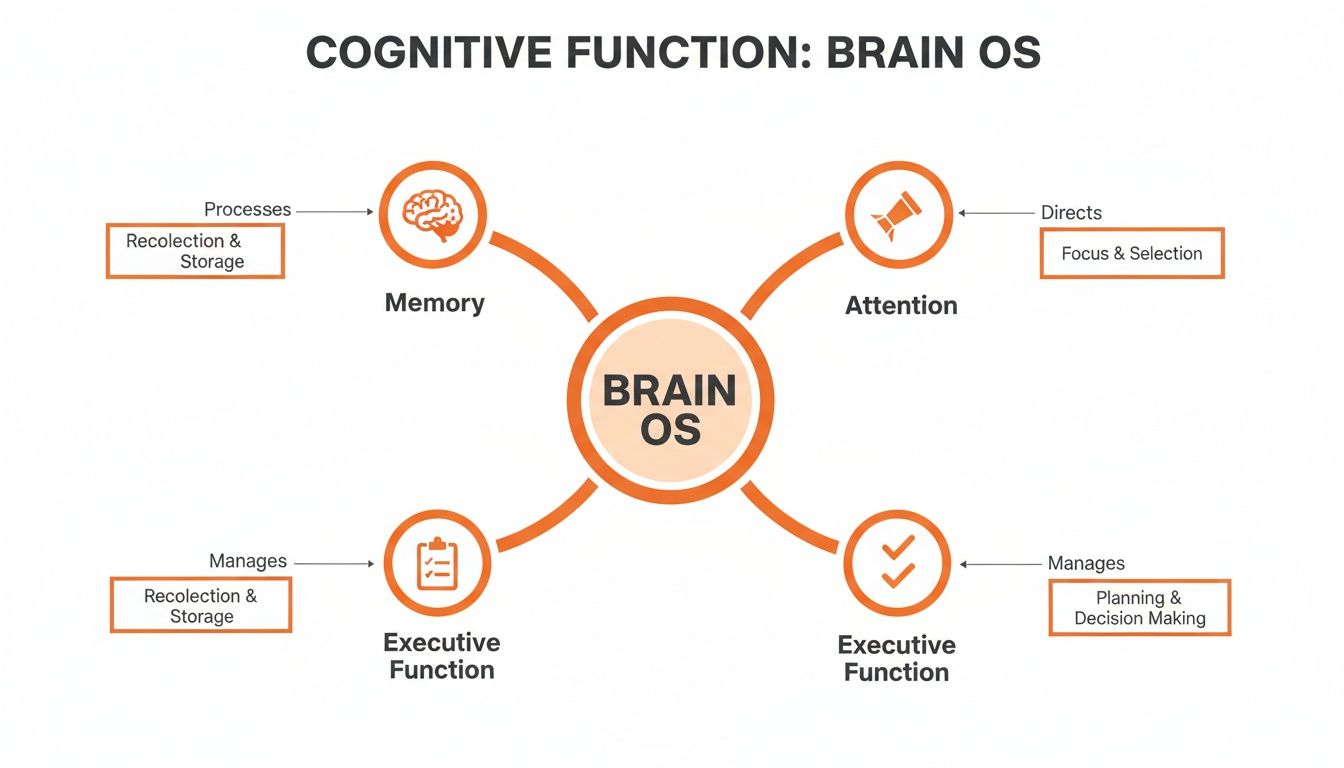
The visual highlights just how interconnected these pillars are, showing that a healthy "Brain OS" depends on every single function running smoothly.
Executive Function: The Project Manager
If your brain has a CEO or a project manager, it’s your executive function. This suite of high-level mental skills is in charge of managing your behaviour and resources to help you reach your goals. It's the command centre that orchestrates all your other cognitive functions.
Executive function is mission-critical for almost anything you do that requires planning or self-control.
Executive functions allow you to analyse tasks, break them down into steps, and carry them out in the right order. They also help you manage your time, pay attention, and switch focus when needed—all while ignoring distractions.
Think about planning a family vacation. That requires a ton of executive function. You have to set a budget (planning), book flights and hotels (organisation), adjust if something goes wrong (flexible thinking), and fight the urge to put it all off until later (inhibition). When looking at these self-management skills, it's also helpful to consider related frameworks like the five core SEL competencies, which share a lot of common ground.
Perception: Interpreting Your World
Perception is your brain's amazing ability to take in sensory information—what you see, hear, taste, touch, and smell—and actually make sense of it. It’s the process that transforms raw data from your environment into a meaningful experience.
It’s how you recognise a familiar face in a crowd, judge the distance of an oncoming car, or pick out the melody of a song. A practical example is looking at an abstract painting and seeing a landscape, or distinguishing the taste of cinnamon from nutmeg in a dessert. Without perception, the world would just be a chaotic jumble of light, sound, and sensation.
Processing Speed: Your Mental Pace
Processing speed is exactly what it sounds like: how quickly you can take in, understand, and respond to information. It’s the pace at which you perform mental tasks. You can think of it as your brain's internal clock speed or its processor power.
A healthy processing speed makes quick thinking and fluid conversations possible. When you’re driving, for instance, you have to rapidly process road signs, traffic lights, and the movements of other cars to react safely and on time. A simple, practical test is how quickly you can find a specific item on a cluttered supermarket shelf. When processing speed is slower, daily tasks can feel much more demanding and effortful.
Eye-Hand Coordination: The Mind-Body Connection
Finally, eye–hand coordination is the vital link between what you see and what you do with your hands. It’s the ability to use visual information to guide your motor skills with precision and control.
This function is essential for a huge range of activities, from the simple to the incredibly complex:
Typing an email on a keyboard
Signing your name on a document
Catching a ball
Threading a needle
These six pillars are the fundamental building blocks of your cognitive health. By understanding each one, you can better appreciate the sheer complexity of your brain and see why it’s so important to keep every "app" running smoothly. To go deeper, check out our guide on the definition of cognitive skills for a more detailed breakdown.
At Orange Neurosciences, our tools are designed to give you clear, objective insights into how these functions are performing, empowering you to take proactive steps toward better brain health. Visit our website to see these tools in action.
Why Cognitive Health Matters at Every Age
Cognitive function isn’t some abstract idea cooked up by researchers in a lab; it’s the very engine of how we experience life. From a child’s first day of school to navigating a demanding career and enjoying retirement, our cognitive abilities are what allow us to learn, adapt, and truly thrive.
Think of cognitive health as the foundation we build our entire lives on. A child’s growing brain needs it to learn to read, figure out maths problems, and make friends. For a teenager, sharp attention and memory are non-negotiable for getting through exams and making smart choices. As adults, our executive functions act as the project manager for our lives, helping us juggle deadlines, manage finances, and plan for what's next.
The Lifelong Impact of Cognitive Skills
Our cognitive vitality has a direct and powerful impact on our quality of life and independence. In childhood and adolescence, these skills are the building blocks for knowledge and self-confidence. A student with quick processing speed can easily keep up in a busy classroom, while another with strong executive function can confidently map out a complex science project.
In our adult years, these same skills are what drive professional success and personal well-being. Imagine a surgeon who depends on flawless eye-hand coordination or a lawyer whose career hinges on a sharp memory and keen analytical skills. It’s why conversations about lifelong brain health so often turn to practical strategies, like how to improve focus and concentration for long-term brain health.
For older adults, maintaining cognitive health is about one thing above all else: preserving independence. The ability to manage medications, remember appointments, and stay socially engaged all rely on these core functions. Even small shifts can have a big impact on daily life, which makes staying proactive absolutely essential. You can learn more about how these changes can appear in our guide on what is cognitive decline.
A Growing Concern for Younger Adults
We often think of cognitive challenges as something that happens later in life, but a startling trend is beginning to tell a different story. Recent data shows a sharp rise in self-reported cognitive difficulties among younger people, pointing to a much broader public health issue that we can’t afford to ignore.
This isn't just a vague feeling; it's a measurable shift. In California, younger adults aged 18-39 are at the centre of a national cognitive health crisis. In this age group, self-reported cognitive disability rates nearly doubled from 5.1% in 2013 to 9.7% in 2023. This alarming trend, based on over 4.5 million CDC survey responses, shows that younger Californians are the main drivers of this national increase.
This trend highlights a critical blind spot in our approach to brain health. We can no longer afford to view cognitive assessment as something reserved for later life. It is a vital health metric for every age.
This worrying increase makes one thing clear: we urgently need accessible, objective ways to monitor brain health across a person's entire life. For parents, teachers, and healthcare providers, having a clear baseline of someone's cognitive function is no longer a "nice-to-have"—it's a necessity. Catching any changes early allows for timely support, empowering people to take control of their cognitive well-being.
At Orange Neurosciences, we believe that understanding your cognitive profile is the first step toward building a lifetime of brain health. Our evidence-based platform delivers the clear, objective data needed to turn insights into action. Visit our website or email us to learn how to get started.
How to Recognize Signs of Cognitive Change
Spotting a shift in cognitive function isn't about looking for the kind of dramatic memory loss you see in movies. Far more often, the signs are subtle and easy to brush off as just an "off day." To truly recognize these changes, we need to look past generic checklists and focus on how a person is functioning in their own world, day in and day out.
These quiet shifts are more common than most people think. In California, a state known for its focus on brain health innovation, subjective cognitive decline (SCD) already affects 11.7% of adults. That means over one in ten Californians aged 18 and up have reported that their memory or concentration has worsened in recent years. This isn't a niche issue; it's a widespread concern, and you can explore the complete cognitive health data from the CDC to see the full picture.

The real key is to watch for patterns, not isolated slip-ups. Forgetting a single appointment is human; consistently missing them, however, might be a quiet signal of an underlying issue with memory or executive function.
Contextual Clues in Daily Life
The signs of cognitive change look different depending on who you are and what you do every day. When you understand what cognitive function is, you start to see these clues for what they are—signs that a core mental process might be under strain.
Here’s what this can look like in the real world:
For a Teacher: A star student who always followed complex instructions now seems lost during class projects. They might keep asking for directions or struggle to organize their thoughts for an essay, possibly pointing to a change in their working memory or executive function.
For a Family Member: An older parent, once meticulous with their finances, now has a stack of unopened bills. Maybe they’re misplacing important things like keys or a wallet far more often than they used to, suggesting a potential challenge with memory or organization.
In the Workplace: A reliable colleague starts missing deadlines or seems completely overwhelmed by tasks they once managed with ease. They might have a hard time adapting to new software or following intricate conversations in meetings, which could hint at issues with processing speed or attention.
These examples make it clear that cognitive difficulties are about so much more than just "forgetfulness." They often show up as trouble with planning, solving problems, or adapting to new information.
It's crucial to remember that a change in behaviour is the first sign. Observing a pattern of difficulty in tasks that were once routine is a more reliable indicator than any single event.
Differentiating from Mimics like Stress and Fatigue
Not every mental slip is a red flag for a lasting problem. Plenty of temporary factors can mimic the signs of cognitive change, creating a kind of "brain fog" that makes thinking feel heavy and slow. It's vital to consider these other possibilities before jumping to conclusions.
Before assuming a long-term issue, think about these common mimics:
Poor Sleep: Just a few nights of bad rest can wreak havoc on your attention, memory, and decision-making. Chronic sleep deprivation will make anyone feel less sharp.
High Stress: When your body is stuck in "fight or flight" mode, your brain prioritizes survival over complex thought. This can make it tough to focus, learn, or recall information on demand.
Burnout: Sustained stress, whether personal or professional, leads to an exhaustion that directly hits cognitive performance. That feeling of being mentally drained and disengaged is a classic sign.
Nutritional Deficiencies: A lack of key nutrients like B vitamins or iron can impact brain energy, leading to fatigue and trouble concentrating.
The main difference between these temporary states and a more persistent cognitive challenge comes down to duration and consistency. Brain fog from a bad night's sleep usually clears up. But when the difficulties stick around even when a person is well-rested and relaxed, it could point to an underlying change.
This is exactly why objective assessment is so powerful. It gives you a clear, data-driven baseline of what a person's cognitive function actually looks like, helping to separate temporary struggles from more significant changes that need support.
At Orange Neurosciences, we provide the tools to get that clear picture. Our platform offers precise, evidence-based assessments that empower you to understand cognitive health objectively. Visit our website to see how we can help you turn observation into actionable insight.
Modern Approaches to Cognitive Assessment
Recognizing the signs of cognitive change is a massive first step, but how do we get from a subjective hunch to an objective understanding? The answer is through assessment. For decades, this meant gruelling, paper-based neuropsychological batteries—the kind of thing that took hours and was far too cumbersome for regular check-ups.
But the field has come a long way. Today, we have tools that are faster, more precise, and accessible to just about anyone.
Modern digital platforms have completely changed the game. Instead of waiting for a significant problem to surface, these tools make regular cognitive check-ups a realistic option. In often less than 30 minutes, they can deliver a detailed, holistic cognitive profile. This efficiency empowers clinicians, educators, and families to be proactive about brain health, not just reactive.
This shift isn't just a convenience; it's a public health necessity. With cognitive health concerns on the rise, we need tools that can keep up. In California, for instance, 11.7% of adults report subjective cognitive decline, placing it right in the middle of states grappling with this burden. These numbers aren't just statistics; they represent a pressing need for effective tools to support everyone from neurologists to senior care providers. You can dive deeper into these trends in the report on cognitive disability in U.S. adults.
Why a Holistic Profile Is Essential
One of the biggest advantages of modern assessment is the ability to see the whole picture. When we talk about what cognitive function is, we're really talking about a network of interconnected skills. A memory problem might actually be rooted in an attention deficit. If you only look at one symptom, you’re getting an incomplete—and possibly misleading—story.
A truly comprehensive assessment looks at all six pillars at once:
Attention
Memory
Executive Function
Perception
Processing Speed
Eye–Hand Coordination
By measuring each of these domains, modern tools create a detailed cognitive map. This profile shows specific areas of strength and pinpoints exactly where support is needed most. It provides the granular data practitioners need to move beyond a one-size-fits-all approach and develop interventions that are genuinely personalized.
An assessment is not a diagnosis. It is a data point—a clear, objective snapshot of a person’s cognitive performance at a specific moment in time. Its true value lies in guiding the next steps.
Interpreting the Results for Actionable Insights
Getting a cognitive assessment report can feel overwhelming, but the goal is simple: turn data into action. The results are a guide, not a final verdict. For a clinician, this profile informs care plans, helps track how well a treatment is working, and supports data-driven decisions about a patient’s next steps.
For educators and therapists, these insights can be used to design highly targeted interventions. If a student's profile reveals a weakness in working memory, for example, a teacher can bring specific strategies into the classroom to support them. Our guide on what is a cognitive assessment offers a much deeper look into how this process works.
And for families, understanding a loved one’s cognitive profile provides clarity and a path forward. It helps them advocate for the right resources and truly grasp the specific challenges their loved one is facing. This objective data takes the guesswork out of care, reduces frustration, and empowers everyone to provide more effective, empathetic support.
Ultimately, modern assessment closes the gap between seeing a problem and taking concrete, meaningful steps toward better brain health.
At Orange Neurosciences, our platform is built to provide this clear, evidence-based data, so you can make informed decisions quickly. Learn how our tools can help you create faster, more effective support plans by exploring our website.
Turning Assessment into Actionable Support
A cognitive assessment gives you a clear, objective snapshot of a person's cognitive function, but its real power lies in what you do next. Getting a cognitive profile isn't the finish line—it's the starting gate for creating meaningful, targeted support that can genuinely improve daily life. The whole point is to turn that data into tangible action.
This is where clinicians, educators, and families can move beyond guesswork and start building strategies that address specific needs. When you understand the unique patterns of strengths and weaknesses, you can focus support where it will have the greatest impact. That saves time, cuts down on frustration, and builds confidence.
From Data to Daily Impact
Objective data acts as a roadmap for everyone involved, pointing the way toward effective, personalized actions. The insights from a cognitive profile can be adapted to fit any setting, whether it's a clinic, a classroom, or a family home.
Here’s how it works in the real world:
For Clinicians: A detailed profile helps build tailored care plans. If a patient shows slow processing speed but has a strong memory, a therapist can skip the unnecessary memory drills and focus on strategies that give the patient more time to think and respond.
For Educators: An assessment revealing a student struggles with attention but has strong visual perception skills gives a teacher a game plan. They can design more visual learning aids and provide a quieter workspace to minimize distractions.
For Families: Realizing a loved one’s forgetfulness actually stems from executive function challenges—not memory loss—changes everything. Suddenly, families can implement practical systems that work, like shared digital calendars or daily checklists.
The most effective support is proactive, not reactive. Transforming assessment data into a clear plan provides a structured pathway to enhance brain health, build skills, and improve quality of life.
Ultimately, understanding what cognitive function actually looks like for an individual is the key to unlocking their potential. It’s what allows for precise, empathetic support that adapts to their unique cognitive landscape.
At Orange Neurosciences, we’re committed to closing the gap between assessment and action. Our platform delivers the clear, evidence-based insights needed to build effective support systems from the ground up. Explore our range of cognitive therapies and see for yourself how you can turn data into real progress today.
Your Top Questions About Cognitive Function, Answered
Diving into the world of cognitive function can often spark more questions than answers. It's a complex topic, after all. Here, we’ll tackle some of the most common queries with clear, practical insights to help you feel more confident about managing brain health.
Can Cognitive Function Be Improved at Any Age?
Yes, absolutely. The brain has a remarkable capacity to change and build new connections throughout our lives, a process called neuroplasticity. Think of it like physical fitness—you can always train your muscles, and similarly, you can always train your brain.
Whether you're a child learning new skills or an adult looking to stay sharp, engaging in mentally stimulating activities, staying active, and using structured training programs can make a real difference in functions like memory and attention. For instance, learning a new language or musical instrument are practical ways to challenge your brain and build new neural pathways.
What Is the Difference Between Cognitive Function and Intelligence?
It's a great question, as the two are often confused. While they're definitely related, they aren’t the same thing.
Think of intelligence—often measured by an IQ score—as the overall capacity of your mental "engine." Cognitive functions, on the other hand, are the individual parts that make that engine run: the gears, pistons, and spark plugs. Things like processing speed, working memory, and attention are the specific tools your brain uses to learn, reason, and solve problems. You can have a very powerful engine (high intelligence) but still have a few parts that need a tune-up.
How Often Should Cognitive Function Be Assessed?
This really depends on the person and their situation. For most people, a single assessment is an excellent way to establish a solid baseline—a snapshot of where your cognitive health stands right now.
In clinical or school settings, we often see assessments done at the beginning of an intervention to guide the plan, periodically to track how things are going, and at the end to see the results. For anyone concerned about changes over time, an annual cognitive check-up can be as valuable as a yearly physical. Thankfully, modern digital tools have made this kind of regular monitoring easier and more accessible than ever before.
At Orange Neurosciences, we provide the objective data needed to answer these questions and more, empowering you with clear insights into your brain health. Discover how our evidence-based platform can help you take the next step by visiting our website.
Orange Neurosciences' Cognitive Skills Assessments (CSA) are intended as an aid for assessing the cognitive well-being of an individual. In a clinical setting, the CSA results (when interpreted by a qualified healthcare provider) may be used as an aid in determining whether further cognitive evaluation is needed. Orange Neurosciences' brain training programs are designed to promote and encourage overall cognitive health. Orange Neurosciences does not offer any medical diagnosis or treatment of any medical disease or condition. Orange Neurosciences products may also be used for research purposes for any range of cognition-related assessments. If used for research purposes, all use of the product must comply with the appropriate human subjects' procedures as they exist within the researcher's institution and will be the researcher's responsibility. All such human subject protections shall be under the provisions of all applicable sections of the Code of Federal Regulations.


© 2026 by Orange Neurosciences Corporation