Assessments occupational therapy: A Clinician's Guide to Effective Evaluation
Jan 29, 2026
An occupational therapy assessment isn't just a test—it's the start of a collaborative partnership. Think of it as a discovery process where you and your client work together to map out their unique strengths, challenges, and goals. This initial evaluation is the crucial first step that lays the groundwork for the entire therapy journey, focusing on potential rather than just problems. This guide provides actionable insights and practical examples to help you master the art of effective OT assessment.
The Foundation of Effective Occupational Therapy Assessments

The initial assessment is where you co-author the first chapter of a client's success story. It’s a joint effort aimed at building a complete, authentic picture of the individual's life. The primary goal isn't diagnosis; it’s discovery.
An OT acts like a skilled detective, carefully gathering clues to understand how a person navigates their day-to-day world. The real mission is to look beyond immediate limitations to uncover untapped resilience and hidden strengths. This holistic, person-first view is the cornerstone of client-centred care and leads to actionable, effective therapy plans.
Uncovering the 'Why' Behind the 'What'
The primary purpose of assessments occupational therapy is to figure out why certain daily activities have become challenging. It’s not enough to know that a child struggles with handwriting. A practical assessment digs deeper to find out if the issue stems from fine motor delays, difficulties with visual-motor integration, or sensory processing challenges.
For paediatric clients, a deep understanding of childhood development milestones provides a baseline to identify where a child might need extra support, helping you pinpoint the true nature of their challenge.
Here’s an actionable example for an adult client. An older individual recovering from a stroke reports they're having trouble cooking safely. The assessment allows the OT to explore whether this is due to:
Physical limitations: Weakened grip strength making it hard to hold a knife.
Cognitive challenges: Forgetting the steps in a familiar recipe.
Safety concerns: Poor balance making it risky to carry a hot pot.
Building a Personalised Roadmap
By thoroughly evaluating all key areas of a person's life—from self-care and work to play and leisure—therapists can draw up a truly personalised roadmap. This plan ensures every intervention is directly tied to the client's own hopes and ambitions, making therapy more meaningful and effective.
The most effective therapy doesn't just treat a condition; it empowers a person. An assessment is the first and most critical step in crafting a plan that respects the individual's goals, environment, and personal strengths, leading to more meaningful and lasting outcomes.
This client-first approach is more vital than ever. The Canadian occupational therapy field has exploded, growing from just 7,575 registered therapists in 1997 to over 20,000 by 2021. But even with this growth, demand often outstrips supply, which makes efficient and effective evaluation methods absolutely critical.
Ultimately, a well-executed assessment provides the clarity and direction needed to guide the entire therapeutic journey. You can learn more about the profession's scope in our guide on https://www.orangeneurosciences.ca/guide/occupational-therapy-in-canada.
Exploring Key Assessment Domains in Occupational Therapy
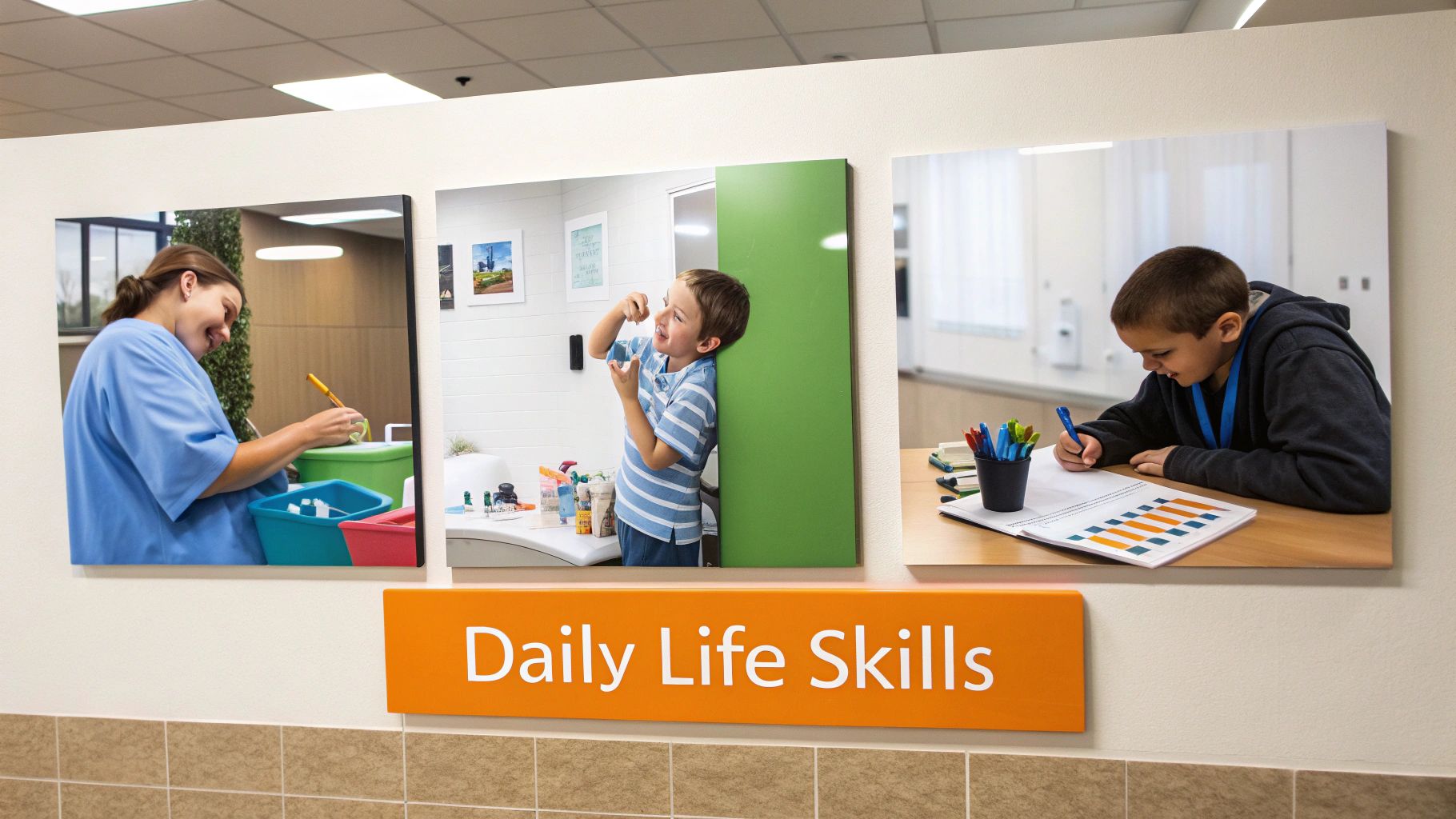
Occupational therapy assessments are not a single, one-size-fits-all test. Think of them as a deep dive into specific areas, or domains, that add up to a person's ability to live a full and meaningful life. Just as a mechanic inspects a car's engine, brakes, and electrical system, an OT methodically explores various domains to pinpoint exactly where a breakdown is happening. A challenge in one area, like motor skills, can easily ripple out and affect another, like the ability to get dressed in the morning.
Activities of Daily Living (ADLs)
This is one of the most foundational domains in OT. Activities of Daily Living (ADLs) are the essential self-care tasks we all perform to manage our basic physical needs. They are the building blocks of independence.
A practical assessment here might involve observing a veteran with mobility challenges as they navigate their morning routine. The therapist would look at their ability to safely get out of bed, dress themselves, handle grooming, and prepare a simple breakfast. The actionable insight is identifying specific barriers—is it a balance issue, a problem with fine motor control when buttoning a shirt, or a memory lapse affecting the sequence of tasks?
Motor and Sensory Skills
The motor skills domain covers everything from large movements to precise hand dexterity. An OT will assess both gross motor skills (like walking or lifting) and fine motor skills (like writing or using utensils). For a factory worker recovering from a hand injury, a practical assessment might involve evaluating their grip strength, coordination, and endurance for repetitive tasks to ensure a safe return to their job.
Closely connected are our sensory processing skills—how our nervous system takes in messages from our senses and turns them into appropriate actions and behaviours. An assessment might reveal that a child's struggles in a noisy classroom are not a behavioural issue, but a hypersensitivity to sound. The actionable insight is that noise-cancelling headphones could be a simple, effective solution.
Cognitive and Executive Functions
Cognition is all about how we think, learn, and remember. This is a critical area that assessments occupational therapy professionals investigate thoroughly. For example, a therapist might evaluate a student's organizational skills by observing how they plan homework, manage time, and keep track of school supplies. Challenges here can have a huge impact on academic success.
Executive functions are like the "CEO of the brain," managing complex tasks like planning, problem-solving, and self-regulation. When this domain isn't working optimally, even simple multi-step activities, like following a recipe, can feel completely overwhelming.
A clear evaluation of these mental processes is vital for creating support strategies that actually work. You can explore this topic in more detail in our guide on what is cognitive assessment, which breaks down how these evaluations paint a clearer picture of an individual's mental processing abilities.
To bring it all together, the table below breaks down what each domain covers with a real-world example.
Key Occupational Therapy Assessment Domains and Examples
Assessment Domain | What It Measures | Practical Example |
|---|---|---|
ADLs | Basic self-care abilities needed for daily independence. | Observing an older adult's ability to safely bathe and dress themselves after a hospital stay. |
Motor Skills | Gross and fine motor coordination, strength, and endurance. | Evaluating a patient's hand dexterity to use a fork and knife after a stroke. |
Sensory Processing | How the brain interprets and responds to sensory input. | Assessing a child’s reaction to different textures to understand feeding difficulties. |
Cognition | Memory, attention, problem-solving, and organizational skills. | Testing a client’s ability to manage their medication schedule accurately. |
Vision | How the eyes and brain work together to interpret the world. | Checking a person's visual tracking ability to read a line of text without skipping words. |
Understanding these domains is the first step toward recognizing where support is needed most. From there, therapists can select the right tools to turn these insights into an actionable plan for progress.
Choosing the Right Tools from the Occupational Therapy Assessment Toolkit
Once an OT has a clear sense of the key life domains needing a closer look, the next step is picking the right tools. Every OT has a toolkit packed with various assessments occupational therapy professionals use to gather specific, high-quality information. Knowing which instrument to use is a critical skill that shapes the entire care plan.
Think of it like a carpenter who wouldn't use a sledgehammer to drive a finishing nail. An OT must select an assessment that precisely matches the question they need to answer. This involves a thoughtful blend of different assessment types to build a complete and accurate picture.
Standardized vs. Non-Standardized Assessments
The OT toolkit is broadly divided into standardized and non-standardized tools. The most powerful evaluations almost always use a combination of both to get objective data and rich, personal stories.
Standardized assessments are like a GPS. They have strict rules for administration and scoring, ensuring results are consistent and reliable. This provides hard, quantifiable data that can be compared against established norms.
A Practical Example: The Assessment of Motor and Process Skills (AMPS) is a classic standardized tool. A therapist observes a client doing an everyday task, like making tea, and scores their physical effort, efficiency, and safety against a standardized scale. The actionable insight is a clear, data-driven measurement of their functional ability.
Non-standardized assessments are more like a detailed travel journal. They are flexible and rely on the therapist's skilled observation and interview skills to capture the nuanced, contextual details of how a person functions in their own environment.
A Practical Example: An OT might visit an older adult's home to watch them prepare lunch. The therapist isn't just noting if they can do it, but how. Do they use clever workarounds? Does the kitchen layout help or hinder them? This qualitative insight is crucial for creating practical, person-centred interventions.
The Power of Client-Centred Tools
While objective data is vital, modern OT is deeply rooted in the client's own perspective. Client-centred tools put the individual's priorities front and centre, ensuring therapy goals are truly meaningful.
Leading the charge is the Canadian Occupational Performance Measure (COPM), a globally recognized tool. First published in 1991, it has been translated into over 40 languages. You can learn more at thecopm.ca.
By asking clients to identify and rate the importance of the daily activities they want or need to do, the COPM shifts the focus from the therapist's clinical eye to the client's lived experience. It answers the most important question: "What truly matters to you?"
Another key tool, especially for evaluating cognitive abilities, is the Montreal Cognitive Assessment. For a deeper dive, check out our guide on Montreal Cognitive Assessment instructions to see how it's used.
The art of OT assessment lies in skillfully choosing and combining the right tools. By weaving together standardized data, non-standardized observations, and the client's voice, therapists build a multifaceted understanding that paves the way for effective, personalized care.
Turning Assessment Data Into Actionable Care Plans
An occupational therapy assessment gathers valuable information, but its real power is unlocked when that data becomes a clear, actionable roadmap for recovery. The artistry of an OT lies in weaving together hard numbers from standardized tests with nuanced stories from observation to tell a complete client story. This transforms raw data into a meaningful plan.
This leap from insight to intervention is the cornerstone of providing high-quality quality care services that genuinely meet a person where they are. It’s all about connecting the dots between what the assessment reveals and what the client wants to achieve.
From Observation to Intervention
Let’s get practical. Imagine a client's assessment shows a low score on a standardized memory test. This is just one piece of the puzzle. When combined with the family’s report of missed appointments and burnt food on the stove, a much clearer picture emerges, pointing directly to the need for specific, real-world strategies.
This synthesis leads to targeted, actionable interventions.
The Data: Low memory score + reports of missed appointments.
The Insight: The client struggles with prospective memory—remembering to do things in the future.
The Actionable Strategy: Introduce a digital reminder app on their smartphone for appointments and medication, and spend a session training them on how to use it confidently.
This flow diagram illustrates how OTs funnel different types of information to build a holistic, actionable plan.
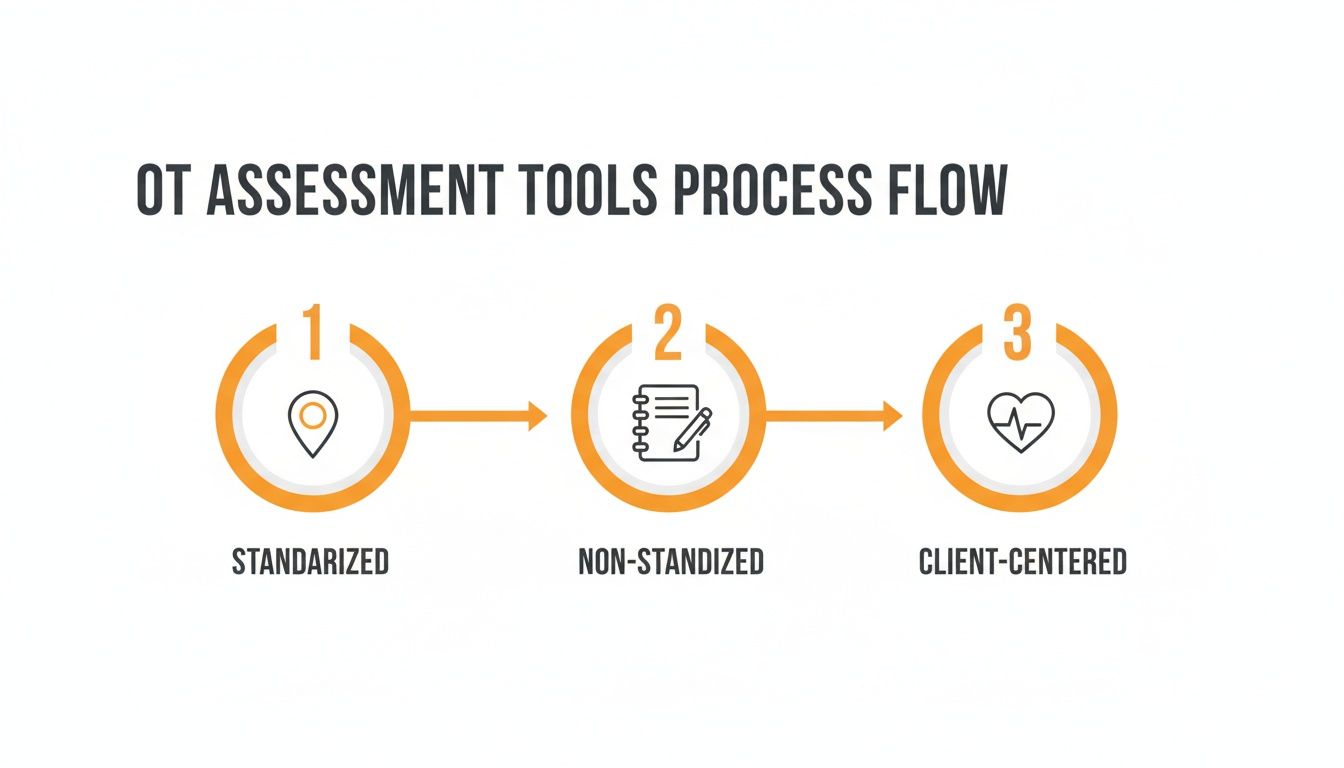
As you can see, the most robust plans are built by integrating precise, standardized metrics with the rich, contextual details that come from observation and listening to the client's own goals.
Creating Collaborative and Clear Goals
Once you've synthesized the data, the next step is building a care plan with clear, jargon-free documentation. The goals must be collaborative, empowering the client and their family to become active partners. This shared ownership is vital for motivation and follow-through.
An effective care plan is a living document, not a static report. It should be written in plain language that everyone on the care team—from the client to their family doctor—can understand and act upon. The goal is clarity, not complexity.
For instance, instead of writing "Improve executive functioning," a collaborative, actionable goal would sound like this: "John will use a weekly planner to independently organize his school assignments four out of five days a week by the end of the month."
This goal is:
Specific: It details what will be done (use a planner for assignments).
Measurable: Success is clearly defined (four out of five days).
Achievable: It’s a reasonable step forward.
Relevant: It directly addresses a challenge from the assessment.
Time-bound: It sets a clear deadline (end of the month).
This approach ensures progress can be tracked effectively. Research highlights its importance; one national survey found that while 68.4% of OTs used standardized assessments for adults with mental disorders, using repeated measures to track outcomes was surprisingly low. By setting clear goals and reassessing progress, therapists ensure the care plan stays effective and provides excellent continuity of care.
Integrating Digital Tools for Modern Assessments
The world of occupational therapy is changing. We’re moving beyond classic paper-and-pencil methods into a more dynamic, data-rich environment. Digital assessment tools are becoming indispensable for therapists who need greater precision, efficiency, and real insight into a client’s functional abilities.
Imagine generating a detailed cognitive profile—covering attention, memory, and processing speed—in under 30 minutes. That’s exactly what’s possible. Platforms like Orange Neurosciences are leading this charge, giving therapists powerful tools that back up their clinical expertise with hard, objective data.
Enhancing Precision and Engagement
One of the biggest wins with digital tools is the incredible precision they bring. These platforms can capture tiny performance details, like response times in milliseconds, that are impossible to track with the naked eye. This objective data removes guesswork and provides a clearer baseline to measure progress.
What’s more, many of these digital assessments are designed like games. This simple shift makes the evaluation process feel less clinical and more engaging for everyone. When a client is enjoying the process, the data we collect is often a truer picture of their abilities.

As you can see, complex cognitive data can be displayed in a clean, straightforward way. This makes it easier for therapists to interpret results and explain them to clients and their families, leading to more collaborative care.
Overcoming the Challenge of Re-testing
One of the most persistent headaches in traditional assessments occupational therapy has been the difficulty of re-testing. Paper-based tests can be a slog to administer and score, making it tough to check progress as often as we'd like. Digital platforms solve this problem.
By automating much of the assessment process, technology makes regular progress monitoring not just possible, but easy. We can consistently track a client’s journey over time, allowing us to make smarter, faster adjustments to their care plan.
This ability to conduct consistent re-assessment is a game-changer. It allows therapists to validate the effectiveness of their interventions in near real-time, ensuring that the therapeutic journey is always heading in the right direction and supported by objective evidence.
Technology is a powerful partner, not a replacement for clinical judgment. It adds a layer of precise, data-driven insight that complements our expertise. To see how these tools work in a real-world setting, check out our deep-dive guide on cognitive assessment online.
Bringing these digital solutions into your practice allows you to provide truly personalized care that’s more efficient, engaging, and effective than ever before. To see how our tools can help, we invite you to visit our website.
What's Next? Putting Modern Assessments Into Practice
Feeling inspired by what's possible with modern occupational therapy assessments? Great. Now it’s time to turn that inspiration into action.
Whether you're a clinician looking to sharpen your practice or an individual advocating for better care, the path forward starts with a single, clear step.
For therapists and clinic owners, embracing digital tools doesn't mean overhauling your practice overnight. The smartest approach is to start small and focused. Consider a pilot program with a specific group—perhaps children with attention challenges or adults recovering from a stroke. This lets you see the real-world impact on your efficiency and their outcomes before a full-scale implementation.
For Therapists and Clinic Owners
Taking that first step is simpler than you might think. A little planning can help you see the benefits firsthand and build confidence in a new way of working.
Pick a Pilot Group: Choose a small cohort of clients whose needs align with the strengths of digital cognitive assessments.
Set Clear Goals: What do you want to achieve? Perhaps it's reducing assessment time, getting better progress-tracking data, or making the process more engaging for your clients.
Book a Demonstration: The best way to understand a platform’s power is to see it in action. This is your chance to ask detailed questions about how it would fit into your practice.
The point of adopting new technology isn’t just to look modern—it's to be more effective. A focused pilot program gives you the concrete data you need to prove how digital tools can elevate your clinical expertise and deliver better results for the people you serve.
Ready to see how objective data can reshape your workflow? We invite you to request a personalized demo of the Orange Neurosciences platform and discover how our tools can bring a new level of clarity to your assessment process.
For Individuals and Parents
As a client or caregiver, you are your own—or your child's—best advocate. Knowing what's possible empowers you to ask for more thorough, objective evaluations.
Before your next appointment, try documenting the specific daily challenges you or your child are facing.
Here's a practical example: Instead of saying, "homework is a struggle," get specific: "It takes over an hour just to start assignments, and he often forgets to write them down in his planner." This detailed information is gold for a therapist—it helps them pinpoint which assessment tools will provide the clearest picture. Don't be shy about asking your OT about the methods they use and whether digital cognitive assessments could offer deeper insights.
By taking these proactive steps, you become a true partner in the therapy journey. Explore Orange Neurosciences to learn more about how our platform supports this collaborative approach to getting better results.
Your Questions About OT Assessments, Answered
Stepping into the world of occupational therapy assessments can feel overwhelming. Whether you're a client, a concerned parent, or a fellow professional, it's natural to have questions. Here are a few common questions with straightforward, practical answers.
How Long Does an Occupational Therapy Assessment Usually Take?
There's no one-size-fits-all answer. An OT assessment is tailored to a person's specific needs, goals, and the complexity of their situation.
A focused assessment for a single issue, like a child's handwriting struggles, might take 60-90 minutes. On the other hand, a comprehensive evaluation for an adult navigating multiple challenges after a traumatic brain injury could take several hours, often split over two or more sessions to prevent fatigue. The timeline is always dictated by what's needed to build an effective and meaningful plan.
What Is the Difference Between an OT Assessment and a Psychological Evaluation?
This is a fantastic question. While they can overlap, they serve very different purposes.
Imagine two experts helping a student who is struggling in class. The psychologist acts as a diagnostician, running tests to determine if a condition like ADHD or a learning disability is present. Their work focuses on diagnosis.
The occupational therapist is the functional strategist. We look at how those challenges impact the student's daily life at school. An OT might observe them in the classroom, analyze how they organize their locker, or see how they manage a multi-step project. The psychologist identifies the "what," while the OT creates the practical game plan for "how" to thrive despite the underlying challenges.
An OT assessment zeroes in on functional performance in real-world contexts. It's less about the clinical label and more about a person's ability to participate meaningfully in the activities that matter most to them—from the classroom to the kitchen.
How Can I Best Prepare for an Occupational Therapy Assessment?
A little preparation can make a world of difference. The best thing you can do is become an active partner. Before the appointment, spend time thinking about and jotting down the specific, day-to-day challenges you or your loved one is facing.
Instead of saying something general like, "Mornings are a struggle," try to get more specific. For example:
Document the details: "Getting dressed takes over 45 minutes because buttoning shirts is so frustrating."
Think about the environment: "The kitchen feels overwhelming, and I can never remember where I put things."
List your goals: "I just want to be able to cook a simple meal for myself again without feeling like it's unsafe."
Bringing these detailed observations helps the therapist focus the assessment on what truly matters to you. It transforms the evaluation into a collaborative strategy session, ensuring the final plan is perfectly aligned with your personal goals.
Ready to move beyond guesswork and unlock clearer therapeutic outcomes with precise, data-driven insights? Orange Neurosciences provides advanced digital tools that empower therapists and clients alike. Discover how our platform can enhance your assessment process by visiting us to request a demo.
Orange Neurosciences' Cognitive Skills Assessments (CSA) are intended as an aid for assessing the cognitive well-being of an individual. In a clinical setting, the CSA results (when interpreted by a qualified healthcare provider) may be used as an aid in determining whether further cognitive evaluation is needed. Orange Neurosciences' brain training programs are designed to promote and encourage overall cognitive health. Orange Neurosciences does not offer any medical diagnosis or treatment of any medical disease or condition. Orange Neurosciences products may also be used for research purposes for any range of cognition-related assessments. If used for research purposes, all use of the product must comply with the appropriate human subjects' procedures as they exist within the researcher's institution and will be the researcher's responsibility. All such human subject protections shall be under the provisions of all applicable sections of the Code of Federal Regulations.


© 2026 by Orange Neurosciences Corporation