The Ultimate Guide to Assessment of Learning Disabilities
Jan 7, 2026
An assessment for a learning disability isn't just a test; it's a comprehensive process designed to build a complete picture of an individual's unique learning profile. Through a combination of cognitive and academic tests, observations, and background information, we can pinpoint the specific processing challenges that get in the way of learning.
This isn’t about applying a label. It’s about uncovering the specific strengths and weaknesses that define how a person learns best, giving us a clear, actionable path forward.
The Modern Roadmap to Understanding Learning Profiles

Trying to navigate the world of learning disabilities can feel overwhelming. But getting a timely, thorough assessment is one of the most powerful, game-changing actions you can take for a student's confidence and future success.
Think of it like a skilled detective gathering clues. A proper evaluation never hinges on a single test score. Instead, it pulls together information from multiple sources to create a complete, actionable picture of a learner’s abilities. This process has moved far beyond slow, outdated methods. Today’s dynamic, evidence-based approaches focus on creating a clear roadmap—one that pinpoints precisely where the learning process breaks down and gives us the actionable insights needed to build real, effective support.
The Team Behind the Assessment
A comprehensive assessment is truly a collaborative effort. It brings together a multidisciplinary team of experts, with each member contributing a unique perspective to build a holistic understanding of the student. This team often includes:
School Psychologists: These professionals are the ones who administer and interpret the key cognitive and educational tests.
Special Education Teachers: They provide crucial, practical insights into how a student performs in the classroom and their day-to-day learning behaviours.
Parents or Guardians: No one knows a child better. Their input on development, history, and home life is invaluable.
Speech-Language Pathologists: If language is a concern, these specialists assess everything from processing to communication skills.
Unfortunately, just getting access to these professionals can be a major hurdle. In Canada, for instance, there is only about 1 school psychologist for every 1,119 students—more than double the recommended standard. This shortage creates a serious bottleneck, delaying essential support for the students who need it most.
To give you a clearer picture of the entire journey, here’s a breakdown of what a thorough assessment involves.
Key Stages of the Learning Disability Assessment Process
Assessment Stage | Primary Goal | Key Activities & Practical Examples |
|---|---|---|
Initial Screening | To quickly identify students who may be at risk for a learning disability and need further evaluation. | Review of school records, classroom-based assessments, teacher and parent questionnaires. For example, a teacher might use a universal reading screener on all students in September. |
Formal Testing | To measure specific cognitive processes and academic skills using standardized, norm-referenced tests. | Administration of tests like the WISC-V or WIAT-4 to assess IQ, memory, attention, and academic achievement. A psychologist might test a student's working memory by having them repeat a sequence of numbers backwards. |
Data Collection | To gather a complete picture of the student's learning profile from multiple perspectives. | Classroom observations, interviews with parents and teachers, analysis of work samples. For example, the assessor may observe how the student tackles a multi-step math problem in class. |
Diagnosis & Reporting | To synthesize all collected data, determine if a learning disability is present, and create a detailed report with actionable steps. | A multidisciplinary team reviews all findings, makes a diagnosis, and writes a comprehensive report with practical recommendations, like suggesting specific assistive technology. |
Each step builds on the last, ensuring that the final conclusions are well-rounded, evidence-based, and, most importantly, helpful.
Formal and Informal Data
The assessment process carefully blends information from different sources to ensure the conclusion is sound. To really get a handle on these different diagnostic tools, it’s useful to explore the differences between informal and formal assessments. Both play a vital role in identifying learning challenges.
A modern assessment views a learning disability not as a deficit, but as a different way of processing information. The evaluation is the key that unlocks how to teach a specific student effectively, turning confusion into a clear plan for academic and personal growth.
This guide will walk you through every step of this journey, from spotting the early warning signs to building practical support plans. We'll explore the critical role of cognitive functions—a topic you can dive deeper into with our guide on what is cognitive assessment. By the end, you'll have the confidence and knowledge to advocate for your student, ensuring they get the understanding and tools they need to truly thrive.
Identifying Early Warning Signs by Age Group
Spotting a potential learning disability isn’t about making a diagnosis on your own. It's about recognizing consistent patterns that show a child might be struggling in a way that’s different from their peers.
Think of these signs not as proof, but as important clues. An actionable first step is to document specific examples. For instance, instead of saying "he struggles with writing," note down, "he took 45 minutes to write one sentence for his book report and crumpled up the paper three times." This simple action lays the groundwork for a productive conversation with teachers and specialists.
Learning challenges look different as a child grows. A subtle difficulty in preschool can morph into a major roadblock in high school. By understanding the common red flags at each stage, you can step in earlier with the right support.
Preschool Signs (Ages 3-5)
In these early years, challenges often pop up in the building blocks of learning: language and motor skills. Every child develops at their own unique pace, but if you see persistent difficulties in a few key areas, it’s worth paying closer attention.
Language development is a big one. A preschooler who might need extra support could consistently say "pasghetti" for "spaghetti" long after their friends have figured it out. They might also have a really tough time learning and remembering the alphabet.
Other practical examples include:
Difficulty with Rhyming: When you read a rhyming book like Dr. Seuss, they struggle to hear or create simple rhymes like "cat" and "hat."
Trouble with Sequences: Finding it hard to remember the days of the week or follow simple, multi-step instructions like "please get your shoes and then put your coat on."
Fine Motor Skill Delays: Consistently having trouble holding a crayon correctly, using scissors to cut along a line, or buttoning up a coat.
Primary School Signs (Grades 1-4)
Once formal schooling starts, the signs of a learning disability often become much clearer. This is when kids are building their foundation in reading, writing, and math.
You might notice a child who is bright and chatty in conversation but finds it incredibly difficult to get their thoughts down on paper. This gap between oral and written expression is a classic red flag. For instance, they might tell you a wonderfully imaginative story but only manage to write a few disconnected sentences.
Common signs in this age group are:
Phonics and Spelling Issues: Persistently confusing letter sounds, reversing letters like 'b' and 'd' after age 7, or spelling "friend" as "fred" repeatedly.
Math Concept Struggles: Difficulty grasping simple concepts like greater than/less than, telling time on an analog clock, or remembering basic math facts like 5+3.
Reading Avoidance: Showing a strong resistance to reading. You'll often hear complaints that it's "boring," or they might act out during reading time to avoid the task.
It’s absolutely crucial to remember that these challenges are not about a lack of effort. Understanding the real reason behind these behaviours is the first actionable step toward finding solutions that actually work.
Middle and High School Signs (Grades 5-12)
In the later grades, schoolwork gets a lot more complex, demanding executive functions like organization, planning, and abstract thinking. A student who managed to get by before might now find the workload completely overwhelming.
The signs often shift from basic skills to problems with organizing huge amounts of information. A teen might spend hours on homework but forget to hand it in, or study hard for a test only to go blank during the exam.
These aren't signs of laziness; they often point to underlying challenges with processing or memory. Recognizing these patterns is essential to fully understand their learning behaviour and get them the support they need to succeed.
Navigating the Multidisciplinary Assessment Process
Starting a formal assessment for a learning disability can feel like trying to solve a puzzle without the box top. It’s not a single test but a methodical journey, involving different experts who each contribute a crucial piece. Think of it like a detective story: you start with a few clues and gradually build a complete picture of what’s going on.
This step-by-step approach creates a deep and nuanced understanding of a student's unique learning profile. Knowing the phases of this journey will help you feel more confident and prepared.
The Initial Screening
The first step is always an initial screening. This is a quick check-in, much like a school nurse testing everyone’s vision. It’s not a diagnosis. Its real job is to flag students who might be falling behind and could use a closer look.
Screening often involves a mix of things: reviewing school records, looking at classroom work, and using simple questionnaires for parents and teachers. A practical example is a teacher using a universal screening tool to check the reading fluency of their entire class. If a student's score is well below the benchmark for their grade, they’re identified for further observation. This is an actionable data point that starts the conversation.
This flowchart gives you a sense of how early signs can evolve, often leading to a screening referral.
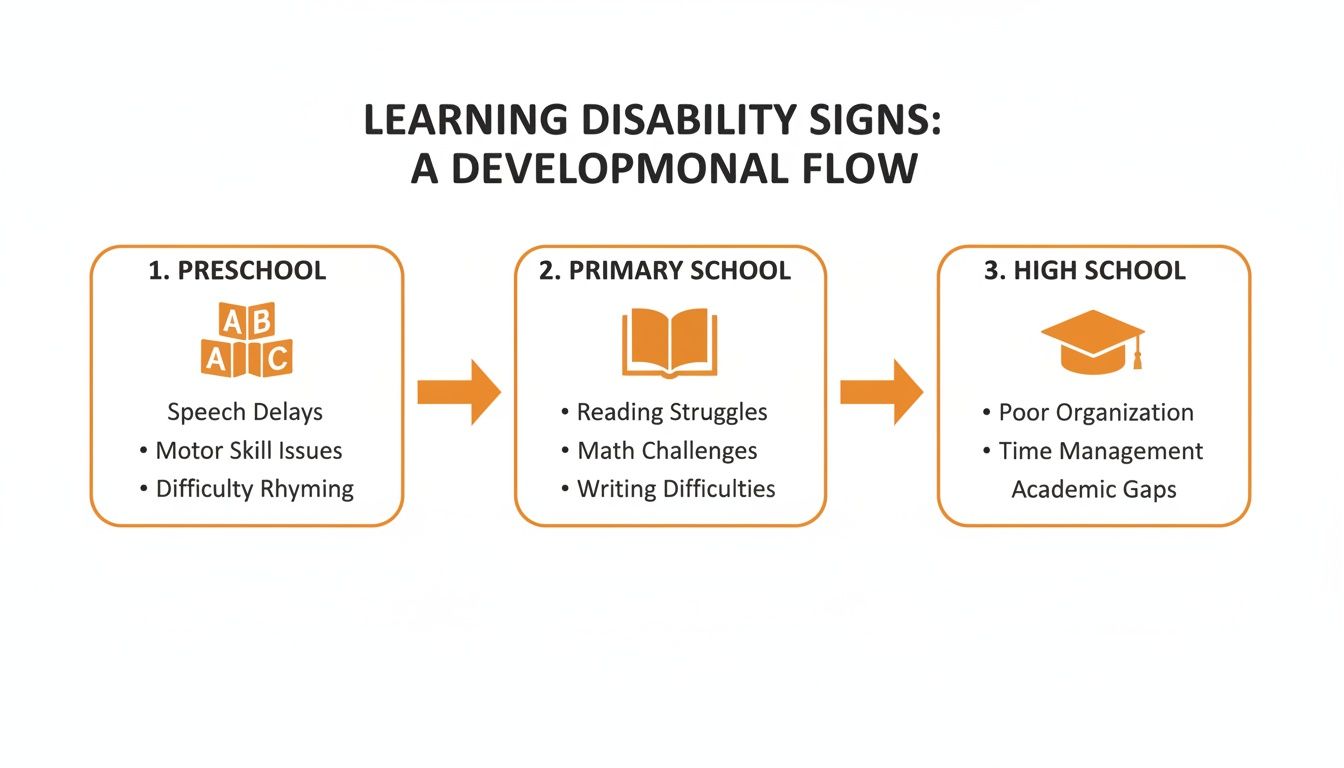
As you can see, what starts as a subtle difficulty with foundational skills can snowball into more obvious academic and organizational challenges as school gets more demanding.
The Comprehensive Evaluation
If the screening raises a red flag, the next stage is a comprehensive evaluation. This is the heart of the assessment process. A qualified professional, usually a psychologist, will conduct a series of standardized tests. These are designed to measure two key things: cognitive abilities (how the brain processes information) and academic achievement (what the student has learned in school).
This stage is absolutely vital because learning disabilities often stem from specific cognitive skill deficits. For example, a weakness in working memory can make it nearly impossible to solve a multi-step math problem. The evaluation provides the hard data needed to pinpoint exactly where those difficulties lie, offering clear insights for intervention.
Gathering Observational Data
Numbers on a test sheet are critical, but they don't tell the whole story. That's why gathering observational data is so important. This is where we get input from the people who see the student in their natural environments every day: parents and teachers.
A teacher might share detailed notes about how a student struggles to stay focused during silent reading or avoids speaking up in group work. A parent can offer priceless insight into how long homework really takes or the frustration that builds at home. For instance, a parent noting that their child spends two hours on a 20-minute math worksheet provides powerful context to the test scores.
A complete assessment blends the what from standardized testing with the why from observational data. This synthesis is what transforms a set of scores into a meaningful and actionable learning plan.
The Differential Diagnosis
The final step is the differential diagnosis. This is where the assessment team methodically rules out other conditions that can mimic a learning disability. For example, is a student's trouble focusing due to an attention disorder like ADHD, an anxiety issue, or an underlying processing weakness? They can all look surprisingly similar.
The team—often a psychologist, educators, and other specialists—analyzes all the data together. They look at everything from the cognitive test scores to the parent interviews to figure out the primary reason for the student’s struggles. This careful detective work ensures the diagnosis is accurate, which in turn ensures the student gets the right kind of support. To learn more about this in-depth clinical process, you can explore our guide on what is neuropsychological assessment. It is this final, analytical step that builds a solid foundation for targeted and effective interventions.
How to Interpret Standardized Test Results
Getting a thick assessment report full of acronyms and charts can feel overwhelming. Instead of giving you clarity, it often feels like you need a secret decoder ring just to figure out what it all means.
The key is to remember these scores aren't a final judgment. They are clues that, when pieced together, create a detailed map of a student’s learning profile. This section will help you read that map, moving past the jargon to understand what the numbers are really telling you. Getting a handle on these results is the first actionable step toward becoming their best advocate.
Demystifying Scores and Percentiles
Think of standardized test scores like a growth chart at the paediatrician's office. When the doctor says a child is in the 75th percentile for height, it doesn’t mean they got a 75% on a height test. It simply means they are taller than 75 out of 100 kids their age.
Most assessment reports you'll see use two main types of scores:
Standard Scores: These are usually scaled with an average of 100. A score between 90 and 110 is considered average. A score below that suggests an area of weakness.
Percentile Ranks: This number, from 1 to 99, shows how a student performed compared to their peers. A percentile rank of 50 is exactly average.
A practical example: if a student gets a standard score of 85 in reading fluency, that would place them in the low average range. This isn't a label, but an actionable insight: it tells the team that a targeted intervention for reading speed is likely needed.
Understanding Common Assessment Tools
While a whole battery of tests can be used, a few pop up constantly. Each one is designed to measure specific cognitive or academic skills, like different tools in a mechanic’s toolbox.
To help you get familiar, we've put together a simple breakdown of some of the most common tests and what they're designed to measure.
Common Assessment Tools and What They Measure
Test Name (Example) | Area Assessed | Actionable Insight It Provides |
|---|---|---|
WISC-V | Cognitive Ability (IQ) | Measures underlying thinking and reasoning skills. A low score in Working Memory can explain why a student struggles to follow multi-step directions. |
WIAT-4 | Academic Achievement | Assesses skills in reading, writing, and math. A low score in Math Problem Solving suggests the student needs strategies for breaking down word problems. |
CTOPP-2 | Phonological Processing | Pinpoints difficulties with the sound structure of language. A low score here is a strong indicator of dyslexia and points toward the need for a phonics-based reading program. |
Beery VMI | Visual-Motor Integration | Checks how well the eyes and hands work together. A low score explains struggles with handwriting and suggests the need for occupational therapy exercises. |
Seeing how the scores line up across these different tools is where the real insights happen. A low score on a specific WIAT-4 subtest, for instance, gives educators a huge clue. For a deeper dive into that particular tool, our guide on the WIAT achievement test offers more detailed insights.
An assessment report is more than just a list of scores; it’s a narrative. The goal is to connect the dots between cognitive processing scores and academic performance to understand the why behind a student’s struggles and what to do about it.
By grasping what these tests measure, you can turn a dense document into a powerful tool. This knowledge empowers you to ask smarter questions and ensure the final support plan truly targets your student's specific needs.
To learn how we can help you get a clearer picture of cognitive skills, please contact us at Orange Neurosciences to explore our assessment solutions.
An assessment report is just the starting line. Its real value comes alive when we translate that data into meaningful, everyday support. This is where insights become actions, turning a diagnostic document into a practical roadmap for success.
The focus shifts to building a powerful support system built on two complementary pillars: interventions and accommodations. Understanding the difference is key to advocating effectively for a child.
Interventions and Accommodations Unpacked
Think of it this way: an intervention is like a targeted training program designed to build a specific skill. An accommodation is like a helpful tool that levels the playing field without changing the core task.
Here’s a practical example:
Intervention: A student with dyslexia might join a structured, multi-sensory reading program that explicitly teaches phonics. This is an active strategy to improve their fundamental reading ability.
Accommodation: That same student could be given text-to-speech software. This tool reads digital text out loud, allowing them to access grade-level science content while their reading skills are being built.
Once you’ve interpreted the assessment results, the next actionable step is to implement targeted interventions. This might involve exploring effective strategies to improve reading comprehension skills to provide that direct support. Both pieces—interventions and accommodations—are essential.
Building an Individualized Education Plan (IEP)
In the Canadian school system, the Individualized Education Plan (IEP) is the formal document that lays out exactly how a student will be supported. It’s a collaborative game plan developed by the school team, the parents, and often the student themselves.
An IEP isn’t just a wish list; it’s a legal commitment from the school to provide specific supports. It turns discussion into direct action.
While IEPs vary by province, they almost always include these key components:
Present Levels of Performance: A clear snapshot of the student's current skills, pulled directly from the assessment findings.
Annual Goals: Specific, measurable goals. For instance, "By June, the student will be able to write a five-sentence paragraph with correct capitalization and punctuation in 4 out of 5 trials."
Specific Services and Supports: The heart of the IEP. It spells out the exact interventions (e.g., "30 minutes of small-group reading instruction, 3x per week") and accommodations (e.g., "access to a calculator for all math tests").
Measurement and Reporting: A clear plan for how progress will be tracked and shared with parents.
A successful IEP hinges on collaboration. Parents should arrive at meetings prepared with specific examples from the assessment and a clear vision of the supports they feel are necessary. When challenges involve executive functions, knowing how to support these skills is vital. You can get practical ideas from our detailed guide on how to improve executive function. Armed with this knowledge, you can steer the conversation from diagnosis to decisive, impactful action.
How AI Is Bringing Assessments Into the Modern Era
The traditional assessment process, while thorough, can be painfully slow. With shortages of school psychologists, waitlists are ballooning, leaving students waiting months for the support they need right now. This is where technology is stepping in—not to replace experts, but to give them a powerful boost.

AI-powered tools are fundamentally changing the assessment of learning disabilities by delivering rapid, objective, and accessible cognitive screening. Think of them as a triage nurse in a busy emergency room; they quickly identify which students need the most immediate attention from a specialist. This provides an immediate, actionable insight for schools managing their resources.
Speeding Up the Path to Support
The biggest win here is speed. Instead of waiting months for a full evaluation, AI-driven platforms can provide critical insights in a fraction of the time, allowing educators to make faster, more confident decisions about who to prioritize.
For instance, a platform like OrangeCheck can generate a detailed cognitive profile in under 30 minutes. It uses engaging, game-based activities to measure the cognitive engines that power learning, including:
Working Memory: The mental sticky note we use to hold and work with information.
Processing Speed: How quickly a student can take in and make sense of information.
Attention: The ability to focus on what matters and tune out the noise.
Executive Functions: Critical skills like planning, organizing, and managing impulses.
This quick, evidence-based screening gives the school team an objective snapshot of a student's cognitive landscape. It takes the guesswork out of the equation and provides concrete data to work with from day one.
AI assessment tools aren't a replacement for a clinician’s judgment; they're a supplement that sharpens it. They provide objective data to reduce diagnostic delays and get support to students faster.
Making Data-Driven Decisions a Reality
This approach helps schools shift from a reactive, waitlist-driven model to a proactive one. When a teacher raises a concern, a rapid cognitive screen can quickly help determine if the struggles might be linked to underlying cognitive weaknesses. This allows for immediate, targeted strategies in the classroom while the student awaits a full evaluation.
Ultimately, modernizing the assessment process ensures that no student falls through the cracks. It builds a much-needed bridge between the first sign of a struggle and meaningful, timely intervention.
To see how these evidence-based tools can streamline your assessment workflow and help you make faster, better-informed decisions, visit our website at Orange Neurosciences to explore our solutions.
Common Questions About Learning Disability Assessments
As a parent or educator, stepping into the world of learning disability assessments can feel like learning a new language. It’s a path filled with questions and uncertainty.
Our goal here is to provide actionable answers to the most common questions we hear, so you can feel confident and prepared for the journey ahead.
How Long Does an Assessment Take?
A full, comprehensive assessment for a learning disability can take anywhere from a few weeks to several months.
Why such a wide range? It comes down to the availability of qualified professionals and the complexity of the student's needs. The traditional route involves interviews, multiple testing appointments, report writing, and a final feedback meeting. It's thorough, but it takes time. This is exactly why rapid screening tools are so valuable—they help identify which students need a full evaluation urgently, letting support start much sooner.
School Versus Private Evaluations
It's crucial to understand the difference between an assessment done through the school system versus one you seek out privately. They serve different primary purposes.
School Assessment: This is provided by the school district at no cost. Its main goal is to determine if a student is eligible for special education services and to help build an effective educational plan.
Private Evaluation: This is paid for by the family and is done by a registered psychologist. These evaluations tend to be more in-depth, provide a specific clinical diagnosis (like dyslexia), and offer detailed recommendations for both school and home.
While a private report can be a powerful advocacy tool, the school may still need to conduct its own assessment before it can formally provide services or create an Individualized Education Plan (IEP). An actionable tip: always ask the school what information they require to avoid redundant testing.
The key difference is the question they're trying to answer. A school assessment asks, "Does this student qualify for our specific services?" A private evaluation asks, "What is this student's complete learning profile and what do they need to thrive everywhere?"
Can a Learning Disability Be Cured?
This question comes from a place of deep care. The short answer is no; learning disabilities are lifelong, neurodevelopmental conditions. They aren't an illness that can be cured.
But that's far from the end of the story. With the right targeted interventions and supportive accommodations, individuals with learning disabilities can develop incredibly effective strategies to manage their challenges. They can—and do—achieve amazing things. The goal of an assessment of learning disabilities isn't to find a cure. It's to build a personalized toolkit of skills and supports that lets the individual's strengths shine through, minimizing the disability's impact.
Getting answers to these questions is the first step toward becoming a strong, informed advocate. At Orange Neurosciences, we create evidence-based tools that bring clarity to cognitive profiles, giving you the objective data you need to take the next step. Visit us at https://orangeneurosciences.ca to see how our solutions can support your journey, or email our team to discuss your specific needs.
Orange Neurosciences' Cognitive Skills Assessments (CSA) are intended as an aid for assessing the cognitive well-being of an individual. In a clinical setting, the CSA results (when interpreted by a qualified healthcare provider) may be used as an aid in determining whether further cognitive evaluation is needed. Orange Neurosciences' brain training programs are designed to promote and encourage overall cognitive health. Orange Neurosciences does not offer any medical diagnosis or treatment of any medical disease or condition. Orange Neurosciences products may also be used for research purposes for any range of cognition-related assessments. If used for research purposes, all use of the product must comply with the appropriate human subjects' procedures as they exist within the researcher's institution and will be the researcher's responsibility. All such human subject protections shall be under the provisions of all applicable sections of the Code of Federal Regulations.


© 2026 by Orange Neurosciences Corporation