Triarchic Theory of Intelligence: A Concise Clinical Guide

You've seen it happen. A learner freezes on timed tests, then solves messy everyday problems with calm, inventive judgment. A patient may look “average” on paper, yet keep a household organised, manage social friction, and adapt quickly when routines change. That gap is exactly why the triarchic theory of intelligence still matters, because it asks a simpler question than traditional IQ tests do, what can this person do in real life, in this context, with these constraints?
Why Traditional IQ Scores Miss the Full Picture
A child can miss several items on a standardised test and still show striking competence in day-to-day problem solving. A clinician may also meet an adult whose score looks unremarkable, but whose judgment, adaptability, and practical sense are obvious the moment they talk through a real problem. That mismatch is the starting point for Sternberg's critique of IQ-centric thinking, and it's why the theory remains so useful in education and care.
The triarchic theory of intelligence was built to capture what a single score leaves out. In Sternberg's model, intelligence is not one fixed number, it's the ability to adapt to, shape, and select environments across the lifespan, which is a far broader target than decontextualised test performance. For readers who want a simpler way to think about developmental screening, a related overview of mental age concepts can help frame why performance often varies by task and setting, even when one label tries to flatten it all into a number, as discussed in this mental age test guide.
That real-world gap is what clinicians and educators see most clearly. A student may struggle with timed worksheets yet excel when asked to explain a concept, build something, or solve an everyday dilemma. A narrow score can miss that pattern, but triarchic thinking makes room for it.
Practical rule: if a score and daily functioning point in different directions, trust the full behavioural picture, not the test alone.
A broader view also changes intervention. Instead of asking whether someone is “smart enough”, the better question is which kinds of thinking are already strong, which ones need support, and which settings allow competence to show up. That's the value of the triarchic frame, it moves assessment from a label to a plan.
The Origins and Architecture of Triarchic Intelligence
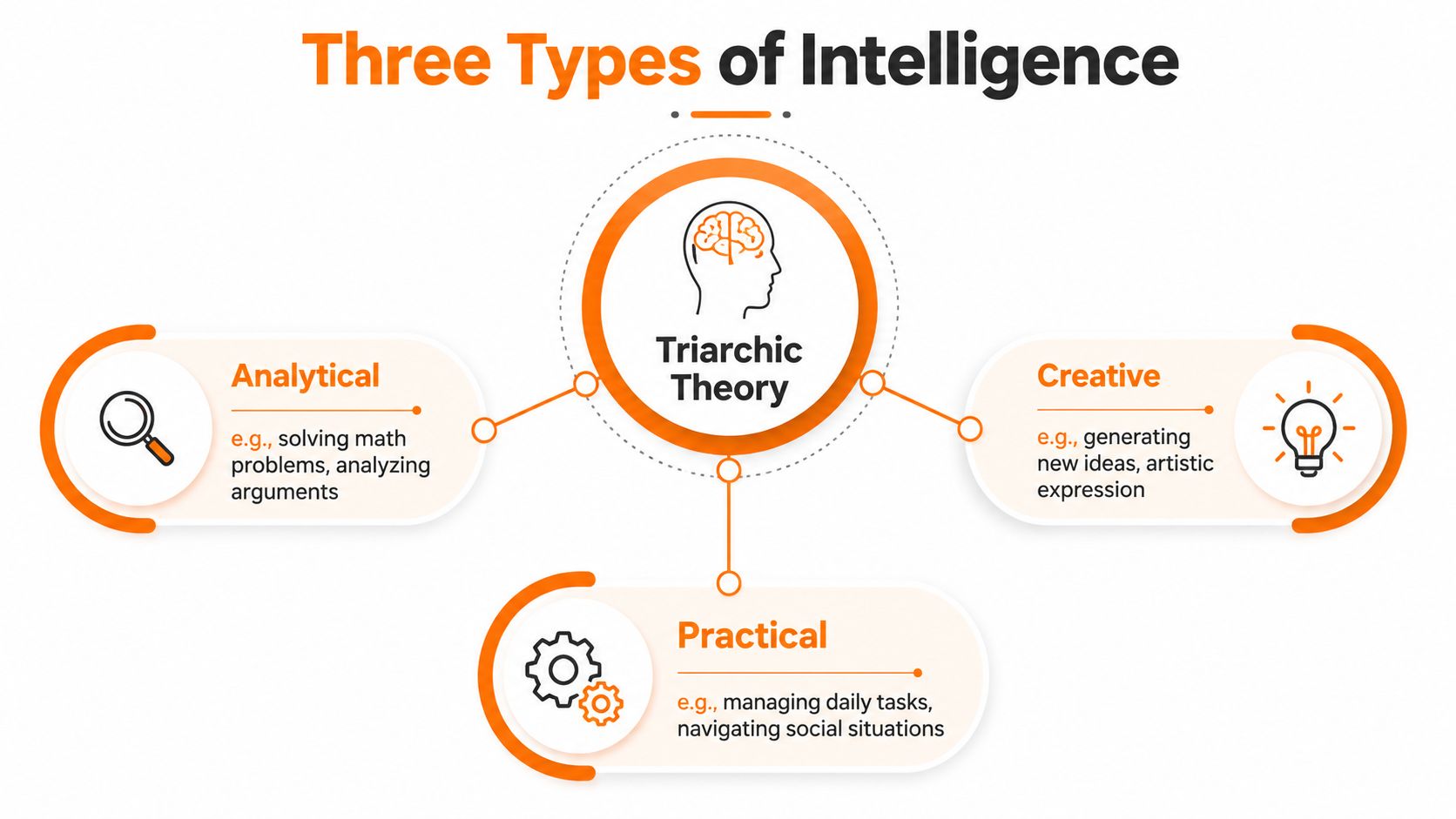
A classroom teacher notices a familiar pattern. One student reasons carefully through written problems, another comes up with original examples, and a third applies classroom ideas well in everyday situations. Sternberg built the triarchic theory of intelligence to explain why those differences matter, and why a single score cannot capture them well. His model was introduced in the mid-1980s and framed intelligence as three interacting capacities, analytical, creative, and practical intelligence, rather than one fixed mental quantity.
Three subtheories, one working model
Sternberg also described the theory through three subtheories that fit together. The componential subtheory addresses the mental processes involved in solving problems, including metacognitive, performance, and knowledge-acquisition components. The experiential subtheory focuses on how people respond to tasks that range from novel to highly familiar, and the contextual subtheory looks at how intelligent behaviour changes across sociocultural context.
The structure becomes easier to grasp through a clinical example. A student meets a new puzzle and has to make sense of it, which draws on experiential processing. The same student then checks options, monitors a plan, and revises a strategy, which reflects componential thinking. Later, the student uses that solution in a classroom or work setting, which shows contextual intelligence in action, as outlined in a university-based explanation of the model (TECFA's triarchic theory summary).
Modern cognitive-assessment platforms can make this architecture visible instead of leaving it abstract. A digital task can separate how a person reasons through a problem, how they respond to novelty, and how they transfer a solution into a familiar setting. For clinicians and educators, that creates a more usable profile, especially when paired with broader descriptors of cognitive skills define in practice, as explained in this guide to cognitive skills.
Why the structure matters in practice
The model works because it does not force one behaviour into one bucket. A person can be strong in one area and weaker in another, yet still function well if the environment lets them use strengths and compensate for weaknesses. That emphasis on strengths, correction, and compensation remains central to Sternberg's broader definition of intelligence in educational materials (StateUniversity.com's triarchic overview).
In practice, that means clinicians should look beyond right-or-wrong items. Strategy use, response speed, tolerance for novelty, and fit with the setting all matter. A modern assessment workflow can record those patterns side by side, then turn them into targets for intervention, classroom support, or follow-up testing. It also helps teams align interpretation with compliance tips from PracticeReady when reports need to support evidence-based decisions.
Analytical, Creative, and Practical Intelligence Explained
A good way to understand the triarchic theory of intelligence is to stop thinking about people as “either smart or not” and start asking how their thinking works under different demands. Sternberg's model describes three partially distinct competencies, and the practical one is especially important because it concerns how people adapt to, shape, and select environments rather than just answer decontextualised questions, as explained in a technical summary of the theory (Triarchic theory of intelligence).
Analytical intelligence in action
Analytical intelligence is the part most familiar to schools and clinics. It shows up when someone breaks a problem into pieces, evaluates evidence, spots errors, and chooses the best answer from competing options. A child who solves puzzles carefully, or a patient who methodically weighs medication choices and side effects, is using this kind of thinking.
This is the type most closely aligned with conventional testing. It's useful, but it only captures part of the picture. A person can be very strong analytically and still struggle when the task becomes messy, open-ended, or socially complex.
Creative intelligence in action
Creative intelligence is what helps people deal with novelty. It appears when someone sees an unusual connection, invents a workaround, or reframes a stuck problem in a fresh way. A student who writes a clever story after struggling with a prompt, or a clinician who finds a new way to explain a concept that finally clicks for a family, is showing creative competence.
For practitioners, this matters because novelty often reveals capacity that routine tasks conceal. If a person thinks well only when the answer is already known, that's not the full range of human competence. Creative intelligence lets you see whether someone can generate something useful when the path isn't obvious.
Practical intelligence in action
Practical intelligence is the most visibly ecological of the three. It appears when a person reads a room, makes a workable plan, and adjusts to context without needing a formal rulebook. A learner who compensates for weak memorisation by organising notes, asking for reminders, and using a structured environment may be showing more practical intelligence than a score would suggest.
If you want a clinician-friendly reminder, compliance tips from PracticeReady can be useful, not as a slogan, but as a prompt to keep decisions tied to evidence, context, and the actual workflow a patient or student can sustain.
Intelligence shows itself when a person can move from knowing, to trying, to functioning in the real setting that matters.
For a related framework on cognitive skill domains, this cognitive skills guide can help readers translate broad theory into observable abilities. That's the bridge practitioners need, not more labels, but clearer behavioural signals.
Measuring Triarchic Intelligence in Practice
The measurement challenge is straightforward to state and hard to solve. Traditional psychometrics often privileges speed, verbal reasoning, and right-answer performance, while triarchic assessment tries to capture how a person thinks across different demands. That shift is especially useful when educators and clinicians want to know not just whether someone can answer, but whether they can apply, transfer, and adapt.
UConn's National Research Center on the Gifted and Talented reported that triarchic teaching, balancing analytical, creative, and practical instruction, improves achievement on both conventional and performance assessments “at all grade levels” and across “a range of socioeconomic and achievement levels” of students (UConn NRCGT newsletter). That matters because it supports a multidimensional view of assessment, not a one-test verdict.
Triarchic assessment principles
Principle | Application |
|---|---|
Teach analytically | Use tasks that require comparison, error detection, and evidence-based reasoning. |
Teach creatively | Add open-ended prompts, alternative solutions, and novel extensions. |
Teach practically | Include real-world scenarios, role-based decisions, and context-sensitive tasks. |
Capitalise on strengths | Let the person show competence through the mode they handle best. |
Compensate for weaknesses | Use supports, scaffolds, or alternate routes to reduce avoidable failure. |
Match assessment to instruction | Test in ways that reflect how the material was actually taught. |
Value diverse abilities | Treat different forms of competence as meaningful, not secondary. |
These principles are described as part of a larger triarchic teaching framework in the same educational research tradition, and they're useful because they turn theory into classroom and clinic design. If you're comparing assessment options, the cognitive assessment examples page offers a practical way to think about task formats without reducing people to a single score.
The main caution is consistency. A triarchic profile is only useful when the tasks are clear, the scoring is disciplined, and the interpretation stays tied to observed performance. When those conditions are met, the assessment becomes more than measurement, it becomes guidance for instruction and care.
Criticisms, Debates, and Ongoing Questions
The triarchic theory has real strengths, but it isn't beyond criticism. The biggest debate is whether analytical, creative, and practical intelligence are separate capacities or just different expressions of broader cognitive ability in different settings. That question matters because it affects how confidently clinicians can interpret a profile.
Measurement validity is another issue. A task can look “creative” or “practical” on the surface while still being heavily influenced by language, schooling, motivation, or familiarity with the testing format. That's where careful design matters, especially when practitioners are trying to compare results across ages, cultures, or clinical groups.
The sociocultural problem
The contextual side of the theory is both one of its strengths and one of its hardest problems. If intelligent behaviour depends on sociocultural context, then cross-cultural assessment needs to be handled carefully, because what counts as adaptive in one setting may not look the same in another. That makes the model more humane, but also more demanding for standardisation.
For clinicians, the answer isn't to abandon the theory. It's to apply it cautiously, with attention to ecological fit, cultural relevance, and test-retest stability. A useful reminder on that front is a guide to test-retest reliability, since a profile that changes randomly isn't helping anyone.
Clinical caution: if a task depends too much on cultural familiarity, it may be measuring exposure as much as intelligence.
The balanced view is simple. Triarchic thinking is most valuable when the goal is richer understanding of functioning, but it should be used alongside careful psychometric judgment, not as a replacement for it. That's how practitioners keep the theory honest while still benefiting from its broader lens.
Applying Triarchic Theory with Digital Cognitive Assessment
Modern digital platforms make the triarchic idea easier to use because they can capture multiple domains of performance quickly and in a more structured way. That matters in clinics, schools, and research settings where waiting weeks for fragmented testing can slow decisions. A recent model of digital cognitive work often includes attention, memory, executive function, perception, processing speed, and eye-hand coordination, which gives practitioners a broader behavioural map than a single summary score can provide.

From theory to workflow
The key shift is operational, not philosophical. A digital platform can present structured tasks, track response patterns in real time, and help a clinician see where a person is strong, where they need support, and where the environment may be masking ability. That lines up well with the triarchic emphasis on capitalising on strengths and compensating for weaknesses, because the tool can support both interpretation and intervention planning.
For teams building cleaner workflows, AI Powered Revision is a useful reference point, since the same logic applies to review cycles, decision support, and iterative improvement. The point isn't automation for its own sake, it's faster iteration with better cognitive data.
Why digital delivery changes the picture
A good digital system also reduces the burden of administration. It can make repeated assessment more feasible, which matters when you want to monitor change rather than rely on a one-time snapshot. For clinicians, that means better follow-up. For educators, it means earlier support adjustments. For researchers, it means cleaner pre-post comparison without dragging every participant through a labour-intensive process.
If you're comparing platforms, the cognitive assessment tools guide is a useful place to think about what kinds of data you need. The practical question is no longer whether someone has “good” cognition in general, but which cognitive components are driving performance in this setting.
Assessment Items, Interventions, and Research Directions
A triarchic assessment works best when the task design is deliberate. A clinician or educator can sample analytical intelligence with items that ask a person to compare options, spot errors, or explain why one answer fits better than another. Creative intelligence is better captured with open-ended prompts that admit more than one plausible response. Practical intelligence calls for scenario-based items that ask what the person would do in a school, clinic, family, or workplace setting, where judgment has to fit the context.
Sternberg's broader definition of intelligence is not limited to test performance. It is the ability to achieve success in life according to one's personal standards and within one's sociocultural context, with success depending on capitalising on strengths and correcting or compensating for weaknesses. That makes intervention planning triarchic as well, because the score is only the starting point for deciding what to change in the person's environment, instruction, or supports.
A practical toolkit looks like this:
Assessment items: ask a student to solve a new problem, explain a workaround, and apply the result in a realistic context.
Interventions: pair direct teaching with scaffolds that support the weakest area while preserving the person's strongest route to success.
Research directions: test longitudinal change, compare cultural groups carefully, and link performance patterns to neural or behavioural markers where protocols allow.
Modern cognitive-assessment platforms can make these ideas operational instead of leaving them as theory. They can present mixed task types, record response patterns across item families, and show whether a person's difficulty lies in reasoning, originality, or everyday application. That is useful for teams that need to connect interpretation with action. A student who reasons well but struggles under time pressure may need a different plan from one who generates strong ideas but cannot use them in a familiar setting.
The most useful next step is a workflow that links assessment to action. If a person's profile shows strong practical reasoning but weak timed performance, the plan should not stop at the score. It should adjust instruction, supports, and review points so the person can function better in the environments that matter.
Orange Neurosciences' Cognitive Skills Assessments (CSA) are intended as an aid for assessing the cognitive well-being of an individual. In a clinical setting, the CSA results (when interpreted by a qualified healthcare provider) may be used as an aid in determining whether further cognitive evaluation is needed. Orange Neurosciences' brain training programs are designed to promote and encourage overall cognitive health. Orange Neurosciences does not offer any medical diagnosis or treatment of any medical disease or condition. Orange Neurosciences products may also be used for research purposes for any range of cognition-related assessments. If used for research purposes, all use of the product must comply with the appropriate human subjects' procedures as they exist within the researcher's institution and will be the researcher's responsibility. All such human subject protections shall be under the provisions of all applicable sections of the Code of Federal Regulations.


© 2026 by Orange Neurosciences Corporation