Cognitive Skills Define: A Guide to How Our Brains Work
Jan 24, 2026
Cognitive skills are the essential mental abilities your brain relies on to think, learn, remember, and maintain focus. They are the fundamental tools that let you process the world around you and successfully handle whatever life throws your way.
What Are Cognitive Skills and Why Do They Matter?
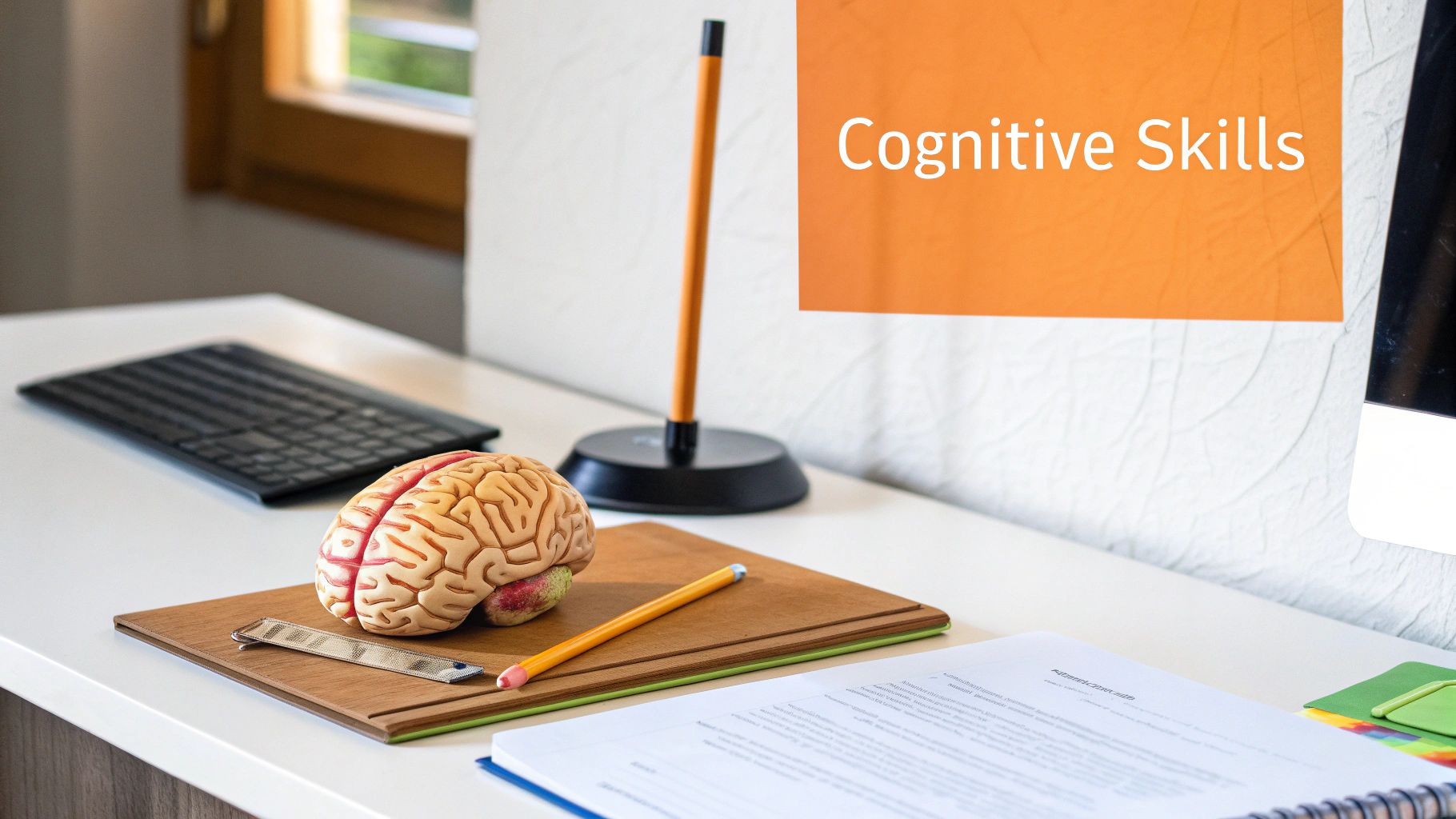
Think of your brain as a high-powered computer. If the brain itself is the hardware, then cognitive skills are the operating system—the software running quietly in the background, making everything else possible. They are the unseen building blocks for learning, reasoning, and problem-solving, involved in every single thing you do.
Driving a car, for example, feels like a single activity, but it’s actually a complex dance of multiple cognitive skills firing simultaneously. Your attention filters out a buzzing phone, your perception processes road signs in a split second, and your executive functions help you make rapid-fire decisions to stay safe. A practical insight here is that improving even one of these skills, like your sustained attention, can make you a safer, more confident driver.
The Brain's Orchestra
A great way to picture this is to imagine your cognitive abilities as a finely tuned orchestra. Each skill represents a different section of instruments, all playing in harmony.
Attention is the conductor, expertly directing focus where it’s needed most.
Memory is the string section, holding the core melody and recalling past performances.
Reasoning and Logic are the brass, providing powerful, structured sound.
Processing Speed is the tempo, setting the pace for how quickly the music is played.
If one section is out of tune or falls behind the tempo, the entire performance suffers. This is why when we seek to define cognitive skills, we must see them not as separate tools but as a deeply integrated system. Even a small dip in processing speed can make it harder for memory to keep up, affecting everyday tasks like following a fast-paced conversation.
Core Cognitive Skills at a Glance
These mental processes aren't just abstract concepts; they're the engine behind our daily actions. The table below breaks down some of the most critical skills and how they show up in real life, offering actionable ways to think about them.
Cognitive Skill | What It Does | Practical, Actionable Example |
|---|---|---|
Attention | Filters distractions and maintains focus on a task. | Actively ignoring notifications to finish a work report in a noisy café. |
Memory | Encodes, stores, and retrieves information. | Remembering a grocery list without writing it down after using a mnemonic device. |
Logic & Reasoning | Solves problems and makes sense of information. | Assembling flat-pack furniture by following the diagrams step-by-step. |
Processing Speed | The time it takes to perceive and respond to information. | Quickly hitting the brakes when a car stops suddenly in front of you. |
Executive Functions | Manages planning, organization, and decision-making. | Creating a schedule and to-do list to manage a multi-step project at work. |
Understanding this interplay is key, as a weakness in one area often has a ripple effect on others.
Cognitive Skills in Everyday Action
These skills are woven into the fabric of our lives. A child in a classroom depends on sustained attention to absorb a lesson. A manager uses executive functions to map out a quarterly budget. An older adult relies on memory to keep track of their medication schedule.
To get a better sense of how these abilities take shape from our earliest years, it’s helpful to understand the principles of cognitive development.
Cognitive skills define our ability to interact with and make sense of our environment. Understanding them is the first step toward identifying challenges and providing effective support, whether in a clinical setting, a school, or at home.
Because these skills are so fundamental to our functioning, assessing them provides a powerful window into overall brain health. For clinicians, educators, and caregivers, having objective data on cognitive performance is a true game-changer. It moves us beyond guesswork and offers clear insights, paving the way for targeted support that can make a meaningful difference.
Our complete guide on the definition of cognitive skills explores this topic in greater detail. This foundational knowledge is the starting point for creating effective care plans and supporting lifelong mental wellness.
A Deep Dive Into the Six Core Cognitive Abilities
While all our cognitive skills work together in harmony—much like an orchestra—it’s helpful to understand what each individual "instrument" does. When we talk about cognitive skills, we're really breaking down the core mental processes that form the foundation for every thought and action we take.
Let's look at the six pillars that make up your mental architecture, moving past the jargon to see how they show up in your day-to-day life.
Think of attention as your brain's internal spotlight. It's the skill that lets you zero in on writing an email while filtering out the chatter of a busy office. Actionable insight: You can strengthen this skill by practicing mindfulness or using time-blocking techniques to train your brain to hold focus.
Next up is memory, which acts like your brain’s own personal library. It’s not just about cramming facts for a test. A practical example is recalling a colleague's name, the steps to a recipe you tried last week, or the familiar route to your favourite coffee shop.
The Brain’s Management Team
Then you have the more sophisticated skills that direct our behaviour. These higher-order abilities are what truly elevate our cognitive performance from basic functioning to thoughtful action.
Executive Functions: This is the CEO of your brain, in charge of planning, organising, and making smart decisions. Every time you map out a project, juggle multiple deadlines, or talk yourself out of an impulse purchase, your executive functions are running the show. For a closer look, check out our guide on how to improve executive function.
Perception: This skill is all about interpreting the raw data your senses collect. A great practical example is how your brain makes sense of what you see, hear, and feel—turning random flashes of light into a recognizable face or a jumble of sounds into a familiar song.
Among these core abilities, the capacity for effective decision making under pressure is a critical skill for navigating life’s complexities. This ability relies heavily on sharp executive functions and quick processing speed working in tandem.
Speed and Coordination in Action
These final two skills are all about how efficiently your mind and body work together. They dictate how quickly and accurately you can respond to the world around you.
Processing speed is like your mental internet connection. A practical example is how quickly you keep up with a rapid-fire conversation or react instantly when a ball is thrown your way. If it’s slow, you might feel like you’re always a step behind.
Finally, eye-hand coordination is the seamless teamwork between what you see and what you do. This skill is vital for almost everything, from typing on a keyboard and signing your name to playing an instrument or catching a set of keys tossed from across the room.
Each of these six abilities is distinct, yet they are all deeply interconnected. Together, they weave the complex and incredible tapestry of our cognitive health.
How Cognitive Skills Evolve Across the Lifespan
Our mental abilities aren't set in stone. Think of them less like a fixed photograph and more like a living, breathing thing that grows and adapts from infancy all the way through our senior years. Just as our bodies change, our cognitive skills follow a predictable—yet deeply personal—developmental journey.
Childhood and adolescence are really the "boom" years for the brain. This is when foundational skills like attention, memory, and processing speed develop at an incredible pace. A toddler meticulously stacking blocks isn't just playing; they're building crucial eye-hand coordination. A teenager debating a topic in class is sharpening their executive functions and reasoning abilities in real time.
This map gives a great visual of some of the most essential cognitive skills we all rely on every single day.
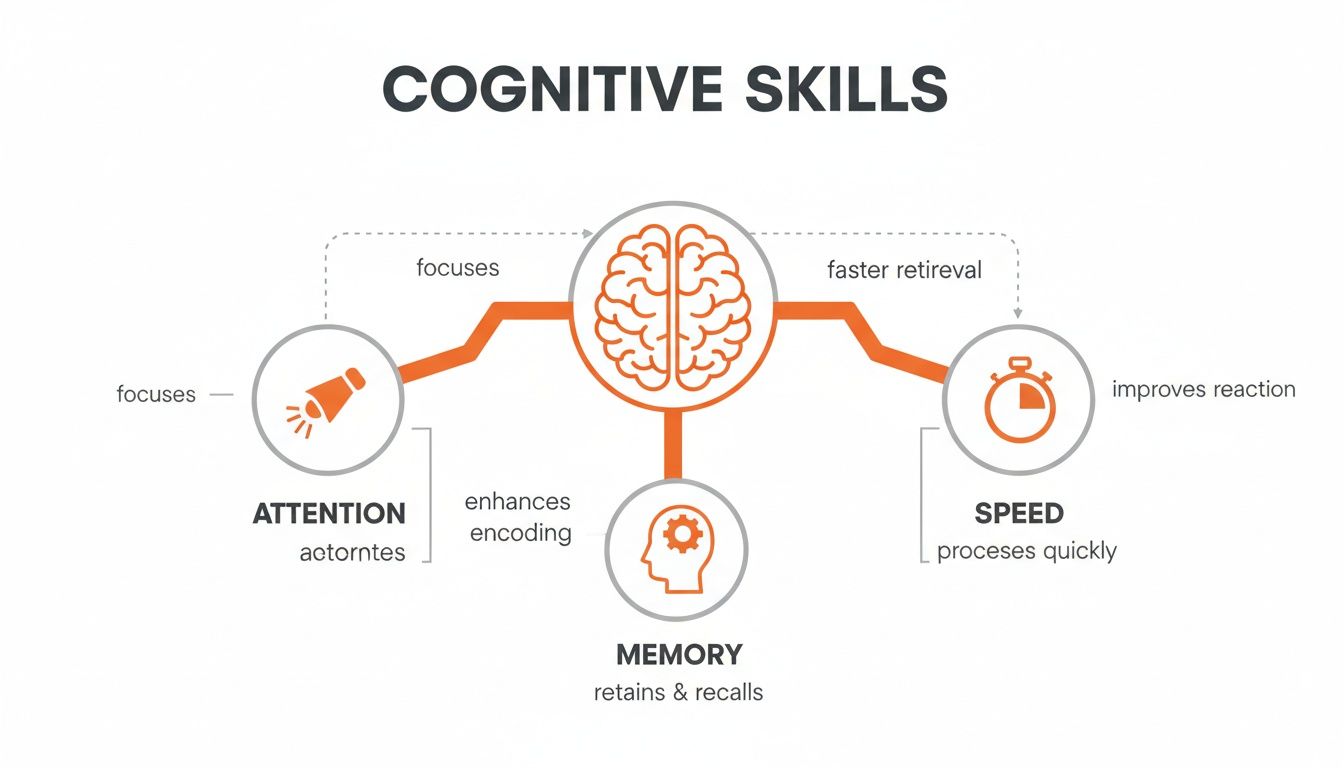
It really highlights how attention, memory, and speed are distinct but interconnected, all branching out from our core cognitive engine.
Cognitive Shifts in Adulthood
As we move into early adulthood, our skills related to planning and complex decision-making hit their peak. This is when the prefrontal cortex—the brain's "CEO"—fully matures, giving us better impulse control and the ability to think strategically about the long term. It’s no wonder so many people find their early twenties to be a time of major personal and professional growth.
But as the years go by, it’s natural for some cognitive functions to begin a gradual decline. It's completely normal for processing speed to slow down a bit, or for recalling a name or a specific fact to take a little more effort. While these small shifts are a typical part of aging, more significant changes can be a sign of underlying issues.
Cognitive impairment impacts a notable portion of the adult population, directly linked to declines in memory, executive function, and perception. Data from California showed that 11.4% of adults aged 50 and older perceived some form of cognitive impairment, with over a quarter reporting it interfered with their daily activities. Read the full analysis of cognitive impairment data in California adults.
This really drives home the importance of monitoring cognitive health throughout our lives.
Understanding the typical trajectory helps clinicians and caregivers distinguish between normal, age-related changes and signs that might warrant a closer look. You can learn more about how cognitive abilities are measured across different age groups in our guide to the mental age test. Recognising these patterns early is the first, most crucial step toward providing timely and effective support.
Recognizing Early Signs of Cognitive Challenges

Spotting a potential struggle with a cognitive skill is the crucial first step toward getting the right support. These changes are rarely dramatic. Instead, they often show up as small, consistent shifts in daily behaviour that are easy to overlook if you don't know what you're looking for.
The key is to move past vague labels and learn to see the specific, observable actions.
A practical example is with memory issues, which are much more than just misplacing your keys now and then—we all do that. A more telling sign is a consistent pattern of forgetting important, recent conversations or asking the same questions over and over. This points to a potential hitch in the brain's ability to encode or retrieve short-term memories.
These early indicators can pop up in any of the core cognitive domains. By understanding what to watch for, clinicians and family members alike can see when it’s time for a proactive assessment.
Observing Changes in Everyday Tasks
Often, noticing cognitive difficulties simply comes down to paying attention to routine activities. A task that was once effortless may suddenly demand more concentration or take a lot longer to finish.
Here are a few practical examples of what to watch for in daily life:
Executive Function: Someone who was always a meticulous planner might now struggle to organize a simple family dinner. You could notice they have a hard time breaking down a trip-planning process into manageable steps, or they can't follow a multi-step recipe they’ve made a hundred times.
Processing Speed: This often appears as a general "slowing down." Following the plot of a fast-paced movie becomes a chore, or they take much longer to respond in conversations. It has nothing to do with intelligence; it's about the time it takes for their brain to process and react to new information.
Attention: A classic sign is having a hard time filtering out distractions. Maybe they can't finish a chapter of a book because of background noise or frequently lose their train of thought mid-sentence when talking in a group.
An actionable insight is that recognizing these signs is not about diagnosing a problem. It’s about gathering observations. It frames the need for an assessment as a positive, proactive step toward understanding someone's needs and providing targeted support.
Ultimately, defining cognitive skills also means understanding what it looks like when they weaken. Catching these red flags early creates a vital window of opportunity to intervene with effective strategies.
At Orange Neurosciences, we believe objective data is the key to clarity. If you've noticed these signs in a loved one or a patient, our tools can provide a precise cognitive snapshot to guide what comes next. Explore our assessment solutions to see how we turn observations into actionable insights.
Modern Tools for Measuring Cognitive Performance
The world of cognitive assessment has changed dramatically over the years. We’ve moved from lengthy, paper-and-pencil tests to rapid, objective digital platforms that deliver insights in minutes, not weeks.
For decades, the standard involved hours of manual testing and scoring. While these methods were foundational, they created a frustrating delay between the assessment itself and any real, actionable steps. Imagine waiting weeks to get a clear picture of someone's cognitive health. Today's digital tools have thankfully made that a thing of the past.
Now, a comprehensive and precise cognitive snapshot can be generated in under 30 minutes. This gives clinicians immediate data to inform care plans, eliminating the lag time that once slowed everything down. The shift isn't just about speed, either. It’s about getting a cleaner, more reliable picture of a person's abilities by removing the potential for human error or subjective bias in scoring.
The Digital Advantage in Detail
Traditional tests have long been the bedrock of cognitive science. A great example is the California Critical Thinking Skills Test (CCTST), a well-regarded tool used to measure reasoning abilities, especially in higher education. It provides a score on a 100-point scale and rates specific skills like analysis and inference. You can discover more about the CCTST's granular metrics to see how deeply it breaks down the components of critical thinking.
But these traditional methods have their limits. Where modern platforms really shine is in their ability to capture data points that were once impossible to measure. They can track micro-responses with millisecond accuracy, offering powerful insights into abilities like processing speed and attention control. That kind of detail was simply out of reach for paper-based tests.
Here’s a look at how the two approaches stack up.
Comparing Cognitive Assessment Methods
When you put traditional and modern digital assessments side-by-side, the differences become crystal clear. It's a leap forward not just in technology, but in what’s possible for patient care.
Feature | Traditional Assessments | Modern Digital Platforms |
|---|---|---|
Time to Complete | Can take several hours over multiple sessions. | Typically completed in 20-30 minutes. |
Scoring Method | Manual scoring, which is slow and can be prone to human error. | Automated, real-time scoring that is objective and consistent. |
Data Granularity | Provides broad scores for major cognitive domains. | Captures fine-grained data, including reaction times and error patterns. |
Accessibility | Requires a trained administrator in a specific physical setting. | Can often be administered remotely on a tablet or computer. |
The takeaway is simple: digital tools offer a faster, more precise, and more accessible way to understand cognitive function, providing a richer dataset for clinicians to work with.
From Measurement to Actionable Insights
This evolution has profound implications for care. By getting quick, data-driven results, clinicians can make faster, more informed decisions. They can pinpoint specific areas of cognitive weakness with a high degree of confidence and immediately start building a targeted support plan.
The goal of modern assessment isn’t just to measure, but to guide. Objective data turns a general concern—like "difficulty concentrating"—into a specific, measurable target, such as a deficit in sustained attention.
This move from observation to objective data is a game-changer. For a deeper dive into the mechanics and benefits of these tools, you can explore our complete guide on what is cognitive assessment.
Understanding how these platforms work is the key to appreciating how they are transforming cognitive care—making it more efficient, precise, and personalized than ever before.
From Cognitive Assessment to Actionable Care Plans

A cognitive assessment is only as good as the action it inspires. While gathering objective data is the critical first step, its true power is unlocked when those insights are translated into a personalized, effective care plan. This is where the numbers and metrics really come to life, forging a clear and practical path forward.
Think of the assessment results as a detailed map of an individual's cognitive landscape. It clearly shows you the peaks—the areas of strength—and the valleys where a bit of extra support is needed. A thoughtfully designed care plan uses this map to build bridges over those valleys, creating new pathways to success.
This process allows us to move beyond a general observation, like a "concentration problem," and deliver targeted interventions. Instead, a plan can be built around a specific, measured deficit in sustained attention.
Turning Data Into Daily Support
The beauty of a data-driven plan is its precision. Every single intervention is directly tied to a measured cognitive skill, making sure support is focused where it will have the greatest impact. It’s an approach that makes care both efficient and incredibly effective.
Here are a few concrete examples of how assessment data can shape a care plan:
Attention Deficit: If an assessment flags a challenge with sustained attention, the plan might include targeted, game-based digital therapy designed to strengthen that focus. It could also mean simple environmental adjustments, like setting up a distraction-free homework corner for a student.
Processing Speed Challenge: For someone with slower processing speed, the plan could recommend specific accommodations. At school, this might look like allowing extra time on tests. In the workplace, it could mean providing meeting agendas ahead of time so they have more time to prepare.
Memory Weakness: When memory is a concern, the plan could introduce mnemonic strategies or the use of digital reminder apps to offload some of the cognitive burden. Structured daily routines can also be a game-changer, reducing the demand on working memory.
A truly actionable plan is not static; it’s a living document. The initial assessment provides a baseline—a starting point from which to measure growth. Regular re-assessment is key to tracking progress and fine-tuning the plan over time.
This dynamic cycle of assessment, intervention, and re-evaluation ensures that care remains responsive to the individual's changing needs. It gives clinicians and caregivers a clear view of what’s working and what isn’t, creating a truly personalized care journey. To learn more about how data informs treatment, explore our guide on cognitive therapies.
At Orange Neurosciences, our platform is designed to close that loop between assessment and action. We provide the clear, objective data needed to build these powerful, targeted care plans. Visit our website for more information or contact us to see how we can help.
Burning Questions About Cognitive Skills
Let's tackle some of the most common questions we hear about cognitive skills. Getting clear answers can give you the confidence to take the next step, whether you're exploring your own cognitive health or supporting someone you care about.
How Often Should Cognitive Skills Be Assessed?
This really comes down to the individual’s specific situation and goals. There's no one-size-fits-all answer.
For a child showing signs of developmental concerns, an annual assessment is a great practical step to track their progress and make sure their support strategies are actually working. Someone recovering from a brain injury, on the other hand, might need more frequent check-ins to closely monitor their rehabilitation journey.
And what about healthy adults? Establishing a baseline and then checking in every few years is a fantastic, proactive way to stay on top of long-term brain health. With modern digital tools, these regular check-ups are quick, objective, and surprisingly easy to do.
Can You Really Improve Your Cognitive Skills?
Absolutely. One of the most incredible things about the brain is its ability to change and rewire itself, a process called neuroplasticity. Just like lifting weights builds muscle, targeted training can strengthen specific cognitive functions at any age.
An actionable insight is that when you learn a new instrument, play a complex strategy game, or use a personalized digital cognitive therapy program, you're literally building new connections in your brain. This directly boosts skills like memory, attention, and how you solve problems.
Is a Digital Cognitive Assessment the Same as a Medical Diagnosis?
No, and this is a critical distinction. A digital assessment is an incredibly powerful screening and measurement tool, but it is not a diagnosis on its own. It provides highly accurate, objective data that gives a clinician a clear picture of cognitive function.
Think of it as the first, essential piece of the puzzle. It gives healthcare providers the reliable information they need to decide if a full diagnostic workup is warranted and to guide the next steps in a complete clinical evaluation.
Understanding your cognitive profile is the first step toward building a stronger, healthier brain. Orange Neurosciences provides the objective data needed to move from questions to answers.
Discover how our rapid, precise assessments can create a clear path forward. Visit https://orangeneurosciences.ca to learn more or sign up for our newsletter to get actionable cognitive health tips delivered to your inbox.
Orange Neurosciences' Cognitive Skills Assessments (CSA) are intended as an aid for assessing the cognitive well-being of an individual. In a clinical setting, the CSA results (when interpreted by a qualified healthcare provider) may be used as an aid in determining whether further cognitive evaluation is needed. Orange Neurosciences' brain training programs are designed to promote and encourage overall cognitive health. Orange Neurosciences does not offer any medical diagnosis or treatment of any medical disease or condition. Orange Neurosciences products may also be used for research purposes for any range of cognition-related assessments. If used for research purposes, all use of the product must comply with the appropriate human subjects' procedures as they exist within the researcher's institution and will be the researcher's responsibility. All such human subject protections shall be under the provisions of all applicable sections of the Code of Federal Regulations.


© 2026 by Orange Neurosciences Corporation