What Is a Mental Age Test and What Does It Really Mean?
Dec 25, 2025
Ever heard of a mental age test? It's a term that gets thrown around a lot, often conjuring up images of a single, scary number that's supposed to define someone's intelligence forever. But that’s a huge misconception.
A mental age test isn't about finding your "brain age." Instead, think of it as a developmental benchmark—a way to compare an individual's cognitive performance against the average performance of a specific age group. It’s a tool designed to offer insights, not to stick a permanent label on someone.
What a Mental Age Test Actually Measures
So, what does one of these tests really tell us? It's far more nuanced and helpful than you might think. The best analogy is a reading level assessment you’d see in school.
Imagine a third-grader who reads at a fifth-grade level. We recognize they're ahead of their peers in that specific skill, but it doesn't change the fact that they're still eight years old. A mental age test works the same way. It provides a snapshot of where someone's cognitive skills are in relation to their age group at that moment. It's simply a comparison, not a final verdict on their lifelong potential.
Beyond a Single Number
One of the biggest myths is that mental age is a definitive measure of "genius" or "deficit." The reality is, having a mental age that's different from your chronological age is just one piece of the puzzle. For a trained professional, it offers valuable clues into how a person learns, reasons, and processes the world around them.
Instead of boiling everything down to one score, modern assessments look at a whole profile of cognitive skills. These key areas usually include:
Verbal Reasoning: How well someone can understand and use language to think through problems. For example, can a child explain the similarity between a cat and a mouse?
Problem-Solving Skills: The approach an individual takes when faced with a new or unfamiliar challenge, like figuring out how to complete a complex puzzle.
Working Memory: The brain's "sticky note" for holding and working with information temporarily. A practical example is remembering a phone number long enough to dial it. For a closer look, you can learn about how a digit span test measures this crucial skill.
Comprehension: The ability to understand complex ideas and follow instructions accurately, such as assembling a toy by following a multi-step manual.
A Tool for Insight, Not a Final Verdict
Let’s make this real. Say a 10-year-old child completes a series of tasks and successfully handles ones that are typically mastered by an average 12-year-old. In this case, their mental age would be considered 12. This doesn't magically turn them into a pre-teen; it just tells us their reasoning skills are developing at a faster pace than many of their peers. This insight could lead to providing them with more advanced learning materials.
On the other hand, if that same child found tasks typical for an 8-year-old to be a real struggle, it’s not a sign of failure. It's a signal that they might need different teaching strategies or extra support to thrive. This is an actionable insight; for instance, a teacher could break down instructions into smaller, more visual steps to help them succeed. It’s an indicator, not an indictment.
To help break this down, here’s a quick guide to the core ideas we're talking about.
Key Concepts in Mental Age Assessment
Term | Simple Definition | Practical Example |
|---|---|---|
Chronological Age | Your actual age in years. | A child who is 8 years and 2 months old. |
Mental Age | A score that compares your cognitive performance to the average for a specific age group. | An 8-year-old performing at the level of an average 10-year-old. |
Cognitive Profile | A detailed breakdown of strengths and weaknesses across different skills (e.g., memory, reasoning). | A report showing strong verbal skills but weaker spatial reasoning. |
Developmental Benchmark | A standard or point of reference for measuring progress in cognitive development. | A checklist of cognitive milestones typically reached by age 5. |
These terms help us move away from a single score and toward a more complete picture of an individual's abilities.
The goal of a modern cognitive assessment is not to deliver a score but to create a detailed map of an individual's cognitive strengths and weaknesses. This map guides the creation of effective, personalized support plans.
Ultimately, the most productive way to see a mental age test is as a starting point. The data it provides is the foundation for building targeted interventions that can make a real difference, whether in a classroom or a clinical setting.
At Orange Neurosciences, our tools are designed to turn these cognitive insights into clear, actionable plans. By understanding where the challenges and strengths lie, we can help create a path forward. To see how our platform transforms data into action, visit our website and explore our tools.
The Historical Journey from Binet to Modern IQ
To really get a handle on the modern mental age test, we have to take a trip back in time to early 20th-century Paris. The whole idea wasn’t dreamed up to stick labels on people. It came from a very real, very human need: helping kids who were struggling in school.
At the heart of this story is Alfred Binet, a French psychologist tasked by the Ministry of Education with a profound mission. He needed a reliable way to spot students who required extra support to keep up. He wasn't trying to measure some fixed, unchangeable "intelligence"—he was trying to solve a practical problem for teachers and students.
The Birth of the Mental Age Concept
Binet, working alongside his colleague Théodore Simon, put together a series of tasks graded by age. These weren't abstract brain teasers. They were practical activities that an average child of a certain age should be able to do, like pointing to their nose, defining simple words, or repeating a short sequence of numbers.
By seeing how a child performed, they could assign a "mental age." For example, if a 7-year-old could easily complete tasks that most 9-year-olds could manage, their mental age was considered to be 9. This created a simple benchmark, a way to compare a child’s cognitive development to that of their peers.
This pioneering work started as a tool to help children. In 1905, Binet and Simon tested their methods on around 2,000 Parisian children to find those who needed special educational assistance, laying the groundwork for a century of cognitive assessment. You can dig deeper into the evolution from Binet to Wechsler on Britannica.com.
From Paris to Stanford: The IQ Formula
It wasn’t long before the mental age concept travelled across the Atlantic, where it was picked up by Lewis Terman at Stanford University. In 1916, Terman published the Stanford-Binet Intelligence Scales, which introduced a powerful and enduring idea to the English-speaking world: the Intelligence Quotient, or IQ.
Terman took Binet's benchmark and turned it into a simple, memorable formula that would dominate psychological testing for decades.
IQ = (Mental Age / Chronological Age) x 100
This formula gave everyone a single, easy-to-understand number. Let’s see how it worked with a quick example. Imagine an 8-year-old child who takes the test and performs at the level of a typical 10-year-old.
Mental Age (MA): 10
Chronological Age (CA): 8
Calculation: (10 / 8) x 100 = 125
In this scenario, the child's IQ score would be 125. This ratio-based score provided a standardized way to quantify just how far ahead or behind a child was developmentally compared to their actual age.
This timeline shows how the concept evolved, moving from simple performance assessment to a more holistic, actionable insight.
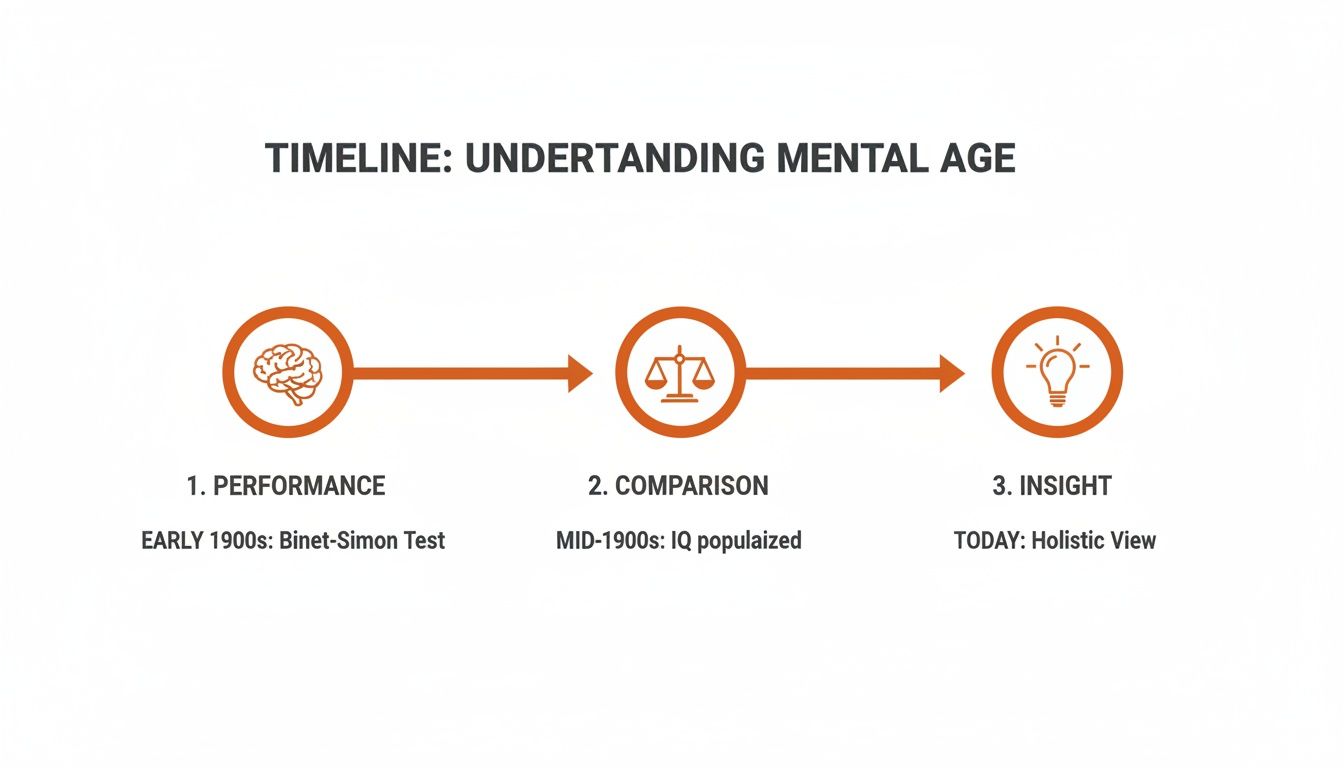
This progression from raw data (performance) to meaningful interpretation (insight) is still a core goal of cognitive assessment today.
The Critical Shift to Deviation IQ
While the ratio IQ formula was a huge step forward, it had some serious flaws, especially when you tried to apply it to adults. Think about it: does it really make sense to say a 40-year-old has a mental age of 50? The concept completely falls apart once cognitive development starts to level off in adulthood.
This problem led to a crucial evolution in cognitive testing. Psychologists like David Wechsler saw the need for a more stable and statistically sound method. His idea was simple but brilliant: instead of comparing a person to a different age group, why not compare them directly to their own age-matched peers?
This new approach, known as deviation IQ, quickly became the gold standard. Here’s the gist of how it works:
Standardization: The test is first given to a huge, representative sample of people in every age group.
Normalization: The scores for each group are then plotted onto a bell curve, with the average score for that group set right at 100.
Scoring: An individual's final score is determined by how much it "deviates" from the average of their specific age group.
This shift in methodology, which underpins virtually all modern cognitive tests, provides a much more accurate and reliable picture of cognitive abilities across a person's entire life. It ensures that an IQ score of 115 means the same thing for a 10-year-old as it does for a 40-year-old: they performed better than the average person in their age bracket.
Understanding this history is key to appreciating why modern tools, like the assessments we’ve developed at Orange Neurosciences, have moved beyond a single, simplistic number to focus on comprehensive cognitive profiles.
How Mental Age Concepts Evolved Into Clinical Practice
The journey from Alfred Binet’s early benchmarks to the modern IQ score was really just the beginning. The true value of a mental age test isn’t found in a textbook; it’s in how these ideas are applied in the real world to help people. Over a century later, those pioneering concepts have evolved into powerful tools that shape today’s clinical and educational support systems.
But the way we use this information has changed dramatically. A clinician today would never just tell a family, "Your 12-year-old has a mental age of 8." It’s a vague and, frankly, unhelpful statement. Modern practice demands a much richer, more detailed picture of an individual's cognitive strengths and real-world functional skills.
This evolution marks a critical shift from a single, often misleading number to a comprehensive, actionable profile. It’s about understanding the whole person, not just reducing them to a test score.
From a Single Score to a Holistic Profile
The biggest change was ditching the old mental-age ratio score. Instead, modern assessments are built on two key pillars that give us a much clearer and more complete picture of a person's needs: deviation IQ scores and adaptive functioning assessments.
Think of it like this: a deviation IQ score tells you how someone's cognitive reasoning stacks up against their direct peers. An adaptive functioning assessment, on the other hand, tells you how they actually use those cognitive skills to manage the demands of daily life.
So, instead of a simple "mental age," a modern report offers specific, concrete data. For example, a report might show an IQ of 95 but also note that the individual struggles with practical daily tasks. This information would guide a support plan focusing on life skills, not just academics. A comprehensive evaluation looks at skills like:
Communication: How well can they express their needs and understand what others are saying?
Social Skills: Are they able to build friendships and read social cues?
Daily Living: Can they manage personal care, handle chores, or stick to a budget?
Motor Skills: How do they manage physical tasks at school or around the house?
This holistic approach became standard practice over several decades. Moving from the mental-age ratio to deviation IQ and adaptive behaviour assessments also transformed how eligibility for support services was determined. By the 1980s and 1990s, clinicians in places like California were reporting deviation IQs and functional descriptions—a practice that was soon reflected in state rules for special education eligibility.
Translating Assessment into Real-World Support
This comprehensive data isn't just for filing away. It’s the key that unlocks practical, real-world resources. The combined insights from cognitive and adaptive assessments are what directly determine a person’s eligibility for essential support services. To see how this works in practice, take a look at our deep dive into what is a neuropsychological assessment.
This modern, data-driven approach is absolutely essential for creating support plans that are both effective and truly personalized.
The screenshot above shows the evolution from simplistic ratios to modern deviation IQs—a change that professionalized cognitive assessment. This shift ensures evaluations are statistically reliable and genuinely useful for planning interventions.
Creating Individualized Education Plans (IEPs)
In a school setting, this detailed profile becomes the bedrock of an Individualized Education Plan (IEP). An IEP is a legal document that maps out the specific goals, services, and accommodations a student needs to have a fair shot at success.
An IEP isn't built on a single mental age number. It's a strategic roadmap created from a detailed cognitive and functional profile, ensuring that every support is tailored to the student's unique pattern of strengths and challenges.
For example, if an assessment shows a student has strong verbal skills but struggles with processing speed, their IEP wouldn’t just say they need "help." It would outline specific actions, like:
Extended time on tests and assignments.
Access to assistive technology, such as text-to-speech software.
Targeted instruction to help build up specific processing skills.
The journey from a basic mental age test to modern cognitive assessment is really a story about the growing sophistication of clinical practice, which you can see in the intricate work of a clinical psychologist. These professionals are tasked with interpreting complex data to build plans that genuinely help people thrive.
Ultimately, the true legacy of the mental age test isn't the test itself. It’s the foundational principle it established: that by understanding cognitive development, we can provide better, more effective, and more compassionate support.
Why a Single Mental Age Number Is Misleading for Adults
Trying to slap a single "mental age" label on a fully grown adult isn't just an old-fashioned idea—it's completely misleading. It fails to capture the rich, complex, and layered reality of how a mature brain actually works. One number simply can't tell the whole story.
Let's use a real-world analogy. You wouldn't tell a 40-year-old they have a "physical age" of 25 just because they can't sprint as fast as they used to. That same person might have far greater endurance, strength, or strategic thinking in a sport than they did in their youth.
Adult cognition is the same. It's not one skill that rises and falls in lockstep. Instead, it’s a dynamic profile of different abilities, each with its own unique developmental timeline.
Your Brain Is a Team of Specialists, Not a Single Athlete
It’s a common mistake to think of the brain as one entity with a single "age." A much better way to look at it is as a team of specialists. Every player on this team has a different role, and each one peaks at a different point in their career.
Think of it this way: a young player might be the fastest sprinter on the field (that’s your processing speed), but a veteran player has a much deeper understanding of strategy and knows every play in the book (that’s your crystallized knowledge and vocabulary). You wouldn't judge the whole team's value based only on the sprinter's speed, would you?
This is exactly why modern neuropsychology has moved on from the idea of a single mental age test for adults. The focus now is on creating a detailed profile that assesses each cognitive "player" on their own terms. This approach gives us a much richer, more actionable picture of an adult’s true cognitive strengths and weaknesses.
How Different Cognitive Skills Peak at Different Ages
Modern research on cognitive aging confirms that our mental skills don't all peak at the same time. In fact, large-scale studies show that different abilities mature and decline on entirely different schedules.
This is a critical point. It turns the idea of a single "mental age" for an adult into something essentially meaningless. It would be like averaging a sprinter's speed, a marathon runner's endurance, and a weightlifter's strength to get a single "athletic score." The result wouldn't tell you anything useful about any of them.
To illustrate this, let's look at how different cognitive domains mature.
Cognitive Skills Peak at Different Ages
Cognitive Domain | Typical Peak Age Range | Implication for Assessment |
|---|---|---|
Processing Speed | 18–19 | Quick reaction times and rapid information processing are sharpest in early adulthood. |
Short-Term Memory | Around 25 | The ability to hold and manipulate information for brief periods is strongest in your mid-twenties. |
Emotional Recognition | 40s–50s | Understanding and interpreting social cues and emotions can continue to improve into middle age. |
Vocabulary | 50s and beyond | Crystallized knowledge, like your vocabulary, often continues to grow well into your later years. |
As the table shows, our brains are constantly changing, with different abilities taking the spotlight at different stages of life. This is why a detailed, multi-faceted assessment is the only way to get a true understanding of an adult's cognitive health.
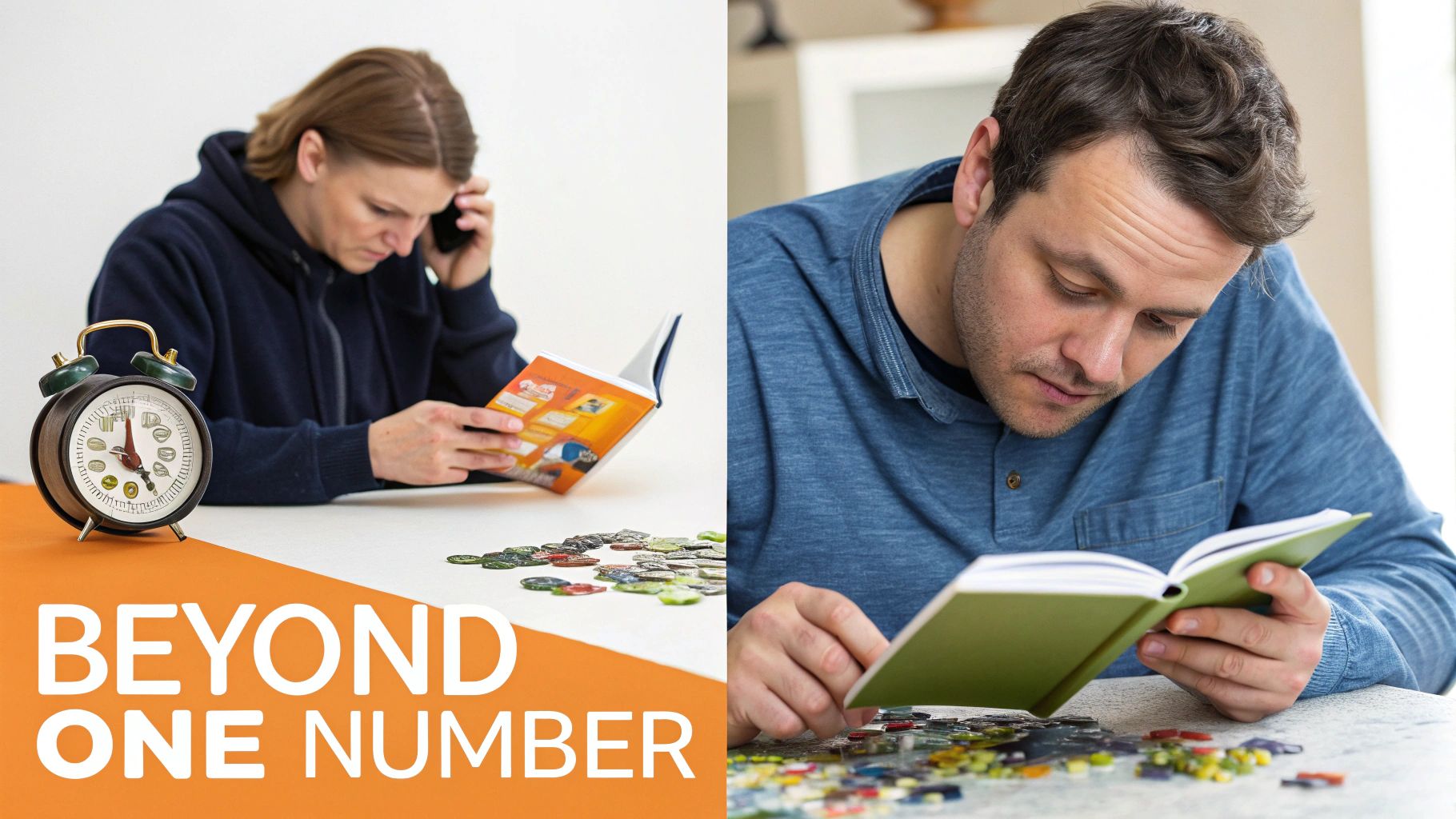
This variety is why a comprehensive profile is so much more helpful than a single number. It recognizes that different tasks, like reading a book (relying on vocabulary) versus solving a puzzle (relying on spatial reasoning), engage different parts of the brain that mature at their own pace.
Why a Detailed Profile Is More Actionable
A detailed cognitive profile is far more valuable because it gives you a clear road map for support and improvement. It’s essential for everything from career development and personal growth to elder care and cognitive rehabilitation. This nuanced view is at the heart of modern assessments, like the detailed evaluations used in a Mini-Mental State Examination (MMSE).
A modern cognitive assessment doesn't ask, "How old is your brain?" It asks, "What are the specific strengths of your cognitive team, and which players might need some extra coaching?"
This approach allows professionals to pinpoint exact areas of need. For instance, a detailed profile might show that someone has excellent verbal reasoning but struggles with working memory. That specific insight allows for targeted interventions—like memory-boosting exercises—that would be completely missed by a vague "mental age" score. A practical action could be teaching them to use mnemonic devices or apps to offload memory tasks, leveraging their strong reasoning skills to implement a new strategy.
Ultimately, a detailed cognitive profile empowers us to move beyond labels and toward targeted, effective action. At Orange Neurosciences, our tools are built to provide this nuanced understanding, giving you the clear, actionable data needed to build on strengths and address challenges effectively. Visit us online to see how a modern profile works.
The Modern Approach to Cognitive Assessment
The old idea of a mental age test has, thankfully, evolved. Best practices in cognitive science today have moved way beyond the limits of assigning a single, often misleading, number. The goal isn't to slap a simplistic "brain age" on someone, but to build a detailed, multi-dimensional cognitive profile.
Think of it like getting your car checked out. You wouldn't trust a mechanic who just listens to the engine and declares, "Yep, that sounds like a 10-year-old car." A real professional plugs in a diagnostic computer, runs tests on the engine, checks the transmission, and analyzes the electrical system separately. This detailed report gives you a precise, actionable understanding of what’s running smoothly and what needs a tune-up.
That’s exactly how modern cognitive assessment works. It gives us a clear map of an individual's unique cognitive landscape, not a vague, one-size-fits-all label.
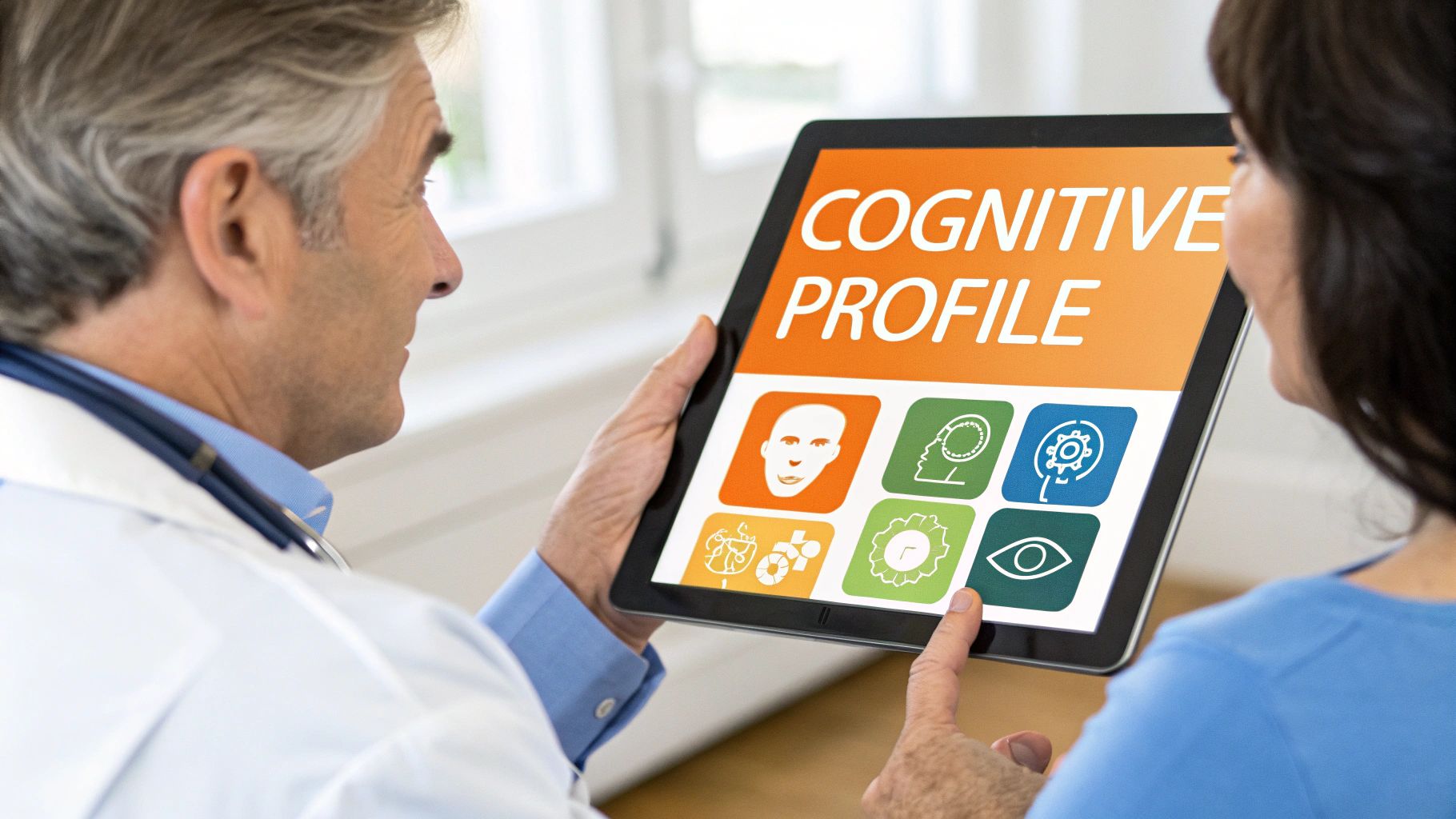
From a Single Number to a Detailed Cognitive Profile
Trying to capture a person's cognitive function with a single mental age number is like trying to describe a symphony by humming just one note. You miss all the richness, complexity, and beauty of the whole performance. Today's assessments, like the tools we’ve developed here at Orange Neurosciences, focus on evaluating multiple cognitive domains independently.
This approach gives us a much clearer and more useful picture of an individual's abilities. Instead of one score, we get specific insights into key areas like:
Attention: The ability to lock onto a task while filtering out distractions.
Memory: Covering both short-term (working memory) and long-term recall.
Executive Function: Higher-level skills like planning, organising, and problem-solving.
Processing Speed: How quickly a person can take in and respond to information.
By measuring these areas separately, we can spot specific patterns of strengths and weaknesses. That’s far more helpful than any single score could ever be. For a deeper dive into this process, you can explore our guide on what is a cognitive assessment.
The Power of Objective and Actionable Data
One of the biggest leaps forward in modern cognitive assessment is the use of AI-powered, evidence-based tools. Platforms like ours at Orange Neurosciences can deliver a rapid and objective cognitive profile, often in under 30 minutes. That kind of speed and precision completely removes the guesswork that held back older methods.
For clinicians and educators, this is a total game-changer. Instead of waiting weeks for a subjective report, they get real-time, data-driven support for their decisions. This means they can design targeted interventions immediately, perfectly matched to the individual’s specific needs. For example, a clinician can instantly see a deficit in processing speed and recommend specific accommodations for school or work that same day.
A modern cognitive profile doesn't just tell you if there's a problem; it shows you where the problem is and provides the data needed to build a precise, effective solution.
This shift empowers professionals to move from diagnosis to action much faster, cutting down on the delays and costs that were so common with traditional assessments.
Targeted Interventions Without the Guesswork
Let's put this into a real-world context. Imagine a student is struggling in school. An old-fashioned approach might have just resulted in a label like "low mental age," offering no clear path forward for anyone.
A modern cognitive profile, on the other hand, might reveal that the student has excellent verbal skills but faces significant challenges with working memory. This specific insight is immediately actionable. The educational plan can now include strategies and tools aimed directly at supporting that student's working memory, such as:
Breaking down complex instructions into smaller, manageable steps.
Using visual aids and checklists to reduce the cognitive load.
Engaging in targeted exercises designed to strengthen memory skills.
As cognitive assessment has evolved, so have diagnostic processes across the board. For anyone navigating contemporary evaluations, looking at a complete guide to ADHD assessment in the UK can offer valuable insights into today's clinical practices. This kind of targeted support, based on a detailed profile, is worlds more effective than the broad, non-specific interventions of the past.
By focusing on a comprehensive profile, we empower clinicians, educators, and families to make better-informed decisions and create personalised plans that lead to real, measurable progress.
Turn Your Assessment Insights into Action
A cognitive assessment is a powerful starting point, but it's not the final destination. The real value is unlocked when you use that data to create meaningful, positive change. This is where a detailed cognitive profile becomes a roadmap, guiding you from understanding challenges to building real-world skills.
An old-fashioned mental age test might have left you with a confusing number and no clear path forward. Modern assessments are different. They provide specific, actionable data that directly informs personalized interventions. This shift—from a single score to a detailed profile—is the key to making tangible progress.
Imagine an assessment reveals a child has strong executive functions but struggles with processing speed. That specific insight is incredibly valuable. Instead of a vague plan to "help them in school," you can now build a targeted strategy. A practical example would be to teach the child to preview test questions before starting, leveraging their strong planning skills to compensate for slower processing.
From Data to Tangible Progress
This process of turning data into real-world action is exactly what platforms like Orange Neurosciences are built for. Our tools don't just assess cognitive function; they bridge the gap between that assessment and effective training. We believe in moving from insight to improvement, seamlessly.
Here’s how clinicians, educators, and parents can use our detailed cognitive profiles to take action:
Identify Specific Needs: Pinpoint the exact cognitive domains that require support, like working memory or attention, instead of relying on general observations.
Create Targeted Plans: Design interventions that focus on strengthening those specific areas. For a student with slow processing speed, this might mean providing extra time on tests or using tools that break information into smaller, more manageable chunks.
Leverage Strengths: Use an individual's cognitive strengths to help overcome their challenges. Someone with strong verbal skills but weaker memory, for instance, can learn to use verbal strategies—like creating stories—to remember information.
This data-driven approach removes the guesswork. It ensures that the support provided is precisely what’s needed to foster growth.
Engaging, Game-Based Training
One of the best ways to build cognitive skills is through consistent, engaging practice. Our platform pairs detailed assessments with fun, game-based training exercises. This keeps both children and adults motivated and makes the whole process of skill-building enjoyable.
An assessment identifies the target. Targeted, engaging training is how you hit that bullseye. It transforms a static report into a dynamic tool for cognitive development.
This combination ensures the insights from an assessment aren't just filed away—they're actively used to improve cognitive function. To explore specific strategies, you can learn more about how to improve cognitive function in our detailed guide.
Don't let valuable data sit in a report. Visit our website to see how Orange Neurosciences' integrated assessment and training tools can help you turn cognitive insights into lasting, meaningful outcomes.
Still Have Questions About Mental Age Tests?
Stepping into the world of cognitive assessments can feel a bit overwhelming. The term mental age test often brings up a lot of old ideas and confusion. Let's clear the air and tackle some of the most common questions people have about mental age and where cognitive testing stands today.
Can Those Online Quizzes Really Tell Me My Mental Age?
You’ve probably seen them pop up on your social media feed: fun, splashy quizzes promising to reveal your "mental age." While they can be a fun distraction, that's all they are—entertainment. They have none of the scientific backing, standardization, or validation that goes into a real cognitive assessment.
Think of them like a magazine personality quiz. For a genuine, reliable understanding of your cognitive profile, you need tools that are based on evidence and have been tested across large, diverse groups of people. Those quick online quizzes just don't have what it takes to provide data you can actually trust. A practical example of a real assessment task might involve scientifically-validated memory challenges, not just questions about your favorite color or music genre.
Is a "Lower Mental Age" Just Another Term for an Intellectual Disability?
Absolutely not. First off, "mental age" is an outdated concept that professionals no longer use for clinical diagnosis. It's a relic of early psychology. More importantly, diagnosing an intellectual disability is a careful, complex process that a qualified professional must conduct.
A diagnosis of intellectual disability looks at two main things: intellectual functioning that is significantly below average (often seen in a low IQ score) and major difficulties with daily adaptive skills, like communication, social skills, and self-care. It's never based on a single score from a single test.
How Can I Use Cognitive Assessment Data to Actually Help My Child?
This is the most important question of all. A modern cognitive assessment gives you a detailed map of your child's cognitive landscape—their unique strengths and weaknesses. This information is pure gold. It allows you to move beyond guesswork and create targeted, effective support strategies.
For example, if an assessment shows that your child struggles with working memory but has excellent verbal skills, you can collaborate with their teachers on specific memory-boosting strategies. A practical insight would be teaching the child to "talk through" multi-step problems out loud, using their verbal strength to support their weaker memory. Platforms like ours are designed to turn this diagnostic data into a practical, actionable plan. It’s all about building on their strengths while supporting the areas where they need a little more help.
At Orange Neurosciences, we're passionate about turning data into real-world progress. Our assessments are built to provide the detailed cognitive profiles needed to create personalized support plans that truly make a difference. Find out how our tools can help you move from assessment to meaningful action by visiting us at https://orangeneurosciences.ca or contacting us today for a demonstration.
Orange Neurosciences' Cognitive Skills Assessments (CSA) are intended as an aid for assessing the cognitive well-being of an individual. In a clinical setting, the CSA results (when interpreted by a qualified healthcare provider) may be used as an aid in determining whether further cognitive evaluation is needed. Orange Neurosciences' brain training programs are designed to promote and encourage overall cognitive health. Orange Neurosciences does not offer any medical diagnosis or treatment of any medical disease or condition. Orange Neurosciences products may also be used for research purposes for any range of cognition-related assessments. If used for research purposes, all use of the product must comply with the appropriate human subjects' procedures as they exist within the researcher's institution and will be the researcher's responsibility. All such human subject protections shall be under the provisions of all applicable sections of the Code of Federal Regulations.


© 2026 by Orange Neurosciences Corporation