Thinking Before You Speak: Practical Skills That Work

A parent asks a child why the milk was spilled, and the answer comes out before the child can explain. A clinician interrupts a patient halfway through a symptom description, then realises the missing detail changed the meaning. In a classroom, a teacher calls on a student before the question has fully landed, and the student blurts out an unrelated answer.
These moments look like carelessness, rudeness, or poor self-control. Often, they reflect a timing problem between intention, inhibition, working memory, and speech. The mouth starts moving while the brain is still assembling, evaluating, or retrieving the thought.
Thinking before you speak is a trainable cognitive skill, not a personality test. The useful work involves choosing language that creates a real delay, practising the delay until it becomes more automatic, adapting the cue to the setting, and recognising when persistent difficulty deserves screening rather than another reminder to “slow down.” People who feel overwhelmed by fear of judgement may also benefit from reviewing social anxiety therapy options, while communication concerns may call for a structured speech-language pathology assessment.
The Moment Words Outrun Intent
A child knocks over a glass. The parent sees the spill, feels the surge of inconvenience, and says, “What were you thinking?” The child opens their mouth, but the parent has already added, “You never pay attention.” The words communicate frustration, yet they don't communicate the actual goal, which may be safety, accountability, or teaching a better way to carry the glass.
In a clinic, the same mismatch appears in a different form. A patient says, “Sometimes I…” and the clinician supplies the ending, assuming the symptom is anxiety, pain, or forgetfulness. The patient agrees because the interruption has changed the direction of the conversation. In a classroom, a student who needs extra processing time may look inattentive when the teacher moves on too quickly.
The first intervention isn't silence. It's a deliberate gap between impulse and output.
What the pause must accomplish
A functional pause gives the brain time to answer three practical questions:
What happened? Separate observation from interpretation.
What am I trying to achieve? Decide whether the purpose is to inform, correct, reassure, or set a boundary.
What response fits the moment? Select words that preserve accuracy and relationship.
This doesn't mean every sentence must be polished internally. Some people organise thoughts through speaking, so forcing complete silence can make communication harder. They may need a short, structured phrase such as “Let me think that through aloud” rather than an impossible demand to produce a finished answer instantly.
Practical rule: A pause isn't successful because it sounds calm. It's successful when it creates enough room to choose a response that matches your intention.
The next steps connect everyday language to the cognitive systems that control verbal output, then turn those systems into drills for home, school, work, and care settings.
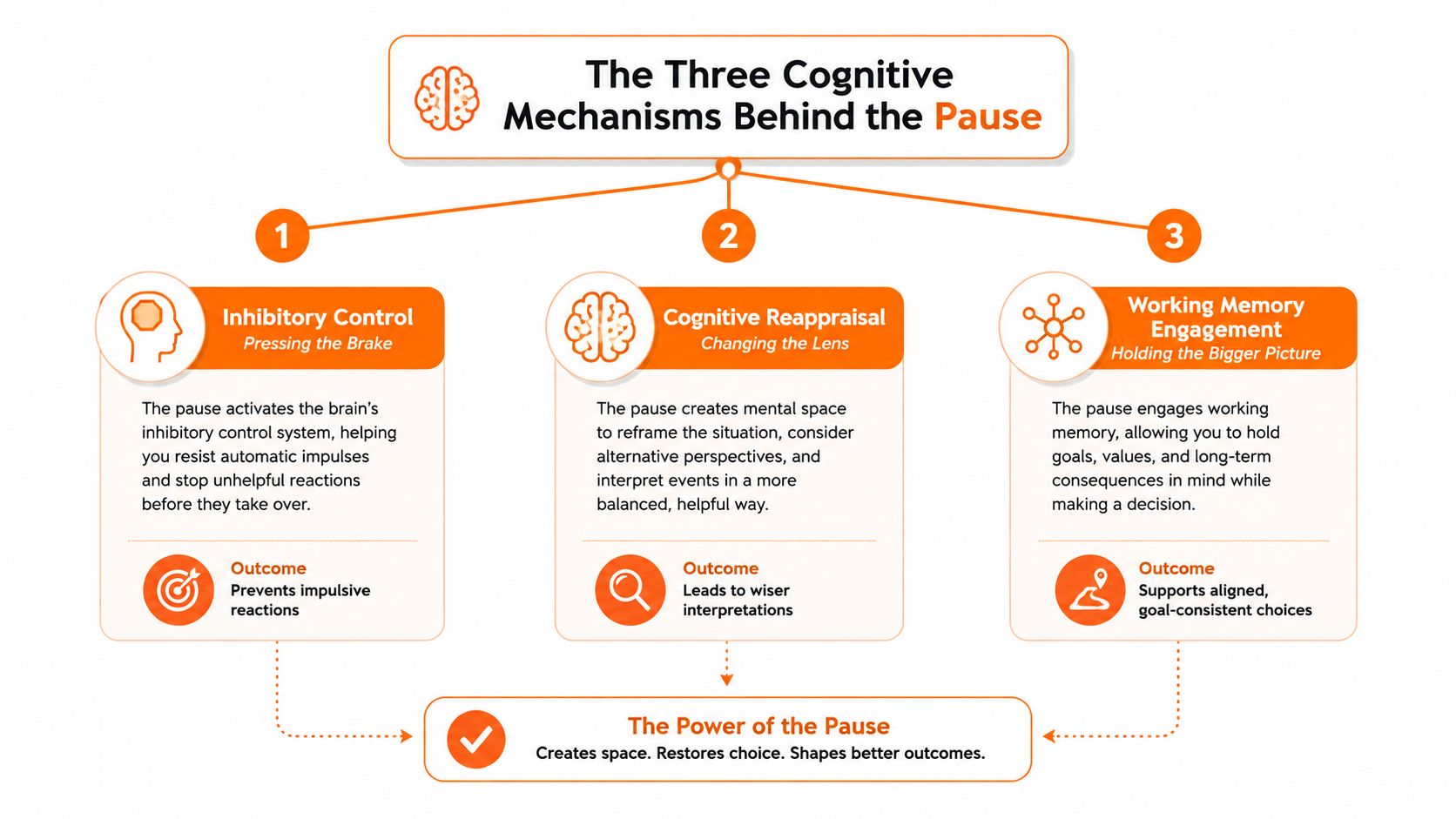
The Three Cognitive Mechanisms Behind the Pause
A pause depends on more than good manners. Inhibition stops a prepotent response, working memory holds the relevant information while a choice is made, and processing speed determines whether the brain can complete that loop before the conversational opening closes. A useful overview of these functions is available in this guide to cognitive functions.
Inhibition is the brake
Inhibition lets you hold back the first response long enough to assess it. In a workplace meeting, a manager hears criticism and begins to interrupt. The inhibition system has to suppress the rebuttal long enough for the manager to identify whether the speaker is raising a factual concern, a relationship issue, or a request for support.
A child may know the classroom rule and still call out during circle time because the response becomes available before the rule can guide behaviour. The difficulty isn't always understanding. It may be stopping the dominant response at the right moment.
Working memory is the holding space
Working memory keeps several pieces active at once. During a difficult conversation, you may need to remember what the other person said, retain your own purpose, monitor your emotional state, and select language that won't escalate the exchange.
When working memory is overloaded, people lose the thread, repeat themselves, or answer the easiest part of a question instead of the important part. Practical tools for organising tasks and reducing executive-function load are described through Pretty Progress executive function resources.
Processing speed controls the window
Processing speed affects how quickly someone can hear, interpret, decide, and respond. An older adult may begin a sentence, lose the thread, and fill the gap with a guess. A child may need more time after a question, while an adult under stress may speak rapidly because the internal decision process feels too slow.
These systems interact. Weak inhibition releases speech before working memory has finished evaluating it. Slow processing narrows the time available for inhibition, and working-memory overload makes the eventual answer less precise. That's why “just think first” rarely works on its own. The cue and the practice must target the mechanism that is failing in that moment.
Scripts and Cues You Can Use Today
A pause works better when it has a physical action and a prepared sentence. Without those supports, people often wait for calm to appear, and calm usually arrives after the conversation has already gone badly.

Start with the body
Use the three-breath rule when your first response carries heat. Keep your lips closed for three comfortable breaths, relax your jaw, and let the exhalation run slightly longer than the inhalation. This gives inhibition a concrete motor task and reduces the chance that the first emotional phrase will become the entire conversation.
The rule isn't “never respond quickly.” Use it when you notice a raised voice, a racing thought, a clenched jaw, or the urge to prove your point immediately.
Add language that buys time
Echoing preserves connection while giving working memory a stable starting point:
At work: “What I'm hearing is that the deadline creates a quality risk. Let me check the details before I respond.”
At home: “What I'm hearing is that you felt ignored. I want to understand what happened before I explain my side.”
During clinical intake: “What I'm hearing is that the episodes happen after poor sleep. I'd like to ask one more question before we draw a conclusion.”
In a classroom: “I want to make sure I understood the question. Can you repeat the last part?”
For a high-stakes conversation, use a direct request: “Can I sit with that for a moment?” or “I want to answer carefully, so give me a moment to organise my thoughts.” These phrases protect verbal processors too, because they create space without requiring a perfectly formed silent answer. Readers preparing for difficult appointments can also find practical guidance on what to say in therapy.
Change the first sound
Lower the volume slightly, slow the first syllable, and make eye contact before you answer. These small changes signal to your own nervous system that speech is beginning deliberately. A useful executive function coaching guide can help translate these cues into a broader practice plan.
Use short scripts for low-stakes exchanges. Reserve “I need a moment to think” for situations where accuracy, safety, or relationship repair matters more than conversational speed.
Practice Drills That Build the Muscle
The pause is a motor behaviour supported by cognition. Repetition matters because you're practising the sequence, notice, hold, choose, speak, before a real argument or interruption makes the task difficult.
Start with four drills. Keep the demands low enough that you can complete them consistently.
Four daily practice options
Three-second silent hold: Set a phone timer to beep at random intervals. When it sounds, ask yourself a low-stakes question such as “What should I have for lunch?” Wait three seconds before answering aloud. A successful rep includes the full gap, not a perfect answer.
Script-back drill: Ask a partner to make a mildly provocative statement, such as “You never listen in meetings.” For one minute, respond only with clarifying language, including “What makes you say that?” and “Which part felt missed?” This trains inhibition while keeping speech available.
Written-then-spoken drill: Write two keywords on a card. Speak for thirty seconds about a simple topic without repeating those keywords. The restriction forces working memory to hold the ideas while you retrieve related language.
Body-check drill: Pair one exhalation with the internal cue word “check.” Then ask, “Is this accurate, useful, and timely?” This anchors the pause in sensation rather than relying on motivation.
Practise each drill during the week, using a brief log with the date, situation, whether the pause happened, and what helped. Review the record after four weeks and look for qualitative changes, such as fewer interruptions, easier recovery after a blurting episode, or more complete answers.
For additional low-pressure cognitive practice, explore brain exercises, but don't treat games as a substitute for observing communication in real situations.
Successful practice is measurable: You paused when the cue appeared, used the chosen script, and returned to the conversation without abandoning your point.
Adapting the Habit for Home, Classroom, and Clinic
The same skill needs different supports in different environments. A parent can use a family code word, a teacher can control wait time, and a clinician can increase task structure. The adult's response must correct the behaviour without turning the pause into shame.
Setting | Visual or Verbal Cue | Adult Script | Expected Behaviour |
|---|---|---|---|
Home | A visible pause card or the family code word “rewind” | “Rewind. Take a breath, then tell me what happened.” | The child stops, breathes, and gives the event before defending or blaming. |
Classroom | Turn-taking tokens, a five-second wait after questions, and sentence stems such as “I want to add to that” | “Use your stem, then wait until your turn.” | The student holds the response, uses the stem, and contributes when invited. |
Clinic | Structured turn-taking, delayed-response tasks, and a written cue | “Take a moment. Tell me the first part, then we'll build the rest.” | The client delays, retrieves the relevant information, and responds with reduced prompting. |
At home
Keep the cue short and time-limited. “Rewind” is more useful than a lecture about self-control because it names the action without labelling the child. If the child continues to interrupt, the parent can say, “I'll listen after you touch the pause card,” then follow through calmly.
In classrooms
Wait time must be predictable. A teacher can ask the question, count, and invite students to use “I want to add to that” when they need processing time. Turn-taking tokens work best when they aren't used as public punishment. They should show whose turn it is, not who is failing.
In clinics
Clinicians can separate comprehension from speed. A delayed-response task, a structured retell, or a written keyword prompt can reveal whether the person struggles mainly with inhibition, retrieval, or verbal organisation. For Canadian families seeking a service pathway, information about speech therapy in Canada can help clarify what type of communication support may fit.
When the Pause Is Harder Than It Should Be
A stubborn habit usually improves when the environment, cue, and practice become consistent. A clinical concern is more likely when the difficulty appears across settings, interferes with functioning, and travels with other cognitive or communication changes.

Red flags by age
For children, look for a pattern that includes several of the following:
interrupting alongside sustained-attention difficulties
trouble following multi-step instructions
frequent peer conflict caused by blurting or misreading exchanges
weak reading comprehension despite normal hearing
For adults, pay attention to repeated interruption in professional meetings, blurting during emotionally charged conversations, and difficulty delaying a desired response even when the consequences are known. These concerns can occur with ADHD, traumatic brain injury, stroke aphasia recovery, or late-life cognitive change, so the context and onset matter.
A practical decision rule is to request cognitive screening when two or more red flags persist across settings for more than eight weeks. This is a triage rule, not a diagnosis. Sudden communication or cognitive change needs prompt medical attention rather than a home practice programme.
What screening can clarify
A fast digital screen can examine processing speed, working memory, and inhibition tasks that map directly onto the pause skill. A profile can show whether the person needs targeted training, classroom or workplace accommodations, or a fuller neuropsychological assessment.
The need for timely triage is especially relevant in California, where a state-population analysis estimated cognitive impairment among 20.3% of adults aged 65 and older, with variation across racial and ethnic groups, including an estimated 29.7% among Black older adults and 25.0% among Asian older adults. These estimates come from the California-based cognitive impairment analysis. They don't identify an individual's cause, but they show why changes in judgement, language, and executive control deserve careful attention rather than dismissal as personality.
Turning Insight Into Your Next Step
Choose one action today, not ten. Pick a single phrase, such as “What I'm hearing is…” or “Can I sit with that for a moment?”, and rehearse it once a day for a week. Then complete a two-minute self-check against the red flags, noting whether the problem appears at home, work, school, or in more than one setting.
Apply one adapted cue where the difficulty occurs. A parent might place a pause card beside the dinner table. A teacher might post a sentence stem. An adult might use the three-breath rule before responding to a challenging email or meeting comment.
The central point is simple: thinking before you speak is built through repetition, not willpower. If inhibition, working memory, or processing speed remains difficult despite consistent supports, a brief cognitive screening can help determine whether targeted training or a fuller assessment makes sense. In Canada, assessment pathways can involve long waits, including psychological evaluation waits ranging from 18 months to five years for adults in Newfoundland and Labrador, as reported by CBC News. A timely screen can help families and clinicians make a more informed next decision while they arrange appropriate care.
Orange Neurosciences provides rapid, AI-supported cognitive assessment and therapy tools that profile skills such as inhibition, working memory, attention, and processing speed for practical planning. Visit Orange Neurosciences to explore screening and training options for adults, caregivers, educators, and clinicians working to turn better pauses into measurable progress.

Orange Neurosciences' Cognitive Skills Assessments (CSA) are intended as an aid for assessing the cognitive well-being of an individual. In a clinical setting, the CSA results (when interpreted by a qualified healthcare provider) may be used as an aid in determining whether further cognitive evaluation is needed. Orange Neurosciences' brain training programs are designed to promote and encourage overall cognitive health. Orange Neurosciences does not offer any medical diagnosis or treatment of any medical disease or condition. Orange Neurosciences products may also be used for research purposes for any range of cognition-related assessments. If used for research purposes, all use of the product must comply with the appropriate human subjects' procedures as they exist within the researcher's institution and will be the researcher's responsibility. All such human subject protections shall be under the provisions of all applicable sections of the Code of Federal Regulations.


© 2026 by Orange Neurosciences Corporation