Executive Function Coaching: Master Focus, Planning & Goals
Mar 29, 2026
Executive function coaching is a hands-on, one-on-one partnership focused on helping you build the practical, real-world skills you need to manage your daily life. This isn't therapy or academic tutoring. Instead, it’s all about strengthening your brain's "management system"—the core skills responsible for planning, organising, and self-control.
What Is Executive Function Coaching, Really?

Think of it this way: your brain has its own air traffic control tower. This tower is in charge of all the incoming and outgoing "flights"—your tasks, plans, impulses, and emotions. When this system is running smoothly, you can effortlessly juggle multiple priorities, stick to your schedule, and pivot when things inevitably go sideways.
But if that air traffic controller is overwhelmed, untrained, or just plain exhausted, chaos is right around the corner. Flights get delayed (hello, procrastination), they collide on the runway (conflicting priorities), or they vanish from the radar completely (forgotten appointments and missed deadlines).
Executive function coaching is the process of giving your personal air traffic controller the training and tools it needs to run the entire operation more efficiently.
Your Brain's Command Center Core Skills
This table breaks down the key skills that act as your brain's command centre. It highlights the everyday frustrations that signal a need for support and shows exactly how coaching steps in to provide practical, lasting solutions.
Executive Function Skill | Common Struggles | How Coaching Provides Actionable Solutions |
|---|---|---|
Working Memory | Forgetting instructions, losing track of conversations, difficulty with multi-step tasks. | Example: A coach teaches a student the "parrot back" method—repeating a teacher's instructions out loud to lock them in before starting a task. |
Inhibitory Control | Acting impulsively, getting easily distracted, speaking out of turn, difficulty resisting temptations. | Example: Creating a "distraction list" on a sticky note. When an off-topic thought appears, you write it down to handle later, instead of derailing your focus now. |
Cognitive Flexibility | Getting "stuck" on one idea, struggling with changes in plans, having trouble seeing other perspectives. | Example: Role-playing a scenario where a group project partner disagrees with your idea, and practicing phrases to find a compromise instead of shutting down. |
Planning/Prioritisation | Feeling overwhelmed by large projects, not knowing where to start, poor time estimation. | Example: Using a visual planner to break a science fair project into small steps: Week 1 is "Choose a Topic," Week 2 is "Research," etc. |
Organisation | A messy backpack, a cluttered workspace, losing important items, chronically late with assignments. | Example: Co-designing a color-coded folder system where every subject gets a color (e.g., blue for Math), making it easy to grab the right materials. |
Task Initiation | Procrastinating on homework or chores, needing constant reminders to get started. | Example: Using the "5-Minute Rule." You agree to work on a dreaded task for just five minutes. Often, that's enough to overcome the initial resistance and keep going. |
By targeting these specific skill areas, coaching moves beyond just managing symptoms and helps build a stronger, more resilient cognitive foundation for success in all areas of life.
Who Benefits From Coaching?
This kind of practical support isn't just for one type of person or a specific diagnosis. It’s a goal-focused partnership that helps people from all walks of life build the systems they need to succeed on their own terms.
We see incredible results with:
Students who are drowning in assignments, can't seem to manage long-term projects, or are stuck in a cycle of last-minute, high-stress cramming.
Professionals feeling buried by their workload, fighting a losing battle against constant distractions, or struggling to find any semblance of work-life balance.
Adults with ADHD looking for concrete strategies to manage the daily realities of inattention, impulsivity, and disorganisation in a world not built for their brains.
Seniors who want to be proactive about maintaining their cognitive sharpness and independence by reinforcing essential skills like planning, memory, and problem-solving.
Honestly, anyone who feels a frustrating gap between their potential and their daily performance can find real value here. While the challenges might look different on the surface—a messy locker for a teen, a chaotic inbox for an executive—they often spring from the same weaknesses in executive skills. To see the bigger picture, you can explore the broader concept in our guide to what is cognitive function.
Executive function coaching is a personalized and structured approach designed to help individuals develop and strengthen their executive function skills such as organization, time management, and emotional regulation.
What Coaching Is (And What It Is Not)
It’s so important to be clear about this: executive function coaching is not therapy. Therapy often looks backward, exploring past experiences and deep-seated emotional patterns to heal. Coaching is forward-looking and action-oriented.
It's also not academic tutoring. A tutor’s job is to help a student master a specific subject, like algebra or French.
A coach, on the other hand, helps you understand how your brain works and then partners with you to co-create practical systems you can use right away. To get a feel for this in action, this article provides a great breakdown of what executive function support looks like in practice.
Practical Example: A coach wouldn't teach you algebra. They would help you build a system to track your algebra homework, a process for breaking down complex problems into smaller steps, and a time management plan to get it all done without the usual stress and panic.
The focus is always on building sustainable habits that empower you for the long haul. If you’re ready to train your brain's command centre, connect with our team to see how our tools can support your journey.
The 3 Core Skills That Power Executive Function

To really grasp what executive function coaching accomplishes, we have to look at the brain's core operating system. While we talk about skills like planning and organizing, these are actually built on top of three fundamental abilities. Effective coaching gets right to the source, strengthening these core skills to create powerful, life-wide change.
Think of it like building a house. You can't put up walls and a roof on a shaky foundation. These three skills are that foundation. When one is weak, the whole structure feels unstable. By reinforcing each one, we create a solid base for all those other complex life skills to grow.
Pillar 1: Working Memory
I like to call working memory the brain’s mental sticky note. It’s the ability to hold a few pieces of information in your mind right now and actually do something with them. This isn't about long-term memorization; it’s about keeping information online and accessible just long enough to complete a task.
Practical Example: Following a recipe. You read the step, "Add two cups of flour and one teaspoon of baking soda," and then turn to your counter. Holding onto those amounts as you measure everything out—that's your working memory in action. Someone with a taxed working memory might get to the flour canister and think, "Wait, was it one cup or two?" forcing them to check the instructions again and again.
Pillar 2: Cognitive Flexibility
Cognitive flexibility, or flexible thinking, is your brain's knack for pivoting. It’s what allows you to adapt when things don't go as planned, switch between different tasks, and look at a problem from a new angle. When your Plan A falls apart, cognitive flexibility is the skill that helps you generate a Plan B without getting completely stuck.
Practical Example: Imagine you've mapped out your drive to a critical meeting, but a surprise road closure blocks your path. Cognitive flexibility is what lets you take a deep breath, pull up a map to find a new way, and adjust your plans without melting down. Without it, that unexpected change can feel overwhelming, making it nearly impossible to problem-solve on the spot.
Pillar 3: Inhibitory Control
This is your brain’s brake pedal. Inhibitory control is the crucial skill that helps you resist impulses, tune out distractions, and pause before you act or speak. This internal "stop button" is the key to staying focused and making deliberate choices instead of just reacting to whatever comes your way.
Inhibitory control is the absolute foundation of self-regulation. It's what keeps you from checking your phone every two minutes while trying to work, or from blurting out something off-topic during a meeting. Focus is almost impossible without it.
Since coaching is about building these cognitive abilities, it’s no surprise that many people also want to improve your concentration and focus, a goal tied directly to this skill.
These three skills are a team; they never work in isolation. A primary goal in executive function coaching is to build a strong foundation across all of them. For more strategies, our detailed guide explores how to improve executive function by targeting these specific areas.
The field itself is drawing in passionate professionals. A 2025 survey of active coaches in California found that 100% identified as female, and 54% were between the ages of 45 and 54. This suggests it’s becoming an ideal 'next chapter' career for many experienced clinicians and educators. With 56% of coaches reporting job satisfaction scores of 5/5, it's clear that helping others build these critical life skills is incredibly rewarding work. You can find more about these industry trends and coach demographics in recent reports.
Whether you're a clinician interested in this growing field or a parent looking for support, understanding these three core skills is the first step. Contact our team through the website to see how Orange Neurosciences provides the data-driven tools to both measure and strengthen this foundational trio.
What a Typical Coaching Journey Looks Like
Ever wonder what really happens in an executive function coaching session? It’s not about sitting on a couch and talking endlessly about theory. It’s a hands-on, forward-looking partnership focused on building practical systems that work for your life, right now.
Think of it this way: we’re less concerned with why you’re struggling and more focused on how we can build a bridge to get you where you want to go. The goal is to move from that constant feeling of being overwhelmed to having a concrete, reliable toolkit for navigating your day-to-day challenges. While every journey is unique, it generally follows a clear, results-focused path.
Stage 1: The Discovery and Assessment Phase
Every coaching relationship starts with a deep dive into your world. This isn't a test or an interrogation; it's a genuine, collaborative exploration. Your coach wants to understand your unique situation—your strengths, your biggest frustrations, and the specific moments where you feel the most "stuck."
This is where we get practical. We move away from vague problems like "I'm just so disorganized" and start defining specific, tangible goals. It's about turning those abstract struggles into solvable puzzles.
Actionable Goal Setting in Practice Instead of saying, "I want to stop procrastinating," we get to the root of it. A goal becomes something you can actually tackle:
"I want to design a system to start my history paper before the night it's due." This defines the what, when, and why.
"I will build a reliable morning routine to get out the door by 8:00 a.m. without feeling stressed or forgetting my lunch." This is measurable and tied to a real daily outcome.
This phase often includes an initial assessment to get a clear picture. For instance, a tool like Orange Neurosciences’ OrangeCheck can give us a data-driven snapshot of your cognitive profile in under 30 minutes. This isn't about getting a score; it’s about giving your coach an objective starting point to build a truly personalized action plan from day one.
Stage 2: The Action and Skill-Building Phase
With clear goals in hand, we shift our focus to hands-on skill-building. This is where you and your coach roll up your sleeves and co-create systems that fit your brain and your life. It’s an experimental process where we try new strategies, see what clicks, and tweak what doesn’t.
Here are some actionable insights you might develop with a coach:
Time-Blocking: You and your coach might actually open up your calendar and physically block out time—not just for appointments, but for specific tasks like "Draft English Essay Outline" or "Organize Backpack."
Creating Visual Checklists: For a task that feels huge and overwhelming, like cleaning a messy room, you'll break it down into a simple visual checklist with steps like "Put clothes in hamper" and "Clear desk," making it much easier to just start.
Breaking Down Big Projects: You'll learn the art of taking a massive project and identifying the very first, manageable steps. For a research paper, that might just be "Step 1: Find three credible sources."
A key part of this stage is often strengthening core cognitive skills. Working memory, for example, is foundational. For a closer look at this specific area, you might find our guide on how to improve working memory helpful.
Stage 3: The Refinement and Independence Phase
Once you start using these new systems in your daily life, the coaching journey evolves. Sessions become less about creating brand-new strategies and more about refining what you’ve built. You’ll troubleshoot what isn’t quite working and, just as importantly, celebrate what is.
A huge win isn't just turning in an assignment on time. It's the moment you realize you used your new system to do it without your coach's prompting. That shift from external guidance to internal habit is the ultimate goal of executive function coaching.
Slowly, the coach begins to step back, encouraging you to become your own best advocate and problem-solver. The journey doesn't end when you're "perfect"—it ends when you feel confident in your own ability to manage challenges independently. You walk away with a sustainable toolkit that you can use for the rest of your life.
Ready to see what your personalized coaching journey could look like? Reach out to our team via our contact page to learn how our evidence-based tools can help you build your roadmap to success.
How to Measure Real Progress in Coaching
So, how do you know if executive function coaching is actually working? It’s one thing to “feel” a bit less stressed, but truly effective coaching goes much deeper than just subjective feelings. The real measure of success comes from blending real-world victories with objective, data-driven insights to see genuine skill growth.
Think of it like getting in shape. You wouldn’t start a new fitness routine without knowing your starting point, and you wouldn't train for a marathon without clocking your time and distance. Executive function coaching follows the same principle: we need an initial assessment to create a baseline and ongoing checks to track real, measurable progress.
The Power of Objective Data
One of the biggest shifts in modern coaching is the move toward using precise data to guide the entire process. Instead of simply guessing where the challenges lie, coaches can now use specialised tools to get a clear cognitive snapshot. This data-first approach takes the guesswork out of the equation, paving the way for a truly personalized plan.
This is where a platform like Orange Neurosciences offers a real advantage.
Tools like OrangeCheck can map out a person's cognitive profile in under 30 minutes. This gives a coach a clear, data-driven starting point to build a plan, highlighting specific areas like working memory or inhibitory control that need the most focus.
This initial assessment isn't a test you pass or fail. It’s a map. It shows the coach exactly where to begin the journey, ensuring every strategy and activity is targeted to the individual’s unique cognitive wiring. It provides a concrete starting line to measure against down the road.
Combining Data with Real-World Wins
Objective data is a powerful piece of the puzzle, but it only tells part of the story. The real magic happens when we pair these cognitive metrics with qualitative, real-world victories—the tangible changes you can see and feel in daily life.
What do these actionable wins look like on the ground?
For a student: It could be as simple as their backpack staying organized all week, with no more frantic morning searches for lost homework.
For a professional: It might mean hitting project deadlines consistently, without the usual stress and all-night work sessions.
For anyone: It could be getting through the morning routine and out the door on time, feeling calm and prepared instead of frazzled and rushed.
This dual approach gives you a 360-degree view of what success looks like, showing growth in both the underlying cognitive skills and the daily habits that matter most. The journey from assessment to celebrating these wins is a clear, powerful process.
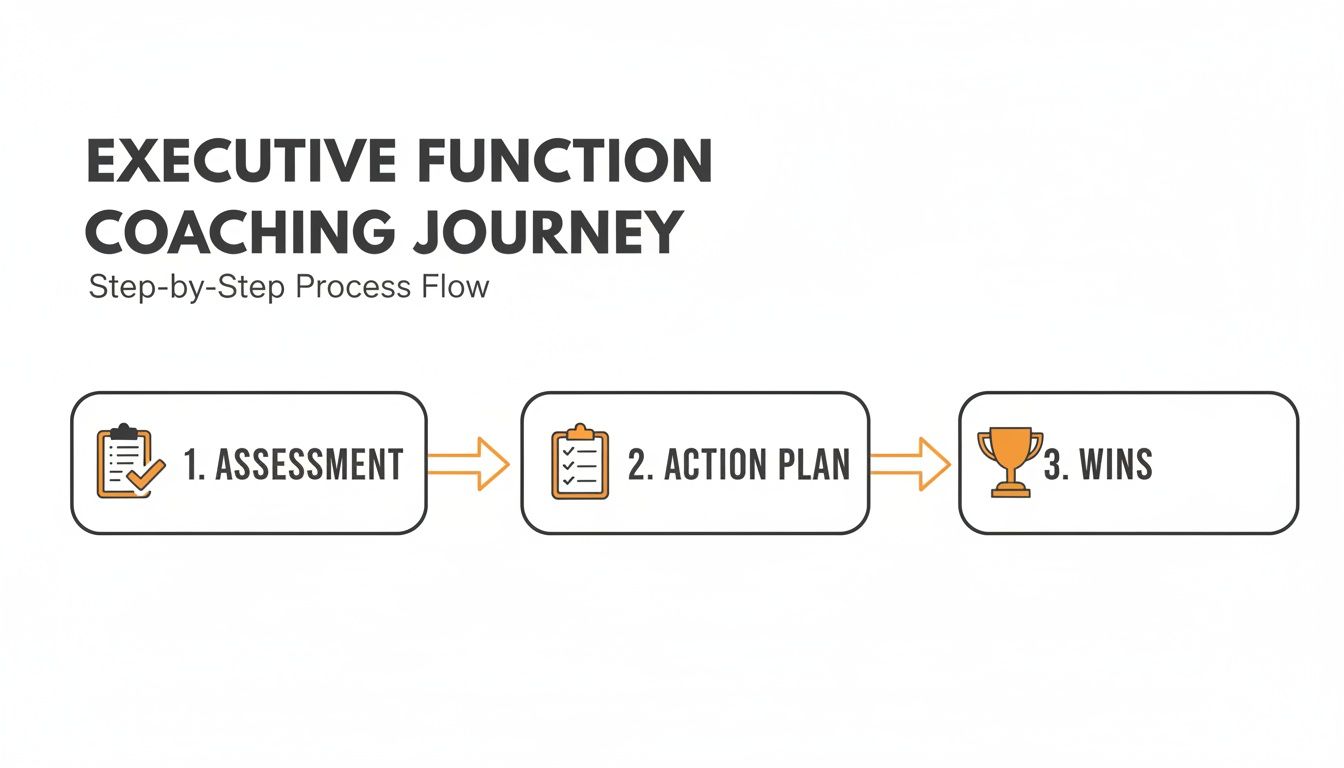
As you can see, the path forward is a straightforward one that starts with understanding, moves to a concrete plan, and ends in tangible success. It’s this blend of objective measurement and noticeable life improvements that defines modern, effective coaching.
A Holistic View of Success
At the end of the day, measuring progress isn’t just about ticking boxes on a chart; it’s about building confidence and seeing meaningful, lasting change. When you combine hard data with real-life improvements, you create a powerful feedback loop. You can learn more about the different types of assessments in our guide to finding a test for executive dysfunction.
This holistic view confirms that the strategies aren't just theoretical ideas—they are actively working to make life easier and more manageable. By tracking both the numbers and the day-to-day changes, you get a complete and honest picture of the journey, ensuring that coaching is leading to sustainable improvements that stick.
Coaching Success Stories You Can Relate To
It's one thing to talk about executive function strategies in theory, but it’s another thing entirely to see them change a life. The systems and support we've been discussing aren't abstract concepts; they are practical, real-world tools that create profound shifts for people every single day.
Let’s look at a couple of common situations we see all the time. These stories show how a dedicated coaching partnership can build the bridge from constant struggle to genuine success, whether it's for a teenager drowning in schoolwork or a professional teetering on the edge of burnout.
The Overwhelmed Teenager
Think about Leo, a bright, creative 14-year-old with ADHD who was completely swamped by school. His parents were getting those dreaded nightly emails about missed assignments. His backpack was a black hole of crumpled papers. Homework had become a nightly battle, creating constant friction in the family. Despite being incredibly smart, his grades were slipping.
The problem wasn't that he couldn't understand the material. The real breakdown was in planning, organisation, and simply starting. A huge history project felt so massive that he couldn't figure out the first step, leading to weeks of procrastination and a panicked, all-night cramming session right before the deadline.
The Coaching Solution in Action:
Leo’s coach didn’t just give him a to-do list. Instead, they worked together, side-by-side, to build a system he could actually manage himself. The approach was built on two simple, powerful habits:
The "Sunday Setup" Routine: They set aside just 30 minutes every Sunday evening to map out the week ahead. All known tests, assignments, and due dates went straight into a shared digital planner. This simple ritual took the chaos out of the week, making it feel predictable and manageable.
A Digital Planner for Task Breakdown: For that monster history project, his coach helped him break it down into tiny, concrete steps right inside the planner. "Week 1: Find five sources." "Week 2: Write an outline." "Week 3: Draft the first two paragraphs." Each small step felt achievable, which was the key to overcoming the paralysis that kept him from starting.
What happened? Within two months, Leo’s late assignments dropped by over 80%. The arguments about homework practically disappeared, and for the first time, he started to feel a sense of pride and ownership over his own work.
The Burnt-Out Executive
Now, consider Sarah, a 45-year-old marketing executive. She was fantastic at her job, but she was paying the price. She found herself working late every night, still answering emails after her kids were in bed, and feeling like she was perpetually "on." It was a classic case of burnout—she was struggling to separate what was truly urgent from what was merely important, leaving her feeling pulled in a million directions at once.
Her core challenge was a lack of effective prioritisation and the inability to block out distractions. Every single notification felt like a five-alarm fire that had to be put out immediately. This reactive state kept her from digging into the deep, strategic work during the day and from ever truly unplugging at night.
The Coaching Solution in Action:
Sarah’s coach introduced her to a simple but incredibly effective framework: the Eisenhower Matrix. It’s a tool for sorting every task into one of four boxes:
Urgent & Important: Do it now.
Important & Not Urgent: Schedule it.
Urgent & Not Important: Delegate it.
Not Urgent & Not Important: Delete it.
This framework was a complete game-changer for Sarah. It gave her a concrete system for making decisions, allowing her to consciously choose where her energy went instead of just reacting to the loudest noise.
Together, they also started time-blocking "deep work" sessions in her calendar, and she learned to turn off all notifications during those periods. She got her evenings back because she left the office with a clear, intentional plan for the next day. The result wasn't just better work-life balance; the quality of her work soared.
These stories get to the heart of executive function coaching: it's about building personalized systems that fit real, messy lives. When we integrate targeted digital tools, like our ReadON platform that strengthens foundational reading and attention skills, coaches can help create even more powerful and lasting change.
If any of these stories feel familiar, it might be a sign that a structured coaching partnership could make a real difference for you or someone you care about. To see how our evidence-based tools can support that journey, connect with the Orange Neurosciences team today.
Understanding the Professional Coaching Landscape
Executive function coaching isn't some niche service anymore. As more people recognise its power, the field is maturing, with a real push towards professional standards and evidence-based support. This is fantastic news for anyone looking for high-quality help. It means the person they’re trusting is better equipped to guide them toward real, lasting change.
This growth is especially clear in places like California, where the demand for structured, skill-based support has created a thriving community of coaches. It’s no longer just a side gig; it's a serious, rewarding career path for clinicians, educators, and other experts who are passionate about this work.
A Career Built on Impact and Expertise
What kind of person becomes an executive function coach? From what we've seen, they are experts who are deeply committed to helping others build practical, life-changing skills. They thrive on seeing their clients succeed and are always learning. This creates a powerful environment where skilled professionals can deliver exceptional outcomes, especially when they have the right tools.
The numbers back this up. In California, for instance, the field's viability is clear. As of March 2026, the average salary for an Executive Function Coach is an impressive $120,520 per year. The pricing reflects this professional standing, too.
56% of coaches charge between $100–$150 per hour.
Some Bay Area providers offer packages like $2,000 for 10 sessions.
These figures show just how much value families and individuals place on this specialised support. You can dig deeper into these salary and pricing trends for coaches to see for yourself.
The Benefits of a Professionalised Field
When a field raises its standards, everybody wins. It builds a culture of continuous learning and a commitment to methods that are proven to work. For clients, this means the support they receive is not just compassionate, but truly effective. The results speak for themselves, with some programs reporting that 95% of their students pass all their classes.
This shift toward standards and data-driven practice is exactly what we believe in here at Orange Neurosciences. We build tools that allow skilled coaches to measure progress objectively, fine-tune their approach, and show concrete results. It moves the practice away from simple advice-giving and toward a structured form of cognitive support, much like other respected therapies. To understand the principles behind this, our guide on cognitive remediation therapy is a great place to start.
The professionalisation of executive function coaching creates a positive feedback loop: higher standards attract more skilled professionals, who in turn deliver better client outcomes, which further validates the field’s importance and drives demand.
For any clinician, therapist, or educator thinking about this career, the message is clear. This is a field with incredible potential for both professional growth and personal fulfillment—a chance to make a direct, measurable impact on people's lives.
If you are a professional interested in elevating your practice with our advanced tools, please contact our team through our website or send us an email to learn more.
Common Questions About Executive Function Coaching
Thinking about executive function coaching is a big step, and it's completely normal to have a few questions. We hear a lot of the same ones from parents and professionals, so we’ve put together some straight-to-the-point answers to help you feel clear and confident.
How Is This Different From Tutoring or Therapy?
This is probably the most important question we get, and the distinction is crucial. While all three are incredibly valuable, they target very different needs.
Tutoring is about the what. A math tutor helps a student nail down algebra concepts to pass a test.
Therapy often explores the why. It digs into the emotional roots of our challenges, helping us heal from past experiences.
Executive function coaching, on the other hand, is all about the how. It’s forward-looking, practical, and focuses on building skills for getting things done.
Practical Example: For a big history project, a tutor would help you learn the facts. A therapist might help you work through the anxiety you feel about presenting it. A coach is the one who helps you figure out how to plan your research, break the project into manageable steps, and organise your notes so you walk in feeling prepared and in control. We build the "how-to" skills that lead to real-world success.
How Long Until We See Results?
The honest answer? It varies from person to person. The wonderful thing about coaching is that many strategies can bring a sense of relief almost immediately. Putting a simple "5-Minute Rule" into practice for a task you've been avoiding, or using a visual checklist for the first time, can make a noticeable difference in the very first week.
But true, lasting change—the kind where new skills become second nature—usually takes a few months of consistent work and partnership. The goal isn’t a quick fix. It's about building a reliable internal system you can count on for life.
Progress is something we track carefully. We use tools like OrangeCheck to get an objective baseline of your cognitive skills right from the start. This allows both you and your coach to see real, data-driven improvements over time, which beautifully complements the day-to-day wins you’ll be celebrating along the way.
Can Coaching Be Done Online?
Absolutely. In fact, we've found that virtual executive function coaching is not only incredibly effective but also much more convenient for busy families and professionals. Online sessions mean flexible scheduling, no travel time, and the ability to connect with the perfect coach for you, no matter where you live.
Actionable Insight: There's another huge advantage to virtual coaching: we can work directly within your real-life environment. If digital disorganisation is a major headache, for example, you and your coach can actually share screens and reorganise your computer files together in real-time. This makes the strategies immediately practical and tailored to your actual daily life.
How Do I Find a Qualified Coach?
Finding the right person to partner with is everything. You'll want to look for a coach who has experience with your specific challenges, whether that’s ADHD, academic overwhelm, or feeling burnt out at work. A truly qualified coach will always focus on a collaborative, goal-oriented process.
One of the key things that separates a modern, effective coach from the rest is their use of data to guide their practice. Don't be shy—ask if they use objective assessment tools to measure progress. This commitment to evidence-based methods, which is at the very heart of the Orange Neurosciences ecosystem, ensures your journey is built on a solid foundation of real, measurable skill growth.
Ready to stop struggling and start building a system that works for you? The experts in the Orange Neurosciences network are here to help. Explore how our evidence-based tools and coaching support can build your personalised roadmap. Learn more about our solutions at orangeneurosciences.ca.
Orange Neurosciences' Cognitive Skills Assessments (CSA) are intended as an aid for assessing the cognitive well-being of an individual. In a clinical setting, the CSA results (when interpreted by a qualified healthcare provider) may be used as an aid in determining whether further cognitive evaluation is needed. Orange Neurosciences' brain training programs are designed to promote and encourage overall cognitive health. Orange Neurosciences does not offer any medical diagnosis or treatment of any medical disease or condition. Orange Neurosciences products may also be used for research purposes for any range of cognition-related assessments. If used for research purposes, all use of the product must comply with the appropriate human subjects' procedures as they exist within the researcher's institution and will be the researcher's responsibility. All such human subject protections shall be under the provisions of all applicable sections of the Code of Federal Regulations.


© 2026 by Orange Neurosciences Corporation