Cognitive Functions Definition: A Practical Guide to Your Brain's Toolkit
Jan 20, 2026
Let’s start with a simple way to think about cognitive functions: they’re the core mental processes your brain uses to think, learn, remember, and make sense of the world. Think of them as your brain’s built-in software—the essential programs running in the background that let you do everything from focusing on a conversation to planning your day.
These functions are the very building blocks of your mental sharpness.
Decoding Your Brain’s Operating System
If your brain is a high-powered computer, then cognitive functions are the critical apps that process information, solve problems, and carry out commands. Without them, even the simplest tasks would feel impossible. Getting a handle on this "operating system" is the first real step toward improving your mental performance and protecting your long-term brain health.
These aren’t just abstract ideas; they are tangible tools you use every single moment. When you tune out the clatter of a busy café to hear what your friend is saying, that’s your attention at work. When you recall the directions to a new restaurant, you’re firing up your memory. Each function works together with the others, creating the seamless mental flow that lets you navigate your life.
Why This Definition Matters to You
Having a clear understanding of cognitive functions is vital for everyone—from parents and teachers to clinicians and individuals wanting to age well. When you know what these core abilities are, it's easier to spot when a specific mental "tool" might need a tune-up. To get a deeper sense of how these processes take root from the very beginning, you can explore the stages of cognitive development in early childhood.
This knowledge empowers you to be proactive. For instance:
Parents and Educators: Can pinpoint learning challenges and give targeted support. Actionable insight: If a child struggles to follow multi-step instructions, it might signal an issue with working memory, not defiance. You could then use visual aids or break tasks into smaller steps.
Clinicians and Therapists: Can use objective data to shape rehabilitation plans for patients recovering from brain injuries or managing neurological conditions.
Adults: Can keep an eye on their own cognitive health, notice early signs of change, and adopt strategies to maintain their mental edge. You can learn more about the importance of mental sharpness in our comprehensive guide.
In North America, cognitive functions are understood as the fundamental mental processes that include attention, memory, executive function, perception, processing speed, and eye–hand coordination. This framework is essential for everyday brain health and performance and aligns perfectly with how platforms like Orange Neurosciences can deliver an objective profile in under 30 minutes for clinicians and families. The demand is undeniable: the North America Cognitive Assessment and Training market was valued at USD 1.74 billion and is projected to hit USD 3.71 billion by 2032.
To give you a clearer picture, here is a quick overview of the core cognitive functions we'll be exploring.
The Core Cognitive Functions at a Glance
Cognitive Function | What It Does | Practical Everyday Example |
|---|---|---|
Attention | Filters distractions and maintains focus. | Listening to a podcast while ignoring traffic noise on your commute. |
Memory | Encodes, stores, and retrieves information. | Remembering the items on your grocery list without writing them down. |
Executive Function | Manages planning, organizing, and self-control. | Budgeting your monthly expenses and sticking to the plan. |
Perception | Interprets sensory information from the world. | Recognizing the smell of brewing coffee before you enter the kitchen. |
Processing Speed | The pace at which you take in and use information. | Quickly reading and understanding road signs while driving. |
Eye–Hand Coordination | Links visual information with motor skills. | Typing on a keyboard without looking at your hands. |
Each of these functions plays a unique role, but they rarely work in isolation. True cognitive health comes from how well they all work together.
Exploring the Brain's Core Toolkit
To really understand what cognitive functions are, we need to open up the brain's toolkit and look at each tool one by one. While these mental processes work together so smoothly we barely notice them, each has a distinct and vital job. Getting to know their specific roles helps us see why a weakness in one area can throw off our entire mental performance.
This map gives a simple visual of how some of these core tools connect within your brain's operating system.
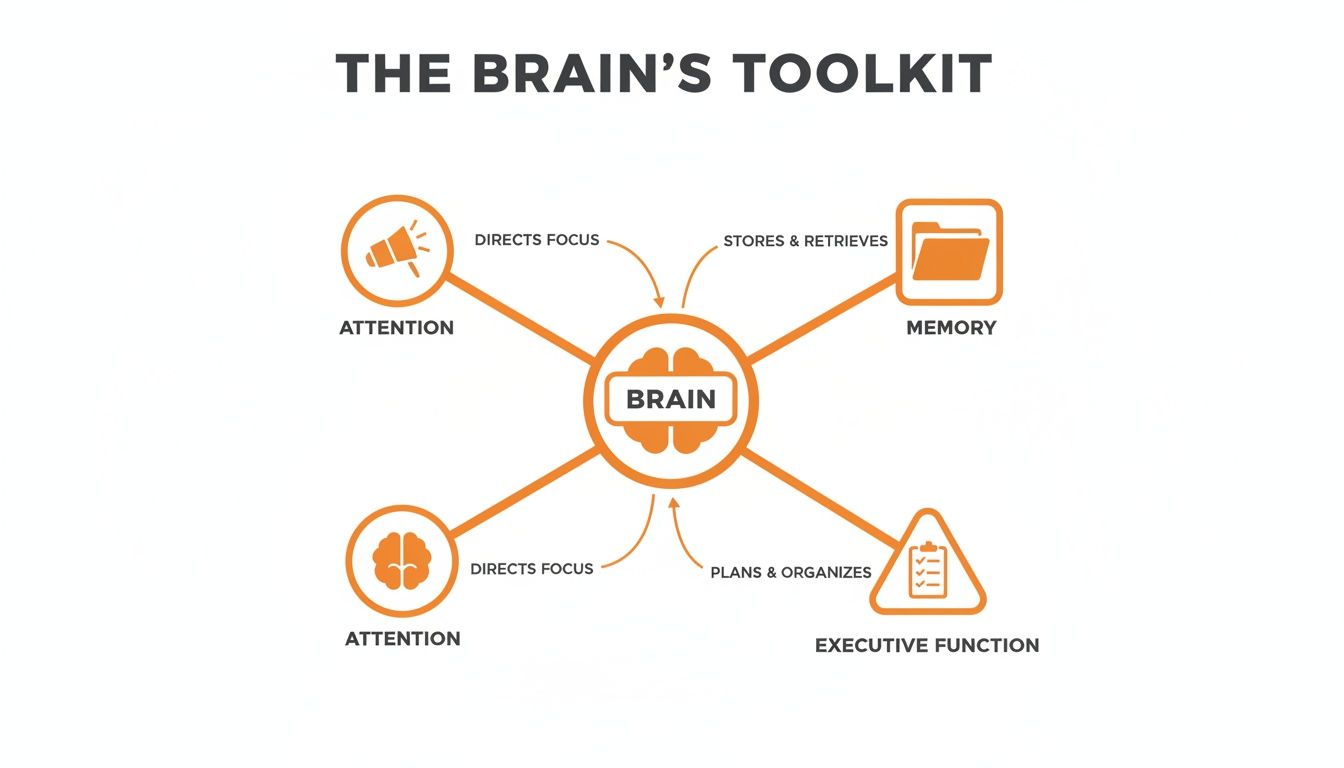
As you can see, attention, memory, and executive function act as central pillars, branching out from the brain to support nearly everything we do.
Attention: The Mental Spotlight
Think of your attention as a powerful spotlight you can aim at any task. It’s what allows you to filter out irrelevant distractions—the chatter in a café, the notifications buzzing on your phone—and focus your mental energy where it’s needed most. Without it, your brain would be completely overwhelmed by a constant flood of information.
Attention isn't just one thing; it comes in a few different flavours:
Sustained Attention: This is your ability to stay focused on a single task over a long stretch. Practical example: Meditating for 20 minutes without letting your mind wander.
Selective Attention: This is the skill of zeroing in on one specific thing while tuning out everything else. Practical example: Having a one-on-one conversation in a loud, crowded party.
Divided Attention: Often called multitasking, this is your brain’s ability to juggle two or more tasks at once. Practical example: Stirring a pot on the stove while helping your child with their homework.
Actionable Insight: If you find your attention wandering during meetings, try actively taking notes. This forces your brain to engage both sustained and selective attention, helping you stay locked in.
Memory: The Brain's Filing System
Memory is your brain’s incredibly intricate filing system, in charge of both storing and retrieving information. But it’s not just a single cabinet. It's a complex network of systems, each handling different kinds of information across different timelines.
We can break it down into two main categories:
Short-Term Memory: This is like your brain’s sticky note. It holds a small amount of information (usually around 7 items) for a very short time (15-30 seconds). It’s what you use to remember a phone number just long enough to dial it. This system includes your working memory, which lets you manipulate that information temporarily.
Long-Term Memory: This is the vast library where you store everything from childhood memories to professional skills. This information is organised and can be recalled hours, days, or even decades later. It's where you keep facts, life events, and learned procedures like how to ride a bike.
Actionable Insight: To move information from short-term to long-term memory, try linking it to something you already know. For example, when learning a new name, connect it to a famous person or a friend with the same name. This creates a stronger mental hook for recall.
Executive Functions: The Project Manager
If cognitive functions are a toolkit, then executive functions are the project manager running the whole show. These are the higher-level processes that govern, manage, and regulate all your other cognitive abilities. They are absolutely essential for any kind of goal-oriented behaviour.
Executive functions allow us to plan for the future, focus our attention, remember instructions, and juggle multiple tasks successfully. Think of them as the air traffic control system of the brain—they manage a multitude of incoming information to avoid collisions and ensure smooth arrivals at our mental destinations.
This internal "project manager" is responsible for three main areas:
Working Memory: Holding and mentally working with information. Practical example: Calculating a 15% tip on a restaurant bill in your head.
Inhibitory Control: The ability to resist temptations and distractions. Practical example: Sticking to your diet when a coworker brings donuts to the office.
Cognitive Flexibility: The skill of switching between different tasks or adapting your thinking. Practical example: Shifting from writing an email to answering an unexpected phone call, then returning to the email without losing your train of thought.
A great way to nurture these skills in a developing brain is through engaging activities. For instance, certain toddler problem-solving toys are specifically designed to boost this kind of critical thinking, helping to build a child's core cognitive toolkit from the ground up.
Processing Speed: The Brain's Internet Connection
Processing speed is all about how quickly you can take in information, make sense of it, and respond. It isn't a measure of how smart you are, but rather how efficiently you handle the information coming your way. Think of it as your brain’s internet connection—a faster connection lets you download and react to things much more quickly.
A practical example is playing a fast-paced video game. You need to instantly process visual cues, make a decision, and execute a response with your hands, all in a split second.
Actionable Insight: Do you often find yourself asking people to repeat things? Or struggle to keep up in fast-paced meetings? It might not be an issue with your hearing or attention, but rather a slower processing speed. Simple, timed brain games can often help improve this efficiency.
Perception: Making Sense of Your World
Perception is the process your brain uses to organise, identify, and interpret sensory information so you can understand the world around you. It's how your brain translates the raw data coming from your eyes, ears, and other senses into meaningful experiences.
It's so much more than just seeing or hearing; it’s about recognition and interpretation. For example, your ears hear a series of sounds, but your perception recognizes it as your favorite song. Your eyes see a collection of lines and colours, but it's your perception that allows you to recognise those patterns as a familiar face, a stop sign, or the words on this screen.
A breakdown in perception can have a profound impact on daily life. Someone with visual perception difficulties might struggle to judge distances, making driving or even navigating a crowded room a serious challenge. Understanding perception is a core part of a complete picture of cognitive functions.
These foundational tools are essential for daily life. To see how a rapid, objective assessment can pinpoint areas for improvement and guide effective interventions, explore the solutions on the Orange Neurosciences website.
When Cognitive Tools Need a Tune-Up
Our minds are like a finely tuned toolkit, with each cognitive function serving as a specific instrument. But what happens when those tools fall out of calibration? This is where the clinical definitions of cognitive functions crash into the messy reality of everyday life, often with profound consequences.
When these essential mental processes start to falter, the impact is rarely subtle. It can upend education, put immense strain on relationships, and completely derail a career. Seeing how these challenges play out in the real world makes it crystal clear why catching them early is so critical.
Attention Challenges in the Classroom
Think about a child with Attention-Deficit/Hyperactivity Disorder (ADHD). Their struggle with sustained attention—that mental spotlight we talked about—isn't a matter of willpower. It's a genuine impairment of a core cognitive tool.
In a busy classroom, this can look like:
Drifting away during lessons: The child might tune out halfway through a teacher's sentence, missing key instructions and falling further and further behind.
Constant distractions: Their selective attention just can't filter out the background noise of shuffling papers or a cough from across the room, making it nearly impossible to focus on the lesson.
Homework feels impossible: For them, starting and finishing an assignment can feel like climbing a mountain, leading to nightly battles that leave both child and parents exhausted and frustrated.
Actionable Insight: If you suspect an attention issue, try creating a "focus zone"—a quiet, clutter-free space for homework. Use a timer to break work into 20-minute chunks with short breaks in between. This simple strategy supports sustained attention and can make a huge difference.
Memory Decline and Daily Safety
For an older adult, a slip in memory can be more than just an inconvenience; it can be a serious safety risk. Forgetting a name is one thing. Forgetting whether you’ve taken your daily heart medication is another thing entirely.
This is a distressingly common scenario. An individual might forget if they took their pills, leading them to either miss a vital dose or, even worse, take a double dose. This simple cognitive lapse can have devastating health consequences. In the same way, they might leave a stovetop burner on or forget to lock the front door, creating immediate hazards in their own home.
These aren't just "senior moments." They are clear signals that a crucial cognitive tool needs support. Actionable Insight: By using objective assessments to pinpoint the specific nature of the memory issue, families can implement life-saving systems like automated pill dispensers with alarms or smart home safety alerts that notify a family member if a door is left unlocked.
Executive Function Impairment After Injury
Imagine a high-flying project manager who suffers a mild traumatic brain injury (mTBI) in a car accident. They might look and feel physically recovered, but their executive functions—the brain's CEO—could be in disarray. In fact, studies show that up to 30% of people who experience a concussion develop persistent symptoms.
Suddenly, the very skills that defined their professional success are gone.
Planning and Organisation: Laying out a project timeline, something that was once second nature, now feels like an overwhelming, chaotic mess.
Inhibitory Control: They might find themselves blurting things out in meetings or making impulsive decisions that they later regret.
Cognitive Flexibility: When an unexpected delay pops up, it triggers intense stress and confusion, whereas before, they would have adapted on the fly.
This kind of invisible injury can shatter a career and lead to crushing personal frustration. The key is to identify the specific executive function weaknesses. With targeted cognitive therapy and the right strategies, these skills can be rebuilt.
These stories bring the definition of cognitive functions to life. It’s not just academic theory; it's a powerful framework for understanding human struggle and finding a path toward improvement. The goal is to stop guessing and start knowing. That's why rapid, objective assessments are so essential—they help us find the exact tool that needs a tune-up before a small crack becomes a major break.
How We Measure Cognitive Performance Today
Knowing the definition of a cognitive function is one thing, but being able to measure it accurately? That's a whole different ball game.
For decades, the process of evaluating cognitive performance was slow, expensive, and frankly, frustrating for everyone involved. It was a world of lengthy interviews, subjective observations, and stacks of pencil-and-paper tests that could take hours to get through and even longer to score. This old-school approach put up some serious roadblocks to getting people the help they needed.
Patients were stuck with long wait times, and the high costs put assessments out of reach for many families. On top of that, the subjective nature of it all meant there was always room for bias, making it tough to get a truly objective snapshot of someone's cognitive health.
This created a massive gap between noticing a potential cognitive issue and getting the clear, actionable data needed to do something about it. Thankfully, technology has completely changed the game, moving us from guesswork to precision.
The Shift to Rapid Digital Assessment
Modern digital platforms have totally reshaped how we measure cognitive abilities. Instead of waiting months for a referral, clinicians can now get a detailed, evidence-based cognitive profile in a fraction of the time. This is all thanks to sophisticated software and AI that can administer, score, and analyze performance with incredible speed and accuracy.
A practical example is a therapist working with a stroke survivor. In the past, they might have relied on general observations. Now, they can use a digital tool to get precise weekly metrics on processing speed and eye–hand coordination. This allows them to tweak the rehabilitation plan in near real-time, based on hard data.
This new era of assessment is all about:
Speed: A comprehensive cognitive profile can be ready in under 30 minutes.
Objectivity: Data-driven results strip away human bias, giving you a clear and consistent baseline to work from.
Accessibility: Digital tools are often more affordable and easier to roll out, bringing crucial cognitive insights to more people than ever before.
Connecting Data to Faster Decisions
This leap forward empowers clinicians to make faster, more confident decisions. An objective cognitive profile delivers the granular detail needed to tell different challenges apart. It helps answer critical questions like, "Is this child's difficulty in school due to an attention issue, or is it a problem with processing speed?" To better understand the details these tools provide, check out our guide on what is cognitive assessment.
The move from slow, subjective methods to rapid, objective assessments isn't just about convenience—it's about fundamentally changing the quality of care. By getting precise data quickly, clinicians can shorten the path from initial concern to effective intervention, ensuring people get the targeted support they need without frustrating delays.
The demand for these advanced tools is skyrocketing. A clear cognitive functions definition for key areas like attention, memory, and executive function has fuelled explosive market growth in the CA region. The U.S. Cognitive Assessment and Training Market recently hit USD 3.67 billion, with North America holding a 32.7% global share. For professionals, this highlights the dramatic shift toward hosted assessments—the fastest-growing segment—which enable precise, data-driven interventions.
Making Cognitive Health Insights Universal
Ultimately, this evolution is about making brain health insights accessible to everyone. Modern platforms make it possible for a wider range of professionals—from developmental paediatricians to rehabilitation therapists—to weave objective cognitive measurement into their daily workflows.
This means a more proactive and personalized approach to cognitive care is finally within reach. For families, it offers a path to clear answers and direction. For clinicians, it provides a reliable, evidence-based foundation for building treatment plans that actually work. By embracing technology, we are finally connecting the dots between a clear understanding of cognitive functions and our ability to measure and support them effectively.
Turning Cognitive Insights into Actionable Plans
Getting an objective cognitive assessment is a huge first step, but its true value comes alive in what you do next. It's one thing to understand the textbook definition of a cognitive function; it’s another thing entirely to use that knowledge to change someone's life.
The data from a detailed cognitive profile isn't just a number on a page—it's a playbook for creating targeted, effective support. This is where the theory becomes practice, and the insights from a rapid assessment lay the foundation for a personalized plan that tackles specific challenges head-on. It’s about moving past a one-size-fits-all approach and into a precise, data-driven strategy.
From Data to Decisive Action
Picture a clinician looking over a new cognitive profile. Instead of just relying on subjective reports, they now have hard data showing a patient has a strong memory but is struggling significantly with processing speed. That clarity changes everything.
With this specific insight, the clinician can act with confidence:
Make Smarter Referrals: They can refer the patient to an occupational therapist who specializes in processing speed, armed with the exact data needed to get a relevant program started immediately.
Rule Out Other Concerns: The strong memory scores might help them deprioritize worries about early dementia, letting them focus on the real issue at hand.
Educate and Empower: They can clearly explain to the patient and their family why certain everyday tasks feel so difficult, replacing frustration with understanding and a clear path forward.
This process cuts through the guesswork that so often causes delays in getting the right care. It gives professionals the proof they need to build a targeted and efficient support system right from day one.
Designing Targeted Support Scenarios
The power of a detailed cognitive profile shows up in all sorts of different settings, making it possible to create tailored plans that fit unique needs. The data becomes a practical roadmap for professionals and caregivers to follow.
An objective cognitive profile is more than just an assessment; it's the blueprint for personalized care. It translates abstract cognitive weaknesses into concrete, actionable steps that can be implemented in therapy sessions, classrooms, and at home.
Here’s how this plays out in the real world:
For the Therapist: A rehabilitation therapist working with a patient recovering from a concussion sees deficits in both attention and eye–hand coordination. With this knowledge, they can design a therapy program with specific game-based exercises to rebuild these skills, tracking progress with quick, regular reassessments.
For the Parent: A parent gets a report showing their child shines in perception but struggles with executive functions like planning and staying organized. Actionable insight: They can now create a supportive home environment with visual schedules for morning routines and step-by-step checklists for homework—building these skills without causing frustration.
In both cases, the support is directly tied to the specific cognitive weakness that was identified. This makes sure that everyone's time and effort are focused where they'll have the biggest impact, which can speed up progress and build confidence. If you're looking to take the next step, our guide on how to improve cognitive function offers more strategies and insights.
Empowering Change with the Right Tools
Ultimately, turning these cognitive insights into real action requires the right tools. Modern platforms don’t just give you the initial assessment; they support the entire journey of intervention and progress monitoring. They connect the dots between spotting a problem and actually solving it.
A platform like Orange Neurosciences allows you to move seamlessly from assessment to intervention. Our system gives you the power to use objective data to build and track personalized plans, making sure every action you take is backed by solid evidence. This is how we close the gap between understanding cognitive functions and making a real, lasting difference.
Your Questions About Cognitive Functions, Answered
Now that we've walked through the core cognitive functions, let's tackle some of the most common questions people have. Think of this as a quick, practical guide to help you feel more confident about cognitive assessment and improvement.
Is a Cognitive Assessment the Same as a Medical Diagnosis?
No, and it's a really important distinction to make. A cognitive assessment isn't a medical diagnosis. The best way to think about it is like a detailed report card for your brain, showing its performance in specific areas. It gives you an objective profile of your strengths and weaknesses in functions like memory, attention, and processing speed.
This data is incredibly valuable for clinicians. It helps them figure out if a full diagnostic evaluation—for something like ADHD or dementia—is the right next step. But the assessment itself isn't the diagnosis. It’s a crucial information-gathering tool that points everyone in the right direction and helps avoid delays in getting the right care.
At What Age Can Cognitive Functions Be Assessed?
You can effectively assess cognitive functions across the entire lifespan, from young kids right through to older adults. Modern, game-based tools are designed to be engaging for different age groups, making sure the tasks feel relevant and the results are reliable.
For children, these assessments can flag learning challenges early on, opening a critical window for intervention. For adults, they're great for tracking recovery after an injury, monitoring cognitive health over time, or simply getting a baseline to compare against later. The key is to use a standardized, age-appropriate tool that delivers accurate, meaningful data.
It's a common myth that serious cognitive decline is just a normal part of getting older. While some changes are expected, significant impairments are not. Regular assessments help distinguish between normal, age-related shifts and signs that might need a closer look, empowering you to be proactive about your long-term brain health.
How Can I Improve My Cognitive Functions?
Improving your cognitive functions really comes down to a mix of targeted training and a brain-healthy lifestyle. Once an assessment has pinpointed specific areas that need a boost, you can use personalized programs to strengthen those skills directly. For instance, if attention is a challenge, game-based exercises that demand sustained focus can help build up that mental muscle.
But beyond any formal training, simple daily habits make a massive difference:
Get moving: Regular physical exercise boosts blood flow to the brain and even supports the growth of new neurons.
Eat well: A balanced diet rich in things like omega-3s, antioxidants, and key vitamins is fuel for your brain.
Prioritize sleep: This is when your brain gets the downtime it needs to consolidate memories and clear out metabolic waste.
Stay mentally engaged: Learning a new skill, picking up a new hobby, or staying social all challenge your brain and help build what we call "cognitive reserve."
When you combine these actionable steps with the objective insights from an assessment, you have a powerful framework for enhancing your cognitive performance at any age.
Ready to move from understanding to action? At Orange Neurosciences, we provide the tools to get a clear, objective profile of your cognitive health in under 30 minutes. Discover how our platform can support your journey by visiting us at https://orangeneurosciences.ca. For more insights and practical tips delivered to your inbox, sign up for our newsletter.
Orange Neurosciences' Cognitive Skills Assessments (CSA) are intended as an aid for assessing the cognitive well-being of an individual. In a clinical setting, the CSA results (when interpreted by a qualified healthcare provider) may be used as an aid in determining whether further cognitive evaluation is needed. Orange Neurosciences' brain training programs are designed to promote and encourage overall cognitive health. Orange Neurosciences does not offer any medical diagnosis or treatment of any medical disease or condition. Orange Neurosciences products may also be used for research purposes for any range of cognition-related assessments. If used for research purposes, all use of the product must comply with the appropriate human subjects' procedures as they exist within the researcher's institution and will be the researcher's responsibility. All such human subject protections shall be under the provisions of all applicable sections of the Code of Federal Regulations.


© 2026 by Orange Neurosciences Corporation