Speech Therapy Canada A Complete Guide for 2026
May 20, 2026

You're probably here because something feels off, but you're not sure whether it's serious enough to act on. A toddler isn't combining words the way peers seem to. A school-aged child understands more than they can express. A parent or spouse after stroke knows what they want to say, but the words won't come. Or you've been told to “look into speech therapy” and then discovered that in Canada, that simple advice opens into wait-lists, referrals, school systems, private clinics, insurance questions, and a lot of conflicting information.
That confusion is normal. The phrase speech therapy canada sounds straightforward, but access and care are anything but simple. What helps is understanding the system in practical terms. Who provides care, where you can get it, how public and private routes differ, what an assessment looks like, and where newer tools such as AI can help without replacing clinician judgement.
Good speech therapy is never just about correcting sounds. It's about helping someone communicate, participate, eat safely when swallowing is affected, and function more confidently in daily life. When families understand that wider picture, they usually make better decisions faster.
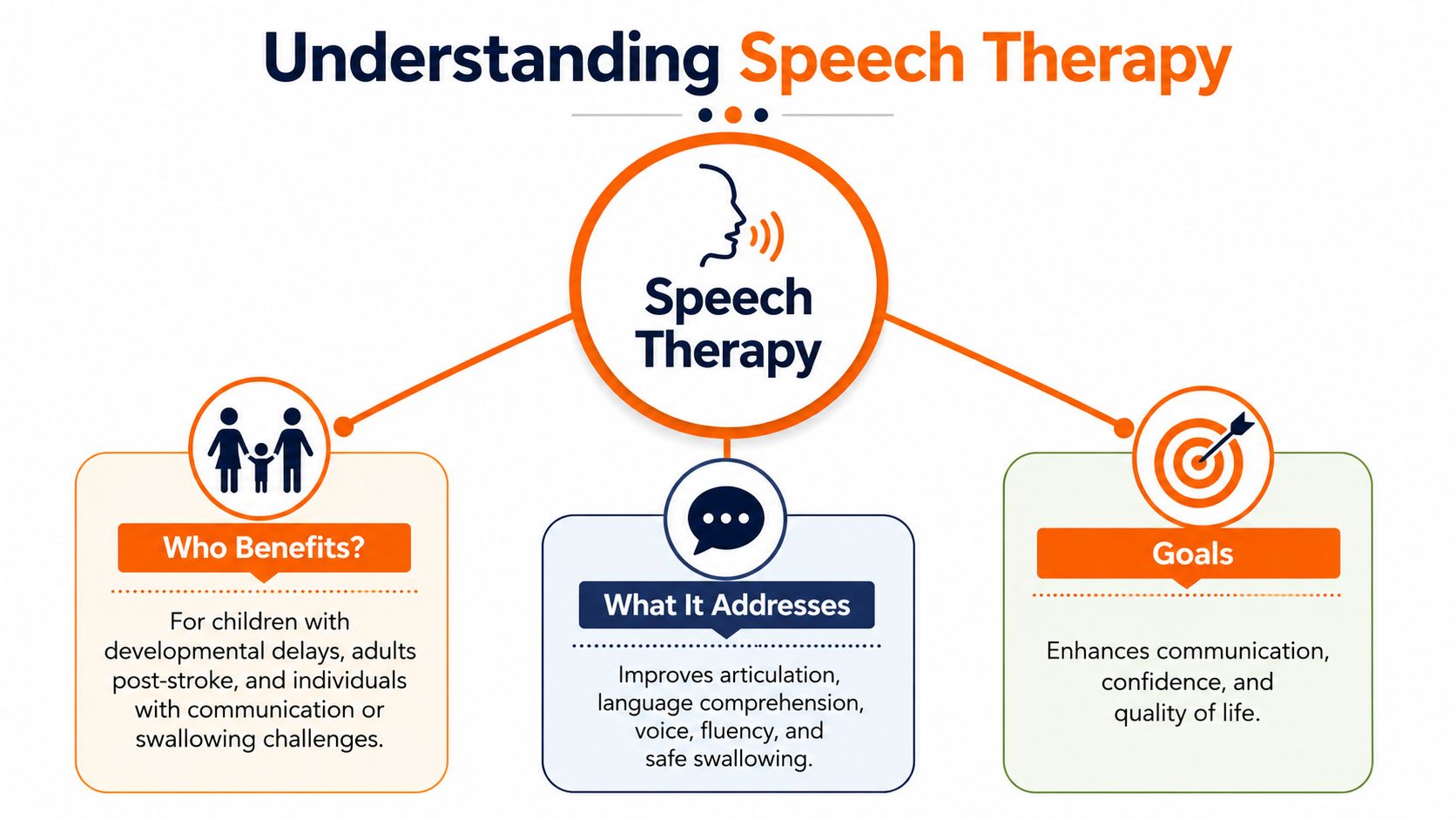
What Is Speech Therapy and Who Is It For
A lot of people still assume speech therapy is mainly for lisps, mispronunciations, or stuttering. Those concerns are real, but they're only one part of the work. In practice, speech therapy can involve speech, language, social communication, voice, fluency, and swallowing.
It's broader than most families expect
For a young child, concerns often sound like this:
Late talking: few words, limited word combinations, or difficulty following directions
Speech clarity: family understands the child, but others don't
Social use of language: trouble taking turns, reading cues, or joining conversation
Play and learning language: weak pretend play, narrow communication patterns, or difficulty answering questions
For teens and adults, the picture shifts:
Aphasia after stroke: trouble finding words, understanding language, reading, or writing
Voice changes: strain, hoarseness, vocal fatigue, or reduced vocal control
Fluency issues: stuttering or speech that feels effortful and disrupted
Swallowing problems: coughing with meals, trouble managing textures, or concerns after illness or neurological change
That's why many families enter the system thinking they need “speech help” and later realise the issue is language, processing, or swallowing. Communication is rarely one isolated skill.
Speech therapy is often less about producing a perfect sound and more about helping a person participate in home, school, work, and community life.
Who it serves across the lifespan
Speech-language pathology in Canada supports children, adults, and older adults. Clinical work can include developmental language disorder, autism-related communication support, aphasia after stroke, and neurogenic swallowing issues. The scope is broad enough that one clinician may see a child with language delay in the morning and an older adult with swallowing concerns later the same day, as outlined in this overview of what speech-language pathologists do in clinical practice.
In day-to-day care, goals differ by person. A toddler may need help learning to understand and use words. A student may need support with classroom language and narrative skills. An adult may need strategies to communicate after neurological injury. Another person may need safer swallowing routines rather than communication treatment at all.
If your concern sits alongside autism, developmental differences, or overlapping support needs, a focused resource such as this autism resource centre for families can also help you sort out what kind of assessment and follow-up to pursue.
The goal isn't perfection
The best outcomes usually come from targeting real-life function. That can mean clearer speech, yes. It can also mean getting through a meal safely, asking for help independently, joining classroom discussion, returning to work conversations, or reducing the exhaustion that comes from trying to communicate all day.
That's why speech therapy canada matters to more people than the name suggests. If communication or swallowing is affecting daily life, this guide is for you.
Who Provides Speech Therapy Services in Canada
In Canada, the main professional who provides speech therapy is the Speech-Language Pathologist, often shortened to SLP. This is a regulated health profession with defined training and scope.
What qualifies someone as an SLP
The profession is formally recognised in Canada's National Occupational Classification, which states that SLPs diagnose, assess, and treat communication disorders including speech, fluency, language, voice, and swallowing, and that the occupation typically requires a master's degree. That same profile also notes the profession's history in Canada, with only about 200 professionals by 1968, and identifies seven self-regulating provinces: New Brunswick, Quebec, Ontario, Manitoba, Saskatchewan, Alberta, and British Columbia, according to the National Occupational Classification profile for speech-language pathology.
Those details matter for families because they give you a practical filter. If someone is presenting themselves as the person making the assessment, setting the treatment plan, or managing complex swallowing or communication disorders, you should be clear on whether they are an SLP and whether they are practising under the rules of their province.
Other team members you may meet
Not every person in the therapy room is an SLP. In some settings, families also work with support personnel such as communicative disorders assistants or therapy assistants. Their role can be very helpful, especially for carrying out practice plans, supporting sessions, or increasing therapy intensity under supervision.
What doesn't work well is assuming all providers do the same job. If you're booking privately, ask directly:
Who does the assessment? Is it an SLP?
Who provides ongoing sessions? Will support staff be involved?
Who adjusts goals and reviews progress?
Who should I contact if swallowing or medical issues come up?
That conversation prevents a lot of disappointment later.
Where services are delivered
Canadian families access speech therapy in several settings:
Hospitals and rehabilitation programmes: often for stroke, neurological conditions, acute swallowing concerns, or medically necessary care
Schools and public community services: often focused on educational impact, developmental concerns, or early intervention pathways
Private clinics: useful when you want faster access, a second opinion, or a treatment model with more scheduling flexibility
Virtual care: practical for follow-up, coaching, rural access, and some adult services
A family may use more than one system at the same time. For example, a child might receive school-based support focused on classroom participation while a private SLP works on a broader language plan at home. Adults with complex needs often benefit from the same kind of coordinated model. If daily functioning also overlaps with self-care, motor planning, or sensory needs, this guide to occupational therapy in Canada is often a useful companion.
Practical rule: Ask every provider what setting-specific goal they're targeting. School, hospital, and private clinic care can all be valuable, but they don't always solve the same problem.
Navigating the System Public versus Private Pathways
The hardest question for most families isn't “What is speech therapy?” It's “How do I get it?” In Canada, that usually means choosing between the public pathway, the private pathway, or a mix of both.
A Canadian policy brief from Speech-Language and Audiology Canada points out that funding and reimbursement are major barriers to access and that many pages about speech therapy in Canada don't explain the difference between medically necessary hospital care and private outpatient therapy. It also highlights the question families ask most often: how to get help quickly and affordably in their province, as noted in this Canadian access and funding brief.
What the public route does well
Public services can be an excellent entry point, especially when concerns are medically necessary, tied to hospital care, or linked to school and community programmes. For many families, this is the route that keeps care financially possible.
What works well in the public system:
No direct fee at point of care in many eligible settings
Connection to larger systems such as schools, hospitals, rehab, or public health
Team-based care when communication issues overlap with broader medical or developmental needs
What often frustrates families:
Eligibility rules are narrow: the service may be tied to age, diagnosis, geography, school impact, or medical status
Wait-lists can be long: especially for non-urgent outpatient concerns
Therapy intensity may be limited: a public service may assess, consult, and discharge with home programming rather than offer frequent sessions
What private care changes
Private speech therapy usually offers speed, flexibility, and more direct choice. If a parent is worried now, private care can let them act now rather than waiting for a system decision.
That doesn't mean private is automatically better. It means private is often easier to access, but you're taking on the work of choosing the clinician, coordinating reports, and funding care yourself unless benefits help.
Here's the practical comparison most families need.
Feature | Public System | Private Practice |
|---|---|---|
Cost | Often covered when eligible | Usually paid out of pocket or through private benefits |
Entry point | Referral, programme intake, school or hospital route | Self-referral is often possible |
Speed | Can involve significant waiting | Usually faster to start |
Eligibility | Programme criteria apply | Broader access if you can fund care |
Session model | May focus on assessment, consultation, or limited treatment | Often more flexible and ongoing |
Choice of clinician | Usually assigned by service area or programme | You choose the provider or clinic |
Best fit | Medically necessary care, school-linked needs, public supports | Faster access, second opinions, tailored scheduling |
The strongest strategy is often hybrid
A lot of families make progress by using both systems strategically. They stay on the public wait-list, accept any school or hospital supports available, and use targeted private sessions to bridge urgent gaps.
That hybrid approach works especially well when you're trying to answer one of these questions:
Do we need a full assessment now, or can we wait?
Is the issue affecting safety, school participation, or recovery enough that delay will cost us time?
Could a few private sessions give us a home plan while we wait for broader public support?
If communication challenges also affect work capacity, income, or broader disability planning, practical legal guidance can help. Families and adults sometimes find UL Lawyers' disability resource on applying for disability in Canada useful when therapy access is only one part of a larger support picture.
What doesn't work
The least effective approach is passive waiting without a plan. If you're on a wait-list, ask what you can do while waiting. Ask whether there's a cancellation list. Ask whether another stream exists for the same concern. Ask whether school, family doctor, rehab, or community programme referrals can run in parallel.
For Ontario readers, a province-specific overview of speech therapy programs in Ontario can help you sort the mix of community, educational, and private options.
If a service says “you're on the list,” your next question should be “What can we do in the meantime, and what signs mean we should escalate sooner?”
The Speech Therapy Process From Assessment to Treatment
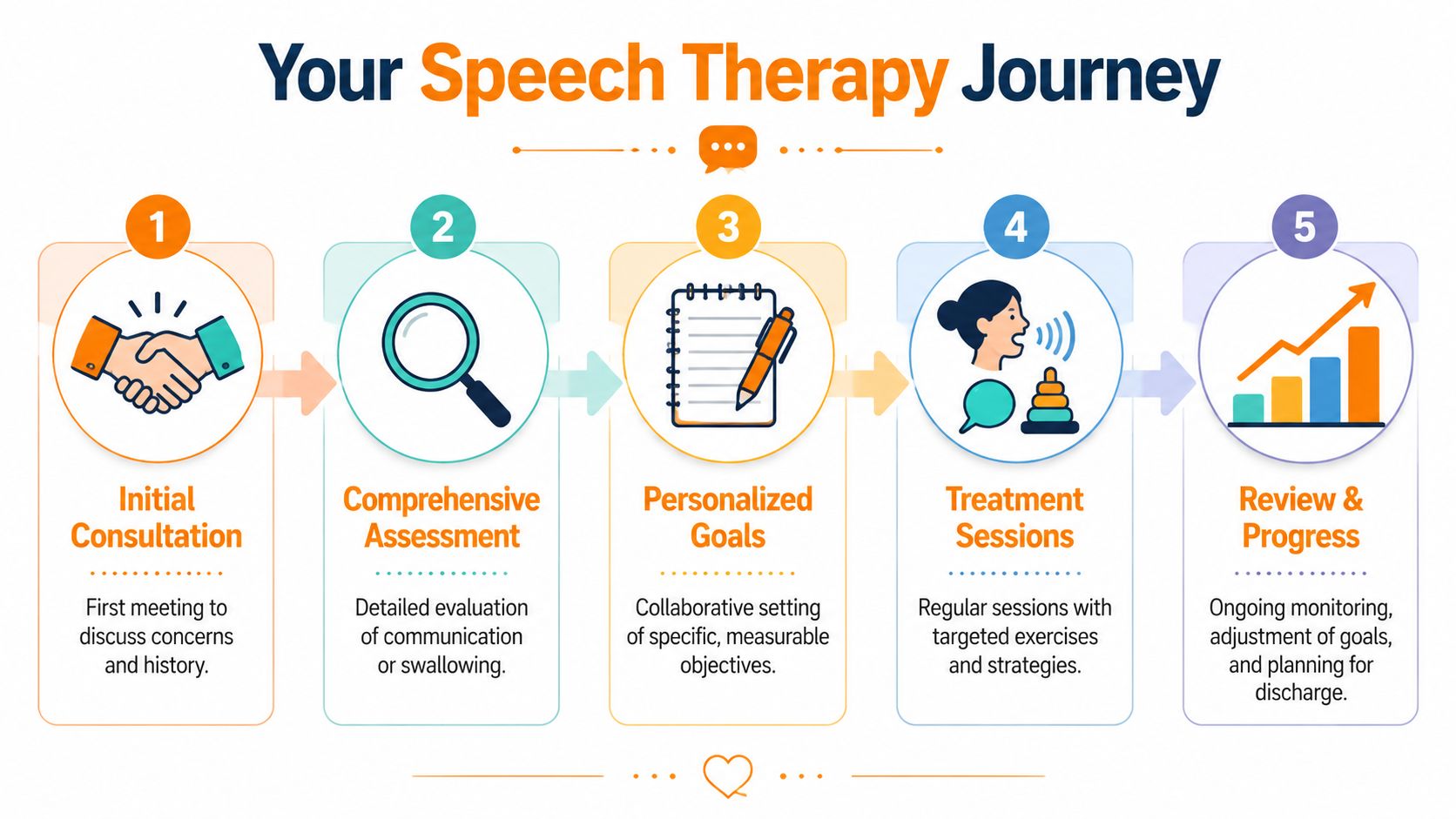
Individuals often feel less anxious once they know what the process looks like. The first appointment usually isn't a test where you pass or fail. It's a structured attempt to understand what's happening, how it affects daily life, and what should happen next.
The first conversation
A parent might call because their child uses only a few words and gets frustrated easily. An adult might book after a stroke because speech feels effortful and confusing. In both cases, the intake starts with history.
Expect questions about:
What you've noticed: when the concern started, what's hard, and when it's easier
Medical and developmental background: hearing, diagnoses, school concerns, neurological events, feeding history
Daily function: what happens at home, in school, at work, or during meals
Your priorities: what you most want to change
That last point matters. Therapy works better when goals match real life. “Improve language” is too broad. “Answer classroom questions with less prompting” is useful. “Order a coffee independently after stroke” is useful. “Eat safely without repeated coughing” is useful.
The assessment itself
Assessment methods vary by age and concern. A child may engage through play, conversation, pictures, and structured tasks. An adult may complete language tasks, speech samples, reading, naming, or swallowing-related evaluation depending on the referral question.
A typical assessment may include:
Observation: how the person communicates naturally
Structured tasks: to look at specific skills such as understanding, word finding, sound production, or fluency
Caregiver or client interview: often the most important part for understanding function
Analysis and feedback: what the pattern suggests, what needs monitoring, and what to do next
If the concern overlaps with listening, processing, or hearing-related questions, additional pathways may matter. For some families, this guide to auditory processing testing helps clarify when speech-language and auditory concerns need to be considered together.
Goal setting and treatment
Once the clinician understands the pattern, treatment should feel collaborative, not mysterious. Goals should be specific enough that everyone knows what success looks like.
A child with expressive language delay might work on combining words during play, answering simple questions, and building vocabulary through routines. A person with aphasia might work on word retrieval strategies, functional scripts, and supported conversation. Someone with swallowing needs may focus on safety strategies, food texture recommendations, and caregiver training.
What usually works:
Small goals tied to daily routines
Practice that's realistic between sessions
Regular review and adjustment
Clear coaching for family or caregivers
What often fails is overloading the plan. Families don't need a binder full of activities they'll never use. They need a few strategies they can repeat consistently in meals, play, reading, or conversation.
A good therapy plan should fit into real life. If it only works inside the clinic, it usually won't hold.
The Future Is Now How AI Augments Speech Therapy
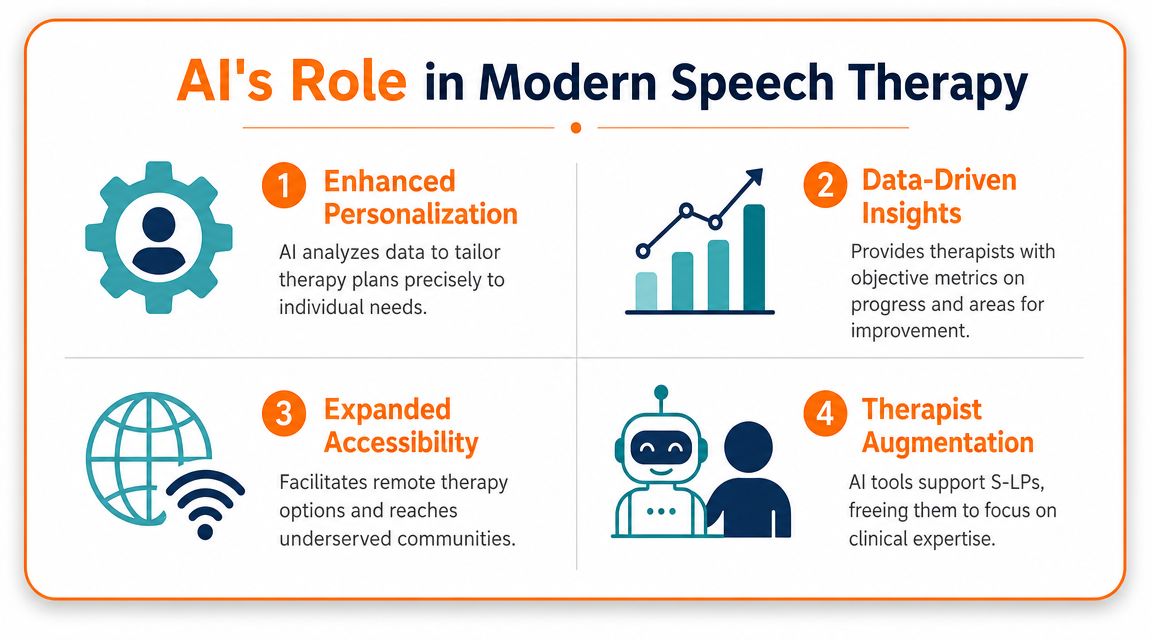
A parent waits months for an assessment, finally gets a first appointment, and then asks the question I hear all the time: can anything help us get clearer answers sooner? In many cases, yes. AI tools can add structure, speed up pattern tracking, and give families and clinicians better information while they work through Canada's uneven mix of public and private services.
What AI is actually good at
Speech-language pathology involves more variables than many people expect. A clinician may be watching speech clarity, language understanding, voice, fluency, swallowing, attention, fatigue, and day-to-day function at the same time. Technology helps most when the job involves repeated measurement, structured observation, and review across time.
The American Speech-Language-Hearing Association has described emerging AI-related applications in speech-language pathology that include speech recognition, transcription support, acoustic analysis, and tools that assist with monitoring and documentation under clinician supervision, as outlined in ASHA's artificial intelligence in speech-language pathology practice resources.
In practice, that can mean:
Cleaner baselines: a more consistent record of how someone is doing at the start
Progress monitoring: easier comparison across sessions instead of relying only on memory or scattered notes
Pattern spotting: a better chance of catching fatigue effects, inconsistent performance, or context-specific breakdowns
More customized home practice: activities can be adjusted based on actual response patterns
I would still treat all of that as support data, not a conclusion. A good tool improves signal. It does not replace interpretation.
Where it helps families in the Canadian system
Canadian families often face a familiar problem. The speech concern is obvious, but access is slow, school information is partial, and each province handles referrals and funding differently. By the time a child or adult reaches a clinician, people may have been guessing for months about whether the issue is language, attention, processing, motor speech, or a mix.
Digital tools can shorten that guessing period.
For children, structured profiling can show whether broader learning or cognitive factors may be affecting communication performance. For teens and adults, digital tracking can make it easier to compare good days and hard days, especially when fatigue, stress, or recovery status changes performance. That matters in real life because therapy decisions often depend on patterns, not one strong or weak session.
A practical example is Orange Neurosciences' digital therapy platform for neurodiverse learners, which offers rapid cognitive profiling and game-based training that may help inform next-step decisions. It is not a diagnostic service, but it can give families, educators, and clinicians useful information while they are waiting for formal assessment or deciding whether a broader referral makes sense.
That trade-off matters. Faster information is helpful. Faster information without clinical context can also send families in the wrong direction.
What still requires a clinician
AI does not read the room well. It does not judge whether a child is quiet because the language task is too hard, the environment is overwhelming, or the adult asking the question is unfamiliar. It does not sort out whether an adult's communication breakdown reflects aphasia, apraxia, hearing status, medication effects, or exhaustion after a long day.
It also should not be making swallowing recommendations on its own. Dysphagia decisions need direct clinical judgment and, in some cases, medical imaging or specialized assessment.
The strongest model is shared work:
The clinician interprets the findings and makes decisions
The family or individual reports what happens at home, school, work, or meals
The technology adds structured observations that are hard to capture consistently by hand
Used carefully, AI can reduce administrative load, tighten monitoring, and help therapists spend more time on coaching and less time on repetitive scoring. Used poorly, it creates false confidence.
The useful question is simpler than the hype suggests. Can this tool help the clinician make a clearer decision, sooner, with better follow-up data? If yes, it deserves a place in modern speech therapy care in Canada.
Actionable Strategies for Families and Individuals
When you're waiting for services or deciding what to do next, you need actions, not theory. Most families can improve the process by tightening how they observe, ask questions, and use daily routines.
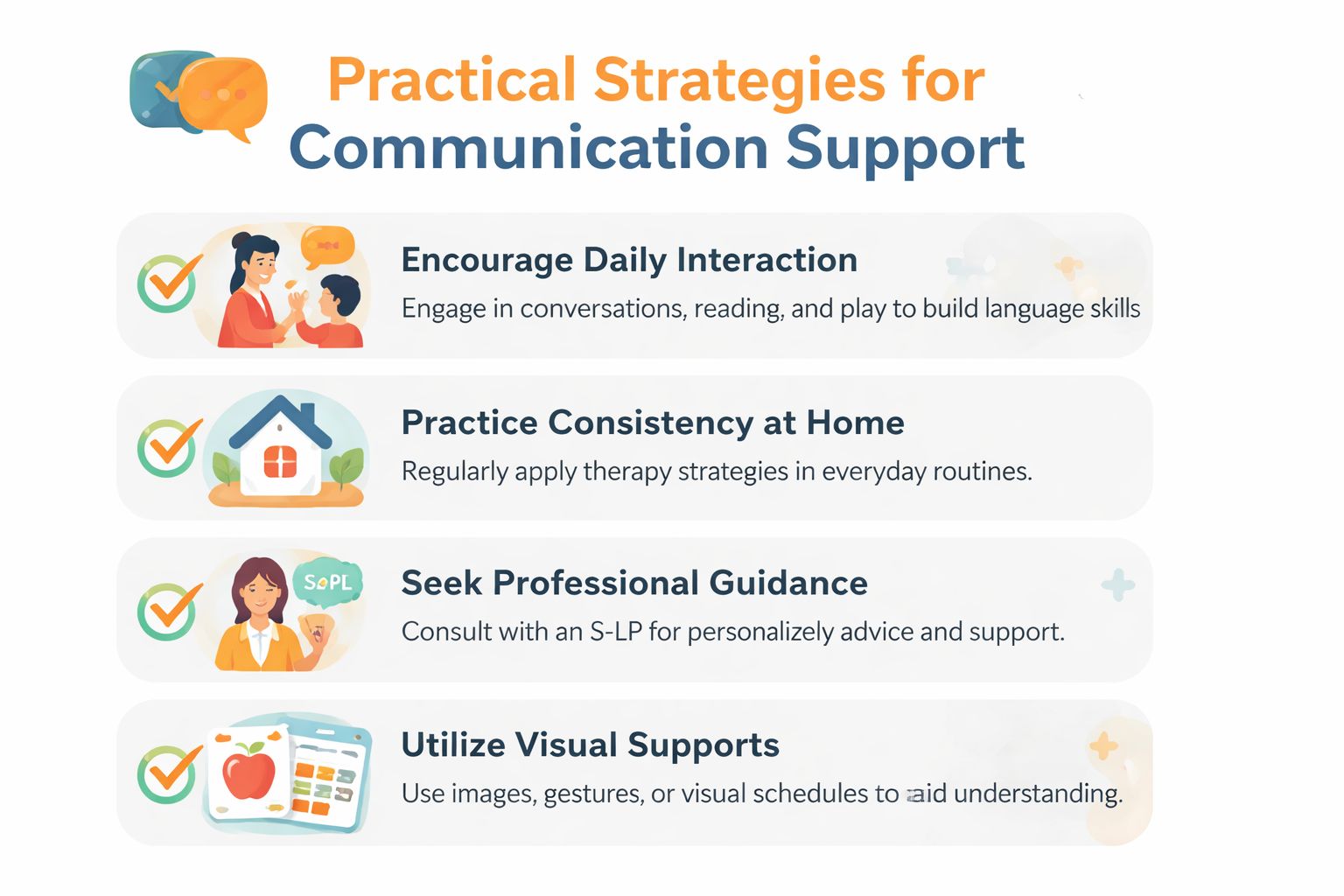
What to do while you're waiting
If you're on a wait-list, don't sit still. Start collecting useful information.
Write down real examples: note what the person tried to say, what went wrong, and what helped
Record patterns, not just worries: does the problem show up in noise, under time pressure, with unfamiliar people, or at mealtimes?
Use one routine every day: reading the same book, narrating bath time, or practising one communication support strategy consistently is more useful than doing ten things inconsistently
For children, simple language facilitation often works better than nonstop questioning. Comment on what they're doing. Expand what they say. Pause and let them take a turn. If they say “car,” you can model “big car” or “car go” without forcing repetition.
How to choose a private clinician well
A lot of private care decisions are made too quickly. Ask sharper questions before booking.
Questions worth asking on the first call
Who will assess and who will treat?
What experience do you have with this concern? Keep it specific. Stroke, stuttering, preschool language, voice, swallowing, autism-related communication, not just “speech.”
How do you involve families or caregivers?
What does progress review look like?
Do you coordinate with school, physician, rehab, or other providers if needed?
A polished website doesn't tell you how thoughtful the clinical reasoning is. The intake conversation usually tells you more.
Be practical about payment and documentation
If you have private insurance, ask what wording they require on invoices and whether the provider must be registered in a specific way. If an employer benefit plan, EAP, school support process, or disability application is involved, ask early what documentation they accept.
If coverage is limited, focus your paid sessions on high-value moments:
Assessment and clear recommendations
A small number of coaching sessions
A progress review after home practice
Specific reports only when they serve a purpose
That approach is often more sustainable than trying to buy indefinite weekly care without a plan.
Access isn't equal across Canada
For First Nations, Inuit, and Métis communities, access issues go beyond clinician numbers. A CASLPA-commissioned report highlights that service delivery is uneven and shaped by geography, jurisdictional complexity, and the need for culturally appropriate care. Community-built models matter because they can improve trust and continuity, as outlined in this report on speech, language, and hearing services for First Nations, Inuit, and Métis communities.
That has direct implications for families. A standard “find a therapist near you” approach may not fit communities where travel is burdensome, jurisdiction is split, or previous healthcare experiences have damaged trust. In those settings, ask not only whether services exist, but also who designed them, how follow-up works, and whether the model is community-based and culturally safe.
Your Path Forward in Canadian Speech Therapy
The Canadian speech therapy system can feel scattered because it is scattered. Public services, private clinics, school systems, rehab programmes, telepractice, and funding pathways don't always line up neatly. But families do better once they stop looking for one perfect door and start building a practical route.
That route usually starts with a clear concern, not a perfect label. It gets stronger when you understand who the qualified providers are, which pathway fits your urgency and budget, and what the assessment and treatment process should look like. It gets stronger again when you use tools that reduce guesswork, whether that's better progress tracking, structured home practice, or clinician-guided digital supports.
If you're a parent, caregiver, adult client, or provider trying to make sense of next steps, don't wait for total certainty. Start with the path that gets you better information fastest. Ask direct questions. Keep records. Use the systems available to you in parallel when needed.
If you want to explore how digital cognitive assessment and therapy tools can support decision-making, care planning, or follow-up, visit the Orange Neurosciences website or contact the team by email through their site. A clearer plan usually starts with clearer data.
Frequently Asked Questions About Speech Therapy
Is speech therapy only for children?
No. Speech-language pathology supports infants, school-age children, teens, adults, and older adults. In practice, I see families surprised by how broad the field is. An SLP may help with late talking, speech sound errors, stuttering, language and literacy-related concerns, voice problems, concussion or brain injury recovery, stroke rehabilitation, and swallowing difficulties.
Can speech therapy help after stroke or with ageing-related changes?
Yes. Adults often come to speech therapy after a stroke, brain injury, neurological diagnosis, head and neck cancer treatment, or a noticeable change in voice, memory for language, or swallowing. Older adults may also need support when communication changes start affecting meals, medical appointments, social connection, or day-to-day independence.
Age-related change is real, but “getting older” should not be used to dismiss a problem automatically. If speech, language, voice, thinking skills used for communication, or swallowing have changed, an assessment can clarify what is expected, what is treatable, and what strategies can help now.
Do I need a referral to see an SLP in Canada?
It depends on where you are entering the system.
Hospitals, rehabilitation programmes, and some publicly funded services often require a physician or programme referral. Many private clinics accept self-referral, which is one reason families use private assessment to get answers sooner while they remain on a public wait-list. The College of Audiologists and Speech-Language Pathologists of Ontario explains that speech-language pathologists work in health care, education, private practice, and community settings across the province, which reflects how different access points can be across Canada: CASLPO overview of speech-language pathology.
How do I know whether I should wait or seek help now?
Seek help sooner if the concern affects safety, recovery, school participation, work performance, or everyday communication. That includes choking, coughing with meals, a sudden change after stroke or illness, a child falling behind and becoming frustrated, or an adult avoiding conversation because speaking has become hard.
If you are unsure, book a screening, consultation, or full assessment. In my experience, early clarification often saves time. Sometimes the answer is treatment. Sometimes it is home strategies and monitoring. Sometimes it is reassurance backed by a baseline.
Are online speech therapy sessions effective?
Often, yes. Virtual care can work well for parent coaching, home-programme review, speech and language therapy for the right client, adult communication treatment, and follow-up sessions where progress tracking matters more than hands-on examination.
There are trade-offs. In-person care may be the better choice for complex swallowing concerns, very young children who cannot engage through a screen, or assessments that depend on close physical observation and direct prompting. A good clinic should tell you plainly when virtual is a strong option and when it is not.
Digital tools can also improve what happens between sessions. If you're looking for a clearer next step, Orange Neurosciences offers information on AI-supported cognitive assessment and digital therapy tools that can help families, clinicians, and educators make more informed care decisions. You can explore the site for practical resources or contact the team directly to discuss whether their platform fits your setting.
Orange Neurosciences' Cognitive Skills Assessments (CSA) are intended as an aid for assessing the cognitive well-being of an individual. In a clinical setting, the CSA results (when interpreted by a qualified healthcare provider) may be used as an aid in determining whether further cognitive evaluation is needed. Orange Neurosciences' brain training programs are designed to promote and encourage overall cognitive health. Orange Neurosciences does not offer any medical diagnosis or treatment of any medical disease or condition. Orange Neurosciences products may also be used for research purposes for any range of cognition-related assessments. If used for research purposes, all use of the product must comply with the appropriate human subjects' procedures as they exist within the researcher's institution and will be the researcher's responsibility. All such human subject protections shall be under the provisions of all applicable sections of the Code of Federal Regulations.


© 2026 by Orange Neurosciences Corporation