Positive and Negative Syndrome Scale Guide for Clinicians

A psychiatrist has a treatment-resistant patient waiting for a medication review, a nursing team with mixed observations, and roughly one appointment slot in which to quantify change. The question isn't whether symptoms matter. It's whether the clinician should spend the available time on the full Positive and Negative Syndrome Scale, or use a shorter measure that can be repeated more often.
That decision captures PANSS's central value and its central problem. The instrument gives psychiatrists, trial teams, and researchers a shared language for schizophrenia symptom severity, but a complete interview can take about 30–45 minutes when administered carefully according to Pearson Clinical Canada. A score can sharpen a treatment discussion, yet it can also consume time that a busy clinic needs for formulation, consent, family communication, or cognitive assessment.
The practical issue, then, isn't how to calculate a PANSS score. It's knowing when the full interview earns its place, when a brief measure is more useful, and how to combine symptom ratings with cognitive and behavioural data without exhausting the patient or the team.
Why the Positive and Negative Syndrome Scale Still Matters
The psychiatrist in that opening situation has three defensible options. A full PANSS can establish a detailed baseline before a clozapine titration meeting. A brief measure can provide a rapid check on whether the most urgent symptoms are moving. Or the clinician can postpone formal scoring and rely on narrative notes, accepting that “less suspicious” or “still withdrawn” may mean different things to different members of the team.
That last option is common, but it weakens communication. PANSS converts observations into a structured rating that can be compared across visits, raters, treatment phases, and research sites. It was validated in 1988 in a study of 82 acute and chronic patients with schizophrenia, where the positive and negative subscales showed interrater reliabilities in the 0.80s and significant correlations with corresponding criterion measures, supporting reliability and construct validity the original validation record is summarised in PubMed.
A shared clinical language
PANSS remains prominent because it lets a treatment team discuss which symptoms changed, not only whether the patient appears better. A fall in hallucination-related severity has a different clinical meaning from improved rapport, and neither necessarily tells you whether processing speed or working memory has recovered.
This distinction matters in several settings:
Medication reviews: A clinician can compare ratings before and after an adjustment instead of relying solely on retrospective narrative.
Research enrolment: Trial teams commonly use PANSS change as an efficacy endpoint, preserving a common measurement framework across sites.
Team handovers: Nurses, psychiatrists, psychologists, and social workers can connect observed behaviour to defined symptom domains.
Longitudinal care: Repeated scores help identify gradual change that may be difficult to detect in prose notes.
Practical rule: Use the full PANSS when the decision depends on a defensible, domain-level baseline. Use a shorter measure when the decision depends on frequent directional monitoring.
The scale also has relevance for Canadian clinicians working in varied settings. In California, for example, PANSS change is already used as a primary efficacy endpoint in a multi-site schizophrenia trial with locations including Bellflower, Culver City, Garden Grove, Glendale, Lemon Grove, Orange, Panorama City, Pico Rivera, Riverside, and San Diego ClinicalTrials.gov lists the study sites and endpoint. The broader lesson isn't that every community clinic should reproduce a trial workflow. It's that PANSS can support comparison across different recruitment and treatment environments.
A useful guide should therefore stay close to workflow. The important questions are how the scale is structured, how reliably different clinicians can use it, what the score conceals, and how to pair it with cognitive testing when symptom improvement doesn't equal functional recovery.
Inside the 30-Item Structure of the Positive and Negative Syndrome Scale
A patient may report fewer voices yet remain withdrawn, poorly motivated, and unable to manage daily tasks. PANSS helps separate those changes instead of reducing the visit to a single impression. The full instrument contains 30 clinician-rated items: 7 positive-symptom items, 7 negative-symptom items, and 16 general psychopathology items. Each item receives a rating from 1 to 7, following the standard structure described by McGill University's measures library provides the standard structure and scoring range.
The three domains
The Positive subscale covers delusions, conceptual disorganisation, hallucinatory behaviour, excitement, grandiosity, suspiciousness or persecution, and hostility. These items capture added experiences or behaviours, including fixed false beliefs, perceptual disturbances, and escalating confrontation.
The Negative subscale covers blunted affect, emotional withdrawal, poor rapport, passive or apathetic social withdrawal, difficulty with abstract thinking, lack of spontaneity and flow of conversation, and stereotyped thinking. Cooperation during the interview does not rule out substantial negative symptoms. A patient can answer politely while showing little emotional expression, initiative, or spontaneous speech.
The General Psychopathology subscale includes somatic concern, anxiety, guilt feelings, tension, mannerisms and posturing, depression, motor retardation, uncooperativeness, unusual thought content, disorientation, poor attention, lack of judgment and insight, disturbance of volition, poor impulse control, preoccupation, and active social avoidance. This domain often captures clinically relevant problems that do not fit neatly into positive or negative symptoms.
How the anchors work
PANSS uses severity anchors rather than a yes-or-no checklist:
Absent
Minimal
Mild
Moderate
Moderate-severe
Severe
Extreme
Suspiciousness illustrates the scoring logic. A rating of 1 means no suspiciousness is evident. At 2, the patient may briefly question another person's motives without sustained concern. At 3, suspicious ideas are noticeable but have limited behavioural impact. A 4 indicates a persistent, clinically meaningful belief affecting interaction. At 5, the belief is more entrenched and substantially interferes with treatment or relationships. Ratings of 6 or 7 indicate severe or extreme conviction, preoccupation, or related behaviour.
The anchor reflects intensity, frequency, persistence, and functional effect. A guarded patient who gives short answers is not automatically severely suspicious. The rater needs evidence from the interview, observation over the defined period, and collateral information where available.
Converting observations into totals
The positive range is 7–49, the negative range is 7–49, the general psychopathology range is 16–112, and the total PANSS range is 30–210, as described in the standardised score ranges are described in the PubMed record.
Consider a patient with moderate hallucinations, mild flat affect, and moderate anxiety. Hallucinatory behaviour might receive a 4, blunted affect a 3, and anxiety a 4. Every other item still requires a rating, so these observations do not determine the total. They demonstrate the practical trade-off: the 30-item interview provides a defensible symptom profile, but it takes time and demands item-by-item judgement.
A commonly used composite index subtracts the negative score from the positive score. It can describe the balance between domains, yet it should not replace the subscales or item profile. For patient education about reduced pleasure and emotional experience, clinicians may use this resource on understanding anhedonia in recovery as background, never as a substitute for PANSS scoring.
Trials sometimes use a 30-point treatment-response threshold, but that threshold belongs to a defined research context, not a universal bedside rule. Lower total scores generally indicate improvement in trial settings. Clinicians still need to identify which items changed and whether functioning changed with them. When repeated full interviews would overburden the patient or clinic, PANSS-6 or speech-based augmentation can provide more frequent directional monitoring, while cognitive-assessment tools help track attention, processing, and related changes that symptom totals may miss.
Reliability and Factor Structure Across Diagnoses
PANSS can support clinical trials and repeated clinical assessment, but a reliable scale still depends on disciplined judgement. Two clinicians may agree that psychosis is moderate while differing on whether sparse speech reflects negative symptoms, sedation, depression, anxiety, or guardedness. The score is only as consistent as the evidence and definitions used to produce it.
The original validation work supports PANSS reliability and construct validity, including interrater reliability in the 0.80s for the positive and negative subscales among 82 patients. Those findings support PANSS as a structured measure, not as a substitute for formulation or observation.
Training matters more than confidence
Experience with psychosis helps, yet familiarity alone does not ensure consistent ratings. Raters need a structured interview method, precise symptom definitions, and calibration with examples. The Structured Clinical Interview for PANSS, commonly called SCI-PANSS, helps limit ratings based on overall impression.
Teams can improve consistency by setting the observation window before scoring, separating current evidence from historical reports, and resolving disagreements through item anchors rather than seniority. A practical guide to reliability and test-retest assessment can support planning for repeated measurements.
This process matters under trial time pressure and in clinics deciding whether a full 30-item assessment is worth the burden. For a baseline, diagnostic clarification, or formal endpoint, the full scale may justify its administration time. For frequent directional checks, PANSS-6 or speech-based augmentation may reduce patient and staff burden, provided the team does not treat those tools as interchangeable with PANSS-30.
Factor models do not transfer perfectly
The familiar positive, negative, and general psychopathology structure helps with teaching and reporting, but factor analyses have challenged its stability across diagnoses. A 2017 analysis examined PANSS data from 3,647 people with schizophrenia, 858 with bipolar disorder, and 592 with schizoaffective disorder the published factor-structure analysis is available through SciELO.
The commonly used five-dimension model did not generalise well across diagnoses. An 18-item version transferred better between schizophrenia and bipolar disorder, although weaknesses remained in schizoaffective disorder. Anxiety and depression formed the most consistent factor, while the positive factor was the least consistent.
Clinicians should therefore interpret subscale changes within the diagnosis and presentation, not compare factor labels mechanically. Pairing PANSS with cognitive-assessment tools can reveal changes in attention or processing that symptom scores may miss, while avoiding an interview burden that the patient or clinic cannot sustain.
Administering the Positive and Negative Syndrome Scale in Real Clinics
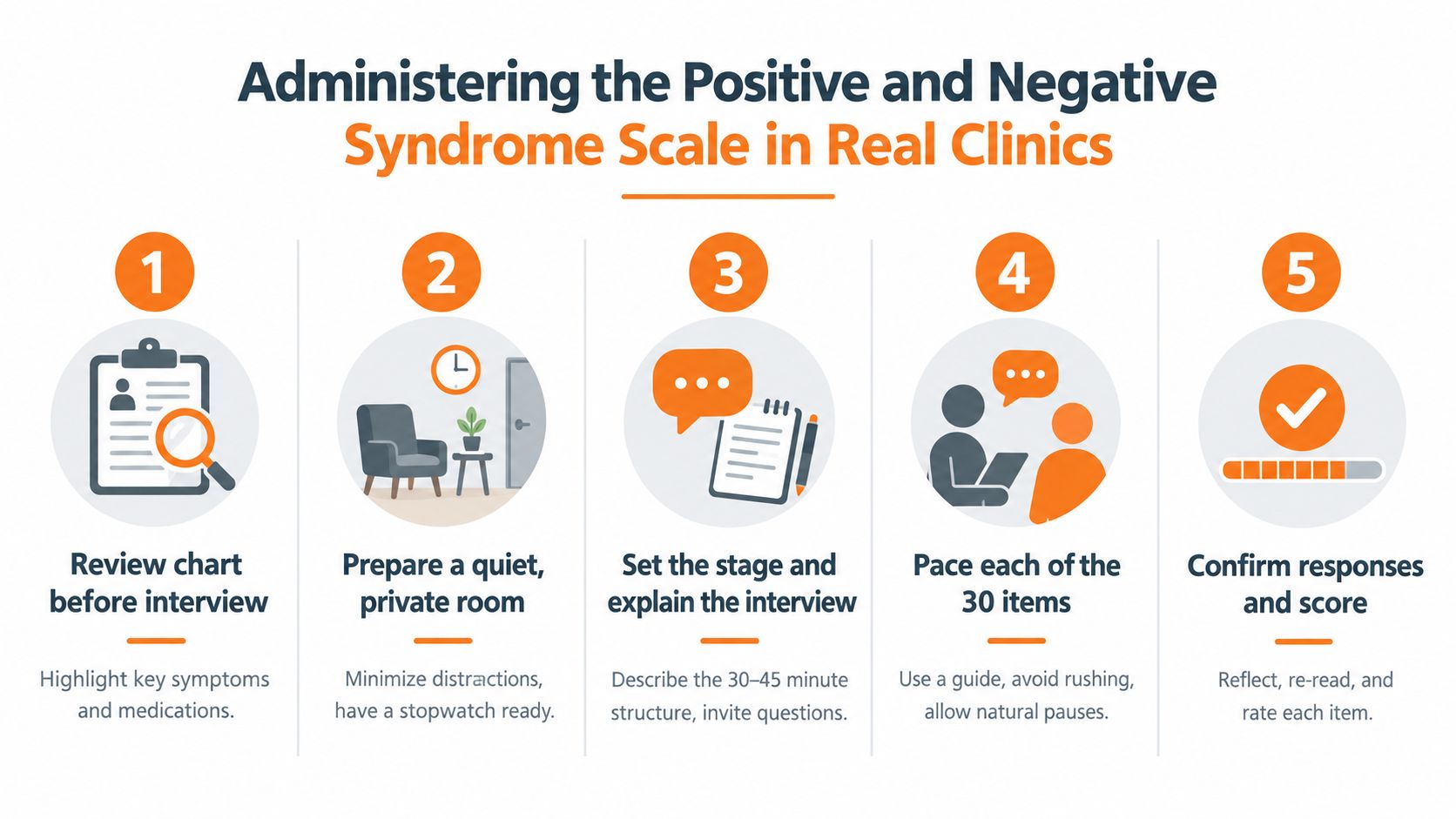
A PANSS session can lose validity before the first question if the clinician has not reviewed the recent record. Check progress notes, medication changes, nursing observations, family reports, substance use, sleep, and events that may have changed the presentation. Separate current findings from historical information, and identify what remains uncertain.
Use a private, quiet room. Explain that the interview will take about 30–45 minutes, that some questions may seem repetitive, and that the patient can request clarification. The full interview is worth that time for a baseline, formal endpoint, trial-compatible assessment, or detailed review after a major treatment change. For a stable patient needing frequent directional checks, that time may displace care that matters more.
Keep the interview structured, not mechanical
Follow the item anchors while allowing natural responses. For hallucinations, ask about unusual experiences, whether they occur while fully awake, their form and frequency, and whether the patient responds to them. For suspiciousness, clarify the belief, the patient's certainty, perceived evidence, and behavioural consequences.
Separate observed presentation from symptom severity. Common traps include:
Sedation: Reduced speech or slowed movement may reflect medication rather than negative symptoms.
Dysarthria: Communication difficulty can make thought disorder appear more severe.
Guardedness: Limited disclosure does not establish whether delusions are present.
Collateral inflation: A severe historical episode should not determine the current rating automatically.
Global impression: Looking unwell does not mean every item is severe.
Document enough detail for another rater to reconstruct the score. Include the patient's account, observed behaviour, collateral information, relevant medication effects, and the reason for an uncertain rating. If family members report voices that the patient denies, record both accounts rather than forcing a choice. A separate mood assessment may also be appropriate. Someone seeking a Kelowna therapist for depression may need depression-focused care rather than having those symptoms folded into a psychosis rating.
A mental status exam template can organise the broader observations surrounding PANSS. It does not replace the scale, but it helps preserve context when the clinic uses a shorter follow-up measure.
Decide when to abbreviate
Use PANSS-6 when the patient is already characterised and the team needs repeated monitoring of core symptoms. It is a directional measure, not a complete replacement for PANSS-30. Speech-based augmentation may provide another frequent signal when verbal output, latency, or other speech features are clinically relevant, but it should complement clinical ratings rather than stand in for them.
Before shortening the assessment, record the purpose, the information being sacrificed, and the threshold that will trigger a full reassessment. A brief score is useful only when the team understands what it captures and what it leaves unmeasured.
Bedside standard: Choose the shortest assessment that answers the clinical question, then document why that choice was made.
Comparing PANSS-30, PANSS-6, BPRS, and SANS-SAPS
A patient entering a trial, a patient needing weekly monitoring, and a patient requiring a broad psychiatric screen do not need the same instrument. The practical choice depends on how much symptom detail the decision requires, how often the team can reassess, and whether the patient can tolerate a longer interview.
Instrument | Items | Time | Training | Best fit for |
|---|---|---|---|---|
PANSS-30 | 30 | About 30–45 minutes | Structured training recommended | Detailed baseline, extended follow-up, clinical trials |
PANSS-6 | 6 | Brief repeated rating | Familiarity with PANSS anchors needed | High-frequency monitoring of core symptom change |
BPRS | Varies by version | Usually shorter than a full PANSS | Version-specific training | Broad transdiagnostic symptom screening |
SANS/SAPS | Separate negative and positive scales | Variable | Domain-specific training | Detailed phenomenology of positive and negative symptoms |
PANSS-30 earns its longer administration time when item-level distinctions will change treatment, clarify a trial endpoint, or establish a reference point for later ratings. Its structure covers positive, negative, disorganised, affective, and general psychopathology domains. That breadth also creates a burden in a busy clinic, particularly when the patient is fatigued, guarded, or struggling to sustain attention.
PANSS-6 is better suited to repeated checks after the baseline profile is understood. It can provide a consistent signal of change in core symptoms, but it should not replace a full reassessment when the clinical picture changes. Canadian health technology review material discusses a composite positive-minus-negative score and evidence that PANSS-6 can correlate strongly with PANSS-30 while helping identify early response and remission prediction at week 2 the Canadian review is available here. A short score still requires context, including sleep, medication exposure, substance use, and daily functioning.
BPRS is useful when the question extends beyond schizophrenia dimensions and the team needs a broader psychiatric symptom screen. Its flexibility can reduce specificity for some negative symptoms. SANS and SAPS remain appropriate when detailed positive or negative symptom phenomenology is the primary research or clinical concern, although they require separate domain-focused ratings.
Match the tool to the decision
Use a mental-health screening tools pathway to distinguish an initial screen from a severity measure. Screening identifies whether further assessment may be needed. PANSS describes the apparent severity of defined symptoms and tracks their change.
For clinics under time pressure, a practical workflow is to establish the patient with PANSS-30, use PANSS-6 for frequent monitoring, and reserve repeat full ratings for unexpected deterioration, treatment changes, or unclear response. Speech-based measures and cognitive assessments can add information about communication and cognition, but they should supplement clinician-rated symptom data rather than replace it.
Limitations of the Positive and Negative Syndrome Scale and the Case for Augmentation
PANSS is not a direct measure of recovery. It rates clinician-observed psychopathology, so a lower score may coexist with difficulty organising the day, returning to study, managing medication, or sustaining social contact.
Its sensitivity also depends on illness stage. In chronic, stabilised patients, some items can remain near the upper or lower ends of the scale, leaving little room to show meaningful change. During early psychosis, initiative, cognitive efficiency, or social engagement may improve before the overall rating shifts clearly.
What a total score hides
A total score compresses different symptoms into one number. Two patients may have similar totals while one has active hallucinations and the other has severe avolition with limited rapport. Decisions based only on the total can miss the domain restricting discharge or participation in therapy.
Factor solutions do not transfer uniformly across diagnoses, so retain the item profile and subscales rather than reducing every follow-up to a single headline number. A separate limitation appears in multi-site work: trained raters may score ambiguous speech, limited disclosure, mood-related withdrawal, or medication-related slowing differently. Interviewing style, local training, and collateral information can therefore introduce variance that looks like symptom change.
Add signals, don't replace judgement
A full 30-item interview can justify its time when the team needs a detailed baseline, a treatment decision depends on domain-level change, or the clinical picture is unclear. Repeating it at every visit is harder to defend when the patient is fatigued or the clinic is under pressure. PANSS-6 can support more frequent monitoring, while a focused subset may be appropriate between full assessments.
Speech analysis offers one augmentation route. A recent study used PANSS interview recordings from 182 participants enrolled in a phase 2 schizophrenia trial and found that positive symptoms aligned with more speech, faster speech, and shorter pauses the speech-analysis research is available in Frontiers in Psychiatry. The finding supports speech as an additional behavioural signal, not as a standalone diagnostic measure.
Actigraphy, passive digital phenotyping, and brief cognitive batteries can track activity, initiation, attention, and processing changes that PANSS does not directly capture. Guidance on cognitive remediation therapy can help teams connect those findings with functional targets without adding a full assessment burden at every appointment.
Use augmentation as triangulation: When PANSS, observed activity, speech features, and cognitive performance move together, confidence in the trajectory increases. When they diverge, investigate the discrepancy rather than averaging incompatible signals into a misleading score.
Integrating PANSS With Cognitive Assessment Workflows
A patient can become less psychotic without becoming cognitively more efficient. Positive-symptom change often helps answer whether acute symptom control is occurring, while cognitive testing can clarify whether the patient can sustain attention, learn information, use working memory, plan, or process information quickly enough for daily demands.
A practical workflow uses different assessment intensities rather than repeating every instrument at every visit.
A 12-week example
At week 0, complete a full PANSS-30 and a brief cognitive battery covering attention, memory, executive function, perception, processing speed, and eye-hand coordination. Record medication status, sleep, substance exposure, education or work demands, and the patient's functional priorities. The baseline should establish both symptom severity and the cognitive domains most likely to affect care planning.
During weeks 1–8, use PANSS-6 or a symptom-focused subset for regular monitoring. Pair those ratings with short cognitive exercises or digital therapy sessions that target the baseline weaknesses. The purpose isn't to create a new diagnosis each week. It's to identify whether symptom changes are accompanied by improved participation, cognitive efficiency, and daily functioning.
At week 12, repeat the full PANSS-30 and the cognitive battery. Compare item-level symptom changes with domain-level cognitive results, treatment adherence, and functional observations. If the PANSS total has fallen but processing speed and initiation remain poor, the next intervention shouldn't be chosen from the symptom score alone.

Make the data usable for the team
Scheduling is usually the limiting factor. Assign one clinician to own PANSS administration, define who can provide collateral, and use a shared template that connects symptom items to cognitive targets. For example, poor attention and reduced spontaneity may prompt an attention and initiation plan, while unusual thought content may require closer symptom review and safety planning.
Raters should reconcile differences without erasing them. If one clinician rates poor rapport as moderate and another rates it as mild, review the observed behaviours and the interview context. The final record should state the evidence supporting the selected rating.
Digital support can also help patients and families maintain routines between appointments. A plain-language resource on daily cognitive support may be useful when the care plan includes structured reminders or daily cognitive scaffolding. For clinicians designing a broader measurement pathway, cognitive assessment tools can sit alongside PANSS rather than being treated as a replacement for psychiatric evaluation.
The important distinction is simple: PANSS tracks rated psychopathology, cognitive assessment tracks abilities, and digital therapy data tracks engagement with structured practice. Together, they can show whether a patient is only less symptomatic or is also becoming more capable in the activities that matter.
Orange Neurosciences offers AI-supported cognitive assessment, individualized cognitive profiles, and digital therapy workflows that can complement PANSS-based monitoring without replacing clinical judgement. Visit Orange Neurosciences to explore how symptom ratings and repeatable cognitive data can be organised into a more practical longitudinal care plan.

Orange Neurosciences' Cognitive Skills Assessments (CSA) are intended as an aid for assessing the cognitive well-being of an individual. In a clinical setting, the CSA results (when interpreted by a qualified healthcare provider) may be used as an aid in determining whether further cognitive evaluation is needed. Orange Neurosciences' brain training programs are designed to promote and encourage overall cognitive health. Orange Neurosciences does not offer any medical diagnosis or treatment of any medical disease or condition. Orange Neurosciences products may also be used for research purposes for any range of cognition-related assessments. If used for research purposes, all use of the product must comply with the appropriate human subjects' procedures as they exist within the researcher's institution and will be the researcher's responsibility. All such human subject protections shall be under the provisions of all applicable sections of the Code of Federal Regulations.


© 2026 by Orange Neurosciences Corporation