Cognitive Remediation Therapy: A Practical Guide to Brain Health
Feb 20, 2026
Think of cognitive remediation therapy (CRT) as physical therapy, but for your brain. Instead of working on muscle strength, this structured therapy targets and rebuilds core cognitive skills—things like memory, attention, and problem-solving. The goal isn't just to get better at puzzles; it's to strengthen these mental "muscles" so you can navigate daily life more effectively.
For example, a student struggling to finish homework might use CRT to improve their focus, while an adult recovering from a brain injury could use it to practice remembering appointments. It’s all about practical, real-world improvement.
Understanding Cognitive Remediation Therapy
This isn't about the vague "brain training" games you might find on your phone. CRT is a targeted, evidence-based intervention grounded in the science of neuroplasticity. It operates on a simple but powerful principle: cognitive abilities are skills that can be practised and improved over time, just like learning to play the piano or picking up a new sport.
CRT is designed for anyone facing challenges that cloud their thinking or get in the way of everyday tasks. The entire process is built around functional improvement. It's all about translating the gains made during therapy sessions into real-world benefits at school, at work, or just in social settings. Whether it's helping a student stay on top of homework or an adult recovering from a brain injury remember appointments, CRT connects practice with purpose.
The Core Goal of CRT
At its heart, CRT aims to give individuals the tools they need to live and work as independently and successfully as possible. It's not about acing a test; it’s about building a stronger, more resilient cognitive foundation for life. A key part of this often involves dedicated executive functioning training, which sharpens practical skills like planning, organisation, and self-control.
To get there, CRT zooms in on several key cognitive domains. Here’s a quick look at what we’re targeting:
Cognitive Skills Targeted by CRT
This table breaks down the main cognitive areas CRT works on and shows how they pop up in everyday life.
Cognitive Domain | What It Helps You Do | Everyday Example |
|---|---|---|
Attention & Concentration | Focus on tasks without getting easily distracted. | Reading a book chapter without losing your place. |
Memory | Strengthen both short-term (working) and long-term recall. | Remembering a shopping list or a friend's birthday. |
Executive Functions | Plan, problem-solve, organise, and monitor yourself. | Breaking down a big project into smaller steps. |
Processing Speed | Respond quickly to information you see or hear. | Following a fast-paced conversation. |
Seeing these skills in action makes the therapy process much clearer.
A practical CRT session might start with simple attention drills, like identifying specific shapes on a screen. As the person gets better, the exercises grow more complex, perhaps requiring them to multitask or ignore distractions. This steady increase in difficulty is what helps build cognitive stamina and resilience. You can explore different therapeutic approaches in our overview of cognitive therapies.
Cognitive remediation therapy acts as a bridge, connecting targeted cognitive exercises to meaningful improvements in a person's daily life. The goal is not just to score higher on a test but to independently manage a schedule, hold a conversation, or complete a work project.
Modern platforms, like those we've developed at Orange Neurosciences, make these powerful techniques more accessible than ever. By providing structured exercises and clear, objective data, they create a straightforward path for clinicians and individuals to track progress and see real results. To learn more about how our tools can help, contact our team through our website.
The Science Behind How CRT Rewires Your Brain
Cognitive remediation therapy might seem complex, but its power comes from a surprisingly simple concept: neuroplasticity. This is your brain's natural talent for reorganizing itself by creating new connections between brain cells, a process that happens throughout your life.
Think of your brain's neural pathways as trails winding through a dense forest. The first time you try something new, like learning a skill, you're blazing a new trail. It’s tough going at first, with plenty of bushes and branches in the way.
But the more you travel that path, the clearer it becomes. Eventually, it turns into a wide, smooth, easy-to-follow road. CRT uses this very principle, guiding the brain through targeted exercises to strengthen the pathways responsible for key cognitive skills.
Building Stronger Brain Pathways
This isn't about playing random "brain games." CRT is a carefully structured workout designed to systematically challenge and reinforce specific brain circuits.
Each exercise targets a particular cognitive "muscle," whether it's attention, memory, or problem-solving. Through consistent practice, the brain is encouraged to build faster, more efficient connections. This is based on a well-known principle called Hebbian learning, often summed up with the phrase, "neurons that fire together, wire together." CRT intentionally makes those neurons fire in sync, forging a stronger, more reliable bond over time.
This dedicated training can lead to real, measurable changes in both brain structure and function, helping people sharpen abilities that were once a major struggle. To see how this works for a specific skill, check out our guide on how to improve working memory.
Two Core Approaches to Cognitive Improvement
In practice, cognitive remediation therapy usually combines two main strategies. A skilled therapist will often blend them together, creating a plan that fits the individual's unique cognitive profile and personal goals.
1. The Restorative Approach This strategy is all about directly rebuilding a weakened cognitive skill through focused, repetitive practice—think of it as physical therapy for the brain.
Actionable Example: Someone who gets easily distracted might start with a simple digital task, like clicking on a specific shape while ignoring other pop-ups. As they improve, the task gets harder, gradually building up their attention and focus.
2. The Compensatory Approach Instead of just rebuilding, this strategy teaches practical workarounds. It gives people new tools and clever tricks to manage their cognitive challenges and navigate daily life more easily.
Actionable Example: A person who struggles with memory might learn mnemonic devices, like using acronyms or vivid mental images, to remember a grocery list or a set of instructions. For instance, to remember to buy Milk, Eggs, Apples, and Tea, they could create the word "MEAT."
By mixing direct skill-building with smart strategies, CRT delivers a powerful one-two punch. It not only helps restore cognitive function but also gives people the tools—and the confidence—to handle challenges in any situation.
At the end of the day, the science of CRT proves our brains aren't fixed. They are remarkably adaptable. Through focused effort and consistent training, we can genuinely rewire them for better performance. The goal is for these newfound skills to generalise, or transfer, from the clinic to the real world, leading to lasting, meaningful improvements in everyday life.
Who Can Benefit From This Type of Therapy
Cognitive remediation therapy isn't some rigid, one-size-fits-all program. Its real power lies in its flexibility. Think of it less like a generic "brain workout" and more like a specialized physical therapy plan for the mind, designed to strengthen specific cognitive muscles that need the most support.
This structured approach can be a lifeline for a surprisingly diverse group of people, each navigating their own unique cognitive hurdles. It’s a targeted intervention that gets right to the heart of the challenges presented by complex neurological conditions, psychiatric disorders, and even sudden brain injuries.
When we look at who benefits, we start to see the real-world impact of this powerful therapy.
Individuals with Serious Mental Illness
For anyone managing a condition like schizophrenia, CRT can be an absolute game-changer. The cognitive challenges that come with schizophrenia—the frustrating struggles with memory, attention, and planning—often create bigger barriers to daily life than the more widely-known symptoms. CRT goes right after these deficits, helping people rebuild the skills they need to work, keep up relationships, and live more independently.
Practical Example: Someone who finds it hard to follow a conversation might work on auditory processing exercises. Another person who gets stuck on planning everyday tasks—like grocery shopping or keeping appointments—can use CRT to practice breaking them down into simple, manageable steps. It’s these practical wins that build confidence and create a real sense of autonomy.
The need for this kind of cognitive support is especially pressing for younger people. In California, where a staggering 1 in 4 people live with a mental illness, programs are increasingly looking to CRT. With nearly two-thirds of the 284,000 affected children and teens not getting treatment, interventions that build these foundational cognitive skills are absolutely critical. You can get a clearer picture of this growing need by exploring the latest California mental health statistics.
Support for Neurodevelopmental Conditions
People with Attention-Deficit/Hyperactivity Disorder (ADHD) know the daily battle with executive functions all too well. These are the crucial mental skills that help us plan, organize, and keep ourselves on track. Cognitive remediation therapy zeroes in on these exact areas, offering concrete strategies and exercises to sharpen them.
Imagine a student with ADHD feeling completely swamped by a big school project. CRT can teach them a structured way to tackle it: break the project into smaller tasks, set a deadline for each part, and use a checklist to stay on track. Suddenly, a massive, daunting challenge becomes a series of achievable goals.
This focus on executive skills isn’t just for schoolwork. It applies to all corners of life, from organizing a messy workspace to simply remembering to pay bills on time. Our own guide offers more tips on how to improve executive function.
Recovery After Brain Injury or Stroke
The road to recovery after a traumatic brain injury (TBI) or a stroke is often long and filled with unexpected turns. Cognitive skills like memory, processing speed, and problem-solving are frequently impacted, which can make getting back to a normal routine feel impossible.
CRT is a cornerstone of neurorehabilitation because it provides a clear, structured path for rebuilding these skills.
Actionable Example (TBI Recovery): Someone might use CRT exercises to work on their attention span, which is often shaky after an injury. A practical goal could be reading a single page of a book without losing focus, then gradually building up to a full chapter.
Actionable Example (Post-Stroke): A person recovering from a stroke might struggle to sequence their morning routine. CRT can help them practice the steps—getting dressed, making breakfast, taking medication—over and over until it feels more natural and automatic again.
Older Adults with Cognitive Decline
It's a natural part of life to experience some cognitive changes as we get older. For those facing Mild Cognitive Impairment (MCI), CRT provides a proactive way to strengthen their cognitive reserves and stay sharp. The therapy is all about reinforcing memory, reasoning, and the speed at which we process information.
A great example is an older adult using mnemonic tricks learned in CRT to remember names at a family gathering. By creating a vivid mental picture or a funny association, they can boost their recall and feel much more confident in social situations. This isn't just about memory games; it's about maintaining independence and enriching one's quality of life.
Taking CRT From Theory to Real-World Impact
Knowing the theory behind cognitive remediation is one thing, but seeing it work in the real world—that’s where the magic happens. Whether you're a clinician guiding a client, a teacher supporting a student, or a family member creating a nurturing home environment, the principles of CRT are incredibly adaptable. The real goal is to turn structured exercises into skills that actually make life easier and more functional.
This all starts by understanding the unique cognitive landscape of the individual. We're not just throwing a bunch of generic "brain games" at a problem. Instead, it’s about crafting a targeted plan that addresses specific challenges with practical, everyday solutions.
For Clinicians: A Structured Roadmap to Success
For therapists and other clinical professionals, rolling out a CRT program involves a clear, multi-step process. The aim is to build a therapeutic journey that’s both backed by evidence and deeply personal to the client's own life and goals.
A successful clinical plan typically unfolds like this:
Start with a Baseline Assessment: Before any training begins, you need a clear snapshot of the client's cognitive strengths and weaknesses. Digital tools can give you a quick, objective profile, highlighting specific areas like working memory or processing speed that need a boost. This data becomes the bedrock of the entire therapy plan.
Set Collaborative, Functional Goals: This is a team effort. Work directly with the client to define what success truly looks like for them. Forget vague goals like "improve memory." Get concrete. A much better goal is, "I want to remember to take my medication on my own every morning for a full week." These kinds of functional goals make progress feel real and keep motivation high.
Choose the Right Tools and Strategies: Armed with the assessment data, you can pick exercises that zero in on the identified deficits. This might mean using a digital platform for gamified attention drills or teaching simple compensatory strategies, like using a calendar app to keep track of appointments. In therapy, CRT is often used to build practical abilities, like developing social skills for autistic adults, to improve how they navigate their daily world.
Track Progress and Be Ready to Pivot: Keep a close eye on performance, both on the therapy tasks and the real-world goals. Modern CRT platforms with progress dashboards make this much simpler, letting you see if the skills practiced in the clinic are actually showing up in daily life. And remember, be flexible—you’ll need to adjust the plan as the client grows and progresses.
For Educators: Weaving Cognitive Support into the Classroom
Teachers are in a fantastic position to bring CRT principles into the school day, especially for students wrestling with attention or executive function challenges. The focus here is on building a supportive structure that reinforces cognitive skills right where learning happens.
Actionable Insight: Use game-based learning tools that target specific skills like attention and focus. A teacher might, for example, set aside 15 minutes for students to work with a digital tool that challenges them to filter out distractions. This isn’t just screen time; it's a targeted cognitive workout that can help students stay more locked-in during lessons and independent work.
Another great approach is to teach organizational strategies directly. A teacher could help a student break a massive research project into smaller, more manageable chunks, complete with a visual checklist to track their progress. This not only helps them get the assignment done but also teaches a vital planning skill they can carry with them for the rest of their lives.
For Families: Building a Supportive Home Base
Families play a huge, indispensable role in making CRT stick. You are the ones who can help generalize skills learned in a clinic and bring them into the rhythm of everyday life. Your home can become the safest, most encouraging place to practice and lock in these new cognitive habits.
The most powerful support at home isn't about becoming another therapist. It’s about finding natural, everyday moments to practice new skills. Consistency and positive reinforcement are your greatest allies.
Here are a few actionable tips for families:
Use Memory Aids Together: If your child is learning to use memory strategies, build them into your daily routines. You could create a funny mnemonic for the steps of their morning routine or use a visual chore chart that they help you update each day.
Break Down Tasks: When it's time for chores or other responsibilities, help your loved one break them down. Instead of saying, "clean your room," try, "First, let's put all the clothes in the hamper. Next, we'll put the books back on the shelf." This models the critical process of sequencing and planning.
By creating a supportive ecosystem across all these settings, we ensure that the gains made during cognitive remediation therapy have a lasting impact. To see how structured programs can support this journey, you can read more about our approach to neurorehabilitation.
How Digital Tools Are Modernizing CRT
Technology is completely reshaping how we think about brain health, and cognitive remediation therapy (CRT) is right at the heart of this change. The days of relying solely on paper-and-pencil exercises are fading. In their place, we're seeing dynamic, engaging digital platforms that offer a much more personal and effective therapeutic experience.
This isn’t just about scanning old worksheets onto a screen. It’s about using technology to deliver smarter, more adaptive care.
For instance, with static worksheets, it's tough to adjust on the fly. Digital tools, on the other hand, allow for real-time personalization. If someone is breezing through a memory task, the platform can automatically ramp up the difficulty. But if they're struggling with an attention exercise, the system can dial back the complexity to prevent frustration and build up their confidence.
This adaptive approach keeps individuals in that sweet spot of being perfectly challenged, which is key for maximizing engagement and encouraging neuroplasticity.
Precision Assessments and Engaging Training
One of the biggest wins for digital CRT is the ability to run quick, objective cognitive assessments. Instead of spending hours on manual testing, these platforms can map out a clear cognitive profile in minutes. This gives clinicians an immediate, data-driven starting point for therapy.
From there, the platform can create a targeted and effective training plan. It usually follows a simple but powerful flow.
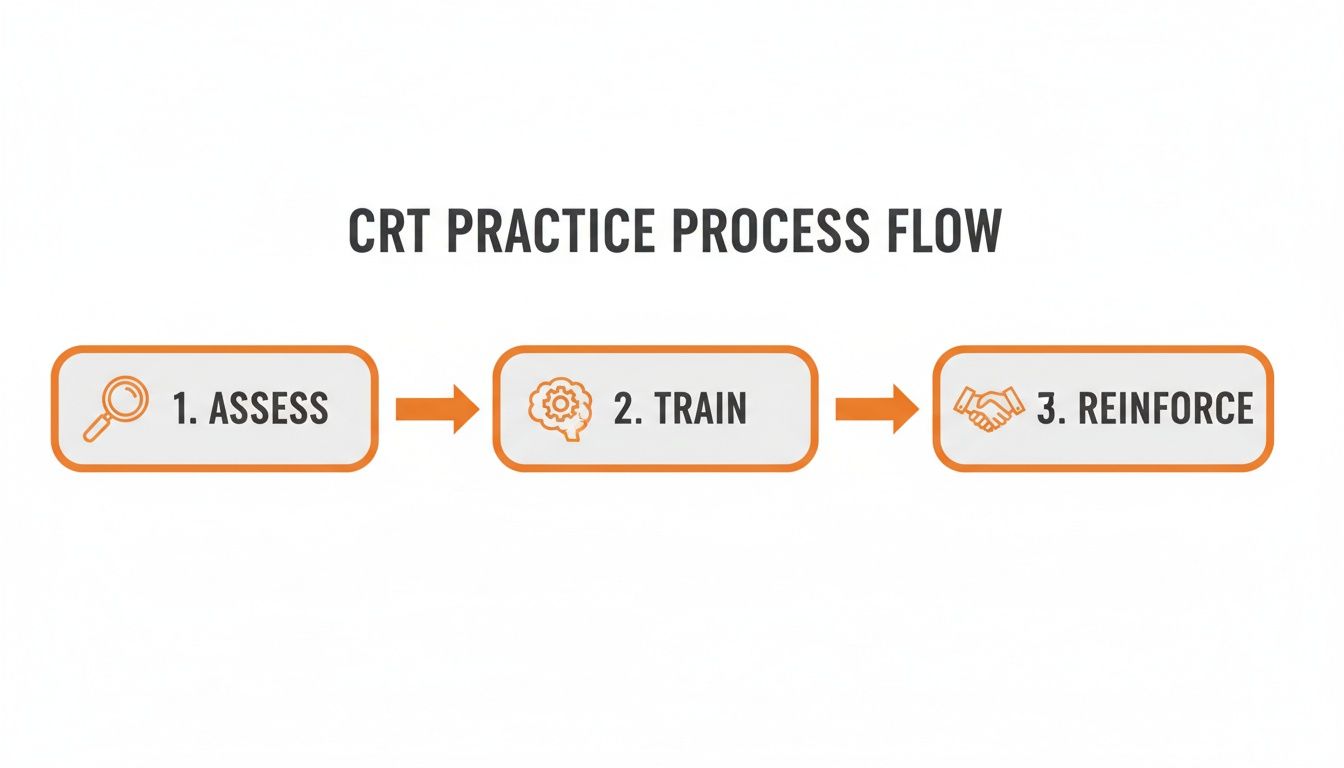
This Assess, Train, and Reinforce model makes sure the therapy is always grounded in real data and focused on steady improvement.
What’s more, digital platforms have managed to turn therapy from a chore into something genuinely engaging. Gamified exercises that use points, rewards, and fun challenges keep users motivated to come back. This is a game-changer, especially for kids and teens who are far more likely to stick with a program that feels more like play than work.
Seamless Data Tracking and Real-World Application
Modern CRT platforms are also fantastic at collecting and visualizing progress data. Clinicians and families no longer have to guess if the therapy is actually working. They can see clear, visual proof through easy-to-read dashboards that track performance over time, showing improvements in areas like reaction time or task accuracy. This data-driven feedback helps everyone make better, faster decisions about a person’s care plan.
We're also seeing these tools expand into some really innovative settings. For example, California's prison system is using cognitive remediation to improve psychosocial functioning alongside rehabilitation programs like supported employment. Platforms like Orange Neurosciences complement this work by offering precise, AI-powered assessments for attention and memory that can be integrated directly into existing workflows.
The table below breaks down just how different the experience is with a modern digital tool.
Traditional vs Digital CRT Platforms
Feature | Traditional CRT | Digital CRT (e.g., Orange Neurosciences) |
|---|---|---|
Delivery Method | Paper-and-pencil exercises, manual tasks | Interactive, gamified digital exercises |
Personalization | Limited; manual adjustments by therapist | Real-time, adaptive difficulty based on user performance |
Assessment | Time-consuming, often subjective | Rapid, objective, and data-driven assessments |
Engagement | Can be monotonous, leading to low motivation | High engagement through rewards, challenges, and game mechanics |
Data Tracking | Manual, sporadic, and difficult to analyze | Automated, continuous, with visual progress dashboards |
Accessibility | Limited to in-person sessions with a clinician | Accessible from anywhere with an internet connection |
Ultimately, digital platforms offer a more dynamic, data-rich, and engaging path forward for cognitive remediation.
The true value of digital CRT is its ability to bridge the gap between clinical exercises and daily life. By offering objective assessments, engaging training, and clear progress tracking, these tools empower both clinicians and individuals to achieve meaningful, functional outcomes.
This accessibility and data-driven approach are making cognitive remediation therapy a more powerful and scalable solution than ever before. To see how these digital tools work in practice, you can explore the details of our innovative solution.
How to Measure Success in Cognitive Remediation
So, how do you know if cognitive remediation is actually working? The answer isn't just about getting better at the exercises. Real success shows up in daily life—the kind of tangible progress you can see and feel.
It’s a bit like a new fitness plan. You can track numbers on a scale or how long you can run, but the real win is being able to climb a flight of stairs without losing your breath. With CRT, we measure both the clinical "reps" and those real-world victories.
Combining Clinical Data and Functional Gains
The journey usually starts and ends with standardized neuropsychological tests. These give clinicians a clear, objective baseline of cognitive function before therapy begins. Repeating them afterwards provides hard data on specific improvements in areas like memory, attention, or how quickly you process information.
But numbers on a page only tell part of the story. The ultimate goal of cognitive remediation is functional improvement. We’re looking for progress in the things that matter every single day.
The most important question isn’t, "Did the test score go up?" It’s, "Can you manage your schedule on your own now?" Success is measured in life skills, not just lab results.
This is where we have to look at how life is changing for the better. Are you seeing improvements in things like:
Holding down a job? Getting to work on time, finishing tasks, and keeping up with colleagues.
Managing your money? Staying on top of bills and sticking to a budget.
Succeeding in school? Remembering what you’ve read and organizing your homework.
Following a conversation? Staying focused and contributing without getting lost.
The Role of Personal and Family Feedback
Self-reports and what family members observe are also incredibly valuable pieces of the puzzle. Someone might say they feel less "foggy" or more confident handling their daily to-do list. A loved one might notice they’re more organized or are remembering important dates without reminders.
This kind of feedback gives crucial context to the clinical data. A higher score on a memory test is great, but it becomes so much more meaningful when it’s paired with the real-life ability to remember the entire grocery list without writing it down.
Digital platforms have made tracking both sides of this coin much easier. Built-in progress dashboards let clinicians, individuals, and families see clinical data and real-world improvements side-by-side. You can draw a direct line from a better score on a digital attention exercise to being able to read a chapter of a book without your mind wandering. It creates a powerful feedback loop that keeps everyone motivated.
Researchers are constantly exploring these real-world outcomes. For instance, in California, studies are looking at how CRT impacts seniors. One notable trial is testing if digital CRT can improve cognition, lower the risk of falls, and boost self-care abilities, all to help older adults keep their independence. You can discover more about these innovative clinical trials and their findings.
By blending objective metrics with personal stories of progress, we get the complete picture. It’s this combination that shows cognitive remediation isn't just changing scores—it’s changing lives. Ready to see how our tools can help you track this progress? Explore the Orange Neurosciences platform or get in touch with our team today.
Common Questions About Cognitive Remediation
As more people hear about cognitive remediation therapy, it’s only natural for questions to pop up about how it all works. Figuring out the difference between clinical therapy and a simple brain training game, or understanding what treatment actually looks like day-to-day, can make all the difference. Let's dig into some of the most common questions we hear.
How Is CRT Different From Brain Training Apps?
It’s a great question, and the answer is simple: cognitive remediation therapy is a clinical, evidence-based intervention. Think of it this way: a brain training app is like a generic workout you find online, while CRT is like working with a personal trainer who knows your specific injuries and goals.
The biggest difference is the therapist. A trained professional uses a formal assessment to pinpoint specific cognitive weak spots. Then, they build a program to target those areas, always with the goal of transferring those new skills into the real world. That last part is often missing from generic apps. Platforms like the ones from Orange Neurosciences are designed to bridge this gap, offering clinical-grade tools that are laser-focused on real-world outcomes.
Practical Example: Imagine someone struggling with attention after a brain injury. A random app might have them play a game to improve focus. In CRT, a therapist would use assessment data to choose specific exercises, track their progress closely, and then help them apply that improved focus to a functional goal, like being able to read and remember a work email.
How Long Does It Take to See Results?
There's no one-size-fits-all answer here. The timeline really depends on the individual, the severity of their cognitive challenges, and how intensive the program is. Most protocols suggest sessions two or three times a week for about three to six months.
You might notice small wins on specific tasks within a few weeks, which is fantastic for motivation. But the deeper, lasting changes in daily life—like being able to manage a budget on your own or follow a complex schedule—usually take several months of consistent practice and applying those new strategies in real-world situations.
Can This Therapy Be Done at Home?
Absolutely! CRT is perfectly suited for home use, especially with today's digital tools. While it traditionally happened in a clinic, platforms from companies like Orange Neurosciences allow therapists to guide, assign, and monitor a client’s work remotely.
These tools are built to be engaging and accessible, so families can easily make them part of their routine at home under a therapist's supervision. This flexibility is a huge advantage. It means the cognitive "reps" can continue between appointments, helping to speed up progress and solidify new skills.
Ready to move beyond questions and start seeing real change? The Orange Neurosciences platform gives you the data-driven assessments and targeted training you need to build a cognitive remediation plan that works.
Explore our solutions and see how we can support your journey.
Orange Neurosciences' Cognitive Skills Assessments (CSA) are intended as an aid for assessing the cognitive well-being of an individual. In a clinical setting, the CSA results (when interpreted by a qualified healthcare provider) may be used as an aid in determining whether further cognitive evaluation is needed. Orange Neurosciences' brain training programs are designed to promote and encourage overall cognitive health. Orange Neurosciences does not offer any medical diagnosis or treatment of any medical disease or condition. Orange Neurosciences products may also be used for research purposes for any range of cognition-related assessments. If used for research purposes, all use of the product must comply with the appropriate human subjects' procedures as they exist within the researcher's institution and will be the researcher's responsibility. All such human subject protections shall be under the provisions of all applicable sections of the Code of Federal Regulations.


© 2026 by Orange Neurosciences Corporation