Memory Loss and Multiple Sclerosis: A Practical Guide

A client's name disappears halfway through a sentence. An appointment appears twice on the calendar. A familiar bedtime story suddenly feels difficult to follow because the reader has lost the thread. For a person living with multiple sclerosis, these moments can look ordinary from the outside while creating real strain at work, at home, and during treatment.
Maya, a 42-year-old project manager with relapsing-remitting MS, might begin her morning by rereading a message she remembers opening but not understanding. Later, she could blank on a client's name, double-book a meeting despite using reminders, and lose her place while reading to her child. None of these events automatically means dementia. They do signal that her clinical team should ask better questions about memory, processing speed, fatigue, mood, sleep, and daily function.
A useful pathway connects three tasks: understanding how MS can change cognition, recognising early patterns, and choosing assessment and rehabilitation that fit the patient's life. Neurologists, MS nurses, neuropsychologists, occupational therapists, other rehabilitation professionals, and family members all have a role. The aim is not merely to label a test score. It's to turn a patient's lived experience into practical support.
When Memory Starts to Slip and MS Is Part of the Picture
Maya's first lapse may not feel like a medical symptom. She knows the client well, has prepared for the meeting, and can discuss the project accurately. Yet the name won't arrive. She pauses, substitutes “your team,” and continues. Later, she notices that she has scheduled two meetings at the same time, even though both invitations were marked in her calendar.
At bedtime, the problem changes shape. Maya can read the words in a familiar story, but fatigue makes it harder to hold the meaning of one sentence while moving to the next. She reaches the end of a paragraph and realises she hasn't retained it. The experience feels less like a dramatic memory loss and more like a failure to keep information available long enough to use it.
Practical rule: Treat repeated everyday lapses as clinical information, not as a character flaw or an inevitable part of ageing.
The first step is to describe the event precisely. “My memory is worse” is important, but “I forget the content of a conversation minutes later” or “I lose the sequence of a three-step instruction” gives the care team something measurable to explore. Ask what was happening at the time, including heat, fatigue, stress, poor sleep, pain, medication changes, or an interruption.
The second step is to look at function. A lapse matters more when it affects medication use, driving decisions, finances, work quality, childcare, or safety. Family members can contribute observations, while clinicians can compare the patient's account with screening results and occupational demands.
The third step is to choose a response that matches the question. A brief screen may identify a need for further assessment. Neuropsychology can clarify the pattern. Occupational therapy can translate findings into strategies for meetings, cooking, studying, or managing treatment. Cognitive rehabilitation can then target both the underlying skills and the situations in which Maya needs them most.
Memory loss and multiple sclerosis don't follow one single pattern. The right response starts with careful description rather than assumption.
Why Multiple Sclerosis Affects Memory in the First Place
MS can interfere with cognition because the brain must coordinate information across connected networks. Demyelination can slow communication between regions involved in attention, learning, retrieval, and planning. Lesions, changes in brain volume such as thalamic atrophy, and reduced network efficiency can make that communication less reliable.
An information highway is a useful analogy. The road still exists, but signals may encounter potholes, detours, and stretches where traffic slows. A person may understand information when it arrives, yet struggle to process enough of it at once or retrieve it quickly during a demanding conversation.
This helps explain why retrieval difficulty often looks different from true loss of stored knowledge. Someone with MS may know that a name is familiar, recognise it when given choices, or remember it later. The problem occurred at the point of access. Fatigue, stress, heat, and divided attention can make that access less efficient.
Formal testing shows that cognitive impairment affects about 34% to 65% of adults with MS, while memory problems specifically affect roughly 22% to 65% of patients, according to a peer-reviewed review of MS cognition (review of cognitive impairment in multiple sclerosis). Visual memory impairment affected 54% to 56% of participants in one representative sample, while verbal memory impairment affected 29% to 34% in that review. These figures describe ranges across studies, not a prediction for any one person.

The pattern matters more than the label
The most vulnerable abilities often include processing speed, episodic memory, working memory, and executive function. A person might learn new information slowly, lose track of multi-step instructions, or need more time to formulate a response. Canadian MS guidance describes cognitive change as affecting more than half of adults with MS and about 30% of children, with slowed processing speed and difficulty remembering new information among the dominant concerns (MS Canada guidance on cognition and MS).
That pattern differs from the common assumption that every memory complaint represents Alzheimer's disease. In MS, a person may retain long-established knowledge while struggling to learn, organise, or retrieve something new. Cognitive change can also appear when physical disability is limited, and progressive forms of MS, fatigue, mood symptoms, and disrupted sleep can add to the burden.
For a clinician, the practical example is straightforward. A patient has normal strength during an appointment but can't retain new medication instructions. A short cognitive screen may reveal slowed processing or memory difficulty that a routine neurological examination won't capture. The next step is not to diagnose based on one result. It's to interpret the finding alongside function, mood, fatigue, sleep, education, language, and the patient's previous abilities. A plain-language guide to these domains can help teams align their terminology when discussing cognitive function.
Spotting Cognitive Change Before It Becomes a Crisis
Early MS-related cognitive change often appears in ordinary tasks. The person may forget the content of a conversation minutes after it ends, lose the sequence of a familiar process, miss an appointment despite reminders, or take longer to find a word in a complex sentence.
That doesn't mean every lapse is pathological. Normal ageing can include occasional tip-of-the-tongue moments, especially when the word returns later and daily responsibilities remain intact. The concern rises when the pattern is new, increasingly frequent, inconsistent with the person's previous ability, or disruptive to safety and independence.
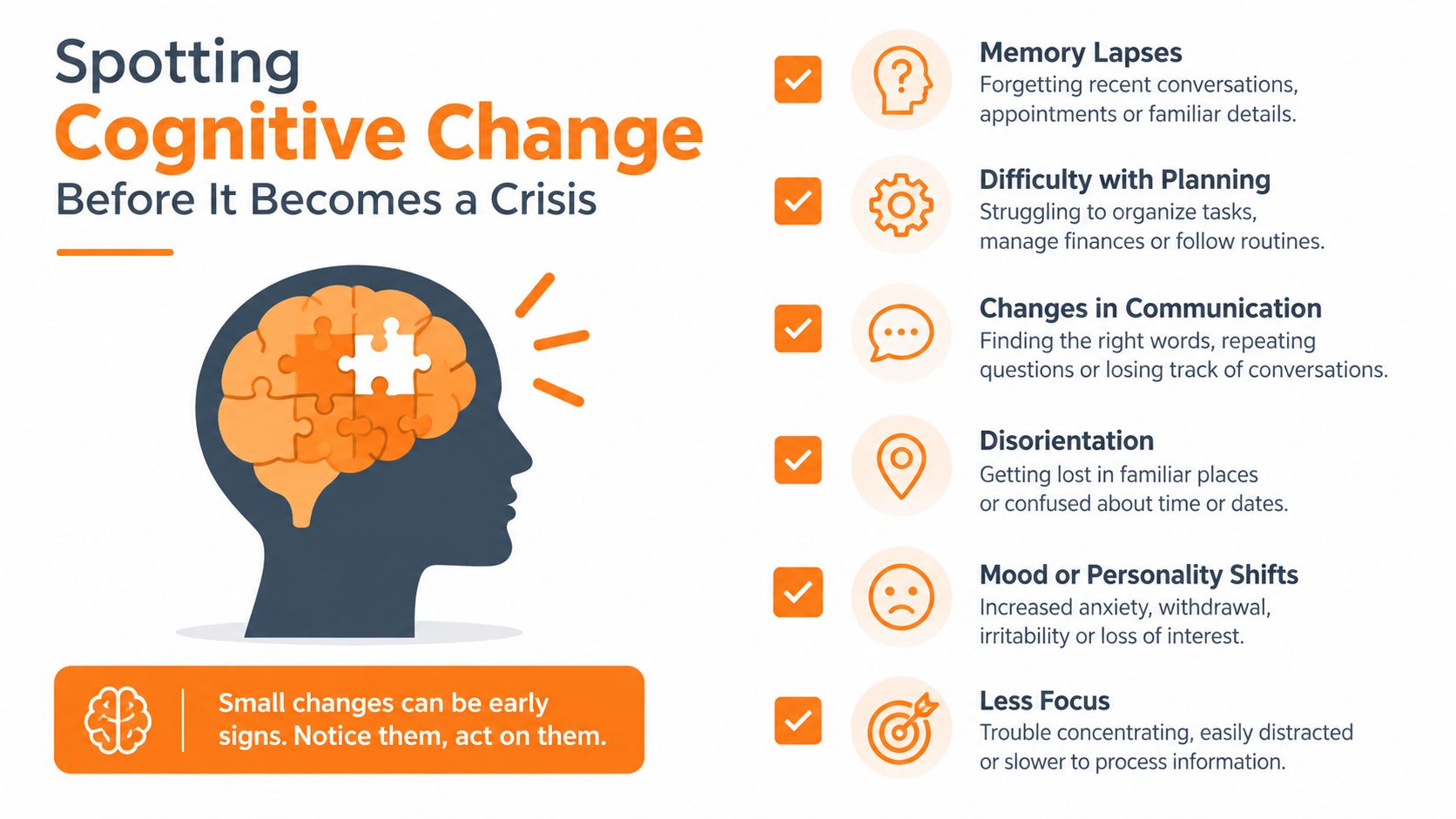
A practical observation checklist
Families and clinicians can track the same few features at home and in the clinic:
Conversation recall: Note whether the person forgets the substance of a recent discussion, rather than a minor detail.
Task sequence: Record whether they lose the thread of cooking, paying a bill, following a recipe, or completing work instructions.
Appointments and medication: Check whether reminders work or whether appointments and doses are still missed.
Word retrieval: Notice whether pauses occur only under pressure or regularly interrupt communication.
Processing under load: Compare performance when rested with performance during fatigue, heat, stress, or multitasking.
Emotional response: Watch for withdrawal, frustration, embarrassment, anxiety, or a drop in confidence.
A simple diary kept over several weeks can show whether the issue is occasional or persistent. Record the task, time of day, fatigue level, sleep quality, and consequence. This information is more useful than a general statement that the person is “forgetful.”
Raise the issue promptly when there's a new decline, a work error with consequences, a medication or financial mistake, a driving concern, or a safety risk. Sudden change needs medical review because infection, medication effects, mood disorders, sleep problems, or another neurological event may be contributing.
Early reporting gives the team time to adjust instructions, add external supports, assess reversible contributors, and arrange rehabilitation before a preventable crisis occurs.
Choosing the Right Cognitive Assessment for Each Patient
Cognitive assessment works best as a two-stage decision. First, use a brief, standardised screen to identify whether a concern deserves attention. Second, arrange a deeper evaluation when the pattern is complex, the functional impact is substantial, or the team needs detailed rehabilitation recommendations.
The Symbol Digit Modalities Test, or SDMT, is useful when processing speed is the main question. BICAMS combines measures relevant to common MS-related difficulties and can fit a routine service pathway. A traditional neuropsychological battery, including approaches such as MACFIMS, offers broader analysis across memory, attention, language, visuospatial ability, and executive function. BICAMS and SDMT are especially practical for repeated screening, while formal neuropsychology is better suited to diagnostic clarification, workplace questions, capacity concerns, or an unclear relationship between symptoms and daily performance.
Digital platforms such as Cogstate, NeuroTrax, and CANTAB can add standardised, repeatable measures and may support monitoring between visits. Their value depends on validation, language suitability, device conditions, patient familiarity, privacy, clinician interpretation, and whether the service can act on the results. A digital result should support clinical reasoning, not replace it.
Tool | Administration Time | MS Sensitivity | Best Use Case | Limitations |
|---|---|---|---|---|
SDMT | Brief | Strong for processing speed | Routine screening and trend monitoring | Narrower cognitive coverage |
BICAMS | Brief | Designed around common MS cognitive domains | Baseline and repeat clinic screening | Doesn't replace a full neuropsychological profile |
MACFIMS-style battery | Extended | Broad assessment of MS-relevant abilities | Complex diagnosis and rehabilitation planning | Requires specialist time and interpretation |
Formal neuropsychology | Extended | Individualised and comprehensive | Functional impact, differential diagnosis, accommodations | Access and scheduling may be limited |
Digital assessment platforms | Brief to moderate, depending on platform | Useful for standardised repeat measures | Remote monitoring and structured reassessment | Results can be affected by device, context, language, and unsupervised administration |
Before interpreting a score, record fatigue, mood, sleep, pain, language, hearing, vision, education, and premorbid ability. A person testing in a second language or after a sleepless night may not be showing their usual capacity. Teams that make decisions about consent or care should also understand practical Mental Capacity Act principles for care staff, particularly the distinction between an unwise decision and an inability to make a decision.
A patient who wants a general cognitive screen doesn't necessarily need the same tool as someone seeking a workplace report. Clinicians can use the Montreal Cognitive Assessment versus MMSE comparison to support broader test-selection discussions, while keeping the MS-specific question at the centre.
Evidence-Based Ways to Manage and Rehabilitate Memory
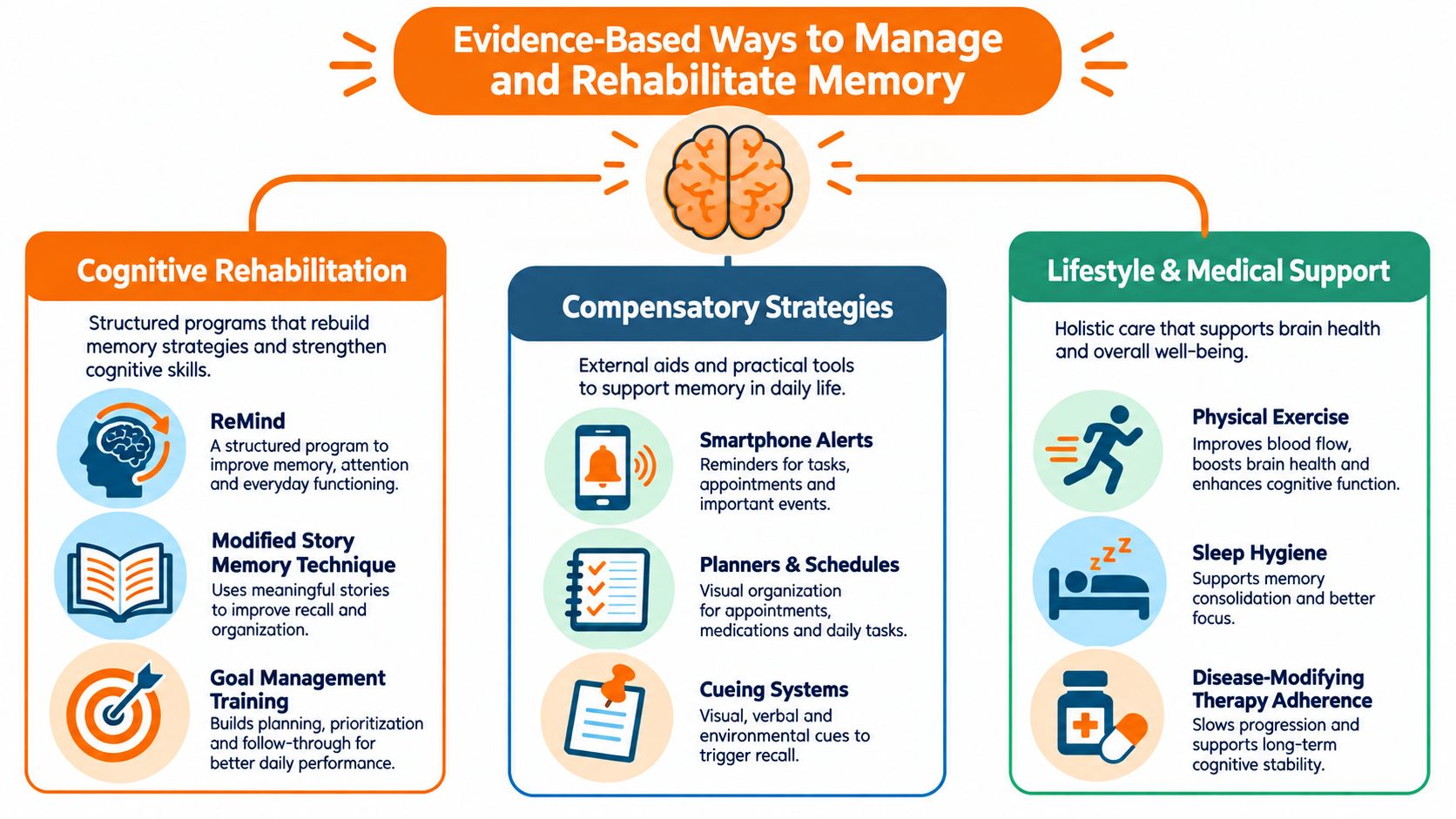
Management should combine restorative training, compensatory strategies, and medical or lifestyle support. No single intervention reverses every MS-related cognitive difficulty, so the plan should target the person's most important activities.
Build skills and reduce task demands
Cognitive rehabilitation can teach a patient how to learn more efficiently and manage competing information. Programs and methods described in MS rehabilitation include ReMind, the modified Story Memory Technique, and goal-management training. A therapist might teach Maya to create a vivid story linking a medication name with its purpose, practise retrieving it at increasing intervals, and then use the strategy during a real medication routine.
Compensatory tools are equally important. A shared calendar, smartphone alerts, written instructions, voice notes, labelled storage, checklists, and a single place for keys can reduce the amount of information the brain must hold. The intervention should be tied to a goal, such as completing a morning routine independently or preparing for a weekly project meeting. Guidance on cognitive remediation therapy can help teams distinguish skills practice from broader environmental support.
Support the brain's working conditions
A patient may perform better when sleep is regular, fatigue is treated, mood symptoms are addressed, and tasks are scheduled for the person's strongest time of day. Aerobic activity, sleep hygiene, treatment for depression or anxiety, and a balanced Mediterranean-style eating pattern can form part of a broader cognitive care plan, provided recommendations are adapted to mobility, heat sensitivity, cardiovascular status, and personal preference.
For example, an occupational therapist and physiotherapist might help a patient choose a tolerable walking or seated exercise routine, while the MS nurse reviews fatigue patterns and the neurologist checks for medication contributors. A family member can support sleep by reducing late-evening demands and keeping the bedroom routine consistent.
Review medicines and disease activity
The clinical team should review anticholinergic burden, sedating medicines, fatigue treatment, mood treatment, and adherence to disease-modifying therapy. Modafinil may be considered for fatigue-related cognitive fog when clinically appropriate, but it isn't a universal memory treatment. Treatment decisions belong with the prescribing clinician and should reflect the patient's full medical history.
Families supporting someone with substantial functional decline may also need broader care planning. A resource to find a memory care facility can be useful when the person's support needs extend beyond outpatient rehabilitation, though MS-related cognitive change should still be assessed in its neurological and functional context.
A Practical Care Pathway From Screening to Follow-Up
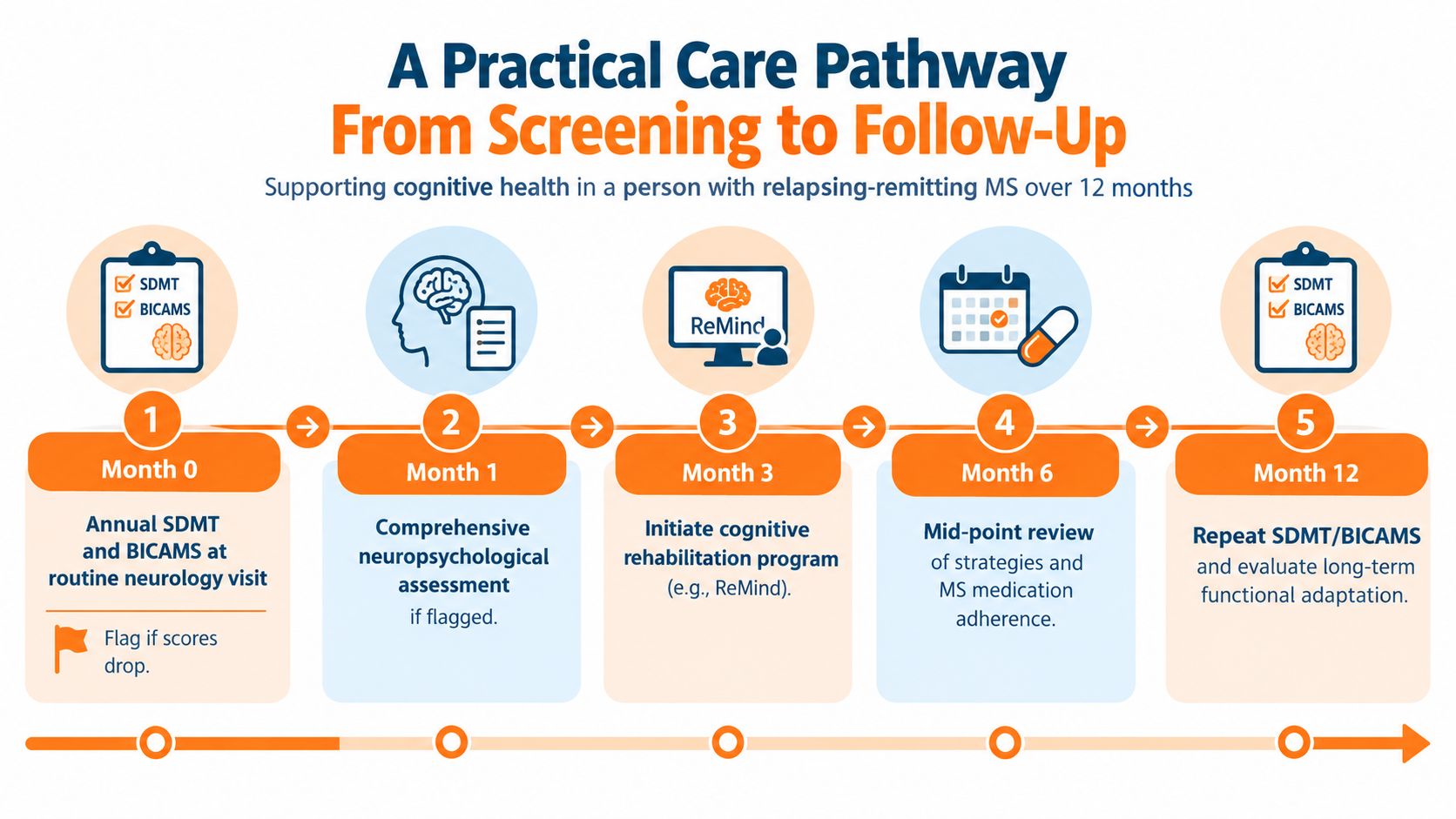
Consider Maya at her routine neurology visit. She reports more word-finding pauses and has made several avoidable scheduling errors, but she remains physically active and continues working. The team doesn't wait for a crisis. It creates a sequence that assigns each professional a clear task.
At the initial visit, the neurologist or trained MS clinician completes annual SDMT and BICAMS screening, reviews fatigue, mood, sleep, medication changes, and work demands, and documents the result for future comparison. A meaningful decline from her own baseline prompts follow-up rather than an automatic diagnosis. The MS nurse gathers examples from home and work, confirms how reminders are being used, and checks whether Maya is missing treatment instructions.
Matching intervention to function
The occupational therapist asks Maya to identify one high-value goal, such as leading client meetings without losing her place. The therapist may introduce a pre-meeting outline, keyword cards, a quiet preparation period, and a post-meeting action list. Neuropsychology provides diagnostic clarity when the team needs a more detailed profile or when mood, sleep, language, or premorbid ability complicates interpretation.
A structured cognitive rehabilitation block then combines practice with real-world application. Maya rehearses how to encode names, summarise instructions, and pause before switching tasks. Her home programme is short enough to sustain, and the team reviews sleep and fatigue rather than treating every lapse as a memory-storage problem.
Between clinic appointments, a validated digital assessment can provide repeat measures for patients who travel, have limited appointment access, or are changing disease-modifying therapy. Results should be reviewed by a clinician who can interpret changes in context. A remote score without a functional discussion isn't a complete follow-up.
At a later team review, the neurologist considers whether ongoing decline warrants a disease activity and treatment review. The therapist updates workplace strategies, the nurse checks adherence and barriers, and Maya's family reports whether home routines have improved. A coordinated continuity-of-care approach prevents each professional from seeing only one fragment of the problem.
Key Takeaways and What to Do Next
Five principles should guide memory care in MS:
Memory symptoms are common and easy to miss. Cognitive change can involve processing speed, learning, retrieval, and executive function, even when physical disability is limited. Canadian population data found that among people whose only neurological condition was MS, 50% reported difficulty remembering most things and/or thinking and solving problems (Statistics Canada report on MS and cognition).
Screening belongs in routine care. Guidelines summarised by Cleveland Clinic recommend baseline and annual cognitive screening for people with MS, including children aged 8 or older, and for adults with a first clinical event or MRI evidence consistent with MS (Cleveland Clinic guidance on cognitive assessment in MS).
The tool should match the question. Use brief screening for surveillance, formal neuropsychology for complexity, and structured digital reassessment when repeat monitoring adds value.
Rehabilitation must connect to daily life. Pair learning strategies with calendars, cueing systems, written instructions, and environmental changes.
Trend matters. A single score can be affected by fatigue, mood, sleep, language, or context. Repeated assessment shows whether a plan is helping.
Actions for the care team
Neurologists: Screen with SDMT or BICAMS, document the patient's trend, and review disease activity, treatment, mood, sleep, fatigue, and medication effects when cognition changes.
Occupational therapists and neuropsychologists: Combine restorative practice with compensatory coaching, define functional goals, and reassess whether strategies work in real situations.
MS nurses: Gather examples from home, work, and treatment routines, then help patients prepare for assessment and follow through with recommendations.
Families and caregivers: Externalise memory with shared systems, reduce multitasking, attend appointments when invited, and report mood changes, safety concerns, or loss of independence.
California has also established a population-based surveillance foundation for local MS tracking. The California Department of Public Health began collecting MS data through the California Neurodegenerative Disease Registry in 2023, with the stated purpose of determining MS incidence and prevalence in the state (UCSF overview referencing California MS registry activity). Better tracking at population level should sit alongside attentive care for the individual in front of the clinician.
Common Questions About Memory Loss in MS
Does cognitive change always get worse? No. A person's course can vary, and function may remain stable when disease activity, fatigue, mood, sleep, and daily strategies are addressed. Rehabilitation and appropriate medical treatment can help preserve independence, but new or persistent decline still warrants review.
Can someone with memory symptoms continue driving? Some people with mild symptoms may drive safely, but the decision depends on attention, processing speed, navigation, reaction demands, judgment, and observed performance. When family or clinicians have concerns, request a formal driving evaluation rather than relying on reassurance alone.
Can people keep working? Many do, especially when the workplace reduces unnecessary memory load. Written instructions, meeting summaries, voice recorders where permitted, fewer simultaneous tasks, and flexible deadlines may help. Disclosure is personal and should be considered with appropriate professional advice.
Is there a medication specifically approved for MS memory loss? There isn't a single drug that treats every MS memory symptom. Clinicians can review disease activity, fatigue, depression, anxiety, sleep, and medicines that may worsen alertness or concentration. Mood can also affect perceived memory, so patients may benefit from reading about depression and memory issues.
Seek urgent medical review for sudden worsening, a new safety risk, loss of independence, severe depression, medication side effects that resemble memory loss, or episodes involving marked emotional changes such as pseudobulbar affect. The most useful next step is a shared plan: describe the change, measure it appropriately, address contributing factors, and reassess function.
Orange Neurosciences offers AI-powered cognitive assessment and therapy tools that can produce individualised cognitive profiles, support repeat evaluations, and help teams monitor attention, memory, executive function, and processing speed. Visit Orange Neurosciences to explore how structured digital assessment and progress tracking may fit into an MS screening and rehabilitation pathway.

Orange Neurosciences' Cognitive Skills Assessments (CSA) are intended as an aid for assessing the cognitive well-being of an individual. In a clinical setting, the CSA results (when interpreted by a qualified healthcare provider) may be used as an aid in determining whether further cognitive evaluation is needed. Orange Neurosciences' brain training programs are designed to promote and encourage overall cognitive health. Orange Neurosciences does not offer any medical diagnosis or treatment of any medical disease or condition. Orange Neurosciences products may also be used for research purposes for any range of cognition-related assessments. If used for research purposes, all use of the product must comply with the appropriate human subjects' procedures as they exist within the researcher's institution and will be the researcher's responsibility. All such human subject protections shall be under the provisions of all applicable sections of the Code of Federal Regulations.


© 2026 by Orange Neurosciences Corporation