Does Depression Cause Memory Issues? Key Facts

Yes, depression can cause measurable memory issues, especially in attention and episodic recall, and the pattern is usually small to moderate, not a complete loss of memory. In many people, the bigger problem is impaired encoding, so the brain never takes the information in cleanly in the first place.
A person can live through this in a very ordinary way. They sit in a meeting, hear the plan, nod along, and then realise later that the details never stuck. That experience can feel frightening, but it does not automatically mean dementia or permanent brain damage.
When Forgetting Feels Like More Than Just a Bad Day
A mother tells her family she keeps forgetting appointments, a retired man can't remember recent conversations, and a student reads the same page three times without it landing. Each of them may start wondering the same thing, whether this is just stress, depression, or the beginning of something more serious.
Depression is often missed in these moments because people describe the problem as memory loss rather than low mood. But the memory complaint itself can be the presenting issue, especially when someone is tired, withdrawn, or no longer enjoying the things that usually keep the mind engaged. A useful place to start is adult depression warning signs, because memory trouble rarely appears in a vacuum.
The key point is simple. Depression can create real cognitive symptoms, but those symptoms don't always mean long-term storage is broken. More often, the brain struggles to focus, encode, and organise information well enough for later recall.
If you want a plain-language overview of how cognition works as a whole, the Orange Neurosciences guide to what is cognitive function is a helpful companion. It gives structure to what many families experience as “brain fog,” which can make the problem feel less mysterious and more discussable.
Practical rule: If someone's memory worsens alongside low mood, poor sleep, rumination, or loss of interest, depression belongs high on the list of possible causes.
That doesn't mean every memory complaint is mood-related. It means the complaint deserves a proper look, not a guess.
Which Types of Memory Depression Actually Affects
Depression doesn't hit every memory system in the same way. The clearest evidence points to episodic memory, the kind used for personal events, recent conversations, appointments, and details from daily life. A large meta-analysis of 205 studies and 236 depressed-control comparisons found small to moderate deficits in episodic memory, with an overall effect size of Hedges' g = −0.36, 95% CI −0.41 to −0.31 (meta-analysis).
That matters because people often assume memory is one single ability. It isn't. A person may remember a childhood holiday, follow a recipe, and hold a phone number briefly in mind, yet still forget a conversation from yesterday.
Encoding is often the weak link
Think of encoding as the camera's focus setting. If the lens is blurry, the picture never captures cleanly, and no amount of later effort can recover details that weren't recorded well. Depression can interfere with that first step because attention is pulled toward worry, rumination, fatigue, or emotional discomfort.
This is why someone can say, “My memory is terrible,” while formal testing shows a more specific pattern. They may struggle most when information has to be learned casually, under distraction, or in a stressful setting. A structured recall task can look better than their day-to-day experience because the task is clearer and the environment is calmer.
If you've seen overlap between attention problems and low mood, the discussion at Insight Diagnostics Global on ADHD depression overlap can help you separate concentration problems from broader memory complaints.
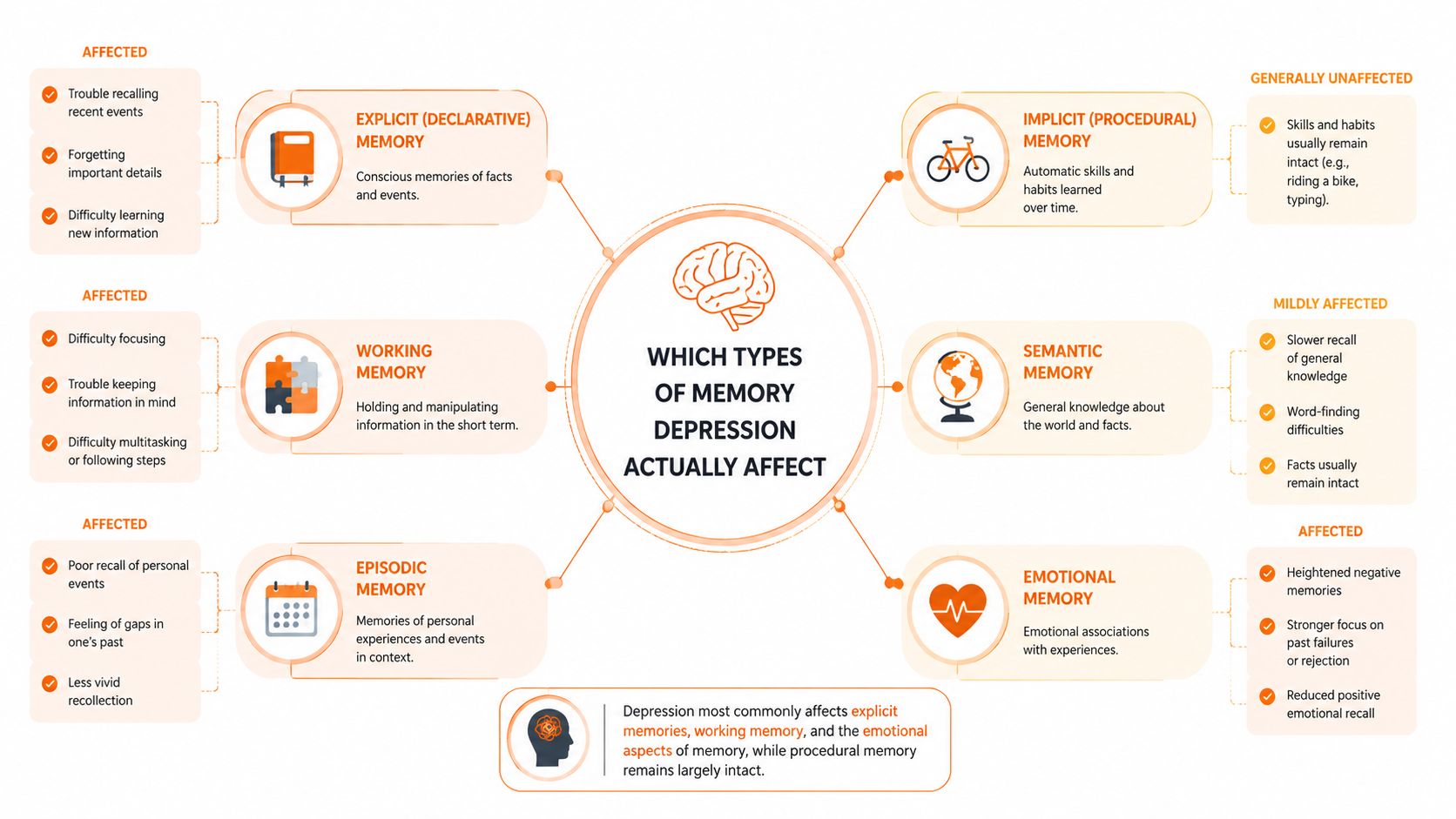
A practical example is a patient who forgets recent conversations, misplaces follow-up instructions, and needs reminders for appointments, but still performs reasonably on a formal recall test when the material is presented clearly. That pattern fits a problem with attention-dependent encoding more than a pure storage failure.
For quick bedside-style screening of attention span, the Orange Neurosciences guide on digit span test is worth reviewing.
The Biological and Cognitive Mechanisms Behind Memory Disruption
Depression affects memory through both biology and thinking style. Stress systems, sleep disruption, and persistent negative self-focus can all interfere with how the brain takes in and uses information.
One commonly discussed pathway is the stress response. When depressive episodes keep the body in a heightened stress state, cortisol can rise, and the hippocampus, the brain region central to forming new memories, may become less efficient. That doesn't mean the brain is “broken”. It means the systems that support learning and recall are under strain.

Why sleep and rumination matter so much
Sleep disruption adds another layer. When sleep is fragmented or too shallow, the brain has a harder time consolidating what happened during the day into durable memory. That's one reason a person with depression may go to bed exhausted, wake up unrefreshed, and still feel mentally “full” by noon.
Rumination works in a different way. It steals cognitive bandwidth. A student who keeps replaying a social mistake in their head may not be unable to learn lecture material, but their brain is partially occupied elsewhere while the lecture is happening. The result looks like forgetfulness, yet the immediate problem is often reduced available attention.
The Orange Neurosciences guide to lobes of the brain can be useful for families who want a clearer picture of where attention, planning, and memory fit anatomically.
Depression doesn't just change mood. It changes how efficiently the brain can receive, organise, and retrieve information under everyday pressure.
That's why some people improve cognitively when mood, sleep, and anxiety are treated together. The memory issue is real, but the mechanism is often reversible or at least modifiable.
Depression-Related Memory Loss Versus Dementia and Other Causes
This is the question that scares many people. Is it depression, or is it dementia?
The answer usually depends on pattern, insight, and timing. Depression tends to produce effortful recall problems, especially when concentration is poor or the person is under emotional strain. Early dementia more often shows a broader and more progressive breakdown in new learning, everyday function, and awareness of deficits.
A comparison table can make the distinction easier to scan.
Feature | Depression-Related | Early Dementia |
|---|---|---|
Onset | Often linked with mood change, stress, or sleep problems | Usually progressive and less tied to mood |
Main issue | Attention and encoding problems, effortful recall | Broader new-learning and recall impairment |
Insight | People often notice and worry about the failures | Insight may be reduced |
Day-to-day pattern | Fluctuates with mood, fatigue, and distraction | More consistent decline over time |
The biggest clinical mistake is assuming that every forgetful older adult has dementia. Depression, medications, sleep disorders, and thyroid problems can all create memory complaints, and they can overlap. The Orange Neurosciences guide on mild cognitive impairment vs dementia is a good reference point when families are trying to understand where the line sits.
What families should watch for
If the person is highly distressed about their memory, repeats questions but still recognises the problem, and has clear depressive symptoms, mood-related cognitive change becomes more likely. If the problem is steadily worsening, affects finances or medication use, or includes confusion about familiar tasks, a broader neurological workup matters more.
There's also a practical distinction in the kind of memory failure. Depression can make retrieval harder, especially when recall is effortful and emotionally loaded. Dementia is more likely to create a deeper breakdown in new learning that persists across settings.
When the memory complaint is paired with low mood, the first job is not to label it. It's to map the pattern carefully enough to see what's actually failing.
How Clinicians Assess Memory Issues in the Context of Depression
A good assessment starts with mood, but it doesn't end there. The clinical review literature notes that depression-related memory complaints require a multidimensional approach, because the memory profile isn't specific enough to diagnose by symptoms alone. That's especially important when subjective complaints and objective testing don't match.
The practical workflow usually includes three layers. First, clinicians screen for depression severity and related symptoms such as sleep disruption, apathy, and anxiety. Second, they ask about real-world function, because forgetting names is different from missing medications or getting lost. Third, they use objective cognitive testing to see which domains are affected.
The Orange Neurosciences guide on cognitive assessment tools is relevant here because objective profiling can help separate attention, memory, executive function, and processing speed, rather than relying on a single impression.
Why objective testing changes the conversation
Subjective complaints matter, but they can overstate or understate the problem. One population study found that depressive symptoms were strongly linked to self-reported memory complaints, yet not to standard objective memory scores after adjustment for age, sex, and general cognitive ability; instead, the depression signal showed up in memory for objects in negative contexts (study). That split between what people feel and what tests show is exactly why objective assessment is so useful.
A practical example is an older adult who insists their memory is collapsing, but a structured screen shows a different pattern, perhaps more attention than storage difficulty. That doesn't invalidate the complaint. It gives the clinician a more accurate target.
The bidirectional evidence matters too. In a longitudinal study of 8,268 adults, higher depressive symptoms at baseline were linked to poorer memory at the same time point and to faster memory decline over time, while worsening depressive symptoms tracked with faster memory decline as well (JAMA Network Open). That makes early, objective measurement more useful, not less.
Treatment and Coping Strategies That Support Cognitive Recovery
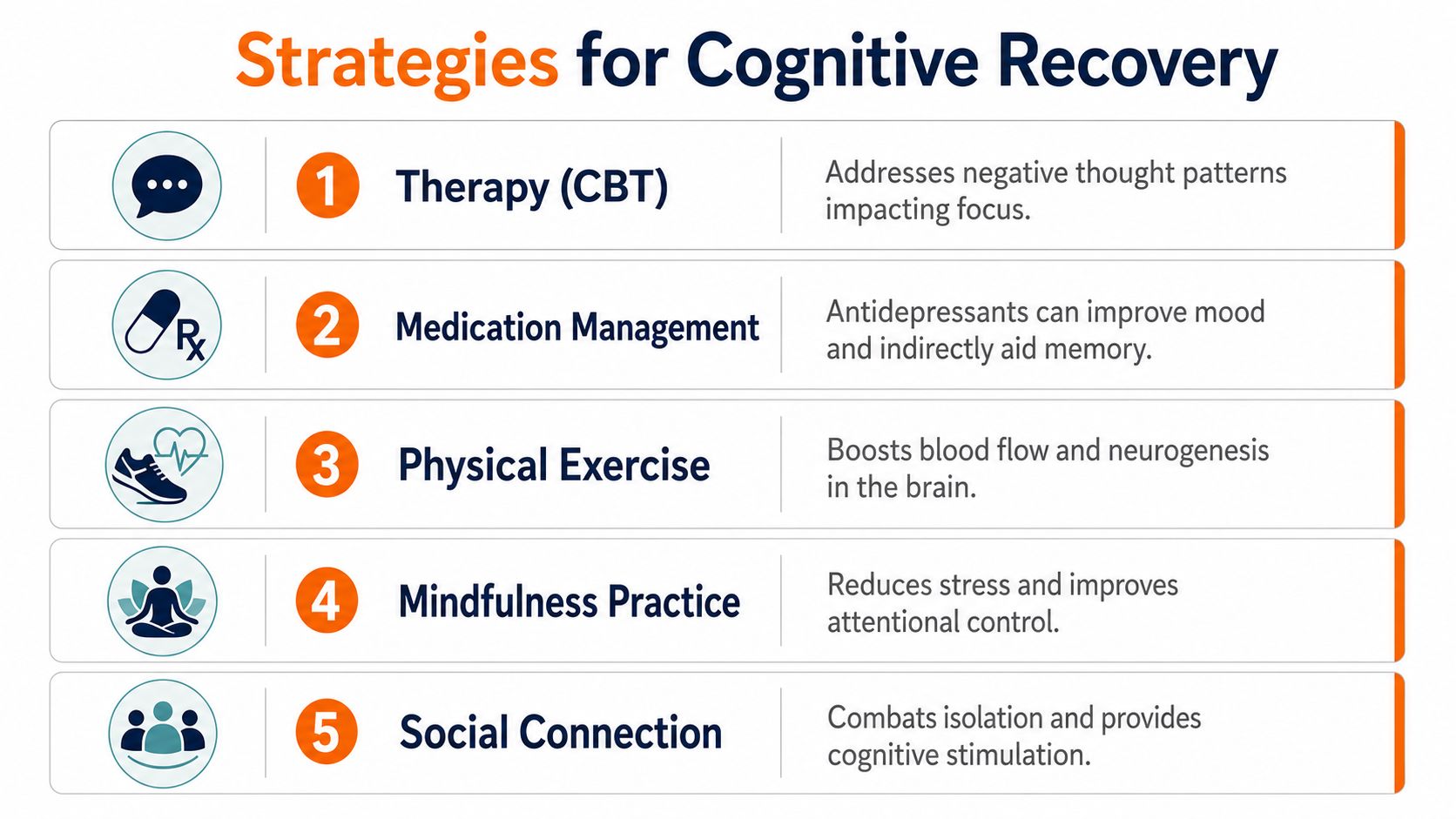
Treating depression can improve memory and attention when the cognitive symptoms are driven by mood, stress, or sleep disruption. That doesn't happen overnight, and it doesn't look identical for every person, but the direction of change matters. The more the mood lifts, the less cognitive bandwidth gets swallowed by worry and fatigue.
For many people, psychotherapy is the most useful starting point because it targets the thought patterns that keep attention stuck. Medication management can also help when depressive symptoms are severe or persistent, and some people benefit from a combined approach. A local example of support is depression counselling in Vernon, which may be relevant for readers who want face-to-face help rather than trying to manage this alone.
Daily supports that reduce cognitive load
Small routines can make memory feel less fragile:
Use one capture system. Keep appointments, tasks, and reminders in a single notebook or app instead of scattering them.
Repeat information out loud. Saying a phone number, medication time, or meeting detail aloud improves the chance it sticks.
Protect sleep. Even modest sleep disruption can make recall feel worse the next day.
Break information into chunks. Short lists are easier to encode than long, unstructured instructions.
Reduce multitasking. If attention is divided, memory often takes the hit first.
A working adult who combines therapy with simple memory supports may notice that confidence returns before perfect recall does. That's normal. The brain often needs repeated, low-stress practice before day-to-day memory feels reliable again.
Practical advice: Don't judge recovery by one good day or one bad day. Track trends over several weeks, especially after treatment changes.
When to Seek Objective Cognitive Screening and Next Steps
If memory complaints stay the same or worsen after mood improves, that's a reason to look deeper. If the person begins missing bills, repeating questions more often, or struggling with tasks they used to manage automatically, objective screening becomes important. Those are the moments when guesswork does more harm than good.
A rapid cognitive profile can give clinicians and families something concrete to work from. Orange Neurosciences offers objective assessment across attention, memory, executive function, and processing speed, with tools such as OrangeCheck designed to fit into real-world care pathways. The practical value is not a diagnosis by itself, but a clearer map of what's changing and what isn't.
For older adults, that matters even more because depressive symptoms and memory decline can move together over time. The JAMA Network Open findings above, along with Canadian-relevant evidence that self-perceived age can shape vulnerability, point to a simple rule. Don't wait for the picture to become obvious before measuring it.
If you're a clinician, educator, or family member, the next step is straightforward. Get objective data, compare it against mood symptoms, and decide whether the person needs follow-up for depression treatment, neurological evaluation, or both.
Orange Neurosciences helps clinicians, educators, and families move beyond guesswork with rapid, objective cognitive assessment and targeted digital cognitive support. If depression and memory problems are making it hard to tell what's changing, visit Orange Neurosciences to learn how objective profiling can guide the next conversation and the next clinical step.

Orange Neurosciences' Cognitive Skills Assessments (CSA) are intended as an aid for assessing the cognitive well-being of an individual. In a clinical setting, the CSA results (when interpreted by a qualified healthcare provider) may be used as an aid in determining whether further cognitive evaluation is needed. Orange Neurosciences' brain training programs are designed to promote and encourage overall cognitive health. Orange Neurosciences does not offer any medical diagnosis or treatment of any medical disease or condition. Orange Neurosciences products may also be used for research purposes for any range of cognition-related assessments. If used for research purposes, all use of the product must comply with the appropriate human subjects' procedures as they exist within the researcher's institution and will be the researcher's responsibility. All such human subject protections shall be under the provisions of all applicable sections of the Code of Federal Regulations.


© 2026 by Orange Neurosciences Corporation