Functional Abilities Form: A Practical Guide for Clinicians

You're at the clinic intake desk with a return-to-work referral, a job description, and a patient who says, “I can probably manage.” The employer needs something more useful than a diagnosis, while the patient needs protection from duties that could worsen symptoms. A functional abilities form fills that gap by translating clinical findings into practical limits, supports, and review points.
The form works only when each entry answers a real operational question. Can the person lift, stand, concentrate, tolerate interruptions, manage personal care, or return to a task safely? The strongest forms communicate those answers without disclosing unnecessary medical information.
What a Functional Abilities Form Actually Is
A functional abilities form is a structured document that records what a person can do, cannot do, or can do with conditions. It may support workplace reintegration, rehabilitation, residential care, school re-entry, or broader care planning. It isn't a diagnostic report. A diagnosis belongs in the clinical record when clinically necessary. The form should describe function.
In Ontario, the Functional Abilities Form for Planning Early and Safe Return to Work has a long-standing regulatory role. It was formally prescribed under the Workplace Safety and Insurance Act through Regulation 28/07, made in 2006 and brought into force in 2007, and later reaffirmed through Regulation 124/16. The Ontario regulation identifying the prescribed Functional Abilities Form connects the document to information a health professional provides for return-to-work planning.
The form performs three jobs:
It communicates safe limits. A worker may be able to stand, but not continuously. A student may attend class, but need reduced cognitive load and scheduled rest.
It anchors accommodation discussions. Employers, schools, families, and care teams can discuss tasks rather than speculate about diagnosis.
It creates a baseline. The next assessment can compare current function with the documented starting point.
Different forms answer different questions
A workplace form focuses on duties, restrictions, capabilities, and accommodation. A clinician's functional capacity evaluation is usually a more detailed assessment of performance, often involving observation and task testing. A care-planning assessment asks what support a person needs for daily living, safety, and participation. Those documents overlap, but they aren't interchangeable.
An orthopedic clinic may document that a worker recovering from shoulder surgery can perform light administrative duties while avoiding overhead reaching. A senior-care team may document support needs for dressing, transfers, continence, or medication routines. A concussion clinic may describe how a student can begin graded school re-entry with reduced screen exposure and rest periods.
For a useful explanation of the broader functional-capacity assessment process, FCA explained by Nursing Assessment Australia offers helpful context. Clinicians should also distinguish activities of daily living from more complex tasks, using this ADL versus IADL clinical guide when deciding which functional domains belong in the assessment.

The clinician completes the form, ideally with the client's input and consent. The timing depends on the referral, but the form is most useful after an assessment has established current function and before duties or supports are finalised.
Field-by-Field Anatomy of a Functional Abilities Form
A reliable form starts with context. Identifying information should make clear who was assessed, which role or environment is relevant, who requested the form, and when the information was gathered. Dates matter because capacity changes. Record the assessment date, relevant injury or illness timeline when required, and the anticipated review date without turning the form into a diagnostic narrative.
The affected domain should be described functionally. Depending on the setting, that may include the musculoskeletal system, vision, hearing, endurance, cognition, emotional tolerance, or behaviour. Avoid writing only “back issue” or “cognitive concerns.” Those labels don't tell a case manager what task needs modification.
The fields that drive decisions
Physical categories commonly include lifting, carrying, pushing, pulling, standing, walking, sitting, reaching, bending, kneeling, climbing, and hand use. Write the condition under which the activity is possible. “Limited lifting” is weak. “Avoid floor-to-waist lifting and keep materials at waist height” gives an employer something to implement.
Cognitive and psychosocial categories need equal precision. Include concentration, memory, processing speed, cognitive stamina, emotional tolerance, communication, judgment, orientation, and response to interruptions when relevant. “Reduced concentration” doesn't explain whether the person can complete a quiet task, follow a sequence, switch between tasks, or sustain attention in a busy environment.
Practical rule: Each restriction should help another person change a task, schedule, environment, or level of supervision.
Duration is another routinely vague field. “Temporary” isn't enough. State whether the restriction is expected to remain until reassessment, fluctuate with fatigue, or require ongoing accommodation. The signature block should identify the responsible clinician and confirm the date of completion. A form without a clear author or assessment date becomes difficult to interpret later.
A lifting entry might read, “Avoid repetitive lifting from floor level. Use a cart for heavier supplies and keep loads close to the body.” A cognitive-stamina entry might read, “Can complete focused reading in short blocks with a quiet workspace and recovery breaks. Avoid simultaneous phone, screen, and customer-facing demands during the initial re-entry period.”
Ontario's WSIB-aligned form is designed around return-to-work communication, while California residential-care requirements illustrate a broader model. California's functional capabilities assessment covers activities of daily living such as bathing, dressing, toileting, transferring, continence, and eating, along with physical and mental domains. It also includes visual, hearing, and speech impairment, walking assistance, dietary limits, medical history, medication needs, wandering, confusion, cash-management ability, potential for violence, suicidal risk, depression, and substance-abuse history. The occupational therapy assessment guide can help teams place those observations within a wider functional assessment process.

Use Cases Across Return-to-Work, Rehab, and Care Planning
The same functional category can mean something different to each reader. A standing restriction might guide a supervisor's staffing plan, a therapist's exercise progression, a care home's support schedule, or a school's classroom arrangement. The template should stay structured, but the interpretation must match the setting.
Use Case | Emphasis | Key Fields | Consumer |
|---|---|---|---|
Workplace return-to-work | Safe duties and accommodation | Lifting, reaching, endurance, hours, cognitive demands, environmental triggers | Employer, worker, case manager |
Rehabilitation clinic | Change over time and treatment planning | Task tolerance, mobility, fatigue, cognition, observed performance | Therapist, physician, insurer, client |
Care planning | Daily support and safety | Transfers, dressing, continence, eating, medication routines, wandering, judgment | Family, care team, residence |
School or paediatric re-entry | Graded participation and learning access | Attendance tolerance, concentration, screen use, memory, sensory load, emotional regulation | Student, family, school team, clinician |
Consider a worker returning after rotator-cuff surgery. The employer doesn't need the surgical details to assign suitable duties. The useful information is whether the worker can reach overhead, carry supplies, use both arms repetitively, and sustain the shift without increasing symptoms.
A stroke survivor entering outpatient rehabilitation may need the form to show observed mobility, transfers, communication, attention, and safety awareness. The rehabilitation team consumes the document as a baseline for treatment planning, while the family may use the same information to organise support at home.
A new assisted-living resident requires a different reading. Bathing, dressing, continence, eating, medication support, confusion, and wandering may matter more than workplace endurance. For people receiving convenient medical care at home, the form can help a visiting clinician communicate practical support needs to family members and home-care staff.
A high-school student returning after concussion may be physically able to attend school but unable to manage a full academic load. The form should describe concentration, memory, screen tolerance, noise sensitivity, transitions, and recovery needs without presenting the student's diagnosis to every person who sees the accommodation plan.
The work-capacity evaluation guide is useful when the central question is sustained participation in work rather than isolated task performance. The document's consumer determines the level of detail. A supervisor needs implementation instructions. A therapist needs measurable activity observations. A family needs understandable support guidance.
How to Administer the Form With a Real Client
Administration should follow a repeatable sequence, but it shouldn't feel like an interrogation. Before the appointment, review the referral, relevant clinical notes, job or school demands, and previous functional documentation. Confirm consent, preferred language, communication needs, and who will receive the completed form.

Start with the client's own priorities. Ask, “What activity are you most concerned about returning to?” Then clarify the task: “Walk me through what happens from the moment you start that task until you need to stop.” This produces better information than asking whether the person is “able” or “unable.”
Use concrete prompts
For lifting, ask, “What can you lift from a counter to a shelf? What about from the floor? How often could you repeat that before symptoms or fatigue change your performance?” For standing, ask, “How long can you stand in one place, and does walking feel different from standing still?”
Cognitive questions should use ordinary work or school situations. Try, “If someone gives you three instructions while you're working, what happens next?” or “How long can you read or work on a screen before you need a recovery break?” To ask about memory without creating alarm, say, “What kinds of information are hardest to hold onto, appointments, conversations, written instructions, or steps in a task?”
Record the source of each finding. Separate subjective report, observed performance, collateral information, and test results. A client who reports difficulty with stairs but walks safely in the clinic hasn't necessarily contradicted the assessment. The clinic may not reproduce the person's home environment, fatigue pattern, pain level, or repeated-demand context.
Manage uncertainty honestly
If a client minimises symptoms, ask for examples rather than challenging their account. If the person exaggerates or gives inconsistent answers, document the inconsistency neutrally and seek corroborating observations or further assessment. Don't convert uncertainty into an artificially precise restriction.
End by reading the functional summary back: “I've recorded that you can perform seated computer work, but need reduced interruptions, scheduled recovery breaks, and gradual progression. Is that accurate?” Give the client an opportunity to correct wording, then record the expected duration and review trigger.
Scoring and Interpretation of Functional Findings
A completed form isn't automatically an interpretation. The assessor must connect the entry to the demands of the activity and explain what the finding means for participation.
Physical capacity is commonly recorded through load, duration, frequency, position, and tolerance. Some forms use weight categories, time limits, or frequency labels. Others use checkboxes. Those conventions aren't interchangeable, so don't import a threshold from one form into another without checking its definitions.
Suppose a worker can lift a light object once but develops symptoms with repeated handling. A single successful lift doesn't establish repetitive work capacity. The interpretation should describe the difference between occasional performance and sustained task demands, then identify a practical control such as smaller loads, a cart, altered storage height, or rotation of duties.
Cognitive findings need functional language
Cognitive findings are often better expressed as descriptive tiers than as a single score. “Independent with written prompts,” “needs step-by-step instructions,” and “requires supervision for safety-critical tasks” tell the reader more than an unexplained numerical result.
For independent living, memory difficulty may affect medication routines, appointments, cooking, or financial decisions. The form should identify the task and support required, not imply incapacity across every area of life. A person may remember familiar routines while struggling with new instructions.
Standardised norms help compare performance with an appropriate reference group, but they don't decide accommodation by themselves. Clinical judgment begins when the assessor integrates test findings, observed behaviour, reported fatigue, environmental demands, and risk.
A useful interpretation paragraph answers three questions: what the person can do, under what conditions, and what should happen next.
A practical summary might state that the client can perform short periods of seated work, has reduced tolerance for sustained concentration, benefits from written instructions and a quiet environment, and should be reassessed after the initial adjustment period. If findings suggest safety concerns, marked inconsistency, or a need outside the assessor's scope, flag further assessment rather than overstating certainty.

Temporary restrictions should include a review condition. Longer-term accommodations should describe stable supports while acknowledging that function can change. The form should guide action, not label the person permanently.
Writing Restrictions That Are Specific and Privacy-Safe
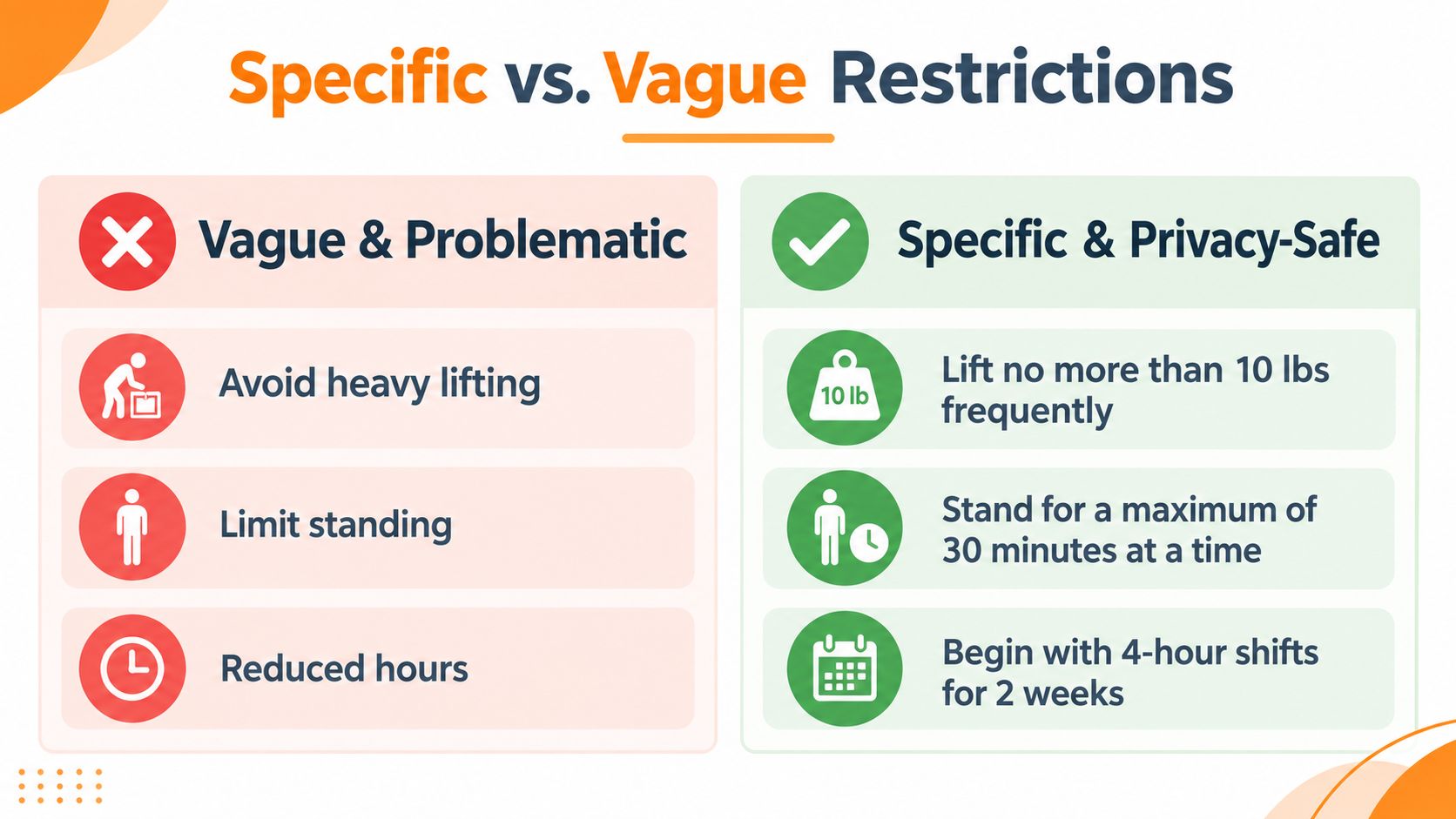
Vague restrictions are often treated as safe because they reveal little. In practice, they shift the burden to the employer, teacher, family, or case manager, who must guess what “avoid heavy lifting” or “reduced hours” means. Ontario WSIB guidance states that medical information shouldn't appear on the form, which supports a functional, privacy-preserving approach through its Functional Abilities Form guidance.
Use task language rather than diagnosis language. “Avoid lifting because of lumbar disc disease” discloses a medical detail and still leaves the employer unsure what to change. “Avoid repetitive floor-level lifting. Use a cart for supply transport and keep frequently used items between waist and shoulder height” is actionable without naming the condition.
Before and after
Musculoskeletal: Replace “no heavy work” with a description of the movement, load, frequency, posture, or assistance required.
Cognitive: Replace “brain fog” with “provide written instructions, minimise simultaneous tasks, and allow additional processing time for new procedures.”
Emotional: Replace “unable to handle stress” with “avoid unpredictable customer escalation during the initial return and provide access to a quiet recovery area.”
Fluctuating symptoms: State the pattern and response, such as “capacity varies with fatigue. Use planned recovery breaks and review if attendance or task tolerance changes.”
For post-concussion symptoms, describe screen tolerance, noise, visual complexity, concentration, memory, and recovery time. For mental-health-related limitations, focus on predictable schedules, task complexity, communication demands, supervision, and environmental triggers. Don't infer risk from a diagnosis. Document observed or reported functional effects and the supports that address them.
Before sharing the form, remove diagnosis, medication details, treatment history, test scores that aren't needed for the recipient, and speculative explanations. Keep those details in the clinical record. Confirm that every restriction has a practical counterpart, a duration or review trigger, and wording the recipient can understand.
Integrating Results With Digital Assessment Workflows
Paper forms often create a predictable failure point. A clinician writes a restriction, another staff member re-enters it into a care plan, and a third person builds a progress report from a different version. Each handoff introduces opportunities for transcription errors, missing dates, and inconsistent language.
A digital workflow should map each form field to a structured record. Start with identity, consent, setting, assessment date, functional domain, finding, restriction, support, duration, and review trigger. Keep free-text space for clinical nuance, but use structured fields for items that need comparison over time.
The next step is linking the functional finding to a relevant assessment. A documented concentration limitation might prompt a cognitive skills assessment covering attention, memory, executive function, perception, processing speed, or eye-hand coordination. Decision support can then help organise priorities, while the clinician remains responsible for interpretation and care decisions.
Orange Neurosciences offers digital cognitive assessment and therapy tools that produce individualised cognitive profiles, support AI-assisted care planning, provide adaptive ReadON exercises, and enable reassessment and progress reporting across clinical, educational, and community settings. Its platform also supports multilingual delivery, which can help teams align the assessment language with the participant's needs. These tools support assessment and training, but they aren't medical diagnoses or substitutes for clinical judgment.
Set reassessment around the client's situation, not an arbitrary calendar. A worker with a short-term restriction may need review when duties change or tolerance improves. A student may need review after a staged academic increase. Families and payers should receive reports that show the original finding, intervention or accommodation, observed change, and next decision. The assessment-on-demand workflow guide provides further context for structuring digital access to assessment.
Quick Reference for Documentation, Billing, and Workflow
Use this checklist before finalising a form:
Document function: Record abilities, restrictions, supports, duration, and review triggers. Keep diagnosis and unnecessary medical details in the clinical record.
Match the setting: Workplace, rehabilitation, care, and school forms may use similar domains but serve different readers.
California Medi-Cal: An annual cognitive health assessment for eligible Medi-Cal beneficiaries aged 65 and older without Medicare coverage is reimbursed at $29.00 per assessment, effective July 1, 2022, with one reimbursement per calendar year and required Dementia Care Aware training. See the California Medi-Cal state plan amendment.
Choose the code carefully: Use CPT 99483 when there is an indication of cognitive impairment. Use 1494F for the eligible annual Medi-Cal fee-for-service assessment. Don't report both for the same encounter, as explained in this California cognitive screening and billing guide.
Remote delivery: California Medi-Cal telehealth reimbursement requires interactive audio, video, or data communication. Telephone, email, and fax aren't reimbursed as telemedicine, and the audiovisual quality must support all billed service components. Review the California telehealth medical provider manual.
Improve access: Spanish administration and cellular-connected tablet delivery are feasible in California cognitive assessment work, as described in this California Cognitive Assessment Battery publication. Use the registration and enrolment module to organise participant access and workflow setup.
Orange Neurosciences provides digital cognitive assessment, AI-supported care-planning tools, adaptive ReadON therapy, multilingual delivery, and reassessment workflows that can carry functional findings into ongoing monitoring. Visit Orange Neurosciences to explore how the platform can support a more consistent path from functional abilities form documentation to care planning and follow-up.

Orange Neurosciences' Cognitive Skills Assessments (CSA) are intended as an aid for assessing the cognitive well-being of an individual. In a clinical setting, the CSA results (when interpreted by a qualified healthcare provider) may be used as an aid in determining whether further cognitive evaluation is needed. Orange Neurosciences' brain training programs are designed to promote and encourage overall cognitive health. Orange Neurosciences does not offer any medical diagnosis or treatment of any medical disease or condition. Orange Neurosciences products may also be used for research purposes for any range of cognition-related assessments. If used for research purposes, all use of the product must comply with the appropriate human subjects' procedures as they exist within the researcher's institution and will be the researcher's responsibility. All such human subject protections shall be under the provisions of all applicable sections of the Code of Federal Regulations.


© 2026 by Orange Neurosciences Corporation