A Modern Guide to Work Capacity Evaluation in 2026
Apr 2, 2026
When someone's recovering from an injury or health issue, a simple doctor's note saying they're ready for "light duty" just doesn't cut it. What does "light duty" actually mean? Can they lift 10 kilograms, or 20? Can they stand for one hour, or four? This ambiguity is risky for everyone.
A work capacity evaluation is what bridges that gap. It's not just a permission slip to go back to a job; it's a deep, objective audit of a person's readiness to work safely and sustainably, matching their current abilities to the real demands of their role.
Going Beyond a Simple Physical
Let's picture a construction worker who's been cleared to return to work after a back injury. A work capacity evaluation replaces guesswork with hard data. It gives clear, evidence-based answers about what that worker can actually do, day in and day out.
Think of it as a detailed performance review of a person's physical and cognitive ability to do their job without putting themselves or others at risk.
While physical tests are a big part of it, a modern evaluation goes much deeper to paint a complete picture. A person’s ability to get back to work successfully isn't just about muscle strength. It’s about the whole person.
To get a quick overview of what these evaluations cover, the table below breaks down the core assessment areas.
Table: Core Components of a Work Capacity Evaluation
Assessment Component | What It Measures | Example Metric & Actionable Insight |
|---|---|---|
Medical History | Past injuries, surgeries, chronic conditions, and current treatments that could affect work performance. | Review of specialist reports and medication lists. Actionable Insight: Identifying that a new medication causes drowsiness points to a need for cognitive testing. |
Physical Abilities | Core strength, endurance, flexibility, and coordination needed for job tasks. | A standardized test measuring the ability to lift and carry 20 kilograms over a set distance. Actionable Insight: Confirms the individual can perform tasks in a 'Light-Medium' work category. |
Functional Tolerances | How long a person can sustain specific activities or postures during a typical workday. | Documenting the ability to sit at a desk for 60 minutes before needing a break. Actionable Insight: Recommending a 5-minute break every hour to prevent fatigue and maintain productivity. |
Cognitive Function | Attention, memory, problem-solving, and processing speed—all vital for safety and productivity. | An assessment of reaction time and decision-making speed using a standardized tool. Actionable Insight: A slower reaction time might necessitate removing the employee from operating heavy machinery. |
Psychosocial Factors | A person's confidence, motivation, and any fear of re-injury that could hinder their return. | A validated questionnaire measuring fear-avoidance beliefs. Actionable Insight: High fear scores indicate a need for graded exposure therapy to build confidence. |
This holistic approach is what makes these evaluations so powerful. It ensures that no stone is left unturned when making crucial return-to-work decisions.
Why This Level of Detail Is So Important
These evaluations provide solid, actionable insights for clinicians, employers, and insurance providers. A closely related process is the fitness for work assessment, which also focuses on ensuring an individual can handle their job duties without risk to health and safety.
Actionable Takeaway: The real goal here is to perfectly match a person's proven capabilities with the specific demands of their job. When decisions are driven by objective evidence instead of assumptions, everyone is safer.
For example, an accountant recovering from a concussion might seem physically fine. But a cognitive assessment could reveal a major drop in their processing speed. This one piece of data explains why they're suddenly struggling with complex spreadsheets. It points to practical solutions, like giving them a quieter workspace or more frequent breaks. Without that evaluation, the real problem might be missed entirely.
Ultimately, a work capacity evaluation gives everyone a clear, defensible plan. It helps decide if a warehouse employee can safely get back to lifting heavy boxes or if an office administrator has the cognitive stamina for a full eight-hour shift. By getting this granular, the evaluation protects the employee's long-term health while helping the organisation manage its risk effectively. It shifts the conversation from what a person can't do to what they can do—and how to bridge that gap safely.
A truly effective work capacity evaluation is much more than a single test. Think of it as a comprehensive investigation built on four interconnected pillars. Each one gives us a crucial piece of the puzzle, and when you put them all together, you get a complete, three-dimensional picture of someone’s readiness for work. It’s the difference between a simple checklist and a deep, functional understanding of a person.
Let's walk through these pillars one by one. You'll see how they work together to reveal the why behind a person's abilities, not just the what.
The Medical Review and History
First things first, we have to start with the foundational Medical Review. This isn't just a quick scan of a medical file; it’s a deep dive into the individual’s entire health history. This is our baseline, and it sets the stage for everything that follows.
An assessor will comb through medical records, diagnoses, surgical reports, and current treatments. What we’re looking for are any underlying conditions or "red flags" that might impact safety or performance.
Practical Example: An employee returning after a cardiac event. A medical review reveals they are on a beta-blocker, which blunts heart rate response. Actionable Insight: During physical testing, relying on heart rate alone to measure exertion would be misleading. The assessor must use other scales, like the Borg Rating of Perceived Exertion (RPE), to accurately gauge their effort and ensure safety.
The Functional and Physical Assessment
Next up is the Functional and Physical Assessment. This is the part most people imagine when they hear "work capacity evaluation." Here, we move beyond what a medical report says and measure what the person can actually do. It's all about objective, observable performance.
This involves a series of standardized tests that mimic real-world job demands in a safe, controlled environment.
We're typically testing abilities like:
Strength: How much can they lift, carry, push, or pull?
Endurance: Can they sustain an activity over time, like walking on a treadmill or repeatedly climbing stairs?
Positional Tolerance: How long can someone comfortably sit, stand, kneel, or hold other job-specific postures?
Dexterity and Motor Control: Can they handle tasks requiring fine motor skills, like assembling small parts or using tools?
Actionable Insight: A real, actionable insight isn't just "the person has a weak back." It's "the person can safely lift 10 kilograms from floor to waist 5 times but shows signs of fatigue and unsafe posture when lifting 15 kilograms." That level of detail makes practical work accommodations possible. To learn more about how these abilities connect to everyday life, you might find our guide on the difference between ADLs and IADLs helpful.
The Cognitive and Psychosocial Evaluation
Finally, we arrive at the pillars that are too often overlooked but are absolutely vital for a successful return to work: the cognitive and psychosocial evaluations. After all, physical ability means very little if a person can't focus on the job or is too afraid to even perform the tasks.
This diagram shows how these different factors fit together, creating a truly holistic picture.
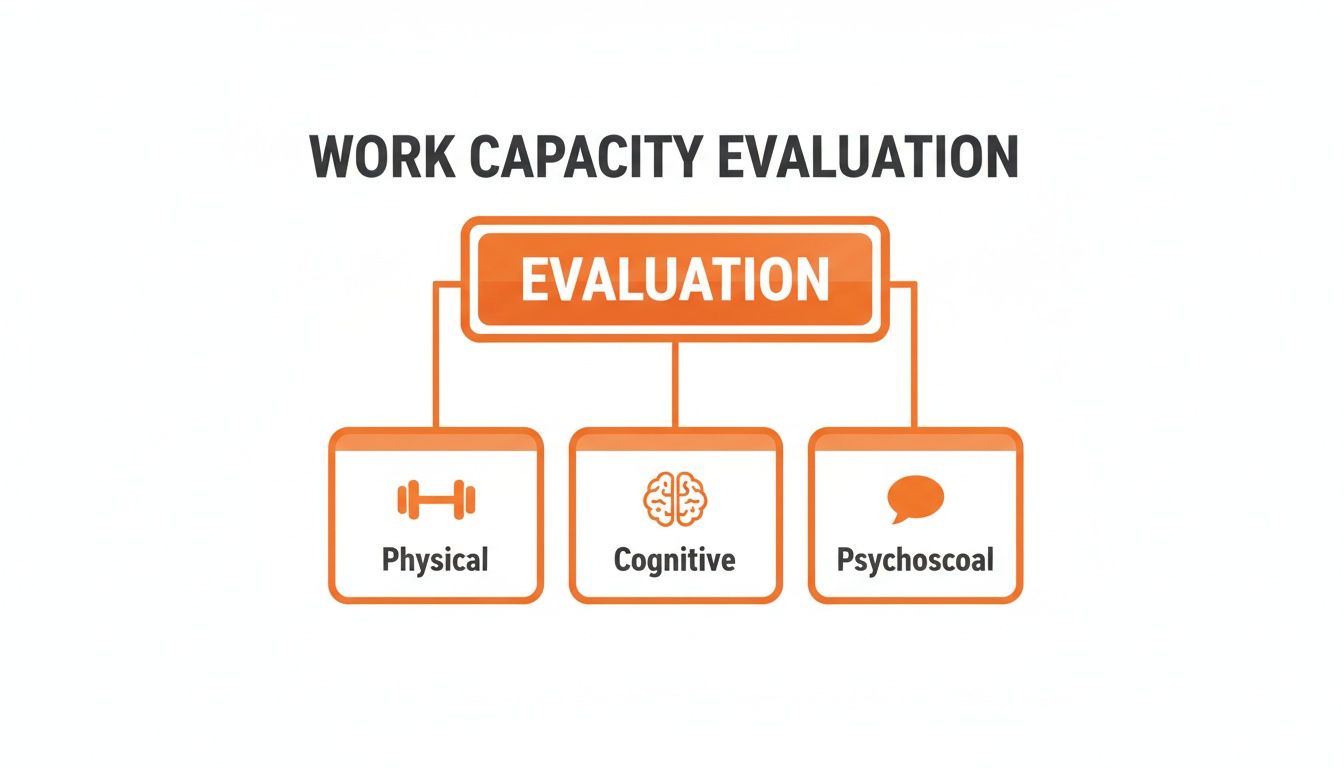
As you can see, looking beyond pure physical strength is what makes an evaluation genuinely comprehensive.
A Cognitive Evaluation measures the mental horsepower needed for safety and productivity. Key areas include:
Attention and Concentration: Can they stay on task, even with distractions?
Memory: Are they able to recall instructions, procedures, and safety protocols?
Processing Speed: How quickly can they perceive information and react to it?
Executive Functions: This covers higher-level skills like planning, organising, and problem-solving.
The Psychosocial Assessment delves into the psychological and social factors that can make or break a person's recovery. It looks at:
Motivation and Confidence: Does the person believe in their own ability to return to work?
Fear-Avoidance: This is a powerful, debilitating fear of re-injury that causes someone to avoid certain movements. It often becomes a bigger barrier than the original injury itself.
Perceived Disability: We look at the gap between their actual functional ability and what they believe they can do.
Practical Example: A warehouse worker recovering from a shoulder injury shows high fear-avoidance scores. Actionable Insight: Instead of just clearing them for lifting, the return-to-work plan should include a graded exposure program where they start by lifting very light, empty boxes and gradually increase the weight over two weeks, with supervision to build confidence and correct any protective, but unsafe, movements.
By assessing all four pillars, a work capacity evaluation delivers a robust, evidence-based report. It doesn’t just say if someone can go back to their job—it shows how they can do it safely and sustainably, providing a clear roadmap for everyone involved.
Getting to Grips With the Tools of the Trade
To pull off a trustworthy work capacity evaluation, an assessor needs more than just a clipboard and a stopwatch. Think of it like a mechanic diagnosing a complex engine problem—they rely on a whole suite of specialized instruments, not just a gut feeling. In our field, these tools give us objective, measurable data that turns guesswork into concrete, defensible insights about what a person can truly do.
One of the most powerful tools in our kit for measuring physical ability is the Functional Capacity Evaluation (FCE). An FCE is a structured battery of tests that directly measures a person's physical stamina and strength for work-related tasks, making it a cornerstone of most comprehensive work capacity evaluations.
During an FCE, a therapist will take the individual through a series of standardized activities that mimic real job demands, all within a safe, controlled environment. The goal isn't to push someone to their breaking point. It's about carefully observing how they perform tasks safely, how consistently they can do them, and whether they can sustain that effort over time.
Reliability vs. Validity: The All-Important Difference
When we talk about these assessment tools, two words pop up constantly: reliability and validity. They might sound interchangeable, but they measure two completely different things. Getting this distinction right is absolutely critical for making sound decisions.
Reliability: This is all about consistency. A reliable test will give you the same results time and time again under the same conditions. Imagine a bathroom scale that reads 80 kilograms every single time you step on it. That scale is reliable.
Validity: This is about accuracy. Does the test actually measure what it’s supposed to measure? That same scale is only valid if you genuinely weigh 80 kilograms. If your true weight is 90 kilograms, the scale is reliable but not valid—it gives you a consistent, but consistently wrong, answer.
This isn't just a technicality; it has massive real-world consequences. A tool can be reliably wrong, leading to bad, and even dangerous, return-to-work plans. This is a well-documented problem in the assessment world.
A landmark 2018 systematic review in the Journal of Occupational Rehabilitation discovered that while many FCE protocols were reliable, a worrying number lacked proven validity. In other words, they consistently measured something, but it wasn’t always the person’s actual ability to handle their job.
Turning Raw Numbers into Real-World Action
The data from an FCE or another assessment is just a pile of numbers until we give it context. The final, crucial step is to compare an individual’s performance against standardized physical demand levels for jobs. This is where we translate abstract metrics into practical guidance.
For instance, a common framework is used to classify the physical demands of different types of work:
Sedentary Work: Lifting no more than 10 pounds; mostly sitting.
Light Work: Lifting up to 20 pounds now and then; lots of walking or standing.
Medium Work: Lifting up to 50 pounds occasionally, and up to 25 pounds frequently.
Heavy Work: Lifting up to 100 pounds occasionally, and up to 50 pounds frequently.
Very Heavy Work: Lifting objects that weigh more than 100 pounds.
Actionable Insight: If an FCE shows a person can safely lift a maximum of 18 pounds and can stand for two hours at a time, the assessor can confidently classify their capacity as being suitable for Light Work. This gives the employer a clear, evidence-based recommendation: the employee can return to a role with these specific demands, but shouldn't be placed in a Medium or Heavy duty position. This is the kind of practical guidance you should expect.
It’s the same on the cognitive side. Tests like the Trail Making Test provide hard data that helps us map a person's mental capacity to the cognitive demands of a job. You can learn more about this in our guide on how the Trail Making Test works.
By using the right tools and interpreting the results with expertise, a work capacity evaluation creates a clear, evidence-based path for a safe and successful return to work.
The Growing Importance of Cognitive Assessment
In today’s world, a person's mental sharpness is often more critical to their job than their physical strength. Yet, it's frequently the most overlooked piece of a work capacity evaluation. It’s simple enough to measure if someone can lift a 50-pound box, but how do you objectively measure their ability to focus through a chaotic shift, remember multi-step instructions, or solve a problem under pressure? This is exactly where cognitive assessment makes a real difference.
From the office administrator juggling a dozen deadlines to the logistics coordinator navigating a complex inventory system, so many roles depend on brainpower. When those core cognitive skills falter, the risk of errors, accidents, and a drop in performance shoots up.
When Mental Readiness Is Compromised
A person’s mental clarity can be affected by a huge range of conditions—some obvious, others almost invisible. We're not just talking about major brain injuries; even issues that seem minor on the surface can seriously impact someone's ability to do their job well.
Some common culprits that can get in the way of essential work functions include:
Concussions and Mild Traumatic Brain Injuries (mTBI): These can leave behind persistent trouble with attention, memory, and processing speed, long after the physical signs have disappeared.
Long COVID: So many people report experiencing "brain fog," a frustrating state of poor concentration, memory slips, and mental fatigue that directly sabotages their performance at work.
Mental Health Struggles: Conditions like depression, anxiety, and PTSD are not just emotional battles; they drain a person's cognitive fuel, making it tough to stay focused, organize tasks, or make clear-headed decisions.
Without a proper cognitive assessment, these deficits often fly under the radar. An employee might get unfairly labelled as "unmotivated" or "careless" when the truth is they are wrestling with a real, measurable cognitive impairment.
The Shift to Objective Cognitive Data
This is where modern technology has completely changed the game. In the past, trying to assess cognition was a lengthy, subjective process, often relying on clunky pen-and-paper tests or simple observation. Now, AI-driven digital tools give us a faster, more precise, and truly objective picture.
Actionable Takeaway: The goal is to stop guessing how an individual is thinking and start gathering hard data. This data pinpoints specific cognitive gaps affecting their job performance, leading to smarter, more targeted accommodations and safer work environments for everyone.
For instance, platforms like OrangeCheck from Orange Neurosciences can map out a detailed and objective cognitive profile in under 30 minutes. You're no longer working with an observation; you're working with actionable data.
This is what it looks like when modern digital platforms turn complex brain data into clear, visual insights for clinicians.
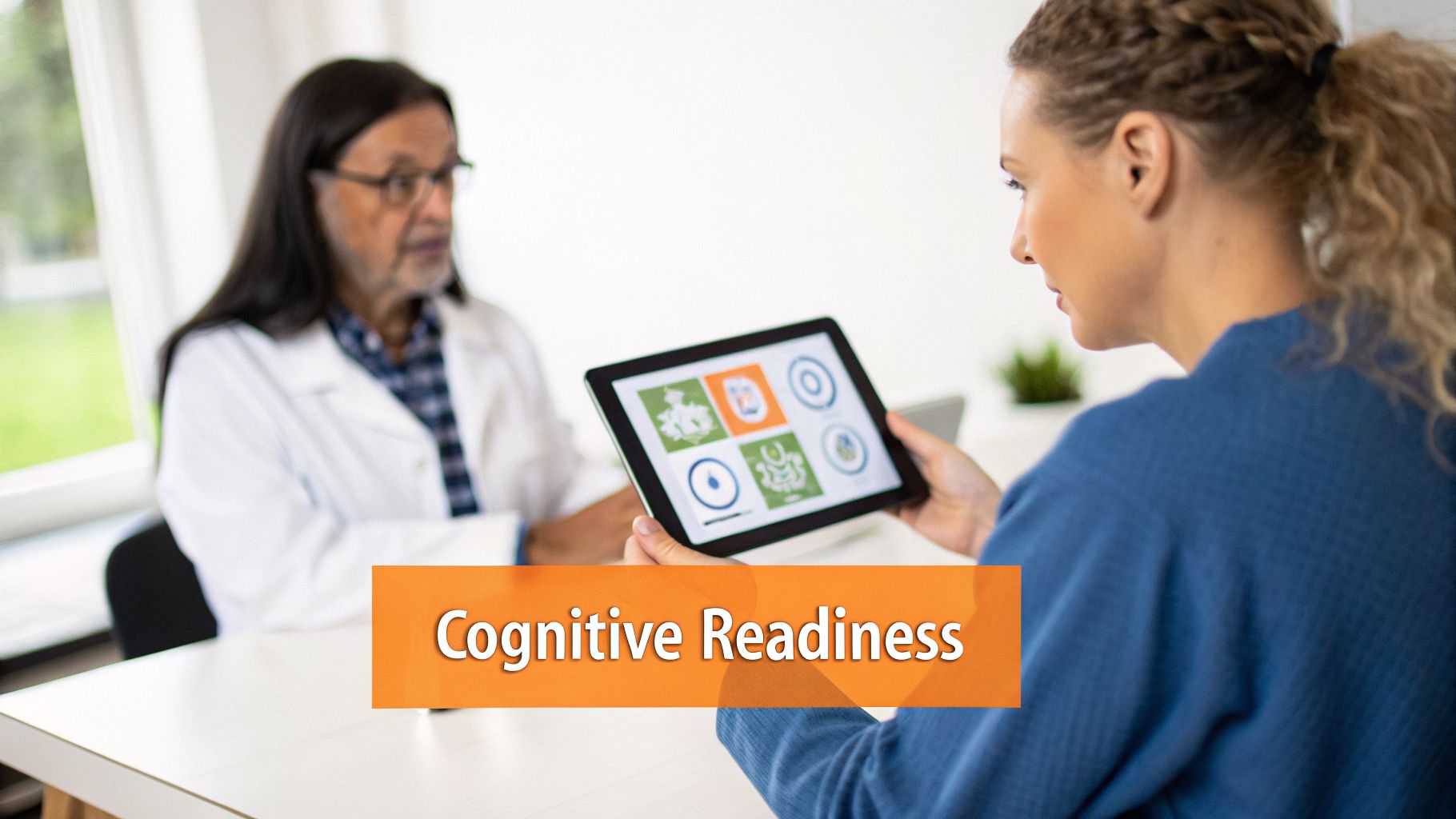
A report like this shows an evaluator exactly which cognitive areas—like processing speed, attention, or executive function—are holding a person back.
Practical Example: A delivery driver who, after a minor car accident, starts making an unusual number of wrong turns. A physical exam might give them a clean bill of health. But a cognitive assessment could uncover a specific deficit in their visuospatial processing. Actionable Insight: With that insight, the solution isn’t just "try to be more careful." It could mean providing a GPS with clear voice-guided directions or simplifying the complexity of their assigned routes. This is a targeted fix for a specific problem.
When we integrate these precise cognitive insights into a work capacity evaluation, we're finally seeing the whole person. It gives clinicians, employers, and insurers the comprehensive evidence they need to make decisions based on fact, not just physical ability. You can dive deeper into this process in our guide on what a cognitive assessment is and see how it delivers these vital insights.
Turning Assessment Data Into Actionable Reports
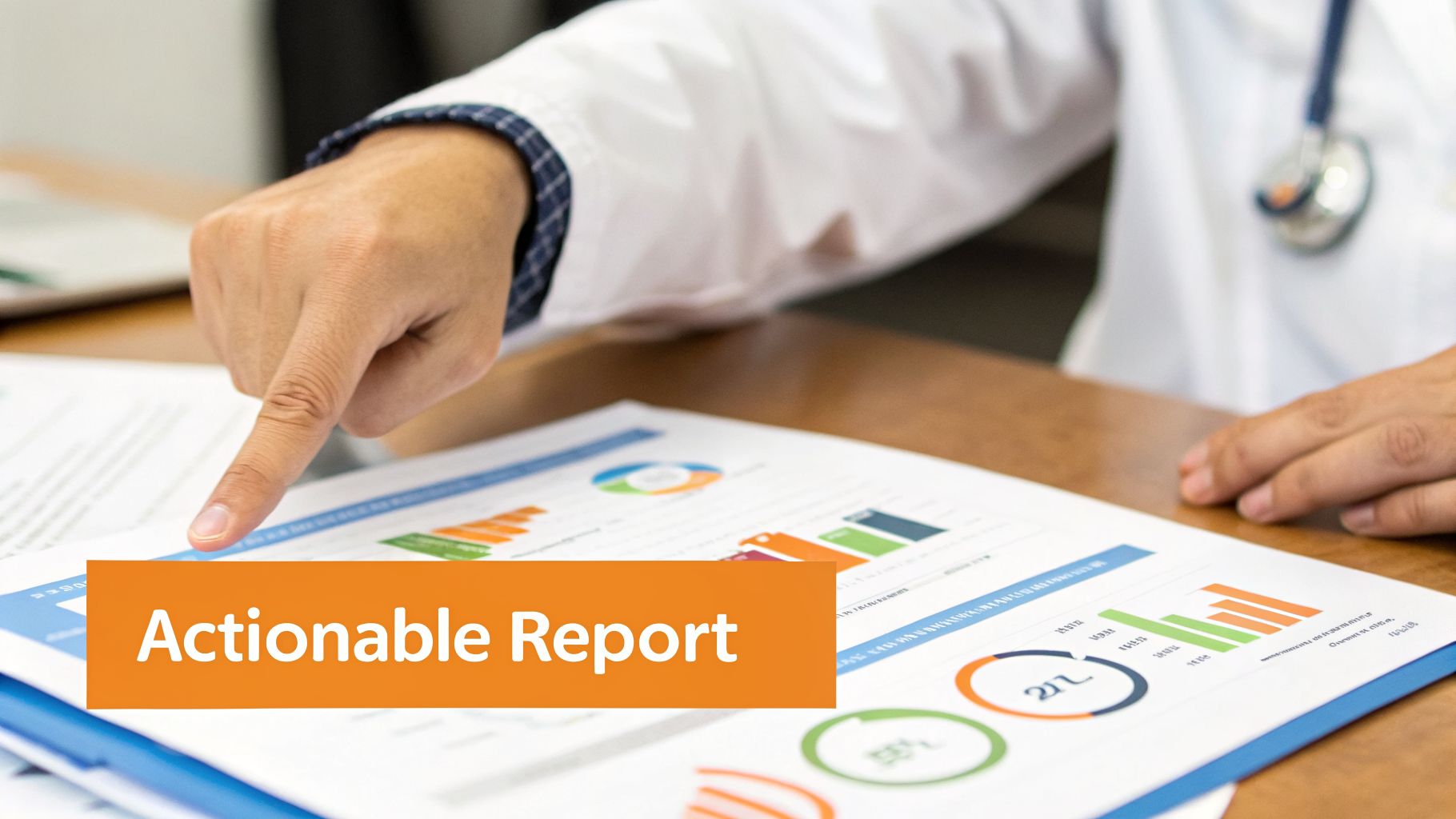
An assessment is only as valuable as the report it generates. Gathering all that precise physical, cognitive, and psychosocial data is just the first step. The real skill lies in translating that complex information into a clear, compelling story that everyone can understand.
This report is the crucial bridge between the evaluation and a successful return-to-work plan. It has to make sense not just to clinicians, but to employers, insurers, and legal teams, too.
The best reports tell a story, one free of dense clinical jargon. They pull together the findings from all pillars of the assessment to create a complete picture of the individual. Simply listing off test scores just doesn't cut it. The key is showing how those scores connect to real-world job functions, painting a clear picture of what the person can—and cannot—do safely.
From Data Points to Defensible Recommendations
A truly powerful report moves beyond just listing limitations. It's solution-focused. This means shifting the whole narrative from what a person can't do to providing a clear roadmap for what they can do, especially with the right support. A great report answers the "so what?" question for every single data point.
The core purpose of a work capacity evaluation report is to create a practical, evidence-based plan. It should clearly map an individual's demonstrated abilities to specific job demands and offer concrete recommendations to bridge any gaps.
Practical Example: Instead of just stating a client has a "20-pound lifting restriction," a strong report provides context. It might recommend something like, "The client can safely lift up to 20 pounds from waist to shoulder height. To accommodate this, their role should be modified to ensure all materials are stored on shelves between waist and shoulder level, eliminating the need for floor-level lifting." This gives the employer an immediate, practical action to take.
Focusing on What Matters for Long-Term Success
For a long time, we placed a heavy emphasis on raw physical performance during a Functional Capacity Evaluation (FCE). That perspective is changing as we realise what truly predicts whether someone can stay on the job long-term.
Research has shown that a strong performance in a physical capacity test doesn't always translate to lasting success at work. It turns out, physical strength is only one piece of a much larger puzzle.
For example, one study found that better FCE performance was only a weak predictor of getting off workers' compensation benefits faster. More importantly, it was completely unrelated to a person's ability to maintain their recovery over time. This highlights a critical point: a physical test measures what someone can do right now, but it doesn't reliably forecast if they will stay healthy and employed down the road. You can learn more about these findings on FCE limitations here.
Building a Practical Roadmap for Return to Work
This is exactly why a modern report has to offer practical, forward-looking solutions that address the whole person. Actionable recommendations are what separate a genuinely useful report from one that just sits in a file.
Here are a few examples of what these solution-focused recommendations look like in practice:
Job Modifications: "Based on the client's demonstrated fatigue after 45 minutes of sustained computer work, we recommend implementing the Pomodoro Technique, with a 5-minute break scheduled every 25 minutes to maintain cognitive stamina."
Assistive Technology: "To compensate for a measured deficit in fine motor control, we recommend providing an ergonomic vertical mouse and a keyboard with larger keys."
Targeted Cognitive Training: "The assessment identified a 15% decrease in processing speed. We recommend a 6-week program using targeted cognitive training tools, like ReadON, to improve this specific skill and track progress before a full return to data-entry duties."
By focusing on these kinds of clear, practical solutions, the report becomes an invaluable tool for every stakeholder. It provides a defensible plan that protects the individual's health while helping the organization manage risk and support its workforce effectively.
Ready to see how objective cognitive data can make your reports even more powerful? Explore the evidence-based tools at Orange Neurosciences and discover how you can bring precise, actionable insights into your evaluation process.
Your Questions About Work Capacity Evaluations, Answered
Even after walking through the entire process, it's natural to have a few lingering questions about how a work capacity evaluation works in the real world. We get it. This is complex stuff.
So, let's tackle some of the most common questions we hear. Think of this as a final conversation to clear up any confusion and help you feel confident about what comes next.
How Is a WCE Different From a Standard Doctor’s Note?
This is a big one. A standard doctor's note might say something general like, "cleared for light duty" or "should avoid lifting more than 10 kilograms." While the intention is good, these statements leave a ton of room for interpretation—and that can be risky for everyone involved.
A Work Capacity Evaluation (WCE), on the other hand, isn't just an opinion; it's a deep dive into what a person can actually do, measured against standardized, evidence-based tests. It swaps vague advice for concrete, objective data.
See the difference for yourself:
A Doctor's Note might say: "Can return to modified duties."
A WCE Report would specify: "The individual demonstrated the ability to lift 15 kilograms from floor to waist height consistently for one hour but showed signs of fatigue and unsafe posture when attempting 20 kilograms. They can stand for 60 minutes before requiring a 10-minute break. This profile aligns with 'Light-Medium' physical demand work."
That level of detail is what makes a WCE so powerful and defensible. It removes the dangerous guesswork and gives employers, insurers, and the individual a clear, evidence-based roadmap for a safe and sustainable return to work.
What Is the Role of AI in Modern WCEs?
This is where things get really interesting, especially for the cognitive side of an evaluation. Traditionally, assessing skills like memory, attention, and problem-solving was a slow, sometimes subjective process that relied heavily on an assessor's direct observation.
AI-powered platforms have completely changed the game. Tools like the ones we’ve developed at Orange Neurosciences use engaging, often game-like tasks to build a detailed and objective cognitive profile—fast. An individual can complete a full screening in under 30 minutes, instead of spending hours on old-school pen-and-paper tests.
This technology helps clinicians pinpoint specific challenges in areas like:
Memory recall
Sustained attention
Executive function (the brain's CEO for planning and organizing)
Processing speed
Actionable Insight: This isn't about replacing the human expert. Far from it. It's about giving them better tools. For example, an AI can flag a subtle delay in processing speed, measured in milliseconds, that even the most skilled observer would miss. This allows evaluators to blend hard cognitive data with their physical findings, leading to a much more accurate picture and truly personalized support plans.
Who Can Request and Perform a WCE?
A work capacity evaluation is usually requested when a key stakeholder needs a clear, unbiased, third-party opinion on a person's ability to work safely.
The request most often comes from:
Employers: To create a safe return-to-work plan and meet their duty of care obligations.
Insurance Providers: To make fair, evidence-based decisions on disability or workers' compensation claims.
Lawyers: To provide expert evidence in a personal injury or disability case.
Doctors or Healthcare Providers: To get a detailed functional baseline before clearing a patient to go back to their job.
The Individual Themselves: To better understand their own abilities and advocate for the right accommodations.
As for who performs the evaluation, it has to be a specially trained and certified healthcare professional. This is most often an occupational therapist or physical therapist who specializes in functional testing. If the case involves complex cognitive or mental health factors, the team might also include neuropsychologists, vocational specialists, or kinesiologists.
Actionable Takeaway: The credibility of a work capacity evaluation hinges on the qualifications of the assessor. They need to be experts in administering standardized tests and interpreting the results without bias. This is what makes the final report reliable and defensible.
Are WCE Results Legally Binding?
This is a fantastic question, and the answer has some nuance. A WCE report isn't "legally binding" in the same way a court order is. However, it is considered incredibly powerful expert evidence.
Decision-makers—from insurance adjusters and HR managers to judges—give these reports enormous weight. Why? Because the conclusions are built on standardized, reproducible data, not just someone's subjective opinion. A well-conducted WCE provides a defensible "why" behind crucial decisions about a person's ability to work.
The report's influence in a legal dispute comes down to a few key things:
Assessor Qualifications: Was the evaluator a certified professional with relevant experience?
Validated Tools: Were the tests reliable and appropriate for measuring the specific demands of the job?
Clear Synthesis: Does the report clearly connect the dots between test results and real-world recommendations?
Ultimately, while not a law in itself, a high-quality WCE is often the most important piece of evidence used to apply laws and company policies fairly. For those looking to learn more, our guide on finding the right cognitive tests online offers deeper insights into the tools that make these evaluations so robust.
A thorough work capacity evaluation cuts through the ambiguity, paving the way for a safer and more successful return to work for everyone. By weaving together physical, functional, psychosocial, and cognitive data, it gives you the complete picture of a person’s abilities. And with modern tools making cognitive assessment faster and more precise than ever, there’s no reason to rely on guesswork anymore.
If you are a clinician, insurer, or employer looking to bring greater objectivity and efficiency to your evaluations, Orange Neurosciences can help. Our AI-powered platform delivers precise cognitive profiles in minutes, giving you the data-driven insights needed to make confident, evidence-based decisions.
Discover how you can improve your workflow and achieve better outcomes by visiting https://orangeneurosciences.ca today. For a personalized consultation or to receive a sample report, please contact our team directly through our website.

Orange Neurosciences' Cognitive Skills Assessments (CSA) are intended as an aid for assessing the cognitive well-being of an individual. In a clinical setting, the CSA results (when interpreted by a qualified healthcare provider) may be used as an aid in determining whether further cognitive evaluation is needed. Orange Neurosciences' brain training programs are designed to promote and encourage overall cognitive health. Orange Neurosciences does not offer any medical diagnosis or treatment of any medical disease or condition. Orange Neurosciences products may also be used for research purposes for any range of cognition-related assessments. If used for research purposes, all use of the product must comply with the appropriate human subjects' procedures as they exist within the researcher's institution and will be the researcher's responsibility. All such human subject protections shall be under the provisions of all applicable sections of the Code of Federal Regulations.


© 2026 by Orange Neurosciences Corporation