Assessment on Demand: Your Practical Guide

You're sitting with a referral, a worried family, and no clear date for the next meaningful answer. A parent may be wondering whether a child's classroom difficulties reflect attention, memory, language, or processing speed. An older adult may be repeating questions while relatives wait for cognitive clarification. A clinician may recognise the need for objective information but lack the appointment capacity to provide it quickly.
Assessment on demand addresses that bottleneck by making structured cognitive measurement available when the person is ready, rather than only when a traditional appointment happens to open. It doesn't eliminate clinical judgement or replace a full diagnostic evaluation. Used properly, it creates an earlier, practical data point that can guide triage, referrals, treatment planning, education support, and follow-up.
The Hidden Cost of Waiting for Cognitive Clarity
A family can spend months trying to answer a simple question: what has changed, and what should we do next? The child may continue struggling with instructions while school staff wait for formal clarification. An adult may stop driving, working, or managing finances before a specialist has assessed the cognitive pattern. Meanwhile, clinicians are asked to make decisions with observations that may be important but remain difficult to compare over time.
The delay affects more than convenience. It can postpone support, increase uncertainty, and leave families unsure whether to pursue educational accommodations, rehabilitation, medical review, or a neuropsychological assessment. A California clinic reports that full assessments are typically completed within two weeks, while it contrasts that pathway with Medicare provider wait times of one to two years. Its published initial consultation fee is $300, so access, cost, and scope must be considered together rather than treated as interchangeable benefits. The clinic's assessment information illustrates why families often look for an earlier step while they decide what level of care is needed.

What assessment on demand changes
Assessment on demand means a person can complete a structured cognitive assessment remotely or in a clinic, often with digital administration, rapid scoring, and a report that can be reviewed by an appropriate professional. The value lies in starting the decision process sooner, not in promising a diagnosis from a short online task.
Consider a parent who receives an objective profile showing that attention and processing speed deserve closer examination. That result doesn't label the child, but it gives the family and school a more focused conversation. A rehabilitation therapist can use a baseline to decide which abilities to monitor. A physician can use the information to determine whether a broader workup is warranted.
Canada shows why this access question matters. Materials from the Alzheimer Society of Ontario state that families are often waiting nine months or more to access a cognitive assessment, and some diagnostic pathways can take years. The Alzheimer Society of Ontario's guidance on preparing for the future makes the practical gap clear: a quick screen has limited value if no referral, triage, or follow-through pathway exists afterward.
Practical rule: The first useful result isn't always a diagnosis. It's a clearer next decision.
How Digital Cognitive Assessment Actually Works
A credible digital assessment follows a clinical workflow, not the logic of a casual brain-training app. The platform should define what it measures, control administration conditions, record usable data, and make clear where professional interpretation begins.
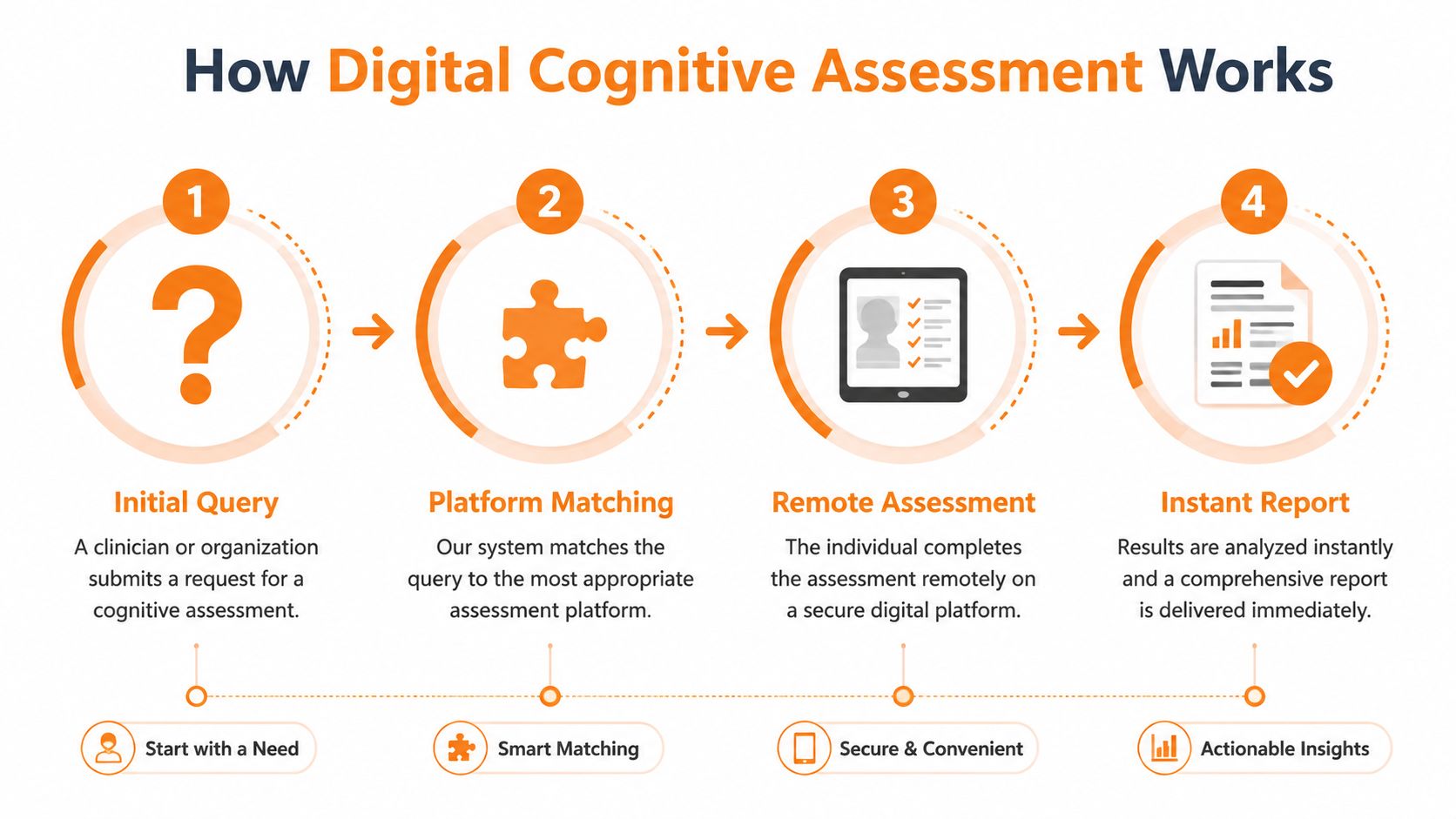
Start with the referral question
The first step is to identify the decision the assessment needs to support. “Is my memory normal?” is too broad to guide a pathway. A better question might be whether an adult's attention and executive function have changed since rehabilitation, or whether a student's processing profile supports a referral for further educational evaluation.
Collect basic context before administration:
Define the concern. Record the symptoms, functional changes, relevant medical history, language background, and reason for testing.
Confirm suitability. Check whether vision, hearing, motor ability, fatigue, language, or acute illness could affect performance.
Choose the setting. Decide whether the person should complete the assessment at home, in a clinic, or with support from a caregiver or trained staff member.
Set expectations. Explain that the result is an objective profile or screening aid, not automatically a diagnosis.
For readers who want the broader context of technology-enabled care, Arch's digital mental health guide is useful because it distinguishes digital access from the clinical processes needed to make that access safe and meaningful.
Match the platform to the person
The platform should support the required device, connectivity, accessibility features, and language needs. A browser-based system can reduce travel and scheduling barriers, but remote testing still depends on a quiet environment, adequate lighting, a suitable screen, and clear instructions. For example, a clinician might arrange a supervised home session for an older adult, while a school may provide a controlled room for a student who cannot test reliably in a busy classroom.
The California Cognitive Assessment Battery offers a relevant precedent. Its published system includes 15 non-verbal and 17 verbal subtests, uses supervised self-administration through a web-browser application, and can run on calibrated tablets over cellular or Wi-Fi at home or in a laboratory. The CCAB publication indexed by PubMed describes a model built around remote supervision rather than unsupervised guessing.
Administer, score, and interpret
During administration, the system presents standardised tasks and captures responses. Depending on the platform, a remote proctor may observe the session, address procedural questions, and document interruptions or technical problems. Immediate scoring helps the clinician see patterns across attention, memory, executive function, perception, processing speed, and eye-hand coordination.
The next step is interpretation. A report should identify strengths, areas requiring attention, test conditions, and recommended follow-up. It shouldn't turn a single score into a definitive clinical conclusion. A practical overview of online cognitive assessment can help families and providers think through the difference between convenience, standardisation, and clinical responsibility.
Evidence and Clinical Outcomes in Digital Health
The strongest argument for digital assessment isn't that it feels modern. It's that a digital workflow can be evaluated against recognised measures, monitored for consistency, and used within clear clinical boundaries.
The CCAB provides a California-based example. Later validation work reported that the battery was a valid and reliable way to assess cognition remotely, with strong correlations to traditional paper-and-pencil tests and solid test-retest reliability. A follow-on report expanded the platform to 30+ cognitive tests and reiterated that participants could be tested at home with remote proctoring through a web interface. These findings support a specific conclusion: remote administration can produce clinically useful information when the instrument, supervision, calibration, and interpretation are designed carefully.
Scale matters, but scale isn't validity
California's public infrastructure offers another useful signal. The California Digital Equity Public Online Survey launched in May 2023 and received 36,273 valid responses across all 58 counties after data cleaning. The survey gathered information about access barriers, affordability, and adoption needs to inform the State's Digital Equity Plan and the allocation of millions of dollars for broadband access, affordability, and adoption. The survey's key findings show that residents will engage with remote, self-service assessment formats when access is straightforward and statewide in reach.
That participation doesn't prove that every digital cognitive test is valid. It does show why delivery design matters in a geographically dispersed population. A technically excellent tool that families can't access, understand, or complete will fail the people it is meant to serve.
Reliability must connect to decisions
A reliable result is one that remains meaningfully consistent when the underlying ability hasn't changed. This matters for rehabilitation, return-to-school planning, medication review, and longitudinal monitoring. Clinicians can compare later performance with a baseline, provided they account for practice effects, fatigue, changes in health, and differences in testing conditions.
Validity also has layers. A screening measure may identify a pattern that merits further evaluation, but it may not explain the cause or predict daily functioning. For a practical discussion of sensitivity and specificity, providers can consider how false positives and false negatives affect referral decisions. The central question is not whether a platform produces a number. It's whether that number improves the next clinical action.
Clinical standard: Treat the digital result as structured evidence within a pathway, never as a substitute for history, examination, collateral information, and professional judgement.
Implementation Checklist for Healthcare Providers
A digital assessment works best when it enters an existing care pathway with a defined role. Practice managers shouldn't begin by asking which platform has the most features. Begin with the problem the service must solve.
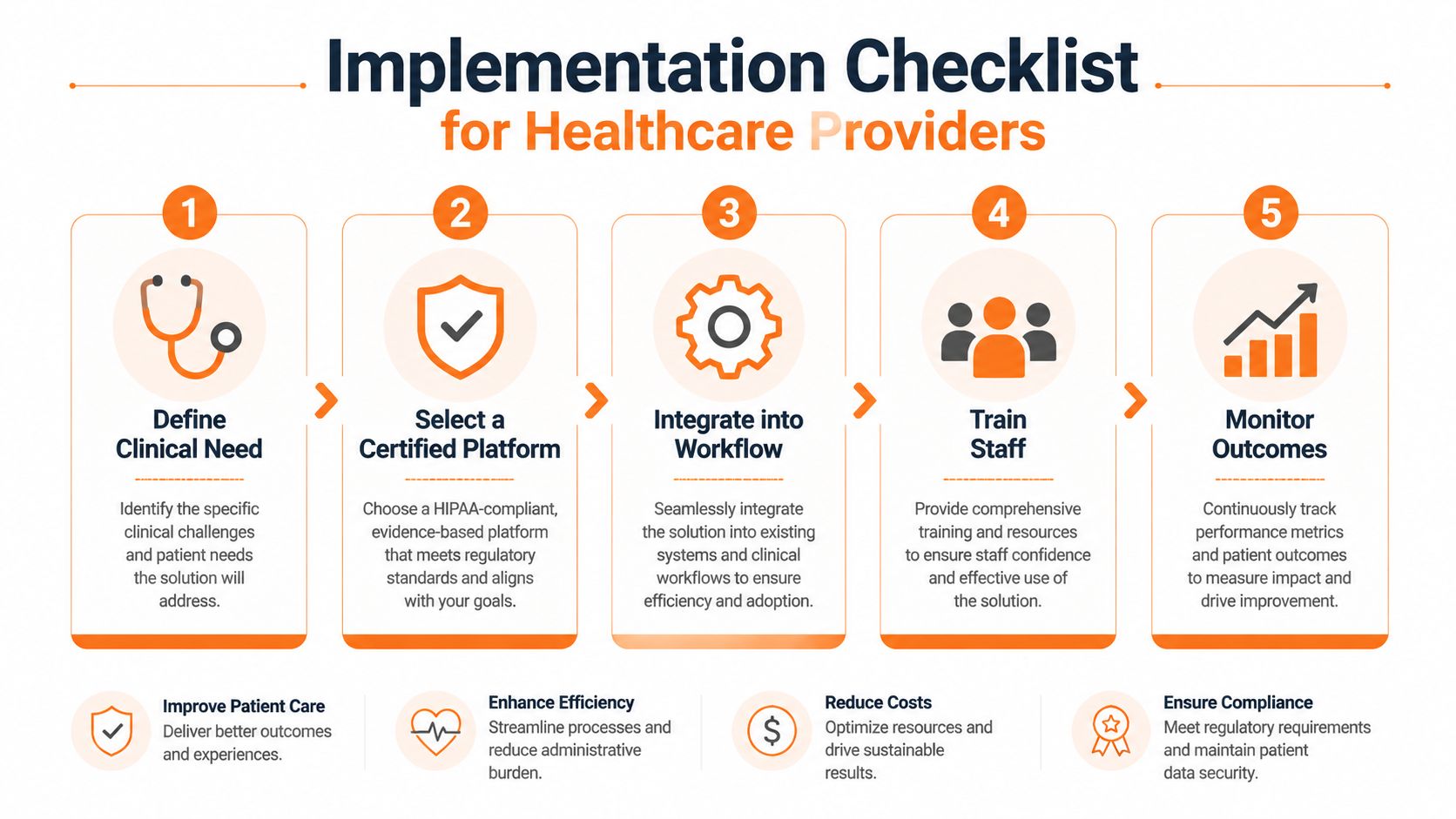
Define the clinical need
Write down the population, referral question, setting, and action that should follow the result. A rehabilitation centre may need repeatable cognitive profiles during recovery. A developmental practice may need a child-friendly first-line screen before deciding whether to pursue a full assessment. A care home may need a consistent way to document change for clinician review.
Select a platform with safeguards
Evaluate the assessment content, device requirements, supervision model, scoring method, accessibility, report format, and data handling. Ask how the system identifies interruptions, incomplete sessions, unusual response patterns, and unsuitable testing conditions. A platform should explain its intended use and limitations in language staff and families can understand.
Integrate it into the appointment pathway
Decide who sends the invitation, confirms consent, handles technical support, reviews the report, and communicates next steps. Avoid creating a result that sits in an inbox without an owner. For example, a clinic might assign a coordinator to check completion and route reports to the referring clinician before the follow-up appointment.
Administrative design matters as much as software. The registration and enrolment module provides a useful reference point for thinking through how people enter a digital assessment workflow.
Train the people, not only the system
Staff need to recognise when a remote result may be compromised by fatigue, poor connectivity, language mismatch, sensory limitations, or assistance from another person. Training should include escalation rules and a standard explanation of what the report can and cannot establish.
Monitor outcomes and privacy
Track whether results arrive in time for decisions, whether clinicians use them, and whether patients can complete the process without avoidable support. Review consent, access controls, retention, and the minimum information needed for the service. In California, the Department of Education's downloadable CAASPP, ELPAC, and other assessment data demonstrate the importance of standardised pipelines for batch downloads, deidentified records, aggregation, and district-level reporting. California's assessment data resources offer a useful infrastructure perspective for organisations planning beyond single-session scoring.
Real-World Use Cases Across Clinical and Educational Settings
The decision after assessment determines its value. A school, rehabilitation team, family doctor, or research group may examine similar cognitive domains, yet each needs a different question, threshold for referral, and follow-up plan. Assessment on demand can reduce access barriers, but the result must fit the setting in which it will be used.
Schools and developmental services
A school psychologist or developmental clinician might request an on-demand assessment when classroom difficulties persist and the team needs a structured profile before referral. Results can indicate whether attention, memory, processing speed, executive function, or broader developmental factors require closer examination. They should not determine eligibility or diagnosis on their own, and a score should not replace an account of the child's learning environment.
Consider a student who completes tasks accurately but works unusually slowly. That pattern may support extra time, fewer task switches, or a fuller review of language and learning. Families and educators can consult these examples of cognitive assessments in practice to see how different questions lead to different assessment choices. The result creates a focused hypothesis. It does not settle the case.
Rehabilitation and return to work
Canadian occupational therapy commentary identifies an ecological validity gap. Standard tools, including MoCA, MMSE, Trail Making, digit span, and verbal fluency, can detect impairment, yet they do not reliably predict whether someone can manage workplace demands. The occupational therapy guide to cognitive assessment and return to work recommends performance-based functional cognition assessment when real-world capacity is the question.
That distinction changes the workflow. A remote cognitive profile may indicate that executive function or working memory needs attention, while a therapist observes performance in a realistic setting. A worker returning after brain injury might complete digital measures, then practise scheduling, prioritising, and responding to interruptions in a graded work simulation. The digital assessment saves time and helps target therapy, while observation tests whether the findings transfer to daily demands.
Senior care and public access
California shows how public assessment infrastructure can connect screening with coverage. Medi-Cal managed care plans must cover an annual cognitive health assessment for members age 65 and older who do not have Medicare coverage. A DHCS fact sheet states that providers no longer need to complete cognitive health assessment training to be paid for performing the assessment. The DHCS provider guidance describes the current payment-related requirement.
California law SB 48, Chapter 484, Statutes of 2021, expanded Medi-Cal to include an annual cognitive health assessment for eligible members age 65 and older who are otherwise ineligible for a similar Medicare annual wellness visit assessment. The DHCS cognitive health assessment fact sheet explains the gap the benefit addresses. The screen has practical value when it prompts communication with the patient and family, appropriate referral, and documented follow-up. This access model offers a useful contrast with Canada's nine-month wait-time gap, where on-demand assessment may help people reach an informed next step sooner, without replacing clinical judgment.
Common Pitfalls and Frequently Asked Questions
Is assessment on demand the same as a diagnosis?
No. A digital assessment can produce objective information about cognitive performance, but diagnosis requires context. A clinician may need medical history, symptom onset, medication review, collateral reports, neurological examination, functional information, and additional testing.
A person who performs poorly during a remote session may be exhausted, anxious, unfamiliar with the device, or dealing with sensory limitations. Conversely, a brief screen may miss a subtle problem. The ethical approach is to use the result to support a decision about further evaluation, not to present it as a final answer.
Does faster mean less rigorous?
Not automatically. Speed can come from removing travel, reducing scheduling friction, using automated scoring, and delivering a structured report. Rigour comes from standardised tasks, appropriate supervision, secure handling, clear eligibility criteria, and transparent interpretation.
Traditional face-to-face neuropsychological evaluations remain important when the referral question is complex or the person needs detailed functional, emotional, behavioural, or diagnostic analysis. California Brain Health states that neuropsychological evaluations typically take 3 to 4 hours and asks patients to cancel at least 48 hours in advance so someone on the waitlist can use the appointment. Its patient FAQ illustrates the depth and scheduling demands of evaluation.
Can the result predict everyday function?
Only with caution. Detection and function are related but not identical. A cognitive score may suggest that attention or memory requires further exploration, while performance-based observation may be needed to determine whether someone can manage medication, workplace demands, school routines, or community tasks safely.
Is personal data secure?
Ask direct questions before enrolling. Find out what information is collected, where it is stored, who can view it, how consent is recorded, how reports are shared, and how long records are retained. Families should also understand whether a caregiver can assist and how that assistance is documented.
What about insurance and public coverage?
Coverage depends on jurisdiction, plan, eligibility, provider status, and the purpose of the assessment. Don't assume that a fast digital screen and a neuropsychological evaluation are billed or covered in the same way. Patients can use this online dementia testing guide to frame questions about screening, interpretation, and when clinical assessment is needed.
A useful comparison: Traditional evaluation offers depth. Assessment on demand offers an earlier, structured signal. Good care uses each for the question it can answer.
Taking the Next Step in Cognitive Healthcare
A teacher may need a clearer starting point for support. A rehabilitation clinician may need a baseline before setting goals. A family may need objective information while waiting for a specialist pathway. In each case, assessment on demand can reduce guesswork without pretending to replace full-spectrum care.
The practical test is simple. Can the assessment be completed under suitable conditions, produce interpretable information, and lead to a named next action? If yes, it can become part of sustainable cognitive care for children and adults.

Orange Neurosciences offers rapid, evidence-based cognitive assessment for clinical, educational, rehabilitation, and family settings, with objective profiles and decision support designed to fit everyday workflows. Visit Orange Neurosciences to explore how an assessment-on-demand pathway can support earlier triage, clearer care planning, and ongoing reassessment.

Orange Neurosciences' Cognitive Skills Assessments (CSA) are intended as an aid for assessing the cognitive well-being of an individual. In a clinical setting, the CSA results (when interpreted by a qualified healthcare provider) may be used as an aid in determining whether further cognitive evaluation is needed. Orange Neurosciences' brain training programs are designed to promote and encourage overall cognitive health. Orange Neurosciences does not offer any medical diagnosis or treatment of any medical disease or condition. Orange Neurosciences products may also be used for research purposes for any range of cognition-related assessments. If used for research purposes, all use of the product must comply with the appropriate human subjects' procedures as they exist within the researcher's institution and will be the researcher's responsibility. All such human subject protections shall be under the provisions of all applicable sections of the Code of Federal Regulations.


© 2026 by Orange Neurosciences Corporation