A Practical Guide to Occupational Therapy Assessment
Jan 13, 2026
An occupational therapy assessment isn't a test with a pass or fail grade. Instead, think of it as a collaborative process where a therapist helps to map out your world. It's about understanding how a health condition, injury, or developmental challenge actually impacts your ability to do the things that matter to you every day.
This holistic look goes far beyond a simple diagnosis, digging into the relationship between you as an individual, the environments you live and work in, and the activities—or "occupations"—that fill your day. It's the essential first step in creating a therapy plan that genuinely fits your life and provides actionable steps for improvement.
The Blueprint for a More Functional Life
Imagine an occupational therapist (OT) as a skilled cartographer. Their job is to create a detailed map of your unique daily life. This map highlights the activities that bring you joy and purpose, identifies the challenges that feel like steep hills to climb, and charts the strengths that serve as your well-trodden paths.
An OT always looks at the whole person. For example, a doctor's diagnosis of a stroke tells the therapist what happened medically. But an occupational therapy assessment reveals how it affects your life. Can you still get dressed on your own? Are you able to make your morning coffee safely? Can you navigate your email to stay in touch with family?
These are the practical, real-world questions the assessment is designed to answer, leading directly to actionable strategies.
Why Is This Holistic View So Important?
The real purpose of this evaluation is to pinpoint exactly where the functional difficulties are so you and your therapist can set meaningful, client-centred goals together. It's all about understanding the dynamic interplay between three key elements:
You: Your physical abilities, cognitive skills, emotional state, and personal values.
Your Environment: The physical layout of your home or workplace, the social support from your family, and the cultural context you live in.
Your Occupations: The everyday activities you need, want, or are expected to do—from self-care and work to leisure and connecting with others.
Practical Example: An assessment might reveal that a child’s difficulty focusing in the classroom isn’t just about attention. It could be due to the overwhelming sensory input from fluorescent lights and background chatter. The actionable insight here is that changing the environment—perhaps with noise-cancelling headphones or a different seating position—could be a more effective first step than attention exercises alone.
This comprehensive approach ensures the therapy plan isn't just a list of generic exercises. It becomes a personalized strategy, custom-built to bridge the gap between your current abilities and your goals for independence.
To learn more about the full scope of this profession, feel free to explore our detailed guide on occupational therapy in Canada. Building this foundational understanding is the key to unlocking a more engaged and functional life.
Mapping the Core Domains of Function
An occupational therapy assessment isn’t a single, narrow snapshot. It’s a wide-angle lens, systematically exploring several interconnected areas of your life to build a complete picture of who you are and what you do every day.
Think of these areas, or domains, as different chapters in your story. Each one is important on its own, but only when read together do they reveal the full narrative of your functional abilities. This holistic approach is what allows an OT to connect the dots between a clinical finding—like reduced grip strength—and a real-world struggle, like not being able to open a jar of pasta sauce.
The goal is to understand how you, your environment, and your daily occupations all fit together.
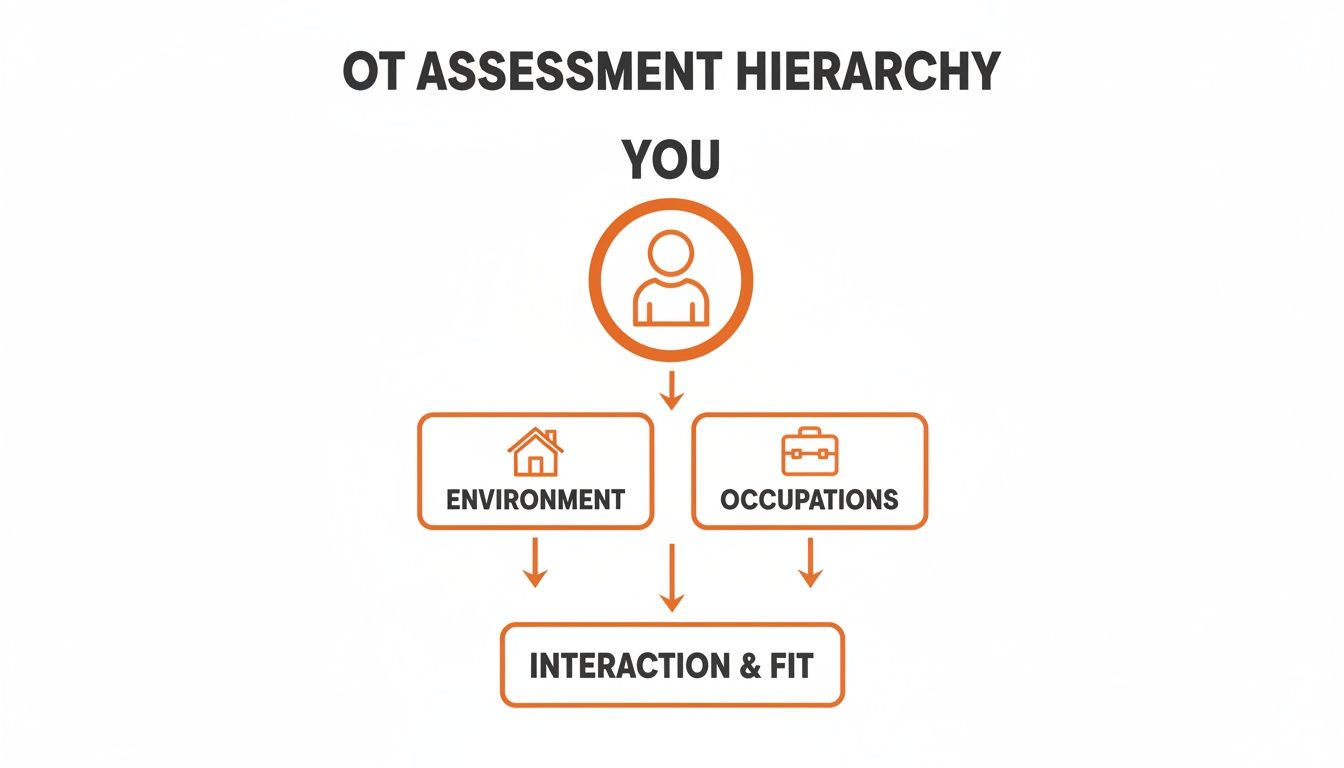
As the diagram shows, true function happens when there's a good "fit" between a person's skills, the demands of their environment, and the tasks they need to accomplish. To find that fit, OTs look closely at a few key domains.
Key Domains in an Occupational Therapy Assessment
To get a clear picture, therapists organize their observations into several core areas. This table breaks down what those domains are and what they look like in real life.
Assessment Domain | Description | Practical Example |
|---|---|---|
Self-Care (ADLs) | These are the essential, foundational tasks we do every day to take care of our own bodies. | Safely getting in and out of the shower, dressing yourself, or managing personal hygiene. |
Home & Community (IADLs) | More complex tasks that require planning and interaction with the world around us. | Planning and cooking a meal, managing a budget, or using public transit to get to an appointment. |
Cognitive Skills | The mental processes that drive our actions, from memory and attention to problem-solving. | Remembering to take daily medication, focusing on a conversation in a noisy room, or organizing the steps to run an errand. |
Motor Skills | Our physical abilities, including large movements (gross motor) and small, precise actions (fine motor). | Maintaining balance while reaching for something on a high shelf (gross) or buttoning a shirt (fine). |
Sensory Processing | How our nervous system interprets information from our senses and responds appropriately. | Feeling overwhelmed and distressed by the bright lights and loud noises in a grocery store. |
By looking at each of these puzzle pieces, an OT can see exactly where the challenges lie and, more importantly, how to build a plan that truly works for you.
Activities of Daily Living (ADLs vs. IADLs)
At the heart of any OT assessment are two crucial categories: Activities of Daily Living (ADLs) and Instrumental Activities of Daily Living (IADLs). These terms help us organize the tasks we all need to do to live independently.
ADLs are the absolute basics of self-care. They're the building blocks of personal independence that we perform every single day.
Dressing: Choosing clothes and putting them on.
Bathing: Washing and drying oneself safely.
Eating: Bringing food from the plate to your mouth.
Toileting: Managing hygiene in the washroom.
IADLs are a step up in complexity. These activities support an independent life within a home and community, often demanding more advanced thinking skills like planning and organization. If you want to dive deeper, our guide on the differences between ADLs and IADLs offers a more detailed breakdown.
Meal Preparation: Everything from planning a meal to shopping for ingredients and cooking.
Financial Management: Paying bills, creating a budget, and handling banking.
Home Management: Keeping your space clean, doing laundry, and basic upkeep.
Community Mobility: Driving or using public transportation to get where you need to go.
The Skills Beneath the Surface
Beyond what you do, an OT assessment digs into how you do it. This means looking at the underlying cognitive and motor skills that make daily tasks possible.
Cognitive functions are all the mental gears turning in the background. A therapist will look at areas like:
Memory: Can you recall important information, like when to take your medication?
Attention: Are you able to stay focused on a task, like balancing a chequebook without getting sidetracked?
Executive Function: This is your brain's CEO—the skills that help you plan, organize, and get things started. Think about all the steps involved in getting to a doctor's appointment on time.
Motor skills, on the other hand, are about your physical ability to interact with your world, from big movements to tiny, precise ones.
Practical Example: An OT might observe how a person's fine motor skills affect their ability to button a shirt. At the same time, they might assess gross motor skills by seeing how that person balances while reaching for an item on a high shelf. It’s all connected, and the actionable insight might be to recommend adaptive equipment for dressing and a home exercise program for balance.
Finally, there's sensory processing—how our nervous system takes in information from our senses and turns it into a meaningful response. Someone with sensory processing challenges might find a noisy supermarket completely overwhelming, which turns a simple IADL like grocery shopping into a major source of stress.
By carefully evaluating these core domains, a therapist creates a detailed map that guides you toward greater independence and helps you get back to the activities that matter most.
Diving Into Essential Assessment Tools and Tests
Once a therapist has a solid grasp of a client's core functional domains, the real detective work begins. It's time to gather specific, objective information. This is where an OT's toolkit comes into play, filled with specialized assessment tools and tests, each chosen carefully for the job at hand. These tools aren't about passing or failing; they're about gaining crystal-clear, actionable insight.
A thorough occupational therapy assessment isn't a one-size-fits-all process. It weaves together different methods to create a complete picture of the person. This blend includes standardized tests, which give us scores to compare against a baseline, and non-standardized methods like casual interviews and keen observations that add that crucial personal story. This combination ensures the final picture is both backed by data and deeply human.
Standardized vs. Non-Standardized: The Best of Both Worlds
Think of standardized tests as the measuring tape in a toolkit. They offer reliable, consistent numbers on specific skills, like memory or hand-eye coordination. A therapist might use a standardized cognitive screener, for example, to get a clear metric on attention. These tools are indispensable for tracking progress over time and for clearly communicating a client's status to other healthcare professionals.
Non-standardized methods, on the other hand, are more like having a chat with a homeowner about how they actually live in their house. They’re less about numbers and more about context. These include:
Clinical Observations: Watching someone perform a real-world task, like making a cup of tea in their own kitchen, can reveal subtle challenges that a formal test in a clinic would completely miss.
Client Interviews: Simply asking open-ended questions about daily routines, frustrations, and personal goals gives invaluable insight into what truly matters to the individual.
Environmental Assessments: Looking at a person's home or workplace helps identify physical barriers or potential supports that affect how they function every day.
The magic happens when an occupational therapy assessment harmonizes both approaches. A standardized score might point to a weakness in fine motor skills, but watching that same person struggle to button their coat reveals the real-world frustration and the specific way their fingers just won't cooperate. This provides the actionable insight: the therapy plan needs to include both finger-strengthening exercises and strategies like using a button hook.
This blended approach ensures the therapist sees not just the "what" (the test score) but, more importantly, the "why" (the personal experience).
Spotlight on the Canadian Occupational Performance Measure (COPM)
Among the many instruments in the OT toolkit, the Canadian Occupational Performance Measure (COPM) is a standout. It’s a powerful, client-centred tool that flips the script. Instead of the therapist dictating what to measure, the COPM empowers clients to identify the everyday activities they want, need, or are expected to do but are struggling with.
This semi-structured interview helps pinpoint problem areas across three key domains:
Self-Care: Things like personal hygiene, getting dressed, and eating.
Productivity: Roles related to work, school, or running a household.
Leisure: Hobbies and social activities that bring joy and meaning to life.
Clients rate the importance of each activity, their current performance, and their satisfaction on a simple scale of 1 to 10. This turns goal-setting into a true partnership, making sure therapy is laser-focused on what matters most to them. For example, a client might identify "gardening" as their number one leisure goal, which immediately directs the therapy plan towards improving the physical and cognitive skills needed to get back into the garden.
A landmark survey of Canadian OT researchers underscored the value of assessment-focused studies, and the COPM is a perfect example of this research making a real-world impact. Developed back in 1991, it's now used in over 50 countries and translated into 40 languages, capturing self-perceived changes in performance. You can learn more about the widespread impact of this Canadian-developed tool.
Tools for Assessing Cognitive Function
Cognitive skills are the bedrock for so many daily tasks, from managing finances to simply following a recipe. Therapists use specific tools to evaluate areas like memory, attention, and executive function.
One of the most well-known is the Montreal Cognitive Assessment (MoCA), a quick screening tool used to spot mild cognitive impairment. But getting a score is only half the battle; understanding what it means is the critical next step. To get actionable insights from the results, we've put together a detailed resource—you can check out our guide on MoCA score interpretation to learn more.
By carefully selecting the right mix of tools—from broad, client-centred measures like the COPM to specific cognitive screens like the MoCA—a therapist assembles a rich, multi-dimensional view of a person's abilities. This detailed information is the foundation upon which a truly personalized and effective therapy plan is built.
Walking Through the Assessment Process
An occupational therapy assessment isn't a one-off event. It’s a thoughtful, collaborative journey with a clear destination: a better quality of life for you or your loved one.
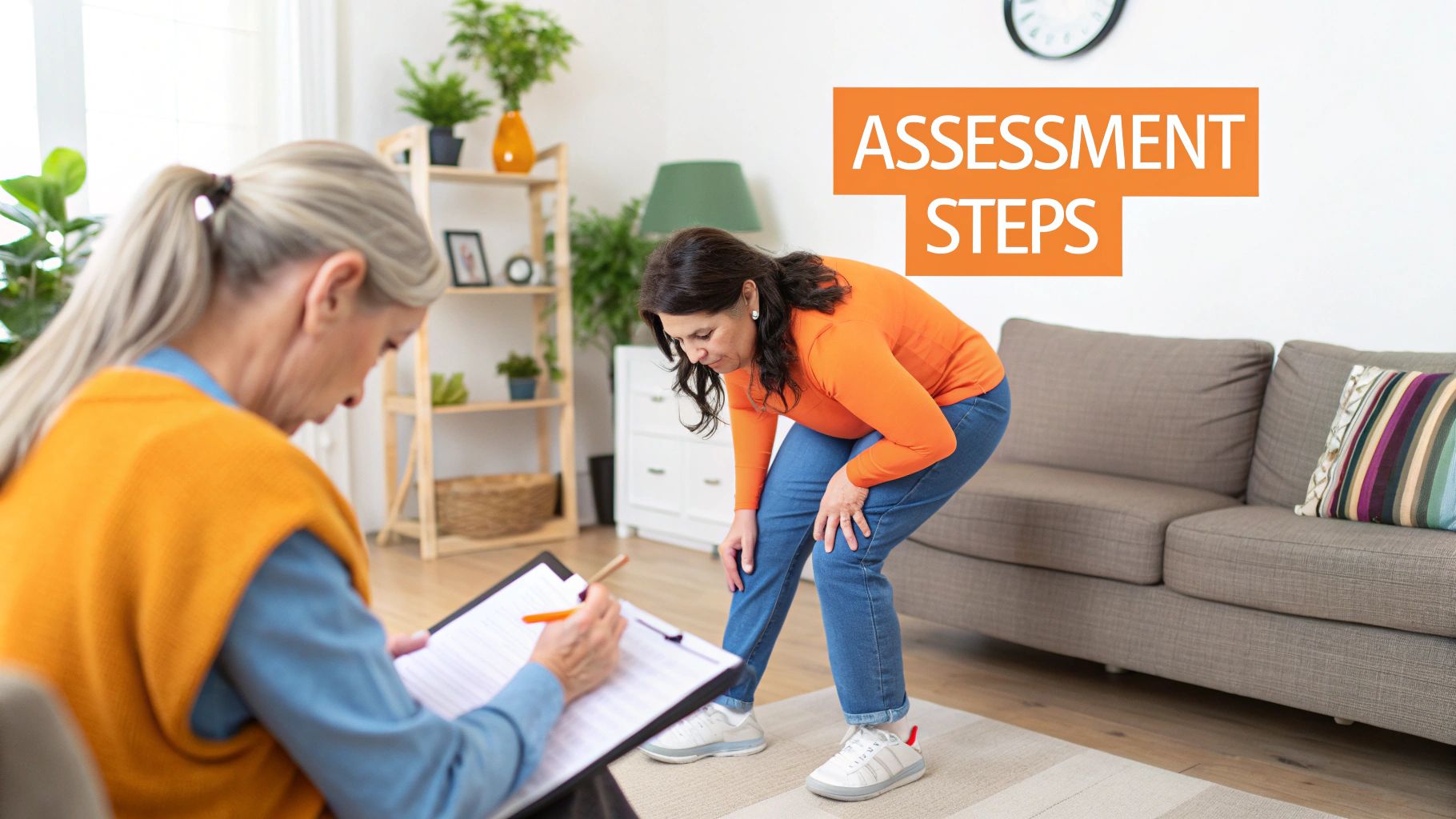
Think of it as a four-stage expedition. You and your therapist work together, mapping out the challenges and charting a course toward your goals. Each step builds logically on the last, ensuring the final plan is both rooted in evidence and deeply personal. This structured approach turns a potentially overwhelming evaluation into a manageable and empowering experience.
Step 1: Initial Referral and Goal Discovery
The journey starts with the very first conversation. This stage is all about understanding why you’re seeking an OT assessment in the first place. Whether it's a referral from a doctor or a personal decision, the therapist’s most important job here is to listen.
They’ll ask open-ended questions to grasp your main concerns, your hopes, and what a successful outcome would truly look like to you. This client-centred dialogue is critical. It sets the tone for a genuine partnership and makes sure your priorities drive the entire process from day one.
Step 2: Information Gathering and Observation
Next, the therapist puts on their detective hat to gather clues from different sources. This means reviewing medical records, chatting with family or other healthcare providers, and—most importantly—observing you in action.
Observation is where the real magic happens. Watching a client make a sandwich in their own kitchen reveals far more about their executive functioning and motor skills than any sterile, clinic-based test ever could.
This step often involves a mix of:
Naturalistic Observation: Seeing how you navigate your real-world environment.
Structured Observation: Asking you to perform specific tasks to assess certain skills.
Interviews: Talking with you and your caregivers to get the full picture of daily routines and challenges.
Step 3: Administering Specific Assessments
With a solid foundational understanding, the therapist will then select specific, often standardized, tools to measure particular functions. These formal tests provide objective data that helps pinpoint the severity of a challenge and track progress over time. This might involve a cognitive screener, a fine motor skills test, or a sensory processing questionnaire.
The key is to blend these formal measures with the rich, qualitative insights from observation. A test score might point to a memory deficit, but observing a client forget to turn off the stove provides the vital, real-world context needed for effective planning. This leads to an actionable strategy, such as introducing a smart stove timer.
Step 4: Analyzing the Results and Creating the Plan
Once all the information is collected—from conversations, observations, and formal tests—the therapist synthesizes everything to identify patterns, strengths, and areas needing support. This analysis becomes the foundation of a comprehensive written report.
Crucially, this isn't done in a vacuum. The therapist sits down with you to discuss the findings and collaboratively create an action plan. This plan will have clear, measurable goals that are directly tied to the activities you identified as important back in Step 1.
Throughout this entire process, meticulous documentation is absolutely essential. Precise, objective notes justify services to insurance, ensure clear communication with other providers, and create the evidence-based care plan that will guide your therapy forward.
Ready to see how technology can support this journey? Visit us at Orange Neurosciences and discover how our AI-powered platforms can offer rapid, precise cognitive profiles to augment the assessment process.
Turning Assessment Results into an Actionable Plan
An occupational therapy assessment pulls together a mountain of information, but the raw data itself—scores, measurements, observations—is just the starting point. The real magic happens when a therapist translates those findings into a personalized and truly actionable care plan.
Think of it less like reading a report and more like a detective piecing together clues. The therapist’s job is to weave together every thread: the hard data from standardized tests, the real-world context from observations, and most importantly, the client’s own hopes and goals. This synthesis creates a clear picture that explains not just what the challenges are, but why they’re happening and how they’re impacting everyday life.
From Data Points to Functional Goals
A low score on a cognitive test is just a number until you connect it to a client’s struggle to manage their morning routine. The art of great care planning is turning these abstract data points into motivating, functional goals that make sense to the client.
To give these goals structure, therapists often lean on the SMART framework. It’s a simple but powerful way to make sure every objective is:
Specific: What, exactly, needs to be done?
Measurable: How will we know we’re making progress?
Achievable: Is this goal realistic for the client right now?
Relevant: Does this matter to the client’s life and priorities?
Time-bound: When do we aim to accomplish this?
Practical Example: A vague goal like "improve memory" doesn't give anyone much to work with. A SMART goal transforms it: "Within four weeks, the client will independently use a digital planner on their smartphone to remember and attend all scheduled appointments, with no more than one missed appointment per week." Now we have a clear, trackable target that’s directly tied to a real-life need.
A Practical Example of Plan Creation
Let's walk through a common scenario. Imagine a client recovering from a stroke who wants to get back to cooking simple meals but is struggling with organization and safety in the kitchen.
Assessment Finding: The occupational therapy assessment shows moderate issues with executive functions, especially when it comes to sequencing and planning. The OT also notes the client has reduced fine motor control in their dominant hand.
Collaborative Goal Setting: After a conversation, the client and therapist agree on a starting goal: to safely prepare a simple three-step recipe (like a sandwich or cereal) within two weeks.
Actionable Interventions: The therapist then designs a plan with concrete, practical steps:
Create a visual recipe card with pictures for each step.
Organise the kitchen workspace to place all necessary items within easy reach.
Practise using adaptive tools, like a rocker knife, to make up for the motor challenges.
This approach turns assessment data into a step-by-step strategy that empowers the client to work toward something that truly matters to them. Of course, a plan often involves recommending other resources; for instance, you can discover various types of modern wellness equipment to support client well-being and participation which can be a great complement to therapy goals.
The Client’s Voice: The Most Important Part of the Plan
At the end of the day, the most effective care plan is one the client feels they own. The therapist is a skilled guide, but the client’s voice, values, and preferences must be the central pillar. A plan created with the client, rather than for them, is far more likely to fuel motivation and lead to lasting change.
This collaborative spirit keeps the plan alive and relevant. As the client makes progress, the plan gets revisited and updated, becoming a living document that evolves with their journey. This ongoing partnership is the key to maintaining momentum and achieving meaningful outcomes, reinforcing what we discuss in our guide on the importance of continuity of care in therapy.
To turn these carefully crafted plans into reality, contact us at Orange Neurosciences. Our team can show you how our tools help track progress and refine interventions.
Integrating AI and Digital Tools for Better Assessments
Technology isn't here to replace the occupational therapist's expertise. Far from it. Instead, it's becoming a powerful partner, augmenting our skills and opening up new ways to understand and support our clients' needs. Digital tools and AI-driven platforms are bringing a level of precision and efficiency to the occupational therapy assessment that was once difficult, if not impossible, to achieve.
This shift helps us gather objective, data-rich cognitive profiles quickly and effectively. Platforms like ours at Orange Neurosciences can precisely measure areas like attention, memory, and executive function, transforming what used to be subjective observations into concrete, measurable data points. This doesn't just speed up the assessment process; it gives us a solid, evidence-based foundation to build a truly effective care plan.
Enhancing Precision and Engagement in Assessments
One of the best things about modern digital platforms is how they make the assessment experience more engaging for clients while delivering deep insights to therapists. Instead of sitting through purely paper-based tests, clients can dive into game-based activities that feel less like a clinical evaluation and more like a focused, interactive challenge.
Practical Example: Imagine a therapist working with a child who has suspected attention difficulties. They could use a tool like our OrangeCheck platform, which provides a fun, game-like experience for the child. While the child is playing, the tool is collecting objective data on their cognitive performance. This information provides an actionable starting point, helping to guide the next steps and potentially reducing the long delays often associated with formal diagnostic processes.
The real magic of these tools is their ability to augment, not replace, our clinical judgment. They provide the "what"—the objective data on cognitive performance—so we, as therapists, can focus on the "why" and "how," connecting that data back to the client's real-world functional challenges.
Streamlining the Assessment Workflow
The demand for occupational therapy services is on the rise. In Canada, the number of registered OTs grew from just 7,575 in 1997 to over 20,000 by 2021. Even with this growth, demand often outpaces supply, leading to shortages and frustrating delays for clients needing crucial assessments. For providers like rehabilitation centres, AI-powered tools offer a practical way to manage this pressure. They can complement traditional evaluations, help reduce wait times, and integrate smoothly into existing clinical workflows.

This image really captures the collaborative spirit of modern digital health. Technology acts as a bridge, connecting the client's experience with the clinician's expertise. The insights we gain from these tools lead to clearer conversations about cognitive strengths and challenges, making the entire care planning process more transparent and client-centred.
The Future of Personalized Intervention
Bringing technology into the assessment process does more than just save time—it unlocks the door to more dynamic and responsive therapy. The data collected gives us a clear baseline, making it much easier to track progress and fine-tune interventions along the way.
Objective Tracking: We can monitor subtle changes in cognitive function over time with consistent, reliable metrics.
Targeted Therapy: Detailed cognitive profiles allow us to design interventions that zero in on specific areas of need.
Improved Communication: It becomes simpler to share clear, data-driven reports with clients, families, and other healthcare providers.
The future of assessment is leaning into approaches that embrace personalized learning with AI, tailoring both the evaluation and the intervention to each person's unique profile. This fits perfectly with the core principles of occupational therapy. If you want to dive deeper into what these modern evaluations look like, check out our guide on how to approach a cognitive assessment online.
By welcoming these powerful tools into our practice, we can streamline our workflows, make more informed decisions, and ultimately, deliver better outcomes for the people we serve.
Common Questions About Occupational Therapy Assessments
It's completely normal to have questions when you're navigating any part of the healthcare world. An occupational therapy assessment is a pretty deep dive, so it makes sense that clients, families, and even other healthcare pros wonder what it involves and what to expect.
We've put together some of the most common questions we hear to help pull back the curtain on the process. The goal is to give you clear, straightforward answers so you feel informed and ready.
How Long Does a Typical Occupational Therapy Assessment Take?
There's really no simple answer here, as every person is unique. A single assessment session might take anywhere from 60 to 120 minutes, but a truly comprehensive evaluation often involves a few appointments spread out over days or even weeks.
Practical Example: For a child's school-based assessment, an OT might observe them in the classroom, on the playground, and during lunch to see how they manage different social and physical environments. For an adult recovering from an injury, the OT may visit their home and workplace to understand the specific challenges in each setting. This thoroughness is far more important than speed; it ensures the final plan is built on a solid, reliable foundation.
How Is an OT Assessment Different from a Psychological Assessment?
This is a great question. While both types of assessments might touch on cognition, they're looking at it from very different angles. A psychological assessment is typically focused on diagnosing mental health conditions, learning disabilities, or specific cognitive disorders.
An OT assessment, however, is all about function. We want to understand how a person’s physical, cognitive, or emotional challenges directly affect their ability to do the things that matter to them every day. Every observation an OT makes is tied back to real-life performance—whether that's cooking a meal, managing a budget, or enjoying a hobby.
Actionable Insight: A psychologist might diagnose an attention deficit. An OT will then assess how that attention deficit gets in the way of following a recipe or meeting deadlines at work, and then recommend practical strategies like using visual timers or breaking down tasks into smaller steps.
What Is the Best Way to Prepare for an OT Assessment?
Honestly, the best way to prepare is just to think about your daily life. What parts of your routine feel challenging or frustrating? It can be helpful to make a quick list—mental or on paper—of the activities you want to do more easily or get back to doing altogether.
Just come ready for an open, honest chat. You don't need to "study" or rehearse anything. The whole point is for the therapist to understand your genuine day-to-day experience so they can build a plan that’s truly personalized and effective for you.
At Orange Neurosciences, we believe that clear, objective data is the bedrock of any great care plan. Our AI-powered tools deliver rapid, precise cognitive profiles that support therapists in their assessment process, leading to better-informed interventions and more successful outcomes. See how our platform can enhance your clinical practice by visiting us at https://orangeneurosciences.ca.
Orange Neurosciences' Cognitive Skills Assessments (CSA) are intended as an aid for assessing the cognitive well-being of an individual. In a clinical setting, the CSA results (when interpreted by a qualified healthcare provider) may be used as an aid in determining whether further cognitive evaluation is needed. Orange Neurosciences' brain training programs are designed to promote and encourage overall cognitive health. Orange Neurosciences does not offer any medical diagnosis or treatment of any medical disease or condition. Orange Neurosciences products may also be used for research purposes for any range of cognition-related assessments. If used for research purposes, all use of the product must comply with the appropriate human subjects' procedures as they exist within the researcher's institution and will be the researcher's responsibility. All such human subject protections shall be under the provisions of all applicable sections of the Code of Federal Regulations.


© 2026 by Orange Neurosciences Corporation