Eriksen Flanker Task: A Practical Guide for ADHD Assessment

You're staring at a row of arrows on a screen, a child is waiting for feedback, and you need to know whether the score reflects real executive-control difficulty or just a tricky task setup. That's the everyday problem the Eriksen flanker task was built to answer. It looks simple, but the interpretation isn't simple at all.
The task was first introduced in 1974 by B. A. Eriksen and C. W. Eriksen to measure interference from irrelevant flankers, and that history still matters because the classic flanker effect is the core signal you're trying to read today historical synthesis of the original paradigm. In plain terms, the task asks a person to respond to a central target while ignoring surrounding distractors, and the key question is how much those distractors slow the response task description.
What the Eriksen Flanker Task Actually Measures
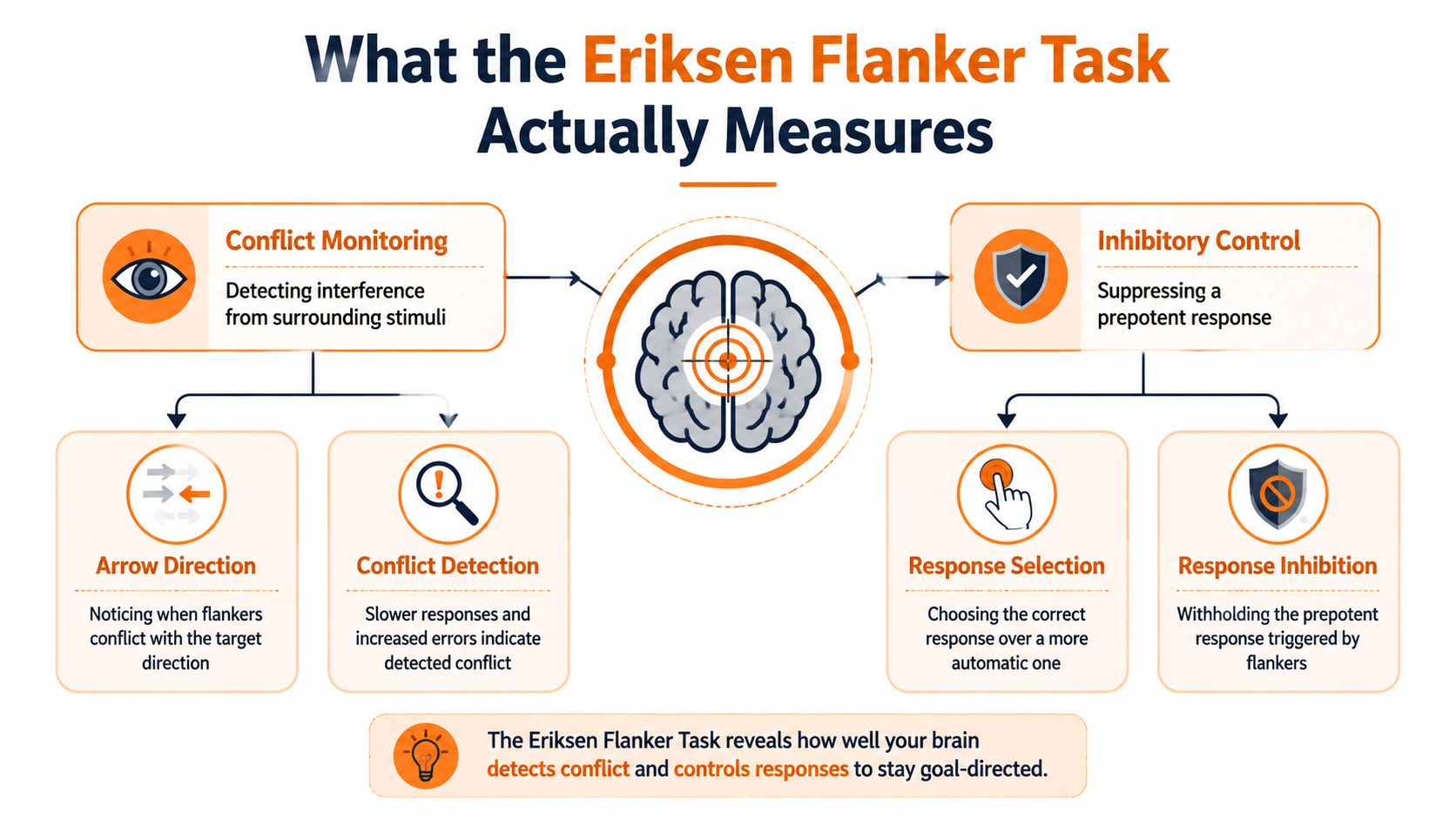
A clinician sits beside a laptop while a Grade 3 student taps through a row of arrows. The student is not being asked whether the screen feels hard or easy. The task asks the student to keep attention on the middle arrow and ignore the arrows around it, which makes the Eriksen flanker task a practical check of selective control in real use.
The task measures response conflict. A central target appears with flanking distractors, and the participant responds to the target's direction or identity while ignoring the other items task structure. In common versions, a brief row of five items appears horizontally, with one item in the centre and two flankers on each side, and the standard outcome is the difference in reaction time between congruent and incongruent trials five-item layout.
Why the score is about interference, not just attention
The score matters because it captures the moment when the brain has already partly processed the distractors, but still has to choose the correct response. That is why the task speaks to selective attention and response inhibition together, rather than to alertness alone.
A useful way to explain it to a parent is straightforward. If the centre arrow points left and the side arrows point right, the person has to suppress the pull of the misleading flankers and answer for the centre only. When the flankers match the target, the response is easier, and the difference between those two conditions is the flanker effect standard metric.
Practical rule: a large flanker effect usually means the distractors are costing the person time, but it does not tell you by itself why that cost is happening.
That distinction matters in practice. The task was designed to study how irrelevant visual information interferes with target identification, and that idea has stayed stable since the original task setup original task origin. What changes is how the task is built, who takes it, and what you expect the score to mean.
What a practitioner should say out loud
If you need a plain-language explanation, keep it short. You can say the task measures how well someone can keep their response tied to the middle item while ignoring competing information around it. That is more accurate than calling it a universal “attention test.”
The historical record helps show why the task still appears in clinical and research settings. In a later synthesis of early flanker findings, incongruent trials produced slower correct-trial reaction times than congruent trials, with one large study reporting 574 ms versus 552 ms, alongside 97% overall accuracy historical flanker data. Those numbers are not a diagnosis. They are evidence that the task reliably produces interference when the flankers conflict with the target.
Use this framing when you document results, because it keeps the score tied to the actual construct rather than to a vague idea of “good” or “bad” attention. For broader context on how cognitive measures fit together, see this overview of cognitive function.
How a Flanker Trial Is Built and Run
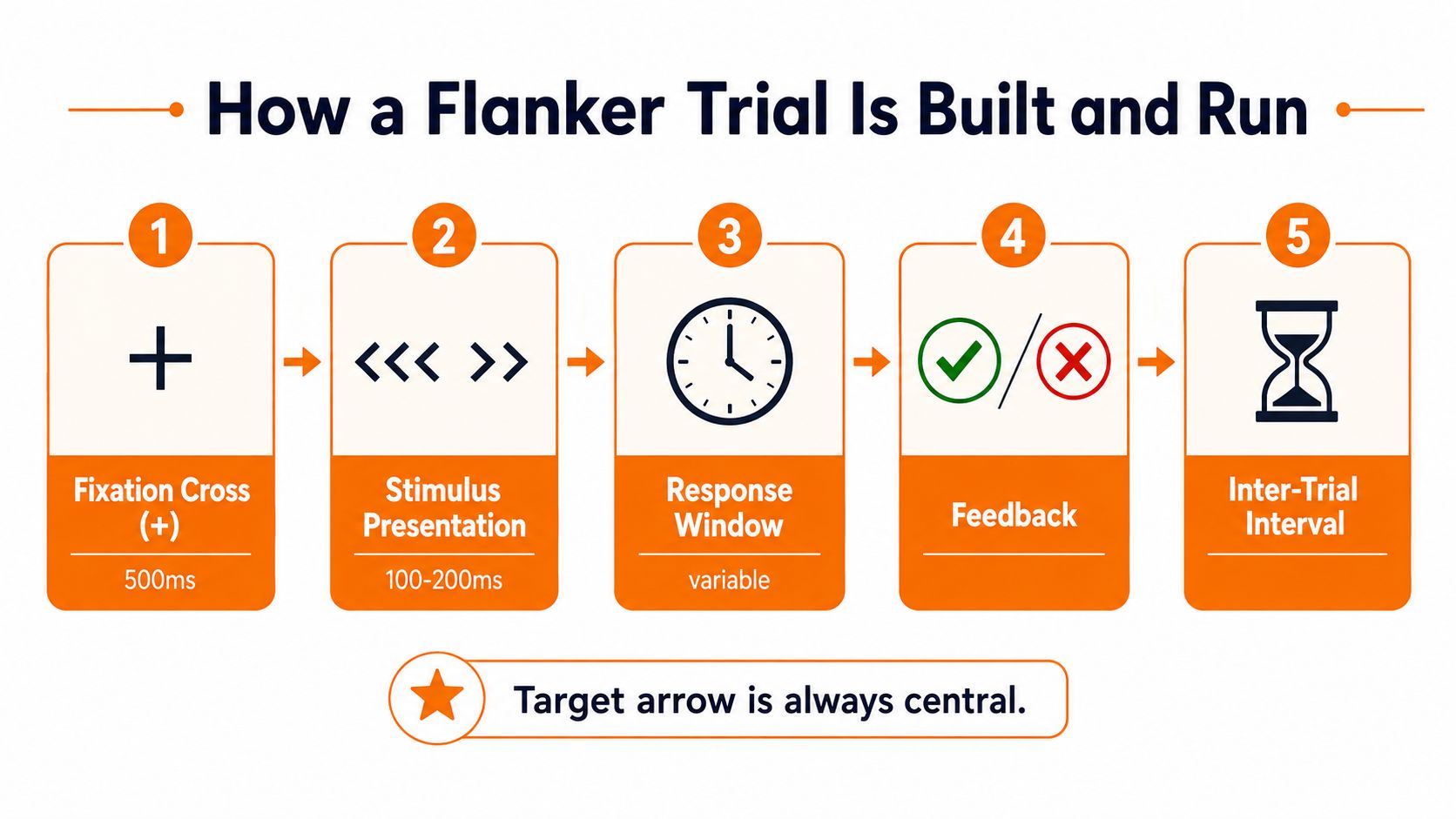
A flanker trial is designed to make distractors matter without turning the display into a guessing task. The participant usually sees a fixation cue, then a brief horizontal array, then a response window where they press the left or right key based only on the centre item trial structure. The goal is speeded responding, but only after the participant has identified the target correctly.
The three trial types clinicians need to know
Congruent trials are the easy ones. The flankers point or align in the same direction as the target, so the competing response is minimal. Incongruent trials create conflict because the flankers point the other way, which is where the interference cost appears. Neutral trials remove the directional competition and can help you separate target processing from conflict effects task categories.
A standard instruction to the participant is simple: “Respond to the centre item only.” That rule has to be repeated clearly, because people often treat the whole row as if every symbol deserves equal weight. In child testing, concrete language helps, and a practice item before the first scored block usually prevents avoidable errors.
Keep the rule constant across the session. If the participant starts reacting to the flankers, the score is no longer about target selection.
What a session usually looks like in practice
Digital versions often use short blocks with repeated trials, and the timing is usually tight enough that people cannot consciously inspect every arrow. The display is brief, the response window is speeded, and the inter-trial interval lets the next item begin without giving the participant much time to overthink. That pacing is what makes the task sensitive to small differences in control.
The same basic structure can be delivered in a clinic room, in a lab, or on a remote platform, but the rules do not change. The participant still responds to the centre target, the flankers still create interference, and the result still comes down to how much that conflict slows responding. For implementation context and broader assessment planning, compare the task with cognitive assessment tools.
In practice, the trial works best when the stimulus set matches the population being tested. A row of arrows may be straightforward for one group and noisy for another, so clinicians should judge the score in the context of the display format, the response mode, and the person's familiarity with the symbols.
Scoring the Flanker Effect Step by Step
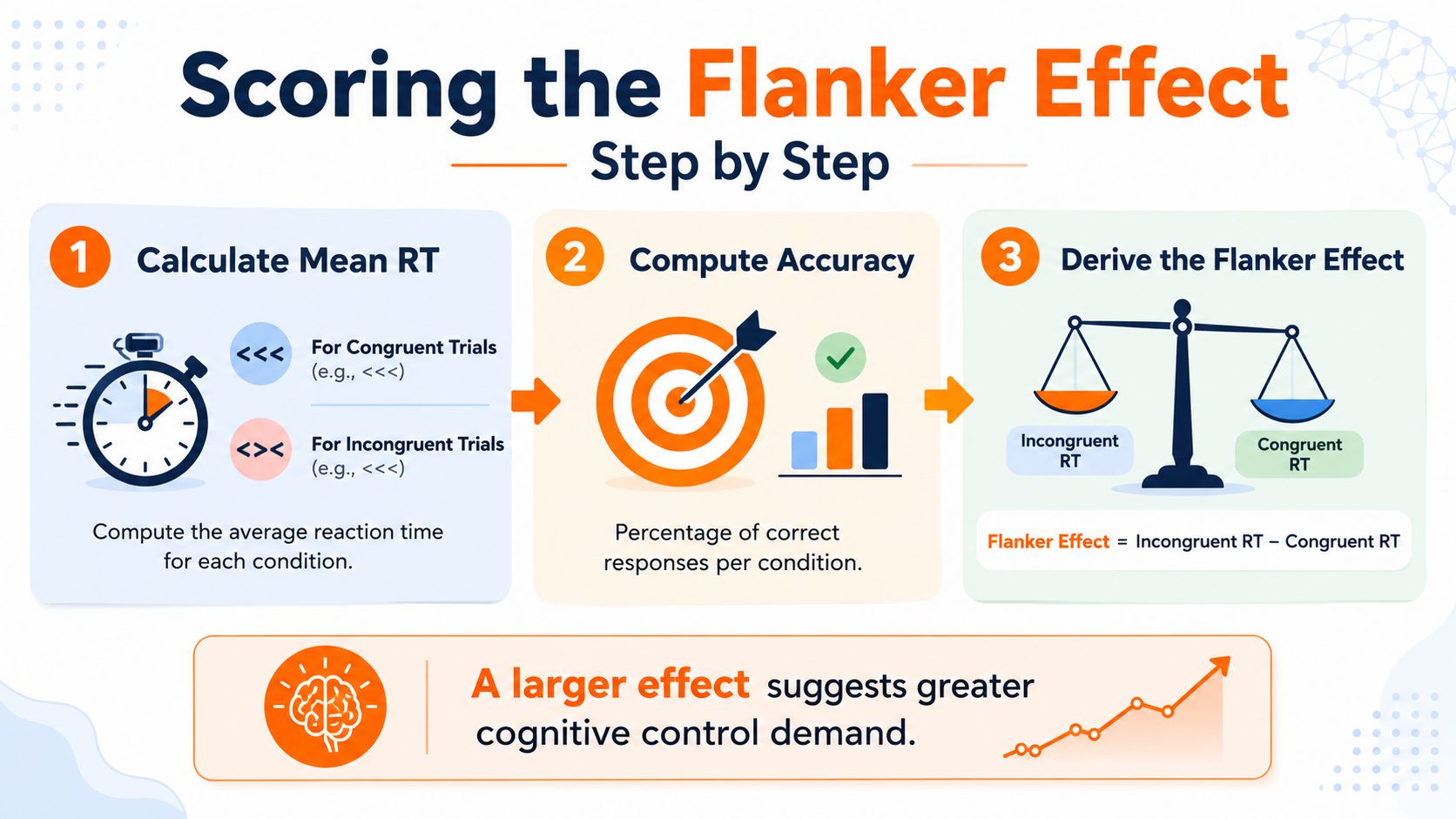
A clean flanker score starts with two basic pieces of information, mean reaction time on correct trials and accuracy. From there, you calculate the flanker effect by subtracting congruent performance from incongruent performance. That difference is the part that matters, because it captures the extra cost created by conflict.
A simple worked example
Say you have six valid congruent trials with correct reaction times of 510, 520, 530, 540, 550, and 560 ms. The mean is 535 ms. Now take six valid incongruent correct trials with reaction times of 560, 570, 580, 590, 600, and 610 ms. The mean is 585 ms. The flanker effect is 50 ms, calculated as incongruent minus congruent.
That subtraction is only meaningful after the data are cleaned. Remove anticipatory responses, exclude missed trials, and check for obvious outliers before averaging. If someone responds too early or pauses after an error, those trials can shift the mean and make the conflict cost look larger or smaller than it really is.
What else to watch in the numbers
Accuracy matters because a reaction-time result can look good while hiding a speed-accuracy trade-off. If a participant gets faster by guessing, the score is less trustworthy. In one empirical example, analysts reported a 62 ms difference between compatible and incompatible trials, with F(1, 23) = 335.27, p < .001, ηp² = .94, plus 99.82% hit rate and 3.15% false alarms on a digit-detection component adult interference cost data.
Another controlled experiment found 97% accuracy on congruent trials versus 95% on incongruent trials, with reaction times of 473 ms and 494 ms respectively. Those figures show why the task can pick up small differences in executive control, but they do not by themselves identify which cognitive process changed. A low score may reflect the participant, the stimulus set, or the way the task was built.
A useful report includes the mean correct-trial reaction time for each condition, percent accuracy for each condition, and the computed difference score. Anything less makes interpretation shaky.
If you are building a scoring workflow for repeated testing, test-retest reliability guidance is worth keeping beside the raw score sheet.
Flanker Task Variants Worth Knowing
The arrow version gets the most attention, but it isn't the only useful one. A letter flanker keeps the same response-conflict logic while swapping in alphabetic stimuli, which can be helpful when you want a familiar symbolic format. Child-friendly versions may use animals or faces to improve engagement, though that change can also alter how the stimulus-response rule works.
Which version fits which setting
The right variant depends on the person in front of you.
Classic arrow version: Best when you want the clearest link to the historical model and a simple left-versus-right response setup.
Letter version: Useful when your participant is comfortable with letters and you want to stay close to standard cognitive-testing conventions.
Child-friendly animal or face version: Often easier to administer with younger children, but the shift in stimulus meaning can change the task demands.
Speed-versus-accuracy variant: Helpful when you want to see whether someone is trading caution for speed.
EEG or fMRI-compatible versions: Chosen when timing precision and event marking matter for brain-based measurement.
A newer line of work has pushed the task beyond simple visual arrows. A 2020 special issue on arrow and multisensory versions argues that the approach now speaks to action control in more complex settings, and a 2020 study introduced a bimodal extension to probe cross-modal conflict multisensory expansion. That matters because the task is no longer just a one-format measure of inhibition.
The better the match between the variant and the client, the more believable the score.
What the trade-offs look like in practice
A child-friendly version may improve cooperation, but it can also make the comparison with adult norms less straightforward. A multisensory version may be more ecologically rich, but it is harder to compare with the classic arrow task. An EEG-ready build may improve event timing, but only if the stimulus presentation and response logging are consistent enough to trust.
For practitioners who use multiple attention tasks, it can help to compare the flanker with the n-back task. They tap overlapping but not identical aspects of control, so a mismatch between them is often informative rather than contradictory.
Why a Low Flanker Score Is Not Always a Deficit
A low score can reflect weaker conflict control, but it can also mean the task setup did not suit the person well. That is the part many brief explanations leave out. The same result can come from different processes depending on the stimulus type, the response set, the age group, and the participant's cultural or language background review of variability and culture.
The main reasons a score can look low
One source is stimulus type. A flanker effect can shift when the target and distractors are built differently, so the task is not measuring a fixed trait in a vacuum. The comparison across formats matters here, because the same person can look stronger or weaker depending on how the array is constructed.
Cultural context is another factor. A review of Eriksen Flanker Task performance found cultural differences, which is a reminder that one norm does not fit every population review of variability and culture. In practice, that means a low score may reflect the match between the task and the participant, not a simple deficit in attention.
Strategy can also lower the score. Someone may slow down on purpose to protect accuracy, and that can reduce errors without showing better inhibition. Familiarity matters too. If the person is not used to that exact stimulus convention, the result can reflect novelty as much as executive control.
A practical decision rule
Use a simple rule in case discussion. If the low score shows up only in one format, and the person does reasonably well on a different but related control task, treat the result as a possible task-format artefact. If the low score repeats across similar tasks, and the pattern fits the rest of the behavioural picture, the case for a genuine executive-control problem is stronger.
This is especially important in multilingual and ethnically diverse Canadian settings, where a single cut-off can over-call impairment if language familiarity or stimulus conventions are ignored. Co-occurring conditions can also shape performance, so it helps to interpret the flanker result alongside the broader picture of comorbidity in ADHD.
Clinical and Research Applications in Practice
In ADHD assessment, the flanker task is most useful when it is part of a broader battery rather than a stand-alone verdict. A larger interference cost can fit attentional and inhibitory difficulty, but it needs to be read alongside history, observation, and other measures. That is how you avoid over-calling a problem from a single reaction-time score.
How different profiles tend to show up
In a child with suspected ADHD, you may see slower responding on incongruent trials and a larger gap between congruent and incongruent performance. In an older adult, the same pattern can point more broadly to slowed conflict resolution and reduced efficiency under competing demands. In stroke, concussion, and other neurodevelopmental or acquired conditions, the task can highlight executive weakness that might not show up on a simple span task alone.
A report should be concrete. You might write that the participant showed a larger incongruent-minus-congruent difference, with preserved overall accuracy, which suggests measurable interference cost without widespread task failure. Or you might note the opposite, where accuracy dropped as speed increased, which raises concern about response strategy rather than pure slowing.
Where the task earns its keep
The task is especially useful in repeated-measures settings. If you are tracking change over time, the same person's own pattern matters more than a single group comparison. That makes the task valuable for intervention monitoring, rehabilitation follow-up, and pre-post comparisons where small differences need to be visible.
For researchers, the flanker task is also a tidy way to operationalise selective attention in a lab or clinic study. The numbers are simple, but the interpretation only works if the rest of the battery supports the same story. The key is to resist the temptation to treat one score as the whole answer.
Best Practices for Digital Flanker Implementation
A digital flanker task is only as good as the build behind it. If the timing slips, the input device lags, or the display differs across screens, the score can drift away from the construct you think you're measuring. That's why implementation checks matter before anyone trusts the numbers.

Checklist before you use the task clinically
Standardise stimuli: Keep arrow or letter forms, size, and spacing identical across devices.
Control timing: Confirm stimulus duration and response windows are precise enough for the test version you're using.
Randomise order: Vary trial types so the participant can't predict the next item.
Calibrate the display: Check screen resolution, brightness, and viewing distance.
Secure the data: Make sure response times export cleanly and reliably.
The participant side matters too. A child sitting too close to a small screen, or an older adult struggling with a motor-heavy input device, may produce noisy data that look cognitive when they're really practical. Keep the response method simple, and document it consistently.
If the build changes, the norms may no longer apply cleanly.
A good report includes the trial types, the scoring method, exclusions for invalid trials, and the exact device setup. That gives another clinician a chance to audit the result instead of taking the number on faith.
Putting the Flanker Task to Work in Your Practice
The flanker task is best thought of as a task-format-sensitive measure of conflict, not a universal inhibition score. Used well, it adds value in ADHD evaluation, paediatric neuropsychology, rehabilitation, and research settings where small shifts in executive control matter. Used carelessly, it can overstate impairment or miss the underlying story.
A practical next step is simple. Pilot one validated digital version with a few clients, compare the result with another attention measure in your battery, and see whether the pattern holds when the format changes. That kind of local check is often more useful than relying on a single external cut-off.
If you want a scalable assessment stack that includes flanker-style measures alongside broader attention, memory, executive function, processing speed, and eye-hand coordination domains, Orange Neurosciences is built for that workflow. The strongest move this week is to test the task in the same clinical context where you'll use it.
If you're ready to see how a digital cognitive battery can fit your practice, visit Orange Neurosciences to explore the platform, review the available assessment tools, and decide whether a flanker-style measure belongs in your workflow.

Orange Neurosciences' Cognitive Skills Assessments (CSA) are intended as an aid for assessing the cognitive well-being of an individual. In a clinical setting, the CSA results (when interpreted by a qualified healthcare provider) may be used as an aid in determining whether further cognitive evaluation is needed. Orange Neurosciences' brain training programs are designed to promote and encourage overall cognitive health. Orange Neurosciences does not offer any medical diagnosis or treatment of any medical disease or condition. Orange Neurosciences products may also be used for research purposes for any range of cognition-related assessments. If used for research purposes, all use of the product must comply with the appropriate human subjects' procedures as they exist within the researcher's institution and will be the researcher's responsibility. All such human subject protections shall be under the provisions of all applicable sections of the Code of Federal Regulations.


© 2026 by Orange Neurosciences Corporation