N Back Task Explained: How It Works and Why It Matters

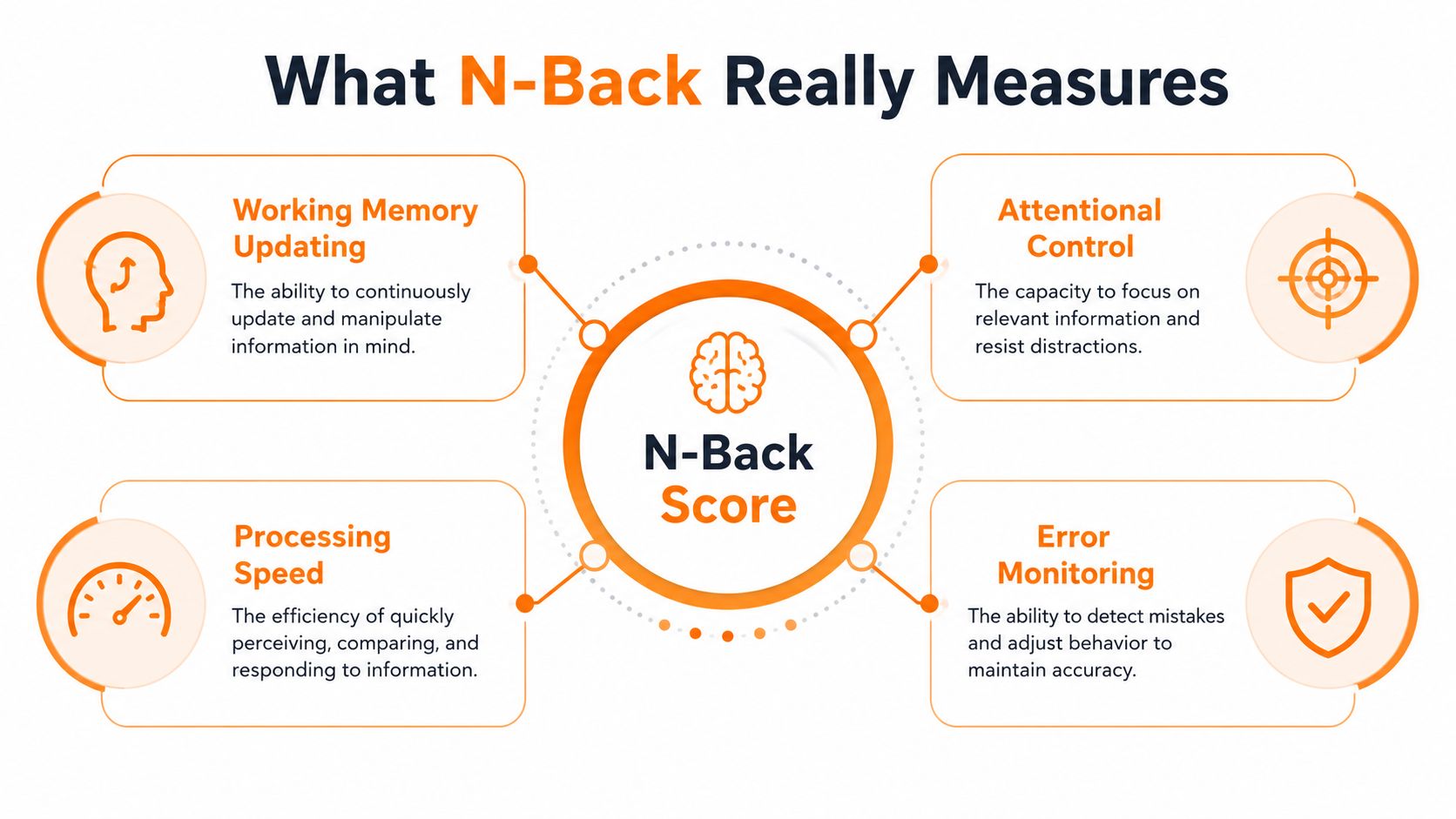
The N back task is often discussed as a simple working-memory score. That's the wrong starting point. A good clinician reads it as a continuous updating task that blends memory, attention, and processing speed in uneven ways, so the number only means something when you know who took it, how it was administered, and what else happened in the battery.
The basic appeal is obvious. A stimulus appears, the participant decides whether it matches the item shown N trials earlier, and the load rises as N rises. The problem is that the same low score can reflect different bottlenecks, which is why a single result should never be handed to a family as a plain “working memory number” without context. If you want a broader plain-language frame for related cognitive terms, Orange Neurosciences has a useful overview of cognitive skills definition.
For caregivers trying to manage memory loss as a caregiver, this distinction matters just as much as it does in clinic. A task that looks like “memory trouble” may be slowed responding, reduced attention, or a combination of both.
What the N Back Task Really Measures
Clinicians often get the N back task wrong on first glance. They call it a working-memory test and stop there. The better reading is more practical, and less flattering to the task. It is a working-memory updating task that also draws on attention, response control, and processing speed, so the score is only interpretable when you know who took it, how it was set up, and what else was happening in the battery.
The core mechanic
The basic rule is easy to teach, but easy rules can hide difficult demands. A stimulus appears, and the participant judges whether it matches the item from N steps back. In a 2-back run, that means each new item has to be compared with a moving target, not with a fixed list in long-term memory. As N increases, the task asks the person to hold more recent items in mind while discarding older ones that no longer matter.
A clinical team should separate recall from updating. In digit span or list recall, the person keeps material and reproduces it. In the n back task, the person keeps changing the reference point, so the next response depends on the current stimulus and the item that now sits N positions behind it. That is why a score can look like “memory trouble” while the actual issue is slower responding, weak attentional control, or a tendency to say yes too often.
Practical rule: if someone misses on the task, do not stop at “memory impairment”. Check whether the error pattern fits attention, speed, response bias, or trouble keeping the target current.
Why the score needs context
Research descriptions often use signal-detection metrics such as d′ and criterion, because they separate sensitivity from response bias better than raw accuracy alone. That matters clinically. Two people can land on the same percent correct while one responds cautiously and the other responds impulsively, and those profiles do not mean the same thing. The n-back reference guide describes the task as a measure of working-memory updating, with common implementations using 1-back to 3-back levels and fixed timing parameters.
For readers who want a broader plain-language frame for related cognitive terms, cognitive skills definition is a useful starting point from Orange Neurosciences. The point is not that the task gives a clean memory number. It gives a profile signal. In older adults, especially, the result often reflects a wider cognitive pattern rather than a single isolated deficit, which is why clinicians should read it as one piece of evidence instead of a standalone verdict.
For caregivers who are trying to manage memory loss as a caregiver, that distinction matters just as much outside the clinic. A low score can reflect several different bottlenecks, and the task only earns its place in a battery when those differences help explain the person's real-world functioning.
How a Trial Works
A newcomer can follow the task by watching one sequence at a time instead of trying to hold the whole theory in mind. In a 2-back run with letters, T, K, R, K, S, the participant sees T first, so there is nothing to compare it with yet. Then K appears, and there is still no match. When R appears, it is compared with T, because T is two positions back.
A concrete 2-back walk-through
The second K is the first clear match. The participant compares it with the letter two steps earlier, which is K, and presses the key. When S appears, the person checks it against R, finds no match, and withholds the response. That rule is the whole engine of the task.
A 1-back version is simpler because the comparison target is just the item that came immediately before. A 3-back version is harder because the person must keep a longer moving window in mind while dropping older items that are no longer relevant. The task stays continuous, since each new stimulus changes the comparison base for the next one.
Why it's not the same as digit span
The difference from digit span is practical, not just theoretical. Digit span asks a person to hold material and repeat it. The N back task asks them to keep updating the target on every trial while deciding whether the new item matches the one already in mind. That is why clinicians use it to probe online updating rather than simple storage.
A junior staff member often understands the contrast fastest when the two tasks are placed side by side. The digit span test measures reproduction. The n back task measures ongoing comparison under changing load.
A useful bedside explanation is, “Keep the last few items in mind, but only answer when the current one matches the one from N steps ago.”
That line works for a parent, a teacher, or a rehab assistant. It also shows why the task feels much harder as load increases, even when the stimuli on the screen look the same.
Common Variants and When to Use Each
Teams often default to whichever version their software already includes. That's a mistake. The variant should follow the question. A single visual task is not the same as a dual auditory-visual task, and a fixed protocol is not the same as an adaptive one.
N back variants at a glance
Variant | Typical use | Strength | Watch out for |
|---|---|---|---|
Single visual | Clinical studies, fMRI, routine cognitive profiling | Easy to standardise and explain | Can hide response speed problems if you only watch accuracy |
Single verbal | Language-heavy protocols, school-age work, some screening settings | Familiar stimuli for many participants | Word or letter familiarity can influence performance |
Single spatial | Research on spatial updating and visuospatial load | Useful when location matters more than identity | Harder to explain without a clear practice run |
Dual n-back | Brain-training products and some experimental studies | Adds simultaneous stream demands | More complex, more confusing, and easier to overclaim |
Fixed-level | Comparability across participants | Simple scoring and clean group comparisons | Can be too easy for some and too hard for others |
Adaptive staircase | Individualised task difficulty | Better fit when you want to track threshold changes | Harder to compare directly across people if the protocol changes often |
The visual-spatial sketchpad guide is a useful companion when a team is deciding whether the stimulus should be letters, objects, or locations. The point is not to chase novelty. The point is to match the variant to the cognitive question and the setting.
When each version earns its keep
Single-task visual n-back is the workhorse in many clinical and imaging studies because it is straightforward to standardise. Dual n-back is the version most often marketed as training, but that marketing pressure doesn't make it the right choice for every workflow. It adds complexity that can be useful in research, yet that same complexity can make interpretation messy in a clinic where the team wants clear, defensible output.
If you want comparability, choose the simplest version that still answers your question.
Adaptive versions earn their place when the team wants a more personalised difficulty trajectory, especially in repeated testing. Fixed protocols make more sense when you need direct across-person comparison and the sample is fairly homogeneous. In practice, the right choice is usually the one that lets you defend the result later without hand-waving.
Administration Protocols and Scoring Basics
Administration details matter more than expected, because small pacing changes can shift cognitive load significantly. One reference description of the task uses 1,500 ms stimulus duration and a 2,000 ms inter-stimulus interval, while a benchmark 2-back protocol uses a maximum of 760 ms per stimulus, a 2,000 ms intertrial interval, and 25 trials per block, which makes a new stimulus appear every 2,760 ms in that implementation (PsyToolkit 2-back protocol). The exact timing matters less than the pattern behind it. Faster pacing, larger stimulus sets, and higher N all raise cognitive load and usually reduce performance.

What to score beyond percent correct
Raw accuracy is only the first cut. A better summary includes hit rate, false alarm rate, d′, and criterion. Those numbers show whether a person is sensitive to true matches, overly cautious, or prone to saying yes too often. A single accuracy score cannot show that difference. A slow, careful participant and a fast, impulsive one can end up with the same total and very different response styles.
A simple clinical example makes the problem obvious. Two people can both post the same 2-back percent correct. One misses many targets but rarely claims a match when there is none. The other catches more targets but also calls too many non-matches hits. Their accuracy looks similar, yet their profiles point in different directions.
Which knobs change task load
Higher N: more updating, more interference, more demand on control.
Faster pacing: less time to rehearse or reset, so the task becomes less forgiving.
Bigger stimulus set: more items to track, which raises the chance of confusion.
Longer blocks: more fatigue and more drift in attention.
A score also has to be stable enough to mean something across repeated sessions. The test-retest reliability statistics guide is useful when deciding how often to repeat the task and how much change is likely to reflect noise rather than signal. If the administration shifts from one session to the next, the result becomes harder to interpret.
Practical rule: if the report only gives percent correct, the report is incomplete.
That does not make accuracy useless. It means accuracy should sit beside the rest of the scoring profile, not stand in for it.
Psychometric Validity and What the Numbers Mean
The validity literature is where the task earns its keep, and where it often disappoints people who want a clean memory index. A Parkinson's disease validation study reported that n-back accuracy at the 0-, 1-, 2-, and 3-back loads did not significantly correlate with digit span backward, and the authors also found a significant correlation with Trail Making Test Part A at the 2-back load (Parkinson's validation study). That pattern supports a blunt interpretation, a poor 2-back score does not automatically mean a pure working-memory deficit.
What the task tracks in different age groups
A lifespan study found that younger participants' performance shared variance mainly with executive functions such as interference control, task switching, and updating, while older adults' performance was more closely associated with attentional functions (lifespan study). That does not make the task useless in older adults. It makes the interpretation different. In that group, the result can reflect attentional demands and processing speed more strongly than a single executive construct.
The same study also reported that Trail Making Test-B correlated with n-back performance in each age group, which is a useful reminder that switching and updating often travel together. A younger adult who drops on a 2-back may be showing executive-control load. An older adult with the same drop may be showing a different mix, where attentional demands and pace matter more.
Why speed belongs in the battery
A Parkinson's sample gives a clear clinical lesson. The authors found that n-back accuracy related to processing speed or motor speed in that group, so a low score should not be read as an isolated memory defect. Pairing the task with a timed speed measure makes the interpretation sturdier. If the person is accurate but slow, the issue may be latency. If the person is quick but error-prone, the issue may be response control.
An fMRI-focused clinical utility study showed mean n-back accuracy at or above 95% for both verbal and object versions, which tells you the task can hit ceiling in some research settings (fMRI clinical utility study). The authors still reported limited clinical utility as a working-memory measure because they did not find additional significant associations with clinical working-memory measures, while reaction time during scanning was more strongly related to intelligence than accuracy was. That is a strong argument for looking beyond the percent-correct column.
Clinical takeaway: interpret the score by age, by speed, and by the rest of the battery. A single number is too thin to carry the meaning.
For families and care teams, that age-sensitive reading is especially important in settings where memory complaints are common but the cause is not yet clear. For clinicians, it means the task belongs in a battery as part of a profile, not as a verdict.
Does N Back Training Transfer
The brain-training story is much less tidy than vendors usually imply. Earlier reviews and meta-analyses found mixed validity, poor reliability for individual differences, and limited evidence for lasting far-transfer beyond tasks that look very similar to the trained task. That critique still matters. If a programme promises broad cognitive change, the burden of proof sits with the programme, not with the sceptic.
Near transfer and far transfer are not the same thing
Near-transfer means improvement on a task that resembles the trained one. Far-transfer means improvement in a different skill, like reasoning or daily functioning. Those claims should never be collapsed into one another, because a person can get better at n-back-style tasks without showing broader cognitive change. Clinical outcome relevance is a separate question, and it matters even more when a team is deciding whether to adopt a training protocol.
Recent evidence adds a more careful layer. A 2025 set of three randomised controlled trials with 460 participants found that improvement on untrained n-back tasks mediated transfer to Matrix Reasoning, even when the overall intervention effects were inconsistent across trials (2025 RCT set). That does not rescue every training claim. It does show that the question is no longer a flat yes-or-no. The better question is for whom, under what conditions, and on what outcome does it transfer.
The insights for special education teams framing is useful because it pushes teams toward progress-monitoring language instead of slogan-level claims. If a school or clinic is considering training, the practical issue is whether the selected outcome is meaningful for the child or adult in front of them.
What a defensible claim sounds like
Defensible: a person practised a working-memory task and improved on similar tasks.
Possibly defensible: there was evidence of transfer to a related reasoning measure in a specific trial context.
Not defensible: n-back training broadly “boosts intelligence” or fixes memory across the board.
The working memory improvement guide is worth reading if your team needs a sober, skills-based frame instead of a hype cycle. Keep the categories separate and the conversation stays honest. Once those categories blur, the intervention starts sounding more scientific than it really is.
Using the N Back Task Well in Practice
The task earns its place when the question is specific. In screening, it helps flag whether a person's difficulty looks more like updating, attention, or slowing. In cognitive rehabilitation, it can track whether a patient can keep pace with a graded load. In ADHD assessments, it can add a structured look at control under demand. In dementia monitoring, it should be interpreted with age, speed, and functional context in mind, not as a standalone label.
A practical workflow for teams
Start with the clinical question. If you want updating, choose n-back. If you want simple span, choose a different task.
Pair it with a speed measure. That helps separate slow responding from memory-specific failure.
Add a switching measure when the case is ambiguous. Trail-type tasks often help you see whether the difficulty is broader than memory.
Report the response style. Accuracy alone can hide bias.
Interpret by age and setting. What looks like impairment in one group may reflect normal load sensitivity in another.
One useful example is an older adult who misses on a 2-back but also slows on a timed reaction task. That pattern points you away from a pure memory interpretation and toward a broader speed-attention view. A child who stays accurate but becomes erratic as load rises raises a different question about sustained control and fatigue.
Where digital platforms fit
Structured digital systems can reduce inconsistency when teams need repeatable administration, automated scoring, and broader cognitive profiles in one workflow. Orange Neurosciences, for example, integrates n-back into a larger cognitive battery alongside tools such as OrangeCheck, which is useful when a clinic wants one set of outputs instead of a one-off research script. In settings that need faster triage, that kind of workflow integration matters more than a flashy interface.
Ethically, the line is simple. Use the result to guide further evaluation, training decisions, or research participation only when the administration is standardised and the interpretation fits the person in front of you. Don't oversell certainty. Don't turn one score into a diagnosis. Do use the task when you need a compact, repeatable probe of updating under load.
If your team needs a scalable way to include the N back task in a broader cognitive workflow, visit Orange Neurosciences and review how its assessment and reporting tools are organised for clinical and research use.

Orange Neurosciences' Cognitive Skills Assessments (CSA) are intended as an aid for assessing the cognitive well-being of an individual. In a clinical setting, the CSA results (when interpreted by a qualified healthcare provider) may be used as an aid in determining whether further cognitive evaluation is needed. Orange Neurosciences' brain training programs are designed to promote and encourage overall cognitive health. Orange Neurosciences does not offer any medical diagnosis or treatment of any medical disease or condition. Orange Neurosciences products may also be used for research purposes for any range of cognition-related assessments. If used for research purposes, all use of the product must comply with the appropriate human subjects' procedures as they exist within the researcher's institution and will be the researcher's responsibility. All such human subject protections shall be under the provisions of all applicable sections of the Code of Federal Regulations.


© 2026 by Orange Neurosciences Corporation