Clock Drawing Test Interpretation: Clinical Guide
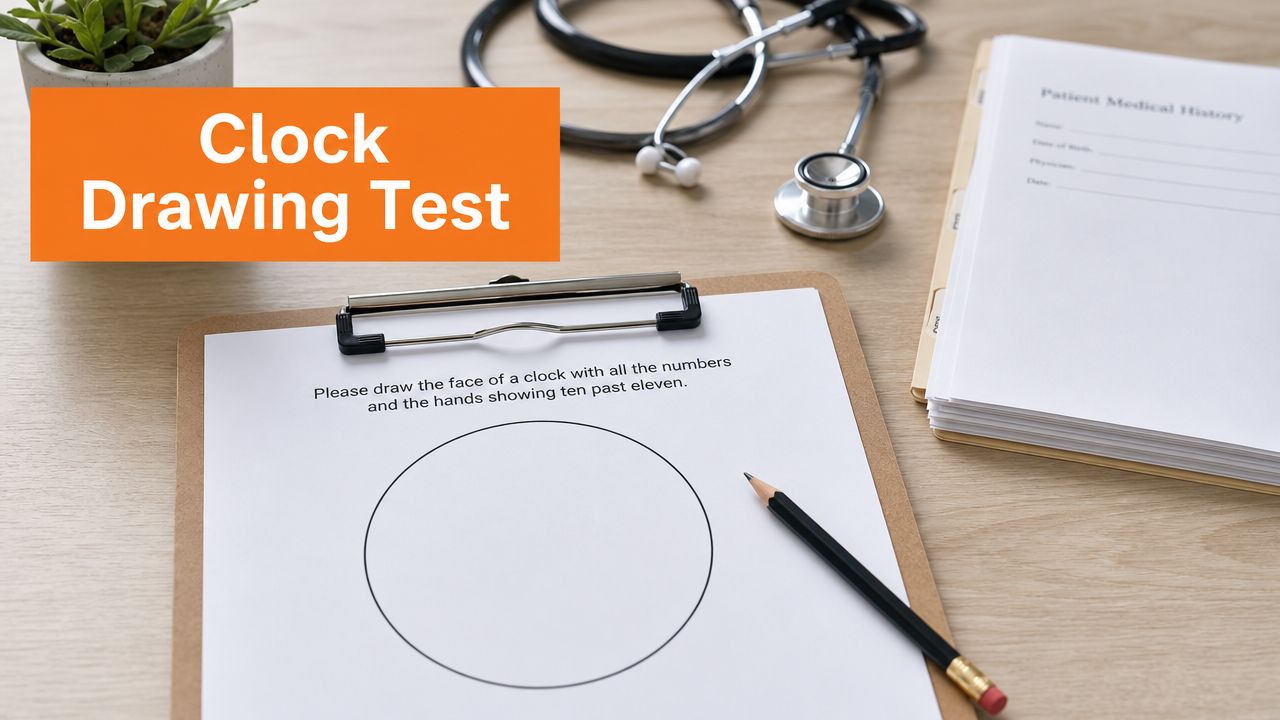
You're probably in a familiar spot. An older patient looks fine on a quick memory screen. They answer orientation questions cleanly, chat easily, and insist nothing has changed. Then a spouse or adult child says, “They're not managing everyday tasks the same way.”
That's where clock drawing test interpretation becomes more than a box to tick.
A simple clock can expose trouble with planning, organisation, spatial judgement, and task control long before a conversation in the clinic does. I've seen patients who appear cognitively intact in casual interview but reveal a very different picture once they're asked to put numbers on a blank circle and set the hands to a time. The drawing turns abstract concern into observable behaviour.
Why a Simple Clock Reveals Complex Truths
A retired teacher sits across from you. She is warm, articulate, and fully at ease in conversation. Her daughter reports missed appointments, repeated questions, and new trouble paying bills, yet a brief screen at the start of the visit does not look especially alarming. Then she draws a clock. The circle is tidy, the first few numbers are placed with confidence, and then the layout collapses. Numbers crowd one side. The hands do not match the requested time. In less than a minute, the referral question changes.
That shift is the primary strength of the Clock Drawing Test. It can expose problems that ordinary conversation often hides, especially when a patient has strong social skills, rehearsed routines, or enough insight to compensate verbally. A clock drawing asks for a finished product, not just correct answers. You are watching how the person organises a task, monitors errors, and turns an idea into an accurate visual plan.
That is also where traditional teaching can mislead junior clinicians.
Many guides present the CDT as a quick screen with a score at the end. Useful, yes, but incomplete. A clock can look acceptable on a simple scoring rubric and still contain early signs of decline. That gap matters most in Mild Cognitive Impairment, where patients often preserve enough ability to produce something recognisably clock-like while showing subtle inefficiency, poor planning, self-correction, or spatial drift. If you focus only on whether the final drawing passes, you may miss the reason the task was hard.
A clock drawing works like a bedside stress test for cognition. It compresses several mental operations into one familiar activity, much the way a short walk down a corridor can reveal gait instability that is not obvious while a patient is seated. The finished page gives you a visible record of whether the patient could hold the rules in mind, organise space, sequence behaviour, and check the result.
What the clock shows that interview alone may miss
Conversation is often forgiving. Patients can rely on habits, personality, and stock phrases. They can answer around a weakness. Clock drawing is less forgiving because the task has structure. The patient has to generate that structure independently.
In practice, this is why the CDT so often sharpens a vague history. A family member says, "Something is off." The patient sounds fine. The clock reveals whether "off" means slowed planning, poor spatial organisation, impulsive responding, or a broader breakdown in task control.
For trainees, this is the mindset to develop: read the clock as behaviour on paper. The misplaced numbers and ambiguous hands are not just errors to count. They are clues about which cognitive operations held up and which ones failed under pressure.
Clinical reality: A polished interview can coexist with clear impairment on a structured task.
The CDT's Role in Daily Practice
The test also earns its place because it fits the clinic day. It is brief, low-cost, and easy to repeat over time. Just as important, it creates a shared visual record that families, trainees, and multidisciplinary teams can all examine together.
Used well, the CDT adds depth to your assessment rather than replacing it. It sits inside a broader evaluation of history, function, and other measures of cognitive function. That broader frame helps you avoid a common mistake. A single clock is never the diagnosis. It is evidence. Sometimes it supports concern. Sometimes it reassures. Sometimes, especially in early MCI, it looks deceptively ordinary unless you pay attention to how the drawing was produced, not only how it looks at the end.
That is why a simple clock can reveal so much. It turns an abstract question, "Is cognition changing?", into observable behaviour you can analyse, compare, and act on.
The Cognitive Demands of Drawing a Clock
The task sounds simple because the instruction is simple. The brain work behind it is not.
When you ask a patient to draw a clock and set the hands to a specific time, you're assigning a compact multi-step project. That's why the task is so clinically rich. One drawing lets you watch several cognitive systems work together, or fail to.
The CDT as a mini-project for the brain
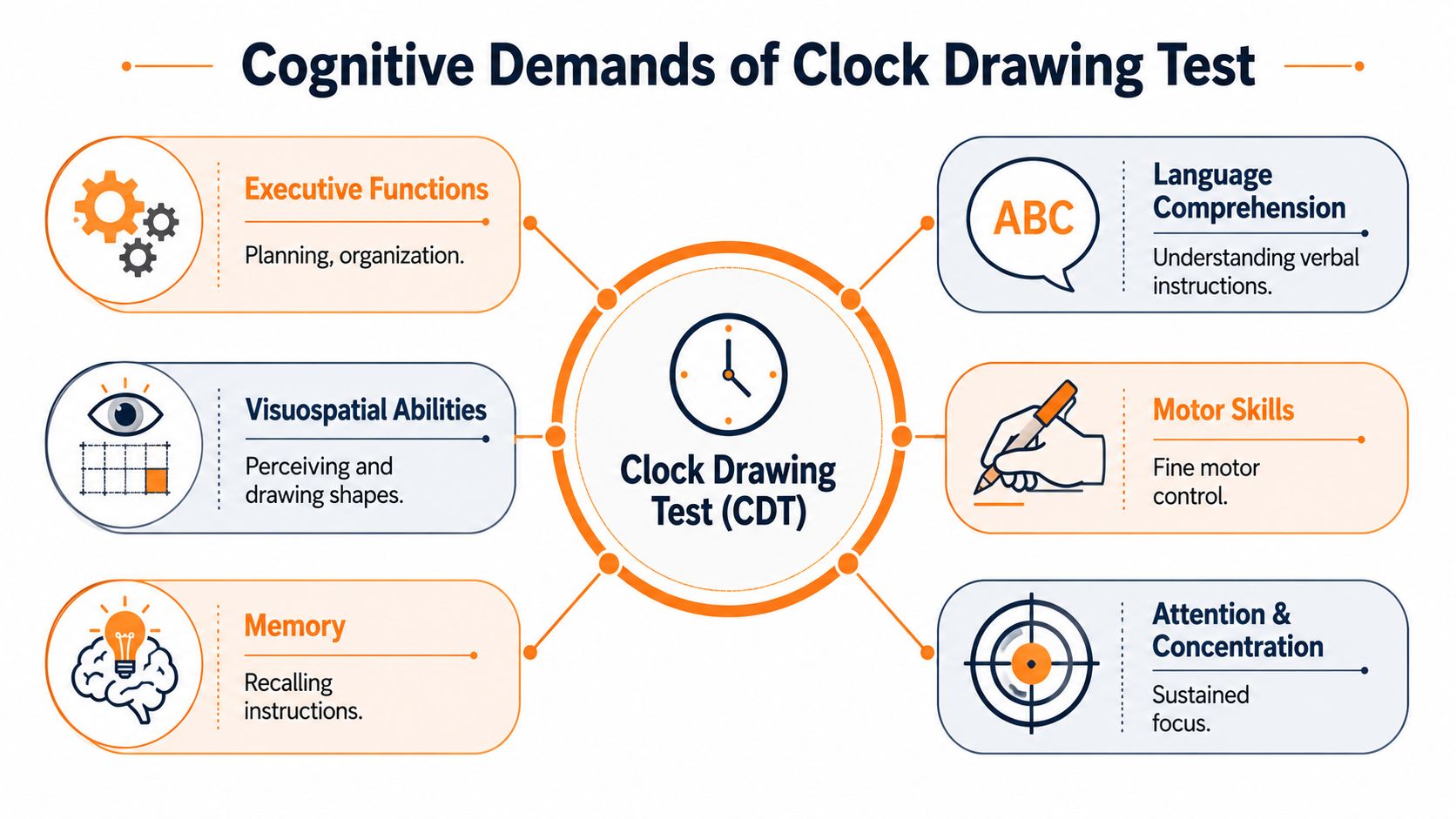
Here's the easiest way to teach it to trainees. A clock drawing is like giving the brain a mini-project with a deadline.
Language comprehension means the patient has to understand the spoken instruction.
Semantic memory means they must know what a clock is supposed to look like.
Attention keeps them on task without drifting or losing the target time.
Executive function helps them plan the layout, sequence the numbers, and inhibit impulsive errors.
Visuospatial skill lets them distribute numbers around the face and place hands correctly.
Motor output allows the plan to become a visible drawing.
If one cog slips, the final clock often tells you where to look next.
A practical example helps. A patient who understands the instruction and knows the concept of a clock, but crowds all numbers into one quadrant, may have a planning or visuospatial problem. Another patient may draw a round face and place numbers neatly, but set the hands incorrectly because they didn't hold the instruction in mind or misunderstood the time concept.
Command versus copy
This distinction matters more than many beginners realise.
In the command condition, the patient draws the clock from verbal instruction alone. That loads comprehension, semantic memory, planning, and self-organisation. It asks, “Can you generate the whole concept and execute it?”
In the copy condition, the patient reproduces an existing clock. That reduces some conceptual demand and helps isolate visuospatial, perceptual, and executive-motor aspects. It asks, “Can you reproduce what you see?”
When a patient fails command but does relatively better on copy, conceptual generation may be the weak point. When both are poor, broader visuoconstructional or executive dysfunction becomes more likely.
When the command clock is poor, don't stop there. A copy trial can tell you whether the patient lost the concept, the plan, the spatial layout, or the motor control.
Where readers often get confused
Many clinicians assume the CDT is mainly a memory test. It isn't. Memory plays a role, but the task is broader. The clock is often more revealing about organisation of thinking than about simple recall.
Another common confusion is treating a shaky drawing hand as cognitive impairment. Sometimes it is. Sometimes it's arthritis, tremor, poor vision, or slow motor output. That's one reason broader models of working memory and spatial processing matter. If you want a concise refresher, this guide to the visual spatial sketchpad helps connect theory to what you see on the page.
The practical takeaway is straightforward. Before you score the clock, understand the job the patient was trying to do.
Applying Key Scoring Systems Accurately
A junior clinician shows you two clocks from the same patient. One earns a “7” under one system and a “9” under another. The drawings are identical. The patient did not change. The scoring lens did.
That is the first lesson to teach. A CDT score is never just a property of the drawing. It is the result of a drawing viewed through a specific rubric. If you forget that, you can mistake scoring variation for clinical change.
Traditional scoring systems were built to bring order to a messy task, and they do help. They improve consistency, support handoffs between clinicians, and make repeat testing easier to compare. But they do not all ask the same question. Some weight spatial layout heavily. Some give more credit to number placement. Others care most about whether the final clock can be interpreted as a plausible time display. The score reflects the priorities of the system as much as the patient's performance.
What different systems actually prioritise
Rouleau, CDIS, and Royall are often discussed together, but they are not interchangeable.
Rouleau works like a structured inspection of the finished product. You look at the clock face, the numbers, and the hands as separate parts, then judge how well each part was constructed. This is useful when you want to know whether the patient's difficulties are spread across the whole drawing or concentrated in one area.
CDIS places a premium on standardised interpretation. It was designed to improve agreement across raters, which matters in busy services where several clinicians may score the same task over time. If your clinic values reproducibility across examiners, that matters a great deal.
Royall is often the easiest for screening settings because it gives clear threshold-based guidance. That makes it practical for triage, case discussion, and follow-up visits. It is especially handy when a multidisciplinary team wants a quick shared language for “likely okay,” “concerning,” and “clearly impaired.”
Here is the catch. A clear threshold is helpful for communication, but it can hide early change. A patient with mild executive inefficiency or subtle conceptual drift may still land in a reassuring range, especially if the final product looks superficially intact. This is one reason traditional scoring can miss early Mild Cognitive Impairment. The patient may compensate well enough to protect the total score while still showing inefficient planning, self-correction, hesitation, or unusual sequencing during the task.
Comparison of Common CDT Scoring Systems
Scoring System | Total Points | Primary Focus | Example Scoring Criterion |
|---|---|---|---|
Royall | 10 | Quantitative thresholding for impairment likelihood | Whether the final score falls at 10, below 8, or below 5 |
Rouleau | Qualitative point-based method | Spatial layout, number sequencing, and hand placement | Whether numbers are evenly distributed and hands are represented accurately |
CDIS | Structured interpretive system | Consistency in identifying clinically meaningful clock features | Whether core clock elements are present and interpretable in a standardised way |
A practical routine for scoring the same way every time
Trainees often want to “blend” methods. That usually creates noise.
Pick one scoring system for your service, teach it explicitly, and document it every time. Otherwise, a score becomes like a blood pressure reading taken with different cuff sizes and different positioning rules. The number looks precise, but the method underneath it is unstable.
A dependable scoring routine usually follows this order:
Start with the global impression. Is this recognisably a clock, or is the whole concept already breaking down?
Score the clock face. Look for a usable boundary and basic structural organisation.
Score the numbers. Check presence, order, anchoring, and spacing.
Score the hands. Separate “two hands are present” from “the time is set correctly.”
Mark major qualitative abnormalities. Record crowding, omissions, perseveration, bizarre placements, or stimulus-bound responses even if the point total seems acceptable.
Write down the exact method used. “CDT = 7” is incomplete documentation. “CDT Rouleau = 7/10” is much more defensible.
One-sentence teaching rule: score what is on the page, not what you suspect the patient meant.
That sounds obvious, but it is where many junior clinicians drift. A patient says, “I know what I wanted to do,” and the scorer starts awarding intention rather than performance. The CDT is an observed task. Partial credit should reflect observable output under standard conditions.
Where traditional scoring starts to fail
A total score is useful for screening and tracking. It is less useful for detecting very early decline.
Consider two patients who both receive the same total. One draws smoothly, places numbers efficiently, and sets the hands with no hesitation. The other pauses repeatedly, starts with the wrong anchor point, erases, self-corrects, and finally produces a passable clock after visible struggle. Traditional scoring may treat those performances as equivalent. Clinically, they are not equivalent at all.
This is the gap that process-based approaches try to close. Instead of looking only at the final clock, they examine how the clock was produced. Sequence, latency, pauses, corrections, and planning behaviour can reveal inefficiency before the finished drawing becomes obviously abnormal. That matters most in early MCI, where compensation often preserves the product longer than the process.
Scores still matter. They are just not the whole story.
If your team uses the CDT alongside broader cognitive screening, it helps to align interpretation across instruments. Orange Neurosciences' guide to MMSE scoring and interpretation is a useful reference for that cross-test comparison.
For day-to-day practice, the safest habit is simple. Use one system consistently, document it clearly, and never let a respectable total score stop you from examining how the drawing was achieved.
Decoding Error Patterns for Differential Diagnosis
A total score can tell you there's a problem. The error pattern tells you what kind of problem may be present.
That's why experienced clinicians often look at the clock the way a radiologist looks at an image. Not just “normal” or “abnormal,” but “what kind of abnormality, and what does it suggest?”

Conceptual errors
These are failures in the idea of the clock itself. The patient may not represent the clock as a coherent object, may omit critical elements, or may show a distorted grasp of how time is represented.
The most clinically important examples are number crowding and stimulus-bound errors. These have been described as highly suggestive of a conceptual deficit and are particularly relevant in Alzheimer's disease, as outlined in the Canadian Geriatrics assessment description of clock test findings.
Examples you might see in clinic:
Number crowding where 11, 12, and 1 are squeezed together.
Stimulus-bound placement where the patient anchors numbers to one local region instead of distributing them conceptually around the face.
Irrelevant or incomplete products where the drawing doesn't function as a clock at all.
A patient who places all numbers between 10 and 11 isn't just making a small spatial error. They may be showing a disrupted internal model of the task.
Visuospatial errors
These errors reflect trouble with layout, spatial relations, or construction.
One patient may draw a distorted contour. Another may neglect one side of the clock. A third may put numbers out of radial alignment, not because they forgot them, but because they can't organise the page spatially.
Watch for:
Missing or compressed numbers on one side
Oval or fragmented clock face
Numbers drifting inside or outside the expected ring
Hands placed at implausible angles despite preserved number knowledge
In rehab settings, these patterns often matter after stroke or other neurological injury. The drawing becomes a compact sample of how the patient maps space.
Executive errors
Executive failures appear when the concept is broadly intact, but task control collapses.
The patient may start well and lose the plan halfway through. They may repeat numbers, add extra hands, or mis-set the time despite knowing what a clock is. Perseveration is especially important. If a patient keeps adding or correcting in an unproductive loop, the behaviour itself is informative.
A useful real-world contrast:
A patient with a conceptual deficit may not know how the clock should work.
A patient with an executive deficit may know the goal but fail to organise action toward it.
Don't overinterpret a single error in isolation. The pattern matters more than any one misplaced number.
Reading the clock like a map
When I supervise trainees, I ask them to narrate what they think happened during production. Did the patient lose the concept? Misread space? Fail to inhibit a wrong response? That habit sharpens differential thinking.
Clock drawing test interpretation is strongest when you combine score, shape, sequencing, and error type. The page doesn't just show a result. It shows a process frozen in ink.
Common Pitfalls and Contextual Interpretation
The most dangerous mistake with the CDT is overconfidence.
Clinicians often trust a reasonable-looking clock too much. Families trust it even more. A patient draws something recognisable, the room relaxes, and everyone moves on. That can be a serious error when the concern is early decline.
A normal-looking clock can still miss MCI
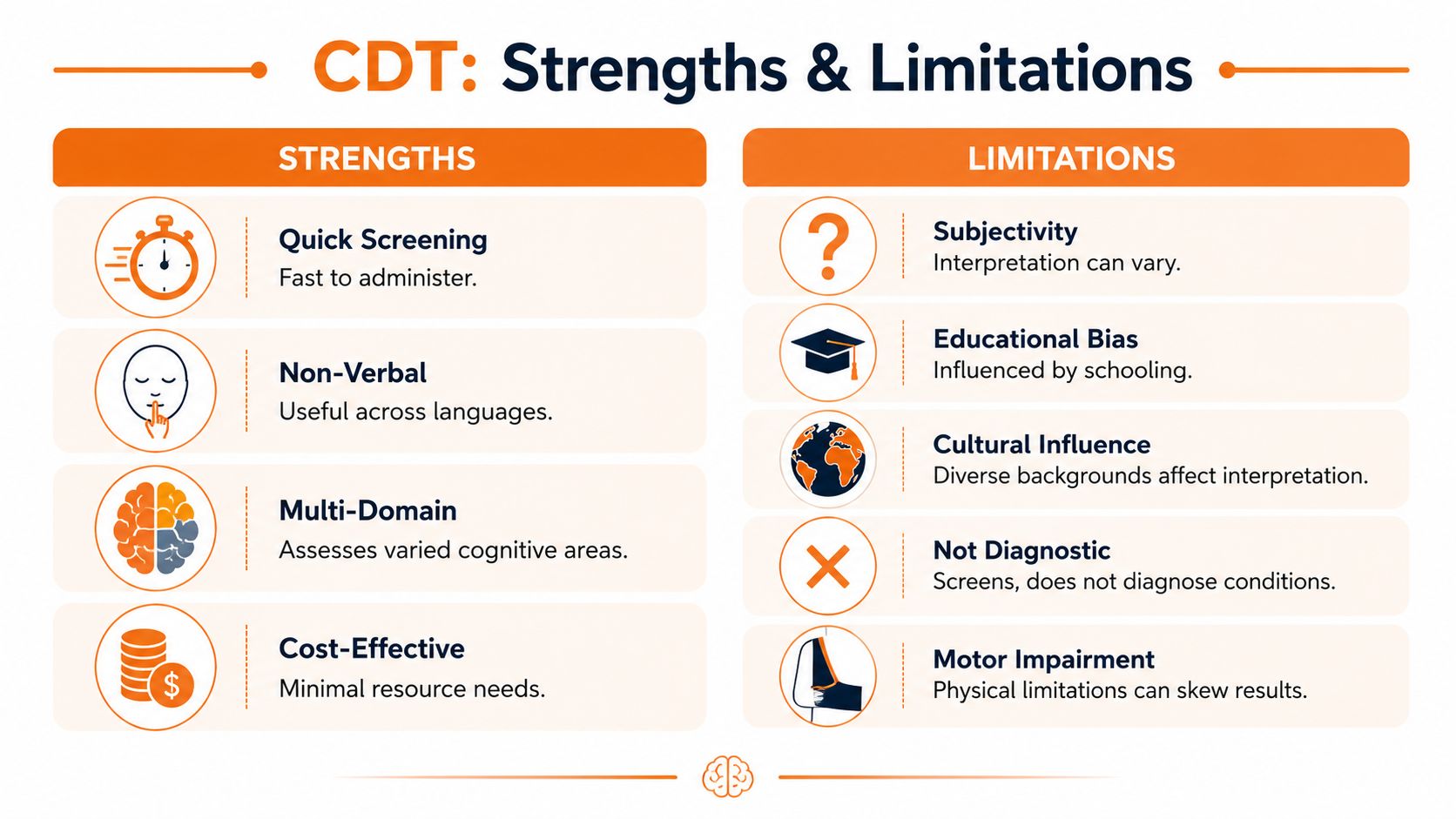
For Mild Cognitive Impairment, the CDT becomes much less dependable as a stand-alone screener. A 2026 report found sensitivity dropped to 47.9 to 60.4% for MCI, making it ineffective on its own for early detection compared with its stronger performance in more established dementia, according to Frontiers in Human Neuroscience.
That finding fits everyday practice. Patients with early decline often produce clocks that are broadly acceptable. The errors are subtle, inconsistent, or visible only if you watched the drawing unfold.
Junior clinicians often get trapped, assuming “not obviously abnormal” means “reassuring.” It doesn't.
A decent final clock can hide a messy process. Hesitation, self-correction, and inefficient sequencing may matter even when the page looks passable.
Context can distort the result in both directions
An abnormal clock doesn't always mean cognitive decline either.
Consider the patient with Parkinsonian tremor who understands the task but produces shaky lines and poorly formed hands. Or the patient with low vision who misplaces numbers because the page isn't visually clear. Or the person with limited formal schooling who has had little reason to draw analogue clocks for years.
Before you interpret the drawing, ask:
Vision first. Could reduced visual input explain spacing or hand-placement difficulty?
Motor status. Is tremor, arthritis, weakness, or slowed output interfering?
Language load. Did the patient fully understand the instruction?
Educational background. Are you expecting familiarity with a task the patient rarely uses?
Behaviour during testing. Did they ask for repetition, appear anxious, or get coached by family?
What to do when the clock and the history disagree
That mismatch is common and worth respecting.
If the family reports planning failures, disorganisation, or subtle decline in daily functioning, don't let a tidy-enough clock end the work-up. Use the CDT as one clue among others, not as final proof. The opposite is also true. A poor clock in someone with severe tremor or major visual impairment needs careful qualification before you label it cognitive.
The practical standard is simple. Interpret the clock in the context of the person, not in isolation from them.
Integrating CDT into a Modern Assessment Workflow
Traditional clock drawing gives you the final picture. Digital clock drawing can also show you the route the patient took to get there.
That difference matters most when the final product looks borderline normal. In those cases, process can tell you what static scoring cannot.
Why process data changes interpretation
Digital CDT systems can capture pen behaviour in real time. That includes features such as stroke latency, pauses between strokes, and angular deviation. One recent study reported that digital CDT implementations extracted over 100 kinematic features and achieved a weighted kappa of 0.81 against expert human coders for classifying mild cognitive impairment, with performance exceeding traditional image-based models, as described in Scientific Reports.
For clinicians, the value is practical. You can begin to separate these questions:
Is the patient slow because they're planning poorly, or because their hand is slow?
Are repeated strokes a motor correction, or a sign of perseveration?
Did the patient know where to place the numbers immediately, or did they hesitate before each decision?
Those distinctions are hard to extract from pen-and-paper scoring alone.
A workflow that works in real clinics
A modern approach doesn't replace clinical judgement. It sharpens it.
A useful workflow often looks like this:
Start with concern, not just screening. Use the history to frame what you're looking for.
Administer a structured cognitive screen. Include the CDT when executive and visuospatial concerns are relevant.
Review both product and process. If the final clock is borderline, process data can reveal hidden inefficiency.
Integrate with broader assessment tools. Use additional measures when the clinical question goes beyond dementia screening.
For families trying to understand how broader neuropsychological testing works across age groups, Children Psych's guide for parents offers a clear explanation of what thorough assessment can add beyond a brief screen.
When to move beyond the classic clock
Move past manual scoring when the referral question is nuanced. That includes possible MCI, mixed motor and cognitive presentations, repeated follow-up assessments, and settings where different raters need more objective data.
If your team is building a more consistent workflow, this overview of cognitive assessment tools is a practical next read.
The larger point is this. Clock drawing test interpretation is no longer limited to what remains on the page. In many cases, the clinically useful signal is in how the clock was produced.
From Interpretation to Actionable Care Plans
A clock drawing should change care only if you use it to guide the next decision.
That means translating the result into action. A low score may support referral for fuller cognitive evaluation. A pattern of conceptual errors may strengthen concern about a degenerative process. A mismatch between a normal-looking clock and a worrying history may justify more sensitive testing rather than reassurance.
In practice, I encourage clinicians to document three things after every CDT: the score, the dominant error pattern, and the contextual modifiers. That brief triad keeps your note clinically useful. It also makes family conversations easier because you can explain not just that the clock was abnormal, but how it was abnormal and why that matters.
A good interpretation also helps you plan next steps:
Further work-up when the clock raises concern that the interview didn't capture
Monitoring over time when the findings are subtle but the history is concerning
Rehab targeting when visuospatial, executive, or motor issues appear especially prominent
Family education when caregivers need a concrete example of decline
For older adults with broader frailty, function, and cognition concerns, a structured geriatric assessment program can place the CDT in a much more meaningful clinical frame.
The key lesson is simple. Don't treat the clock as the end of the assessment. Treat it as the start of a better care plan.
If you want a more objective way to move from brief screening to clear clinical decisions, explore Orange Neurosciences. Their platform helps clinicians, educators, and families turn cognitive signals into usable profiles and next-step recommendations. If you'd like to see how it fits your workflow, visit the website or contact the team by email for details.

Orange Neurosciences' Cognitive Skills Assessments (CSA) are intended as an aid for assessing the cognitive well-being of an individual. In a clinical setting, the CSA results (when interpreted by a qualified healthcare provider) may be used as an aid in determining whether further cognitive evaluation is needed. Orange Neurosciences' brain training programs are designed to promote and encourage overall cognitive health. Orange Neurosciences does not offer any medical diagnosis or treatment of any medical disease or condition. Orange Neurosciences products may also be used for research purposes for any range of cognition-related assessments. If used for research purposes, all use of the product must comply with the appropriate human subjects' procedures as they exist within the researcher's institution and will be the researcher's responsibility. All such human subject protections shall be under the provisions of all applicable sections of the Code of Federal Regulations.


© 2026 by Orange Neurosciences Corporation