Unlocking the Visual Spatial Sketchpad
Nov 30, 2025

Ever tried to picture how you'd rearrange the furniture in your living room before actually lifting anything? Or mentally retraced your steps to that new café you found last week? When you do this, you're firing up your visual spatial sketchpad—a powerful cognitive tool that acts as your brain’s inner whiteboard.
This guide will provide actionable insights into how your visual spatial sketchpad works and practical examples of how to strengthen it.
Introducing Your Mind's Eye
The visual spatial sketchpad is a core component of your working memory. You can think of it as a temporary mental canvas where you hold, inspect, and manipulate images and spatial layouts. It’s what lets you see the world around you in your mind, even when your eyes are closed.
Here’s a practical example: imagine you're putting together a piece of flat-pack furniture. You look at the diagram (that's your visual input), then you hold that image in your mind while you hunt for the right screws and panels. That ability to mentally "see" the diagram and rotate the pieces to match the real-world objects in front of you? That’s your visual spatial sketchpad hard at work.
What Does the Sketchpad Actually Do?
This mental tool is responsible for briefly storing and processing information about what things look like (visual) and where they are in relation to one another (spatial). It’s generally understood to have two main parts:
The Visual Cache: This is the part that stores information about form and colour. Actionable insight: When you're trying to remember a new logo, pay close attention to its specific colours and shapes. This deliberate focus helps "stamp" the image into your visual cache.
The Inner Scribe: This component handles spatial and movement information. It mentally rehearses what's in the visual cache and helps you track objects in motion. Practical example: Watch a ball fly through the air and predict where it will land—that's your inner scribe in action.
Together, these components help you navigate countless daily tasks. This diagram shows how the visuospatial sketchpad fits into the bigger picture of our working memory.
As the model illustrates, the sketchpad doesn’t work in isolation. It operates alongside other systems, all coordinated by the "Central Executive," to process information smoothly.
To break it down even further, here are some of the key functions the sketchpad manages every day.
Key Functions of the Visual Spatial Sketchpad
Function | Everyday Example | Actionable Insight |
|---|---|---|
Spatial Navigation | Mentally mapping out the best route to the grocery store. | Before leaving, close your eyes and visualize the turns you need to make. |
Mental Rotation | Figuring out if a suitcase will fit in the overhead bin. | Practice by rotating objects in your mind before physically moving them. |
Visual Recall | Describing a person's face from memory. | Actively notice 3-4 key features of a person you meet. |
Object Manipulation | Playing a game of Tetris or packing a moving box efficiently. | Sketch out a plan for packing a box to optimize space. |
Motor Coordination | Following a dance tutorial or mimicking someone's movements. | Watch the movement first, then visualize yourself doing it before you try. |
Creative Visualization | Imagining a new design for a room or a piece of art. | Use a simple app or paper to sketch out your visual ideas quickly. |
These tasks feel automatic, but they all rely on the sketchpad's ability to hold and work with visual information.
Why Your Inner Whiteboard Matters
A well-functioning visual spatial sketchpad is crucial for so much more than just assembling furniture or remembering routes. It’s fundamental to learning, problem-solving, and even creativity. For example, understanding how we mentally organize information is key to appreciating the visual spirit of a canvas app builder, where digital layouts are designed to align with our natural cognitive processes.
The visual spatial sketchpad isn't just about memory; it's about active visualization. It’s the engine that powers mental rotation, spatial reasoning, and our ability to build and interact with a mental model of our environment.
By getting a handle on this foundational concept, we can start to see just how vital it is for navigating the complexities of our visual world. In the sections that follow, we'll dive deeper into how this system works, how it’s measured, and what you can do to strengthen it.
To see how your own cognitive abilities measure up, explore the assessment tools available at Orange Neurosciences. Sign up on our website for a consultation or to receive cognitive health tips directly in your inbox.
How the Sketchpad Fits into Your Working Memory
Your visuospatial sketchpad isn't a solo act. It’s a key specialist on a larger cognitive team we call working memory—the system in charge of holding and juggling information for whatever you're doing right now. To really get a feel for its role, it helps to see how it works with the other members of this mental project team.
Picture your working memory as a busy workshop, an idea first mapped out by psychologists Baddeley and Hitch in their groundbreaking model. In this mental workshop, every component has a specific job, and they all answer to the manager.
The Project Team of Your Mind
This mental workshop has a clear structure. The seamless collaboration between these parts is what allows you to process the world around you, blending what you see, hear, and think into one coherent experience.
Let's meet the key players:
The Central Executive: This is the project manager, the "boss" of your working memory. It doesn't store information itself but instead directs your attention, delegates tasks to the other components, and decides what’s important and what can be ignored.
The Phonological Loop: Think of this as the team's verbal specialist. It handles all things spoken and written, like remembering a phone number someone just rattled off or silently repeating a sentence from a book to make sense of it.
The Visual Spatial Sketchpad: This is your workshop’s designer and architect. It manages all visual and spatial information, letting you mentally picture a room's layout, recall a friend's face, or map out a route in your head.
The real magic of working memory is its ability to weave these different streams of information together. The central executive acts as the conductor, making sure the phonological loop and the visuospatial sketchpad can work at the same time without tripping over each other.
Seeing the Sketchpad in Action
Here’s a practical example you can relate to: imagine you're driving and listening to your GPS. Your visual spatial sketchpad is hard at work processing the road ahead, keeping track of other cars, and picturing the upcoming turn. At the exact same time, your phonological loop is processing the spoken command: "In 200 metres, turn left."
This is where your central executive steps in as the coordinator, merging the visual data from your sketchpad with the verbal instructions from the loop. It helps you time the turn just right, ensuring both systems are perfectly in sync. Without this teamwork, you’d be overwhelmed trying to process the visual chaos of the road and the spoken directions simultaneously.
This diagram shows the core functions the visuospatial sketchpad manages within the working memory system.
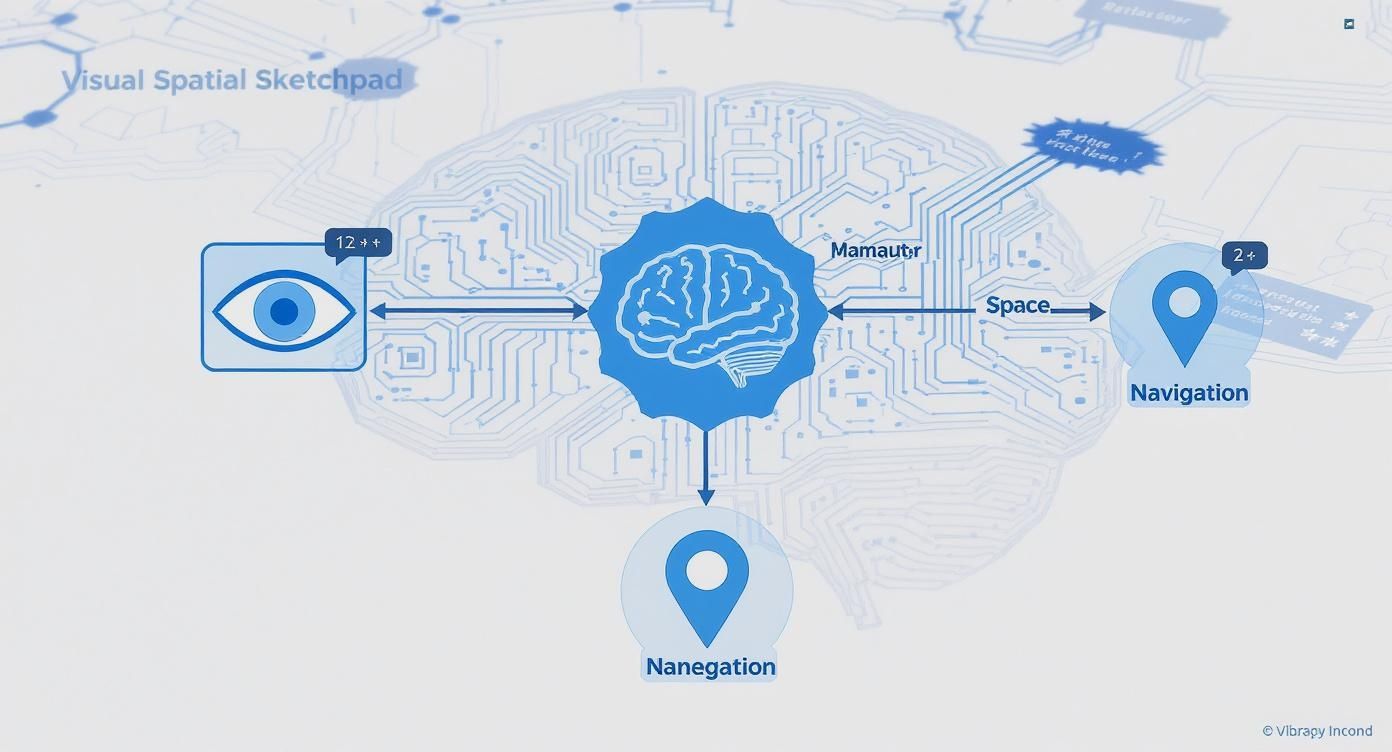
As you can see, this mental tool is essential for holding images, manipulating spatial relationships, and navigating your environment. This knack for working with visual data is a cornerstone of how we think and act. To explore the broader system, check out our guide on how to improve working memory.
Understanding this dynamic relationship gives you a clearer map of how your brain handles complex tasks. When you appreciate how the visual spatial sketchpad collaborates with other cognitive components, you can see just how vital it is for everything from learning and problem-solving to simply getting through your day.
Measuring and Understanding Visuospatial Abilities
So how do scientists actually peek inside our "mind's eye" to see what it's capable of? Abstract ideas like the visual spatial sketchpad become concrete through cleverly designed psychological tests. These aren't just academic exercises; they're practical tools that let researchers and clinicians measure how well someone can hold, recall, and mentally shuffle around visual and spatial information. They bridge the gap between theory and real-world function.
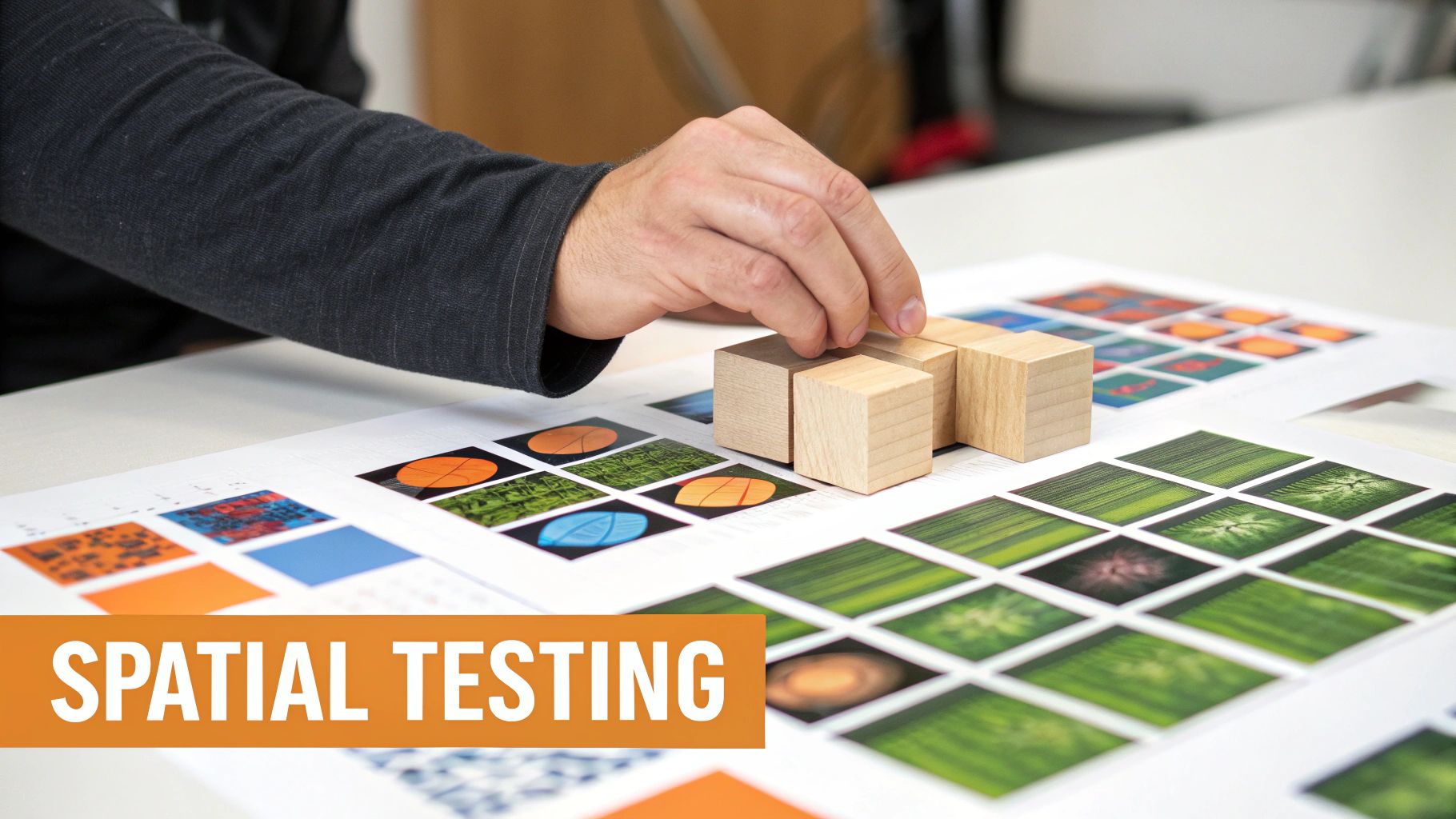
These assessments might sound intimidating, but they're often wonderfully simple in design. Their power lies in what they reveal. By isolating specific functions of working memory, they paint a clear picture of a person's cognitive strengths and where they might be struggling. Two of the most foundational and widely used tools are the Corsi Block-Tapping Test and the Visual Patterns Test.
The Corsi Block-Tapping Test
Imagine a board with nine identical blocks scattered on it. An examiner taps a few of these blocks in a specific order. Your job is to immediately tap them back in the exact same sequence. That’s the core of the Corsi Block-Tapping Test, a classic method for measuring spatial memory span.
The test starts easy, maybe with a two-block sequence. Get it right, and the next sequence gets longer—three blocks, then four, and so on. Your score is simply the longest sequence you can correctly remember and reproduce.
Practical example: This is the same skill you use when you watch someone enter a passcode on a keypad and try to remember the pattern of their finger movements. The test isolates your ability to recall a path of locations.
The Visual Patterns Test
Now, let's switch gears to a different kind of challenge. You're shown a grid with some squares filled in, creating a unique pattern. You have just a few seconds to study it before it vanishes. Then, you're handed a blank grid and asked to fill it in to match the pattern you just saw.
This is the Visual Patterns Test (VPT). Much like the Corsi test, it begins with simple patterns (maybe just two or three filled squares) before getting progressively more complex. Its main job is to assess the visual side of the sketchpad—your ability to remember static visual information that isn't in a sequence.
Practical example: This skill is what allows you to remember the layout of a website's homepage after only glancing at it for a moment, recalling where the search bar and menu icons were located.
Together, these tests give us a well-rounded view of the visuospatial sketchpad's dual functions. The Corsi test isolates your ability to track where things are (spatial memory), while the VPT gauges your capacity to remember what things look like (visual memory).
Getting to know these measurement tools is the first step in building a complete cognitive profile. For anyone looking for a clearer understanding of their own abilities, there are a variety of modern cognitive assessments available that build on the principles of these classic tests. Visit our website to explore the assessments we offer and see how you can gain actionable insights into your cognitive health.
The Sketchpad's Role in Learning and Academic Success
A strong visuospatial sketchpad is far more than a simple tool for getting around town; it’s a powerhouse in any learning environment, from a kindergarten classroom to a university lecture hall. This mental "inner whiteboard" is critical to how students wrap their heads around complex ideas, solve problems, and ultimately succeed in school, especially in STEM fields.
Imagine a student in a geometry class. To really get a proof, they need to mentally twist shapes around, visualize angles, and hold the entire structure in their mind's eye. This isn't just about memorizing formulas. It's an active, dynamic process of mental manipulation that’s powered entirely by the visuospatial sketchpad.
Why Visuospatial Skills Are Crucial in Education
In today's highly visual and data-rich world of learning, the ability to process and interpret visual information is non-negotiable. A well-developed visuospatial sketchpad allows students to turn abstract concepts into tangible mental models, which makes learning feel more intuitive and stick more effectively.
Here’s a look at the sketchpad in action across the curriculum:
Chemistry: A student pictures the 3D structure of a molecule to predict how it will react with another one.
Physics: A student mentally maps the arc of a projectile to solve a tricky motion problem.
Engineering: A student imagines how different parts of a machine will fit and function together long before touching a single real component.
History: A student organizes key events on a mental timeline, seeing how they connect and flow from one to the next.
Actionable insight for students: When studying, don't just read the text. Actively try to create a mental image or a quick sketch of the concept. For example, when learning about the water cycle, draw the process instead of just reading about it.
The Link to Mathematical Achievement
The connection between visuospatial skills and school performance is glaringly obvious when it comes to mathematics. All those essential tasks—arranging numbers on a mental number line, making sense of charts and graphs, and manipulating geometric shapes—rely heavily on this cognitive skill.
A strong visuospatial sketchpad doesn't just help with math—it's a foundational part of mathematical thinking itself. It lets learners break free from rote memorization to truly grasp how numbers and concepts relate to one another.
Research backs this up time and again. For instance, one study with elementary school children in California found that visuospatial working memory was the only memory component that uniquely predicted math calculation scores. It explained an extra 10.2% of the difference in scores, even after accounting for other factors like age and attention.
This powerful link highlights just how important it is to spot and build these skills from a young age. Often, a student struggling in certain subjects has a hidden hurdle in their visuospatial sketchpad. If you want to better understand your child's learning behaviour, looking at their visuospatial processing is a great place to start. For personalized insights, contact us through our website to discuss assessment options.
When Your Internal GPS Needs Support
When the visual spatial sketchpad starts to falter, everyday life can feel like you're trying to navigate through a thick fog. Suddenly, simple tasks like figuring out how to fit all your groceries into the fridge or just picturing where you last saw your keys become surprisingly difficult.
For many, these are the first subtle hints that the brain’s inner navigation system is off course.
Visuospatial difficulties can show up in a number of conditions. Adults with ADHD often talk about losing their train of thought or misjudging distances. People with non-verbal learning disabilities might struggle with diagrams. Conditions like dementia and stroke can scramble long-held mental maps.
Here are practical examples of these challenges:
ADHD challenges: An individual might miss their highway exit because they were mentally overwhelmed trying to track their position, speed, and surrounding cars simultaneously. Organizing a closet becomes a monumental task because they can't visualize where everything will fit.
Non-verbal learning disability: A student might be an excellent reader but get completely stuck trying to interpret a simple bar graph or assemble a model from a visual guide.
Stroke effects: After a stroke, someone might consistently pour water next to a glass instead of into it, unable to judge the distance correctly.
Dementia impacts: An individual might get lost in their own home, unable to recall the layout of rooms they’ve lived in for decades.
Actionable Support Strategies
If you or a loved one are facing these challenges, the goal is to provide external structure to support the internal "sketchpad."
Practical Example: ADHD Take Alexia, a graphic designer with ADHD. She struggles to visualize room layouts. Her actionable strategy is to always use a simple tablet app to sketch a floor plan before a client meeting. This externalizes the task, freeing up her working memory to focus on creativity.
Practical Example: Dementia or Stroke After his stroke, Carlos really struggled to pour a glass of water without spilling. His occupational therapist provided an actionable insight: use a high-contrast mat to place the glass on. The bright color provides a clear visual target, making the spatial judgment easier and reducing spills.
“Disorientation from sketchpad impairment can feel like being adrift at sea,” says neurotherapist Dr. Elina Rousseau. "The key is to provide anchors—simple, consistent visual cues that help the brain reorient itself."
How to Get Help
Addressing these visuospatial gaps early is crucial. The first step is a proper assessment to understand the specific nature of the difficulty.
Get Assessed: A clinician can use tests like the Corsi block-tapping task and the Visual Patterns Test to get a baseline for spatial and visual memory.
Implement Targeted Training: Based on the assessment, a program of cognitive exercises can be created.
Adapt the Environment: Simple changes, like labeling drawers with pictures or using colored tape to mark pathways, can make a huge difference.
Our cognitive therapies at Orange Neurosciences offer a field-tested approach, combining classic assessment tasks with interactive digital tools designed to help rebuild those essential mental mapping skills.
If you are noticing persistent disorientation, it's important to act promptly. Contact our team to schedule a full spatial assessment. We can provide a personalized support plan delivered right to your email. It’s time to start regaining your internal GPS.
Actionable Strategies to Enhance Your Visuospatial Skills
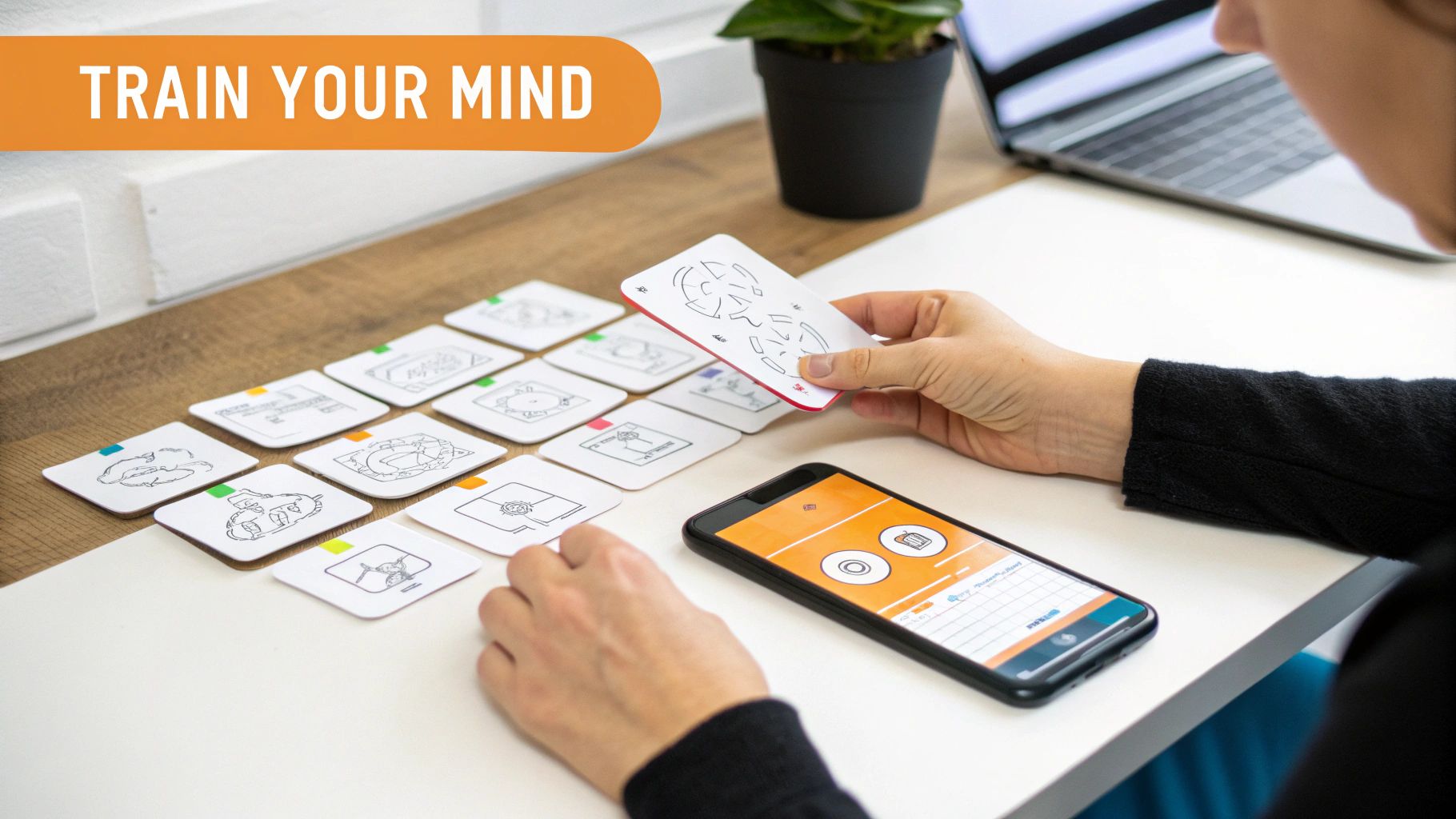
Knowing what your visuospatial sketchpad is marks the starting line. The real progress begins when you start actively training it. Think of it like a muscle—with consistent and targeted practice, your ability to hold and twist visual and spatial information in your mind can get significantly stronger.
The best part? Many of the most effective strategies are engaging and can be easily integrated into your daily routine. These techniques offer benefits for everyone, helping to keep your mind sharp and your internal GPS finely tuned.
Classic Techniques to Build Your Mind's Eye
These timeless methods are incredibly effective because they get right to the heart of what your visual spatial sketchpad does.
Here are some actionable strategies to try today:
Mind Mapping: Instead of writing a linear to-do list, draw it as a mind map. Put your main goal in the center and branch out with tasks. This forces your brain to organize information spatially, making it easier to recall your plan.
The Method of Loci (Memory Palace): Practical example: To remember your grocery list (milk, bread, eggs), picture a giant bottle of milk blocking your front door, a loaf of bread on your sofa, and eggs smashed on your TV. By mentally "walking" through your house, you'll easily recall the items.
Jigsaw Puzzles and Tangrams: These hands-on activities are fantastic for training mental rotation. Actionable insight: Try to find the correct piece by visualizing its shape and how it would fit, rather than just by trial and error.
These analogue exercises are perfect for building a strong foundation. In fact, many align with learning styles that prove highly effective in school.
Digital Tools for Modern Cognitive Training
Today, we have an incredible variety of digital tools designed to make cognitive training more interactive and dynamic. Brain-training games and specialized apps offer targeted exercises that adapt to your performance, providing a personalized path to building your visuospatial abilities.
Digital platforms offer a unique advantage by providing immediate feedback and tracking progress over time. This data-driven approach allows you to see tangible improvements, which helps maintain motivation.
These tools often turn cognitive exercises into fun challenges. Many apps feature tasks where you have to memorize and replicate complex patterns, find your way through virtual mazes, or mentally rotate 3D objects to solve a puzzle.
Strategies for Strengthening Visuospatial Skills
Strategy Type | Analogue Method (Practical Example) | Digital Tool (Practical Example) |
|---|---|---|
Pattern Recognition | Completing a jigsaw puzzle. | Playing a game like Bejeweled or Candy Crush. |
Spatial Navigation | Drawing a map of your route to work from memory. | Playing a first-person navigation video game. |
Mental Rotation | Solving a Rubik's Cube. | Playing a 3D puzzle game like Tetris or Blockudoku. |
Visual Memory | Playing the card game "Memory" (Concentration). | Using brain-training apps that flash objects for you to recall. |
Both analogue and digital methods offer distinct benefits. The key is finding a consistent practice you enjoy, as that's what will lead to lasting improvements in your visuospatial processing. Many of these exercises also strengthen skills that support other abilities, like physical coordination. You can dive deeper into this connection by exploring our guide on eye-hand coordination exercises. Similarly, to boost mathematical reasoning, consider adopting effective strategies for studying math.
A Few Common Questions
As you delve into the world of working memory, a few questions naturally pop up. Let's clear up some common points of confusion about the visual spatial sketchpad to round out your understanding.
What's the Difference Between Visual and Spatial Memory?
Think of it like this: can you picture your best friend’s face? That’s visual memory. Now, can you picture where they usually sit when you grab coffee together? That’s spatial memory.
One is about what something looks like—its colour, shape, and specific features. The other is about where something is in space, and how it relates to everything else around it.
Visual Example: Remembering the exact design on your favourite coffee mug.
Spatial Example: Mentally mapping out the quickest route from your desk to the kitchen.
The visual spatial sketchpad is responsible for both, but they're distinct abilities. That's why some psychological tests, like the Visual Patterns Test, focus squarely on visual recall, while others, like the Corsi Block-Tapping Test, are designed to measure how well you remember spatial sequences.
Can You Actually Improve Your Visual Spatial Sketchpad?
Absolutely. Your visual spatial sketchpad isn't set in stone. It's a cognitive skill, and just like a muscle, you can strengthen it with the right kind of exercise. When you consistently engage in activities that challenge you to visualize and mentally manipulate objects, you're actually building stronger, more efficient neural pathways.
Our brains have a remarkable ability to adapt and rewire themselves, a concept known as neuroplasticity. This means that targeted training can create real, measurable improvements in how well your visuospatial sketchpad functions.
Actionable insight: Spend just 15 minutes a day on activities like jigsaw puzzles, 3D video games, or even just sketching out ideas. Consistency is more important than intensity.
Is the Visual Spatial Sketchpad the Same as a Photographic Memory?
That's a great question, but no, they're very different things.
What people call photographic memory (the technical term is eidetic memory) is the incredibly rare ability to recall an image with near-perfect detail after seeing it just once. It's like having a high-resolution snapshot stored in your head—a passive recall of information.
The visual spatial sketchpad, on the other hand, is an active, dynamic mental workspace. It’s not for storing flawless pictures. It’s for working with visual information. Practical example: Someone with a photographic memory might perfectly recall a complex blueprint, but it's the sketchpad that allows an engineer to look at that blueprint and mentally assemble the machine, rotating parts to see how they fit.
Ready to move from theory to practice and get a clearer picture of your own cognitive abilities? Orange Neurosciences offers precise, evidence-based cognitive assessments and personalized training tools.
Our platform can help you pinpoint strengths and weaknesses in areas like the visual spatial sketchpad, giving you actionable insights to support brain health. See how our game-based assessments can create a detailed cognitive profile for you or your clients.
Learn more and get actionable tips by visiting us at https://orangeneurosciences.ca or by signing up for our email newsletter.

Orange Neurosciences' Cognitive Skills Assessments (CSA) are intended as an aid for assessing the cognitive well-being of an individual. In a clinical setting, the CSA results (when interpreted by a qualified healthcare provider) may be used as an aid in determining whether further cognitive evaluation is needed. Orange Neurosciences' brain training programs are designed to promote and encourage overall cognitive health. Orange Neurosciences does not offer any medical diagnosis or treatment of any medical disease or condition. Orange Neurosciences products may also be used for research purposes for any range of cognition-related assessments. If used for research purposes, all use of the product must comply with the appropriate human subjects' procedures as they exist within the researcher's institution and will be the researcher's responsibility. All such human subject protections shall be under the provisions of all applicable sections of the Code of Federal Regulations.


© 2026 by Orange Neurosciences Corporation