Expert Guide: Test Photographic Memory
Apr 18, 2026

Most advice on how to test photographic memory starts in the wrong place. It treats the task as a party trick. Show a picture, ask a few trivia-style questions, assign a label, move on.
That approach fails clinically.
When practitioners talk about “photographic memory”, we’re usually dealing with a looser public term for eidetic memory, a much narrower and far rarer phenomenon. The primary work isn’t to prove that someone has a superpower. It’s to determine whether their recall reflects high-fidelity visual persistence, strong but ordinary visual memory, learned mnemonic strategy, attentional strength, or reconstruction from gist.
That distinction matters in schools, clinics, rehab settings, and research protocols. It affects how you question the participant, how you score responses, what you infer from errors, and whether you escalate to broader cognitive assessment. If your conceptual model is sloppy, your testing will be sloppy too.
The Myth of Photographic Memory
The popular image of photographic memory is simple. A person glances at a page once and can replay it exactly at will. In clinical work, that claim almost never survives structured assessment.
The more accurate term is eidetic memory. Even then, we need to be careful. An eidetic report is not the same as excellent recall, high intelligence, or a well-practised memory technique. It refers to unusually vivid visual persistence after the stimulus is removed, with detail that appears to be “read off” an internal image rather than reconstructed.
That’s why broad cognitive context matters more than the label. A child may perform strongly on a visual recall task because of attention, perceptual organisation, or rehearsal strategy, not because they retain a literal internal snapshot. A useful refresher on that broader frame is this guide to cognitive function, especially if you’re training staff who tend to isolate memory from the rest of the profile.
Why pop tests mislead
Online quizzes usually reward quick noticing, familiarity with common image patterns, and confidence under pressure. They rarely control for examiner language, cueing, stimulus complexity, or response bias.
They also ignore a basic clinical problem. If a participant gives a mostly accurate answer, what produced it? Was it visual persistence, semantic clustering, inferential filling-in, or simple luck on multiple-choice items? Without a structured protocol, you can’t tell.
A strong score on an internet quiz doesn’t establish eidetic memory. It usually establishes that the person noticed more than average, or guessed well enough to look exceptional.
What actually deserves attention
The practical question is narrower and better. Can the person retain a detailed visual image after removal in a way that exceeds ordinary recall and resists explanation by standard strategies?
For most practitioners, the answer won’t lead to a dramatic diagnosis. It will lead to a better cognitive description. That’s more useful anyway. It tells you how to teach, when to probe attention, when to suspect processing weaknesses, and when a “photographic memory” claim should be reframed before it hardens into family lore.
Defining Eidetic Memory Versus Strong Visual Recall

If you want to test photographic memory properly, you need an operational distinction. Otherwise every high-performing participant starts to look “eidetic”, and every dramatic story from a parent or teacher starts to sound plausible.
What counts as eidetic memory
The clearest clinical marker is this. After a complex image is removed, the participant appears to retain a vivid internal visual representation and can report details as though scanning what is still “there” in the mind’s eye.
That’s different from remembering the main theme of the image. It’s also different from recalling a few striking details. The standard protocol described in this overview of picture recall testing uses 30 seconds of exposure before recall. It also notes that eidetic memory is more common in children, with estimates of 2% to 10% in young children on picture recall tests, while less than 1% maintain high-fidelity recall in standard testing after removal.
In practice, that means the child who says, “There was a red balloon near the top left, and below it a dog facing the fence,” is not automatically eidetic. The child who continues to report spatial detail in a stable, image-like way after the picture is gone deserves closer attention.
What strong visual recall looks like instead
Most impressive performers fall into another category. They have strong visual recall, not eidetic memory.
That profile often includes:
Good attentional capture: They encode more because they looked carefully the first time.
Efficient chunking: They group related features into meaningful units.
Semantic organisation: They remember “kitchen”, then retrieve likely kitchen details.
Learned strategy use: They rehearse, compare, name, or map locations.
An adult using a memory palace can outperform an untrained child on a recall task and still show nothing like eidetic persistence. That’s why conceptual clarity matters before you interpret results.
For trainees, I often recommend reviewing a concise explanation of how memory works because it helps separate encoding, storage, retrieval, and reconstruction. Those distinctions prevent overcalling a striking performance.
Why age changes the picture
Childhood reports deserve a different lens from adult self-claims. The visual system, language development, and representational style aren’t static across development.
From a practical standpoint:
Young children may rely more heavily on image-based retention in some tasks.
As language and categorisation become more dominant, image persistence may become less apparent.
Adults with excellent recall usually show strategic, associative, or practised memory rather than true eidetic performance.
That developmental shift is one reason visual memory should sit within a broader model of the visual spatial sketchpad, not as a stand-alone curiosity.
Clinical distinction: Eidetic memory is about post-stimulus visual persistence. Strong visual recall is about effective encoding and retrieval. They can look similar in casual testing, but they are not the same construct.
A practical example
Consider two participants shown the same busy street scene.
One child reports, after the image is removed, “The second window had blue curtains, and the bicycle was behind the bench.” The report unfolds as if the child is still inspecting the scene.
An adult says, “I remembered the scene by grouping it into transport, buildings, and people.” That adult may score well. But that is strategy-based recall, not evidence of eidetic imagery.
When you hear “I can still see it” or “I’m looking at it in my head,” don’t treat that as proof. Treat it as a hypothesis to test.
A Protocol for Administering Photographic Memory Tests
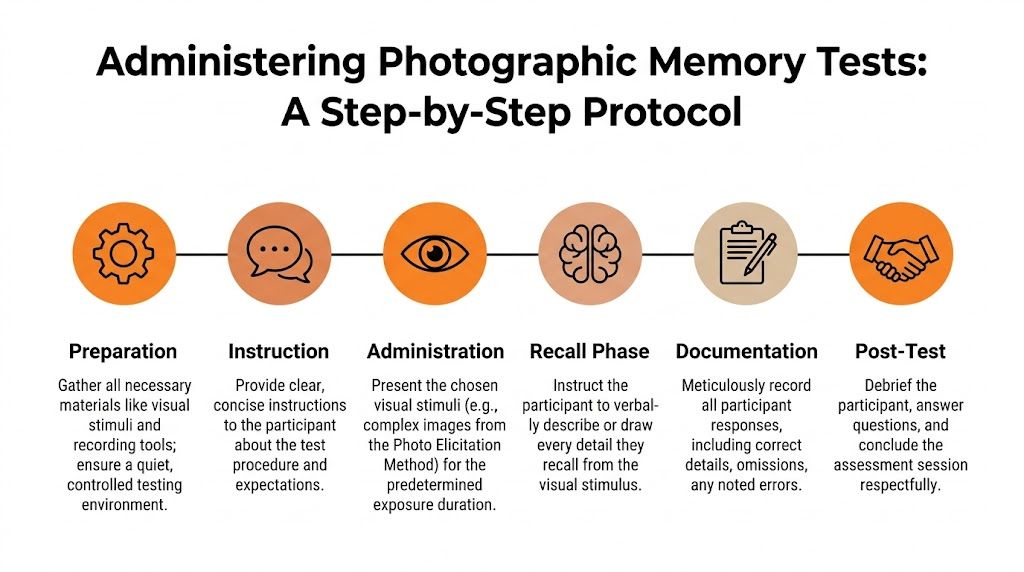
The most reliable way to test photographic memory is to stop improvising. Use a controlled procedure, standardise your wording, and document the participant’s behaviour as carefully as the content of the response.
Start with the room, not the image
Poor administration begins before the stimulus appears. If the room is noisy, the screen is poorly calibrated, or the examiner keeps rephrasing prompts, the task stops being interpretable.
Set up these basics first:
Control distractions: Reduce competing visual and auditory input.
Use consistent display conditions: Keep viewing distance, lighting, and screen quality stable.
Prepare response capture: Record verbatim responses where possible. Notes alone often miss clinically useful phrasing.
Keep prompts standardised: Don’t reward one participant with richer cues than another.
I also advise deciding in advance whether the participant will give a verbal report, a drawing, or both. Mixed decisions made on the fly create scoring problems later.
Use the Photo Elicitation Method correctly
The most defensible core procedure is the Photo Elicitation Method. A concise description appears in this review of whether photographic memory is real. The protocol requires the participant to view a complex image for 30 seconds, after which the image is removed and the participant gives a detailed verbal report. According to that review, fewer than 1% of the population achieve over 90% detail accuracy that persists for more than 30 seconds. It also notes that many self-proclaimed eidetikers fail tasks such as reverse-text recall, exposing reconstructive bias.
That matters because the test is not “Did they remember a lot?” The test is “What kind of memory process produced the response?”
A workable clinic protocol
I train juniors to use a simple sequence.
Select unfamiliar, detail-rich stimuli
Use scenes with multiple objects, colours, positions, and anomalies. Avoid famous images or highly schematic pictures that invite guessing from scripts.Deliver brief, fixed instructions
Tell the participant to look carefully because the image will be removed and they’ll then describe everything they can recall. Don’t mention “photographic memory”. That phrase changes behaviour.Present the image for 30 seconds
Don’t extend the exposure because the participant “seems engaged”. Consistency matters more than comfort.Remove the image cleanly
No partial fade, no thumbnail left on screen, no reflective monitor artefacts.Elicit free recall first
Ask for an uninterrupted report before probing. Free recall tells you more about organisation and image persistence than leading questions do.Probe systematically after free recall
Move through categories such as objects, colours, spatial layout, text, and unusual features.Record process observations
Note pauses, scanning eye movements into blank space, self-corrections, confidence shifts, and whether answers sound inferential.
What to watch while they answer
Content is only half the data. The process often tells you whether the participant is retrieving, reconstructing, or confabulating.
Useful observations include:
Stable spatial referencing: The participant repeatedly locates details in the same relative positions.
Image-like scanning: Their gaze may move as though tracking parts of the absent image.
Low need for prompting: They continue retrieving detail without repeated examiner scaffolding.
Resistance to suggestion: They don’t absorb false details inserted by the examiner.
Practical rule: If your questioning becomes increasingly specific, your test gradually shifts from memory assessment to cue-assisted recognition.
Comparison of visual memory assessment methods
Method | Description | Best For | Limitations |
|---|---|---|---|
Photo Elicitation Method | Complex image shown briefly, then removed for detailed recall | Suspected eidetic phenomena, structured clinical observation | Examiner training matters, scoring can drift |
Delayed scene recall drawing | Participant reproduces a viewed scene from memory | Educational settings, visual-spatial organisation | Drawing skill can distort interpretation |
Recognition-style image quiz | Participant identifies correct details from options | Quick screening, group administration | Encourages guessing and inflates apparent accuracy |
Reverse-text or anomaly recall tasks | Participant reports unusual text or hard-to-infer details | Testing claims of literal visual retention | Narrow task demands, can frustrate children |
Broader working memory tasks | Assesses attention and retention under controlled load | Differential diagnosis, wider cognitive profiling | Not a direct eidetic test |
For broader attentional context, I often pair visual tasks with a separate measure such as a digit span test. Not because digit span measures photographic memory. It doesn’t. But it helps clarify whether weak performance came from visual memory limits or from general attentional fragility.
Adaptation for children and adults
The wording should differ, even if the protocol doesn’t.
With children, keep language concrete: “Tell me everything you can remember about the picture.” With adults, you can ask for structured description by category after free recall. In both groups, avoid praise that signals accuracy mid-test. Once participants realise the examiner is pleased by certain kinds of answers, they start manufacturing detail.
A simple school-based example shows why this matters. A pupil says she can remember pages “exactly”. During testing, she reports gist well but misses object placement and invents likely classroom items that never appeared. That profile points to strong comprehension and reconstructive recall, not eidetic performance. The distinction helps teachers far more than the myth ever would.
Scoring Interpretation and Differential Diagnosis
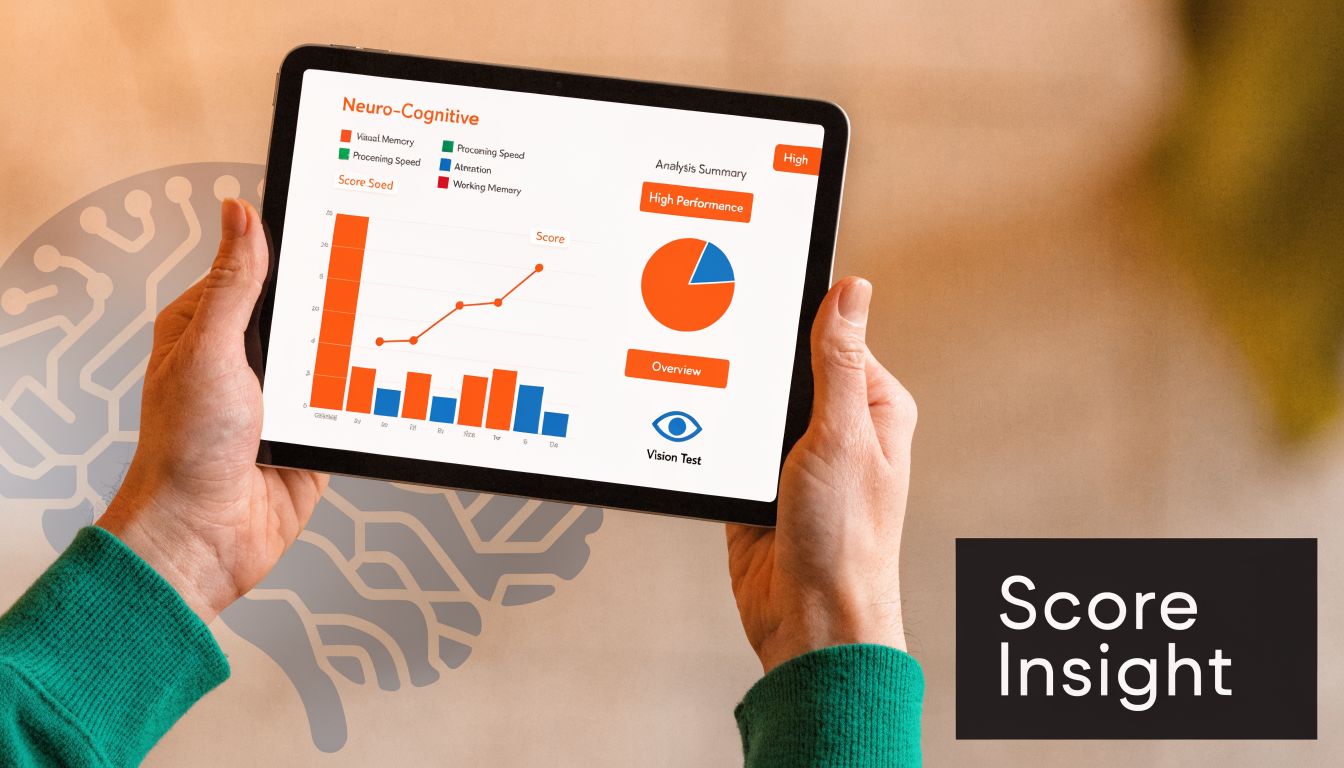
Scoring is where many otherwise careful assessments unravel. A dramatic report feels convincing, so the examiner overweights confidence, vocabulary, or speed. That’s a mistake. The scoring system has to separate accurate detail, omission, distortion, and plausible invention.
Score the response, not the performance style
A participant may sound authoritative and still be wrong. Another may hedge and still be highly accurate. Build your scoring around observable match to the original stimulus.
I use four response classes:
Correct detail: Matches the stimulus in content and position where relevant.
Partially correct detail: Captures the item but misses an important attribute such as colour or placement.
Intrusion: Adds content not present in the image.
Inference: Supplies a likely but unobserved detail based on context.
Eidetic-like reporting should produce a pattern of dense, stable correct detail with relatively few inferential additions. By contrast, strong gist memory often produces coherent but “too sensible” responses.
Interpret rarity carefully
Adult claims deserve extra caution. This summary of eidetic memory research reports heritability at around 50% from twin studies, but also notes that fewer than 1% of adults show true eidetic traits under rigorous testing, often using 30-second exposures to abstract patterns. The same source explains why broader benchmarking of attention and processing speed is often more clinically informative than chasing a rare eidetic label.
That doesn’t mean striking adult performance is unimportant. It means your interpretation should be broader than “yes” or “no” on photographic memory.
Differential questions that actually help
When results are unusual, ask these questions:
Is this primarily an attention effect
Some participants encode unusually well because they sustain focus, resist distraction, and inspect systematically. Their output may be excellent, but the mechanism is attentional efficiency.
Clues include strong initial capture, orderly recall, and good performance across non-visual concentration tasks.
Is this a visual-spatial strength without eidetic persistence
A person may excel at layout, position, and pattern while still relying on ordinary memory processes. These participants often draw reproductions better than they verbally describe them.
That profile may matter in educational planning, occupational assessment, or rehab, even if it doesn’t qualify as eidetic.
Is this reconstruction from semantics
This is common. The participant recalls the theme and fills missing pieces with likely content. Kitchen scenes gain extra cups. Classrooms gain posters. Street scenes gain signs.
Those errors are not random. They are organised by schema.
When a response sounds more logical than visual, I assume reconstruction until the data prove otherwise.
Is there a broader neurodevelopmental or cognitive issue
A child can show a sharp visual memory strength alongside weaknesses in verbal retrieval, processing speed, or impulse control. Conversely, a child referred for “amazing memory” may show uneven performance driven by narrow interests, anxiety, or inconsistent attention.
That’s why isolated eidetic-style findings should never stand alone. Interpretation is stronger when the rest of the profile is stable and repeatable. If you’re building a longitudinal workflow, it’s worth grounding the process in principles of test retest reliability so you know whether apparent strengths persist across administrations or fluctuate with context.
A practical scoring example
Suppose a participant recalls fifteen details from a market scene. Ten are correct, three are partially correct, and two are plausible but absent. If those two absent details are both typical market items, that’s not evidence of extraordinary visual persistence. It’s evidence that semantic structure helped retrieval.
Now compare that with a participant who recalls an odd sign placement, an unusual object colour, and a spatial relation that was hard to infer. Those are the details that deserve weight. They’re less “guessable”, and therefore more diagnostically useful.
Validity Concerns and Integrating Digital Assessments
Traditional eidetic testing has an old problem. It can look rigorous while still being surprisingly vulnerable to bias. Examiner wording drifts, scoring rubrics loosen, and memorable performances receive more weight than reproducible ones.
That’s why many online versions are worse than unhelpful. They create confidence without validity. This review of online photographic memory testing notes that most such tests lack clinical validity. It also highlights a practical service gap in California, where over 1 in 6 children have neurodevelopmental disorders and diagnostic wait times can run 6-12 months. In that setting, weak screening practices aren’t trivial. They can delay appropriate referral and obscure conditions such as ADHD.
The main validity problems
A practitioner who wants to test photographic memory ethically has to confront at least four problems.
Construct confusion
People use “photographic memory” to describe very different things. Some mean vivid imagery. Others mean strong recognition, superior rote learning, or quick study skills. If you don’t define the construct tightly, your assessment has no target.
Suggestibility
Participants, especially children, are highly sensitive to examiner cues. A single leading prompt can turn uncertain recall into false confidence.
Scoring subjectivity
Two examiners can hear the same response and score it differently unless the rubric is explicit. This is especially true for partially correct details and inferential answers.
Label inflation
Once a parent, teacher, or clinician says “photographic memory”, the label can become sticky. That creates unrealistic expectations and may distract from genuine weaknesses in attention, language, or executive function.
The ethical risk isn’t just false positive identification. It’s building an identity around a trait you haven’t actually established.
Where digital assessment helps
Digital tools don’t solve the construct problem by themselves. The clinician still has to ask the right question. But they do help with standardisation.
A well-built digital workflow can:
Fix timing precisely: Exposure duration and recall intervals remain consistent.
Standardise stimuli: Every participant sees the same calibrated presentation.
Capture richer process data: Response latency, error patterns, and consistency become easier to track.
Reduce examiner drift: Less ad hoc prompting means cleaner comparisons.
Support broader profiling: Visual memory can be interpreted alongside attention, processing speed, executive function, and perception.
That broader frame matters more than many clinicians admit. A child referred because they seem “visually gifted” may need support for uneven cognitive development. Another may appear weak on a visual task because of poor impulse control, not because of a memory deficit.
How to integrate digital tools without overclaiming
The strongest workflow is blended, not purely automated.
Use direct visual recall testing when the referral question specifically concerns eidetic-like ability or unusual visual retention. Then place those findings within a wider digital cognitive battery. If the person performs inconsistently across visual memory, attentional control, and processing measures, the interpretation becomes far more useful than a stand-alone “photographic memory” score.
In practical terms, I’d suggest this order:
Clarify the referral question.
Run a structured visual recall task.
Follow with standardised digital assessment of adjacent domains.
Review convergence and discrepancy.
Report functionally, not theatrically.
For teams building remote or hybrid services, a resource on online cognitive assessment is useful because the logistics of screen-based testing, supervision, and interpretation differ from in-person administration.
What doesn’t work
Three habits repeatedly undermine good assessment.
Using novelty quizzes as if they were clinical screens: They are not.
Treating one exceptional trial as proof: Outlier performance needs replication.
Ignoring the rest of the profile: Memory claims become misleading when detached from attention, language, and executive control.
The practical trade-off is simple. Narrow testing gives you a cleaner answer to a narrow question. Integrated testing gives you a more useful answer for treatment, education, and follow-up. In real-world practice, the second is usually what people need.
Actionable Tips for Clinicians and Educators
The most useful improvements in this area are usually small. Better prompts. Better stimulus selection. Better explanation of results. That’s what makes a photographic memory assessment clinically usable rather than merely interesting.
Sharpen your testing habits
Choose culturally neutral or at least culturally transparent stimuli: If the image relies on specific background knowledge, you may end up scoring familiarity instead of memory.
Ask free recall before specific questions: Once you begin cueing, you change the task.
Separate “saw” from “figured out”: Ask, “Did you remember seeing that, or does it just seem likely?” Older children and adults can often make that distinction usefully.
Document exact wording from unusual responders: A phrase like “I can still see the left corner” has more interpretive value than a summary note saying “good visual memory”.
Give feedback without sensationalising
Parents and teachers often want a headline. Resist that pressure.
Say things like:
“Your child showed strong visual recall for complex scenes.”
“The pattern suggests careful encoding and good spatial memory.”
“The results don’t support the idea of literal photographic recall, but they do show a meaningful visual learning strength.”
That language is accurate and still helpful. It steers the conversation toward support, not mythology.
In supervision: If a result would sound impressive on a school open night but vague in a case conference, rewrite it.
Use training ideas carefully
One non-clinical visual memory study summarised in this photographic memory quiz write-up tested 2000 adults with a 7-second exposure to 10 images. Only 1.2% achieved a perfect 10/10. Among those top scorers, 71% were female, 92% did regular brain exercises, and 83% had artistic hobbies or weekly video gaming.
That doesn’t prove causation, and I wouldn’t present it that way. But it does support a practical point. Visual memory benefits from active engagement. For students and families, that means drawing from memory, noticing visual detail intentionally, and using retrieval-based review methods rather than passive re-reading.
If you want a simple framework to recommend for study routines, this guide to the spaced repetition study technique is a reasonable companion resource because it reinforces retrieval over exposure.
Match recommendations to the profile
A child with good visual recall but weak verbal organisation may benefit from diagrams, mapping, and image-supported instruction. An adult rehab patient with strong recognition but poor free recall may need more structured cueing and repetition. An anxious high-achiever may need reassurance that not having “photographic memory” says nothing negative about learning potential.
The best assessments end with a plan. If the result doesn’t change teaching, therapy, monitoring, or referral, the testing wasn’t focused enough.
Conclusion From Assessment to Actionable Insights
To test photographic memory well, you have to stop chasing the myth and start measuring the process. The useful question isn’t whether someone seems extraordinary. It’s whether their recall reflects true image persistence, efficient encoding, strategic reconstruction, or a broader cognitive pattern that matters more than the memory label.
That shift changes the entire workflow. You choose cleaner stimuli, use tighter instructions, score more cautiously, and interpret the findings alongside attention, processing, and executive control. You also avoid one of the most common mistakes in this area, which is turning an intriguing performance into an overconfident identity claim.
For clinicians and educators, the practical standard is straightforward. Use structured visual recall methods when the referral question warrants them. Pair those observations with broader objective cognitive data. Report functionally. Reassess when needed. Keep the language precise.
That’s how “photographic memory” stops being a pop-culture distraction and becomes a legitimate part of cognitive assessment.
If you want a more objective, workflow-friendly way to move from visual memory questions to a broader cognitive profile, explore Orange Neurosciences. The platform supports rapid assessment across memory, attention, executive function, perception, processing speed, and related domains, helping clinicians, educators, and families turn uncertain observations into actionable next steps.

Orange Neurosciences' Cognitive Skills Assessments (CSA) are intended as an aid for assessing the cognitive well-being of an individual. In a clinical setting, the CSA results (when interpreted by a qualified healthcare provider) may be used as an aid in determining whether further cognitive evaluation is needed. Orange Neurosciences' brain training programs are designed to promote and encourage overall cognitive health. Orange Neurosciences does not offer any medical diagnosis or treatment of any medical disease or condition. Orange Neurosciences products may also be used for research purposes for any range of cognition-related assessments. If used for research purposes, all use of the product must comply with the appropriate human subjects' procedures as they exist within the researcher's institution and will be the researcher's responsibility. All such human subject protections shall be under the provisions of all applicable sections of the Code of Federal Regulations.


© 2026 by Orange Neurosciences Corporation