A Guide to the Digit Span Test for Memory
Nov 27, 2025
Ever tried to remember a phone number just long enough to dial it? That mental juggling act is exactly what the digit span test measures. It’s a core cognitive assessment that acts like a quick "stress test" for your brain's ability to hold onto and work with small bits of information.
What Is the Digit Span Test?
At its heart, the digit span test is a fundamental tool used by cognitive psychologists and neuropsychologists to get a clear look at a very specific kind of memory: your verbal working memory. This isn't about remembering what you had for breakfast last week; it's about the mental sticky note you use for immediate, temporary storage and manipulation of information.
This simple but incredibly powerful evaluation gives us crucial clues about attention, concentration, and immediate recall. Because it’s so focused, it’s an indispensable part of any comprehensive cognitive assessment, helping clinicians map out a person's unique cognitive strengths and weaknesses.
The Two Core Components
The test is neatly divided into two distinct parts. Each one targets a slightly different brain function, which allows for a much more detailed picture of an individual's memory profile.
Digits Forward: This is the more straightforward part. You listen to a sequence of numbers and simply repeat them back in the exact order you heard them. It’s a pure measure of short-term memory and attention.
Practical Example: If the examiner says "8-3-5," your actionable task is to repeat it back verbatim: "8-3-5." This is similar to hearing a confirmation code over the phone and holding onto it just long enough to type it into a keypad.
Digits Backward: Now, things get a bit trickier. You hear a sequence of numbers, but this time, you have to repeat them in the reverse order.
Practical Example: If the examiner says "2-9-4," your actionable task is to mentally flip the sequence and say, "4-9-2." This requires you not only to store the numbers but to actively manipulate them—a true test of your working memory.
Researchers have found that the backward digit span task is particularly sensitive. One fascinating study showed a 20% improvement on this task after participants simply took a brief walk in nature versus a walk in a city, showing just how much our environment can impact our working memory.
What the Test Reveals
By comparing how someone performs on both parts of the test, a clinician can uncover some really valuable insights. A big gap between the forward and backward scores can signal specific challenges.
For example, a person might easily recall a long string of numbers forward but stumble when asked to reverse them. This could suggest that while their simple recall is strong, they struggle when they need to mentally shuffle information around. This often points toward difficulties with executive functions—the higher-level brain processes that govern planning, focus, and mental flexibility.
Ultimately, the test provides a clear, measurable snapshot of a cognitive skill that we rely on for countless everyday tasks, from following a recipe with multiple steps to keeping up with a complex conversation.
How to Administer the Digit Span Test
Running a digit span test is more than just reading numbers off a page. To get valid, reliable results, you need precision and a controlled environment. Think of it as creating a clear, quiet channel for the brain to receive and process information without any static or interference.
The first thing you need to sort out is the testing space. It has to be a quiet room, free from distractions like chatter, visual clutter, or unexpected interruptions. This ensures the only thing the person is focused on is your voice. Their performance should reflect their cognitive capacity, not their ability to tune out a noisy room.
Once the environment is set, it all comes down to your delivery. Your job is to be a neutral, consistent presenter of the digit sequences.
This flowchart shows the simple yet crucial cognitive process happening behind the scenes.
As you can see, the journey from hearing the numbers to speaking them aloud involves distinct stages of attention, mental processing, and verbal recall. The test is designed to measure how well each of these stages functions.
The Standardized Protocol
To ensure consistency and accuracy, the test follows a very specific, two-part protocol. Here’s a quick overview of how the two subtests are administered.
Step | Digits Forward | Digits Backward |
|---|---|---|
Instructions | Provide clear, simple instructions: "I will say some numbers. When I am done, say them back to me exactly as I said them." | Provide new instructions: "Now, I will say more numbers. When I am done, say them backwards." Give a practice trial. |
Pacing | Read each digit at a steady pace of one per second. Avoid rhythm or grouping. | Read each digit at the same steady pace: one per second. Maintain a neutral tone. |
Starting Point | Begin with a simple, three-digit sequence (e.g., "5-8-2"). | Begin with a two-digit sequence (e.g., "2-4") after the practice trial. |
Progression | If the participant passes at least one of two trials at a given length, they move to the next length (e.g., from 3 digits to 4). | The same progression rule applies. If they pass at least one of two trials, they advance to the next sequence length. |
Discontinuation | The test stops when the participant fails both trials at a specific sequence length. | The test stops when the participant fails both trials at a specific sequence length. |
Let's break down each part of the protocol in a bit more detail.
Digits Forward: The First Step
The test always kicks off with the Digits Forward portion. This part is a fairly straightforward measure of attention and basic short-term memory. It's structured to start easy and get progressively harder.
You’ll start by explaining the task simply and clearly. Then, you begin with a short sequence, maybe three digits long. For example, the first trial could be "5-8-2." If the individual repeats it correctly, you give them the second trial of the same length. If they get at least one of the two trials right, you move on to the four-digit sequences.
This continues until the participant fails both trials at a particular sequence length. This "discontinuation rule" is important because it prevents frustration and efficiently pinpoints their maximum capacity.
Digits Backward: The Real Workout
After finishing the forward section, you move on to Digits Backward. This is a much more demanding task because it taps into working memory. It's not just about holding numbers in mind; it's about mentally manipulating them.
The setup is similar, but the instructions change. You’d say something like, "Now I am going to say some more numbers, but this time, when I stop, I want you to say them backwards."
It's a good idea to provide a quick practice trial, like "2-4," to make sure they've grasped the concept before you start the scored portion. If you say "7-1-9," the correct response is "9-1-7." Just like the forward test, the sequences start short and get longer, and the same discontinuation rule applies.
Sticking to these standardized steps is what makes the results meaningful. If you're interested in seeing how these protocols fit into larger cognitive evaluations, our guide on the Montreal Cognitive Assessment instructions offers more context on structured clinical testing. At the end of the day, proper administration is the foundation for any useful cognitive insight.
Scoring and Interpreting Your Results
Finishing the digit span test is just the beginning. The numbers you’ve collected are simply raw data—meaningless until they’re scored and put into the right context. Think of it like a blood test; a single number doesn’t tell you much without knowing the normal range for someone of a similar age and background.

This is where the real work begins. The scoring process is what transforms those raw numbers into powerful insights about an individual’s short-term and working memory. It’s how clinicians and researchers see beyond a simple digit count to understand how someone’s performance truly stacks up against their peers.
From Raw Scores to Meaningful Metrics
The first step is calculating the raw scores. This part is straightforward—you just tally the maximum number of digits a person correctly recalled for each part of the test.
Digits Forward Raw Score: This is the longest string of digits the person repeated correctly in the forward sequence.
Digits Backward Raw Score: This is the longest string of digits they managed to repeat correctly in reverse order.
Total Raw Score: Simply add the Digits Forward and Digits Backward scores together.
So, if someone’s best forward sequence was 7 digits and their best backward was 5, their raw scores are 7 and 5. Their total raw score is 12. But what does a score of 12 actually mean?
By itself, a raw score offers very little information. To become clinically useful, it has to be compared against normative data—a massive, standardized dataset collected from a representative sample of the population.
This comparison is what elevates a simple number into a diagnostic tool. By seeing how a score measures up against the average performance of others in the same age group, we can figure out if it falls within a typical range or if it might hint at a potential cognitive issue. For any assessment, consistent measurement is key, and understanding concepts like test-retest reliability statistics provides deeper insight into the accuracy of these tools.
Why Demographics Matter in Interpretation
One of the most crucial parts of interpreting the digit span test is using the right normative data. Things like age and education level can make a huge difference in performance. An 8-digit forward span might be outstanding for a 75-year-old but perfectly average for a 25-year-old.
This is why standardized tests always provide tables that break down scores by demographic groups. For example, research from the University of California, Davis, found that for women between 85 and 95, the average digit span forward score was 5.80 digits. The same study noted that higher education levels often correlated with slightly better scores, which really drives home the need for context. You can read the full research on how age and education impact scores for a more detailed look.
Putting It All Together: A Practical Example
Let’s walk through a quick scenario to see how this all comes together.
Imagine a 68-year-old man with 12 years of education takes the digit span test.
Calculate Raw Scores: He correctly remembers a maximum of 6 digits forward and 4 digits backward. His raw scores are 6 (Forward) and 4 (Backward).
Consult Normative Data: The clinician pulls up a normative table for men aged 65-69 with a high school education.
Convert to Standardized Scores: According to the table for his demographic, a raw score of 6 forward translates to a scaled score of 9, while a raw score of 4 backward becomes a scaled score of 8.
These scaled scores are standardized so that 10 is always the average, with a standard deviation of 3. This means most people will score somewhere between 8 and 12. In our example, scores of 8 and 9 are in the low-average range. While not low enough to signal a major deficit on their own, they could be noteworthy when considered alongside other assessment data. This actionable insight helps clinicians decide if further testing is needed.
It’s this conversion—from a simple raw number to a standardized score—that gives the digit span test its power, allowing for a fair and accurate picture of an individual's cognitive function.
A score from the digit span test is far more than just a number—it’s a powerful lens into how a person’s brain is functioning. This isn't some abstract academic exercise; it's a practical, real-world tool used in clinical settings every day. Clinicians rely on it to help diagnose, monitor, and create effective treatment plans for a whole host of conditions. Its simplicity and speed make it a go-to in any neuropsychologist's toolkit.
What makes the test so insightful is its ability to separate simple short-term recall (Digits Forward) from the more complex task of mental manipulation (Digits Backward). This lets clinicians pinpoint specific cognitive struggles. A low score doesn't just tell us "memory is poor." It helps us dig deeper and ask why it might be struggling, which is crucial for developing targeted, effective support.
Identifying ADHD and Executive Function Challenges
For anyone with Attention-Deficit/Hyperactivity Disorder (ADHD), the core struggle often comes down to executive functions—think of them as the brain's self-management system. The digit span test, especially the Digits Backward part, directly measures working memory, which is a cornerstone of executive function.
Practical Example: A student with ADHD might understand every single step of a multi-step math problem but lose track of the numbers before they can complete the calculation. The digit span test can quantify this exact challenge. A score that's noticeably lower than expected for their age can be a strong indicator of a working memory weakness, a true hallmark of ADHD.
Of course, no one diagnoses ADHD with a single test. But it provides a vital piece of the puzzle. When you combine a low digit span score with other assessments and clinical observations, you start to build a complete picture of an individual's cognitive profile. This actionable insight guides treatment toward strategies that genuinely support and strengthen their working memory, such as breaking down instructions into smaller chunks.
An Early Indicator for Dementia and Cognitive Decline
As we age, even small changes in memory can be a real cause for concern. The digit span test is a remarkably sensitive tool for picking up on the early signs of cognitive decline linked to conditions like dementia and Alzheimer's disease.
As dementia progresses, it often impacts the brain's frontal cortex. This is the very region that’s working hard during the Digits Backward subtest. A significant drop in the Digits Backward score, especially when the Digits Forward score is holding steady, can be an early red flag. This pattern suggests that while the ability to hold information is still there, the capacity to mentally work with it is starting to fade.
The digit span test is particularly useful for dementia care because it helps identify patterns of cognitive change, allowing for timely interventions. These insights are used to create personalized care plans that align with the specific needs of individuals, promoting dignity and independence.
This kind of early insight allows families and healthcare providers to be proactive. Catching these changes early can lead to interventions aimed at preserving cognitive function and making sure quality of life remains as high as possible, for as long as possible.
Measuring Recovery from Traumatic Brain Injury
When someone experiences a traumatic brain injury (TBI), the cognitive fallout can be immediate and life-altering. The digit span test is a crucial benchmark for not only assessing the extent of the damage but, just as importantly, tracking the journey of recovery.
Right after a TBI, a patient's digit span scores are often very low, reflecting serious difficulties with attention, concentration, and memory. These initial scores give clinicians a clear, objective baseline to measure all future progress against.
Practical Example: A TBI Recovery Journey
Imagine a patient who, one month after a car accident, can only recall 4 digits forward and 2 digits backward. This score quantifies their initial impairment. As they begin cognitive rehabilitation, clinicians can use the digit span test at regular intervals to track their progress.
Three months post-injury: Their scores might improve to 5 digits forward and 3 backward.
Six months post-injury: They could reach 6 digits forward and 5 backward, getting much closer to the normal range for their age.
This kind of steady, measurable improvement offers tangible and motivating feedback for both the patient and their clinical team. It’s solid proof that the rehabilitation strategies are working and helps everyone decide what the next steps in the recovery plan should be. The test turns a long, complex recovery process into clear, understandable data points.
At Orange Neurosciences, we integrate tools like the digit span test into a broader digital framework, allowing for precise, ongoing monitoring of cognitive changes. To see how modern platforms are making this process more efficient and insightful, we invite you to explore our cognitive assessment solutions and learn how you can gain a clearer understanding of brain health.
The Shift to Digital Digit span Tests
Cognitive assessment is leaving the clipboard and stopwatch behind. The classic digit span test, a staple of paper-and-pencil evaluations for decades, is making the move to digital platforms. This isn't just a facelift for an old tool; it’s a fundamental upgrade in how we measure, track, and understand a person's working memory.
This evolution smooths out the subtle, often unavoidable, inconsistencies of manual testing. Digital versions bring flawless standardization to the table—every single digit appears for the exact same duration and at the same tone. This removes tiny variables that could skew results, while automated scoring eliminates the chance of human error and delivers objective data in an instant.
That level of precision is the bedrock of reliable assessment. For a closer look at how technology is reshaping the field, our comprehensive guide on cognitive assessment online is a great resource.
Enhanced Reliability and Efficiency
One of the biggest wins with digital administration is the dramatic improvement in test reliability. When every test is delivered under identical conditions, the results become far more consistent over time. That’s absolutely critical when you’re trying to track cognitive changes or see if an intervention is actually working.
This isn't just a theory; the research backs it up. Studies have shown that computerized digit span tests produce more dependable and efficient results. For example, work done at the VA Northern California Health Care System found that the test-retest reliability was significantly higher with digital methods, showing correlations between sessions ranging from 0.76 to 0.85. You can learn more about these findings on computerized digit span assessment and what they mean for cognitive screening.
Integration with Comprehensive Cognitive Profiles
Modern platforms like Orange Neurosciences don't just put the test on a screen; they weave it into a complete cognitive profile. This allows a clinician to finally see the whole picture: how working memory performance connects to other key areas like attention, processing speed, and executive function.
This is what it looks like in practice on the Orange Neurosciences platform, where different cognitive metrics are displayed for clear, simple interpretation.
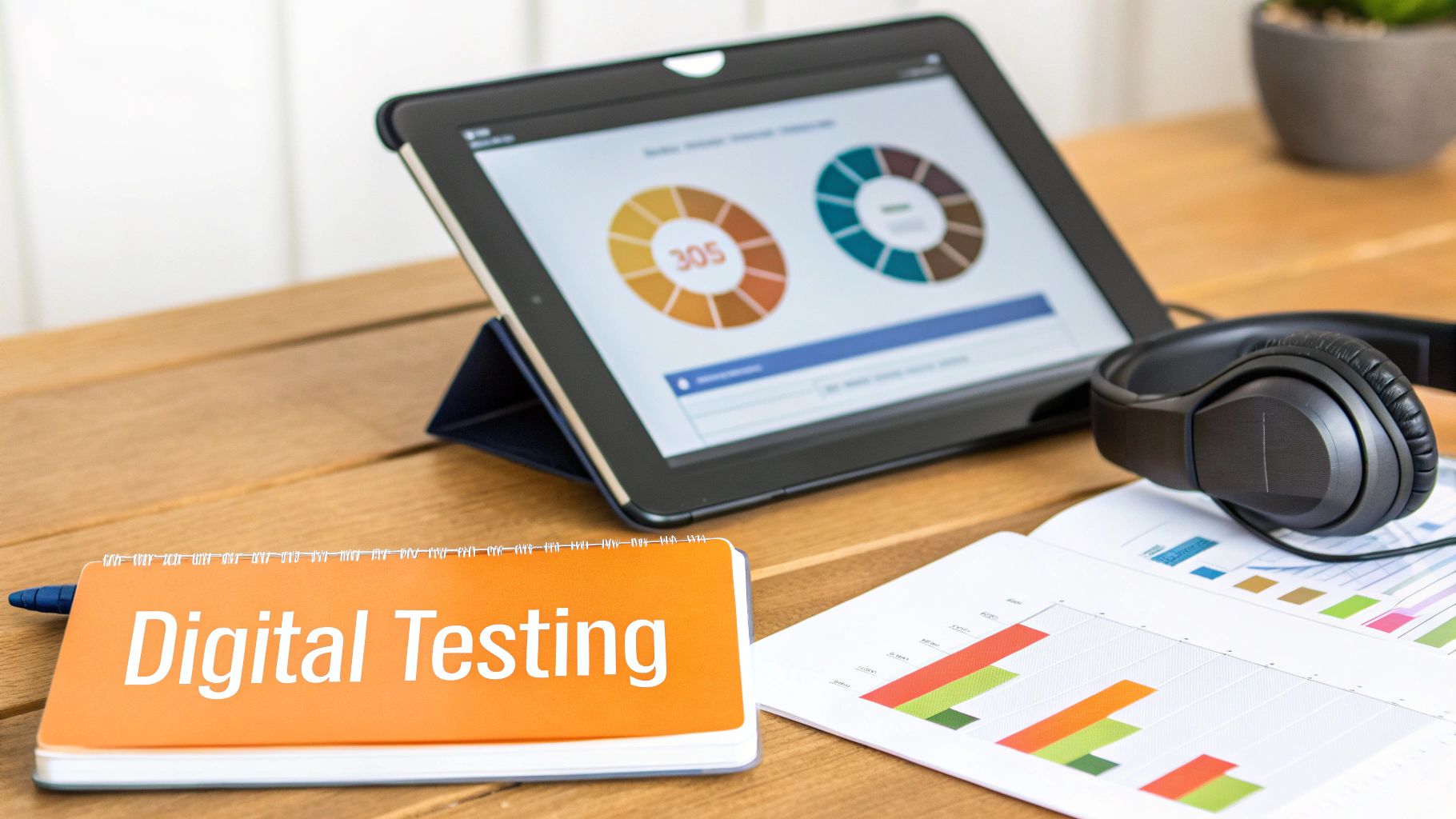
The dashboard gives you an at-a-glance view of a person’s cognitive strengths and weaknesses, turning what used to be isolated test scores into a story that makes sense and points toward a clear path forward.
Instead of one static score, these platforms generate detailed, ongoing reports. This data is incredibly valuable for:
Monitoring Progress: Seeing how cognitive function changes throughout therapy or a training program.
Informing Interventions: Pinpointing specific weak spots that need targeted support.
Providing Feedback: Sharing clear, visual reports with individuals and their families to help them understand their cognitive journey.
By bringing the digit span test into a broader digital ecosystem, clinicians can move from a single snapshot of memory to a dynamic, continuous understanding of a person's brain health.
This shift makes truly personalized and responsive care possible. Imagine a patient recovering from a TBI whose digit span scores have hit a plateau. A clinician can see that trend immediately and adjust their cognitive rehabilitation plan on the fly to introduce fresh strategies.
Digital tools are fundamentally reshaping cognitive care, making assessment more accurate, efficient, and insightful than ever before. To see how these advanced digital assessments can work in your practice or for your own cognitive monitoring, we invite you to explore the Orange Neurosciences platform. Discover how our data-driven approach provides the clarity needed to make confident decisions about brain health.
Common Questions About the Digit Span Test
As one of the most fundamental tools in cognitive assessment, the digit span test naturally brings up a lot of questions. Let's dig into some of the most common queries to clear up the nuances of how it works and what the results really mean.
What Is a Normal Score on the Test?
This is probably the most-asked question, and the answer isn't a single number. There’s no universal “normal” score. A person's performance is always measured against a normative sample of their peers—people of a similar age and sometimes education level. This context is everything; it’s what gives the score its meaning.
That said, a good rule of thumb is that an average scaled score is 10, with the typical range falling between 8 and 12. Looking at raw numbers, a healthy adult can often recall about 7 digits forward and 5 digits backward, but this can vary quite a bit from person to person.
Can You Practise to Improve Your Score?
Yes, you can definitely improve your score with a bit of practice, but it's crucial to understand what that improvement signifies. Using memory tricks like chunking—where you group numbers into memorable clusters like a year (19-84) or a phone prefix (613)—can give your performance a temporary boost.
However, this is often just a "practice effect" and doesn't necessarily mean you've made a fundamental change to your underlying working memory capacity. In a clinical setting, the administrator will always note if you've been exposed to the test before, as it can inflate the score and muddy the interpretation. If you're interested in lasting improvements, check out our guide on how to improve working memory.
How Long Does the Test Take?
The digit span test is popular for a reason: it's incredibly efficient. A complete administration, covering both Digits Forward and Digits Backward, is quick. It typically takes just 5 to 10 minutes to complete. Its speed is one of the main reasons it’s a staple in comprehensive clinical batteries and research studies.
This efficiency allows clinicians to gather crucial data on working memory without causing fatigue, ensuring the results are a reliable snapshot of a person’s cognitive abilities at that moment.
Does Anxiety or Fatigue Affect Performance?
Absolutely. The digit span test is highly sensitive to a person's state of mind. It relies heavily on attention and concentration, so things like anxiety, stress, fatigue, or even just low motivation can pull scores down significantly.
A skilled administrator is trained to spot these factors. They're essential for an accurate interpretation. A low score doesn't automatically point to a memory deficit; it might just reflect a temporary dip in focus or a tough day emotionally. Background and specialized training can also play a role. For instance, one study found that musicians with absolute pitch had a remarkably higher auditory digit span, showing just how much unique skills can shape cognitive performance. You can discover more about these findings on auditory memory here.
Understanding your cognitive profile is the first step toward strengthening it. At Orange Neurosciences, we use precise, data-driven assessments to provide the clarity you need to make informed decisions about your brain health.

Orange Neurosciences' Cognitive Skills Assessments (CSA) are intended as an aid for assessing the cognitive well-being of an individual. In a clinical setting, the CSA results (when interpreted by a qualified healthcare provider) may be used as an aid in determining whether further cognitive evaluation is needed. Orange Neurosciences' brain training programs are designed to promote and encourage overall cognitive health. Orange Neurosciences does not offer any medical diagnosis or treatment of any medical disease or condition. Orange Neurosciences products may also be used for research purposes for any range of cognition-related assessments. If used for research purposes, all use of the product must comply with the appropriate human subjects' procedures as they exist within the researcher's institution and will be the researcher's responsibility. All such human subject protections shall be under the provisions of all applicable sections of the Code of Federal Regulations.


© 2026 by Orange Neurosciences Corporation