Rivermead Post Concussion Symptom Questionnaire: A Practical Scoring Guide
Feb 4, 2026
When a patient is recovering from a mild traumatic brain injury (mTBI), their world can feel completely upside down. Symptoms like persistent headaches, dizziness, and that frustrating mental fog are invisible, subjective, and often incredibly hard for them to put into words.
This creates a real challenge for clinicians: how do you accurately measure something you can't see? This is where the Rivermead Post Concussion Symptom Questionnaire (RPQ) comes in. It acts as a bridge, translating a patient's internal experience into clear, actionable clinical data.
Decoding Concussion Symptoms with the RPQ
Think about it. A patient might just say, "I feel off." While that's honest, it doesn't give you much to work with for a treatment plan. The RPQ takes that vague feeling and methodically breaks it down into 16 specific areas, asking about everything from headaches and dizziness to irritability and forgetfulness.
This simple process gives structure to the patient's experience, turning a general complaint into a detailed, quantifiable report. It's a simple, 16-item self-report tool, but its impact is profound.
From Subjective Feelings to Objective Data
The most critical role of the RPQ is to establish a clear baseline. By quantifying symptoms soon after an injury, clinicians get a snapshot of the patient's starting point. This initial score becomes the benchmark against which all future progress is measured. Without it, tracking recovery is mostly guesswork.
The questionnaire helps to:
Pinpoint Key Problem Areas: A high score for "Noise Sensitivity" is an actionable insight. You can immediately advise the patient on practical steps like using earplugs in loud environments or planning quiet time during their day.
Track Recovery Over Time: Seeing the total score drop from 25 to 15 over three weeks provides concrete evidence that your treatment plan is working, motivating both you and the patient.
Guide Clinical Decisions: A steady drop in RPQ scores provides the evidence needed to support decisions about returning to work or sport. For example, consistently low scores on cognitive items can help you confidently approve a phased return to office duties.
Improve Patient Communication: The questionnaire provides a structured way for patients to talk about their struggles, helping them feel truly heard and understood.
A Foundational Tool in Modern Concussion Care
"The correlation between the structural changes shown in [neuroimaging] and the self-reported results of the RPQ-16 highlights how [tools like this] can be a nonpharmacologic option for the treatment of concussion symptoms."
This quote gets to the heart of the matter: a patient's self-reported data is a powerful piece of the clinical puzzle. Before diving into the specifics of the RPQ, it's helpful to have a solid grasp of the condition it helps assess. For more background, check out this clear guide to understanding what post-concussion syndrome is.
Ultimately, the RPQ empowers clinicians to move beyond simple observation to an approach grounded in data. While it measures subjective symptoms, its structured format provides an objective framework for evaluation. When you pair this with objective cognitive data from platforms like those offered by Orange Neurosciences, you start to get a complete picture of a patient's brain health.
To dig deeper into the questionnaire itself, you might be interested in our full guide to the Rivermead concussion questionnaire.
Administering and Scoring the RPQ Step by Step
Using the Rivermead Post Concussion Symptom Questionnaire effectively is about more than just handing a form to a patient. To turn a patient's subjective feelings into solid clinical data, you need precision in how you administer it and accuracy in how you score it. Let's walk through a clear framework to make sure you get high-quality, reliable information every time.
The whole process hinges on one core instruction to the patient. They are comparing their symptoms in the last 24 hours to how they felt before their injury. This comparison is absolutely crucial. If a patient misses this, they might just rate their current pain without that vital pre-injury baseline, which can throw off the entire assessment.
Mastering the Patient Instructions
Before they even pick up the pen, take a moment to walk them through the rating scale. It’s not just about asking, "Do you have a headache?" It's about, "How much worse is your headache now compared to your normal before the injury?"
A simple script can make a world of difference:
"We're going to look at 16 common symptoms. For each one, I want you to first think about how you typically felt before your injury."
"Next, think about how that same symptom has been over the last 24 hours."
"You'll rate it from 0 to 4. A 0 means it's no more of a problem than before your injury, and a 4 means it's a severe problem now."
Practical Example: If a patient regularly had mild headaches before their accident, a score of "0" or "1" might be normal. But if their headaches are now debilitating, that would warrant a "3" or "4", reflecting the change in severity. This small step is your best defence against the most common administration errors. Getting this right is fundamental to the questionnaire's reliability. For a deeper dive into why consistency matters so much in measurement, check out our guide on test and retest reliability.
The 16 Symptoms and Their Clinical Clusters
The RPQ organizes its 16 symptoms into three clinical categories. Understanding these clusters is like having a roadmap to a patient's struggles; you can quickly see patterns and pinpoint where they need the most support, going far beyond just a total score.
Below is a breakdown of how the symptoms are grouped and what the scoring scale really means in a clinical context.
RPQ Symptom Clusters and Scoring Key
Symptom Cluster | RPQ Item Example | Likert Scale Score | Clinical Meaning |
|---|---|---|---|
Somatic (Physical) | Headaches, Dizziness, Nausea, Noise/Light Sensitivity | 0 | Not a problem |
Cognitive (Thinking) | Forgetfulness, Poor Concentration, Taking Longer to Think | 1 | Present, but not a problem |
Emotional (Feeling) | Irritability, Feeling Depressed, Frustration, Restlessness, Poor Sleep | 2 | A mild problem |
(All Clusters) | Items from any cluster | 3 | A moderate problem |
(All Clusters) | Items from any cluster | 4 | A severe problem |
This structure helps translate a patient's personal experience into a clear, organized picture that informs your clinical judgment.
This chart really captures how the RPQ works as a bridge, turning a patient's internal, subjective experience into structured data that you can actually work with.
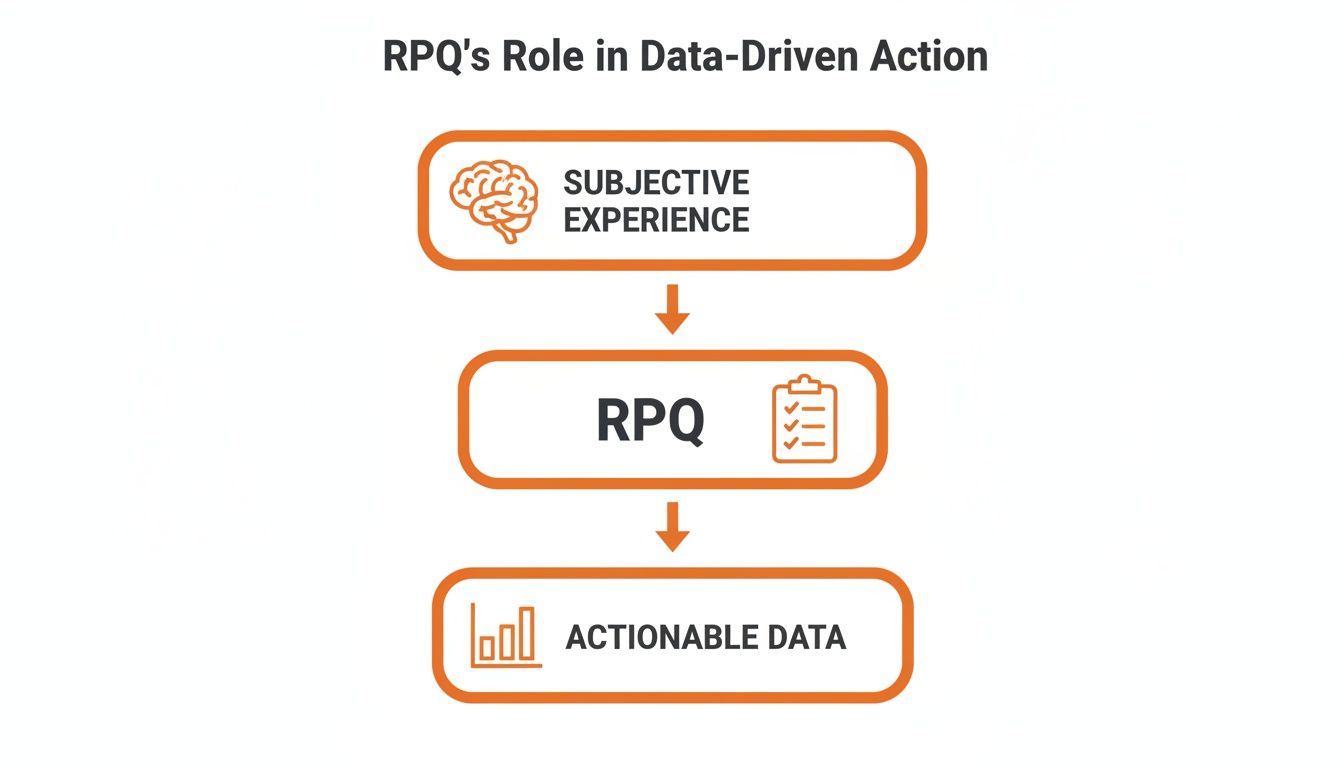
It’s all about systematically translating that internal state into numbers that can guide a truly effective treatment plan.
Calculating the Two Key Scores
Once the patient is finished, you’ll calculate two different scores. Each one gives you a unique piece of the puzzle.
The RPQ provides two distinct but complementary data points: a Total Severity Score that measures overall symptom burden and a Symptom Count that measures the breadth of the patient's issues.
First up is the Total RPQ Score. This one's straightforward: just add up the ratings (0-4) for all 16 items. The score can land anywhere from 0 (meaning no symptoms are worse than before the injury) to a maximum of 64 (where all symptoms are rated as severe). This number is a powerful, at-a-glance measure of the patient’s overall post-concussion symptom load.
Second is the Symptom Count. This is a much simpler metric that asks: how many of the 16 symptoms did the patient rate as a 2 or higher? This tells you the number of symptoms that are causing at least a mild problem. It’s an important number because a patient might have a relatively low total score but a high symptom count, which points to a wide range of milder issues that still need attention.
Practical Example: A patient scores a total of 12. This seems low. But their symptom count is 6, with six different symptoms all rated as a "2" (mild problem). This insight tells you the patient is dealing with a broad array of persistent, low-level issues that require a multi-faceted approach, rather than focusing on one severe symptom.
By carefully walking through these steps—clear instructions, understanding the clusters, and calculating both scores—you equip yourself with a much deeper, more nuanced understanding of your patient's recovery. You're no longer just guessing; you're ready to build a targeted and effective plan.
Interpreting RPQ Scores for Actionable Insights
Once a patient finishes the Rivermead Post Concussion Symptom Questionnaire, you’re looking at a page of numbers. But a score is just a number until you know what it means for your patient’s recovery. The real clinical art is in translating these figures into a clear story that shapes your diagnosis and, more importantly, your treatment plan.
A high initial score can look scary, but its real value is in the context it gives you. Think of it as a signal—a starting point that helps you decide what to do next in that patient's care journey.
From Numbers to a Narrative
First things first, you need to know what a 'high' versus 'low' score actually looks like in the real world. While there's no single magic number that works as a clinical cutoff, research gives us some really useful benchmarks to work with.
For example, a major study out of the University Health Network in Toronto found the average total score for patients within a week of their injury was 21.0 out of 64. This gives you a practical yardstick. A score well above this suggests a higher-than-typical symptom burden, which might be a flag to consider a more intensive care plan or a specialist referral right from the get-go.
A single RPQ score is just a snapshot in time. Its power is unlocked when you analyze the patterns within that snapshot and compare it to future assessments to reveal the trajectory of recovery.
By digging deeper than just the total score, you can uncover what’s really going on. Looking at the two key metrics—the total severity score and the symptom count—together tells a much richer, more nuanced story.
Decoding Symptom Patterns for Targeted Care
Let’s imagine two different patients walk into your clinic, both with post-concussion symptoms. A closer look at their RPQ scores can send them down completely different clinical paths.
Case Study 1: The Diffuse Sufferer
Patient A has a fairly low total RPQ score of 15. But here’s the kicker: her symptom count is high at 11. This pattern tells you she’s dealing with a wide range of mild issues—a little bit of a headache, some mild irritability, and minor trouble concentrating.
Actionable Insight: Her symptom profile is diffuse and less severe. The care plan here might start with broad strategies like improving sleep hygiene, pacing activities, and providing general education on managing symptoms. Your first step is to recommend a strict sleep schedule and a daily 20-minute walk.
Case Study 2: The Focused Problem
Patient B also has a total score of 15. The difference? His symptom count is only 4. He rated his headaches, light sensitivity, noise sensitivity, and dizziness as 'severe' (a score of 4), while most other symptoms are at 0.
Actionable Insight: This points to a highly concentrated and severe problem, likely clustered in the somatic (physical) domain. It’s an immediate signal for targeted interventions, like a referral to a vestibular therapist for the dizziness or specific strategies to manage sensory sensitivities, such as wearing sunglasses indoors.
This kind of detailed interpretation takes you from a general diagnosis to a precise, personalized treatment strategy. It can also highlight the need for specialized executive function support to tackle common post-concussion challenges head-on.
Using RPQ Scores as a Prognostic Tool
Beyond guiding immediate treatment, those initial RPQ scores can also help you predict a patient's recovery path. This is a huge advantage when it comes to managing patient expectations and deciding how to best use your clinical resources.
Research on older Canadian adults recovering from mild traumatic brain injury, for instance, has shown that baseline RPQ scores are powerful predictors of how things will look down the road. One Ontario-based study found that people with high RPQ scores right after their injury had more than double the risk of poor outcomes six months later, including significant limitations in daily life and a slower recovery. This really drives home the questionnaire's value when used with other clinical tools. You can find all the details of this prognostic research on RPQ scores here.
Actionable Insight: If a patient's initial score is 35, you can proactively set expectations. You might say, "Your score is on the higher side, which suggests recovery might take a bit more time. Let's start with a robust support plan now to get ahead of it." This shifts from reactive problem-solving to proactive care management.
For a broader view on building these support systems, check out our guide on complete concussion management. When you understand how to read the story behind the numbers, the RPQ becomes more than just an assessment—it becomes a central part of your clinical toolkit for delivering effective, evidence-based care.
Using the RPQ to Track Recovery Over Time
A single Rivermead Post Concussion Symptom Questionnaire score gives you a valuable snapshot, but its true clinical power really shines through when you track it over time. By using the RPQ for longitudinal tracking, you can move beyond a static picture and start building a data-driven story of a patient's recovery. This simple shift helps you move from reactive care to a proactive approach, giving you clear evidence to guide your most critical decisions.
This ongoing measurement turns the RPQ from a simple assessment into a dynamic monitoring tool. Administering it at each follow-up appointment creates a series of data points that tell a story, showing you exactly how a patient's symptom burden is changing—for better or for worse.
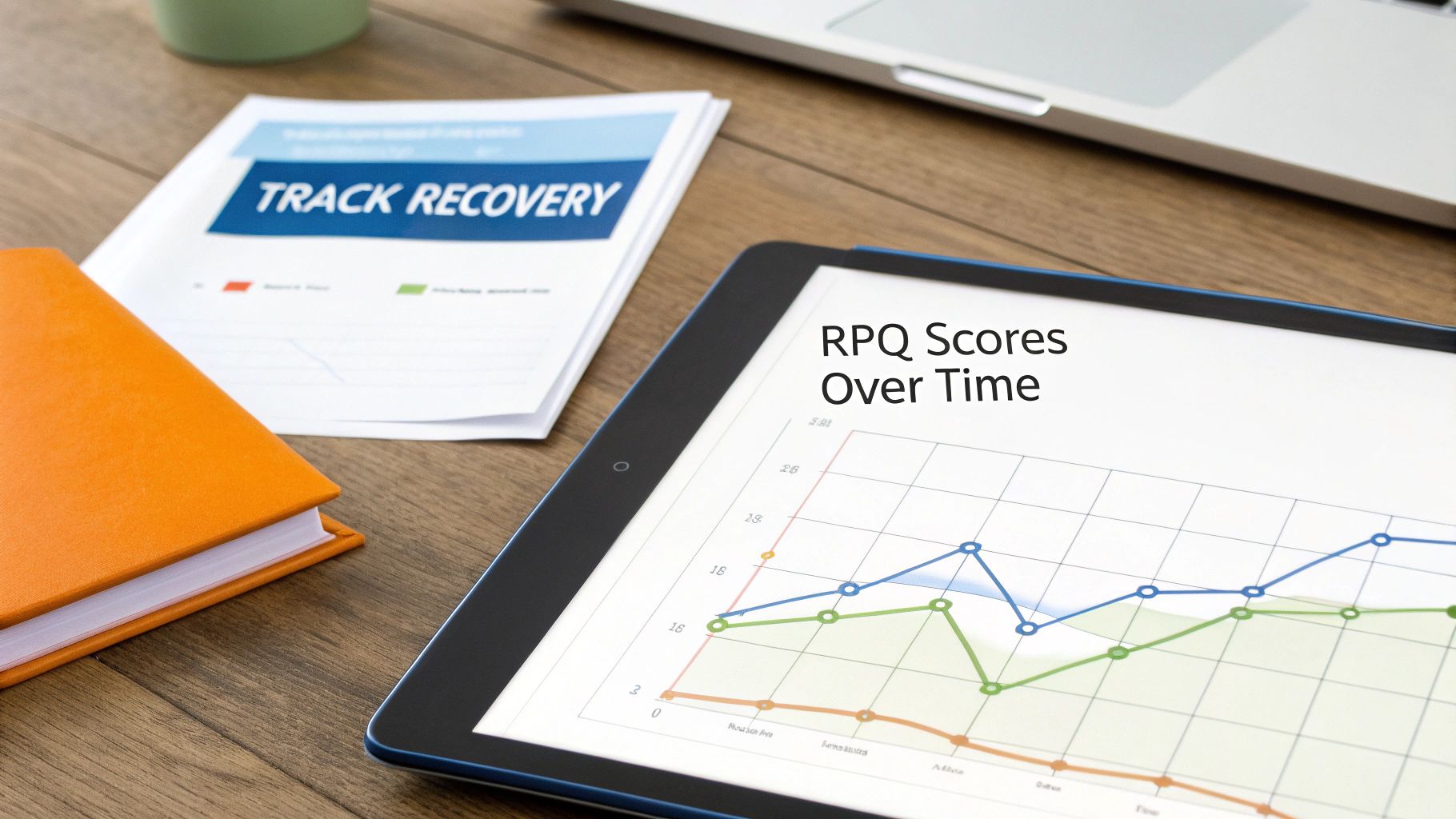
Visualizing the Path to Recovery
Plotting these scores over weeks or months creates a simple yet incredibly powerful visual chart. This graph immediately tells you the trend—a steady decline in scores signals improvement, while a flat line suggests things have stalled. This visual feedback is not just useful for you as a clinician; it can be incredibly motivating for patients, who finally get to see tangible proof that their hard work is paying off.
Let's walk through what this looks like in practice.
Patient Example: Sarah
Week 1 (Initial Assessment): Sarah’s total RPQ score is 32. She reports a high number of symptoms (12), with headaches and dizziness being the worst offenders.
Week 3 (Follow-up 1): You've started her on a plan with vestibular therapy and activity pacing. Her new score is down to 24, and her symptom count has dropped to 9. The graph is already showing a clear downward trend.
Week 6 (Follow-up 2): Her total score is now 15, and her dizziness is almost gone. But you notice her ratings for 'poor concentration' and 'fatigue' are stubbornly high.
Actionable Insight: The stagnant cognitive scores are a clear signal to adjust the care plan. You introduce cognitive pacing strategies, like the Pomodoro Technique (25 minutes of focus followed by a 5-minute break).
Week 9 (Follow-up 3): After implementing the new strategy, her score drops to 8. She’s now down to only 4 reported symptoms.
This tracking process gives you objective signals to act on, allowing you to pivot your treatment strategy based on real-time data.
Informing Critical Clinical Decisions
This longitudinal data is the bedrock for guiding major recovery milestones, like clearing an athlete for return-to-play or an employee for return-to-work. A consistent, downward trend in RPQ scores gives you the hard evidence needed to support these decisions confidently and, most importantly, safely.
Tracking RPQ scores over time takes the guesswork out of the recovery timeline. It provides an objective measure to validate when a patient is ready to get back to their life, ensuring decisions are based on data, not just on how the patient feels on a given day.
Instead of relying only on a patient's subjective report of "feeling better," you have a documented history of symptom reduction. This is crucial for managing the risks of returning to demanding environments too soon. For a student-athlete, their RPQ scores must show a significant and stable decline before you even begin a gradual return-to-learn and return-to-play protocol. The same logic applies to an office worker, where stable, low scores on cognitive symptoms support a phased return to their duties.
Adjusting Care Plans with Precision
But what happens when the scores aren't improving? A plateau—or worse, an increase—in RPQ scores is an immediate, objective trigger to hit pause and re-evaluate the treatment plan. It forces you to ask some critical questions:
Is there an unidentified complicating factor? For instance, persistently high scores in 'poor sleep' might be a red flag. This could warrant a deeper dive into their sleep hygiene or potential sleep disturbances, a common and often overlooked issue post-concussion. Addressing this directly can often unlock the next stage of recovery. For more on this, our guide on concussion and sleeping offers some valuable insights.
Does the patient need a specialist referral? If emotional symptoms like irritability or depression just aren't budging, it may be time to bring a psychologist or counsellor into the care team.
Is the current therapy enough? Stagnant scores might be telling you that the current approach isn't working and that a different or more intensive form of therapy is needed.
By systematically using the Rivermead Post Concussion Symptom Questionnaire to track recovery, you build a responsive, evidence-based model of care. It empowers you to celebrate progress with your patients, pinpoint roadblocks, and make confident clinical decisions that guide them safely back to health.
Combining the RPQ with Objective Cognitive Data
The Rivermead Post Concussion Symptom Questionnaire gives you the patient’s side of the story—a detailed, personal account of how they're feeling. While that's incredibly valuable, it’s only one half of the clinical puzzle. To build a truly complete picture of a patient's brain health, you have to pair this subjective story with hard, objective evidence of their cognitive performance.
This approach elevates your practice from a reliance on self-reporting to a model grounded in measurable data. Think of it like a detective using a witness statement (the RPQ) to guide their search for physical evidence (objective cognitive testing). One informs the other, and together, they build a much stronger case for your clinical decisions.

From "I Feel Forgetful" to Measurable Deficits
Let’s walk through how this synergy plays out in a common scenario. Imagine a patient, Mark, comes into your clinic a few weeks after a fall. His RPQ scores are high in the cognitive cluster, especially for "forgetfulness," which he rates as a 4 (severe problem).
This subjective report is your starting point. It tells you what Mark is experiencing. But the real clinical question is, why? Is this perceived forgetfulness a true memory deficit, or is it being amplified by other common post-concussion factors like anxiety, poor sleep, or even a lack of concentration?
This is where objective data becomes non-negotiable. Using a tool like Orange Neurosciences' OrangeCheck, you can move beyond Mark’s feeling of forgetfulness and measure his actual cognitive performance. You can administer specific tasks designed to test key domains like:
Episodic Memory: How well can he recall recent events and their context?
Sustained Attention: Can he maintain focus over a period of time?
Processing Speed: How quickly can he understand and react to new information?
This objective data provides the "evidence" needed to properly interpret his subjective RPQ score.
Two Scenarios, One Integrated Approach
The results from the objective assessment will almost always lead you down one of two distinct clinical paths. Either way, you end up with a more precise and effective care plan for Mark.
Pairing subjective symptom reports from the RPQ with objective cognitive data removes the clinical guesswork. It either validates your treatment direction or prompts you to investigate alternative causes, ensuring care is always personalized and evidence-based.
Scenario A: The Data Confirms the Symptom
Mark's objective tests show a clear, measurable deficit in his short-term memory performance. His scores are well below the expected baseline for his age and education.
Clinical Insight: The RPQ report is validated by the data. You now have strong evidence that a true memory impairment is a core issue in his recovery.
Actionable Plan: You can confidently design a treatment plan with targeted cognitive rehabilitation exercises aimed squarely at improving memory function. His progress can be tracked using both the RPQ and repeated objective tests—giving you two powerful data streams to show improvement over time.
Scenario B: The Data Contradicts the Symptom
Surprisingly, Mark’s objective memory tests come back within the normal range. His performance is solid, showing no significant impairment.
Clinical Insight: There's a mismatch between his experience ("I feel forgetful") and his objective performance. This is a critical finding that stops you from chasing a phantom memory problem.
Actionable Plan: Your investigation pivots. A closer look at his full RPQ reveals high scores for "feeling anxious" and "poor sleep." Your treatment plan can now focus on managing his anxiety and improving sleep hygiene, which are the likely root causes of his perceived memory issues.
In both scenarios, combining the Rivermead Post Concussion Symptom Questionnaire with objective data leads to a better outcome by making sure the treatment is aimed at the true underlying problem. This principle is a cornerstone of modern brain health care. To see how this works, you can learn more about our approach to integrated cognitive assessments and how they support better clinical decision-making. It’s an approach that empowers you to deliver truly personalized concussion care with confidence.
Common Questions About Using the RPQ
Even after you get the hang of administering and scoring the Rivermead Post Concussion Symptom Questionnaire, you’ll find that questions pop up in the middle of a busy clinic day. Getting clear, practical answers to these questions will help you use this powerful tool with more confidence and precision, making sure you get the best information to guide your patient's care.
Let's walk through some of the most common questions we hear from clinicians using the RPQ in their day-to-day practice.
How Is the RPQ Different from Other Tools Like the SCAT5?
Think of it this way: the SCAT5 is a broad, immediate snapshot taken right after an injury, while the RPQ is a specialized deep dive into the patient's ongoing symptoms. The RPQ zooms in on the severity of 16 common post-concussion symptoms, which makes it perfect for tracking a patient’s recovery over time.
The SCAT5, on the other hand, is a multi-part assessment you’d use on the sidelines or in an emergency room. It has a symptom checklist, but it also tests balance, cognitive function, and other neurological signs.
Actionable Insight: Use the SCAT5 for that initial, wide-angle assessment right after a suspected concussion. Use the RPQ for detailed, consistent symptom tracking in the clinic as the patient moves through their recovery over weeks or months. They are complementary, not competing, tools.
What Is a Clinically Meaningful Change in an RPQ Score?
There's no single magic number, but a change of 8-10 points in the total score is generally considered clinically significant. It suggests a real shift in how the patient is feeling. But context is everything.
What’s most valuable is tracking the trend over several assessments. A steady downward trend, even if it’s just by a few points each time, is a fantastic sign of progress. It’s also incredibly helpful to look at changes within the specific symptom clusters (somatic, cognitive, and emotional). This tells you where the patient is improving and where they might need more targeted help.
A change in the total score tells you if the patient is getting better. A change in the cluster scores tells you how they are getting better, pointing you toward the most effective parts of your treatment plan.
Can the RPQ Be Used with Children and Adolescents?
The RPQ was designed for and tested on adults. For kids and teens, it’s always best practice to use a tool that was made for their age group. Using a questionnaire that isn't validated for a specific age can lead to kids misunderstanding the questions, which gives you unreliable results.
Actionable Insight: For younger patients, use the Post-Concussion Symptom Inventory (PCSI). This tool is built specifically for children and adolescents (ages 5-18) and even includes separate forms for the child and their parent to fill out. Always pick the tool that best fits your patient's age and developmental stage to get the most accurate picture.
How Can We Integrate the RPQ with a Platform Like Orange Neurosciences?
This is where you can take your clinical practice to the next level, moving beyond guesswork by combining subjective reports with objective data. It’s a simple, but powerful, two-step process.
First, you administer the RPQ to get the patient’s own report on their symptoms. This tells you the "what"—what symptoms are bothering them the most right now.
Second, you use that information to guide your objective assessment with a tool like Orange Neurosciences. This helps you uncover the "why" by giving you measurable data on their actual cognitive performance.
Practical Example of Integration
Let's say a patient scores high on cognitive items from the RPQ, like 'poor concentration' and 'forgetfulness'. That’s your signal to dig deeper.
You can then use the Orange Neurosciences platform to have them complete specific, game-based tasks that objectively measure things like sustained attention or short-term memory. The results will either confirm that there’s a real cognitive deficit that needs targeted training, or they might show that the patient’s performance is actually normal. If that’s the case, you can then explore other potential causes for their reported symptoms, like anxiety or poor sleep.
By documenting both the subjective RPQ scores and the objective data from a platform like Orange Neurosciences, you build a complete profile that validates your treatment plan and lets you track progress from every angle. This approach ensures you’re treating the root cause of your patient's struggles, not just the symptoms they report.
At Orange Neurosciences, we believe that combining subjective patient reports with objective cognitive data is the key to effective care. Our platform is designed to seamlessly integrate with your existing clinical workflows, providing the hard evidence you need to make better-informed decisions.
Discover how our AI-powered assessment and therapy tools can help you build a complete picture of your patients' brain health. Visit us at https://orangeneurosciences.ca to learn more or email us to schedule a personalized demo.

Orange Neurosciences' Cognitive Skills Assessments (CSA) are intended as an aid for assessing the cognitive well-being of an individual. In a clinical setting, the CSA results (when interpreted by a qualified healthcare provider) may be used as an aid in determining whether further cognitive evaluation is needed. Orange Neurosciences' brain training programs are designed to promote and encourage overall cognitive health. Orange Neurosciences does not offer any medical diagnosis or treatment of any medical disease or condition. Orange Neurosciences products may also be used for research purposes for any range of cognition-related assessments. If used for research purposes, all use of the product must comply with the appropriate human subjects' procedures as they exist within the researcher's institution and will be the researcher's responsibility. All such human subject protections shall be under the provisions of all applicable sections of the Code of Federal Regulations.


© 2026 by Orange Neurosciences Corporation