Complete Concussion Management: Your Step-by-Step Guide
Nov 22, 2025
Complete concussion management represents a shift in how we think about recovery. It's an active, modern approach that moves far beyond the outdated advice of simply resting. Instead, it’s a structured, multi-stage process involving precise assessment, personalized therapy, and carefully managed return-to-activity protocols to guide a safe and complete recovery.
Rethinking Recovery: A Modern Approach to Concussion Care
It's time to forget the old "cocoon therapy" myth—the idea that someone with a concussion should just lie down in a dark room for weeks and wait. That passive waiting game is being replaced by a proactive journey, transforming concussion care into a structured, evidence-based recovery plan. A modern, complete concussion management strategy is absolutely vital for promoting long-term brain health and minimizing the risk of persistent symptoms.
This process treats the brain like any other injury. You wouldn't just "wait and see" with a broken leg, and the same principle applies here. It requires a clear roadmap to guide healing, breaking down recovery into manageable phases with specific goals. This ensures you aren’t doing too much too soon—or too little for too long. For example, instead of just hoping a headache goes away, a structured plan would involve tracking the headache's intensity and triggers, then using that data to guide activity levels.
The Core Pillars of Modern Concussion Care
Effective management is built on a few key principles that work together to support the brain's natural healing process. These pillars ensure every aspect of the injury is addressed, from the initial impact right through to the final all-clear.
This structured approach has proven incredibly effective. In Canada, implementing comprehensive concussion management protocols has dramatically improved how sports-related concussions are handled. Studies show that when proper protocols are in place, the number of correctly identified concussions increases five-fold, simply because everyone involved—coaches, parents, and athletes—is more aware.
A modern plan is built on:
Accurate Assessment: Moving beyond just asking, "How do you feel?" to using objective data to understand the specific ways the brain has been affected. Actionable insight: Use a symptom checklist daily to track changes in headaches, dizziness, or brain fog.
Personalized Therapy: Creating a targeted treatment plan based on what the assessment reveals. For example, if balance is an issue, your plan would include specific gaze stabilization exercises, not generic rest.
Graduated Protocols: Following evidence-based, step-by-step guidelines for safely getting back to school, work, and physical activity. Actionable insight: Don't return to full activity at once; follow a staged plan where you only advance to the next step after 24 symptom-free hours.
A complete concussion management plan acts as a GPS for your brain's recovery. It provides a clear, evidence-based route with defined checkpoints, preventing you from getting lost on the path back to full health.
What to Expect in This Guide
To give you a high-level overview, we've broken down the entire process into four main pillars. The table below summarises the key phases of a successful recovery, which we'll explore in detail. Understanding this framework will empower you to advocate for proper care and navigate your own neurorehabilitation journey with confidence.
The Four Pillars of Complete Concussion Management
This table provides a snapshot of the key phases in a modern concussion recovery plan.
Pillar | Objective | Key Activities |
|---|---|---|
Assessment | To identify the injury and establish a functional baseline. | Sideline screening, objective cognitive testing, symptom tracking. |
Active Recovery | To gradually reintroduce activity without worsening symptoms. | Light cognitive tasks, low-intensity cardio, targeted therapies. |
Return Protocols | To safely resume normal life, school, sport, and work activities. | Step-wise return-to-learn, return-to-play, and return-to-work plans. |
Monitoring | To track progress and ensure recovery is complete. | Ongoing symptom checks, objective data comparisons, communication. |
By following this modern, active approach, recovery becomes a predictable and manageable process instead of a frustrating waiting game.
The First 48 Hours: Objective Assessment and Red Flags
The first moments and days after a suspected concussion are absolutely critical—they set the entire tone for recovery. This isn't a time for guesswork or telling someone to just "tough it out." The initial 48-hour window demands immediate, careful observation. We need to shift away from subjective feelings ("I'm fine, coach!") and move toward objective facts. This is where a proper, complete concussion management plan begins, whether you're on the sideline or at home. The two primary goals are simple: spot serious warning signs and gather unbiased data.
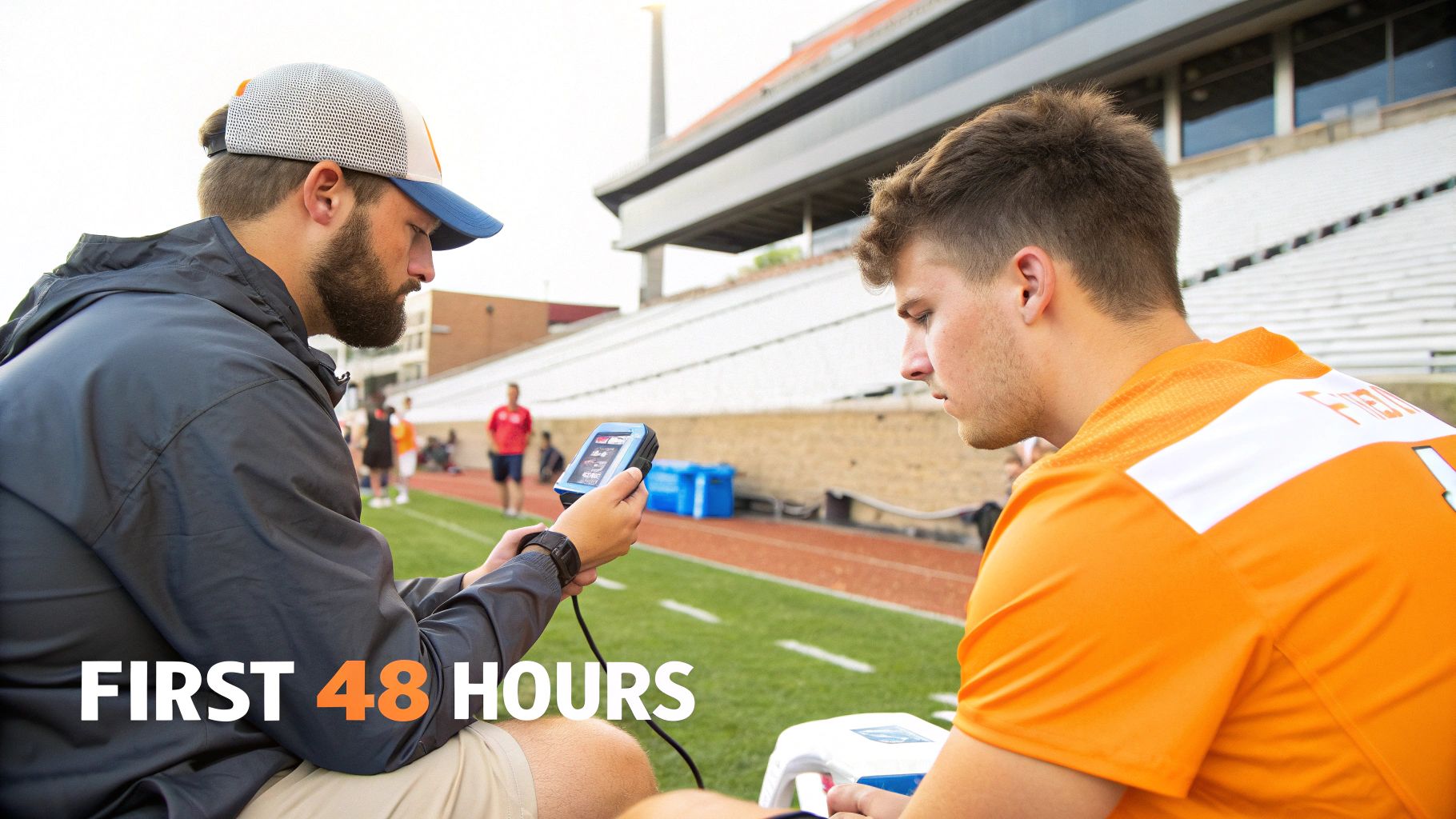
This image shows exactly what that first step looks like: an athletic trainer conducting an immediate sideline assessment. Using objective digital tools gives them instant, reliable data to make safe decisions, taking the athlete's own (often biased) opinion out of the equation.
Identifying Immediate Red Flags
First things first: you have to be able to recognise the signs of a more severe injury that needs an immediate trip to the emergency room. These aren't subtle symptoms. They are clear, unmistakable indicators that something is seriously wrong and professional medical help is needed right away.
Think of these red flags as the brain's alarm system. A mild headache after a knock to the head is common, but one that gets progressively worse is a major warning. In the same way, one instance of nausea is very different from repeated vomiting.
Actionable Insight: If you see any of the following signs in someone after a head injury, seek emergency medical care immediately:
Worsening Headaches: A headache that keeps intensifying instead of getting better.
Repeated Vomiting or Nausea: Multiple episodes of being sick point to significant distress.
Seizures or Convulsions: Any seizure-like activity after an impact is a critical emergency.
Loss of Consciousness: Not every concussion involves losing consciousness, but any period of unresponsiveness is a serious sign.
Unusual Behaviour: Growing confusion, restlessness, or agitation that doesn't go away.
Slurred Speech: Difficulty speaking clearly or forming words.
Beyond these physical signs, objective assessment also includes evaluating neurological symptoms like persistent dizziness and understanding double vision, which are also potential red flags. Catching these signs is the most important first step in preventing a more severe outcome.
Moving Beyond "I Feel Fine" with Objective Data
An athlete might insist they feel okay, but their own perception is often an unreliable gauge of brain function right after an injury. This is why objective assessment is so crucial. It replaces subjective feelings with hard data, painting a clear, unbiased picture of what's really going on with their cognitive and neurological function.
Standardised tools like the Sport Concussion Assessment Tool 5 (SCAT5) offer a structured way to evaluate symptoms, balance, and cognition. But now, digital assessment tools are taking this a huge step further by providing even faster and more precise measurements.
A player's desire to get back in the game can easily cloud their judgement. Objective data acts as an impartial referee, making the call based on evidence, not emotion, to protect the player's long-term health.
Practical Example: A hockey player takes a hard hit. They skate to the bench, claiming they're ready to go back in. A coach or trainer can use a tool like Orange Neurosciences' OrangeCheck to get an instant, unbiased report on their cognitive function, reaction time, and balance. If the data shows a significant drop from their baseline performance, the decision is made for them—it's not safe to return. This is the heart of modern, complete concussion management: taking the guesswork out of the equation.
Creating Your Personalized Active Recovery Plan
The old advice for a concussion—lie down in a dark room and wait it out—is officially a thing of the past. We now know that prolonged, passive rest can actually slow down healing, leading to physical deconditioning and even anxiety. Today, the gold standard is active recovery, a structured, step-by-step approach that is the heart of modern concussion management.
This process kicks off with a brief period of relative rest, usually just 24 to 48 hours. After that, we begin to carefully and gradually reintroduce light cognitive and physical activities. The goal isn't to push through symptoms, but to gently stimulate the brain without overwhelming it. This careful stimulation helps promote crucial blood flow and supports the brain's natural healing process, known as neuroplasticity.
From Assessment Data to Actionable Steps
The real magic of active recovery is in the personalization. A cookie-cutter plan just won’t work because every concussion is unique, affecting different parts of the brain. This is where the objective data gathered during your initial assessment becomes your roadmap to recovery.
For example, if tests show you’re struggling with balance and coordination, that’s a clear sign of a vestibular issue. Your recovery plan would then focus on specific exercises designed to retrain that system, like gaze stabilization drills (keeping your eyes fixed on a point while turning your head) or single-leg balancing tasks.
Likewise, if cognitive tests reveal a lag in your processing speed or trouble paying attention, the plan will zero in on those specific deficits. Your recovery becomes a targeted intervention, not a guessing game. It's this precise, tailored approach that helps you get back on your feet faster.
Think of it like physiotherapy for an injured knee. You wouldn't just rest it for weeks on end. A therapist gives you specific exercises to rebuild the exact muscles that were weakened. Active recovery applies the same smart, targeted principle to healing the brain.
This data-driven strategy is quickly becoming the standard across Canada. Organizations like Parachute Canada have been instrumental, spearheading the Canadian Concussion Harmonization Project, which has successfully brought 42 National Sport Organizations on board with aligned concussion protocols. This nationwide effort ensures that evidence-based tools and resources are being used consistently, leading to better outcomes for everyone.
The Role of Targeted Cognitive Therapy
Once we've pinpointed the specific cognitive challenges you're facing, the next move is targeted therapy. This is where generic brain games or puzzles just don't cut it. To be effective, recovery exercises need to be both engaging and adaptive—meaning they get easier or harder based on how you're doing in real-time.
This is exactly why tools like ReadON are so valuable. Instead of a static worksheet, ReadON delivers adaptive, game-based cognitive exercises that directly tackle your unique needs. If your assessment flagged a weakness in executive function, for instance, the platform serves up activities specifically designed to challenge and rebuild those skills.
The screenshot here gives you a peek at ReadON's engaging, game-like interface. This visual style makes cognitive therapy feel less like a chore and more like an interactive challenge—a crucial factor for keeping motivation high during the recovery journey.
By seamlessly connecting assessment with therapy, platforms like this create an efficient feedback loop for healing. You can dive deeper into specific strategies in our guide on how to improve executive function, which breaks down practical methods for strengthening these vital cognitive skills.
Building Your Phased Recovery Plan
Your personalized active recovery plan is broken down into clear, manageable phases. Moving from one stage to the next is always guided by your symptoms. You only advance when you can handle an activity without a significant flare-up.
Here’s an actionable plan you can adapt:
Initial Rest (24-48 hours): Limit both mental and physical strain. Practical tip: No screen time, listen to quiet audiobooks instead of reading, and avoid any real physical exertion.
Light Cognitive Activity: Start with short bursts, maybe 15 minutes at a time, of activities like reading a book, listening to a podcast, or doing a simple puzzle. If symptoms worsen, stop and rest.
Light Physical Activity: Introduce gentle, low-intensity exercise like a slow-paced walk for 10-15 minutes. The goal is just to get your heart rate up slightly without triggering headaches or dizziness.
Targeted Therapies: Now you’ll begin incorporating the specific vestibular, ocular, or cognitive exercises prescribed in your plan, all based on your initial assessment data.
Gradual Reintegration: From here, you’ll slowly increase the duration and intensity of both cognitive and physical tasks, steadily preparing you for the formal return-to-learn and return-to-play protocols.
This structured, personalized process is the cornerstone of effective concussion management, putting you in the driver’s seat of your own healing journey.
Navigating Return to School, Sport, and Work
Once the initial active recovery phase is behind you, getting back to your normal life isn't a single jump—it's a series of carefully planned steps. It’s tempting to rush back into school, sports, or your job, but going too fast can easily cause a major setback. The key to complete concussion management is following distinct, graduated protocols for each part of your life. This ensures your return is not just successful, but also safe and lasting.
Actionable Insight: The golden rule is simple: you have to be completely symptom-free at one stage for at least 24 hours before moving on to the next. If symptoms pop up again, take a step back, wait for them to go away, and then try moving forward once more.
This active recovery process maps out those crucial first steps. It all starts with relative rest, followed by a thorough assessment, which then informs a personalized plan that guides your return to daily activities.
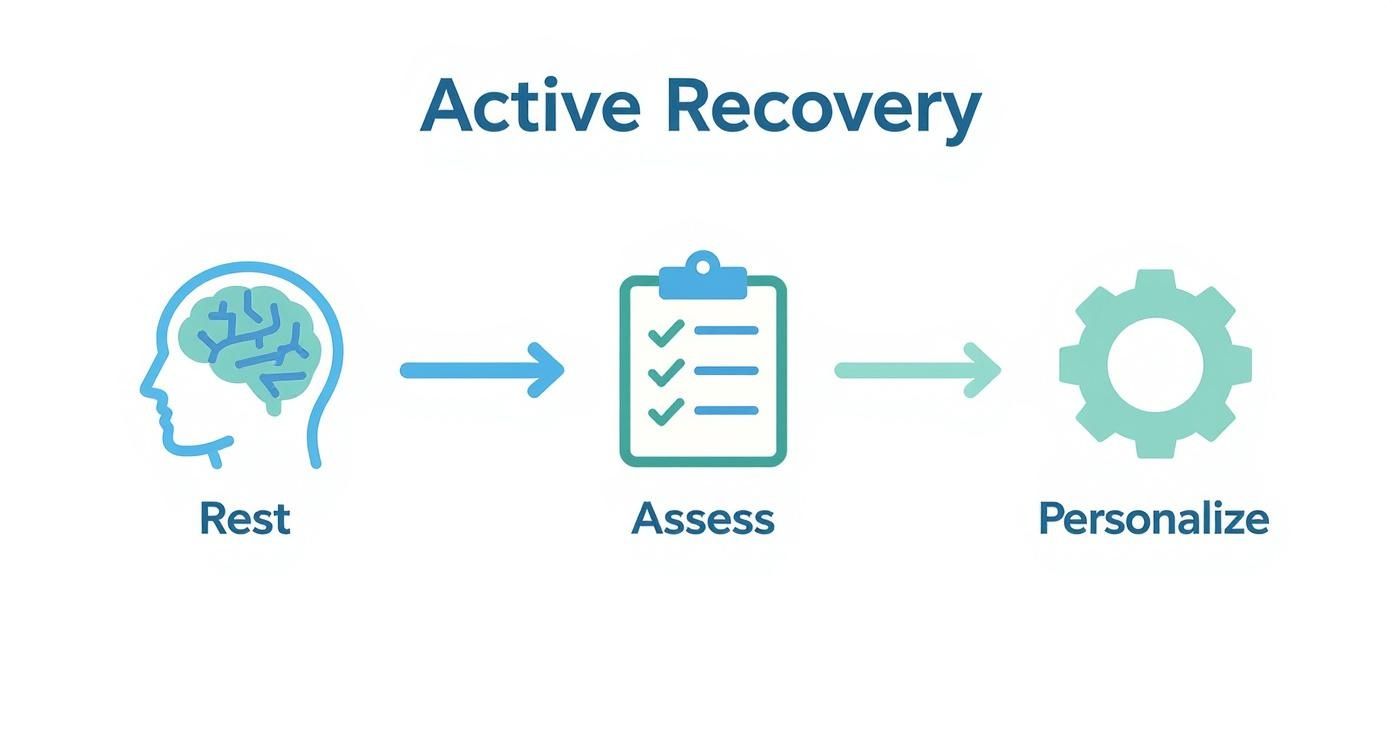
This visual really drives home the point that a safe return isn't a guessing game. It's a structured journey that begins with rest and is steered by objective data to build a roadmap that's truly yours.
The Return-to-Learn Protocol
Jumping back into an academic setting can be surprisingly tough on a healing brain. The cognitive load from lectures, reading, and homework needs to be reintroduced gradually. The Return-to-Learn protocol is designed to make this transition smoother with specific, practical accommodations.
Practical Example: A student might start with a modified school schedule. Instead of a full day, they could begin by just attending two classes in the morning. If that feels good for a day or two, they can add an afternoon class, slowly building their way back to a full timetable.
Other common supports include:
Extended Deadlines: Giving extra time for assignments helps lower the pressure.
Quiet Testing Environments: Taking tests in a separate room minimizes distractions and cognitive strain.
Note-Taking Assistance: Getting notes from a classmate or using a recorder for lectures can be a huge help.
The Return-to-Play Protocol
For any athlete, the pull to get back in the game is incredibly strong. That makes a structured Return-to-Play protocol absolutely non-negotiable. This is typically a six-stage process where each stage must last at least 24 hours. Here, objective data is king—it’s far more reliable than an athlete’s eagerness to play.
A graduated return-to-play protocol is the standard of care, ensuring an athlete builds tolerance step-by-step without triggering symptoms.
Graduated Return-to-Play Protocol Stages
Stage | Activity Goal | Example Exercise |
|---|---|---|
1 | Symptom-Limited Activity | Daily activities that don't provoke symptoms (e.g., walking around the house). |
2 | Light Aerobic Exercise | 10-15 minutes of light cardio, like walking or stationary cycling. |
3 | Sport-Specific Exercise | Drills specific to the sport, like skating in hockey or running in soccer (no impact risk). |
4 | Non-Contact Training Drills | More complex training, like passing drills, while still avoiding physical contact. |
5 | Full-Contact Practice | Rejoining regular team practice with controlled contact (requires medical clearance). |
6 | Return to Competition | The final step, where the athlete is cleared to play in a game. |
This process ensures that each increase in intensity is handled safely before the athlete is exposed to the unpredictable environment of a real game.
Think of it like climbing a ladder. You can't just skip rungs. Each step has to feel solid and symptom-free before you can safely move to the next. Rushing just leads to a fall.
The Return-to-Work Protocol
The Return-to-Work protocol is just as critical, though it’s often overlooked. The demands of a workplace—from constant screen time and meetings to tight deadlines—can easily overwhelm a recovering brain. A phased return is essential for a recovery that sticks.
Practical Example: An office worker might begin with only offline tasks for a few days, steering clear of long meetings or heavy data analysis. For someone in a more physical job, it could mean shorter shifts or avoiding tasks that involve heavy lifting. Open communication and managing the continuity of care between you, your healthcare provider, and your employer are absolutely vital for success.
A sample phased return might look something like this:
Week 1: Work half-days from home, sticking to low-demand tasks like organizing files.
Week 2: Move to half-days in the office, but with a quiet workspace and no back-to-back meetings.
Week 3: Progress to full days but with scheduled 15-minute screen breaks every hour.
Week 4: Resume normal duties and hours, as long as no symptoms have returned.
By sticking to these structured, evidence-based plans, you’re giving your brain the best chance to be truly ready for each new challenge, turning recovery into a confident return to all aspects of your life.
Building Your Concussion Care Team and Communication Plan
Recovering from a concussion isn't a solo journey—it's a team sport. Real, complete concussion management depends on a coordinated network of professionals, family, and educators all pulling in the same direction. The first step is getting the right people on board, but the secret to making it all work is a solid communication plan that keeps everyone on the same page.
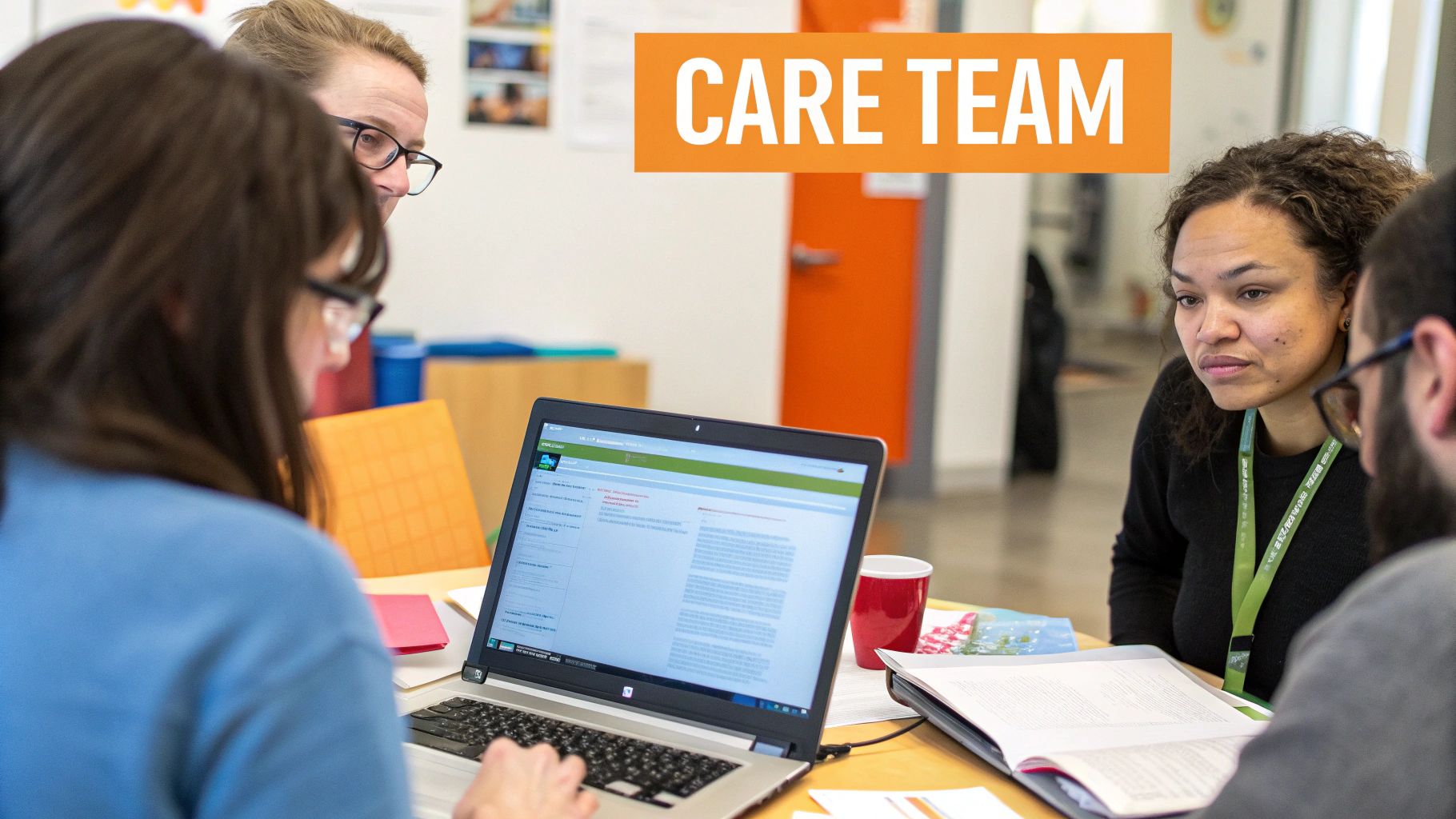
Without everyone working together, recovery can quickly become disjointed and confusing. Imagine a therapist recommending more activity while a teacher is still seeing signs of cognitive fatigue in class. These kinds of disconnects create frustration and can seriously slow down the healing process.
Assembling Your Core Care Team
Your concussion care team is a multidisciplinary group where each person has a distinct and vital role. Think of it like a project team in a business, with each member bringing their own expertise to the table. The goal is simple: cover all the bases—medical, therapeutic, academic, and personal.
Actionable Insight: Start building your team by scheduling an appointment with your primary care physician and asking for referrals to specialists who have experience with concussions.
Your core team will likely include:
A Primary Care Physician: This is often your quarterback, making the initial diagnosis and connecting you with the right specialists.
Specialised Therapists: This could be a physiotherapist for balance, an occupational therapist for daily tasks, or a speech-language pathologist for cognitive-communication hurdles.
Family Members: They are the day-to-day support system, helping track symptoms and provide emotional support.
School or Work Liaisons: A guidance counsellor or HR manager who can implement practical accommodations.
A concussion care team is like an orchestra. Each musician is a specialist, but without a conductor—a clear communication plan—they can't create a harmonious recovery. Everyone needs to be working from the same sheet of music.
The Power of Centralised Communication
The single biggest hurdle for any care team is keeping everyone in the loop. A parent might have notes from a doctor's visit, a coach has observations from a light practice, and a teacher holds the academic data. When all this information is stuck in different silos, no one sees the complete picture of the recovery journey.
This is where integrated digital platforms can be a game-changer. They serve as a central hub for all recovery-related information, from the first assessment data to daily symptom logs and therapy progress notes. This setup ensures every team member has the same up-to-date information, cutting through the confusion.
For example, a student-athlete's physiotherapist can log progress from a vestibular therapy session. Their coach can then see that data and understand why they're still on non-contact drills. At the same time, their teacher can see notes about potential dizziness and know to offer screen breaks. This seamless flow of information empowers everyone to make smarter, more supportive decisions.
Streamlining Reporting for Healthcare Providers
For clinicians juggling multiple patients, efficient communication is just as critical. Manually compiling reports and sharing updates with every stakeholder is incredibly time-consuming and leaves room for error. This is where digital tools built specifically for healthcare providers can make a huge difference.
Platforms like the ones we’ve developed at Orange Neurosciences pull assessment results and therapy progress into easy-to-read, shareable reports. A neuropsychologist can instantly send objective cognitive data to a patient's family doctor or school counsellor, making sure that decisions about academic accommodations are backed by solid evidence. This doesn't just save clinicians precious time; it reinforces the collaborative care model that is so essential for a successful recovery.
By putting together a well-defined team and using technology to keep communication clear and consistent, you can turn a potentially chaotic process into a structured, supportive journey. Explore our platform to see firsthand how integrated tools can bring your entire concussion care team together.
Your Concussion Management Questions, Answered
Working through a concussion can feel like navigating a maze in the dark. There's a lot of information out there, and plenty of it is conflicting, which only adds to the uncertainty. We want to clear up some of that confusion.
This section tackles the most common questions we hear from patients, athletes, and parents. Our goal is to give you clear, evidence-based answers so you can feel confident and in control of your complete concussion management plan.
How Long Does a Typical Concussion Recovery Take?
This is the big question, but there's no single answer. Concussion recovery is a deeply personal journey, and timelines can vary quite a bit.
For most people—around 80-90%—symptoms from a sports-related concussion will resolve within 7 to 10 days. For non-athletes, it might take a bit longer, maybe up to 3 or 4 weeks. But for a significant number of people, symptoms can linger for much longer than that.
What makes the difference? Several things can influence your recovery speed: the severity of the initial hit, a history of previous concussions, or even pre-existing conditions like anxiety and migraines. This is exactly why a one-size-fits-all "just rest" approach doesn't work. A proper management plan digs deeper to find and treat the specific issues slowing you down, like a vestibular imbalance, instead of just waiting for the fog to lift on its own.
What Is Baseline Testing and Do I Really Need It?
Think of baseline testing as a "before" picture of your brain's performance. It’s a series of assessments done before a sports season or school year starts, measuring your normal, healthy brain function—things like reaction time, memory, and balance.
While it’s not mandatory for everyone, we strongly recommend it for any athlete in high-contact or high-risk sports. Practical Example: A soccer player completes a baseline test in August. In October, she takes a hit to the head. Post-injury tests show her reaction time is 20% slower than her own baseline, confirming a cognitive deficit even though she says she "feels fine." This data provides a clear, objective reason to keep her out of play until her scores return to normal.
Without a baseline, clinicians are stuck comparing a patient's scores to the average scores of the general population. It’s like trying to judge if your car is running properly by comparing it to every other car on the road, instead of its own original factory specs.
Can I Use My Phone or Screens During Recovery?
This is probably the most-asked question of the modern era. In the first 24 to 48 hours after a concussion, the answer is a firm "no." We strongly recommend limiting all cognitive effort, and that absolutely includes screen time.
After that initial rest period, screens can be carefully reintroduced. Actionable Insight: Start with very short sessions, maybe 10-15 minutes at a time, with brightness turned down and blue light filters on. You must stop immediately if you feel symptoms coming back or getting worse. This careful, symptom-guided approach is a cornerstone of both "Return to Learn" and "Return to Work" protocols. It’s all about finding that delicate balance.
Why Is Active Recovery Recommended Over Complete Rest?
The science on concussion care has made a major leap forward. We now know that the old advice to rest in a dark room for weeks is not just outdated—it can actually be harmful. Prolonged rest (anything beyond 48 hours) can lead to physical deconditioning, amplify feelings of anxiety and depression, and create social isolation.
Active recovery, on the other hand, is about the gradual re-introduction of light physical and cognitive activity, always staying below the point where it triggers a major flare-up of symptoms. Practical Example: Instead of doing nothing, a person might take a slow 10-minute walk outside. This gentle activity increases blood flow to the brain, which aids healing, and provides a psychological boost without overwhelming the system.
The need for these modern protocols is clear when you look at the numbers. In British Columbia alone, it's estimated that roughly 1 in 165 Canadian adults suffers a concussion each year—and that’s likely low due to underreporting. The rate is even higher for high school athletes, with about 1 in 9 getting a concussion while playing sports. You can dig deeper into these concussion statistics and their impact on the CATTONLINE website.
A successful recovery hinges on precise assessment and a personalized plan. At Orange Neurosciences, we provide the objective data and targeted cognitive tools needed to guide every step of your journey, from initial injury to a safe return to life. Our platform removes the guesswork, empowering your entire care team with the insights needed for a confident and complete recovery.
Take the next step in mastering your concussion recovery. Visit https://orangeneurosciences.ca to learn how our tools can help, or contact our team to get your questions answered.
Orange Neurosciences' Cognitive Skills Assessments (CSA) are intended as an aid for assessing the cognitive well-being of an individual. In a clinical setting, the CSA results (when interpreted by a qualified healthcare provider) may be used as an aid in determining whether further cognitive evaluation is needed. Orange Neurosciences' brain training programs are designed to promote and encourage overall cognitive health. Orange Neurosciences does not offer any medical diagnosis or treatment of any medical disease or condition. Orange Neurosciences products may also be used for research purposes for any range of cognition-related assessments. If used for research purposes, all use of the product must comply with the appropriate human subjects' procedures as they exist within the researcher's institution and will be the researcher's responsibility. All such human subject protections shall be under the provisions of all applicable sections of the Code of Federal Regulations.


© 2026 by Orange Neurosciences Corporation