A Clinician's Guide to the Rivermead Post Concussion Questionnaire
Jan 31, 2026
When you're working with a patient recovering from a concussion, their own experience is the single most valuable piece of the puzzle. The Rivermead Post Concussion Questionnaire (RPQ) is the tool that helps you translate that subjective experience into structured, quantifiable data.
At its core, the RPQ is a self-report scale designed to measure the severity of 16 common symptoms that pop up after a mild traumatic brain injury. It’s not a tool for that initial diagnosis. Instead, think of it as your go-to method for tracking how a patient is feeling over time, setting a clear baseline, and watching their recovery unfold.
Decoding the Patient Experience with the RPQ

Think of the RPQ as a guided "symptom diary." It gives patients a standardized framework to report on everything from headaches and dizziness to irritability and forgetfulness. This systematic approach takes what might be vague complaints and turns them into a sharp, trackable symptom profile that you can actually work with.
The Role of the RPQ in Clinical Practice
The real job of the RPQ isn't to diagnose; it's to monitor. Its value skyrockets when you use it to establish a symptom baseline and then track changes over the following weeks and months. This is fundamental to guiding rehabilitation in a way that truly responds to the patient's needs.
For example, a patient might come in initially with severe headaches (a high score on that item) but report minimal cognitive trouble. Two weeks later, their headaches might be much better, but their score for "poor concentration" could jump as they try to get back to work. This kind of shift gives you critical, real-time insight into their recovery path.
In day-to-day practice, the questionnaire helps you:
Establish a Baseline: Capture a clear snapshot of the patient’s symptoms shortly after their injury. This becomes your reference point for everything that follows.
Monitor Recovery: Use the RPQ at follow-up appointments to objectively track if symptoms are getting better, worse, or staying the same.
Guide Treatment: Quickly pinpoint the most troublesome symptoms for your patient, allowing you to prioritise interventions and tailor the rehab plan.
Facilitate Communication: Give patients a structured way to talk about what they're going through, ensuring nothing important gets missed in a busy consultation.
The real power of the RPQ is in seeing it used over time. A single score gives you a snapshot, but a series of scores tells the story of the patient's recovery journey, highlighting patterns and flagging any stalls in their progress.
Beyond Subjective Reporting
While the patient's self-report is invaluable, it’s just one part of the picture. The data from the RPQ becomes even more potent when you pair it with objective metrics. If a patient consistently circles "forgetfulness," an objective cognitive assessment can quantify just how significant that memory deficit is.
The RPQ plays a crucial role in post-concussion care, perfectly complementing the broader process of concussion diagnosis. By blending this subjective feedback with objective data, you build a much more complete clinical picture. This sets the stage for a truly comprehensive approach to patient care. For a closer look at integrating these tools, you might find our guide on using a post-concussion symptom questionnaire helpful.
Breaking Down the 16 RPQ Symptoms
The Rivermead Post Concussion Questionnaire is far more than a simple checklist. Think of it as a structured way to capture the patient's lived experience after an injury. To really tap into its clinical power, we need to look past the individual items and see the bigger picture.
By grouping the 16 symptoms into practical, clinically relevant clusters, we can transform the questionnaire from a list of complaints into a detailed map of the patient's recovery journey. It helps us see the patterns and understand the story behind the score.
For instance, a patient in the acute phase might report high scores primarily in the physical cluster. Weeks or months down the line, that same patient might see those physical scores drop, but their cognitive and emotional scores could be climbing. This clustering approach lets us see that shift clearly.
The 16 Symptoms of the Rivermead Post Concussion Questionnaire
Here's a practical breakdown of the RPQ's 16 items, grouped into the three core domains. This table can help you quickly identify patterns and understand the primary drivers of a patient's reported difficulties.
RPQ Item | Symptom Category | Clinical Significance |
|---|---|---|
Headaches | Physical | The most common complaint; intensity and triggers provide key diagnostic clues. |
Dizziness | Physical | Indicates potential vestibular or autonomic nervous system disruption. |
Nausea/Vomiting | Physical | Often linked to dizziness and headaches, common in the acute phase. |
Noise Sensitivity | Physical | Points to sensory processing issues (hyperacusis); affects daily functioning. |
Light Sensitivity | Physical | Classic sign of neurological irritation (photophobia); can be debilitating. |
Blurred Vision | Physical | Suggests issues with visual accommodation or oculomotor control. |
Double Vision | Physical | A more specific and concerning visual symptom requiring further investigation. |
Fatigue | Physical | A profound, pervasive exhaustion that is often disproportionate to activity. |
Poor Concentration | Cognitive | Impacts the ability to sustain focus on tasks at work, school, or home. |
Forgetfulness | Cognitive | Affects short-term memory and learning new information. |
Taking Longer to Think | Cognitive | Reflects slowed processing speed, a common but frustrating deficit. |
Irritability | Emotional | Short temper and low frustration tolerance; often distressing for patients and families. |
Feeling Depressed | Emotional | Indicates mood changes, which are common and can complicate recovery. |
Feeling Frustrated | Emotional | A sign of emotional dysregulation and the patient's struggle with their symptoms. |
Restlessness | Emotional | An inability to relax or sit still; can be linked to anxiety or internal discomfort. |
Sleep Disturbance | Physical/Emotional | A critical symptom that can exacerbate nearly all other concussion symptoms. |
Looking at the symptoms this way helps you move from just counting problems to understanding the nature of the patient's struggle. It’s about seeing the forest, not just the trees.
The Physical Symptom Cluster
This first group covers the most immediate and often most distressing symptoms right after a concussion. They are the classic, visceral signs that something is physically out of sorts.
Think of these as the "loudest" symptoms in the early days. Managing them effectively can dramatically improve a patient's quality of life and create a foundation for deeper recovery.
Headaches: The number one complaint. A patient might say, "It's this constant, dull ache that just explodes when I try to look at my computer."
Dizziness: This isn't always a spinning room. It can be a vague sense of unsteadiness or feeling lightheaded, like, "I feel off-balance whenever I stand up too quickly."
Nausea and/or Vomiting: Often goes hand-in-hand with dizziness and severe headaches. A patient might report, "I just feel queasy all the time, especially when I'm tired."
Noise Sensitivity: Suddenly, everyday sounds become overwhelming. "The clatter of dishes in the kitchen feels like an assault. I just have to leave the room."
Light Sensitivity: Bright lights can feel physically painful (photophobia). "I have to wear sunglasses inside because the fluorescent lights at the office are just unbearable."
Blurred & Double Vision: These are key signs of neurological disruption. A patient might describe it as, "The words on the page seem to shimmer, and I can't get them to stay still."
Fatigue: This is a bone-deep, pervasive exhaustion that sleep doesn't seem to fix. It’s the difference between being tired and being completely drained of energy.
The Cognitive & Emotional Clusters
As the initial physical storm starts to calm down, the cognitive and emotional struggles often come into focus. These are the symptoms that can be profoundly frustrating as patients try to get back to their normal lives.
A high score in these clusters, especially weeks or months post-injury, signals that the patient's challenges have shifted from acute physical distress to more subtle, but equally debilitating, functional impairments.
These symptoms often feel invisible to the outside world, which can make them even harder for the patient to deal with.
Poor Concentration: The inability to stay on task. "I'll sit down to answer an email, and 20 minutes later I realize I've just been staring at the screen, getting nothing done."
Forgetfulness: Trouble with short-term memory is classic. "My partner will tell me something important, and five minutes later, it's just gone. I have no memory of the conversation."
Taking Longer to Think: This is all about reduced processing speed. "It feels like my brain is moving through mud. By the time I figure out what to say in a meeting, the conversation has moved on."
Irritability: A short fuse and emotional volatility. "I find myself snapping at my kids over the smallest things, which just isn't me. Then I feel terrible about it."
Feeling Depressed or Tearful: Mood changes are incredibly common. "I just feel flat. The things I used to enjoy don't bring me any joy anymore."
Feeling Frustrated or Impatient: A low tolerance for everyday hassles. "Waiting in line at the grocery store makes me feel incredibly anxious and angry now. It never used to."
Restlessness: A physical or mental inability to relax. "I feel this constant buzz of energy, like I need to be moving, even when I'm completely exhausted."
Sleep Disturbance: Trouble falling asleep, staying asleep, or sleeping too much and still feeling tired. Any of these can throw the whole recovery process off track.
Understanding these clusters helps you see the story behind the scores on the Rivermead Post Concussion Questionnaire. Our complete guide to the post-concussion symptom questionnaire offers even more insight into applying this knowledge in your practice. This approach allows you to pinpoint a patient's primary area of struggle and tailor your interventions with much greater precision.
How to Score and Interpret the RPQ Accurately
Scoring the Rivermead Post Concussion Questionnaire is straightforward enough, but the real clinical magic happens during interpretation. Moving from raw numbers to actionable insights means looking beyond the total score to see the subtle patterns in a patient’s responses. The ultimate goal is to translate their self-reported experience into a clear roadmap for their recovery.
The scoring process itself is simple. Each of the 16 symptoms gets a rating on a 5-point scale. The critical instruction for the patient, however, is what gives the RPQ its clinical power: they must rate each symptom compared to their pre-injury baseline.
Understanding the 0-4 Rating Scale
This scale gives us a clear gradient of symptom severity, but it’s always anchored to the patient’s life before the injury. It’s not just about what they feel now, but how different it is from their normal.
0 – Not experienced at all: The patient didn’t have this symptom before the injury and doesn’t have it now.
1 – No more of a problem: This is a crucial baseline marker. The symptom is present, but it’s no worse than it was before the accident.
2 – A mild problem: The symptom is either new or has noticeably worsened, but it's still manageable.
3 – A moderate problem: Now we're seeing a significant issue that consistently gets in the way of daily activities.
4 – A severe problem: The symptom is debilitating and severely impacts the patient's ability to function.
To get the total score, you just sum the ratings for all 16 items. This gives you a score somewhere between 0 and 64, where a higher number points to a greater overall symptom burden.
From Total Score to Clinical Insights
A total score is a great starting point—a quick snapshot of the patient’s overall distress. While cut-off scores can vary between studies, a score above 16 is often considered clinically significant and may suggest the presence of post-concussion syndrome (PCS). But let's be clear: a single number never tells the whole story.
Archival data from a neuropsychology practice right here in Ontario reinforces just how well the RPQ captures PCS symptoms. In a study of 140 participants, total scores spanned the entire 0-64 range. This shows the tool’s incredible capacity to measure a wide spectrum of symptom severity, cementing its role in comprehensive cognitive care. You can explore the study on post-concussion syndrome symptoms for a closer look.
Looking Deeper with Subscale Scores
To get more specific, we need to analyze the subscale scores. The RPQ can be broken down into two main clusters that often reveal different phases of recovery. This is where we can start to see the patient’s journey unfold.
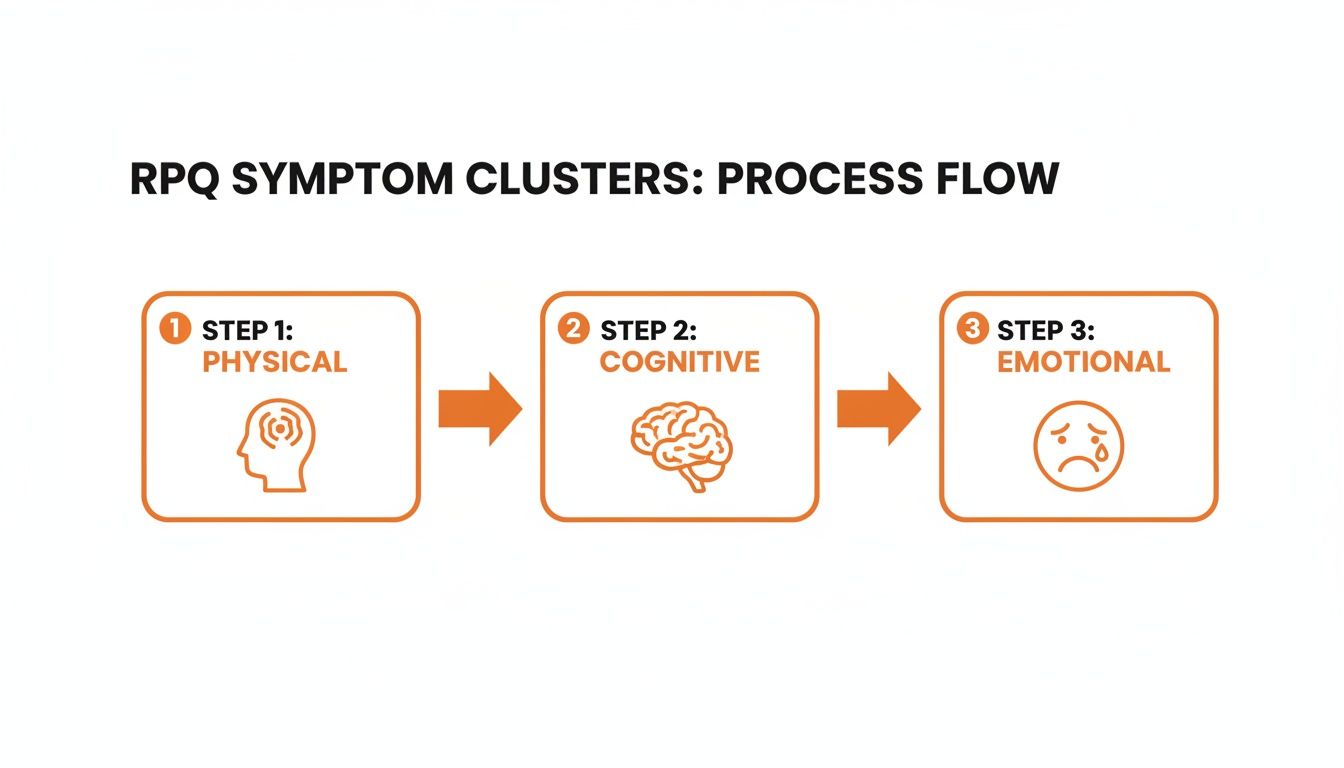
This visual flow shows how a patient's primary symptom burden can shift over time, a pattern that subscale scoring helps us quantify.
RPQ-3 (Physical Symptoms): This cluster includes the first three items—headaches, dizziness, and nausea/vomiting. The score ranges from 0 to 12 and often reflects the acute, physical phase of the injury. It’s common to see high scores here in the days immediately following a concussion.
RPQ-13 (Cognitive-Emotional Symptoms): This covers the remaining 13 items, like fatigue, forgetfulness, and irritability. With a score range of 0 to 52, this cluster tends to capture the persistent symptoms that make it tough for a patient to return to work or daily life.
By tracking these subscales separately, you can spot recovery patterns. For example, a patient whose RPQ-3 score is dropping while their RPQ-13 score stays high is likely moving out of the acute physical stage and into a more prolonged cognitive-emotional recovery phase. This kind of consistent tracking is a cornerstone of good assessment, and you can learn more about it in our guide on test-retest reliability in clinical settings.
Practical Example: A Sample Scoring Interpretation
Let's put this into practice with a patient, "Mark," who is four weeks post-concussion and wants to get back to his office job.
Here’s a snapshot of his RPQ scores:
Headaches: 2 (Mild)
Dizziness: 1 (No more of a problem)
Nausea: 0 (Not experienced)
Forgetfulness: 4 (Severe)
Poor Concentration: 4 (Severe)
Taking Longer to Think: 3 (Moderate)
Irritability: 3 (Moderate)
Interpretation in Action:
Total Score: Mark’s total score is 28. That's clinically significant and immediately flags a high symptom burden that needs attention.
Subscale Analysis: His RPQ-3 score is just 3/12, which tells us his initial physical symptoms are getting better. The real story is in his RPQ-13 score, which is high. It's being driven by severe cognitive complaints (forgetfulness, poor concentration) and moderate emotional challenges (irritability).
Actionable Insight: The interpretation is crystal clear. Mark’s main barrier to returning to work isn’t physical; it’s cognitive. His treatment plan should focus on strategies for managing cognitive load, introducing memory aids, and using attention exercises. That high irritability score also tells us we need to address the emotional toll his struggles are taking.
This process transforms the Rivermead Post Concussion Questionnaire from a simple form into a powerful clinical instrument. It allows you to pinpoint the patient's most significant challenges and tailor your interventions with precision, guiding them more effectively on their path to recovery.
Integrating the RPQ into Your Clinical Practice
Knowing the theory is one thing, but making the Rivermead Post Concussion Questionnaire a real workhorse in your daily practice is another. The goal is to weave it so seamlessly into your patient encounters that it stops being just a form and becomes a dynamic tool for decision-making and tracking recovery.
The true power of the RPQ comes alive when it’s a consistent, structured part of your assessment process. It becomes the narrative thread connecting one appointment to the next, telling the story of your patient’s recovery journey.
Best Practices for Administration
To get the most out of the RPQ, timing and context are everything. A well-timed initial questionnaire gives you a clean baseline, while consistent follow-ups reveal the patterns of recovery that matter most.
Here’s an actionable rhythm that works well in a clinical setting:
Initial Assessment (First 72 Hours): Administer the first RPQ as soon as you practically can after the injury. This sets the all-important symptom baseline against which you'll measure everything else.
Two-Week Follow-Up: This is often when patients start trying to get back to their normal activities. Comparing this score to the baseline can show early patterns, like a drop in physical symptoms but a spike in cognitive ones.
One-Month and Three-Month Check-Ins: These touchpoints are crucial for catching persistent symptoms that might signal a risk for post-concussion syndrome. A score that flatlines or even gets worse at this stage is a clear red flag to dig deeper.
When you hand the form to your patient, how you frame it makes a huge difference. You have to emphasize the core instruction: "Please rate these symptoms compared to how you felt before the accident." This simple bit of context is critical. It stops patients from just rating how they feel today in a vacuum and ensures the data reflects a true change from their normal state.
Using the RPQ to Guide Clinical Decisions
The RPQ really proves its worth when you use it as more than just a measurement tool—think of it as your first-line alert system. An elevated score on a specific item or cluster should immediately make you ask, "Okay, what's the next step?"
This is where you connect the dots between a patient's subjective report and objective data. For example, if a patient consistently scores a 3 or 4 on cognitive items like 'forgetfulness' or 'poor concentration,' that's a clear signal to investigate further.
This screenshot from the Shirley Ryan AbilityLab shows the standard layout of the questionnaire, highlighting the 0-4 rating scale for each of the 16 symptoms.
Seeing consistently high scores in that cognitive section should immediately trigger you to pull out a more precise, objective assessment to actually quantify the deficit.
This creates a clear, evidence-based pathway for your clinical decisions. A prospective cohort study right here in Canada backs this up powerfully, showing that higher baseline RPQ scores in older adults strongly predict disability and delayed recovery six months down the road. In that study, people with high initial scores had a relative risk of 2.13 for poor outcomes and a 2.64 relative risk for incomplete recovery—critical evidence for clinicians in Ontario. You can read more about how the RPQ predicts mTBI recovery outcomes and its validated reliability.
Practical Example: A patient circles 'severe problem' for forgetfulness on their RPQ. That subjective flag prompts you to use an objective tool like OrangeCheck to measure their memory and attention. The results come back showing a clear deficit in working memory. Now you can build a targeted, data-driven rehab plan using specific cognitive exercises that address that exact problem.
This kind of integrated workflow—where the RPQ flags an issue, objective tools confirm and measure it, and a personalized plan addresses it—takes the guesswork out of the equation. It makes sure your treatment is hitting the patient’s most significant challenges head-on, leading to more efficient and effective care. For a deeper dive into building these workflows, our guide to complete concussion management offers more practical strategies.
Comparing the RPQ with Other Concussion Tools
Choosing the right assessment in concussion care is a bit like a mechanic picking the right tool for the job. You wouldn't use a tire pressure gauge to check the engine diagnostics, and the same principle applies here. Every tool has its purpose, and knowing when to use which is what separates good clinical practice from great. The Rivermead Post Concussion Questionnaire holds its own in a busy field, but you need to understand how it works alongside instruments like the SCAT and PCSS to build a truly effective toolkit.
The biggest difference comes down to timing and intent. Think of the Sport Concussion Assessment Tool (SCAT) as the first responder's kit—it's designed for the sidelines, for that immediate, on-field assessment right after a suspected sports injury. It's built for rapid screening. The RPQ, on the other hand, is your long-term monitoring device back in the clinic, designed to track how symptoms change over weeks or even months. This makes it perfect for the general population, not just athletes.
Where the RPQ Fits in Your Toolkit
While the SCAT is essential for the moment of impact, the RPQ truly shines in the follow-up appointment. Its real power lies in the pre-injury baseline comparison, which gives you a crucial frame of reference: what was the patient's "normal" before this happened? This context makes it incredibly valuable for tracking those subtle, nagging symptoms that often define a patient's long-term recovery.
It’s this deep dive into the patient's subjective, ongoing experience that really sets the RPQ apart. It helps you answer the most important clinical question of all: "Is my patient actually getting better, and what specific symptoms are still holding them back?"
The RPQ isn't for the moment of injury; it's for the journey of recovery. It provides the narrative thread that connects each follow-up appointment, telling the story of the patient's progress through their own reported experience.
But that strength—its subjectivity—is also its biggest challenge. Because it's a self-report tool, scores can be swayed by a patient's mood, how well they remember things, or even just how they interpret the questions. This is where the high base rate of symptoms in the general population can muddy the waters.
A major Canadian study with over 11,000 TBI participants really brings this to light. It showed that while the RPQ is great at picking up on comorbidities like depression (which 27.0% of mild TBI patients reported), many of the symptoms it tracks are surprisingly common in perfectly healthy people. In fact, research out of British Columbia found that somewhere between 35.9% and 71.8% of healthy volunteers report symptoms that are on the RPQ. This can definitely blur the lines between post-concussion pathology and just... life. You can dig into the full study on RPQ symptom prevalence and mental health burdens to see the data for yourself.
This doesn't make the RPQ any less useful; it just means we have to be smart about how we interpret the scores. A high number isn't an automatic diagnosis—it's a signal to investigate further.
RPQ vs SCAT vs PCSS A Clinical Comparison
To make it easier to decide which tool to grab when, let's break down their distinct roles and features in a real-world clinical setting. This table should clear things up.
Feature | Rivermead Post Concussion Questionnaire (RPQ) | Sport Concussion Assessment Tool (SCAT) | Post-Concussion Symptom Scale (PCSS) |
|---|---|---|---|
Primary Use Case | Long-term monitoring of symptom severity in a general clinical setting over weeks or months. | Acute, on-field or sideline assessment immediately following a suspected sports concussion. | Symptom checklist often used within other tools (like SCAT) or for serial tracking of symptom severity. |
Key Strength | Compares current symptoms to the patient's pre-injury baseline, offering a personalized recovery metric. | Combines symptom evaluation with brief cognitive, balance, and coordination tests for rapid screening. | Simple, quick, and widely used for tracking a standard list of 22 concussion-related symptoms. |
Ideal Population | General population, including non-athletes, following any type of mild traumatic brain injury. | Athletes aged 13 and older (with child and youth versions available for younger athletes). | Broadly applicable, but frequently used in sports medicine and paediatric concussion clinics. |
Limitation | Purely subjective, self-report nature; high symptom base rates in the general population can complicate interpretation. | Less detailed for tracking long-term, nuanced recovery; designed for immediate, post-injury scenarios. | Lacks the crucial "compared to pre-injury" instruction found in the RPQ, making baseline comparisons less direct. |
At the end of the day, these tools aren't rivals; they're collaborators. A truly comprehensive approach might see you using the SCAT for that initial sideline check, then bringing in the RPQ at regular clinic appointments to map out the long road to recovery.
When you understand what each instrument was built for, you can pick the right one for the right situation, giving you a much clearer and more accurate picture of your patient's health. To see how these subjective insights can guide objective testing and treatment, contact Orange Neurosciences today to learn how our platform can fit into your clinical workflow.
Turning RPQ Insights into Better Patient Outcomes
Collecting data with the Rivermead Post-Concussion Questionnaire is just the first step. The real value comes when that data sparks action. The scores and patterns you uncover are the perfect jumping-off point for a deeper conversation about how a patient's symptoms are actually impacting their day-to-day life. This is where modern rehabilitation shifts from theory into practice.

This approach creates a powerful, closed-loop system of care that takes the guesswork out of recovery and brings a new level of precision to your practice. When you carefully interpret RPQ scores, you can design truly tailored interventions and set realistic expectations. It helps patients grasp complex topics, like how long the brain takes to heal after their injury.
From Subjective Report to Objective Intervention
The RPQ is brilliant at flagging the problem; objective tools help you solve it.
Let's say a patient consistently reports a severe issue with 'forgetfulness' and 'poor concentration' on the RPQ. That subjective data is your cue to dig deeper with objective, hard metrics.
This is the perfect bridge to integrated care with Orange Neurosciences:
Assess (RPQ): The patient’s high score on the cognitive items confirms they are genuinely struggling. You have a clear subjective complaint.
Quantify (OrangeCheck): Now, you bring in OrangeCheck to get objective, quantifiable data on their attention and memory. The results don't just confirm a problem—they pinpoint a clear deficit in working memory.
Treat (ReadON): Armed with that precise data, you can build a personalized therapy plan. Using a tool like ReadON, you can target those specific cognitive deficits with engaging, game-based training.
This Assess-Quantify-Treat model transforms a patient's self-report into a data-driven, targeted intervention. It ensures your rehabilitation plan directly addresses the patient's most significant functional impairments.
This integrated workflow creates a clear path from symptom reporting straight to effective treatment. It dials down clinical uncertainty and drives up patient outcomes. You can get more context on this by exploring our detailed guide on the long-term effects of concussion.
Ready to see how this objective approach can fit into your practice? Book a demo with Orange Neurosciences to discover how our platform can help you turn patient insights into measurable results.
Common Questions About the RPQ
Even after getting the hang of the Rivermead Post Concussion Questionnaire, you'll inevitably run into some practical questions in the clinic. Let's tackle some of the most common ones that come up, giving you quick, actionable answers to help you fine-tune how you use the tool.
Think of this as a cheat sheet to help you apply the RPQ with more confidence and precision.
How Often Should I Be Using the RPQ?
The best approach is to get an initial RPQ done as soon as you can after the injury. This gives you a solid symptom baseline to work from. After that, you'll want to administer it serially to really track the patient's recovery over time.
A good starting cadence is to check in at key points—say, two weeks, one month, and three months post-injury. But this isn't set in stone. You absolutely should adjust this rhythm based on how the individual is progressing. If you see their scores plateau or, worse, suddenly spike, that's a clinical flag. It’s a clear signal to dig deeper or rethink the current treatment plan.
Can I Use the RPQ with Kids and Teenagers?
Yes, you can. The RPQ works well for adolescents and older children who can reliably describe their own symptoms. For the younger kids, though, you’re usually better off with a parent-reported symptom scale to make sure you're getting an accurate picture.
When you are using the Rivermead Post Concussion Questionnaire with younger patients, it’s a really good idea to have a clinician in the room. You can clear up any confusing questions and, most importantly, make sure they grasp that all-important instruction: "compared to before the injury."
What if a Patient's RPQ Score Is High, but Their Objective Tests Are Normal?
This is a classic clinical puzzle, and it’s incredibly insightful. When a high RPQ score sits next to normal results on objective cognitive tests, it often means the patient's distress is being driven by something else.
This "something else" could be:
Physical symptoms like stubborn headaches or dizziness.
Emotional factors, like a spike in anxiety or depressive feelings.
Major sleep disruptions, which have a knack for making every other symptom feel worse.
This isn't a contradiction; it's a clue. It tells you the treatment plan needs to pivot and focus more on these other areas. It's also a perfect example of why you need to combine subjective reports with objective assessments to see the full clinical story.
Is the RPQ a Diagnostic Tool for Concussion?
No, and this is a critical point to remember. The RPQ is not a standalone diagnostic tool. It's a symptom severity scale. Its job is to put a number on a patient's subjective experience and track how that experience changes.
A formal diagnosis of a concussion or post-concussion syndrome has to come from a comprehensive clinical evaluation. That means looking at the patient's history, conducting a thorough clinical exam, and often bringing in other objective tests to build a complete and accurate diagnosis.
By weaving the subjective insights from the Rivermead Post Concussion Questionnaire together with hard, objective data, you create a much more powerful, evidence-based approach to care. At Orange Neurosciences, our platform is built to provide those crucial objective metrics, helping you turn what your patients tell you into targeted, effective treatment plans.
Discover how Orange Neurosciences can complement your clinical workflow.

Orange Neurosciences' Cognitive Skills Assessments (CSA) are intended as an aid for assessing the cognitive well-being of an individual. In a clinical setting, the CSA results (when interpreted by a qualified healthcare provider) may be used as an aid in determining whether further cognitive evaluation is needed. Orange Neurosciences' brain training programs are designed to promote and encourage overall cognitive health. Orange Neurosciences does not offer any medical diagnosis or treatment of any medical disease or condition. Orange Neurosciences products may also be used for research purposes for any range of cognition-related assessments. If used for research purposes, all use of the product must comply with the appropriate human subjects' procedures as they exist within the researcher's institution and will be the researcher's responsibility. All such human subject protections shall be under the provisions of all applicable sections of the Code of Federal Regulations.


© 2026 by Orange Neurosciences Corporation