Unpacking Cognitive Speed: reaction time humans and what slows us down
Dec 27, 2025
Think about that heart-stopping moment when you slam on the brakes to avoid a car accident. That split-second response is your reaction time in action. In simple terms, human reaction time is the time it takes to perceive something and then launch a response to it. It’s a fundamental process that quietly governs how we navigate our world, safely and efficiently.
Why Split Seconds Matter in Daily Life
Reaction time isn't just an abstract number; it's a real-world indicator of your nervous system's efficiency. Picture it as your brain's internal courier service, rushing urgent messages from your senses to your muscles. This system is working all the time, whether you're lunging to catch a falling phone, figuring out an answer in a meeting, or weaving through a crowded street.
Even though it feels instant, this entire process is a complex, high-speed chain of events. It involves seeing, hearing, or feeling a stimulus, your brain processing what it means, and then sending a signal for your muscles to get moving. The speed of that entire sequence is crucial in countless situations. For example, a difference of just 100 milliseconds in braking time can be the difference between a safe stop and a fender bender.
More Than Just a Reflex
It’s a common mistake to lump reaction time in with simple reflexes, like yanking your hand away from a hot stove. While they're related, reaction time usually involves a critical extra ingredient: decision-making.
A reflex is completely automatic and involuntary. Reaction time, on the other hand, almost always requires a moment of conscious thought, no matter how quick.
Here are some practical examples:
Driving: A squirrel darts onto the road. You don't just see it; you have to instantly decide whether to brake or swerve (processing) before your foot actually moves to the pedal (response).
Playing Sports: When a baseball is hurtling toward a batter, they don't just react. They have to process the ball's speed, spin, and location to decide when and where to swing.
Having a Conversation: That tiny pause before you reply to a question? That’s your reaction time. Your brain is busy processing what was said and formulating your answer.
This cognitive component is precisely why measuring reaction time in humans gives us such a powerful glimpse into our overall brain health. Any unusual delays can sometimes be an early sign of underlying issues, long before other symptoms become obvious.
Your reaction time is a direct reflection of your brain's processing speed. It's not just about how fast your muscles can move, but how quickly your mind can size up a situation and tell your body what to do.
Knowing your own baseline is the first step toward improving this vital cognitive skill. As we'll get into, many factors can affect this speed, but there's also a lot you can do about it. To see where you stand, you can explore what's considered an average reaction time in our detailed guide. Platforms like Orange Neurosciences offer the tools to precisely measure and track these functions, giving you clear insights to guide your progress.
Your Brain's High-Speed Relay Race
Every time you react—whether it's catching a dropped phone, swerving to avoid a pothole, or just answering a question—your brain kicks off an incredibly fast internal relay race. Think of it as a biological message delivery service, where a signal zips from your senses to your muscles in a tiny fraction of a second. This journey is the core of reaction time in humans, and getting to know it helps us understand why some reactions feel instantaneous and others… not so much.
The whole thing starts with a stimulus. This can be anything your senses register: the bright flash of a speed camera, the sound of your name across a crowded room, or the feel of a tap on your shoulder. This sensory information is the package that needs to be delivered, and fast.
Once a sensory organ like your eye or ear picks up the stimulus, it immediately converts it into an electrical signal. This signal is the message, and it starts its trip along sensory nerves, which act like dedicated courier routes leading straight to the central command centre—your brain.
From Signal to Decision
But the message doesn't just get dropped into a general mailbox in your brain. It's routed to highly specialized departments. Visual information travels to the occipital lobe at the very back of your brain, home to the visual cortex. If it's a sound, it’s sent to the temporal lobe. In these areas, the brain gets to work deciphering the message: "Is this important? Is it a threat? What do I need to do about it?"
This is the most critical—and often the longest—part of the journey. Your brain doesn't just see a red light; it understands what a red light means when you're behind the wheel. This step involves pulling up memories, applying rules, and making a judgement call. It’s the key difference between a simple reflex and a deliberate, considered reaction.
This infographic breaks down the core stages, from that first stimulus to the final physical response.
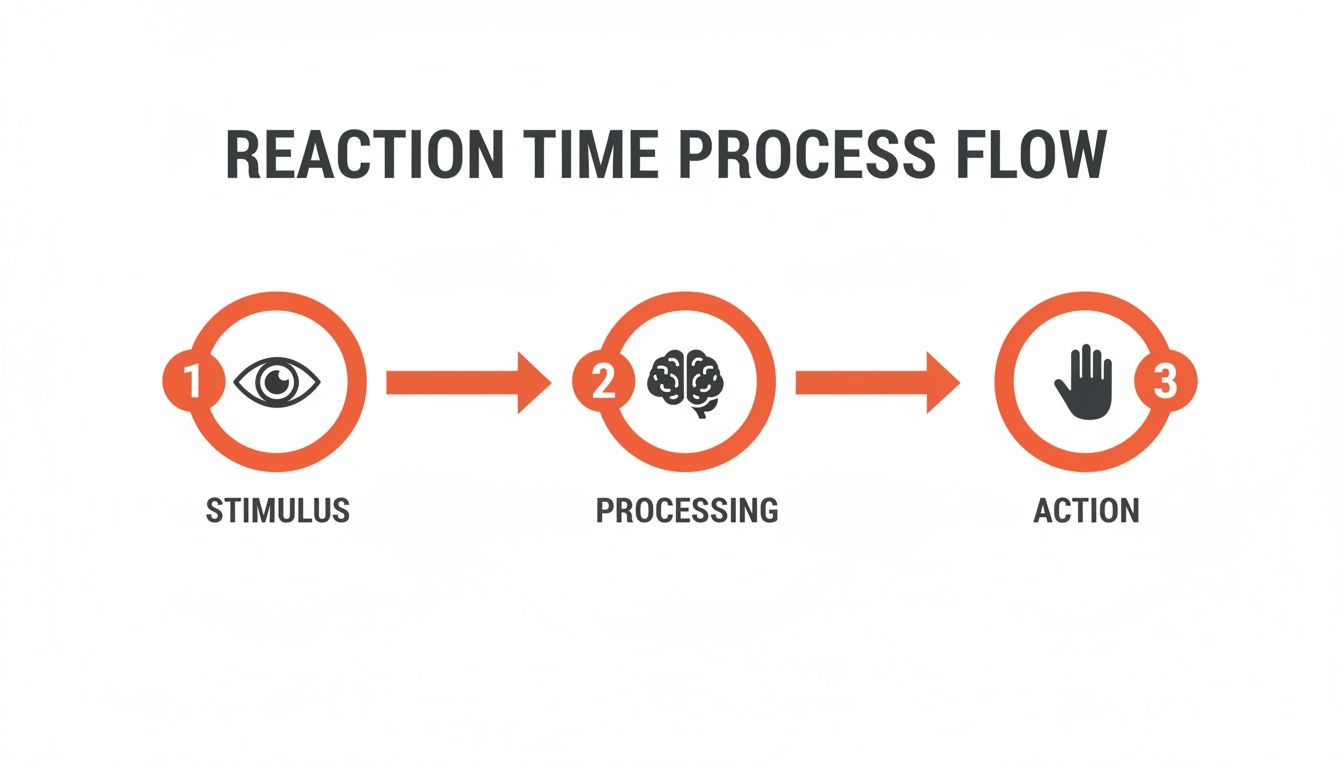
As you can see, it’s a clear sequence, and each step adds precious milliseconds to your total reaction time.
Once the decision is made—"Hit the brakes!"—the brain’s motor cortex takes command. Located in the frontal lobe, this area acts as the dispatch centre. It formulates a precise action plan and sends out a new set of instructions.
The Final Action Command
These new instructions are motor commands. They travel down an entirely different set of pathways—the motor nerves—headed for the specific muscles needed to get the job done. In our driving scenario, the signal races down to the muscles in your leg and foot. The moment your foot actually presses the brake pedal is the final step, completing the entire sequence.
This whole process, from seeing the red light to moving your foot, happens in about 200 to 250 milliseconds for an alert young adult. That's quicker than the blink of an eye.
The journey of a reaction is a three-part biological marvel: sensory input, cognitive processing, and motor output. The time it takes to complete this circuit is your reaction time, a key indicator of your nervous system's efficiency.
Understanding this pathway is crucial because delays can creep in at any stage. A practical insight here is to identify where your potential delays are.
Sensory Stage: Poor vision or hearing can mean the initial signal gets a late start. Actionable step: Get regular eye and hearing check-ups.
Processing Stage: Fatigue, distraction, or cognitive impairment can significantly slow down your brain's decision-making. Actionable step: Prioritize sleep and practice single-tasking.
Motor Stage: Physical injuries or limitations can delay the final muscle movement. Actionable step: Engage in exercises that improve coordination and mobility.
By pinpointing where delays are happening, we can start to understand what's influencing cognitive speed. At Orange Neurosciences, we provide tools that help measure these intricate processes, offering clear insights into your brain's performance and paving the way for targeted improvements. Explore our platform to see how you can get a clearer picture of your own cognitive hardware.
How We Measure Cognitive Speed
Not all reactions are created equal. Think about it: a sprinter launching off the blocks is a world away from a driver navigating a busy intersection. One is a pure, almost reflexive action, while the other demands quick thinking. The way we measure cognitive speed has to account for these differences.
Understanding these measurement methods is the key to pinpointing exactly where our processing might be slowing down. It gives us a much more detailed map of our brain's performance, showing us the difference between a simple reflex and a response that requires genuine thought.
Simple Reaction Time: The Sprinter's Start
The most fundamental way to measure our brain's processing speed is with Simple Reaction Time (SRT). This is the raw, unfiltered speed of your nervous system.
Imagine a sprinter coiled and ready, waiting for the starter's pistol. There's only one possible signal—the bang—and only one possible response: run. There’s no decision to make, just pure reaction.
In a lab or clinical setting, the task is just as direct.
A Classic Example: A light flashes on a screen. Your only job is to press a single button the very instant you see it. The time between the light appearing and your finger hitting the button is your SRT.
This measurement gives us a clean look at the efficiency of your sensory and motor pathways. It tells us how quickly your eyes can spot the signal and how fast that message can zip through your brain and down to your hand, bypassing any deep cognitive analysis.
Choice Reaction Time: The Video Game Challenge
Things get far more interesting—and much more telling—with Choice Reaction Time (CRT). This is where decision-making enters the picture, giving us a measurement that much more closely mirrors the demands of everyday life.
Instead of one signal and one response, CRT throws multiple potential signals at you, each demanding a different, specific action.
A Classic Example: Picture a simple video game. A red circle might appear on the left side of the screen, and a blue square on the right. Your job is to press the left key for the red circle and the right key for the blue square. Now, you’re not just reacting; you’re identifying the stimulus, remembering the rule, and then executing the correct action.
That extra layer of thinking is what makes CRT such a powerful tool. It doesn't just measure the raw speed of your neural wiring; it also assesses your executive function—your brain's ability to process information and make the right call under pressure.
To dive deeper into the nuts and bolts of cognitive speed, you can explore our complete guide on the reaction time of a human, which unpacks these measurement techniques even further.
So, how do these two essential methods really stack up against each other? The table below breaks down the core differences.
Simple Reaction Time vs Choice Reaction Time
Feature | Simple Reaction Time (SRT) | Choice Reaction Time (CRT) |
|---|---|---|
Stimuli | One predictable stimulus. | Multiple possible stimuli. |
Response | One pre-determined response. | Multiple, stimulus-dependent responses. |
Cognitive Load | Very low; focuses purely on detection speed. | Higher; requires discrimination and decision. |
What It Measures | The baseline efficiency of sensory and motor pathways. | Processing speed plus decision-making ability. |
Real-World Analogy | Slamming on the brakes for a sudden stop sign. | Navigating rush-hour traffic with multiple signals. |
As you can see, the two tests reveal very different aspects of our cognitive abilities.
While SRT gives us a baseline for your nervous system's raw speed, CRT offers a clearer window into real-world cognitive agility, where making the right choice quickly is just as important as being fast.
For clinicians and educators, this distinction is critical. A person might have a lightning-fast SRT but a noticeably slower CRT. This pattern suggests the delay isn't in their physical response time but somewhere in the cognitive processing—the thinking part. This insight is actionable: it means training should focus less on motor drills and more on decision-making exercises. This is exactly why specialized platforms like Orange Neurosciences use both types of assessments to build a complete cognitive profile and create effective interventions.
What Speeds You Up or Slows You Down
Think of your reaction time not as a fixed number, but as a dynamic measure of your nervous system's efficiency. It ebbs and flows throughout the day, influenced by a whole host of internal and external forces that can either sharpen your responses or bog them down.
Getting a handle on these factors is the first step toward actually improving your cognitive speed.

The good news? Many of these influences are squarely within your control. Once you recognise what’s putting the brakes on, you can take direct steps to speed yourself back up. This knowledge is a powerful tool for taking charge of your cognitive health.
Age and Experience: The Surprising Curve
It’s a common assumption that reaction time in humans just gets slower as we age. While there's some truth to a gradual decline in raw motor speed, the full picture is far more interesting—and it often pushes back against stereotypes about aging.
Take driving, for example. You might think older drivers are riskier because their reactions are slower. But when you look at the data from a place with a large aging population like California, you see that real-world experience and caution often more than make up for any minor declines.
An analysis of 2019 CHP data showed that drivers aged 70 and over made up 10.4% of all licensed drivers but were involved in only 7.2% of fatal crashes. Younger drivers, especially those in the 25-29 age group, were far more likely to be involved in accidents. This tells us that while a simple button-press test might show slower times, things like better judgment and risk avoidance are huge in the real world. You can find more details in the LA Times analysis of driver safety data.
This is a perfect illustration of why it’s so vital to separate pure processing speed from motor output. That’s exactly what platforms like Orange Neurosciences allow clinicians to do—dissect these different components to create more targeted and effective therapies.
Fatigue and Attention: The Cognitive Toll
Few things slam the brakes on your reaction time quite like being tired or distracted. When you’re running on empty, your brain's processing speed takes a massive hit.
Think about a new parent, exhausted from lack of sleep. They might hear their baby cry just as quickly as they would well-rested, but the time it takes for their brain to process that sound and trigger the action of getting up can feel like an eternity. That’s fatigue directly impairing the decision-making part of the reaction chain.
Distractions pile on another layer of delay. Ever try texting while walking? You’re forcing your brain to split its focus, creating a cognitive bottleneck. That bottleneck is what slows down your ability to react to something unexpected, like a crack in the pavement.
A tired or distracted brain is a slow brain. Making sleep a priority and cutting down on multitasking are two of the most powerful things you can do to keep your reactions sharp.
To really dig into this connection, have a look at our guide on the close relationship between attention and cognitive processing.
Lifestyle Factors You Can Control
Beyond age and how alert you feel, a handful of everyday choices have a huge impact on how well your nervous system performs. The best part is that these are all areas where you can make immediate, positive changes.
Physical Fitness: Regular cardio is one of the best things you can do for your brain. It boosts blood flow, which means more oxygen and nutrients to support healthy neural function and, you guessed it, faster reaction times. Actionable step: Aim for 30 minutes of moderate activity, like a brisk walk, five days a week.
Nutrition: Your brain needs the right fuel to run efficiently. A diet packed with antioxidants (think berries and leafy greens) and omega-3 fatty acids (found in fish) helps protect brain cells and keeps the communication lines open. Actionable step: Try adding a handful of blueberries to your breakfast or a serving of salmon to your dinner once a week.
Hydration: It sounds simple, but even mild dehydration can cause a noticeable slowdown in cognitive function, including reaction time. Sipping enough water throughout the day is a small habit with a big payoff. Actionable step: Keep a water bottle on your desk and take a few sips every time you check your email.
Health Conditions: Some chronic conditions, like diabetes or thyroid disorders, can affect nerve function and slow down response speeds. It's also worth noting that certain medications can have side effects that impact alertness and processing. Actionable step: Discuss any concerns about cognitive changes with your doctor to manage underlying conditions effectively.
By focusing on these controllable factors, both individuals and healthcare providers can take a proactive role in supporting and even enhancing cognitive speed.
The Real-World Stakes of Reaction Time
While lab tests give us clean, controlled data, the true importance of reaction time in humans snaps into focus in the messy, high-stakes moments of everyday life. Nowhere are the consequences of a delayed response more visible—or more serious—than behind the wheel of a car.
It’s where milliseconds can separate a close call from a catastrophe. Suddenly, an abstract concept like cognitive speed feels incredibly urgent and real.
But here's the thing: raw speed isn't the only piece of the puzzle. We see a strange paradox on our roads. Younger drivers, who usually have the fastest baseline reaction times, are often involved in a disproportionate number of accidents. This highlights the critical difference between controlled reaction speed and real-world perception-reaction time—the total time it takes from spotting a hazard to actually doing something about it.
The Paradox of Youthful Speed
In a quiet lab, a young adult might hit a button in about 200 milliseconds. But driving in the real world is anything but quiet and simple.
Things like inexperience, a tendency toward risk-taking, and—most critically—distraction can stretch that fraction of a second into a dangerously long interval of 1.5 seconds or more. A quick glance at a phone or a moment of hesitation can completely wipe out any natural neurological advantage they have. A practical example: traveling at 60 mph, a 1.5-second delay means the car travels 132 feet—almost half a football field—before the driver even hits the brake.
Traffic safety data tells this story loud and clear. In California, for example, drivers aged 20-24 made up just 8.1% of licensed drivers in 2019 but were involved in 11.9% of fatal crashes and 12.5% of injury crashes. This overrepresentation shows how tragically behaviour can override peak physical ability. For a deeper dive into these trends, you can review the findings from the NHTSA.
Quantifying Risk Beyond Guesswork
For parents, therapists, and even insurance providers, this gap between potential and actual performance is a huge concern. How can you objectively know if someone's reaction time is truly safe enough for driving, especially after a cognitive setback like a concussion? This is where precise measurement moves us beyond guesswork and gives us actionable answers.
A concussion, for instance, can introduce subtle but significant processing delays that aren't obvious in a normal conversation. On the road, those delays can have devastating consequences. For a better understanding of these cognitive impacts, you can read our guide on the long-term effects of concussion.
Platforms like Orange Neurosciences are designed to quantify these exact deficits. Instead of just relying on subjective observation, clinicians can use a tool like OrangeCheck to get a rapid, objective profile of a person's cognitive state.
A post-concussion assessment might reveal a 15-20% slowdown in a patient's simple reaction time. That's a critical piece of data that directly informs whether it's safe for them to drive and helps guide a targeted rehabilitation plan to close that gap.
This data-driven approach empowers healthcare providers to:
Identify At-Risk Individuals: Pinpoint subtle processing speed deficits before they lead to an incident.
Guide Targeted Interventions: Use objective data to create personalized, game-based training plans with tools like ReadON to rebuild cognitive speed.
Track Progress Objectively: Measure improvements in eye-hand coordination and reaction time to validate that the therapy is working.
In high-stakes situations like driving, understanding how to calculate stopping distance makes the impact of reaction time crystal clear. By turning abstract cognitive science into concrete, life-saving data, we can better protect individuals and make our communities safer for everyone.
Actionable Steps for Improving Cognitive Speed

Understanding the science behind reaction time in humans is one thing; actually making yourself quicker is another challenge entirely. The goal isn't just about hitting a high score on a test. It’s about strengthening the neural pathways that allow for fast, sharp, and accurate decision-making in the real world.
The good news? Many of the most effective strategies are simple lifestyle adjustments and targeted exercises you can start today. Think of these habits as creating the ideal biological environment for your brain to fire on all cylinders.
Foundational Lifestyle Improvements
Before jumping into specific drills, it's crucial to get the fundamentals right. These core pillars of cognitive health have a direct and proven impact on your brain's processing power and overall responsiveness.
Prioritize Quality Sleep: Seriously. Aim for 7-9 hours of solid, uninterrupted sleep each night. It's during this deep sleep that your brain clears out metabolic waste and consolidates memories—processes that are absolutely essential for maintaining sharp cognitive function the next day. A practical tip: set a consistent bedtime and wake-up time, even on weekends.
Engage in Regular Physical Exercise: Activities that get your heart pumping, like a brisk walk, a bike ride, or a swim, boost blood flow to the brain. This surge delivers the oxygen and nutrients needed to support neurogenesis (the creation of new brain cells) and strengthen existing neural connections.
Adopt Brain-Healthy Nutrition: What you eat directly impacts your brain. A diet rich in omega-3 fatty acids (think fish and flaxseeds), antioxidants (berries and leafy greens are fantastic), and B vitamins supports the health of your nerves and reduces inflammation, helping your brain's signalling system run without a hitch.
Making these lifestyle changes is like performing regular maintenance on your cognitive engine. A well-rested, well-nourished, and active brain is naturally a faster and more resilient brain.
Targeted Cognitive Training
Once you've built a solid foundation of health, you can actively train your brain for speed. Much like physical exercise builds muscle, targeted cognitive exercises strengthen the specific neural circuits responsible for rapid processing and response.
To really move the needle, it's worth exploring proven accelerated learning techniques that focus on mastering new information efficiently. Engaging, game-based activities are a great way to do this because they keep the training process fun and motivating. For example, any activity that challenges your eye-hand coordination is brilliant for sharpening the link between seeing and doing. You can learn more by exploring these simple eye-hand coordination exercises you can do right at home. A simple practical example is playing catch, juggling, or even trying a fast-paced video game.
In some situations, these interventions are truly life-or-death. In California, alcohol-impaired driving fatalities jumped 16.1% to 1,370 in 2021—a grim reminder of how deadly impaired processing can be. Under the influence, a person's perception-reaction time can stretch beyond two seconds, a massive delay compared to the baseline 125-138 milliseconds for simple tasks. You can see these stark statistics in NHTSA's 2021 traffic safety report.
For healthcare professionals, therapists, and even concerned family members, establishing a precise cognitive baseline is the critical first step. It's impossible to measure improvement without knowing where you started. Platforms like Orange Neurosciences’ ReadON use personalized, adaptive training to help users achieve measurable gains in their processing speed.
Ready to see how a data-driven approach can sharpen cognitive performance? Contact us for more information or a product demo to discover how our platform provides the clear insights needed to guide effective, life-changing interventions.
Answering Your Questions About Reaction Time
As we've unpacked the science behind how quickly we react, a few common questions always seem to pop up. Let's tackle them head-on with some practical answers.
What’s a "Good" Reaction Time, Anyway?
This is a tricky one because "good" really depends on who you are and what you're doing. For a basic visual test, a healthy young adult might clock in around 200-250 milliseconds. An elite athlete might be closer to 150 ms.
But here’s what’s far more important: your own personal baseline. A sudden change in your own consistent reaction time is a much bigger red flag for things like fatigue or other health issues than how you stack up against some generic average. The actionable insight is to track your own performance over time to spot changes early.
Can I Really Improve My Reaction Time with Brain Games?
Absolutely. Purposeful cognitive training can lead to real, measurable improvements in how fast you respond. This isn't magic; it's neuroplasticity—the brain's incredible capacity to rewire itself by forging new neural pathways.
When you consistently challenge your brain with adaptive games, like those we've developed at Orange Neurosciences, you're essentially taking your brain to the gym. You're strengthening the specific neural circuits that handle quick responses, making them faster and more efficient over time.
Targeted training does more than just make you better at a game. It fortifies the underlying neural pathways that dictate how quickly you perceive, process, and act. That translates to sharper reflexes out in the real world.
Is a Slower Reaction Time Just a Normal Part of Getting Older?
While some slowing is a natural aspect of aging, a sharp decline is definitely not a given. The lifestyle choices we make have a massive impact on preserving our cognitive speed as we get older.
Study after study shows that older adults who stay physically active, keep their minds engaged, and maintain strong social connections have significantly faster reaction times than their peers who don't. A proactive approach to health, paired with targeted cognitive exercises, can fight back against much of that age-related slowing, helping you stay sharp for life.
Understanding and working on your reaction time is a powerful way to take control of your brain health. At Orange Neurosciences, we create tools that give you a clear, objective window into your cognitive function, then guide you with personalized training built on real data. See how our evidence-based platform can support your cognitive journey by visiting us at https://orangeneurosciences.ca.
Orange Neurosciences' Cognitive Skills Assessments (CSA) are intended as an aid for assessing the cognitive well-being of an individual. In a clinical setting, the CSA results (when interpreted by a qualified healthcare provider) may be used as an aid in determining whether further cognitive evaluation is needed. Orange Neurosciences' brain training programs are designed to promote and encourage overall cognitive health. Orange Neurosciences does not offer any medical diagnosis or treatment of any medical disease or condition. Orange Neurosciences products may also be used for research purposes for any range of cognition-related assessments. If used for research purposes, all use of the product must comply with the appropriate human subjects' procedures as they exist within the researcher's institution and will be the researcher's responsibility. All such human subject protections shall be under the provisions of all applicable sections of the Code of Federal Regulations.


© 2026 by Orange Neurosciences Corporation