Unpacking the Reaction Time of a Human
Dec 20, 2025
On average, a person’s reaction time to a visual cue falls somewhere between 200 and 300 milliseconds. But this isn't some fixed number etched in stone. It’s a dynamic skill that shifts based on a whole host of factors, making it a fascinating window into our cognitive speed and overall brain health.
What Is Human Reaction Time and Why It Matters
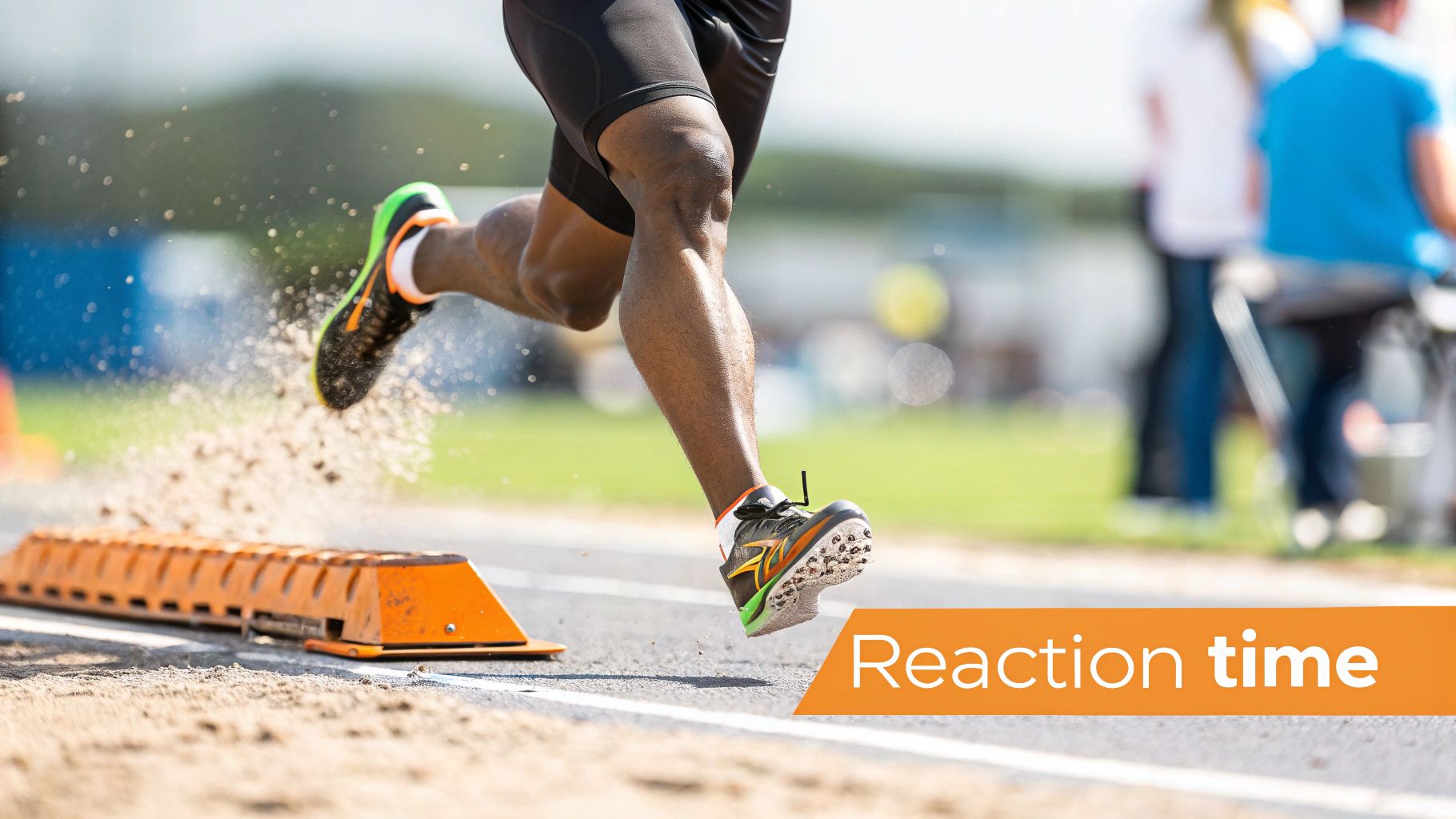
Picture a sprinter coiled at the starting line. The instant the gun fires, they explode forward. That tiny, almost imperceptible gap between the sound and their muscles firing is reaction time in its purest form.
It’s the total time it takes for your nervous system to run through a critical sequence:
Perceive: Your senses spot a stimulus—the brake lights on the car ahead suddenly glow red.
Process: Your brain rapidly interprets this signal and decides what to do next.
Respond: Your brain sends the command to your muscles, and your foot slams on the brake pedal.
This whole chain reaction happens in a fraction of a second, but that fraction is everything. It’s the difference between catching your phone before it hits the pavement and watching the screen shatter.
More Than Just a Number
It's easy to think of reaction time as a single, static value, but that’s a misconception. In reality, it’s a fluid metric that shows how efficiently your brain’s communication pathways are working. Think of these pathways as highways; when they’re clear and well-maintained, information travels lightning-fast.
Your reaction speed is a direct window into your cognitive processing ability. It’s not just about reflexes—it’s about how efficiently your brain can receive, interpret, and act on information from the world around you.
This core cognitive skill is influenced by everything from your morning coffee to how well you slept last night. Because of this, measuring it gives us incredibly valuable insights. You can learn more about this in our detailed guide on what is cognitive assessment, which explores how these measurements help build a complete picture of brain function.
Its Importance in Daily Life
Quick reaction times aren’t just for elite athletes and gamers. They are absolutely critical in countless everyday moments that demand fast decisions and physical responses.
Driving: Reacting to an unexpected car or pedestrian is essential for road safety. A faster reaction time can be the difference between a near-miss and a serious accident.
Cooking: Snatching your hand away from a hot stove prevents a nasty burn. This is a purely protective reflex that relies on speed.
Parenting: Lunging to catch a toddler before they take a tumble is a daily reflex for many.
Workplace Safety: Responding instantly to a machinery warning can prevent serious injury. In high-risk jobs, this skill is non-negotiable.
Understanding this fundamental skill is the first step toward improving it. Once you recognize the factors that influence your response speed, you can take practical steps to sharpen your mind and boost your performance in all areas of life.
The Different Ways We Measure Reaction Time
To get a meaningful read on human reaction time, we first have to understand how it’s actually measured. Not every reaction is the same; the task's complexity completely changes how we clock the speed of a response. Let's break down the three core types of tests, which build on each other from a simple reflex to a calculated decision.
Simple Reaction Time: The Purest Reflex
The most fundamental measurement is Simple Reaction Time (SRT). Think of this as the purest form of response—a straight line from sensing something to acting on it, with zero decision-making in between. It’s like a game where your only job is to hit a button the instant a light flashes on the screen. Any light, any time.
A great real-world example is flinching at a sudden, loud noise. You don't stop to think about it; your body just reacts. This test measures the raw, unfiltered speed of your neural pathways, from sensory input all the way to motor output.
SRT isolates the fundamental processing speed of your nervous system. It answers a single question: How fast can you detect a stimulus and kickstart a physical response?
Choice Reaction Time: Making a Decision Under Pressure
Next up, we add a layer of complexity with Choice Reaction Time (CRT). This test throws a decision-making element into the mix, which is much closer to what we do all day, every day. Instead of just one possible stimulus, there are several, and your job is to respond correctly to a specific one.
Imagine a screen with three lights: red, blue, and green. Your instruction is to press the button only when the green light appears. Now, your brain has to do a lot more work:
Identify which light just flashed.
Compare it to the target (the green one).
Decide whether to press the button or hold back.
This whole process naturally takes longer than a simple reaction. It’s the difference between slamming on the brakes for any obstacle in your path versus navigating a busy highway, where you have to spot your specific exit sign among many others and make the right turn at the right time. These kinds of measurements are a staple in modern cognitive tests online, which help map out your decision-making speed.
Go/No-Go Reaction Time: The Power of Inhibition
Finally, we have the Go/No-Go Reaction Time test. This measures your ability not just to react, but also to withhold a reaction. It’s a true test of your brain's inhibitory control—that crucial skill of hitting the brakes on an automatic response.
Think of a baseball batter. They’re primed to swing ("Go"), but they have to stop that swing cold if the pitch is a ball ("No-Go"). In a test setting, you'll see a rapid series of stimuli, requiring a response for the "Go" signal but demanding you do absolutely nothing for the "No-Go" signal.
This is a critical skill for everyday focus and self-control. It’s what stops you from blurting something out in a meeting or helps you stick to a diet when faced with a tempting snack. Each of these tests gives us a different piece of the puzzle, revealing not just your reflex speed but also the efficiency of your brain's decision-making and control centres.
Finding the Baseline for Human Reaction Time
To really get a handle on your own cognitive performance, you need a frame of reference. Establishing a baseline for the average reaction time of a human gives you a clear benchmark, helping you see where your own speed fits into the bigger picture. This isn't about chasing one single number; it's about understanding the typical ranges and why they shift depending on what kind of information your brain is processing.
Think about it this way: you’ll react much faster to a sudden car horn than you will to seeing distant brake lights. That’s because our nervous system is hardwired to process auditory signals more quickly than visual ones. Sound waves get translated into neural signals faster than light is processed by our eyes and interpreted by our brain.
This chart gives you a simple visual breakdown of how reaction times stretch out as a task gets more complex.
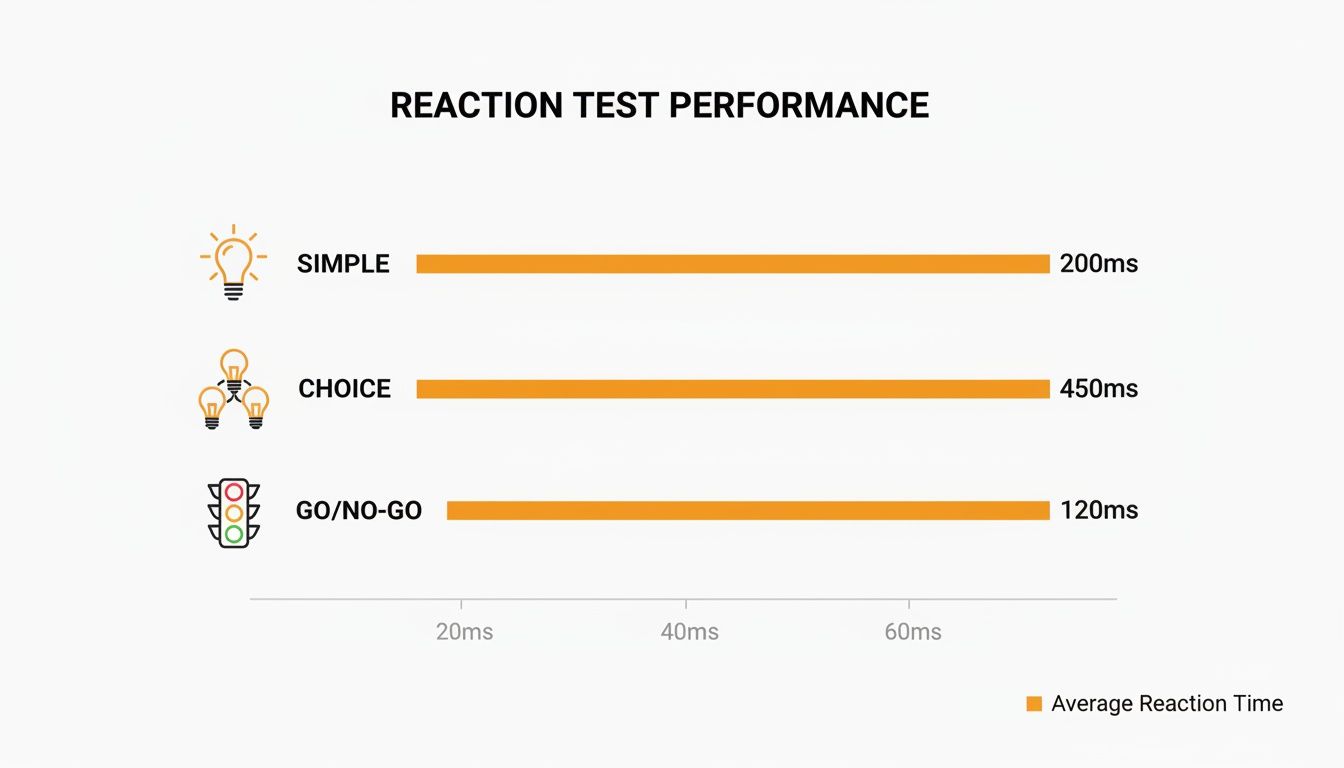
As you can see, the moment you add a layer of decision-making (Choice) or the need to hold back a response (Go/No-Go), the time it takes to act increases significantly compared to a simple, almost reflexive task.
Average Human Reaction Time by Sensory Stimulus
For a healthy young adult, the benchmarks in the table below are a solid starting point. These numbers show the typical reaction times when information comes in through different senses. It’s worth remembering that "milliseconds" (ms) are thousandths of a second—so while these differences are easily measured by technology, they happen in the blink of an eye.
Sensory Stimulus | Average Reaction Time (Milliseconds) | Real-World Example |
|---|---|---|
Auditory | 140–160 ms | Slamming on the brakes when you hear a horn. |
Visual | 180–200 ms | Catching a ball that's thrown to you. |
Touch | 150–170 ms | Pulling your hand away from a hot surface. |
These figures aren't just guesses; they're remarkably consistent. Research cited in California courts confirms that for college-age individuals, simple reaction times average around 190 ms for visual cues and 160 ms for sounds. Touch is even quicker, at about 155 ms. What's truly fascinating is that these findings line up with data collected over a century ago, showing just how fundamental these processing speeds are to our biology. You can dive deeper into the full research about these sensory reaction times to see a detailed breakdown.
How Age Shapes Your Reaction Speed
Your reaction time isn’t set in stone. It follows a predictable curve throughout your life. Most of us hit our peak cognitive speed in our early twenties, often around age 24. At this point, the brain's neural pathways are fully myelinated and firing on all cylinders.
After that peak, a gradual and completely natural decline begins. It’s not a sudden drop-off but a slow, steady increase in processing time as we get older. The brain’s white matter, which is like the insulation on the cabling for neural signals, starts to change, making communication between different brain regions just a little less efficient.
This age-related slowing is a normal part of the human experience. It underscores the importance of consistent measurement to distinguish natural changes from more significant shifts that might require attention.
This is a perfect example of why tracking your cognitive health is so valuable. By establishing your own baseline, you can monitor how your reaction speed changes over your lifetime. Knowing your own data is key to maintaining cognitive function, and measuring consistently is the only way to ensure that data is trustworthy. You can learn more about why consistency matters by exploring test-retest reliability statistics in cognitive assessment.
Think of this baseline knowledge as your starting point. It provides the context you need to understand the many other factors—from sleep to fitness—that can make these numbers fluctuate from one day to the next. With this information in hand, you can start to pinpoint what helps or hinders your own reaction speed, which we'll get into next.
Key Factors That Influence Your Reaction Speed
Your reaction time is far from a fixed number. Think of it less like a static benchmark and more like the reading on a dynamic dashboard, constantly fluctuating with a whole host of internal states and external pressures.
Getting a handle on these variables is the first real step toward optimizing your own cognitive speed. These factors generally fall into two buckets: physiological (your body) and psychological (your mind). Let's break down the ones that have the biggest impact, starting with the natural changes that come with age.
Age and The Natural Arc of Speed
As we touched on earlier, the reaction time of a human usually hits its peak in our early to mid-twenties. This is when the nervous system is firing on all cylinders. After that, we see a gradual, predictable slowing as part of the natural aging process. The signals between brain cells just aren't quite as zippy, and motor responses can take a few extra milliseconds.
But this isn't some steep cliff you fall off. For most healthy adults, the change is subtle and often balanced out by experience and better judgment. An older, more seasoned driver might have a slightly slower reflex than a teenager, but they more than make up for it by anticipating problems on the road long before they happen.
Physical Fitness and Neural Efficiency
The link between a healthy body and a sharp mind is rock-solid. Regular physical activity does more than build muscle; it fundamentally juices up your brain's processing power. Exercise boosts blood flow to the brain, encourages the growth of new neurons, and strengthens the connections between them.
This has a direct, measurable effect on reaction time. A detailed study of medical students in California found that those who exercised regularly had significantly quicker responses than their sedentary classmates. The research even showed that active females often matched or outpaced the reaction speeds of sedentary males, driving home the powerful connection between physical conditioning and neural speed. You can dig into the data yourself in the full study on physical activity and reaction time.
A well-exercised body supports a faster brain. Think of physical fitness as upgrading your internal hardware—it allows your cognitive software to run more smoothly and efficiently.
Sleep Deprivation: The Silent Performance Killer
One of the most potent brakes on your reaction time is a lack of quality sleep. When you're running on empty, your brain's prefrontal cortex—the command centre for attention, judgment, and quick decisions—is operating at a serious deficit.
Even a single night of bad sleep can slow your reaction time to a level comparable to being legally impaired by alcohol. This is exactly why drowsy driving is so incredibly dangerous; a driver's ability to spot a hazard and react is severely hamstrung. For a deeper look at how sleep fuels cognitive function, our guide on how to improve focus and concentration covers the critical role of restorative rest.
Substances and Mental State
It’s simple: what you put into your body directly impacts your brain's performance. The effects are well-known:
Caffeine: As a stimulant, a moderate amount of caffeine can give you a temporary boost, increasing alertness and decreasing reaction time. A morning coffee can make your commute safer.
Alcohol: As a depressant, alcohol slams the brakes on brain function, dramatically increasing reaction time and messing with motor control and judgment.
Medications: Many common prescription and over-the-counter drugs can cause drowsiness or cognitive slowing as a side effect.
Beyond what you consume, your mental state is a massive player. If you're fatigued, bored, or distracted, your attention drifts, and your reaction speed will naturally drop. Stress is another major culprit. When you're stressed or anxious, your cognitive resources are tied up, leaving less bandwidth for rapid responses. This makes effective stress management techniques vital for anyone looking for consistent performance.
By understanding and managing these key factors, you can take real, actionable steps to maintain and even improve your reaction speed, ensuring your brain is ready to respond when it matters most.
How to Reliably Test and Improve Your Reaction Time

Knowing what affects your reaction time is one thing, but actually measuring and improving it? That’s where theory meets action. It all starts with getting a trustworthy baseline before diving into evidence-based habits that genuinely work.
While those simple online games can be a fun distraction, they aren’t precise enough for real measurement. For a true baseline, you need standardized digital tools that account for things like screen lag and create consistent testing conditions. This is the only way to know if you're tracking your own cognitive speed or just your device’s quirks.
Once you have that solid baseline, the real work—and fun—begins. The takeaway is simple: consistent, targeted practice leads to real gains in how efficiently your brain processes information and responds.
Practical Lifestyle Changes for a Faster Brain
Improving reaction time isn’t just about running drills. It’s about building an internal environment where your brain can fire on all cylinders. You'd be surprised how much of a difference small, consistent tweaks to your daily routine can make.
Here are a few evidence-based habits to start with:
Prioritise Sleep Hygiene: Don't underestimate the power of 7-9 hours of quality sleep. A rested brain clears out metabolic junk and consolidates memories, which directly translates to better alertness and quicker processing. A simple trick is to ditch screens for an hour before bed.
Boost Neural Health with Exercise: Getting your heart rate up with a brisk 30-minute walk or jog does wonders for brain health. It increases blood flow and even encourages the growth of new neural connections, making your brain’s communication network that much more efficient.
Fuel Your Mind with Proper Nutrition: Think of it as premium fuel for your brain. A diet packed with antioxidants (berries, leafy greens) and omega-3 fatty acids (fish, nuts) protects your brain cells and supports sharp cognitive function. And don't forget to hydrate—even mild dehydration can put the brakes on your mental processing.
Targeted Training to Sharpen Your Responses
Beyond general wellness, you can train your reaction time with specific, focused activities. This isn't all that different from how an athlete practices a golf swing until it becomes second nature; you're strengthening the neural pathways responsible for rapid decision-making.
A key study from the University of California pointed out something fascinating. While reaction speed often peaks around age 24 and can slow by 4-10 milliseconds each year after, lifestyle habits are a game-changer. Researchers found that older, experienced individuals often outpaced younger ones simply by sticking to good habits like quality sleep and nutrition.
Consistent training doesn’t just help you react faster to a specific test. It improves the overall efficiency of your brain's processing systems, creating benefits that spill over into countless areas of your life.
To get started, you can explore ways to improve reaction time with practical drills. Here are a couple of accessible ideas:
Engage in Brain-Training Games: Seek out games that specifically target choice reaction time or go/no-go responses. They put your brain under a bit of pressure to make quick decisions, which strengthens both your processing speed and your ability to inhibit incorrect responses.
Practice Sports and Physical Drills: Think about activities like table tennis, boxing, or even just bouncing a tennis ball against a wall. These are fantastic for training your brain to react to unpredictable visual cues, forging a stronger link between what you see and how you move. For more ideas, check out our guide to eye-hand coordination exercises.
The secret ingredient here is consistency. By establishing a reliable baseline and weaving these habits and drills into your life, you can take meaningful control over your cognitive performance.
A Few Common Questions About Reaction Time
As we've explored the world of human reaction time, a handful of questions tend to come up again and again. Let's tackle some of those curiosities and clear things up.
What's the Absolute Fastest a Human Can React?
The pinnacle of human performance seems to top out just over 100 milliseconds (that's a tenth of a second). You'll typically see these incredible speeds in response to a sound, like the starting pistol at a track meet.
In fact, professional sports organizations will call a false start on any athlete who reacts faster than that 100 ms threshold. Why? It's widely believed to be physiologically impossible for our nervous system to hear a sound, process it, and signal the muscles to move any quicker.
So, while you might see a faster score on an online game, remember those aren't calibrated for scientific accuracy. They can't account for the tiny delays in your monitor's refresh rate or your mouse's click.
The 100 ms barrier is essentially the biological speed limit of our neural highway. It’s the fastest our brain and body can possibly run the full perception-to-action sequence, even under perfect conditions.
Does Caffeine Really Make Me Quicker?
Yes, that morning coffee gives you a genuine, temporary speed boost. Caffeine acts as a stimulant for your central nervous system by blocking a neurotransmitter called adenosine—the chemical that signals sleepiness to your brain.
By getting in adenosine's way, caffeine amps up your alertness and helps you fight off fatigue. This heightened state of arousal can lead to a real, measurable improvement in your reaction time, making you quicker on the draw for both simple and complex tasks. The effect is especially noticeable if you're already feeling a bit tired.
But there's a catch. Too much caffeine can make you jittery and anxious, which can actually harm your performance, especially on tasks needing a steady hand or careful thought. Sometimes, a calm mind and precise control are more important than raw speed.
Can I Actually Train My Reaction Time?
You absolutely can. While your genetics might set your baseline potential, training can make you significantly faster and far more consistent. It works in a couple of key ways.
Practice, Practice, Practice: When you repeat a specific action over and over, you strengthen the dedicated neural pathways for it. Think of a competitive gamer whose fingers fly across the controller without a moment's thought—that response has become automatic. The same principle applies to playing a musical instrument or mastering a sport.
Boost Your Brain's Overall Health: Think of this as upgrading your entire operating system. A healthy lifestyle directly impacts your brain's processing speed. Things like regular cardio, getting enough quality sleep, and eating well all contribute to a more efficient brain, which in turn improves your reaction time across the board.
Does My Reaction Time Change Throughout the Day?
For most of us, it certainly does. Our reaction time tends to follow a natural daily cycle, known as a circadian rhythm. It's often at its slowest right after we wake up; that groggy state is called "sleep inertia," where your brain is still booting up for the day.
Your speed then sharpens, usually peaking in the late morning or early afternoon when you're at your most alert. But as the day wears on, mental fatigue from work, stress, and making countless decisions starts to accumulate. This cognitive load causes your reaction speed to slowly dip as you head into the evening.
This is exactly why something demanding, like driving in rush-hour traffic, can feel so much harder at the end of a long day. Your brain simply isn't as quick on its feet as it was that morning.
Understanding and tracking your reaction time is the first step toward optimizing your cognitive health. At Orange Neurosciences, we provide evidence-based tools that offer precise, objective cognitive assessments to help clinicians, educators, and individuals monitor and improve brain function. Discover how our AI-powered platform can provide a clear picture of your cognitive profile by exploring our solutions at https://orangeneurosciences.ca. For actionable insights and strategies to enhance your cognitive performance delivered right to your inbox, sign up for our newsletter today.
Orange Neurosciences' Cognitive Skills Assessments (CSA) are intended as an aid for assessing the cognitive well-being of an individual. In a clinical setting, the CSA results (when interpreted by a qualified healthcare provider) may be used as an aid in determining whether further cognitive evaluation is needed. Orange Neurosciences' brain training programs are designed to promote and encourage overall cognitive health. Orange Neurosciences does not offer any medical diagnosis or treatment of any medical disease or condition. Orange Neurosciences products may also be used for research purposes for any range of cognition-related assessments. If used for research purposes, all use of the product must comply with the appropriate human subjects' procedures as they exist within the researcher's institution and will be the researcher's responsibility. All such human subject protections shall be under the provisions of all applicable sections of the Code of Federal Regulations.


© 2026 by Orange Neurosciences Corporation