Understanding Your Reaction Time Average: A Practical Guide
Dec 10, 2025
Ever dropped your phone and somehow managed to snatch it out of the air before it hit the floor? That incredible, split-second chain of events—seeing it fall, processing the danger, and whipping your hand out to catch it—is your reaction time in action.
For a healthy adult, a good reaction time average for a simple visual cue usually lands somewhere between 200 to 270 milliseconds. This number gives us a quick baseline for understanding just how fast our own internal wiring is working and provides a benchmark for improvement.
Understanding Your Reaction Time Average
Reaction time is so much more than just a score in a video game or a metric for an athlete. It’s a core measure of your nervous system's overall efficiency, showing how quickly you can perceive something, make sense of it, and trigger a physical response.
Think of it as the total travel time for a message running through your body. The journey looks something like this:
Sensory Perception: Your eyes, ears, or skin detect something happening—say, a ball flying toward you.
Neural Processing: That signal zips to your brain, which has to identify what it is and decide what to do about it.
Motor Response: Your brain sends a command back down through your nervous system, telling your muscles to move and catch the ball.
The entire time it takes for that circuit to complete is your reaction time. A quicker time generally points to a more efficient and well-oiled neural pathway.
What Different Senses Tell Us
Interestingly, your reaction time isn't a single, fixed number. It actually changes depending on which sense is picking up the signal. Our brains are simply hardwired to respond faster to certain types of input over others.
A quick look at the average human reaction times shows a clear hierarchy based on the type of sensory input we receive.
Typical Reaction Time Averages by Stimulus
Here's a quick overview of how the numbers stack up.
Stimulus Type | Average Reaction Time (Milliseconds) |
|---|---|
Visual (Sight) | 250 ms |
Auditory (Hearing) | 170 ms |
Tactile (Touch) | 150 ms |
As you can see, our response to touch is lightning-fast, followed closely by hearing, with sight being the slowest of the three.
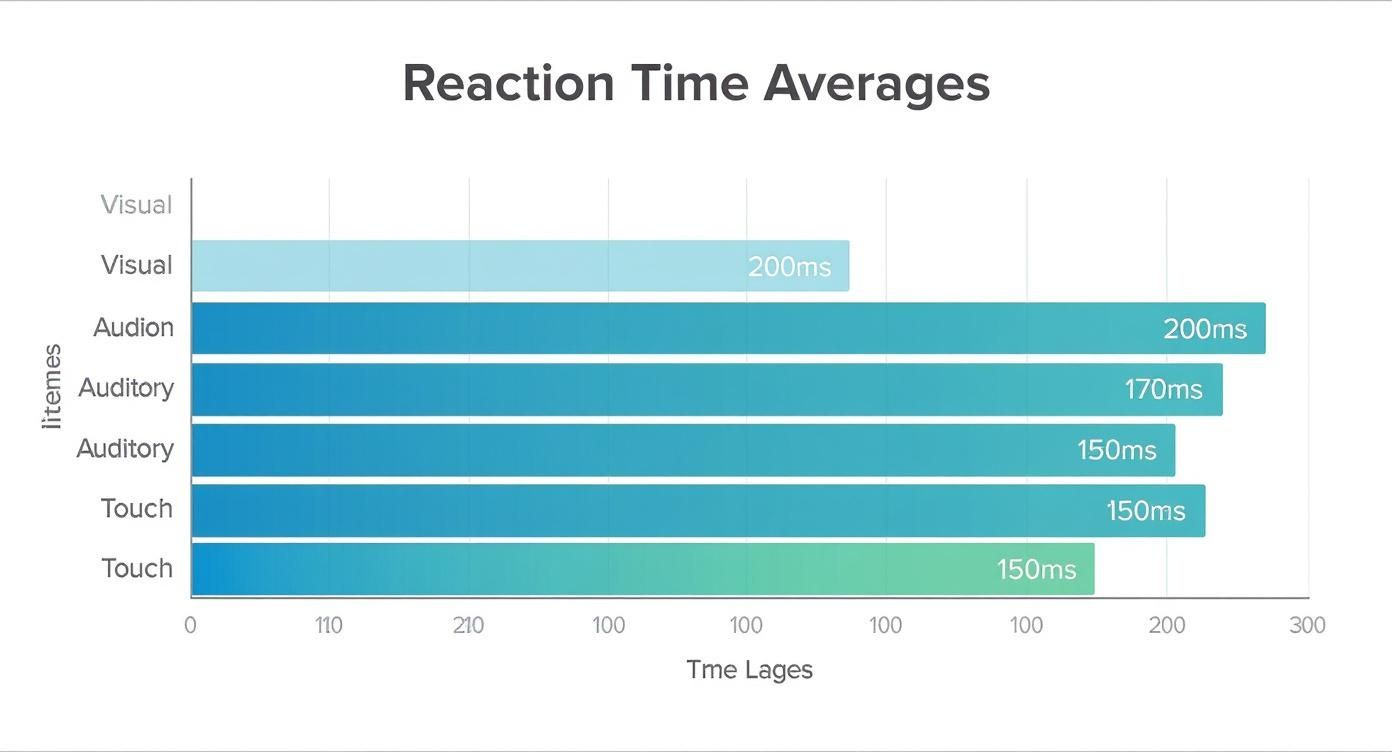
This makes perfect sense when you think about it. The neural pathways for touch and sound are slightly shorter and more direct than the one for vision, which requires a bit more heavy lifting and processing once the signal reaches the brain.
Practical Example: This is why a starting pistol (auditory) is more effective than a flashing light (visual) in a track race. Athletes can physically respond to the sound faster than they could to a visual cue.
Understanding these subtle differences is a huge part of interpreting cognitive speed accurately. For anyone looking to get a more detailed and personalized profile of their processing abilities, professional cognitive assessments can offer a much deeper dive.
How We Measure Your Reaction Speed
Putting a number on something that happens in the blink of an eye might seem tricky, but the methods we use are actually grounded in straightforward principles. These tests are all about timing the tiny gap between a stimulus appearing and your physical response, giving us a clear window into your cognitive processing speed.
The most common starting point is the Simple Reaction Time (SRT) test. You’ve probably seen a version of this online: a light turns green, and your only job is to click a button as fast as you can. It’s a pure measure of your baseline processing speed, with no complex decisions to slow you down.
From Simple Clicks to Complex Choices
While SRT is a great baseline, the real world rarely asks for such a simple response. We’re constantly making split-second decisions before we act. This is where Choice Reaction Time (CRT) tests come in, adding a layer of complexity to better mirror the cognitive demands of everyday life.
A CRT test will present you with multiple possible signals, each requiring a different, specific response.
Practical Example: Picture a screen that can flash either a red or a blue circle. Your task is to press the 'L' key if you see the red one, but the 'A' key if it’s blue.
What It Measures: This setup isn't just timing how fast your fingers move. It's also capturing the time your brain takes to identify the colour and then select the correct action. This gives us a much richer picture of your decision-making speed.
By comparing your performance on both simple and choice-based tasks, we can start to tease apart different cognitive functions. A big gap between your SRT and CRT, for example, could suggest that while your basic processing is quick, the decision-making part of the equation might be taking a bit longer.
Ensuring Accuracy and Consistency
In a clinical or research setting, getting precise measurements is absolutely critical. Unlike the casual tests you might find online, professional assessments use specialized hardware and software. This is crucial for eliminating variables like monitor lag or inconsistent keyboard inputs, which can easily throw off the results.
On the field, milliseconds can make all the difference for an athlete. To see how professionals track responsiveness in real-time, it's worth exploring guides on wearable football sensors that capture these incredibly precise metrics.
Just as important as precision is consistency. For any measurement to be clinically useful, it needs to be reliable over time. You can dive deeper into why this matters in our guide on test-retest reliability statistics.
Using these controlled methods ensures that the data we collect is a true reflection of your neural processing, providing solid, reliable insights into your cognitive health. Curious how your own reaction time average stacks up? Visit our website to try our validated digital assessments and get an accurate baseline.
Key Factors That Influence Your Reaction Time
Ever wonder why you feel lightning-fast one day and sluggish the next? Your reaction time isn't a fixed number carved in stone. It’s a dynamic measure that shifts and changes based on your biology, habits, and even your environment.
Getting a handle on these variables is the first step toward understanding—and maybe even improving—your own cognitive speed.
Your reaction time average is influenced by a whole host of internal and external factors. Some are out of your hands, like the natural aging process, while others are tied directly to your daily lifestyle choices.
Let's break down the most significant ones.
The Inescapable Influence of Age
Age is one of the most well-documented factors affecting how quickly we respond. Our reflexes tend to hit their peak in our early to mid-20s. From there, it's a gradual, natural decline in processing speed as we get older.
This doesn't mean you fall off a cliff overnight. Instead, think of it as a slow, steady change in how efficiently your neural pathways communicate. While this is a normal part of aging, staying mentally and physically active can certainly help pump the brakes on this decline.
A slower reaction time is a primary reason why everyday tasks, like driving, become more challenging with age. The ability to quickly perceive a hazard and respond accordingly is a critical component of road safety, making this a key area of focus in traffic studies.
For example, historical studies on traffic safety have shown the average human reaction time to a visual cue can range from 1.5 to 1.9 seconds. This window shifts based on alertness and age, which is why understanding these changes is so vital. You can find more insights into these traffic safety findings from the National Safety Council.
Your Daily Habits and Their Impact
Beyond age, your everyday choices play a massive role in your response speed. Think of these as the dials you can actually turn to fine-tune your performance.
Sleep Quality: This is arguably the biggest one. A single night of bad sleep can noticeably slow you down. When you’re tired, your brain’s ability to process information and fire off signals to your muscles is impaired.
Physical Fitness: Regular exercise isn't just for your body; it's for your brain. It boosts blood flow, supports the growth of new neurons, and sharpens overall cognitive function. An active person will generally have quicker reactions than someone sedentary.
Caffeine and Stimulants: A cup of coffee can give you a temporary edge, sharpening your focus and decreasing your reaction time. But go overboard, and you might get the jitters, which can actually have the opposite effect.
Hydration and Nutrition: Ever feel that mental fog when you haven't had enough water? Dehydration can slow your response times right down. A diet lacking in brain-fuelling nutrients can also impact performance over the long term.
Actionable Insight: Try a simple online reaction test first thing in the morning, and then again after your morning coffee. You'll likely see a measurable improvement, demonstrating the direct impact of alertness on your performance.
The connection between rest and brain function is profound. You can learn more about how conditions like concussions disrupt sleep in our guide on concussions and sleep.
Why Reaction Time is a Critical Safety Metric
In our day-to-day lives, a split second can mean the difference between a close call and a serious accident. Your reaction time isn't just some abstract number from a cognitive test; it's a foundational part of your personal safety, influencing how you navigate the world around you.
We often think of quick reflexes in the context of sports, but their real-world importance is most obvious in high-stakes situations. Whether you're behind the wheel, crossing the street, or operating machinery, your ability to respond to the unexpected is what keeps you safe.
A slower reaction time average—whether from fatigue, distraction, or something else—ramps up the risk factor significantly. Nowhere is this more apparent than on our roads, where a tiny delay in perception and response can have enormous consequences.
The Critical Role of Speed on the Road
Think about what happens when you're driving on the highway. Even a small delay in your reaction adds a surprising amount of distance to how long it takes to bring your vehicle to a complete stop. This "stopping distance" is really two things combined: the time it takes you to react and the time it takes the car's brakes to actually halt its forward motion.
Let's break it down with a practical example:
Driving at 100 km/h: At this speed, your vehicle is travelling almost 28 metres every single second.
Adding Half a Second: If your reaction time slows by just half a second, your car travels an extra 14 metres before you even touch the brake pedal. That’s about the length of a city bus.
That extra distance is often the make-or-break margin in a sudden traffic event, like the car ahead of you slamming on its brakes. This really drives home why something like texting while driving is so dangerous—it introduces delays that leave absolutely no room for error.
A delayed response doesn't just add a few feet; it fundamentally changes your ability to avoid a collision. In situations where every centimetre counts, a quick reaction time is your most important safety feature.
Essential for High-Stakes Professions
Beyond our own personal safety, the ability to respond in an instant is a non-negotiable requirement for many professionals. For first responders, pilots, and surgeons, processing information and acting decisively under immense pressure is part of the job description. Their performance directly affects the lives of others.
In California, for instance, the efficiency of emergency response teams is a constant focus. Data shows that even small improvements in their operational times—which includes the reaction speeds of the responders themselves—have a direct life-saving impact. A recent report highlighted a significant decrease in the time it takes to get crash victims out of vehicles and to a hospital, underscoring how faster responses lead to better outcomes. You can dig into the full details in the 2023 Annual Report from the California Office of Traffic Safety.
This just goes to show that whether you're behind the wheel or on the front lines of an emergency, optimizing reaction time is vital. Interested in understanding your own cognitive speed? Visit our website to try our validated digital assessments and see how you measure up.
When Should You Be Concerned About Your Reaction Time?
It’s perfectly normal for your reaction time to shift a bit from day to day. A rough night’s sleep or a stressful morning can definitely slow you down for a while. But when does a change in your response speed become a red flag?
Knowing how to spot the difference between these normal, temporary dips and a more significant, lasting decline is key to understanding your own cognitive health. A single slow score on an online test is almost never a reason to worry. What we’re looking for is a consistent downward trend over weeks or months—that's what deserves a closer look.
Identifying Potential Red Flags
Think of your typical reaction time as your personal baseline. When you start to see a clear and sustained drop from that baseline, it’s time to pay attention. Some patterns are more telling than others and might suggest that a professional assessment is a good next step.
Here are a few specific signs that could point to a bigger issue:
A Sudden, Sharp Decline: This is a dramatic drop in performance that you can't easily explain away with fatigue or feeling under the weather. Maybe you suddenly struggle with something that used to be automatic, like catching a set of keys tossed your way.
Growing Inconsistency: If your response times become really erratic—swinging wildly between fast and very slow—it could signal fluctuating attention or issues with cognitive processing.
Asymmetry Between Sides: Noticing that one side of your body is consistently slower than the other (like your left hand versus your right) can sometimes be a neurological indicator that’s worth checking out.
Slowness Paired with Other Symptoms: A slower reaction time is much more significant when it’s accompanied by other cognitive changes. If you’re also experiencing memory lapses, confusion, or trouble with planning, it’s important to see a doctor. Our guide on dementia-related assessments like the clock test provides more context on these kinds of related cognitive screenings.
A significant and lasting slowdown in your reaction speed is more than just a number; it’s objective data. Presenting this information to a healthcare provider can help them build a more complete picture of your cognitive well-being.
This isn't just about individuals, either. Reaction time is a critical performance metric for entire systems. For instance, it’s a key metric for fire and emergency services across California. The state's Incident Data and Statistics Program analyzes response reports from thousands of fire departments to improve public safety, showing just how vital institutional reaction time is. You can read more about California's incident data program to see how these metrics are applied on a massive scale.
If you have concerns, validated digital tools can give you objective data to share with your doctor. Explore our assessments on the Orange Neurosciences website to get a clear, reliable measure of your cognitive speed and start tracking your progress.
Actionable Ways to Improve Your Reaction Time
Ready to sharpen your reflexes and improve your reaction time average? While you can't exactly turn back the clock on age, you absolutely can adopt habits and specific exercises to boost your neural efficiency. The best results always come from a holistic approach—one that combines targeted mental training with smart, healthy lifestyle choices.
Think of it like training a muscle. The more you challenge your brain to process information and respond quickly, the stronger and faster those neural pathways become.
Targeted Cognitive and Physical Training
Some activities are especially good for this because they demand rapid-fire decision-making and precise motor control. Weaving these into your regular routine can lead to some very real, tangible improvements in your response speed.
Jump into Fast-Paced Sports: Think table tennis, badminton, or even certain video games. These activities force you to track fast-moving objects and react in an instant, building exceptional hand-eye coordination. For a deeper dive, you can explore specific eye-hand coordination exercises that directly train this vital skill.
Try Cognitive Training Drills: There are plenty of apps and online tools designed around choice reaction time tasks. For instance, a drill might ask you to tap the screen only when a specific shape or colour appears, forcing your brain to filter out distractions and make split-second decisions.
The goal here isn't just about moving your hand faster. It’s about shortening the mental processing time—that crucial gap between perceiving a stimulus and initiating the correct movement.
Foundational Lifestyle Habits
Your daily habits are the bedrock of optimal cognitive function. Without a solid foundation, achieving a faster reaction time is much, much harder. Small, consistent improvements in these key areas can make a world of difference.
Focus is a huge piece of the reaction time puzzle. For anyone looking for structured ways to improve their concentration, resources like Sachs Center's guide on How to Focus Better with ADHD offer proven strategies that can help sharpen anyone's responses.
Here are a few lifestyle adjustments to start with:
Prioritize Sleep: This is a non-negotiable. Aim for 7-9 hours of quality sleep per night. Sleep is when your brain consolidates memories and clears out metabolic waste—processes that are absolutely essential for peak performance.
Stay Physically Active: Regular aerobic exercise gets the blood pumping to your brain, supporting sharper, clearer cognitive function.
Eat a Brain-Healthy Diet: Foods that are rich in antioxidants and omega-3 fatty acids, like blueberries and fatty fish, are fantastic for supporting overall neural health.
By combining this kind of targeted practice with a healthy lifestyle, you create the perfect conditions for a quicker, more reliable reaction time. If you're looking for personalized tools to measure your progress, visit our website to explore our suite of cognitive assessment solutions.
A Few Lingering Questions
As we’ve explored what goes into your reaction time average, you might still have a few questions. Let's tackle some of the most common ones to make sure you have the full picture.
Key Queries Answered
Here are a few quick insights into some of the questions we hear the most.
What is considered a very slow reaction time? For simple tasks, the typical range is 200-270ms. If you’re consistently hitting numbers over 350-400ms, that might be considered on the slower side. But remember, context is king. Age, how complex the task is, and how alert you're feeling all play a huge part. One slow score is nothing to worry about, but a persistent pattern might be worth looking into.
Can you permanently improve your reaction time average? Absolutely. While our genes and age set a certain baseline, you can definitely make lasting improvements through consistent practice and healthy habits. Think of it like training a muscle. Things like targeted cognitive exercises, sports, meditation, and getting enough quality sleep can all boost your neural efficiency, leading to a quicker and more stable average reaction time.
A quick note on online tests: they're a great way to get a general feel for your reaction time, but they aren’t perfect. Things like your computer’s performance, a laggy internet connection, or your screen’s refresh rate can all throw off the results. For clinical or research settings, professionals rely on highly calibrated equipment to get precise, reliable data. This ensures the numbers truly reflect cognitive function, without any technical noise.
Ready to get a truly precise measure of your cognitive speed, free from guesswork? The validated digital assessments from Orange Neurosciences deliver objective, reliable data to help you clearly understand your cognitive profile. Take the first step and explore our solutions today.
Orange Neurosciences' Cognitive Skills Assessments (CSA) are intended as an aid for assessing the cognitive well-being of an individual. In a clinical setting, the CSA results (when interpreted by a qualified healthcare provider) may be used as an aid in determining whether further cognitive evaluation is needed. Orange Neurosciences' brain training programs are designed to promote and encourage overall cognitive health. Orange Neurosciences does not offer any medical diagnosis or treatment of any medical disease or condition. Orange Neurosciences products may also be used for research purposes for any range of cognition-related assessments. If used for research purposes, all use of the product must comply with the appropriate human subjects' procedures as they exist within the researcher's institution and will be the researcher's responsibility. All such human subject protections shall be under the provisions of all applicable sections of the Code of Federal Regulations.


© 2026 by Orange Neurosciences Corporation