Mastering the Attention Short Form for Modern Marketers
Dec 15, 2025

An attention short form isn’t just about making content shorter; it's a calculated response to the way our brains have adapted to a world overflowing with information. It’s all about crafting a high-impact message that lands in seconds, grabbing someone's focus before they can scroll past. For marketers, this means creating content that delivers value instantly, turning fleeting glances into meaningful engagement.
Why Our Brains Are Wired for Short Form Content

Have you ever found yourself scrolling endlessly through short videos on your phone, only to look up and realize an hour has vanished? You're not alone. That experience isn't an accident—it’s a direct consequence of how the digital world has retrained our brains.
We're constantly bombarded. Notifications, headlines, and rapid-fire content have fundamentally changed how we process information. Our minds now expect—and even crave—quick, digestible, and highly stimulating inputs. This new reality has made capturing and holding attention more challenging than ever.
The Attention Budget Concept
Think of your focus for the day as an "attention budget." Like your bank account, you only have so much to spend. Every piece of content you see, whether it's an email, a social media post, or a video, is asking for a small withdrawal from that budget.
Because the demands on our attention are constant, we've become incredibly selective about where we "spend" it. We make snap judgments, often in a fraction of a second, about whether something is worth our time. Short form content works so well because it asks for a tiny "payment" from our attention budget while promising an immediate reward, like a laugh or a quick piece of information.
In this environment, understanding the attention short form is more than a marketing tactic. It's become a vital communication skill for anyone who needs to cut through the digital noise and deliver a message that sticks.
This shift in our mental wiring is backed by some eye-opening data. For instance, attention spans in Canada have become razor-thin, with the average person's focus now lasting just 6.8 seconds. This aligns perfectly with the explosion of short-form video, which 87.5% of Canadian adults watch weekly, making it one of the most dominant online activities.
Actionable Insight: To work with our audience's rewired brains, not against them, your content must provide an immediate payoff. If you're curious about the science behind focus and want to dive deeper, check out our guide on how to improve your attention span.
The Core Principles of High-Impact Short Form Content
Making great short form content isn't just about cutting down the length; it's about adopting a whole new mindset. To really connect, you need a strategy built around how our brains work today. This framework has three essential pillars that, when you master them, make the difference between a video that gets instantly swiped and one that stops a viewer dead in their tracks.
First up, and arguably the most important, is the powerful hook. You have less than three seconds to give someone a reason to stop scrolling. That first moment has to be a showstopper—something visually striking, a question they can't ignore, or a bold statement that makes them curious. It's your digital storefront window.
Practical Example: A TikTok video opens with someone holding a common kitchen gadget, with on-screen text reading: "You've been using this wrong your entire life." This hook works because it immediately creates a knowledge gap, a mystery the viewer feels a sudden urge to solve. Just like that, you've earned their attention for the next few seconds.
Delivering Immediate and Obvious Value
Once you have their attention, you can't waste it. The second pillar is all about immediate value delivery. Your viewer is subconsciously asking, "What's in it for me?" Your job is to answer that question without delay, whether you're teaching, entertaining, or inspiring them.
Practical Example: An Instagram Reel demonstrates a 15-second cooking hack for peeling garlic perfectly. The value is crystal clear and delivered on the spot—the viewer walks away with a new skill in under 30 seconds. This feeling of a quick win is what makes the content satisfying and worth their time.
The entire transaction of short form content boils down to this: a viewer gives you a few seconds of their focus in exchange for a tangible piece of value. If that deal feels lopsided, they're gone.
To nail that value exchange, you need the third pillar: crystal-clear messaging. There's simply no time for confusion. Every video should have one single, central idea—a takeaway that's easy to grasp and even easier to remember.
This is where a lot of creators stumble. They try to pack too much into a tiny package, and the result is a muddled message that nobody remembers. A great short form video is relentlessly focused on one thing.
Bad Example: A 60-second YouTube Short attempting to explain three different marketing strategies. It’s too much, too fast. Viewers will feel overwhelmed and leave with nothing.
Good Example: A YouTube Short that zeroes in on one surprising marketing tip, shows a quick example, and wraps up with a clear next step. The message is sharp, memorable, and actionable.
Traditional vs. Short Form Content Principles
The shift to short form requires a fundamental change in how we approach content creation. It's not just about length; it's about structure, pacing, and the entire value proposition. The table below breaks down the key differences between the old way and the new.
Principle | Traditional Long-Form Approach | Attention Short Form Approach |
|---|---|---|
Pacing | Gradual build-up, detailed exploration | Front-loaded value, rapid delivery |
Hook | Within the first minute or introduction | Within the first 1-3 seconds |
Focus | Comprehensive coverage of a topic | Single, memorable takeaway |
Value | In-depth knowledge, thorough analysis | Quick win, practical tip, or emotion |
Call to Action | Often placed at the end of the content | Integrated early or implied quickly |
This comparison highlights that short form isn't just a condensed version of long-form—it's a completely different language. Success means learning to speak it fluently.
Actionable Insight: Start your next video script by defining the single takeaway first. Build the hook and value delivery around that one idea to ensure your message stays sharp. To truly master this art, digging into foundational guidelines is a great next step; you can learn more about the 10 Best Practices for Short Form Video Content to build on these principles.
Of course, maintaining this level of clarity requires intense mental discipline. For anyone looking to sharpen their own ability to concentrate on a single task, our guide offers practical advice on how to improve focus and concentration. By weaving together a powerful hook, instant value, and a sharp message, you create a blueprint for content that doesn't just grab attention—it holds it.
Choosing the Right Platforms for Your Strategy
Jumping into the attention short form game without a solid platform strategy is a bit like shouting into the wind. It’s tempting to just push the same video out everywhere, but that one-size-fits-all approach almost never connects. Every platform is its own world, with its own audience, its own algorithm, and its own unwritten rules of content culture.
Success comes from knowing these distinct ecosystems. You wouldn't wear a tuxedo to a beach party, right? In the same way, you shouldn't post a perfectly polished corporate video on a platform that lives and breathes on spontaneous, trend-based humour. It all comes down to matching your message to the medium.
TikTok The Trend Incubator
Think of TikTok as the pulse of internet culture. Its algorithm is legendary for its ability to rocket new content into the spotlight, turning unknown creators into viral sensations almost overnight. The audience here is generally younger and places a high value on authenticity, humour, and jumping on the latest trends.
Content on TikTok really takes off when it’s:
Relatable and Authentic: Overly produced or salesy videos tend to get ignored. Users want to see real people and genuine moments.
Trend-Driven: Using popular sounds, participating in challenges, and adopting trending formats is your key to getting seen. The platform rewards people for being part of the conversation.
Entertaining First: Even if your goal is to educate, you have to wrap it in an entertaining package.
Practical Example: A financial advisor could break down a tricky concept like compound interest using a trending audio clip and some simple text on the screen. It feels native to the platform and makes the information easy to digest.
Instagram Reels The Aesthetic Storyteller
Instagram Reels functions within a more established social network. While discoverability is still a factor, your content is most often seen by your existing followers first. Reels is the perfect home for visually beautiful, aesthetically pleasing content that tells a quick story. It’s a natural fit for brands that already have a strong visual identity.
The real difference is user intent. People scroll through TikTok to be entertained by anyone. They go to Instagram to connect with the people and brands they already follow and admire.
Practical Example: A travel company could shine here with a Reel that shows off a breathtaking destination with quick, cinematic shots set to inspiring music. The goal is visual storytelling that fits the brand’s polished image, creating something that feels both aspirational and within reach.
YouTube Shorts The Educational Funnel
YouTube Shorts plays a totally different role. It’s often the first touchpoint—a discovery tool that leads viewers to your longer content. People on YouTube are frequently in a learning or problem-solving mode. A great Short can act like a trailer, hooking viewers and pointing them toward a more detailed video on your main channel.
This makes it an incredible platform for educators, coaches, and any business that builds trust by showing expertise.
Practical Example: A software company could create a 30-second Short highlighting one powerful but lesser-known feature, then end with a call-to-action to watch the full tutorial linked in the description.
Actionable Insight: By picking your platforms with purpose and tailoring your content to each one, you put your time and energy where it will make the biggest difference. Ready to build a cohesive strategy that turns views into real results? Visit our website to see how Orange Neurosciences can help you understand audience engagement on a much deeper level.
Your Guide to Producing Attention-Grabbing Videos
You don't need a Hollywood budget or a professional film crew to create short-form videos that stop the scroll. Honestly, with a clear plan and a few key techniques, you can produce incredible content using just the smartphone in your pocket.
The whole process really breaks down into four essential stages.
Getting this production flow right is more important than ever. In Canada, short-form video has become a dominant force, fitting perfectly with our fast-paced digital lives. A huge 29.18% of Canadian marketers now prioritize it over any other content format, and 21.02% say it delivers the best return on their investment.
Brainstorming and Scripting for Brevity
Before you even think about hitting the record button, you need a solid idea. The best short-form videos are built on a single, powerful concept. Your goal isn't to create a mini-documentary; it's to deliver one valuable takeaway, one laugh, or one surprising fact.
Once you’ve landed on your core idea, script it out. It doesn't have to be formal—even a few bullet points will do. This simple step forces you to be concise and makes sure you don't ramble on camera. For a 30-second video, you're probably only looking at 60-75 words.
Hook (First 3 seconds): Kick things off with a bold question or a surprising visual. Grab their attention immediately.
Value (Next 15 seconds): Get straight to the point. Deliver the main information quickly and clearly.
CTA (Final seconds): Tell your viewer what to do next. A simple "Follow for more tips" works wonders.
This structure helps you keep a tight focus, which is absolutely critical for holding a viewer's working memory. If you're curious about how this cognitive process works, take a look at our guide on how to improve working memory.
Filming and Editing for Maximum Impact
Forget fancy equipment. Your smartphone can shoot in high definition, which is more than good enough for TikTok, Reels, and Shorts. What truly matters is good lighting and clear audio. Try filming near a window to get some nice, natural light, and find a quiet room to avoid any distracting background noise.
The editing suite is where the real magic happens. Your main goal here is to create a dynamic pace that keeps people glued to the screen.
Quick cuts are your best friend. A new shot every two to three seconds prevents the video from feeling static and holds the viewer's attention. This visual rhythm is a core element of the attention short form style.
Actionable Insight: Don't forget to add on-screen text or captions to emphasize your key points. So many people watch videos with the sound off, and captions are your insurance that the message always lands. For anyone focusing on this platform specifically, mastering a few essential TikTok video editing tips can make a massive difference in your engagement.
This flowchart shows the typical workflow you might see across the major short-form platforms.
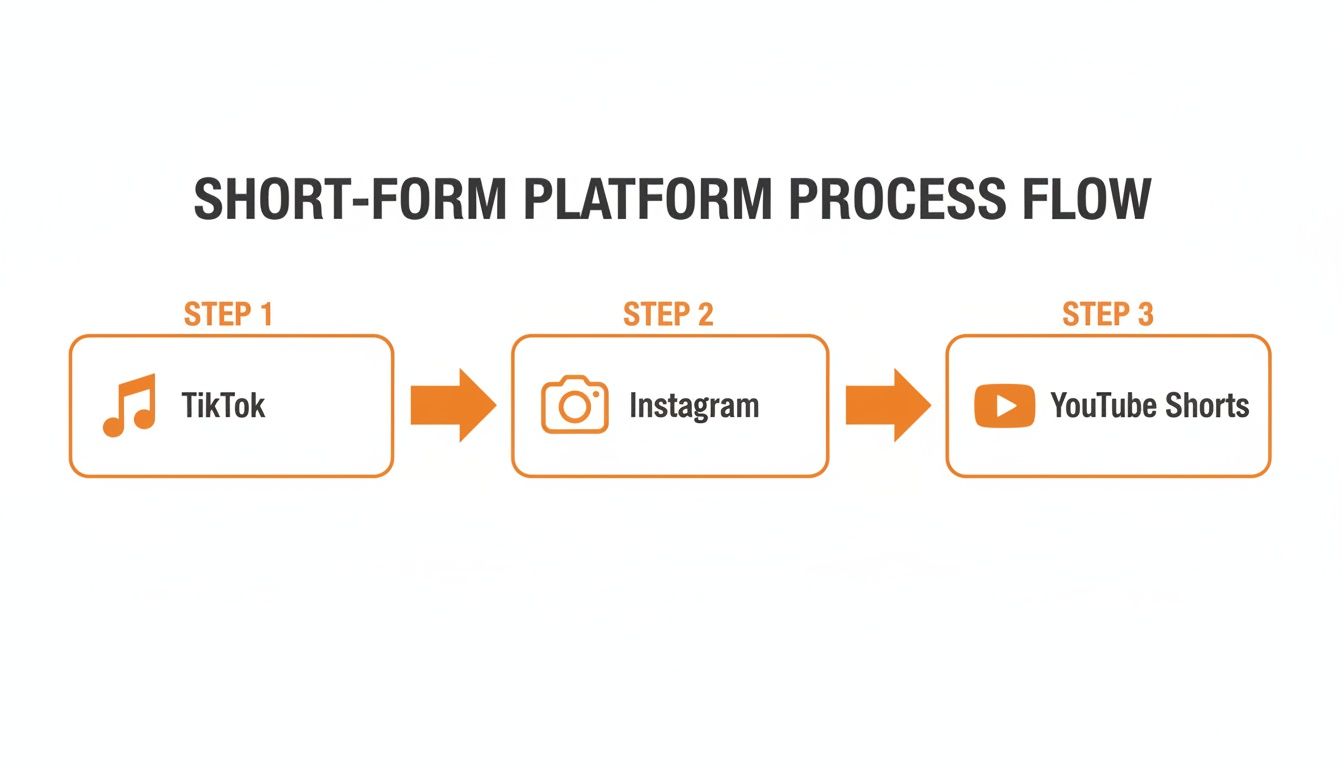
As you can see, content often starts on one platform before it's adapted for others, and each one usually needs slight tweaks to really connect with its unique audience.
Optimizing Your Post for Discovery
Finally, even a brilliant video needs to be discoverable. Using hashtags strategically helps the algorithms figure out what your content is about and show it to the right people. Do a little research to find relevant hashtags in your niche, and use a mix of popular ones with smaller, more targeted tags.
Your caption is just as important. Use that space to add a bit of context, ask a question to get comments flowing, and include a clear call-to-action. By following these steps, you can consistently produce videos that don't just grab attention but actually drive results.
How to Measure Success and Optimize Your Approach
Putting great content out there for the attention short form is a fantastic start, but the real magic happens when you figure out what's working and why. It's easy to get distracted by flashy numbers like views and likes, but those are often just vanity metrics. To really understand your success, you need to dig into the numbers that show true audience engagement.
These are the metrics that tell the real story of whether your content is capturing and holding attention. They show if people are sticking around, buying into your message, and feeling motivated to take the next step. This is how you move from just making content to building a reliable engine for growth.
Moving Beyond Vanity Metrics
The most revealing numbers for short-form video are the ones that measure how people interact beyond a quick tap of the "like" button. You can find all of this right inside the analytics dashboards on platforms like TikTok, Instagram, and YouTube.
Here's what you should really be zeroing in on:
Average Watch Time: This tells you exactly how long, on average, people are watching your video. A high number here is a clear sign that your content was strong enough to make them stop scrolling.
Audience Retention: This graph is your best friend. It shows you the precise moment viewers are dropping off. If there’s a massive dip in the first three seconds, your hook needs work. A nice, steady line means you've got them hooked.
Shares: A share is a personal endorsement. When someone sends your video to a friend or posts it on their own profile, it's one of the strongest signals that your content truly connected with them.
Click-Through Rate (CTR): If your video has a link or a call-to-action (CTA), the CTR shows how many people actually followed through. This is vital if your goal is to drive traffic or sales.
A Framework for Optimization
Once you know which numbers matter, you can start making smarter decisions. The best approach is to treat your content like a series of small experiments, a method known as A/B testing. This helps you pinpoint exactly which changes are making a real difference.
Actionable Insight: For your next video, create two different openings—maybe one that asks a question and another that makes a bold claim. Post them at different times and then compare the audience retention graphs. You'll get a clear picture of which approach grabs attention more effectively.
By consistently testing small elements like your hooks, CTAs, or even the background music, you start to build a real, evidence-based playbook for what your audience responds to. This continuous loop of testing and refining is the secret to getting better and better over time.
This data-first mindset is backed up by what we're seeing across the board. Industry stats show that short-form videos get 2.5 times more interactions than long-form content. Even more telling, a solid 60% of viewers watch for 41-80% of a video's total length, proving just how well this format holds attention. Here in Canada, businesses are taking note: 44% plan to use more short-form content this year, a trend explored in this deep dive on the rise of short-form content in Canada.
Mastering these analytics is all about building a reliable and repeatable process. You can learn more about establishing that kind of consistency in our guide to understanding test-retest reliability statistics. If you're ready to apply these ideas and get objective insights into how your audience is really engaging, connect with Orange Neurosciences. We can show you how our tools bring a new level of clarity to your strategy.
Integrating Short Form into Your Marketing Funnel
Going viral is great, but that initial flash of excitement doesn't pay the bills. The real goal is to build a reliable growth engine by connecting your short-form content to actual business results. This is how you turn a few seconds of attention into a full-fledged marketing funnel, guiding people from a quick laugh or a neat tip all the way to becoming a customer.
Think of each video not as the final destination, but as the front door.

This approach is especially powerful in Canada, where a staggering 72% of all adults have recently watched user-generated content (UGC). This isn't just a passing trend; it's directly tied to the power of attention short form. These authentic, bite-sized clips feel more trustworthy, influencing the buying decisions of 46% of shoppers.
With 73% of people preferring short videos to learn about a product, these clips are the perfect way to introduce your brand at the top of your funnel. You can dig deeper into these Canadian digital consumption trends on ubmedia.ca.
Crafting an Actionable Funnel
To actually move viewers from one stage to the next, every single video needs a clear purpose and a strong call-to-action (CTA). Your CTA is the bridge that takes someone from passively watching your video to actively engaging with your brand.
Awareness Stage (Top of Funnel): A 15-second TikTok shows a surprising productivity hack using your software. The CTA is simple and low-commitment: "Follow us for more daily tips!" This grows your audience.
Consideration Stage (Middle of Funnel): You create an Instagram Reel answering a common customer question in 30 seconds. The CTA asks for a bit more: "Grab our free guide to master this technique—link in bio!" This captures a lead.
Conversion Stage (Bottom of Funnel): A YouTube Short shares a glowing customer testimonial. The CTA is direct: "Ready to see results? Visit our site to start your free trial." This drives a sale.
Creating a Cohesive Content Ecosystem
The most effective funnels don't just exist in one place. They connect different content formats to create a seamless journey for your audience. A single 30-second Reel can act as the perfect appetizer for a more substantial piece of content.
Your short-form video makes the introduction, sparking curiosity and building initial trust. Your long-form content then closes the loop, delivering deeper value and solidifying the relationship.
Practical Example: Your video might tease "3 mistakes people make when trying to improve focus." It then directs viewers to a comprehensive blog post on your website that explores each mistake in detail and offers real solutions. This strategy respects the viewer’s time while giving those who want to learn more a clear path forward. Understanding these cognitive processes can give you an edge, which you can explore in our guide on how to improve executive function.
Ready to build a smarter, more effective marketing funnel? Explore the advanced assessment tools and strategies on the Orange Neurosciences website to start turning attention into action today.
Your Top Questions Answered
Diving into the world of short-form content can feel like trying to catch lightning in a bottle. What works? What doesn't? How do you even start? Let's tackle some of the most common questions we hear from marketers trying to get a handle on the attention short form.
How Often Should I Be Posting?
This is the big one, isn't it? But there’s no secret formula. The real key is consistency, not just sheer volume. It’s far more effective to post one genuinely useful, well-thought-out video each week than to scramble and push out three half-baked ones every day.
Actionable Insight: Find a rhythm that you can actually stick to, maybe two or three posts a week to start. Focus on making each one count. Once you've got your process down and it feels manageable, then you can think about posting more often. The platforms tend to favour steady, reliable effort over chaotic bursts of activity.
What's the Smartest Way to Repurpose Content?
Repurposing is your best friend when it comes to working smarter, not harder. The trick is to stop thinking about shrinking your long-form content and start thinking about extracting the most potent, single ideas from it.
Got a Blog Post? Pull out one compelling statistic or a single, game-changing tip. You can easily turn that into a 15-second video with some simple text on screen.
Hosted a Webinar? Find a 30-second clip where an expert gives a brilliant answer to a tough question. This immediately builds authority and gives your audience a valuable nugget of information.
Recorded a Podcast? Use a simple tool to create an audiogram of a powerful quote. Put it against a moving background, and you've got something visually interesting that stops the scroll.
Think of it like this: you're not trying to serve the whole meal in one bite. You're offering a delicious, single taste that leaves them wanting more.
How Do I Keep Up with All the Trends?
Trends move at the speed of light, and trying to jump on every single one is a recipe for burnout. You don't have to. A much better approach is to spend just 15 minutes a day simply being on the platforms you use.
Actionable Insight: As you scroll, notice what you're seeing again and again in your specific field. Are there certain sounds, video styles, or challenges popping up? Keep a "swipe file" of videos you find interesting or inspiring. That way, when a trend comes along that actually fits your brand and what you want to say, you'll be ready to make it your own.
Ready to move from guessing to knowing? Orange Neurosciences provides sophisticated tools that help you truly understand how your audience engages with your content. We can help you fine-tune your strategy for real impact. See how our platform can clarify your marketing efforts by visiting us at https://orangeneurosciences.ca.

Orange Neurosciences' Cognitive Skills Assessments (CSA) are intended as an aid for assessing the cognitive well-being of an individual. In a clinical setting, the CSA results (when interpreted by a qualified healthcare provider) may be used as an aid in determining whether further cognitive evaluation is needed. Orange Neurosciences' brain training programs are designed to promote and encourage overall cognitive health. Orange Neurosciences does not offer any medical diagnosis or treatment of any medical disease or condition. Orange Neurosciences products may also be used for research purposes for any range of cognition-related assessments. If used for research purposes, all use of the product must comply with the appropriate human subjects' procedures as they exist within the researcher's institution and will be the researcher's responsibility. All such human subject protections shall be under the provisions of all applicable sections of the Code of Federal Regulations.


© 2026 by Orange Neurosciences Corporation