A Clinician’s Guide to Online Testing for Dementia
Feb 2, 2026
Online dementia tests offer a convenient, private way to get a preliminary look at cognitive changes, right from your own home. It’s crucial to remember that these are not diagnostic tools. Instead, think of them as an important first step, providing initial insights that can help you and your doctor decide if a full clinical evaluation makes sense.
The Shift to Digital Cognitive Screening
The way we think about cognitive health is undergoing a major shift. Not long ago, the first hint of memory trouble was often a quiet worry, something you might not bring up until the symptoms became too obvious to ignore. That’s changing.
Today, there's a growing embrace of proactive health management, and online testing for dementia is a key part of this new approach to brain health. This fits perfectly with the broader trend of proactive health screening, where people are empowered to seek early insights into their well-being.
You can think of an online cognitive test as a digital stethoscope for the brain. A stethoscope can't diagnose heart disease on its own, but it allows a doctor to hear subtle sounds, giving them the vital data needed to decide if an ECG is necessary. In the same way, an online cognitive assessment can flag early, subtle signals of cognitive change that might otherwise go unnoticed.
Why Digital Screening is Gaining Momentum
So, what's driving this move from reactive to proactive cognitive care? For patients and their families, it’s about having an accessible, private way to address their concerns without the stress, stigma, or long wait times of an immediate specialist visit.
The goal of online screening isn't to replace clinicians, but to empower them. These tools transform a vague concern like, "I just feel foggy," into measurable data, creating a solid starting point for a meaningful conversation with a doctor.
The benefits for healthcare providers are just as significant. Digital tools give them an efficient way to establish cognitive baselines during routine check-ups. Instead of relying only on a patient's memory of their symptoms, doctors can collect objective data over time.
This longitudinal data is incredibly powerful. It allows clinicians to track a person's cognitive health and spot meaningful changes much sooner. For example, a family doctor can administer a brief online assessment to a 65-year-old patient during their annual wellness visit. A year later, a follow-up assessment can clearly show if their cognitive function has stayed stable or if there's been a decline, providing real evidence to guide the next steps.
This digital approach makes early detection more scalable and accessible than ever before. To dig deeper into how these assessments are built and validated, take a look at our detailed guide on what makes a high-quality cognitive assessment online.
Navigating the Types of Online Dementia Tests
When you start searching for online testing for dementia, you'll quickly discover a huge range of options, from simple online quizzes to comprehensive assessment platforms. It’s absolutely crucial to understand that these tools are not created equal. They generally fall into two very different categories, each with a distinct role to play in managing cognitive health.
Think of it this way: a simple, consumer-focused screener is like a pair of off-the-shelf reading glasses. They're easy to find and can help with minor, obvious issues. On the other hand, a clinical-grade assessment platform is like the complex phoropter an optometrist uses during a full eye exam. It’s a sophisticated tool that gives a professional the precise, nuanced data needed to make a proper diagnosis.
Both have their place, but knowing the difference is the key to using them responsibly.
Consumer-Grade Screeners: The First Look
Consumer-grade screeners are often the first thing people find. These are typically free, downloadable pen-and-paper tests, like the Self-Administered Gerocognitive Exam (SAGE). They’re designed as a quick, accessible first step for someone who has some initial worries about their memory or thinking skills.
These tools are valuable for raising awareness and can be the catalyst for starting a conversation with a doctor. However, their limitations are significant.
Limited Specificity: They can flag potential concerns but often have a high false-positive rate. For example, a low score might trigger unnecessary anxiety for someone who was just having an off day, without reflecting a true cognitive impairment.
Lack of Detail: You get a single score, not a detailed breakdown of different cognitive functions. This makes it tough to understand the specific nature of any potential changes.
Requires Interpretation: A person has to print the test, fill it out, and then bring it to a clinician for scoring and interpretation, which adds extra steps and potential delays.
For a closer look at how these types of screeners measure up, check out our guide on the MoCA vs MMSE, which explores two of the most common pen-and-paper assessments.
Clinical-Grade Platforms: The Professional Standard
Clinical-grade platforms, like the ones we develop at Orange Neurosciences, are a major leap forward in precision and reliability. These are sophisticated digital tools built for use in a healthcare setting, giving clinicians objective, detailed data to support their professional judgment. They go far beyond a simple "pass" or "fail."
A clinical-grade assessment doesn’t just ask if you can remember a list of words; it measures how quickly you recall them, analyzes response patterns, and compares your performance against large, age-matched datasets. That depth provides a much clearer picture of cognitive health.
These platforms are scientifically validated, which means their accuracy has been rigorously tested against established neuropsychological standards. They assess multiple cognitive domains, including:
Executive Function: Your ability to plan, organise, and make decisions.
Processing Speed: How quickly you can take in and respond to information.
Attention and Memory: Your capacity to focus and retain new information.
The flowchart below shows how these different levels of cognitive care—from flagging a concern to screening and diagnosis—fit together.
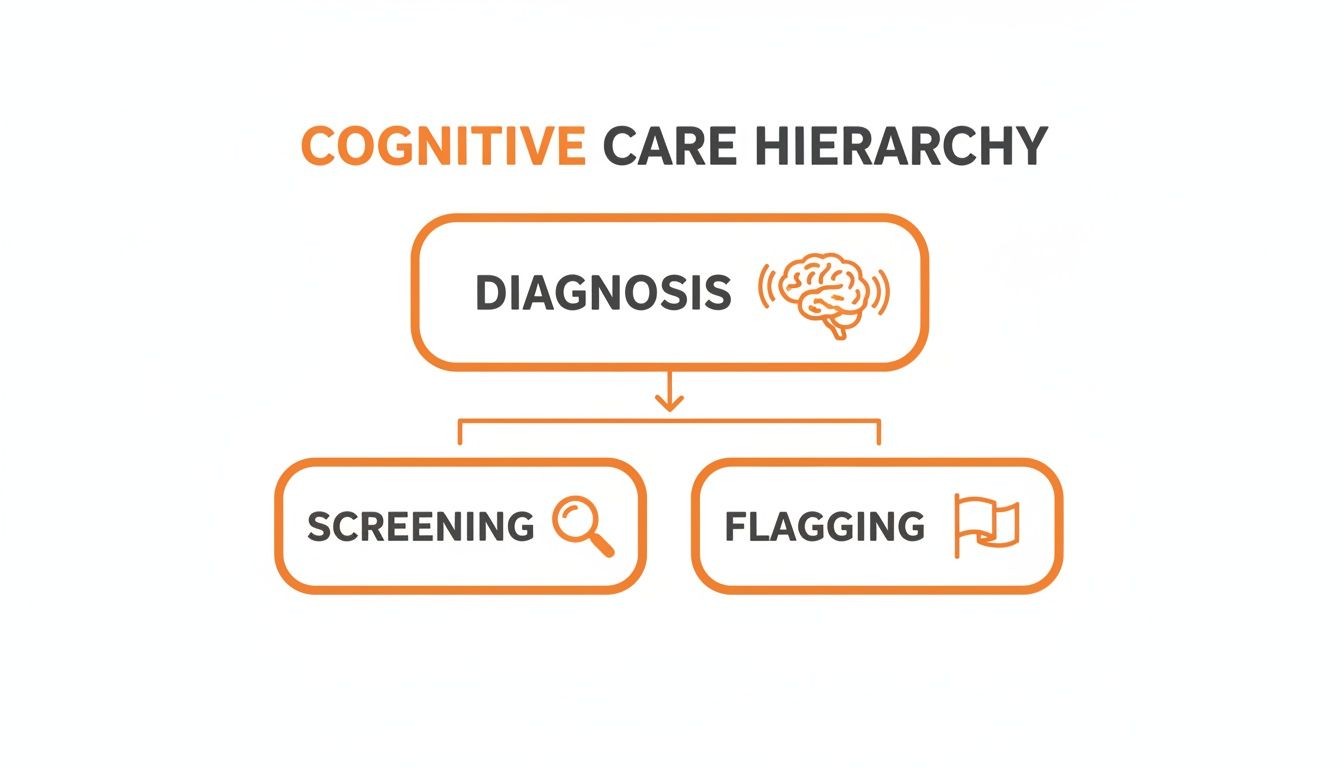
This hierarchy makes it clear: flagging a concern is just the beginning. It leads to more formal screening, which then helps determine if a comprehensive diagnosis is needed.
A major advantage is that the reports from these platforms are available immediately and are easy for clinicians to interpret, allowing for faster, more informed decisions. By choosing the right tool for the right situation, both patients and providers can navigate the path to understanding cognitive health with much greater confidence.
Comparing Online Cognitive Assessment Tools
To make the distinction even clearer, here's a side-by-side comparison of what you can expect from a basic screener versus a professional platform.
Feature | Consumer-Grade Screeners | Clinical-Grade Platforms (e.g., Orange Neurosciences) |
|---|---|---|
Primary Purpose | Raise initial awareness; a starting point for discussion. | Aid in clinical decision-making; provide objective data for diagnosis and monitoring. |
Data & Results | A single, overall score. | Detailed breakdown of multiple cognitive domains (e.g., memory, executive function). |
Scientific Validation | Varies widely; often not rigorously validated. | Scientifically validated against gold-standard neuropsychological tests. |
Administration & Interpretation | Self-administered; requires a clinician for scoring and context. | Administered in a clinical setting (or remotely supervised); instant, clinician-friendly reports. |
Accuracy | High potential for false positives and false negatives. | High sensitivity and specificity; benchmarked against normative data. |
Accessibility | Often free and easily downloadable. | Available through healthcare providers; integrated into clinical workflows. |
Ultimately, while simple screeners can open the door to a conversation, only clinical-grade platforms provide the robust, reliable data needed for professional cognitive healthcare.
The Science Behind Reliable Cognitive Testing
For any clinician, the big question is always about trust. How can you be sure the data from an online testing for dementia platform is solid enough to base your decisions on?
The answer is a tough, scientific validation process that separates a real clinical tool from a simple online quiz. Think of this process as turning a rough measuring tape into a finely calibrated scientific instrument. It’s all about ensuring the assessment is accurate and dependable.
The foundation of any trustworthy platform is its ability to measure what it claims to measure—and to do it consistently. This is done by benchmarking its performance against the long-established "gold-standard" neuropsychological tests. These are the comprehensive, in-person evaluations that have been the bedrock of cognitive assessment for decades.
This benchmarking process hinges on a few key statistical concepts that are vital for clinicians to really get a handle on.
The Pillars of Clinical Validation
For an online cognitive assessment to be considered reliable, it needs to prove itself in three critical areas. These aren't just academic buzzwords; they're practical measures of how dependable a tool is in a real-world clinic.
Sensitivity: This tells you how well the test can correctly flag individuals who do have a cognitive impairment. High sensitivity means the test is great at catching potential issues and won't miss people who need help.
Specificity: This measures how well the test can correctly identify individuals who do not have a cognitive impairment. High specificity is crucial to avoid false positives, which can cause a lot of unnecessary worry for patients and trigger needless follow-ups.
Reliability: This is all about consistency. A reliable tool will give you similar results if the same person takes it at different times under similar conditions. You can take a closer look at this in our guide on test and retest reliability in our guide.
Think of it this way: a sensitive test makes sure you don't miss anyone who needs help. A specific test makes sure you don't worry the healthy. And a reliable test ensures the results aren't just a fluke.
Beyond Scores: The Power of Behavioural Analytics
What really sets modern, clinical-grade platforms apart is how they use artificial intelligence and machine learning to look at so much more than just right or wrong answers. These systems can capture and interpret subtle behavioural clues that are often completely invisible during a traditional pen-and-paper test.
For example, the platform doesn't just log whether a patient remembered a word. It analyzes the hesitation time before they answered, it tracks mouse movements or screen taps for signs of uncertainty, and it even identifies patterns in the types of mistakes they make. This firehose of data gives you a much richer, more nuanced cognitive profile.
And this approach is already proving its worth. A 2020 study of healthy adults aged 52-76 found that remote, self-administered digital cognitive assessments (DCAs)—like those that power our platform—were highly reliable. The results not only matched those from clinic-supervised tests but also helped reduce patient anxiety, making them a great fit for a wide range of people.
By pairing rock-solid validation against traditional standards with sophisticated, AI-driven behavioural analysis, these online assessments give you a powerful, data-rich view of a patient’s cognitive health. That scientific rigour is what gives you the confidence to bring these tools into your clinical workflow, knowing the information you get is robust enough to truly guide your judgment.
When and Why to Use Online Dementia Testing
Knowing the right moment to consider an online cognitive assessment is the first step in shifting from a reactive to a proactive mindset about brain health. These tools aren’t just for crisis situations. In fact, they are most powerful when used strategically to establish baselines, track changes over time, and gather objective data.
The "who, when, and why" for using online testing for dementia can look different for everyone, but the goal is always the same: to replace uncertainty with clarity.
For many individuals and families, the "when" starts with a vague but persistent worry. Maybe it’s what people call "brain fog," or perhaps it's misplacing keys more often than usual. It could even be a subtle, frustrating difficulty finding the right words in conversation.
Instead of letting these anxieties fester, an online assessment offers a concrete first step. It helps turn an abstract fear into a measurable data point. This gives you a structured way to talk to a doctor, armed with objective information instead of just a feeling that something is off.
Ideal Scenarios for Clinicians
For healthcare providers, online assessments are incredibly versatile tools that slot neatly into many clinical scenarios. They allow for a crucial shift away from relying solely on subjective patient reports to incorporating hard data.
Here are just a few practical moments when a clinician might use them:
Annual Wellness Visits: A family doctor can integrate a brief online cognitive screener for patients over 65. Doing so establishes a vital cognitive baseline, which makes spotting significant changes year-over-year much, much easier.
Post-Concussion Monitoring: After a patient has a head injury, an online test can help track their cognitive recovery. It provides objective metrics on things like processing speed and attention, which can guide important return-to-play or return-to-work decisions.
Medication Management: When starting a new medication known to have potential cognitive side effects, a baseline test followed by regular check-ins can help monitor its true impact on a patient’s cognitive function.
The need for these kinds of scalable tools is especially sharp in areas with large aging populations. For example, in California—the epicentre of Alzheimer's disease in the U.S.—nearly 720,000 people were estimated to be living with Alzheimer's dementia recently. You can find more details about Alzheimer's prevalence in California on latimes.com. A number that big underscores just how urgent the need is for accessible screening platforms.
Empowering Caregivers and Monitoring Progression
Caregivers are so often the first to notice the small, subtle shifts in a loved one's cognitive abilities. But bringing up these concerns can be incredibly difficult and is often met with denial. An online test can serve as a neutral, objective tool to ground the conversation in data, not just feelings.
For example, a caregiver notices their parent is suddenly struggling to manage their finances. Suggesting an online "brain health check-up" can feel a lot less confrontational than saying, "I'm worried about your memory." The results then provide something concrete to bring to a specialist.
For neurologists and other specialists, these platforms are indispensable for longitudinal tracking. Once a condition like Mild Cognitive Impairment (MCI) has been identified, regular online assessments can monitor whether it's progressing or remaining stable. You can learn more about the crucial differences in our article on Mild Cognitive Impairment vs Dementia.
This continuous stream of data helps clinicians make far more informed decisions about treatment plans and interventions. It allows for a dynamic approach to care, where adjustments are based on objective cognitive performance rather than just periodic, subjective check-ins.
Ultimately, weaving online testing for dementia into these key moments changes everything. It gives clinicians the data they need, empowers individuals to take control of their brain health, and provides families with a clear path forward. If you're a clinician looking to bring these powerful tools into your practice, we invite you to contact us for a demo to see how our platform can establish baselines and track cognitive health efficiently.
How to Integrate Online Assessments Into Your Practice
Successfully weaving a validated tool for online testing for dementia into your clinical practice isn't just about plugging in new software. It’s about fundamentally refining your entire approach to cognitive care. The process is a game-changer, turning subjective patient concerns into objective, actionable data.
Think of it as a structured pathway that sharpens your clinical judgment, boosts efficiency, and ultimately leads to better patient outcomes.
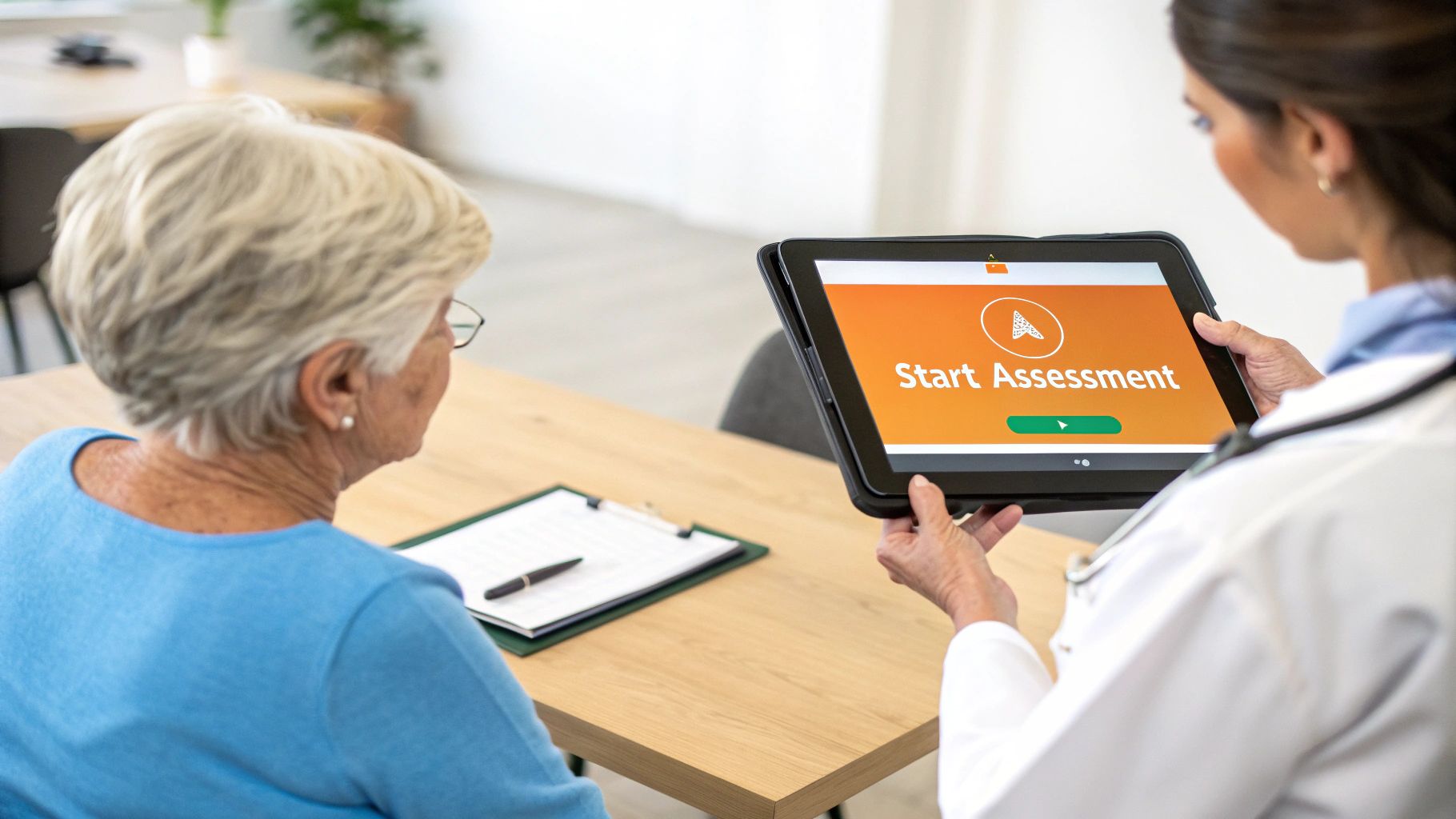
This whole integration can be broken down into four clear, manageable stages. Each one is designed to fit right into your existing workflows, whether you're in a bustling primary care clinic or a specialized neurology practice. Let’s walk through the playbook.
Stage 1: Patient Onboarding and Setup
The first move is introducing the assessment to your patient in a way that’s clear, reassuring, and simple. Simplicity is everything here. Modern platforms are built to be intuitive, getting rid of any technical headaches for both your staff and the patient.
It usually starts with your clinic sending a secure link straight to the patient’s email or through their patient portal. This first touchpoint should explain why you're recommending the assessment, framing it as a proactive "brain health check-up" instead of a scary "dementia test."
Actionable Insight: Frame the assessment as a routine check-up. For example, a 68-year-old patient, Mr. Chen, mentions during his yearly check-up that he's been "more forgetful lately." Instead of just telling him to come back in six months, you can act immediately. Your medical assistant sends him a link to the OrangeCheck platform before he even leaves the clinic, explaining that it's a simple, game-like activity he can do right at home.
Taking this immediate action shows the patient you’re taking their concerns seriously and empowers them, bridging the gap between a vague complaint and a solid evaluation.
Stage 2: Administering the Assessment
Flexibility is one of the biggest wins with digital cognitive assessments. You can administer them in whatever way works best for your practice and the patient's comfort level.
There are two main ways to do it:
Remote Administration: The patient completes the assessment from the comfort of their home, using their own tablet or computer. This model cuts down on clinic time, saves the patient a trip, and lets them take the test in a familiar, low-stress setting.
In-Clinic Administration: For patients who aren't comfortable with technology or don't have a device, the assessment can be done on a clinic-provided tablet in a quiet room. This ensures the test is done right, but it's still way more efficient than an old-school pen-and-paper test.
In Mr. Chen's case, he decides to take the test at home. The platform walks him through a series of engaging, game-based tasks that take less than 30 minutes. He finds the whole experience much less intimidating than a formal, timed exam.
Stage 3: Interpreting the Intuitive Report
This is where you see the real power of a clinical-grade platform. As soon as the assessment is done, the system generates a comprehensive, data-rich report and sends it securely to you, the clinician.
The days of manual scoring and guesswork are over. These reports are designed for quick clinical interpretation, laying out complex cognitive data in an easy-to-read, visual format.
The report doesn't just spit out a single score. It delivers a detailed profile of the patient's performance across multiple cognitive domains—like memory, processing speed, and executive function—and benchmarks it against age- and education-matched normative data.
For Mr. Chen, the report shows that while his general memory is normal for his age, his processing speed is quite a bit slower. This specific, objective insight is so much more useful than his vague complaint of being "forgetful." It points to a specific cognitive area that needs a closer look. The need for precise tools like this is ballooning, especially in places like Orange County, California, where over 164,000 residents are affected by Alzheimer's or mild cognitive impairment. Online platforms from Orange Neurosciences are crucial here, offering evidence-based, game-based assessments that profile cognition in attention and processing speed, suitable for both adult care and child-friendly settings. To get a better sense of the impact of these tools, you can read more about the rise of digital health solutions.
Stage 4: Crafting an Evidence-Based Care Plan
The final stage is turning these data-driven insights into a solid, actionable care plan. The assessment report becomes the foundation for a much more productive and focused conversation with your patient.
Armed with Mr. Chen's cognitive profile, you can now have a very specific discussion. You can explain that the "forgetfulness" he's experiencing might actually be linked to his processing speed. This insight leads to a targeted care plan that could include lifestyle recommendations for brain health, specific cognitive exercises, and a plan to re-assess in six months to track any changes. Just like that, a subjective worry has been transformed into a clear, evidence-based clinical pathway.
By integrating a platform like OrangeCheck into your practice, you're not just improving patient care—you're also making your own operations more efficient. To see how our tools can fit into your specific clinical workflow, we invite you to visit our website and request a demonstration today.
Translating Test Results into Actionable Next Steps
Getting a report from an online testing for dementia platform isn’t the finish line; it’s the starting line. These results aren't a simple pass-or-fail grade. Think of them instead as a detailed, nuanced map of a person's cognitive landscape, showing you both the strengths and the specific areas that might need some support.
This data-rich report is the key to turning a vague concern into a focused conversation and, ultimately, a collaborative plan. For patients and caregivers, it provides the objective language needed to talk with a healthcare professional, moving beyond subjective feelings like "brain fog" to concrete data points. For clinicians, it’s the evidence that informs every decision that comes next.
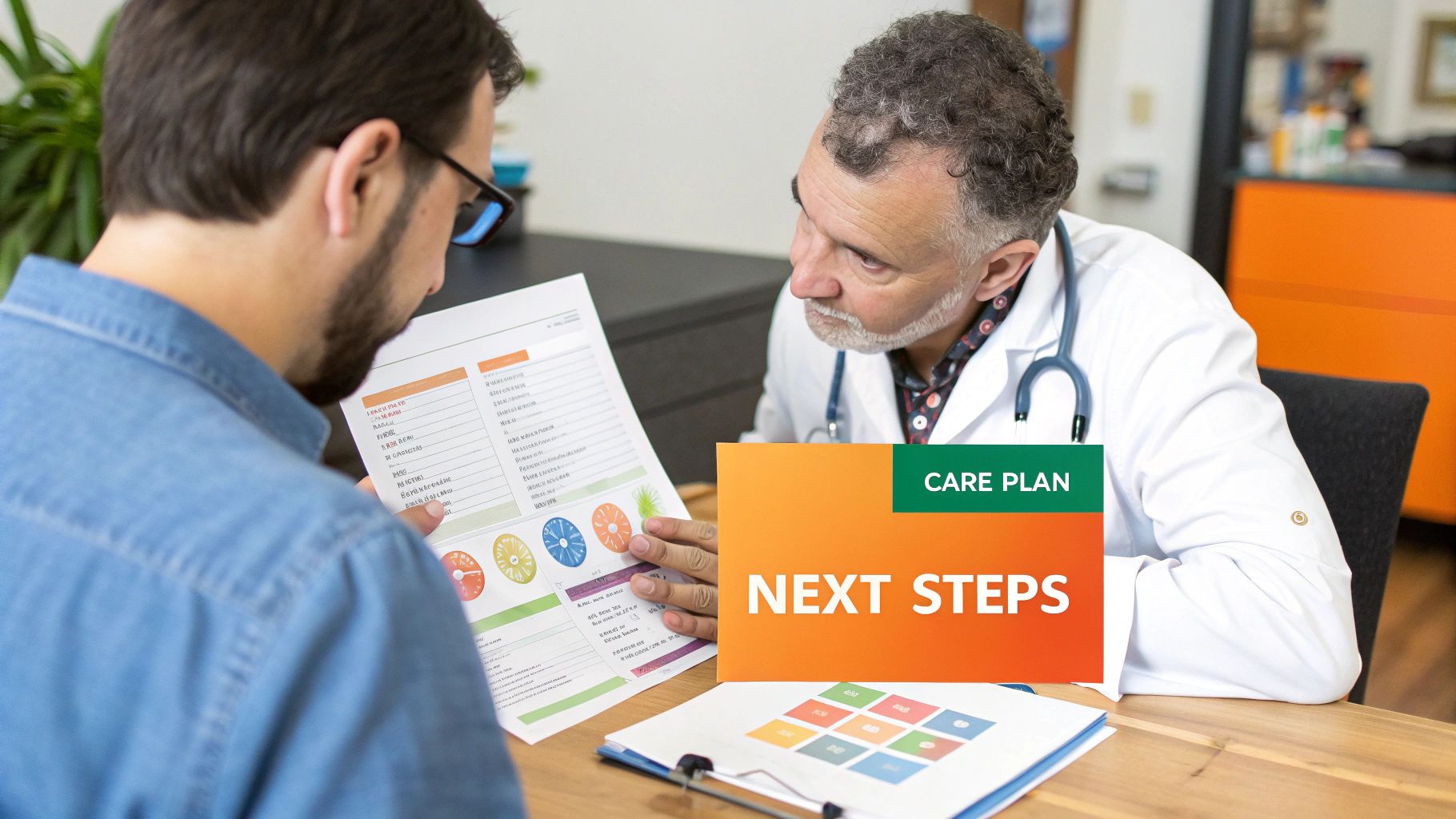
From Data to Dialogue
The most critical first step for any clinician is to communicate these sensitive results effectively. This conversation is about building a partnership, not delivering a verdict. The real goal is to walk through the report with the patient and their family, explaining what each metric means in a practical, understandable way.
A strong clinical approach frames the results as a catalyst for action. It’s not about focusing on a deficit but about identifying an opportunity to intervene, whether that’s through lifestyle adjustments, cognitive training, or further medical evaluation.
This kind of dialogue turns abstract numbers into a shared understanding, empowering everyone involved to take ownership of what happens next. It builds trust and helps the patient feel supported rather than judged—which is absolutely essential for long-term engagement with any care plan. For a deeper look at scoring specifics, our guide on MoCA score interpretation offers valuable context, even if you're using a different assessment tool.
Building a Collaborative Care Plan
Once everyone is on the same page, the next step is to build an actionable, personalized care plan. The specifics will vary widely depending on the individual's cognitive profile, but the report provides the perfect blueprint to get started.
A solid care plan, developed with the patient and family, might include several key components:
Lifestyle Interventions: Recommendations could focus on diet, physical exercise, social engagement, and sleep hygiene—all of which are known to support brain health. Actionable Step: Provide a handout with local walking groups or brain-healthy recipes.
Cognitive Support: This might involve targeted cognitive exercises or activities designed to strengthen the specific domains highlighted in the assessment. Actionable Step: Recommend a specific, reputable brain-training app or provide puzzle books focused on logic or memory.
Further Medical Workup: If the results point to a significant concern, the plan will almost certainly include a referral to a specialist, like a neurologist, for a more comprehensive diagnostic evaluation.
Environmental Adjustments: Simple, practical changes at home can make a huge difference in safety and daily function. Exploring thoughtful aging in place home modifications can significantly enhance independence for individuals experiencing cognitive changes.
This approach transforms the assessment from a one-time event into the first step of an ongoing journey toward better brain health management. For clinicians looking to make this process smoother, the Orange Neurosciences platform provides the clear, intuitive reports needed to facilitate these crucial conversations and build effective care plans. Visit our website to see how our tools can support your practice.
Your Questions Answered: Online Dementia Testing
When it comes to something as important as cognitive health, it's natural to have questions. For clinicians and patients alike, understanding how these new online tools fit into the bigger picture of dementia care is key. Let's tackle some of the most common queries we hear.
Can an Online Test Actually Diagnose Dementia?
The short answer is no. An online assessment can't give you a formal diagnosis of dementia or Alzheimer's disease on its own. It's best to think of it as a powerful screening tool—much like a blood pressure cuff flags potential hypertension. It spots the warning signs and gives you critical data, but it isn’t the final word.
A proper diagnosis is a comprehensive process led by a qualified healthcare professional. It involves clinical exams, a deep dive into patient history, and sometimes, brain imaging. What clinically validated platforms do provide is the objective data needed to confidently decide if that full diagnostic workup is the right next step.
How Is My Patient’s Privacy Protected?
Patient privacy isn't just a feature; it's a fundamental requirement. Any reputable, clinical-grade platform, like those we've developed at Orange Neurosciences, is built from the ground up to comply with strict privacy laws like HIPAA in the US and PIPEDA here in Canada.
You should expect that all patient data is encrypted, both when it's being sent and when it's stored. Security isn't an add-on; it's woven into the very fabric of the platform's architecture. This ensures sensitive health information stays protected, especially when integrated into a professional healthcare setting. Always double-check a platform's compliance standards before you bring it into your practice.
What Should We Do if a Test Shows Concerning Results?
If an online cognitive assessment flags potential concerns, it’s not an endpoint. It’s the beginning of a meaningful clinical conversation, backed by objective data.
The detailed report from the assessment gives you, the clinician, a solid foundation to guide a discussion with the patient and their family about what comes next. It allows you to move beyond worry and into action. These next steps can be personalized based on the individual's specific cognitive profile and might include:
Lifestyle adjustments focused on diet, exercise, and social connection.
Targeted cognitive training to help strengthen weaker areas.
A referral to a specialist, like a neurologist, for a complete evaluation.
Ultimately, the test provides the evidence to build a proactive, collaborative care plan that truly serves the patient.
At Orange Neurosciences, our goal is to equip clinicians with scientifically validated tools that bring objective cognitive data into everyday practice. Our platform is designed to help you move from subjective concerns to actionable insights, enhancing patient care and making your workflow more efficient. See how Orange Neurosciences can support your practice by exploring our solutions at https://orangeneurosciences.ca.
Orange Neurosciences' Cognitive Skills Assessments (CSA) are intended as an aid for assessing the cognitive well-being of an individual. In a clinical setting, the CSA results (when interpreted by a qualified healthcare provider) may be used as an aid in determining whether further cognitive evaluation is needed. Orange Neurosciences' brain training programs are designed to promote and encourage overall cognitive health. Orange Neurosciences does not offer any medical diagnosis or treatment of any medical disease or condition. Orange Neurosciences products may also be used for research purposes for any range of cognition-related assessments. If used for research purposes, all use of the product must comply with the appropriate human subjects' procedures as they exist within the researcher's institution and will be the researcher's responsibility. All such human subject protections shall be under the provisions of all applicable sections of the Code of Federal Regulations.


© 2026 by Orange Neurosciences Corporation