Mood Disorder Questionnaire: A Clinician's Practical Guide
May 3, 2026

A patient sits across from you and says, “I’ve tried treatment for depression, but something still doesn’t fit.” Sometimes the missing piece isn’t more intensity in the same treatment plan. It’s a better question.
The mood disorder questionnaire often enters care at exactly that moment. It’s brief, easy to complete, and deceptively simple. But its value isn’t in producing a label. Its value is in helping clinicians, patients, and families notice a pattern that might otherwise stay hidden.
The Diagnostic Challenge of Hidden Mood Disorders
A familiar scenario in practice goes like this. Someone presents with low mood, poor motivation, sleep disruption, and concentration problems. They’re diagnosed with depression. Months later, the picture still feels muddy because there are scattered clues that don’t sit neatly inside major depressive disorder alone.
Maybe the person describes periods of unusually high energy, needing far less sleep, talking faster, starting multiple projects, or becoming far more impulsive than usual. Those episodes may have seemed productive or even enjoyable at the time, so they were never reported as symptoms. That’s one reason bipolar-spectrum presentations can stay concealed in routine care.
When the history doesn’t line up
The challenge is rarely a lack of effort. It’s that mood disorders don’t always present in a tidy, textbook sequence. Patients often seek help in the depressed phase, not during hypomania or mania. Clinicians then have to reconstruct a lifetime pattern from a snapshot.
A practical consequence follows. If the underlying picture is broader than depression alone, the care plan may need revision, and even administrative details matter. When teams are sorting through complex differential diagnoses, resources that support accurate mental health coding can help keep documentation aligned with the clinical formulation.
A useful screener doesn’t replace clinical judgment. It gives that judgment a better starting point.
That’s where the MDQ helps. It gives the clinician a structured way to ask, “Have there been lifetime episodes of heightened or activated mood that change how we should understand this case?”
What Is the Mood Disorder Questionnaire
A common clinical scene goes like this. A patient presents with depression, anxiety, poor concentration, and a history that feels inconsistent. Parts of the story suggest bipolar-spectrum illness, but the pattern is still too blurred to diagnose from conversation alone. The Mood Disorder Questionnaire (MDQ) gives that interview a more structured frame.
The MDQ is a brief, patient-completed screening tool for identifying a lifetime pattern of manic or hypomanic symptoms. It was introduced in 2000 and follows DSM-based symptom content. The form includes 13 yes/no symptom questions, followed by two practical questions: whether several symptoms occurred during the same period, and whether they caused meaningful problems in functioning.
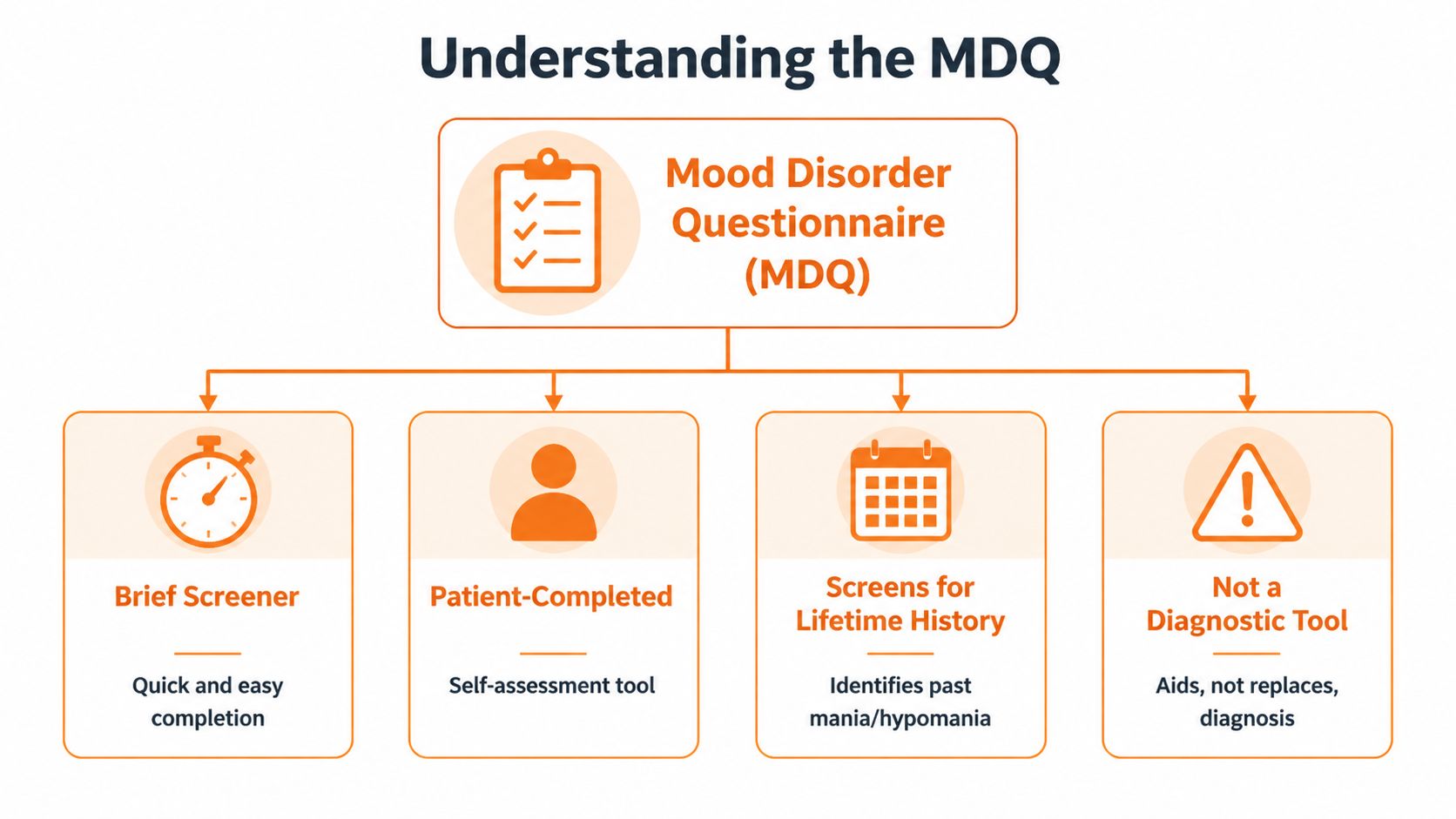
Its job is to raise a clinical flag
The MDQ serves as an alert system. It helps a clinician ask a better question: does this person’s history include episodes of activation, decreased need for sleep, accelerated speech, unusual confidence, or impulsive behavior that belong to the same syndrome rather than appearing as isolated traits?
That distinction matters. A single symptom, such as sleeping less for a few nights, can reflect stress, personality style, substance use, ADHD, or ordinary life disruption. A cluster of symptoms occurring in the same window is much more informative. In psychometric terms, the MDQ is trying to capture pattern, not just presence.
The three parts of the MDQ
The structure is simple, but each part does a different job:
Symptom history
The patient responds to 13 yes/no items covering lifetime experiences associated with mania or hypomania.Symptom clustering
The patient reports whether several endorsed symptoms happened during the same period.Functional impact
The patient rates how much trouble those experiences caused.
You can compare this to assembling a case formulation. The first part gathers raw clues. The second asks whether the clues belong to one episode. The third asks whether that episode changed real-world functioning. Without those last two steps, the measure would overread normal variation.
Why the MDQ remains useful
Clinicians still use the MDQ because it is brief, easy to score, and grounded in symptom patterns that often go unasked in routine visits. It is especially helpful in settings where bipolar-spectrum conditions may be missed because the patient presents during depression, burnout, irritability, or cognitive complaints rather than obvious hypomania.
Its limitation is just as important as its usefulness. The MDQ screens for a history suggestive of bipolar-spectrum illness. It does not establish subtype, rule out competing explanations, or tell you how current cognition is functioning.
That is where a broader assessment strategy becomes more clinically useful. For readers comparing instruments, this guide to mental health screening tools used in clinical assessment helps place the MDQ in context. In practice, the most informative next step is often to combine an MDQ result with interview data, collateral history, and modern cognitive measures, such as Orange Neurosciences, so the clinician can connect mood history with present-day attention, processing speed, memory, and executive function. That turns a simple screen into a more actionable picture of what the patient is experiencing now and what kind of care plan makes sense.
How to Administer and Score the MDQ
In most settings, the MDQ is simple to administer. A primary care physician, psychiatrist, psychologist, nurse practitioner, counsellor, or other trained mental health professional can incorporate it into intake or follow-up. It is often completed quickly, which makes it practical in busy clinics.

The scoring rule
A positive screen requires all three of these conditions:
Seven or more “yes” responses on the first 13 symptom items
A “yes” to the question asking whether several symptoms occurred during the same period
Moderate or serious impairment on the functional impact item
If one part is missing, the screen is not considered positive by the standard rule.
A practical example
Suppose a patient answers “yes” to eight of the first 13 items. So far, that meets the symptom-count threshold.
Now imagine the patient says those symptoms did not happen at the same time. Even with eight endorsed symptoms, the screen does not meet standard criteria. The reason is simple. The MDQ is trying to identify a syndrome-like cluster, not just a collection of unrelated experiences spread across many years.
Consider a second example. Another patient endorses seven symptoms, reports that they did occur together, and rates the consequences as moderate. That result counts as a positive screen and should prompt fuller assessment.
Practical rule: Count the score only after checking all three gates. Clinicians often focus on the symptom count and forget that clustering and impairment are part of the screen.
Administration tips that reduce confusion
A few habits improve accuracy:
Clarify the time frame. The MDQ asks about lifetime experiences, not just the last week or month.
Explain “together” carefully. Patients may need help deciding whether symptoms belonged to one episode or several separate periods.
Explore impairment gently. Some patients minimise impairment because heightened mood felt productive at the time.
If you want a comparison point for how structured scoring rules work in another well-known instrument, this guide on scoring the Beck Depression Inventory is a helpful contrast.
Interpreting MDQ Results Accurately
A patient checks enough boxes to screen positive, then asks, "So do I have bipolar disorder?" That moment is where interpretation matters. The MDQ gives you a signal, not a diagnosis, and the quality of your next questions determines whether that signal becomes clinically useful.
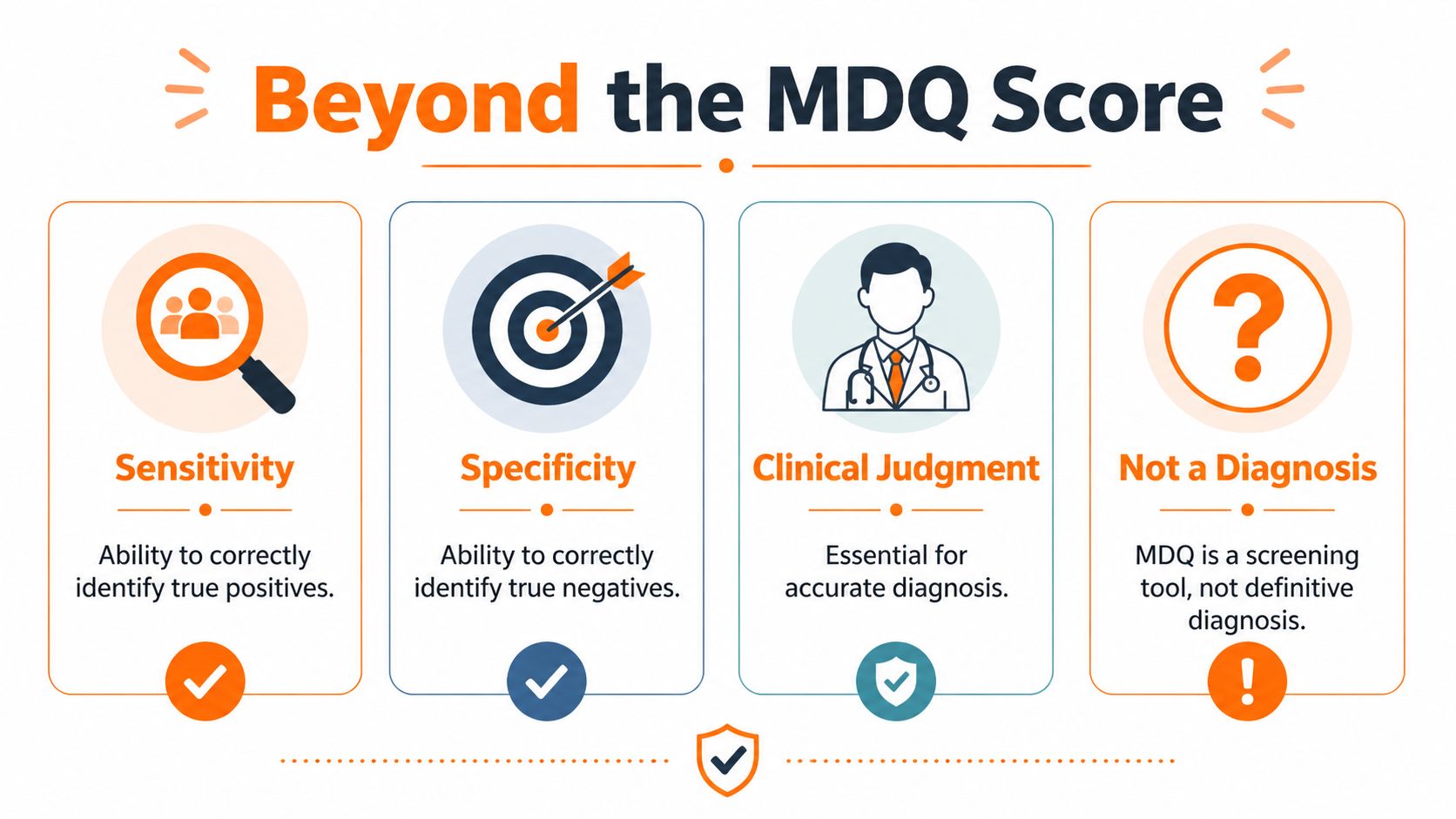
Translating psychometrics into plain language
Three concepts shape how an MDQ result should be read.
Term | Plain-language meaning | Clinical use |
|---|---|---|
Sensitivity | How often the screen catches people who may truly have bipolar-spectrum illness | Helps you estimate how many possible cases the tool may identify |
Specificity | How often the screen stays negative in people who likely do not have bipolar-spectrum illness | Helps you judge how many positive screens may be false alarms |
Predictive value | How much a result means in the setting where you use it | Reminds you that the same score can carry different weight in primary care, psychiatry, or community screening |
The practical point is simple. Screening tools sort people into "needs a closer look" and "less likely, but still consider the full picture." They do not settle the differential diagnosis.
A positive MDQ raises suspicion when the history also suggests distinct episodes, decreased need for sleep, and meaningful change from the person's usual baseline. A negative MDQ lowers suspicion, but it does not rule out every bipolar presentation, especially if recall is limited, insight is poor, or symptoms were interpreted as personality style, stress, or productivity.
What a result means in real clinical work
The cleanest way to read the MDQ is to treat it as one layer of evidence. A score has more value when it matches the interview, collateral history, course over time, and functional change.
Prevalence matters too. In a specialty mood clinic, a positive screen carries different weight than it does in a general population sample. The same is true for many symptom measures. Clinicians already accept this logic in careful PHQ-9 interpretation, where the total score matters less than the surrounding context of medical illness, stress, duration, and impairment.
Here is the "so what" for practice. A positive MDQ should shift you toward a more structured bipolar assessment. A negative MDQ should shift you toward broader hypothesis testing, not premature reassurance.
Clinical reminder: The score only makes sense beside sleep history, substance use, medication exposure, developmental pattern, and the patient's description of whether symptoms came in episodes or felt chronic.
Questions to ask after scoring
After a positive result, the interview should clarify four areas:
Episode structure. Did the symptoms cluster into a distinct period with a beginning and end, or do they describe the person's usual way of functioning?
Sleep quality and meaning. Was there a reduced need for sleep with sustained energy, or ordinary sleep loss followed by fatigue and strain?
Context and triggers. Did symptoms emerge out of the blue, or mainly during substance use, antidepressant exposure, interpersonal conflict, or severe stress?
Change in consequences. Did the person become more impulsive, grandiose, financially risky, sexually disinhibited, or unusually driven compared with baseline?
Those answers often guide care more accurately than the raw score.
They also show where the MDQ reaches its limit. The questionnaire samples mood and activation symptoms, but it does not measure attention control, processing speed, working memory, or other cognitive patterns that can help separate episodic bipolar symptoms from ADHD, trauma-related dysregulation, sleep disruption, or medication effects. That is why a stronger clinical picture often comes from pairing the MDQ with targeted cognitive assessment. The screen tells you where to look. Cognitive data can help clarify what kind of impairment or instability you are seeing.
Common Pitfalls and Diagnostic Challenges
The most common mistake with the mood disorder questionnaire is overconfidence. Someone screens positive, and everyone in the room starts thinking “bipolar disorder” before the differential diagnosis has been done.
That’s understandable because the MDQ asks about impulsivity, activation, rapid thoughts, reduced need for sleep, and increased activity. The problem is that those features do not belong exclusively to bipolar-spectrum conditions.

Where overlap creates trouble
Two conditions create repeated confusion in practice: ADHD and borderline personality disorder.
ADHD can look similar because patients may report distractibility, impulsivity, high activity, and inconsistent follow-through. The key distinction is often temporal pattern. ADHD traits are typically longstanding and often traceable to childhood. Bipolar symptoms are more episodic.
Borderline personality disorder can also resemble bipolar presentations because both may involve affective instability, impulsive behaviour, and turbulent relationships. But here again, timing and triggers matter. BPD-related shifts are often rapid and closely tied to interpersonal stressors. Bipolar mood episodes usually unfold with a different rhythm.
Why youth require extra caution
This issue gets sharper in adolescents and young adults. In youth, the MDQ’s sensitivity can drop because of comorbidities, and some outpatient studies show up to 40% false positives where symptoms overlap with ADHD or BPD, according to the clinical discussion summarised by Dr. Lisa Long’s MDQ review.
That doesn’t make the tool useless. It means a positive screen in a younger patient should trigger more careful differential diagnosis, not faster conclusions.
If a teenager endorses distractibility, irritability, and impulsivity, the central question isn’t “Did the MDQ turn positive?” It’s “What developmental pattern best explains these behaviours?”
What the MDQ cannot tell you
The MDQ does not reliably sort out:
Episodic symptoms versus lifelong traits
Mood elevation versus trauma-related arousal
Hypomania versus externally triggered emotional reactivity
Primary bipolar disorder versus a mixed clinical picture
That limitation is not a flaw in the questionnaire. It’s the nature of screening. Screeners cast a wide net. Diagnosis requires finer tools.
A practical response is to slow down and organise the next steps. Review chronology. Ask for examples. Seek collateral if appropriate. Look at school, work, relationship, and sleep patterns over time. False positives become less mysterious when the clinical interview is built around pattern recognition instead of symptom counting alone.
The Next Step Integrating MDQ with Cognitive Assessments
A common clinical scene looks like this. A patient screens positive on the MDQ, then spends the rest of the visit talking about missed deadlines, scattered thinking, risky decisions, or mental fog. The questionnaire has pointed toward possible bipolar-spectrum symptoms, but it has not yet clarified how those symptoms are showing up in daily function.
That is the practical gap after screening. The MDQ samples a person’s history of mood activation. It does not measure the current efficiency of attention, processing speed, working memory, or executive control. If the goal is a care plan rather than a label, those domains matter.

Why add cognitive assessment after the MDQ
The MDQ works like a wide-angle lens. It helps you spot a pattern that may deserve closer examination. Cognitive testing gives you the closer view by showing how the person is functioning right now under structured tasks.
That added layer helps answer different questions than the MDQ can answer on its own:
Are concentration problems broad and persistent, or more variable and state-dependent?
Is “brain fog” reflected in measurable weaknesses, and if so, in which domains?
Are planning and inhibition difficulties severe enough to affect safety, work, or school performance?
Does the profile fit an episodic mood condition, a neurodevelopmental picture, or a mixed presentation that needs staged follow-up?
Patients often report the functional consequence before they can describe the mood pattern. They notice the crash in performance, the impulsive choices, or the inability to organise tasks. A cognitive assessment helps convert those subjective complaints into a more specific map of strengths and weaknesses.
What combining the two methods adds
Used together, the MDQ and cognitive testing answer different parts of the same clinical question.
Assessment type | What it captures | What it can miss when used alone |
|---|---|---|
MDQ | Self-reported lifetime pattern of elevated mood symptoms | Current cognitive efficiency and day-to-day performance impact |
Cognitive testing | Attention, memory, processing speed, and executive functioning | Whether those difficulties occur in the context of bipolar-spectrum symptoms |
Combined use | History plus current functioning | Fewer blind spots during differential diagnosis and care planning |
That combination is often more useful than either tool by itself. A positive MDQ score may increase suspicion, but cognitive findings help determine urgency, functional supports, and the shape of the next assessment step. Orange Neurosciences is one example of a tool that helps bridge that gap by pairing symptom screening with structured cognitive data, so the discussion can move from “Could this be bipolar disorder?” to “How is this affecting functioning, and what should we do next?”
A practical example
Consider two patients with the same positive MDQ result.
The first describes reduced need for sleep, bursts of energy, and impulsive spending. Cognitive testing also shows slowed processing speed and weak executive control. That pattern may support faster psychiatric follow-up, closer safety review, and practical support at work or school.
The second also screens positive, but the history suggests chronic distractibility since childhood, and the cognitive profile points more toward attentional inefficiency than an episodic change from baseline. The same MDQ score now means something different. The next step may be a fuller ADHD assessment, a broader diagnostic interview, or both.
The point is simple. The MDQ tells you where concern begins. Cognitive assessment helps determine what that concern looks like in real life and how to respond.
For a broader clinical primer, this overview of what cognitive assessment is outlines how these measures can inform treatment planning, functional recommendations, and follow-up.
Frequently Asked Questions About the Mood Disorder Questionnaire
Can someone take the MDQ on their own
Yes, many people complete it on their own. But self-administration works best when the result becomes the start of a conversation with a qualified clinician.
The risk of taking it alone is interpretation. A person may either dismiss a meaningful result or become alarmed by a positive screen that ultimately reflects something else. The questionnaire is a prompt for assessment, not a final answer.
Is the MDQ appropriate for adolescents
Sometimes, but carefully. The MDQ is used in research with adolescents, yet its validity can be complicated by developmental change and high comorbidity, so expert clinical judgment is especially important in this age group, as noted in the adolescent-focused discussion at PubMed.
In plain terms, adolescence is already a period of changing sleep, emotion, identity, and behaviour. That makes interpretation more nuanced than it is in many adults.
What should someone do after a positive screen
The next step is a fuller assessment, not self-diagnosis.
That usually includes:
A careful timeline of mood episodes, sleep changes, energy shifts, and impairment
A review of overlap conditions such as ADHD, trauma-related symptoms, substance use, and personality factors
A medication and treatment history to understand what has and hasn’t helped
Functional review of work, school, relationships, and safety
What if the screen is negative but concerns remain
A negative result doesn’t erase the person’s distress. It only makes one specific explanation less likely. Depression, anxiety, trauma-related conditions, ADHD, and sleep disruption can all produce serious symptoms without yielding a positive MDQ.
A useful question for patients is, “What pattern is troubling you most right now?” That keeps the conversation grounded in lived experience rather than in the score alone.
Should families pay attention to the result
Yes, especially when they’ve noticed changes the patient may minimise. Families often see the behavioural pattern more clearly than the patient does, particularly around sleep, spending, irritability, or sudden surges in goal-directed activity.
That said, family observations should inform assessment, not replace it. The goal is a more accurate clinical picture, not a quicker label.
From Screening to a Strategic Care Pathway
The MDQ earns its place because it is fast, structured, and clinically useful. It helps uncover bipolar-spectrum risk that might otherwise remain buried inside a depression narrative. Used well, it sharpens questions that matter.
Used alone, it can also mislead. Symptom overlap, developmental complexity, and the limits of self-report all mean that a positive score is only the beginning. Good care comes from pairing screening with differential diagnosis, functional assessment, and when appropriate, objective cognitive data.
For readers looking at treatment pathways from the patient side, this Dallas guide for bipolar disorder offers a practical overview of what support options can look like beyond the screening stage. For clinicians, the broader principle is continuity. A result only helps if it leads to the right next step, which is why a framework for continuity of care matters as much as the screener itself.
The best use of the mood disorder questionnaire is simple. Let it open the door. Then do the deeper work required to decide what lies behind the score.
If you want to move from basic screening to a more strategic, data-informed care pathway, explore Orange Neurosciences. Their platform helps clinicians, educators, and families add objective cognitive profiling to the assessment process, so decisions don’t rest on a single questionnaire alone. You can visit the website to learn more, request a consultation, or contact the team by email to discuss how this fits your setting.

Orange Neurosciences' Cognitive Skills Assessments (CSA) are intended as an aid for assessing the cognitive well-being of an individual. In a clinical setting, the CSA results (when interpreted by a qualified healthcare provider) may be used as an aid in determining whether further cognitive evaluation is needed. Orange Neurosciences' brain training programs are designed to promote and encourage overall cognitive health. Orange Neurosciences does not offer any medical diagnosis or treatment of any medical disease or condition. Orange Neurosciences products may also be used for research purposes for any range of cognition-related assessments. If used for research purposes, all use of the product must comply with the appropriate human subjects' procedures as they exist within the researcher's institution and will be the researcher's responsibility. All such human subject protections shall be under the provisions of all applicable sections of the Code of Federal Regulations.


© 2026 by Orange Neurosciences Corporation