Discover moca test online free: Safe, reliable cognitive screening
Feb 13, 2026
If you’ve ever searched for a "MoCA test online free," you've probably noticed a ton of unofficial versions floating around. But relying on one of these is a bit like using a home blood pressure cuff to diagnose a complex heart condition. It might give you a vague idea, but it's a far cry from the accuracy and context you'd get from a proper medical assessment.
Understanding Your Online MoCA Test Options
It all boils down to the difference between a quick online quiz and a clinically validated MoCA test given by a healthcare professional. One is an informal screener, while the other is a formal tool designed to gather meaningful data for a potential medical evaluation. Knowing this distinction is key before you click "start" on any free version you stumble across online.
This decision tree helps visualize the two main paths you can take.
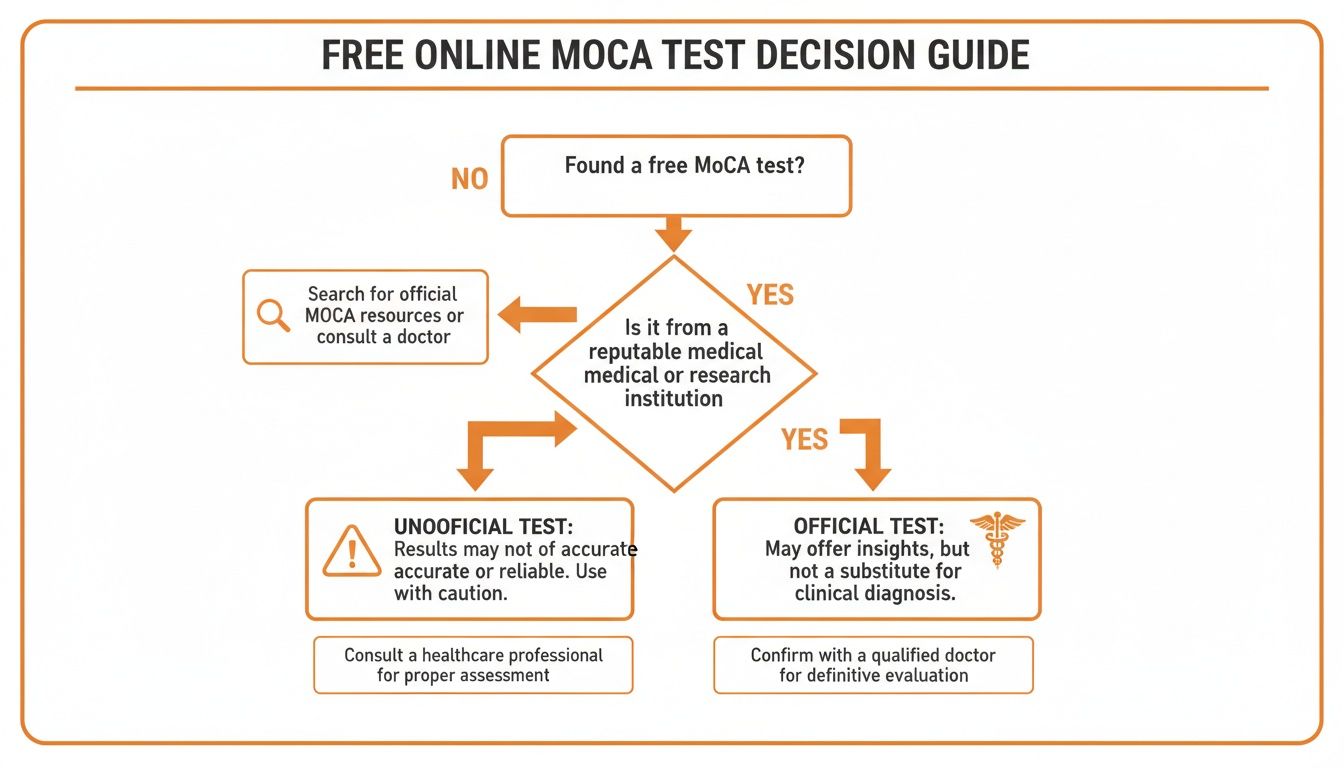
As the flowchart shows, unofficial tests come with some pretty big warnings. The official assessments, on the other hand, are firmly rooted in a clinical setting. It's a clear visual reminder that the road to reliable results starts with professional oversight, not a random web search.
Unofficial Quizzes vs. Clinical Assessments
These unofficial online tests often try to mimic the format of the real MoCA. They'll present similar-looking questions about memory, attention, and language. For instance, you might be asked to draw a clock or remember a short list of words after a few minutes.
Here’s a quick breakdown to help you see the difference at a glance:
Free Online Versions vs Clinician-Administered MoCA Test
Feature | Free Online Version | Clinician-Administered Test |
|---|---|---|
Accuracy | Varies wildly; often unreliable. | Clinically validated and standardized for accuracy. |
Administration | Self-administered; no oversight. | Administered by a trained and certified professional. |
Interpretation | Automated score with no context. | Professional interpretation of score and observed behaviours. |
Context | Lacks observation of non-verbal cues (hesitation, process). | Observational data is a critical part of the assessment. |
Validity | Not recognized for clinical diagnosis or tracking. | Can be used as part of a formal diagnostic process. |
Cost | Typically free. | Billed through a clinical provider or service. |
As you can see, while convenience is a plus for the free versions, they just can't replicate the controlled environment or the trained administrator's observations. Those elements are absolutely essential for an accurate interpretation.
Practical Example: A professional picks up on subtleties an online form completely misses. For instance, they might notice you hesitate before naming an animal or that you re-read the instructions multiple times. This observational data is often where the real insights are found.
The official MoCA Cognition website makes it clear that their resources are exclusively for certified professionals. If you have genuine concerns about your cognitive health, the most effective first step is to talk to your doctor. They can determine if a proper screening is needed and administer it correctly.
For a deeper dive into what a formal assessment involves, you can learn more about finding a cognitive screening test online in our detailed guide.
What The MoCA Test Actually Measures
You can think of the Montreal Cognitive Assessment as a quick, 10-minute workout for the mind. It was designed to screen for potential cognitive challenges across several crucial areas of brain function.
While most people think of "memory" when they hear about cognitive tests, the MoCA goes much deeper than just simple recall. It looks at how you process visual information, your ability to find the right words, how well you can maintain focus, and your problem-solving skills in straightforward situations.
“This test captures snapshots of brain performance,” says one certified neuropsychologist. It’s a fast, standardised way to get a baseline of a person’s cognitive strengths and weaknesses.
You might stumble across a "moca test online free" with a quick search, but only the official, clinician-administered version is designed to evaluate each domain with the necessary precision. Let’s break down what those domains are to see why having a professional guide you through it is so important.
Core Cognitive Domains
Each part of the MoCA is designed to test a different "mental muscle." These aren't abstract academic exercises; they often mirror challenges we face in our daily lives.
Domain | Real-World Example |
|---|---|
Visuospatial | Trying to assemble IKEA furniture by following the diagram. |
Language | Naming all the different types of animals you can think of in one minute. |
Attention | Crossing items off your grocery list in a noisy, distracting store. |
Memory Recall | Remembering a short shopping list you were told a few minutes earlier. |
Executive | Acting as your brain’s ‘CEO’ to plan and organise your schedule for the week. |
For instance, the visuospatial tasks are a lot like trying to read a map or follow assembly instructions. Then, shifting from images to words, the language section might check your word fluency by asking you to name as many words as you can in a specific category within a tight time limit.
How Scoring Works
Once you've completed the exercises, a trained professional doesn't just add up the points. They tally your score against a set of strict criteria, and the final number isn't a diagnosis—it's a screening indicator that suggests whether a deeper look is needed.
A certified clinician administers the test, ensuring the timing and instructions are exactly the same for everyone.
A professional scorer doesn't just look at the final answer; they also consider behaviours during the test, like hesitation or if you corrected yourself.
Most importantly, they interpret the score in context, considering factors like your education level, overall health, and even your mood that day.
Key Insight: A number on a page means very little without the clinical expertise to interpret it correctly.
If you’re wondering how the MoCA stacks up against other common screeners, our article on the comparison of MoCA and MMSE provides a helpful breakdown. It explains why the MoCA has become such a trusted benchmark in the field of cognitive screening.
Think about the classic clock-drawing task. It’s not just about drawing a circle. It reflects real-world challenges like being able to tell time on an analog clock or planning out your appointments. Understanding this context is what makes the test so insightful.
Why Understanding Matters
When you grasp what each domain measures, you can start to see where you might want to build up your own mental strengths.
Here are a couple of simple, actionable tips:
Practical Example: Try doing a simple jigsaw puzzle for 5 minutes each day to sharpen your visuospatial skills.
Actionable Insight: Set a one-minute timer and challenge yourself to list as many animals as you can. This is a great way to strengthen language fluency.
Working on small exercises like these can help you feel more prepared and confident if you ever take an official assessment. Every small victory in building your cognitive health is worth celebrating.
The Hidden Dangers Of Unofficial MoCA Tests
Googling "moca test online free" might feel like a smart, proactive step in looking after your health. But the truth is, these unofficial versions are riddled with risks and often create more confusion than clarity. The real problem is they completely miss the two things that make a cognitive screening meaningful: a controlled environment and professional oversight.
An online test is just a script; it can't see the person behind the screen. A certified administrator, on the other hand, is trained to notice the subtle things. They can see if anxiety is getting in the way, if you’ve simply misunderstood the instructions, or even if poor eyesight is affecting your performance. A free online quiz can't distinguish between these human factors and a genuine cognitive issue.
This is a massive flaw, and it can send you down two equally dangerous paths: false reassurance or unnecessary panic. An inaccurate high score might lead you to brush off a real concern, delaying a vital conversation with your doctor. On the flip side, a flawed low score could cause a huge amount of stress and worry over a problem that isn't even there.
Incorrect Scoring and Missing Context
One of the biggest problems with these free tests is the complete lack of standardized administration. A valid MoCA assessment depends on precise timing for specific tasks and perfectly clear, consistent instructions. Unofficial online versions rarely get these critical details right, which can completely throw off your score.
Practical Example: Imagine a memory task where you must recall five words after five minutes. An official test uses a specific distraction during that delay. An online quiz might let you sit in silence, making the task easier and the score artificially high.
A clinician does so much more than just mark answers right or wrong. They watch your problem-solving process, notice your hesitation, and pick up on non-verbal cues. This observational data is often just as revealing as the final score itself. Without that expert interpretation, you're only getting a tiny—and likely distorted—piece of the puzzle.
The Real-World Consequences
There's a growing demand for accessible digital screening tools. In fact, the US neurocognitive assessment and rehabilitation market is projected to hit $6,972.8 million by 2030. This shows just how much people want these tools, but it also ramps up the risk posed by unreliable ones. When you consider that studies show 10% of Americans over 65 have dementia and another 22% face mild cognitive impairment, the need for accuracy is non-negotiable. You can learn more about the neurocognitive assessment market growth to appreciate what's at stake.
These unofficial tests also have very poor test-retest reliability, which means your score could swing wildly from one day to the next. That kind of inconsistency makes them useless for tracking cognitive changes over time. If you want to dive deeper into this, check out our guide on the importance of test-retest reliability in cognitive assessments.
Ultimately, putting your trust in a free online MoCA test can lead to poor health decisions. It might stop you from seeking help when you really need it, or it could cause you to chase unnecessary treatments based on bad data. For genuine peace of mind and insights you can actually act on, a professionally administered assessment is the only way to go.
How To Get A Legitimate Cognitive Assessment
Once you realise the dead end that is searching for a "moca test online free," the next question is obvious: where do you go for a reliable alternative? The best and safest place to start is always with your primary care physician or family doctor.
This first conversation is so important. Your doctor knows your entire medical history, what medications you’re on, and your overall health—all critical context for any concerns about your cognition. They are perfectly positioned to judge whether your symptoms need a formal screening and can often administer a validated tool right there in the office.
Your Doctor Is Your Best Starting Point
Think of your family doctor as your trusted guide on this journey. They can perform an initial assessment themselves or, if they feel it’s needed, refer you to a specialist for a deeper look. This makes sure you're on the right track from the very beginning.
Here are the paths your doctor will likely recommend:
In-Office Screening: Many physicians can administer a validated paper-based or digital screener during your appointment.
Specialist Referral: For more complex situations, they might send you to a neurologist, who specializes in the brain and nervous system, or a neuropsychologist, an expert in how brain function impacts our behaviour and thinking.
To get a feel for how professional online medical services work and ensure you receive a reliable evaluation, it's helpful to see what's out there. You might consider exploring resources on legitimate UK online doctor consultation services that provide formal medical assessments.
Embracing Modern Digital Solutions
Healthcare is moving beyond traditional paper tests and embracing clinically-backed digital solutions. These modern tools offer a level of precision and objectivity that those informal online quizzes just can't touch. Instead of a random online test, a clinician might use a platform like Orange Neurosciences' OrangeCheck to get a rapid, objective, and precise cognitive profile.
These professional-grade digital platforms are built for clinical use, delivering insights that are both meaningful and actionable. They do more than just spit out a score; they often analyze response times, patterns, and consistency to paint a much richer picture of your cognitive health. It’s a huge leap forward from the generic results of an unverified moca test online free.
The US cognitive assessment market is projected to hit an incredible $9,378.5 million by 2031, which shows the massive demand for effective digital tools. Platforms like Orange Neurosciences' AI-powered assessments are stepping in to fill this need, and they've been shown to reduce diagnostic delays by up to 50%. This shift makes validated digital tools a far smarter choice than informal online screeners, especially for people in places like California, where over 6 million residents are aged 65 and older.
Actionable Insight: The goal here is to shift from unreliable self-testing to a professionally guided assessment. With the right tools in the hands of a qualified clinician, you can get the clarity and peace of mind you deserve.
The call to action couldn't be simpler: skip the shaky free tests you find online. Instead, ask your doctor about professional-grade digital tools and other validated cognitive assessments. They can provide the trustworthy insights you need to take control of your brain health.
Making Sense Of Your Cognitive Screening Results
Whether it comes from a quick online quiz or a formal assessment, getting a score after a cognitive test can feel pretty heavy. The natural instinct is to slap a "good" or "bad" label on that number, but it’s so important to resist jumping to conclusions.
If you take away just one thing, let it be this: a score is not a diagnosis.
Think of it as a single snapshot in time. It captures one moment, but it doesn't even begin to tell the whole story of your cognitive health. A trained clinician never, ever looks at that number in isolation. They piece it together with your entire health profile—your education level, medical history, current medications, and even how you were feeling on the day of the test.
Why Context Is Everything
To really grasp why context is king, let’s look at a real-world example. Imagine two different people take the same cognitive screening and get the exact same score—say, 24 out of 30.
Practical Example (Person A): This person might have scored a 24 because they were running on fumes after a week of terrible sleep and were stressed about the test itself. Their performance was dragged down by temporary factors, not necessarily a sign of an underlying cognitive problem.
Practical Example (Person B): This person, on the other hand, might have scored a 24 because they're in the very early stages of mild cognitive impairment. For them, the score points to a subtle but real change that needs a closer look.
Without a clinician's trained eye, there’s no way to tell these two situations apart. A score from a random moca test online free would treat both results as identical. This could cause needless worry for one person while giving false reassurance to the other—neither of which is helpful.
A screening score is a starting point for a conversation with your doctor, not the final word. It’s a piece of data that helps guide the next steps in understanding your overall brain health.
Questions To Ask Your Doctor
To get the full story behind your score, you need to have a proactive conversation with your healthcare provider. For a deeper dive into what different scores might point to, our guide on MoCA score interpretation offers some great background for this discussion.
You can empower yourself by walking into your appointment with the right questions. This helps you and your doctor work as a team to build a clear picture.
"What does this score mean in the context of my personal health history?" This question immediately prompts your doctor to connect the number to you.
"Were there any specific areas where I showed strengths or weaknesses?" A good assessment is more than a total; it highlights performance across different cognitive skills.
"What are the recommended next steps based on this result?" This shifts the focus from the number itself to creating an actionable plan for the future.
So You've Got Your Results. What's Next?
Getting the results from a cognitive assessment isn't the finish line; it’s the starting line for taking charge of your brain health. Think of it as a baseline, a snapshot in time. No matter what the results show, you now have powerful information to help you build a plan for keeping your mind sharp for years to come.
Your next steps will obviously depend on what you've learned, but the ultimate goal is the same for everyone: create a sustainable, long-term plan for brain wellness. Let's break down what that looks like.
If Your Results Are Within a Normal Range
Getting a normal result is fantastic news! But it’s not a signal to sit back and do nothing. It’s actually the perfect time to get proactive. Just like getting a good report from the dentist, this is your cue to keep up the good habits that got you here. The focus now shifts from assessment to preservation.
Here are a few science-backed, actionable strategies to weave into your daily life:
Get Moving: Aim for at least 150 minutes of moderate-intensity exercise each week. A brisk walk, a bike ride, or a swim all count. This gets blood flowing to the brain, which is absolutely vital for keeping it healthy.
Eat for Your Brain: A diet packed with fruits, vegetables, and healthy fats—like the Mediterranean diet—gives your brain the nutrients it needs to thrive.
Stay Connected: Make time for friends and family. Socializing isn’t just fun; it’s a powerful mental workout that keeps your cognitive skills from getting rusty.
If Your Results Raise a Few Questions
If your results point to some areas of concern, the first step is simple: don't panic. This isn't a diagnosis. It’s a signal that it’s time for a deeper conversation with your doctor. They’re your partner in figuring out the bigger picture and what comes next.
This conversation will likely lead to a few things:
A Deeper Dive: Your doctor might suggest more detailed assessments with a specialist, like a neurologist. This helps get to the root cause of any changes.
Creating a Plan: Once there's a clearer picture, you and your healthcare team will work together on a personalized plan to manage any symptoms and support your cognitive function.
Exploring Modern Tools: This is where you can take action. Ask your doctor how something like Orange Neurosciences' game-based training programs could fit into your plan. These aren't just games; they're designed to strengthen specific cognitive functions in an engaging way, all under professional guidance.
Actionable Insight: The most important thing you can do is work hand-in-hand with your healthcare provider. They are your best resource for exploring modern intervention tools and building a strategy that truly fits your needs.
The takeaway here is straightforward. Whether you’re looking to maintain your cognitive edge or address a specific concern, you have options. By talking to your doctor about tools like targeted cognitive training programs, you can play an active role in your own brain health journey.
To see how these tools work in the real world, learn more about Orange Neurosciences' approach to cognitive support on our website.
A Few Common Questions About Cognitive Screening
It’s completely normal to have questions when you start looking into cognitive assessments. The internet is flooded with unofficial tests, and it can be tough to know what's what. Let's clear up a few of the most common questions people have when they search for a "moca test online free."
Can I Take The Official MoCA Test Myself At Home?
The short answer is no. The official MoCA test isn't a DIY assessment—it has to be given by a trained and certified healthcare professional.
This is critical for a couple of reasons. First, it makes sure the test is done and scored correctly. More importantly, it allows a professional to interpret your results in the bigger picture of your overall health. Any version you take by yourself online just won't be considered clinically valid.
What Does A Low Score On An Online Test Mean?
Getting a low score on an unofficial test can be alarming, but it’s important not to jump to conclusions. It’s not a diagnosis.
So many things can influence that score—distractions at home, feeling stressed, or just the unreliability of the test itself. If a result has you worried, the best thing you can do is talk to your doctor. Share the result with them and ask for a proper, validated assessment. If you're dealing with symptoms like brain fog, it's also helpful to look into what causes brain fog and bring those concerns up with your doctor, too.
Actionable Insight: A single score from an unverified online source lacks the clinical context to be meaningful. Your most practical step is to consult a healthcare provider for a reliable evaluation.
Are There Reliable Digital Alternatives?
Absolutely. Many clinicians are now using validated digital assessment tools to get quick and objective insights into cognitive function. These aren't the same as the free quizzes you find online.
Platforms like those from Orange Neurosciences are designed specifically for professional use. They offer a modern, efficient, and reliable alternative. It's definitely worth asking your healthcare provider about these professional-grade digital options.
Ready to move beyond unreliable online quizzes? Discover how Orange Neurosciences provides clinicians with the precise, evidence-based tools needed for accurate cognitive assessment and care planning. Explore our solutions at https://orangeneurosciences.ca.
Orange Neurosciences' Cognitive Skills Assessments (CSA) are intended as an aid for assessing the cognitive well-being of an individual. In a clinical setting, the CSA results (when interpreted by a qualified healthcare provider) may be used as an aid in determining whether further cognitive evaluation is needed. Orange Neurosciences' brain training programs are designed to promote and encourage overall cognitive health. Orange Neurosciences does not offer any medical diagnosis or treatment of any medical disease or condition. Orange Neurosciences products may also be used for research purposes for any range of cognition-related assessments. If used for research purposes, all use of the product must comply with the appropriate human subjects' procedures as they exist within the researcher's institution and will be the researcher's responsibility. All such human subject protections shall be under the provisions of all applicable sections of the Code of Federal Regulations.


© 2026 by Orange Neurosciences Corporation