Your Practical Guide to the Mini Cog Test
Jan 19, 2026
Clocking in at just three minutes, the Mini-Cog test is an incredibly efficient screening tool designed to spot early signs of cognitive impairment. It’s a powerful little test that combines a three-word recall task with a clock-drawing challenge, giving clinicians a quick yet insightful snapshot of an individual's cognitive health. Its biggest strength is its speed, making it a perfect first-line screener in busy clinical settings.
What Is the Mini Cog Test and Why It Matters
Think of the Mini-Cog as a quick vital sign check for the brain. Just like a nurse takes your temperature to get a fast reading on your physical health, this test offers an immediate signal about potential cognitive issues. It does this without the need for a long, drawn-out examination.
It’s important to remember that the Mini-Cog is a screener, not a full diagnostic tool. Its job is to flag individuals who might need a more comprehensive workup.
The test's real genius lies in its two-part structure, which cleverly assesses different, complex brain functions at the same time:
Three-Word Recall: This part gets right to the point, testing short-term memory. A clinician might say something like, "I'm going to say three words that I want you to remember: Banana, Sunrise, Chair." It's a simple instruction, but it reveals a lot about the brain's ability to register, hold onto, and pull back new information.
Clock-Drawing Test: This task might seem simple, but it’s a powerhouse for evaluating executive function, visual-spatial skills, and even abstract thinking. Asking someone to draw a clock face and then set the hands to a specific time, like "10 past 11," shows how well they can plan, organize their thoughts, and execute a command with multiple steps.
Here's a quick summary of what makes the Mini-Cog so practical.
Mini Cog Test at a Glance
Feature | Description |
|---|---|
Time to Administer | Approximately 3 minutes |
Components | Three-word recall and a clock-drawing test |
What It Measures | Memory, executive function, visual-spatial skills |
Primary Use | Rapid screening for cognitive impairment |
Best For | Primary care, busy clinics, initial evaluations |
In short, it’s a fast, effective way to get an initial read on cognitive function.
Its Role in Early Detection
Because it’s so quick and easy to administer, the Mini-Cog is invaluable in primary care, where every minute counts. In places like California, it has become a go-to for early dementia screening as the population ages. Studies have shown it’s quite reliable, with 76% sensitivity (correctly identifying those with impairment) and 89% specificity (correctly identifying those without) across diverse groups of people.
When a Mini-Cog suggests there might be an issue, that’s not the end of the story—it’s the beginning. It signals that it's time for a deeper dive. This is where more comprehensive cognitive assessments come in, moving beyond a simple flag to build a detailed profile of a person’s cognitive health.
How to Administer the Mini-Cog Test Step-by-Step
Running the Mini-Cog is a quick and simple process, but the key is consistency. The whole point is to deliver clear instructions and stick to a reliable sequence every single time. This guide breaks it down with the exact scripts and actions you'll need, so you can feel confident administering the test in any setting.
The test has two main components: a three-word recall task wrapped around a clock-drawing task. It's best to find a quiet, well-lit space where the patient can focus without being easily distracted.
Part 1: Three-Word Registration
First up, we’re looking at immediate recall and short-term memory. Can the individual take in new information and hang onto it for a brief period?
State the Words Clearly: Start by letting the patient know you're about to give them three words to remember. Use a calm, clear voice. You can say something like: "I am going to say three words. I want you to repeat them back to me now and try to remember them for later."
Say the Three Words: Stick to simple, unrelated nouns. The classic, validated set is "Banana, Sunrise, Chair." Make sure to speak slowly and distinctly.
Ask for Immediate Repetition: Right after you've said the words, ask them to repeat them back. A simple prompt like, "Please repeat those three words back to me now," works perfectly. This step just confirms they've heard and registered the information. If they struggle, you can repeat the list up to two more times, but what really matters for the score is whether they can recall them later.
Actionable Insight: It's common for patients to say something like, "Oh, I have a terrible memory." If they do, or if they ask for a hint, just gently redirect them. A simple, "Just do the best you can for me," is perfect. It's crucial not to give any clues, as that would compromise the test results.
Part 2: The Clock-Drawing Task
Next, we introduce a distraction. But it's not just any distraction—the clock-drawing task is a powerful mini-assessment of its own, tapping into executive function and visuospatial skills.
Provide the Materials: Hand the patient a pen and a piece of paper with a pre-drawn circle on it. If you don't have one with a circle, a blank sheet is fine.
Give the Instructions: Tell them to draw a clock. Say: "Next, I want you to draw a clock face in this circle. Please put all the numbers where they are supposed to go."
Set the Time: After they've placed the numbers, give the final instruction. The standard time to use is "11:10." This specific time is chosen because it forces the person to place the clock hands in two different quadrants, which is a great test of their planning and spatial awareness. Simply say: "Now, please draw the hands on the clock to show the time ten past eleven."
Part 3: The Three-Word Recall
Once the clock is drawn, it's time to circle back to the memory test. This is the final step in the administration process.
Ask for the Words: Bring their focus back to the first task. Ask them directly: "What were the three words I asked you to remember earlier?"
Record the Response: Carefully note how many of the words the patient can recall without any prompting from you.
And that's it. In just a few minutes, you've gathered all the data you need for scoring. This simple process yields incredibly valuable insights and is often a key piece of a wider mental state assessment. Now, let's move on to how you actually score the results.
Scoring and Interpreting Mini Cog Test Results
Once the two parts of the Mini Cog are complete, the next step is to tally the score and see what it tells us about the person's cognitive function. The real elegance of this tool lies in its simple and direct 5-point scoring system. It combines the results from the word recall and clock-drawing tasks into one clear, easy-to-understand number.
Nailing the scoring is what makes the screen reliable. Let's break down exactly how it works.
The 5-Point Scoring System Explained
The total score is just the sum of the points from both components, with a maximum possible score of 5 and a minimum of 0.
Three-Word Recall (0-3 points): This is scored based on how many words the individual remembers without any prompting. You award one point for each word they get right. For example, if they recall "Banana" and "Chair" but forget "Sunrise," they get 2 points. Simple as that.
Clock-Drawing Test (0 or 2 points): This one is all-or-nothing. An individual scores 2 points for a normal, correctly drawn clock. A "normal" clock has all the numbers in the right places and the hands pointing to the specific time you requested (like 11:10). Any significant errors—missing numbers, wrong placement, or incorrect time—means the score for this part is 0 points.
Practical Scoring Examples
To paint a clearer picture, here are a few common scenarios and how they would be scored.
Example 1: Perfect Score The person correctly recalls all three words ("Banana, Sunrise, Chair") and draws a perfect clock showing 11:10.
Word Recall Score: 3 points
Clock Draw Score: 2 points
Total Score: 5
Example 2: Some Memory Difficulty They remember only one of the three words. However, their clock drawing is completely accurate.
Word Recall Score: 1 point
Clock Draw Score: 2 points
Total Score: 3
Example 3: Significant Errors The person recalls two words but really struggles with the clock. Maybe they put the numbers in counter-clockwise or drew the hands pointing to 10:20 instead of 11:10.
Word Recall Score: 2 points
Clock Draw Score: 0 points (due to the errors)
Total Score: 2
This flowchart gives a great visual of the decision-making process based on the final score.
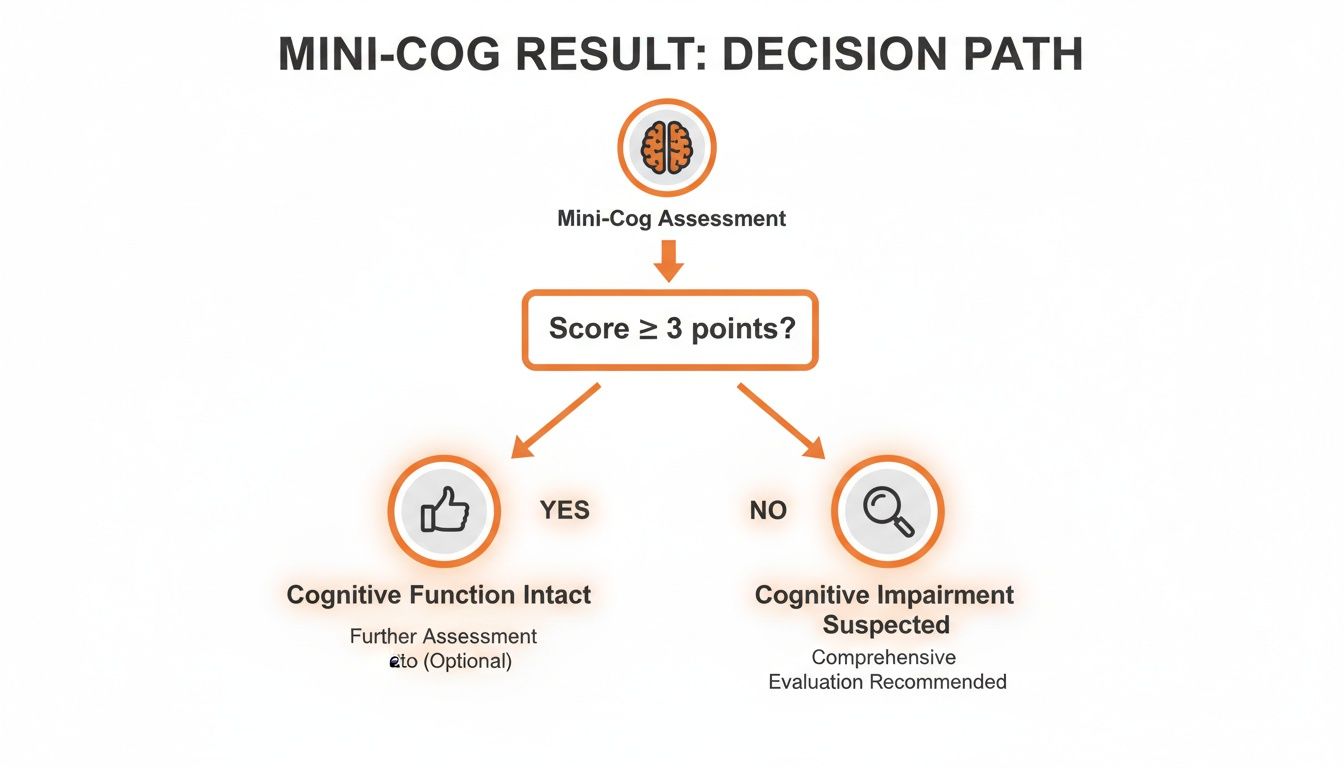
As the chart shows, the total score quickly channels the results into one of two pathways, helping to guide your next clinical steps.
Mini Cog Scoring and Interpretation Guide
This table summarizes how a final score translates into a clinical interpretation and what the recommended next steps are.
Total Score | Interpretation | Recommended Next Step |
|---|---|---|
0-2 | Positive Screen for cognitive impairment. | Further comprehensive diagnostic evaluation is strongly recommended. |
3-5 | Negative Screen for cognitive impairment. | Cognitive impairment is unlikely. Continue to monitor as part of routine care. |
A score in the lower range acts as a clear signal that something needs a closer look, while a higher score is reassuring.
Turning a Score into a Clinical Interpretation
The final number from the Mini Cog gives a clear initial direction, helping to separate individuals who are likely cognitively intact from those who need a more thorough evaluation.
Actionable Insight: A score of 0-2 is considered a positive screen, pointing to a high probability of cognitive impairment. This result is a strong signal that further diagnostic work is needed to figure out what's going on. Don't stop here; use this result to initiate conversations about a full workup.
On the other hand, a score of 3, 4, or 5 is a negative screen. This suggests that cognitive impairment is unlikely, though it doesn't entirely rule it out, especially in the very early stages of a condition.
It’s essential to realise that the Mini Cog is a powerful screener, not a diagnostic tool. A positive screen is a red flag that prompts a deeper investigation, which might include more detailed neuropsychological assessments. To see how another common tool fits in, you can explore our guide on MMSE scoring and interpretation, which provides a different lens for cognitive evaluation. Ultimately, the goal is to use these quick screens to build a complete picture and ensure people get timely, appropriate care.
Comparing the Mini-Cog Against the MMSE and MoCA
When it comes time to pick a cognitive screening tool, clinicians usually have a few key players in mind. The Mini-Cog is incredibly effective, but it’s not the only option out there. To choose the right tool for the right situation, it’s essential to understand how it stacks up against more in-depth screeners like the Mini-Mental State Examination (MMSE) and the Montreal Cognitive Assessment (MoCA).
Think of these tests on a spectrum. The Mini-Cog is your quick, initial check—the triage tool. The MMSE and MoCA are the more detailed follow-ups you bring in when you need to dig deeper.
Time and Simplicity: The Mini-Cog's Advantage
The biggest, most practical difference is simply how long each test takes. The Mini-Cog was built for speed and can usually be done in just three minutes. This makes it the perfect screener for a busy primary care clinic or during an annual wellness visit where every minute counts.
For comparison:
The MMSE generally takes about 7-10 minutes. It covers a wider range of cognitive territory, asking about orientation, attention, calculation, and language.
The MoCA also clocks in at around 10 minutes. It was specifically developed to be more sensitive to mild cognitive impairment (MCI) and includes tougher tasks that probe executive function and abstraction.
This efficiency is what positions the Mini-Cog as an ideal first line of defence. It can flag potential issues quickly without throwing the whole clinic schedule off track.
Depth of Assessment and Sensitivity
While the MMSE and MoCA take longer, that extra time buys you a more detailed picture of cognitive function. They assess multiple domains, which is incredibly useful when a concern has already been raised. The MoCA, in particular, is often favoured for its knack for catching subtle deficits that other screeners might miss. Our detailed guide on MoCA vs MMSE digs into their specific differences.
But don’t mistake the Mini-Cog’s brevity for a lack of power. A pivotal 2021 multicenter trial at Stanford University screened 850 people and found the Mini-Cog delivered impressive results. It hit sensitivity rates of 82% for mild cognitive impairment and was 15% more time-efficient than the MMSE.
The Impact of Language and Education
Another critical advantage of the Mini-Cog test is how little it's affected by a person's language skills or educational background. The simple instructions for recalling words and drawing a clock aren't easily thrown off by cultural or linguistic differences.
Practical Example: Consider a patient who is a recent immigrant with limited English proficiency and did not complete formal schooling. Administering an MMSE might yield a low score due to language and education barriers, not actual impairment. The Mini-Cog, however, provides a much fairer assessment because its tasks are less dependent on these factors.
Ultimately, the choice of tool comes down to the clinical context. For a rapid, routine screening, the Mini-Cog is hard to beat. But when that initial screen raises a red flag, or when you need a more thorough assessment from the get-go, turning to the MMSE or MoCA is the logical next step.
Practical Applications and Known Limitations
The real magic of the Mini-Cog isn't found in a textbook; it’s in the clinic, where its speed and simplicity make a world of difference. In a bustling primary care office, it's a powerful tool that lets clinicians quickly flag potential cognitive issues without derailing the entire appointment schedule. That efficiency is invaluable.
Think about it: a family doctor can work the test into an annual wellness visit. In less than five minutes, they can get a baseline or spot changes from the previous year. Just like that, cognitive screening becomes a routine part of preventative care, catching problems early when interventions have the best shot at working.
Common Clinical Use Cases
The Mini-Cog is incredibly versatile, fitting neatly into several specific clinical scenarios.
Pre-operative Evaluations: Before surgery, especially with older adults, knowing a patient's cognitive baseline is critical. A low Mini-Cog score can alert the surgical team to a higher risk of post-operative delirium or other complications, giving them a chance to adjust the care plan ahead of time.
Long-Term Care Facilities: In nursing homes or assisted living communities, staff can use the Mini-Cog for regular check-ins. It offers a consistent, straightforward way to monitor residents for cognitive shifts and decide when a full neurological workup is necessary.
Understanding the Test's Boundaries
As useful as it is, the Mini-Cog has its limits, and clinicians need to respect them. It’s a screener, not a diagnostic tool. Its results should always be viewed as one piece of a much larger clinical puzzle. A major limitation is its reduced sensitivity for very mild cognitive impairment (MCI).
The test might miss the faintest early-stage changes that a more exhaustive assessment, like the MoCA, would likely pick up. Plus, other conditions can muddy the waters.
Actionable Insight: If a patient scores poorly, check for confounding factors before assuming cognitive decline. For instance, severe depression, uncorrected vision or hearing problems, or even significant motor skill deficits (like severe arthritis making it hard to hold a pen) can produce a low score that has nothing to do with dementia.
Screening is just the beginning. From there, understanding the "why" behind cognitive patterns can lead to targeted interventions, like using a cognitive therapy thought record to help manage distressing mental loops. A positive screen on the Mini-Cog should be seen for what it is: a crucial first step that signals the need for a deeper dive. This is where advanced platforms, like those from Orange Neurosciences, can step in to provide a much more detailed and nuanced cognitive profile.
Your Next Steps After a Positive Screen
A positive screen on the Mini-Cog isn't a diagnosis. Think of it as a crucial first signal—an important flag that tells you it's time to dig deeper. It’s the starting point of a more thorough clinical investigation, not the final word.
The immediate next step is to start building a fuller picture of the patient's health. This means taking a detailed clinical history, carefully reviewing all current medications for any that might have cognitive side effects, and talking with family or caregivers to get their perspective on changes in day-to-day functioning.
Moving From Screening to In-Depth Assessment
A positive screen is the perfect trigger to move from a quick check to a more robust evaluation. It’s where the simplicity of the Mini-Cog connects to the depth of advanced diagnostics.
Actionable Insight: A positive Mini-Cog test prompts a crucial question: "What is causing this cognitive change?" Answering this requires moving beyond the screener to explore the specific cognitive domains that may be affected, such as memory, attention, or executive function. Use this opportunity to schedule a follow-up dedicated to a full cognitive workup.
If the initial workup suggests that ongoing support at home might be needed, looking into comprehensive options like disability home care services can be an essential step for both patients and their families. It's also vital to ensure a smooth transition between different stages of care; our guide on the continuity of care offers practical insights for clinicians on this very topic.
This is where AI-powered tools from Orange Neurosciences can make a real difference. Our platform takes that initial red flag from the Mini-Cog and helps transform it into a comprehensive, multi-domain cognitive profile. It provides the detailed, objective data you need to move from a simple screening result to a precise, personalized care plan with confidence.
Visit the Orange Neurosciences website to learn how our platform empowers you to build a complete cognitive picture for your patients and request a demo.
Answering Your Questions About the Mini-Cog
When clinicians start using the Mini-Cog, a few common questions always seem to pop up. Let's get right into them with some clear, practical answers.
Can This Test Diagnose Alzheimer's Disease?
In short, no. The Mini-Cog test is a screener, not a diagnostic tool.
Think of it like a smoke detector. Its job is to sound an alarm when there's a potential problem, signalling that a deeper investigation is needed. A positive screen on the Mini-Cog strongly suggests the patient needs a full diagnostic workup, but it doesn't confirm a specific condition like Alzheimer's on its own.
Are Specific Words and Times Mandatory?
While there isn't a single, universally required word list, sticking to validated, simple words is crucial for reliable results. Consistency is key.
Actionable Insight: The standard clock time of '11:10' is highly recommended for a reason. Asking a patient to draw this time forces them to place the hands in two different quadrants of the clock face. This simple instruction is surprisingly effective at testing number placement, planning, and visuospatial skills all at once. Using a different time, like 3:00, is far less challenging and may not reveal subtle deficits.
How Does the Test Perform Across Diverse Populations?
This is one of the Mini-Cog's biggest strengths. It holds up remarkably well across different cultures and languages.
Because it doesn't rely heavily on a patient's formal education level or primary language, it offers a much fairer baseline for cognitive screening. This makes the Mini-Cog test an incredibly valuable tool for clinicians working in diverse communities, helping ensure everyone gets an equitable first look at their cognitive health.
Screening is the first step, but what comes next? For a deeper understanding of cognitive health, Orange Neurosciences has developed an AI-powered platform that delivers a precise cognitive profile in under 30 minutes. It's designed to turn screening results into actionable care plans. Discover the next level of cognitive assessment at https://orangeneurosciences.ca.
Orange Neurosciences' Cognitive Skills Assessments (CSA) are intended as an aid for assessing the cognitive well-being of an individual. In a clinical setting, the CSA results (when interpreted by a qualified healthcare provider) may be used as an aid in determining whether further cognitive evaluation is needed. Orange Neurosciences' brain training programs are designed to promote and encourage overall cognitive health. Orange Neurosciences does not offer any medical diagnosis or treatment of any medical disease or condition. Orange Neurosciences products may also be used for research purposes for any range of cognition-related assessments. If used for research purposes, all use of the product must comply with the appropriate human subjects' procedures as they exist within the researcher's institution and will be the researcher's responsibility. All such human subject protections shall be under the provisions of all applicable sections of the Code of Federal Regulations.


© 2026 by Orange Neurosciences Corporation