What is Neuropsychological Assessment: A Concise Guide
Nov 8, 2025
A neuropsychological assessment is a deep dive into your cognitive world. Through a series of specialized tests, it measures crucial abilities like memory, attention, and problem-solving to help diagnose conditions and shape effective treatment plans.
When you're facing unexplained cognitive or emotional challenges, this evaluation offers a detailed look at the relationship between your brain's function and your day-to-day behaviour. For instance, if you're consistently misplacing your keys or struggling to follow conversations, an assessment can help determine if it's stress, a medical condition, or something else. It’s a comprehensive look at how your brain is wired to work.
Decoding Brain Function and Behaviour
Picture your brain as the intricate control centre of a bustling city. A neuropsychological assessment acts like a top-to-bottom diagnostic report, checking every single system. It looks at traffic flow (processing speed), the public library’s filing system (memory), and even the city planning department (executive functions). If one area isn't working at its best, it can throw the entire city's performance off-kilter.
The goal here isn't to pass or fail. Instead, the assessment is designed to map out your unique cognitive strengths and pinpoint areas that might be causing difficulties. It’s all about creating a detailed, personal profile of your brain's function that leads to actionable insights you can use immediately.
A Roadmap to Understanding
Think about a student who, despite their best efforts, just can't seem to stay focused in class. A standard academic test might only flag poor grades, but a neuropsychological assessment could uncover an underlying attention deficit that's been missed for years. The actionable insight here is that the student doesn't need to just "try harder"—they need specific strategies like breaking down assignments and using a distraction-free workspace.
Or consider an older adult experiencing memory lapses who fears the worst. An assessment can be the key to distinguishing between normal, age-related changes and the early signs of a neurodegenerative condition. This clarity allows the family to proactively plan for the future, from setting up medication reminders to exploring long-term care options.
This process provides objective, concrete data that goes far beyond what subjective reports or simple observations can tell us. It helps answer critical questions by measuring specific skills, giving us a much clearer picture.
This table breaks down the key parts of a neuropsychological assessment so you can quickly understand what the process involves.
Neuropsychological Assessment at a Glance
Component | What It Measures | Practical Example |
|---|---|---|
Attention & Concentration | Your ability to focus on a task and filter out distractions. | Listening to a series of numbers and repeating them backward. |
Memory & Learning | How effectively you learn and recall new information. | Being told a short story and asked to retell it 30 minutes later. |
Executive Functions | Your capacity for planning, organising, and problem-solving. | Solving a complex puzzle with a specific set of rules. |
Language Skills | How well you understand and express yourself, both verbally and written. | Naming as many animals as you can in 60 seconds. |
Visuospatial Abilities | Your skill in perceiving the relationships between objects around you. | Copying a complex geometric drawing. |
By measuring these distinct areas, we can build a complete profile of an individual's cognitive functioning.
A neuropsychological assessment provides a clear, evidence-based picture of cognitive functioning, empowering individuals and their care teams to make better-informed decisions about treatment and support.
This detailed understanding is crucial for creating truly personalized and effective intervention plans.
For a deeper look into how these evaluations work, feel free to explore our guide on cognitive assessments to learn more about the tools involved. As you explore this field, it's also insightful to consider the broader landscape, including advancements like AI's progress in healthcare assessment that are shaping the future of diagnostics.
When Is a Neuropsychological Assessment Recommended?
Knowing what a neuropsychological assessment is is one thing, but the real question is, when do you actually need one? Think of it as calling in a specialist. You wouldn't hire an electrician to fix a leaky pipe, and in the same way, this kind of deep-dive assessment is reserved for specific situations where you suspect a link between how the brain is working and changes in thinking, behaviour, or mood.
It’s often the next logical step when a general medical exam or a standard psychological evaluation just isn't giving you the full picture. The results can light up the path forward, whether that’s for a child falling behind in school, an adult recovering from an injury, or an older loved one struggling with memory.
Navigating Developmental and Learning Hurdles
For kids and teenagers, school or behavioural struggles can cause a lot of stress for the whole family. A neuropsychological assessment is often the key when a student consistently shows a gap between what they seem capable of and what they’re actually achieving in the classroom.
Take, for example, a bright kid who just can’t seem to grasp reading comprehension or has a terrible time organizing their thoughts for an essay. This isn't about not trying hard enough; it could point to an underlying issue that typical school testing might completely miss.
An assessment can help put a name to specific challenges like:
Learning Disabilities: By evaluating things like language processing and fine motor skills, we can pinpoint conditions like dyslexia (a reading disorder) or dysgraphia (a writing disorder).
Attention-Deficit/Hyperactivity Disorder (ADHD): This involves measuring executive functions—the brain’s management system—including attention, impulse control, and working memory to get a clear diagnostic picture. If you're looking into this, understanding the process of an ADHD screening for adults can provide some helpful background.
Autism Spectrum Disorder (ASD): Here, the focus is on assessing social cognition, communication styles, and how someone processes non-verbal cues.
Once you identify the root cause, the results lead straight to a real-world support plan. A practical example would be a recommendation for a student with dyslexia to use text-to-speech software, turning a frustrating reading assignment into an accessible learning experience.
Evaluating the Impact of Injury or Illness
The brain is resilient, but it can be affected by a huge range of medical events. After something like an injury or illness, a neuropsychological assessment is crucial for understanding the cognitive fallout and mapping out a recovery plan. It gives us a solid baseline of function and lets us track progress over time.
Think about an athlete who gets a concussion. They need more than just physical rest. An assessment can objectively measure their attention, processing speed, and memory. The actionable insight from this is a data-driven decision on when it’s truly safe for them to return to play, which helps prevent the risk of a more serious injury.
A neuropsychological assessment quantifies the invisible impact of a brain injury or neurological condition, turning subjective symptoms into objective data that guides effective rehabilitation and support.
Other common scenarios where an assessment is vital include:
Traumatic Brain Injury (TBI): After a fall or car accident, an assessment shows the extent of cognitive damage to areas like memory and executive function. This information is used to build a rehabilitation program that’s truly personalized.
Stroke: This evaluation maps out which cognitive abilities were hit by the stroke, helping therapists zero in on specific areas like language recovery (known as aphasia) or spatial awareness.
Neurological Conditions: For progressive conditions like Multiple Sclerosis (MS) or Parkinson's disease, regular assessments can monitor cognitive shifts. This helps individuals and their doctors manage the disease's progression and tweak treatment plans as needed.
Clarifying Changes in Cognitive Functioning
For adults, and especially older adults, noticing a change in memory or thinking skills can be really frightening. A neuropsychological assessment can bring much-needed clarity, helping to distinguish between normal, age-related forgetfulness and the early signs of a more serious condition.
Picture an aging parent who has started misplacing things more often or seems confused during conversations. An assessment can help figure out if this is a sign of Mild Cognitive Impairment (MCI), Alzheimer's disease, or another type of dementia. Getting an early diagnosis is everything—it opens the door to timely, actionable interventions like starting medication, engaging in cognitive therapy, or making home safety modifications. It empowers families to provide the best care possible.
What to Expect During the Assessment Process
Walking into a neuropsychological assessment can feel a bit daunting, but the whole process is much more collaborative and less mysterious than you might imagine. It’s structured to build a complete picture of your cognitive world, piece by piece.
Think of it less like a test you can pass or fail and more like a series of brain puzzles and mental exercises. There are no grades. The real goal is to map out your cognitive strengths and pinpoint any areas that might be causing you trouble in your day-to-day life. Let's break down what actually happens, from the first chat to the final activity.
This process flow shows how different life events—like an injury, learning challenges, or age-related changes—can all point toward the need for a neuropsychological assessment.
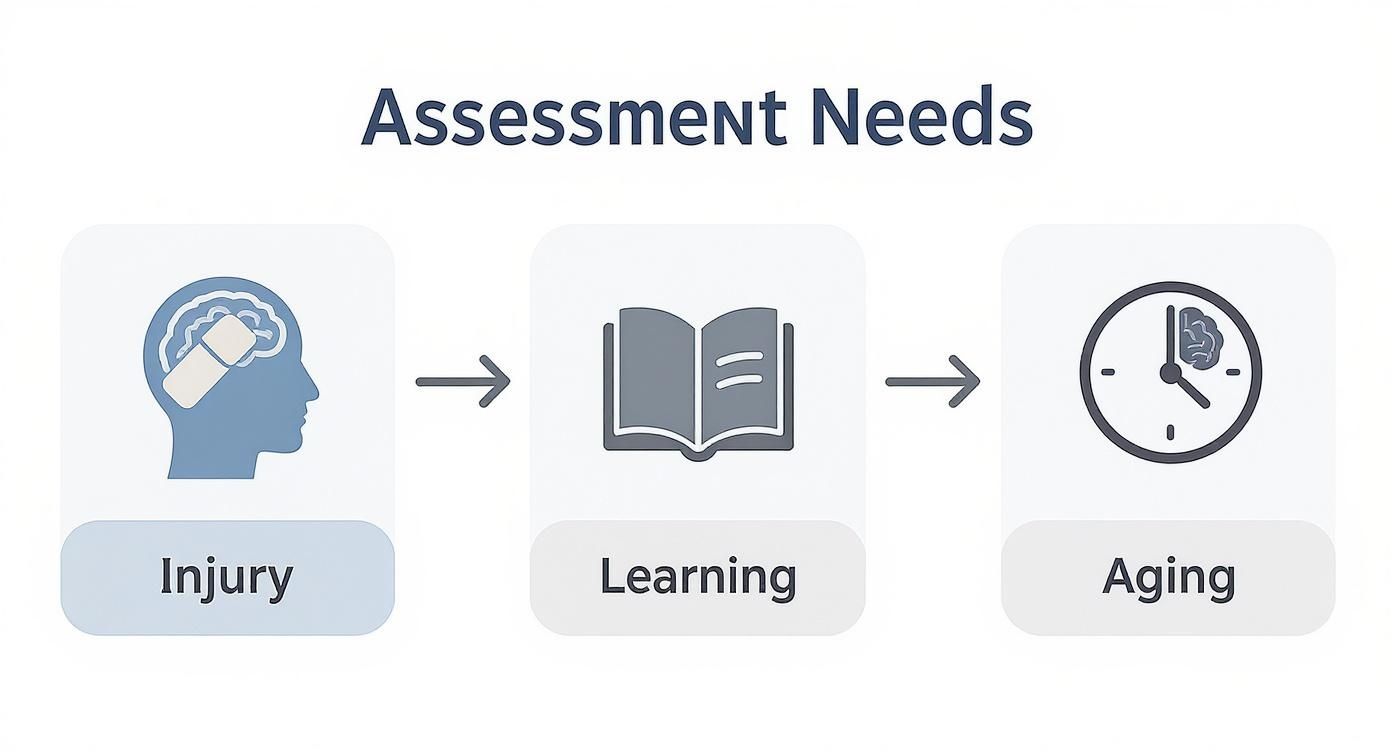
As the visual shows, the path to an assessment can start from many different places, but the destination is always the same: gaining clarity on how you think and process the world.
The Initial Clinical Interview
Your journey starts with a simple conversation. The first step is a clinical interview, where the neuropsychologist sits down with you—and sometimes your family—to just talk. This isn't small talk, though. It’s a vital information-gathering session that sets the stage for everything that follows.
You’ll be asked about your medical history, your school and work life, and, most importantly, the specific concerns that brought you in. The specialist wants to hear what you’re experiencing in your own words.
The clinical interview is the foundation of the entire assessment. It helps the neuropsychologist form hypotheses about what to look for and select the most appropriate tests for your unique situation.
For example, if you mention that you’re struggling to remember conversations, the neuropsychologist will know to include specific tests for verbal memory. If you describe difficulty multitasking at work, they’ll choose tasks that measure executive functions like planning and organisation. This chat ensures the rest of the process is focused entirely on you.
The Standardized Testing Phase
This is the core of the assessment, where you'll work through a series of standardized tests. These are carefully researched activities with very specific rules for how they’re given and scored. That consistency is key, as it allows the specialist to objectively compare your performance to a large group of people of a similar age and educational background.
What does it feel like? A mix of puzzles, questions, and hands-on tasks. You definitely won’t be doing the same thing for hours on end; the activities are kept varied to hold your attention and measure different cognitive skills.
Here are a few practical examples of what you might actually do:
To test memory: You might listen to a short story and then be asked to recall as many details as possible, both right away and again after a short break.
To assess executive functions: You could be given a task where you have to plan a schedule or solve a complex problem using a set of rules, much like the Tower of London test.
To measure attention: A common task involves listening to a long string of letters and tapping the table every time you hear a specific one. The well-known Montreal Cognitive Assessment uses similar attention-based tasks. You can get a feel for this type of test by reviewing the Montreal Cognitive Assessment instructions.
The neuropsychologist will be with you the entire time, giving clear instructions and making sure you feel comfortable. Breaks are not only allowed but encouraged! The goal is to prevent fatigue from affecting your performance.
It's a true partnership, all aimed at uncovering your unique cognitive profile. By the end, the specialist will have gathered a wealth of information to create a comprehensive report that guides what comes next. To take that first step toward clarity, visit our website to schedule a consultation or email us with your questions.
How to Understand Your Assessment Results
After your neuropsychological assessment is complete, you'll get a detailed report. Let’s be honest—at first glance, it can look pretty intimidating. It’s often packed with scores, clinical terms, and complex graphs that feel more like a scientific paper than a helpful guide to your own brain. But this document is the key to unlocking a much clearer picture of your cognitive health.
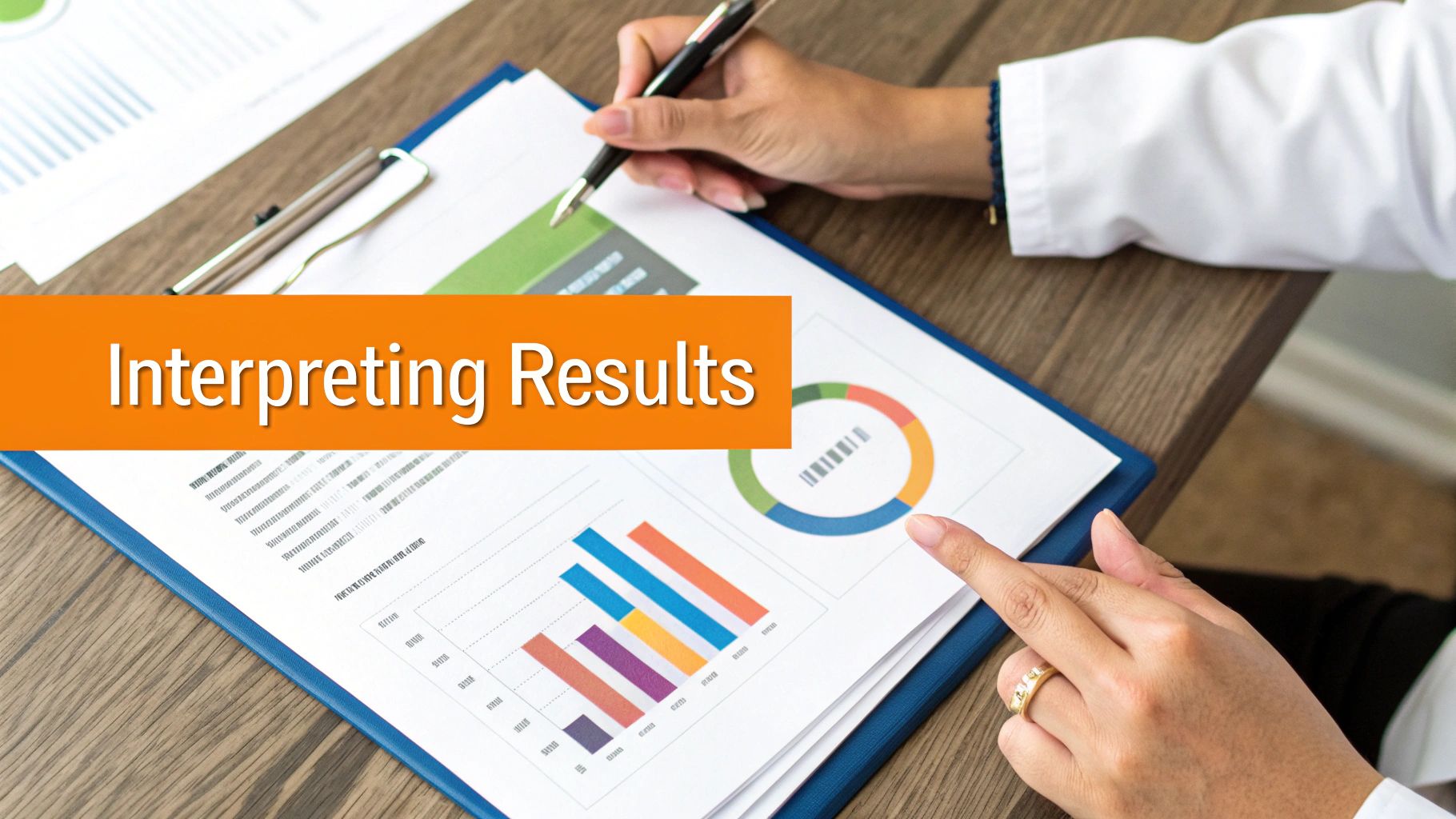
The goal here is to get past the jargon and turn all that data into a real, actionable plan. These numbers and descriptions aren't just labels; they're clues. They help us map out your unique cognitive profile, highlighting your personal strengths just as much as your challenges.
So, let's break down what these results really mean for you.
What Is Normative Data?
One of the first things to understand is the concept of normative data. Think of it like this: when a doctor measures your height, they compare it to the average height for people of your same age and gender. It gives them context. Neuropsychological tests work the same way.
Your scores aren't just floating in a vacuum. They are compared against the performance of a large, standardised group of people from a similar background (factoring in age, education, and other details). This comparison group, or "normative sample," is what allows a neuropsychologist to tell if a score is 'average' or 'below average' for someone like you. A score that’s perfectly normal for a 70-year-old might signal a concern for a 25-year-old.
It’s a crucial step that helps determine whether a specific cognitive skill is developing as expected, is a personal strength, or is an area that could use some support.
However, the quality of these norms is everything. Applying norms from one population to another can lead to serious misinterpretations. For example, some research has shown that using norms developed for non-Hispanic, English-speaking groups on Spanish-speaking Caribbean adults can incorrectly flag 27–31% of healthy individuals as being impaired. This is exactly why using culturally and linguistically appropriate data is non-negotiable for getting accurate results.
Turning Scores into Actionable Insights
The real power of an assessment comes from turning those scores into practical, real-world strategies. The report isn’t just a diagnostic tool; it's a personalized instruction manual for your brain. Every finding is directly tied to recommendations that can make a tangible difference in your day-to-day life.
Here are a few practical examples of how that works:
Finding: A low score points to a weakness in verbal memory (you have a tough time recalling things you've heard).
Actionable Plan: The actionable insight here is to use external aids. We might recommend using a note-taking app during meetings, asking for important instructions in writing, or using a smart assistant to set verbal reminders for appointments.
Finding: The results show challenges with executive functions, like planning and organisation.
Actionable Plan: The strategy could involve using a digital calendar with colour-coded categories, breaking big projects into smaller, checklist-style steps, or setting aside 15 minutes each evening to map out the next day. This turns the abstract problem of "being disorganized" into a concrete daily habit.
Finding: The assessment reveals a slower processing speed.
Actionable Plan: For a student, we might recommend requesting extended time on exams. For an adult, it could mean creating a quieter, distraction-free workspace or learning to focus on one task at a time instead of multitasking. To learn more about how different cognitive skills are measured, check out our guide on what is a cognitive assessment.
The Importance of the Feedback Session
You will never be handed a dense, technical report and be expected to figure it out on your own. A vital part of the process is the feedback session. This is a dedicated meeting where the neuropsychologist sits down with you and walks you through the results, section by section, in plain language you can actually understand.
The feedback session is a collaborative conversation. It’s your opportunity to ask questions, connect the findings to your own experiences, and work with the expert to build a practical and effective support plan.
This session is where the clinical data meets your lived experience. It’s the moment a score on a test becomes a clear explanation for why you’ve been struggling with a specific task at work or feeling overwhelmed at home. It can also be a space to discuss things like masking in autism, which can provide deeper context when neurodevelopmental conditions are part of the picture.
It's completely normal to feel a bit overwhelmed by a report or unsure about what to do next. Our team is here to help you make sense of your results and build a personalized plan that empowers you. Visit our website or email us today to schedule a consultation and turn your assessment into a clear roadmap for your cognitive health.
The Role of Culture in Accurate Assessments
When you’re trying to understand how someone’s brain works, a one-size-fits-all approach is a recipe for failure. The human brain isn’t just a product of biology; it’s shaped by a rich and complex tapestry of cultural, linguistic, and educational experiences. To get a truly accurate picture, any neuropsychological assessment worth its salt has to account for this diversity. Otherwise, we risk completely misinterpreting a person's abilities.
Think of it like this: imagine a puzzle-solving task designed to measure problem-solving skills. Someone educated in a system that values methodical, step-by-step logic will tackle it very differently from someone whose background encourages creative, outside-the-box thinking. Without that cultural context, one approach could be wrongly labelled as "slower" or "less efficient," leading to a completely inaccurate conclusion.
This is exactly why a skilled neuropsychologist acts more like a cultural interpreter than a simple test administrator. They get that how you were taught to learn, the language you think in, and the social norms you grew up with all play a massive role in how you perform on standardized tests.
Beyond the Standardized Score
Most neuropsychological tests were developed and standardized using very specific groups of people—often Western, English-speaking, and with a formal education. When these same tests are given to people from different backgrounds without careful adaptation, the results can be seriously misleading. A person’s performance might say more about their unfamiliarity with the test format than their actual cognitive abilities.
Here are a few practical examples of how this plays out:
Linguistic Differences: A task that relies heavily on verbal fluency in English could put a bilingual person at a disadvantage, even if they’re perfectly proficient. Their brain is wired differently, and that's not a deficit.
Educational Styles: Someone who learned math through rote memorization might ace calculations but struggle with a test that asks them to explain their reasoning. This doesn't mean they can't think logically; it's just not how they were taught to express it.
Cultural Norms: In some cultures, taking time to give a thoughtful, deliberate response is valued far more than a quick, impulsive answer. On a timed test, this could easily be misinterpreted as slow processing speed.
A culturally sensitive assessment doesn't ignore these factors—it brings them into the interpretation.
A neuropsychological assessment is only as accurate as its ability to reflect the individual's true cognitive function, free from cultural or linguistic bias. The goal is to measure the brain's capabilities, not a person's level of acculturation.
This commitment is crucial for building trust and making sure the final report is a fair and precise evaluation of someone's unique cognitive profile.
Adapting Methods for a Fair Evaluation
So, how do clinicians make sure their assessments are fair? It’s a multi-layered approach that goes way beyond just translating a few questions. An experienced neuropsychologist knows how to adapt their methods to fit the individual sitting in front of them.
This often involves a few key steps:
Choosing Appropriate Tests: Whenever possible, they’ll select tests that have been specifically designed and normed for the person’s cultural and linguistic group.
Using an Interpreter: This means working with a trained professional who understands the nuances of both the language and the culture, not just a family member.
Modifying Administration: The clinician might adjust test procedures, like allowing more time on certain tasks or giving more detailed explanations of the instructions.
Integrating Qualitative Data: Test scores are just one piece of the puzzle. The initial clinical interview, personal history, and direct observations are given greater weight to provide crucial context for the numbers.
These adjustments are vital for telling the difference between a true cognitive deficit and a simple cultural or linguistic variation. The details really matter. For instance, research has shown significant differences in test performance even within groups that seem similar. One study found that Spanish-speaking older adults from South America had different cognitive performance patterns than those from Caribbean backgrounds, mostly tied to where they went to school.
Ultimately, understanding the role of culture is at the very heart of the question, what is a neuropsychological assessment? A truly expert evaluation is one that sees the whole person, honouring their background to provide the clearest, most accurate insights into their cognitive health.
If you have concerns about how your cultural or educational background might be understood in an assessment, our team is here to listen. Reach out via our website or email us to discuss a culturally sensitive approach to understanding your cognitive well-being.
Creating Your Action Plan After an Assessment
Think of a neuropsychological assessment not as the final destination, but as the starting point of a targeted journey toward better cognitive health. The detailed report you get back isn't just a collection of scores; it's your personal roadmap. It's designed to translate all those complex findings into a clear, personalized action plan you can use at home, school, or work.
The real power of an assessment comes from what you do with it. It allows us to move past the guesswork and create strategies that zero in on your specific challenges while playing to your strengths.
From Findings to Practical Strategies
Every single recommendation in your report is tied directly to what we discovered during the assessment. This is key because it means the plan is built around your brain's unique needs, giving you real, actionable steps that can make a difference. The whole point is to build a support system that actually works for you in your daily life.
Let's say an assessment brings some attention deficits to light. The action plan won’t just point out the problem. It will lay out concrete ways to manage it.
This might look like:
Time Management Techniques: A practical example is using the Pomodoro Technique (working in 25-minute focused blocks) to help you stay locked in on tasks without feeling overwhelmed.
Mindfulness Exercises: The actionable insight is that even 5 minutes of a guided meditation app each morning can improve your ability to filter out distractions throughout the day.
Workplace or Academic Accommodations: Suggesting things like a quieter spot to work or getting extra time on exams to create an environment where you can truly concentrate.
If the results point to memory issues, the plan will offer targeted support. This could mean a referral to a specialized cognitive rehabilitation program or simple but effective ideas like using digital reminders and structured note-taking systems. For a deeper dive, our guide on how to improve executive function has some fantastic starting points.
An action plan turns diagnostic data into a living, breathing guide for change. It gives you the tools and strategies you need to navigate daily life with more confidence and control.
Building a Long-Term Support Network
A solid action plan is also about building a strong support network around you. It often includes recommendations for connecting with other professionals or community resources that can help you succeed in the long run. This might mean a referral to an occupational therapist to work on practical daily living skills or finding a support group to share experiences with others who get it.
It's also crucial to remember that your cultural context matters. Creating normative data is a challenge in diverse regions, for example, and a person's educational background is a consistent predictor of how they'll perform on tests. Understanding these complexities is vital for creating support that is both accurate and fair.
Your neuropsychological assessment is the key to unlocking a future with more clarity and control. The action plan is your guide to getting there.
Your Questions, Answered
Stepping into the world of brain health and cognitive assessments can feel a bit overwhelming, and it's natural to have questions. Here are some straightforward answers to the practical things people often wonder about.
How Long Does a Neuropsychological Assessment Take?
A thorough evaluation is a deep dive, not a quick scan. You can expect it to take somewhere between four to eight hours in total. But don't let that number intimidate you! This is almost always broken up into two or more appointments to make sure you stay fresh and focused, which is crucial for accurate results.
The exact timing really comes down to the specific questions we're trying to answer. A quick screening for a single, focused concern might be on the shorter end. On the other hand, a comprehensive assessment for a more complex situation will naturally take more time, as it involves an initial interview, a broad range of standardized tests, and, of course, scheduled breaks.
Is a Neuropsychological Assessment Covered by Insurance?
This is a big question, and the answer can be a bit tricky. In Canada, some provincial health plans, like OHIP, may cover evaluations if they happen in a hospital setting. This is often the case when it's for a clear medical reason, like after a stroke or a traumatic brain injury.
Assessments done in a private practice, however, are usually an out-of-pocket expense. The good news? Many extended health benefit plans do provide coverage for services from a registered psychologist.
An Actionable Tip: Before you book anything, give your insurance provider a call. Ask them directly about your coverage limits for psychological services, if you need a referral from your doctor, and what paperwork you'll need to submit for reimbursement. A few minutes on the phone can save you a lot of headaches later.
What Is the Difference Between a Psychological and a Neuropsychological Assessment?
This is a fantastic question, and one that causes a lot of confusion. Even though both are done by psychologists, they're looking for very different things.
A psychological assessment is all about your emotional health, personality, and general mental well-being. The goal here is usually to diagnose conditions like depression, anxiety, or PTSD. Think of it as creating a map of your emotional and inner world.
A neuropsychological assessment, however, is focused on the direct link between your brain's health and how you think, remember, and problem-solve. It uses very specific, standardized tests to get an objective look at skills like memory, attention, and executive function. The goal is to build a detailed blueprint of how your brain is processing information, which can help pinpoint the effects of a brain injury, neurological disease, or a developmental condition.
To put it another way, if you were having memory issues, a psychological assessment might explore how your mood is impacting your memory. A neuropsychological assessment would measure the actual mechanics of how well your brain is encoding, storing, and retrieving information.
At Orange Neurosciences, our mission is to provide advanced tools that deliver clear, objective data about cognitive function. This empowers you and your care team to make the best possible decisions for your brain health. Our evidence-based, game-based platform translates assessment results into a clear cognitive profile and actionable next steps.
See for yourself how our precise approach can bring the clarity you've been looking for. Explore our solutions today.
Orange Neurosciences' Cognitive Skills Assessments (CSA) are intended as an aid for assessing the cognitive well-being of an individual. In a clinical setting, the CSA results (when interpreted by a qualified healthcare provider) may be used as an aid in determining whether further cognitive evaluation is needed. Orange Neurosciences' brain training programs are designed to promote and encourage overall cognitive health. Orange Neurosciences does not offer any medical diagnosis or treatment of any medical disease or condition. Orange Neurosciences products may also be used for research purposes for any range of cognition-related assessments. If used for research purposes, all use of the product must comply with the appropriate human subjects' procedures as they exist within the researcher's institution and will be the researcher's responsibility. All such human subject protections shall be under the provisions of all applicable sections of the Code of Federal Regulations.


© 2026 by Orange Neurosciences Corporation