A Guide to Instrumental Activities of Daily Living ADLs in Senior Care
Mar 26, 2026
When we talk about someone's ability to live on their own, we're really looking at two different sets of skills. Instrumental activities of daily living (IADLs) are those complex, multi-step tasks we all do to manage a household and engage with the world around us—things like handling finances, cooking meals, or going shopping.
They're a step above the more fundamental activities of daily living (ADLs), which cover basic self-care like bathing and dressing. Because IADLs demand higher-level thinking, any new difficulty with them can be an early signal that a person might need more support to stay independent.
Defining IADLs: Beyond Basic Self-Care
Think of daily life as a two-story house. The ground floor holds the absolute essentials for survival. These are your basic Activities of Daily Living (ADLs). They're the non-negotiable, fundamental tasks: getting dressed, feeding yourself, maintaining personal hygiene, and simply moving from a bed to a chair. Without this foundation, the house isn't truly liveable.
But a home is more than its foundation. The second story is where the "living" happens—it’s what makes the house functional and connects it to the community. These are the Instrumental Activities of Daily Living (IADLs).
IADLs are the "life management" skills that go far beyond just looking after your own body. They’re what allow a person to run their household and interact successfully with the wider world.
The Critical Difference
So, what really sets these two categories apart? It all comes down to complexity. ADLs are purely about self-care, while IADLs are about independent living within a community.
For example, being able to feed yourself is a basic ADL. But planning a weekly menu, making a grocery list, navigating a store, and then preparing a meal? That's a whole chain of IADLs requiring sophisticated cognitive skills like planning, organization, and problem-solving. This is an actionable insight: if you notice a loved one struggling to remember all the steps for making their favorite pasta sauce, it's a sign to pay closer attention to their IADL skills.
This hierarchy shows that IADLs demand more from our brains, sitting a level above basic ADLs in functional complexity.
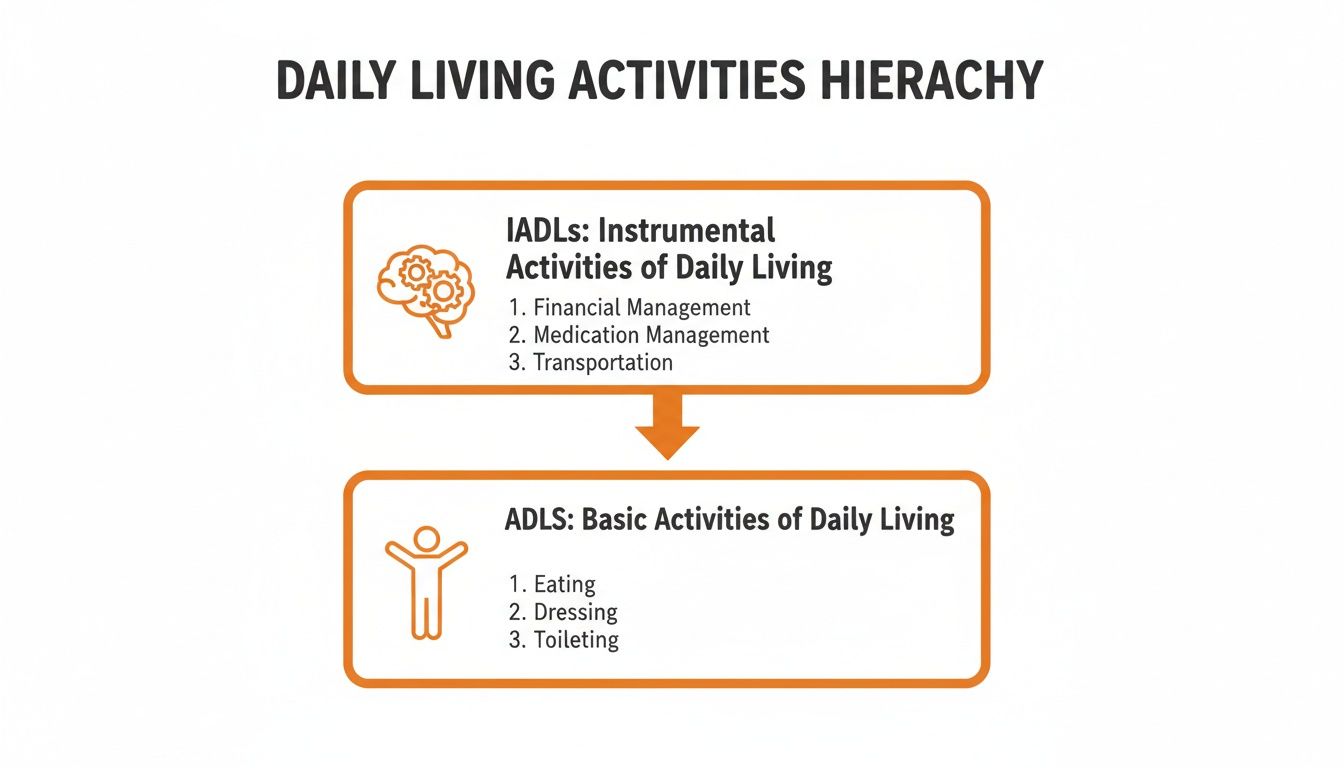
As you can see, IADLs build on the bedrock of ADLs but tap into more advanced brain functions.
This distinction is crucial for families and clinicians. Often, struggles with IADLs are the very first sign of declining independence, appearing long before basic self-care becomes an obvious problem. For a more detailed breakdown, have a look at our complete guide on the distinction between ADLs and IADLs.
To make the contrast even clearer, this table lays out the fundamental differences.
Comparing Basic ADLs and Instrumental ADLs (IADLs)
Category | Basic ADLs (Fundamental Self-Care) | Instrumental ADLs (Independent Community Living) |
|---|---|---|
Core Purpose | Tasks for personal survival and basic physical well-being. | Tasks needed to manage a household and live independently in a community. |
Complexity | Simple, routine, and focused on the self. | Complex, multi-step, and require interaction with the environment. |
Cognitive Skills | Basic motor skills and procedural memory. | Executive functions like planning, organising, problem-solving, and decision-making. |
Common Examples | Bathing, dressing, eating, toileting, transferring (e.g., bed to chair). | Managing finances, cooking, shopping, transportation, using the phone, managing medications. |
When Challenges Appear | Typically decline in later stages of cognitive or physical impairment. | Often the first area where decline is noticed, serving as an early warning sign. |
This table highlights how IADLs represent a significant step up in functional demand, requiring us to not just care for our bodies but to navigate the complexities of modern life.
Why IADLs Are an Early Warning System
Subtle new difficulties with IADLs are more than just minor inconveniences; they're a vital early warning system for families and caregivers. These challenges often point to underlying shifts in cognitive health that need attention sooner rather than later.
An older adult's ability to accomplish IADLs often declines before their ability to perform ADLs diminishes. This makes tracking IADL performance a practical way to anticipate future care needs.
Recognising these early signs opens the door for proactive steps to support a loved one's autonomy and safety. It's helpful to frame this by understanding the distinction between personal care and home help, as IADL support often falls into the latter category.
This is especially relevant today. For instance, in some regions, the population aged 65 and older is set to grow dramatically over the coming decades. While a significant portion of all adults may have a disability, this rate can jump to over 36% among those 65 and over, with IADL-related challenges being a primary driver.
By paying attention to IADLs, we can move from a reactive to a proactive approach in care. In the sections that follow, we'll explore the specific IADLs in detail and discuss how to identify when support is truly needed.
Now that we’ve drawn the line between basic ADLs and IADLs, let's look at what these instrumental activities actually are in the real world. Occupational therapists and geriatric clinicians have a list of eight core IADLs they use to get a practical sense of how well a person can live on their own.
Each of these tasks needs a mix of physical skill and, more importantly, some pretty complex thinking—things like planning, organizing, and solving problems as they come up. When someone starts to struggle with any of these, it’s often an early sign that they might need more support.

Let’s dig into each one to see what skills are really at play.
1. Financial Management
This isn't just about having money; it’s one of the first areas where you might notice something is off. Managing finances involves a whole sequence of complex cognitive steps.
Practical Example: A person needs to open the mail, spot a bill from the utility company, understand that $75.50 is owed by the 15th, and then either write a cheque for the correct amount or log into their online banking portal to schedule a payment. It’s a chain of events that relies heavily on attention, memory, and executive function.
Actionable Insight: Look for piles of unopened mail, late payment notices, or confusion about account balances. An uncharacteristic vulnerability to scams is another major red flag. If you notice these signs, one practical step is to suggest setting up automatic bill payments for recurring expenses like utilities or insurance.
2. Transportation
Getting from point A to point B is absolutely fundamental for staying connected, making appointments, and just living life. This can mean driving a car or figuring out public transit.
Practical Example: Taking the bus requires planning a route using a map or app, reading schedules to know the 2:15 PM bus is the right one, having the correct fare ready, and navigating unfamiliar stops. Driving demands processing traffic signals, judging the speed of other cars, and making split-second decisions to stay safe.
Actionable Insight: If a loved one starts getting lost on familiar routes, has a few minor fender-benders, or just stops driving altogether without a clear reason, it's time to talk. Suggest ride-sharing services or community senior transit as alternatives to maintain their independence safely.
3. Shopping
A successful shopping trip is a major cognitive workout. It’s so much more than just grabbing items off a shelf; it’s about planning from start to finish.
Practical Example: It starts with checking the fridge and pantry to see what's needed. Then, a person has to make a coherent list (e.g., milk, bread, chicken, apples), get to the store, find everything, choose the right products, and handle the payment process.
Actionable Insight: Check the kitchen. Is the pantry often bare? Or, is it the opposite, with five bottles of the same ketchup? Both can point to memory and planning challenges. A helpful action is to create a pre-printed checklist of common grocery items they can simply tick off each week.
4. Meal Preparation
Just like shopping, preparing a meal goes far beyond the physical act of cooking. It’s a powerful window into a person’s ability to manage their own nutritional needs.
A person's capacity to plan and cook a meal is a strong reflection of their executive functioning. It requires sequencing steps, managing time, and ensuring safety in the kitchen.
Think about it: you have to decide on a meal, get the right ingredients, follow the steps in the right order (e.g., chop vegetables before starting to sauté), and handle hot appliances safely. If this ability declines, it can quickly lead to poor nutrition or dangerous situations in the kitchen. A formal evaluation can really help pinpoint the issue. For a deeper dive, you might find our guide on assessment for occupational therapy helpful, as it often covers these exact skills.
The Remaining Core IADLs
Beyond those four big cognitive-heavy tasks, another four IADLs are just as essential for keeping a home safe and functional.
Medication Management: This is much more than just swallowing a pill. It involves understanding doses, sticking to a schedule, remembering to get refills, and even noticing side effects. Practical Example: Remembering to take a blood pressure pill every morning at 8 AM and a different pill with dinner, and knowing to call the pharmacy for a refill a week before the bottle runs out.
Housekeeping and Home Maintenance: This is all about keeping a living space reasonably clean and safe. It includes tasks like light cleaning, taking out the garbage, and knowing when to call for a repair. Practical Example: Noticing a leaky faucet and knowing to call a plumber, or regularly taking the trash and recycling bins to the curb on the correct day.
Communication Management: This means being able to use a phone or computer to stay in touch. It’s how someone schedules appointments, calls for help in an emergency, and avoids social isolation. Practical Example: Looking up a doctor's number, making an appointment, and adding it to a calendar.
Laundry: This simple chore actually requires sorting clothes, operating machines, and measuring detergent—all of which involve both physical ability and following a clear sequence of steps. Practical Example: Separating whites from colors, choosing the correct wash cycle (e.g., 'delicate'), and adding the right amount of detergent.
By understanding these eight instrumental activities of daily living, families and caregivers can become much better at spotting the early signs of a struggle. This allows you to step in with timely and truly effective support.
How Clinicians Perform an IADL Assessment
When a family sees a loved one struggling with things like paying bills or keeping up with groceries, those observations are a critical first step. But for a clinician, turning those heartfelt concerns into a real, effective care plan requires something more concrete. We need objective, measurable data.
This is where a formal assessment of instrumental activities of daily living (IADLs) comes into play. Think of it less like a test and more like a structured conversation. These tools help us translate those initial worries into a clear picture of what's happening, pinpointing specific struggles and giving us a solid baseline to track any changes over time.

The Lawton-Brody IADL Scale in Practice
One of the most trusted tools in our toolkit is the Lawton-Brody IADL Scale. It’s a straightforward but powerful questionnaire that looks at eight key areas of living independently. It’s not about passing or failing; it's about painting a realistic portrait of a person's functional abilities.
Typically, a clinician—often an occupational therapist or geriatrician—will sit down with the individual or a close family member who knows their daily routine well. They’ll go through the list, asking questions to understand how much help, if any, is needed for each IADL.
The goal of an IADL assessment is to understand a person's functional level in their everyday environment. It helps answer the critical question: "What support does this person need to live as safely and independently as possible?"
Let's break down what this looks like with a real-world example.
Translating Scores into a Clear Picture
The Lawton-Brody scale uses a simple scoring method, but the insights it generates are incredibly deep. For each of the eight IADLs, a score is given based on how independently the person performs the task.
Ability to Use the Telephone:
1 point: Can look up and dial numbers on their own initiative.
0 points: Only dials a few familiar numbers, or doesn’t use the phone at all.
Shopping:
1 point: Handles all shopping needs without assistance.
0 points: Must have someone go with them on any shopping trip, or is completely unable to shop.
Meal Preparation:
1 point: Independently plans, prepares, and serves proper meals.
0 points: Needs someone else to prepare and serve their meals.
The final score, from 0 (completely dependent) to 8 (fully independent), gives everyone a quick, understandable snapshot. A score of 4, for example, is an actionable insight. It might tell us that someone can handle their personal grooming but needs quite a bit of help with more complex tasks like managing their finances or getting around town.
This number is more than just a score. It’s a powerful piece of evidence we can use to make a case for home care services to an insurance provider, to guide sensitive family conversations about living arrangements, or to objectively monitor the progression of a condition like dementia. This is why many provinces and states have adopted similar tools. For instance, how California measures these activities uses standardized scales to evaluate skills essential for living in the community, especially since IADL decline often shows up before issues with basic self-care.
Of course, an IADL assessment is just one piece of the puzzle. To see the full picture, clinicians often place it within a much broader evaluation. You can learn more about this process in our guide to the Comprehensive Geriatric Assessment in Canada. By weaving IADL scores together with other clinical data, we can build a truly holistic and effective care plan.
Connecting IADL Struggles to Cognitive Health
When a loved one suddenly has trouble with an everyday task, it’s rarely just about the task itself. A growing pile of unopened mail isn't simply about being forgetful, and getting lost on a familiar drive to the grocery store is more than a one-off mistake.
These moments are often the first visible signs of a deeper issue. They build a bridge between the behaviour we can see and the underlying health of the brain. This is where we need to shift our thinking from what is happening—difficulty with an IADL—to figuring out why.
From Behaviour to Brain Function
Think of the brain as the project manager for our daily lives. The IADLs are the big projects it oversees: managing a household budget, navigating a trip across town, or putting together a healthy meal. Each of these projects relies on a specific set of cognitive tools and skills.
If the project manager’s planning abilities (executive function) start to weaken, the budget project can quickly fall into disarray. If their knack for reading blueprints (visuospatial skills) falters, that trip across town becomes confusing and stressful.
An IADL assessment tells us if a person can still manage their finances. A cognitive assessment tells us why they can't—perhaps because of a decline in memory, attention, or problem-solving. Making that distinction is absolutely crucial for finding the right kind of help.
By linking an observable IADL struggle to a specific cognitive domain, we can go beyond just helping with the task. We can start to address the root of the problem.
Unpacking the Cognitive Links
Let’s break down how specific IADL challenges can point to distinct cognitive issues. This is often the starting point for clinicians trying to form a hypothesis about what’s happening inside the brain.
Financial Management Difficulties: If someone starts making uncharacteristically impulsive purchases or becomes vulnerable to scams, it often flags an issue with executive function. This is the cognitive skill set that governs our judgment, planning, and impulse control.
Transportation Troubles: Getting lost frequently in familiar neighbourhoods or struggling to follow a map can point to a decline in visuospatial processing. This is the brain's ability to make sense of the visual world around us.
Meal Preparation Issues: Forgetting key ingredients, being unable to follow the steps in a recipe, or leaving the stove on are often tied to poor memory and sequencing abilities—both essential for completing multi-step tasks.
Medication Management Errors: Missing doses or taking medication at the wrong time is a direct signal of problems with prospective memory (remembering to do something in the future) and attention.
This process of connecting behaviour to brain function is essential. While traditional scales like the Lawton-Brody can confirm a functional problem exists, they don't explain the why. For that, we need to look more directly at cognitive health.
Pinpointing the Root Cause with Modern Assessments
This is where modern cognitive assessments make all the difference. They act like a diagnostic tool for the brain's "project manager," identifying exactly which skills are becoming weaker. Instead of just noting that the “budget project” is failing, these tools can specify that the issue lies in poor calculation, a faltering short-term memory for numbers, or weakened planning abilities.
This level of precision is a game-changer for care. Once we know the specific cognitive deficit behind an IADL struggle, we can develop highly targeted interventions. This could mean specific cognitive exercises, adaptive strategies for daily life, or environmental changes designed to compensate for that exact weakness.
For anyone interested in how these evaluations work, our guide on cognitive screening tests for dementia offers a deeper dive into the tools used to assess brain health.
By understanding the cognitive roots of IADL difficulties, we can shift care from being reactive to proactive. It empowers families and clinicians to not only manage the symptoms but to actively support the underlying cognitive foundations of a person's independence.
Actionable Strategies to Support Independence
Watching someone you care about begin to struggle with everyday tasks like managing their finances or preparing meals can be tough. It’s easy to feel overwhelmed, but noticing these changes is the most crucial first step you can take. The real goal isn't to take over, but to find clever ways to support them.
The best approach is to provide just enough help to bridge the gaps left by physical or cognitive challenges. This way, you can enhance their safety and well-being without stripping away their sense of control and dignity.
Practical Support for Key IADLs
Every complex task, from managing pills to paying bills, comes with its own set of hurdles. But with a little creativity, you can often find simple tools or new routines that make a world of difference. The trick is to break down these big jobs into smaller, more manageable steps.
Here are a few proven strategies for common trouble spots:
Medication Management: This is one area where mistakes can have serious consequences, so it’s a great place to start.
Practical Solution: A simple, pre-sorted pill organiser—the kind with compartments for each day and time—is a game-changer. Pair it with daily alarms on a smartphone or a dedicated digital reminder clock. For more complicated medication schedules, an automated pill dispenser is an excellent investment.
Financial Management: Protecting a loved one from scams or simple financial errors is paramount.
Practical Solution: If they're comfortable with technology, budgeting apps with spending alerts can provide a helpful safety net. A lower-tech option is to set up a joint-access bank account with a trusted family member. This allows for easy oversight on bill payments and adds a crucial layer of support.
Meal Preparation & Shopping: Good nutrition is the cornerstone of good health, but planning and cooking can become exhausting.
Practical Solution: Consider a meal delivery service that sends pre-portioned ingredients with simple recipe cards. This takes the mental load out of planning and shopping. Another great option is for family members to help draft a weekly meal plan and a matching grocery list, which makes shopping trips much more focused.
Adapting the Environment for Safety and Success
Beyond specific aids for specific tasks, changing the home environment itself can be one of the most powerful ways to boost independence. Small adjustments can prevent falls, reduce physical strain, and make daily life feel much less intimidating. This is what "aging in place" is all about.
A supportive environment is one that compensates for functional limitations without being restrictive. The right modifications can transform a challenging space into one that promotes confidence and self-sufficiency.
Implementing these kinds of thoughtful adjustments is key. For a closer look at what this can involve, you might want to explore a guide on aging in place home modifications. These changes, big and small, work hand-in-hand with other tools to build a truly supportive system.
Strengthening the Cognitive Foundation
While pill boxes and modified homes are fantastic tools for managing daily life, they help compensate for challenges. To get to the root of many IADL struggles, we also need to support the cognitive skills that power these activities in the first place—things like memory, attention, and executive function. Think of them as the brain's "muscles."
This is where targeted cognitive training becomes such a vital piece of the puzzle. It’s not just about compensation; it’s about proactively strengthening the brain's core abilities.
Platforms from Orange Neurosciences are designed to do exactly that. Our engaging, game-based exercises provide a structured "workout" for the brain, targeting the specific skills needed to manage medications, plan a shopping trip, or follow a recipe. Bolstering these cognitive foundations is a proactive way to help individuals maintain their instrumental activities of daily living adls for as long as possible.
To learn more about how stimulating activities can support brain health, check out our guide on brain games for seniors. By combining practical daily aids with proactive cognitive support, you create a robust strategy that promotes both safety and independence.
The Future of IADL Assessment Is Digital
Let's be honest, the days of relying solely on paper questionnaires and subjective notes to assess instrumental activities of daily living are numbered. While traditional tools like the Lawton-Brody scale have given us a valuable starting point, they have their limits. They can be slow, miss the finer details, and hinge on self-reporting, which isn't always the full picture.
A new wave of digital health technology is changing the game. These tools aren't just putting old forms online; they're completely rethinking how we measure the cognitive skills that make instrumental activities of daily living (IADLs) possible.
Moving from "What" to "Why"
Think about trying to understand why a person is struggling with managing their finances. A traditional scale might just confirm that, yes, they need help paying their bills. But a digital cognitive assessment can dig much, much deeper to reveal the "why" behind the struggle.
This is where a platform like OrangeCheck comes in. In under 30 minutes, it can provide an objective, in-depth cognitive profile. It doesn't just ask if someone can manage money; it precisely measures the underlying abilities they need to do it successfully:
Working Memory: Can they actually hold account numbers and balances in their head while they sort through bills?
Attention: Are they able to focus on the task at hand without getting sidetracked?
Executive Function: Can they plan out the necessary steps to make sure a payment is made on time?
This shift—from a subjective "yes or no" answer to objective, data-backed insights—is what this digital evolution is all about.
The future of IADL evaluation is all about precision. When we can measure the specific cognitive pieces that make up daily tasks, we move from simply spotting a problem to truly understanding its roots. That’s how we build interventions that actually work.
The Power of Clear, Objective Data
The data from these digital tools gives clinicians something they've rarely had before: immediate, actionable insights. Instead of waiting for the next appointment to see if anything has changed, they can track cognitive performance over time with a level of accuracy that was once impossible. This makes care planning faster and far more informed.
This is a huge step forward. A clinician can now see if a particular therapy is making a difference, tweak care plans based on real-time data, and give families a clear, understandable map of a loved one's cognitive strengths and weaknesses. The focus moves away from generic support and toward personalized care that's backed by real evidence.
Ultimately, it comes down to giving professionals better tools to build better interventions. By precisely measuring the cognitive skills that support instrumental activities of daily living (IADLs), we can help people hold onto their independence and enjoy a better quality of life for longer.
Discover how Orange Neurosciences is setting this new standard in cognitive assessment. Visit our website to see how we're empowering clinicians to deliver faster, more precise care.
Frequently Asked Questions About IADLs

When families and caregivers start to navigate the world of instrumental activities of daily living (IADLs), it’s natural for practical questions to pop up. We hear them all the time. Here are some straightforward answers to the most common ones.
At What Age Do IADL Difficulties Typically Begin?
There’s no magic number here. A person’s ability to manage IADLs is tied much more closely to their overall health and cognitive state than it is to their age on a calendar.
That said, challenges often start to become more noticeable in adults over the age of 65. This is especially true if underlying health conditions, like mild cognitive impairment, are part of the picture.
Can IADL Function Be Improved?
Yes, in many cases, it absolutely can. Improvement usually comes from a combination of smart strategies.
This might look like occupational therapy to learn new ways of tackling old tasks, making simple changes to the home environment like using pill organizers, or engaging in targeted cognitive training to help strengthen the brain functions needed for these activities.
Who Can Perform an IADL Assessment?
On an informal level, family members can get a sense of things just by paying attention to daily routines. Are the bills getting paid? Is there fresh food in the fridge?
For a formal assessment, however, you need a healthcare professional. A geriatrician, occupational therapist, or physician can conduct a proper evaluation to get an accurate picture and build a care plan that will actually work.
Ready to move beyond subjective observation? Orange Neurosciences gives clinicians the objective data they need to precisely measure cognitive function and build better, more effective care plans.

Orange Neurosciences' Cognitive Skills Assessments (CSA) are intended as an aid for assessing the cognitive well-being of an individual. In a clinical setting, the CSA results (when interpreted by a qualified healthcare provider) may be used as an aid in determining whether further cognitive evaluation is needed. Orange Neurosciences' brain training programs are designed to promote and encourage overall cognitive health. Orange Neurosciences does not offer any medical diagnosis or treatment of any medical disease or condition. Orange Neurosciences products may also be used for research purposes for any range of cognition-related assessments. If used for research purposes, all use of the product must comply with the appropriate human subjects' procedures as they exist within the researcher's institution and will be the researcher's responsibility. All such human subject protections shall be under the provisions of all applicable sections of the Code of Federal Regulations.


© 2026 by Orange Neurosciences Corporation