Fundamental Movements Skills: Your Guide to a Healthy, Active Life
Apr 4, 2026
Imagine trying to write a story without knowing your ABCs. It's a frustrating, almost impossible task. That’s exactly what it's like for a child trying to be physically active without first mastering fundamental movement skills.
These core abilities—things like running, balancing, and catching—are the absolute building blocks for a healthy, active life. They are the foundation for everything, from fun on the playground to the thrill of competitive sports.
The Building Blocks of Lifelong Health
Fundamental movement skills (FMS) are the basic movement patterns that we use every day, involving different parts of the body. Think of them as the alphabet of physical literacy. Once a child learns these individual "letters," they can start stringing them together to form "words" and "sentences"—more complex actions like playing soccer, dancing, or swimming.
But developing these skills early on isn't just about being "good at sports." When a child becomes proficient at running, jumping, and throwing, something powerful happens: they gain confidence. This confidence is what motivates them to try new things and stay active as they grow up.
A kid who feels capable and sure-footed on the playground is far more likely to become an adult who enjoys a weekend hike, joins a gym, or plays in a community sports league.
The Connection to Overall Wellbeing
The ripple effects of strong fundamental movement skills go far beyond just physical health. The journey of learning and refining these movements is deeply intertwined with a child's total development. As they practice, they aren't just training their muscles; they're also building crucial pathways in their brain.
You can learn more about this powerful mind-body connection in our guide on what is cognitive function and its link to physical activity.
Teaching proper form is also a non-negotiable part of the process. It’s one thing to run or jump, but it’s another to do it safely and efficiently to build a resilient body for life. For instance, good footwork and landing techniques aren't just for performance in sports like basketball; they're critical for preventing injuries, today and decades from now.
Mastering fundamental movements is not about creating elite athletes; it's about empowering every child with the physical vocabulary needed to lead a healthy, active, and engaged life.
This guide will break down exactly what these skills are and why we're seeing a decline in proficiency. More importantly, we'll give parents, educators, and clinicians practical, actionable ways to support their development. We'll look at age-specific activities and see how modern tools can give us objective insights to help every child build a healthier future, one movement at a time.
The Three Pillars of Fundamental Movement
When we talk about fundamental movement skills (FMS), it’s helpful to think of them as the three primary colours of physical ability. Just like red, yellow, and blue can be mixed to create any colour imaginable, these three skill sets blend together to form the vibrant picture of an active, healthy life.
Each pillar supports a different kind of movement, but a child needs a solid foundation in all three to become truly confident and capable in their physical world.
The diagram below lays out these three pillars—Locomotor, Stability, and Object Control—showing how they come together to build overall movement competence.
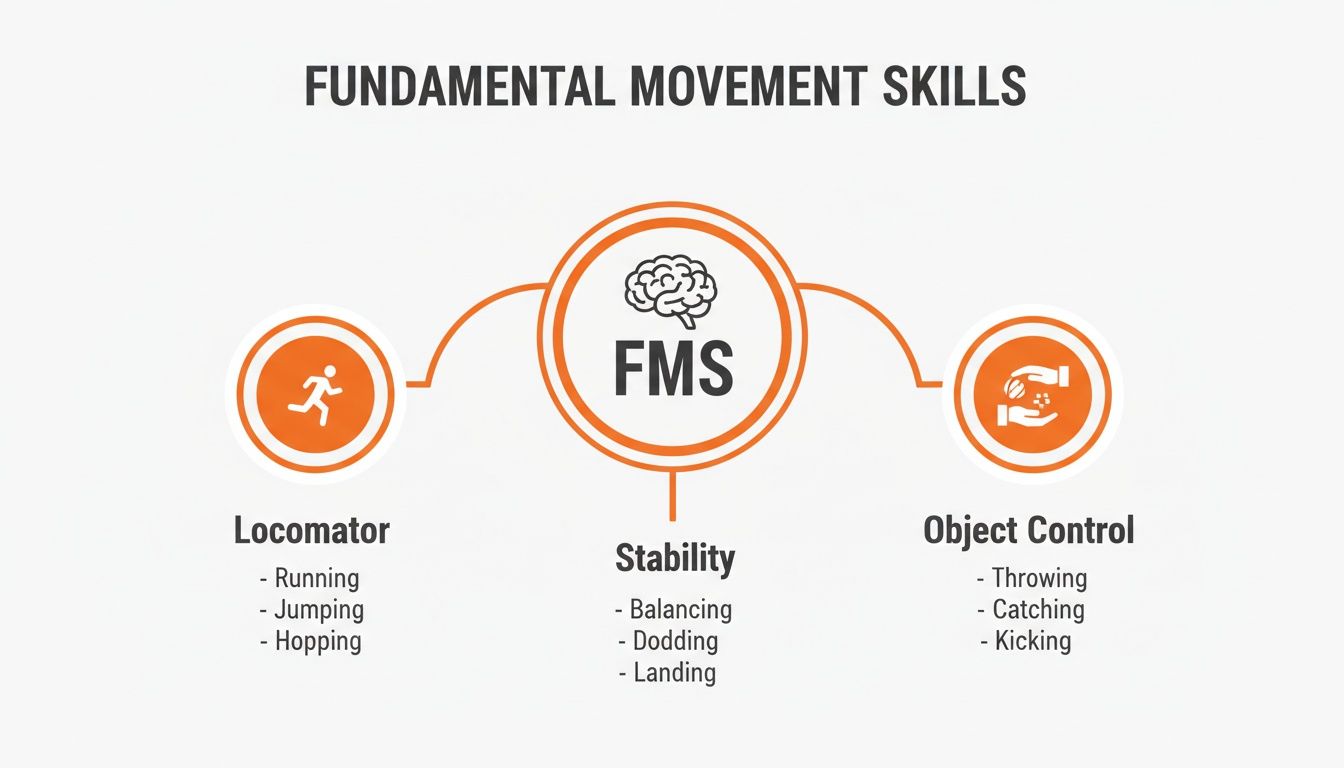
As you can see, each category is a distinct branch growing from a central trunk. For a child to thrive physically, they need to develop abilities in every single one. Let's break down what each of these pillars actually looks like in practice.
The Three Types of Fundamental Movement Skills
This table gives a quick overview of the three core FMS categories, with simple definitions and everyday examples to help you spot them in the wild.
Skill Category | Description | Practical Examples |
|---|---|---|
Locomotor | These are the skills that move the body from one place to another. They are all about transportation. | Running across a park, skipping to the car, jumping over a puddle, galloping like a horse. |
Stability | Often called balance skills, these involve controlling the body and maintaining equilibrium, whether you're stationary or in motion. | Standing on one leg to put on a sock, twisting to grab a toy, bending to pick up a crayon. |
Object Control | These skills involve controlling an object with your hands or feet. This is where hand-eye and foot-eye coordination come into play. | Throwing and catching a ball, kicking a soccer ball, striking a balloon with your hand. |
By understanding these categories, we can better support a child's development, ensuring no single area gets left behind.
Pillar 1: Locomotor Skills
Think of locomotor skills as your body’s transportation system. Quite simply, they are the movements that get you from point A to point B. Every time a child dashes across the playground, hops on one foot, or jumps in a puddle, they’re putting locomotor skills to work.
These are often the most obvious and recognizable movements a child makes. They include essential abilities like:
Running: Moving forward quickly, with moments where both feet are off the ground.
Jumping: Launching off from one or both feet and landing on both feet.
Hopping: Taking off and landing on the same foot.
Skipping: A slightly more complex pattern of a step and a hop, alternating feet.
Mastering these skills gives children the freedom and confidence to explore their world and join in on active games.
Pillar 2: Stability Skills
If locomotor skills are about moving, stability skills are all about not moving—or at least, controlling the body’s position with purpose. Think of stability as the body’s anchor. It's the quiet, constant work happening in the background that prevents tumbles and allows for smooth, controlled actions.
Stability is the unsung hero of movement. It's the core control that lets a dancer spin without falling or a child balance on a curb without a wobble.
These skills are all about maintaining balance, whether the body is still or in motion. Common examples include:
Balancing on one foot.
Twisting the torso to see what’s behind you.
Bending at the waist to tie a shoe.
Swaying side-to-side without losing your centre of gravity.
Without a strong foundation in stability, even simple movements like walking or running can look clumsy and inefficient. It's the root system that keeps the tree from toppling over in the wind.
Pillar 3: Object Control Skills
The third and final pillar, object control, is all about how we interact with the world around us. These skills require the body to manipulate an external object, whether it’s a ball, a bat, or a beanbag. This is where hand-eye and foot-eye coordination really get a chance to shine.
Object control skills are absolutely critical for playing most sports and many playground games. Key examples are:
Throwing: Using the arm to propel an object away from the body.
Catching: Using the hands to receive and control a moving object.
Kicking: Striking an object with the foot.
Dribbling: Bouncing a ball repeatedly with the hands or feet.
Developing these skills opens up a world of social play, from a simple game of catch to participating in team sports, which are so important for both physical and social growth. For more ideas on how to build this specific ability, check out our guide on hand-eye coordination exercises.
The need to develop all three pillars isn't just theory; it's backed by solid research. A major systematic review of 49 different studies found a direct and positive link between FMS proficiency and better health outcomes in kids. In fact, 100% of the studies analyzed showed that strong fundamental movement skills were connected to improved heart and lung function as well as better muscular strength. To build a physically literate child who is set up for a lifetime of healthy activity, all three pillars must be built together, brick by brick.
The Modern Decline in Movement Proficiency
Something is happening on our playgrounds and in our living rooms, and it’s a change that many parents and educators are noticing firsthand. Today’s children seem to be struggling with the basic movements that past generations took for granted. This isn't just about being less athletic; it's a growing public health issue that can have a serious impact on a child's entire life, affecting both their physical and mental well-being.
So, what’s behind this shift? It’s a mix of things we see every day. The powerful draw of screens, fewer chances for kids to just run around and play outside, and schedules that are more packed and sedentary than ever before. Technology has reshaped childhood, and while it brings many good things, it has often pushed active, hands-on exploration to the side in favour of passive entertainment.
The Data Tells a Sobering Story
This isn’t just a feeling or an observation—the research is telling us the same thing. Studies from around the world are showing an alarming trend: kids are simply not developing movement skills the way they used to. When you compare children aged 6–10 today to data from the late 1990s, many now fall into the 'below average' category for fundamental movement skills (FMS).
One recent study painted a particularly stark picture of a typical school day. Researchers found that children were only getting about 32.19 minutes of moderate-to-vigorous physical activity. That same study showed below-average scores in both locomotor skills (like running and jumping) and object control skills (like throwing and catching). If you're interested, you can read the full research about these findings to see the full scope of the problem.
This isn't just a small dip in performance; it's a generational shift. We are seeing a measurable gap between what children are physically capable of and what their developmental potential should be.
This growing gap has led to what experts call a "proficiency barrier." When children don't feel competent or confident in their basic physical abilities, they start avoiding sports and active games altogether. They opt out.
From Playgrounds to Passivity
The decline in these fundamental skills isn't some abstract statistic. It shows up in small, everyday moments that parents and teachers see all the time.
Actionable Insight: Look for clumsiness in simple tasks. A child who constantly trips over their own feet or struggles to stand on one leg to put on a sock might lack stability skills.
Actionable Insight: Watch for avoidance of physical games. The child who always sits out during kickball might do so because they fear failing due to poor object control skills.
Actionable Insight: Observe playground engagement. If a child hangs back instead of running to the swings, they may lack the locomotor confidence to join in.
These little observations are symptoms of a much bigger issue. If children don't master the "alphabet" of movement, they can't form the "words" and "sentences" they need to enjoy a lifetime of physical activity. It creates a tough cycle: low skill leads to low participation, and low participation means there’s no opportunity to build those skills.
It's clear we need to make a change. Making movement a priority in this digital age isn't just a nice idea—it's absolutely essential for raising a healthier, more capable generation. In the sections that follow, we'll get into practical strategies and activities to help do just that.
To learn how modern, objective tools can help measure and improve these critical skills, we invite you to explore the solutions we’ve developed at Orange Neurosciences. Our evidence-based platform gives parents and professionals the insights needed to create targeted, effective support for every child.
Actionable Activities to Build Skills by Age
Knowing what fundamental movement skills are is one thing. Putting that knowledge into practice is where the real development happens. The best way to build these abilities isn't through rigid drills, but through joyful, engaging play. When skill-building becomes a game, it feels effortless, and children are naturally eager to join in.
This section is your playbook for doing just that. We've gathered simple, low-cost activities for every age group, from toddlers just finding their feet to older kids refining their coordination. These ideas are easy to weave into your daily routine, whether you're a parent at home, a teacher in a classroom, or a clinician in a therapy session.
Here is a quick-reference guide with fun, simple activities to boost locomotor, stability, and object control skills for different age groups.
Table: Age-Specific Activities for FMS Development
Age Group | Activity Idea | Target Skill |
|---|---|---|
Toddlers (2-3) | Animal Walks: Stomp like an elephant, hop like a frog. | Stability, Locomotor |
Toddlers (2-3) | Bubble Chase: Run, jump, and reach to pop bubbles. | Locomotor, Object Control |
Preschool (4-5) | Red Light, Green Light: Run and freeze on command. | Stability, Locomotor |
Preschool (4-5) | Beanbag Toss: Throw beanbags into a laundry basket. | Object Control |
School-Age (6+) | Balloon Volleyball: Keep a balloon from touching the floor. | Object Control, Stability |
School-Age (6+) | Hopscotch: Hop, jump, and balance through the squares. | Locomotor, Stability |
These activities are just a starting point. The real goal is to make movement a natural and fun part of your child's day.
Toddlers (Ages 2-3 Years)
At this age, movement is pure exploration. Toddlers are building the very first layers of their movement vocabulary. The best activities are simple and repetitive, focusing on big body movements to grow their locomotor and stability skills.
Practical Example (Animal Walks): This classic is fantastic for building strength and body awareness. Urge your toddler to move like different animals—stomp like an elephant to practice balance, waddle like a penguin to work on shifting weight, or hop like a frog to develop the foundations of jumping.
Practical Example (Bubble Popping): Who knew a simple bottle of bubbles could be such an effective workout? Toddlers will run, jump, and reach to pop them, all while tracking moving objects with their eyes. This builds locomotor skills and the basics of hand-eye coordination.
Practical Example (Ramp Rolling): Grab a piece of cardboard, prop it against a cushion, and you have a ramp. Let your toddler roll different balls down it. This teaches cause and effect while they practice a controlled release, a direct precursor to throwing.
These activities do more than just build physical skills; they fire up cognitive development, too. If you're looking for more inspiration, there are many fun gross motor activities for preschoolers that can be easily adapted for this younger age group.
Preschoolers (Ages 4-5 Years)
Preschoolers are ready for a bit more complexity. With better balance and coordination, they can start combining skills and playing games with simple rules, sequences, and more precise object control. This is the perfect time to introduce activities that challenge their stability and reaction time.
For preschoolers, play starts to have more structure. Games with simple rules are excellent for building not only fundamental movement skills but also cognitive abilities like listening, following directions, and taking turns.
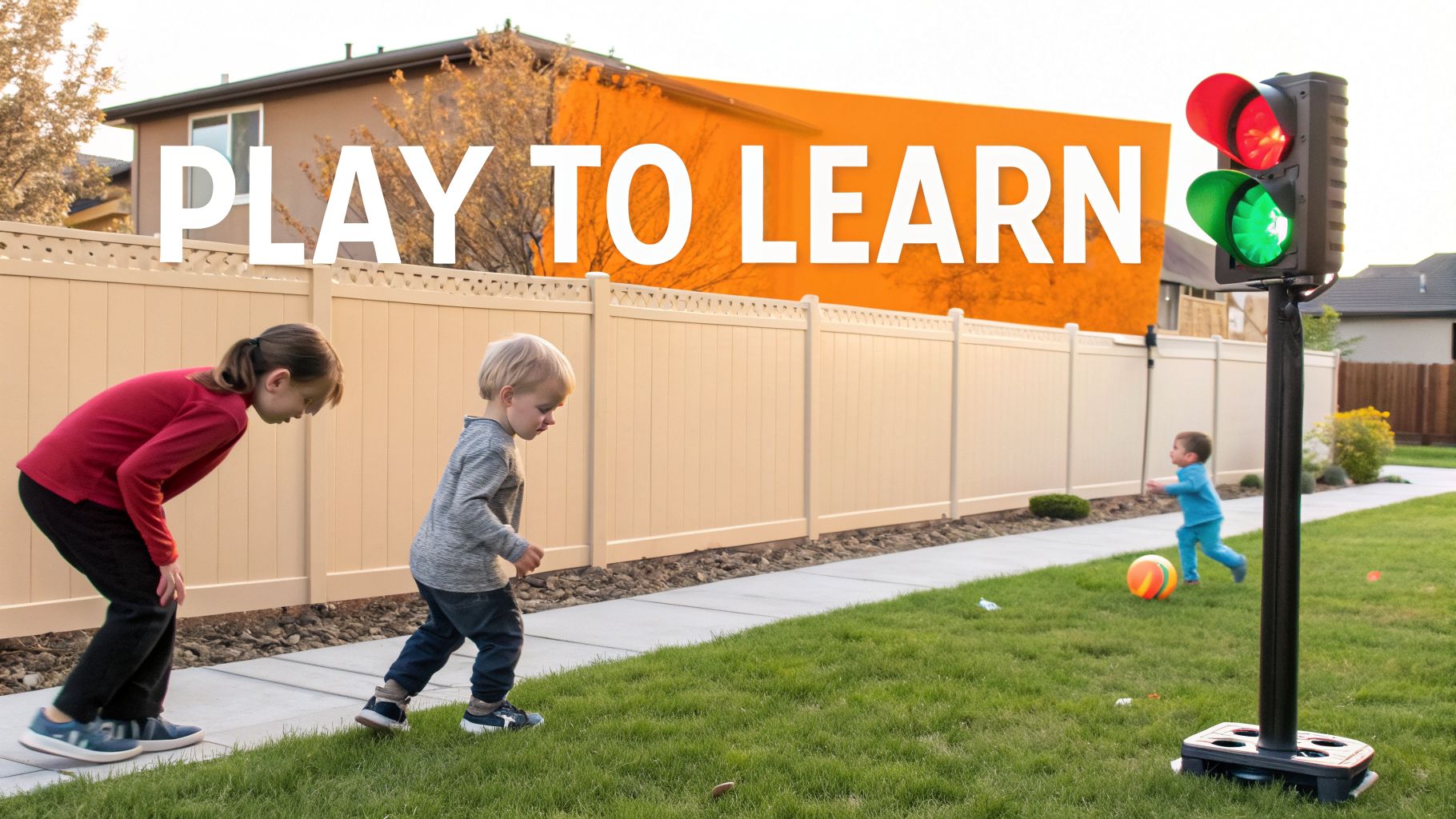
A perfect example is the timeless game of "Red Light, Green Light." This activity directly targets stability and body control. When you call out "Red light!", the child has to stop suddenly and hold their body still, mastering the ability to freeze without toppling over. "Green light!" is their cue to practice running.
Here are a few more ideas for this age:
Practical Example (Beanbag Toss): Set up buckets or laundry baskets as targets and have your child practice throwing beanbags underhand. This is a great way to develop their object control skills, especially aiming and judging distance.
Practical Example (Follow the Leader): This game lets you incorporate a huge range of movements. As the leader, you can hop on one foot, skip, walk backward, or balance on a line (real or imaginary), prompting the child to mimic every action.
Practical Example (Obstacle Course): You can build a great course right at home using pillows, chairs, and blankets. Have your child crawl under a table, climb over a cushion, and walk along a line of tape on the floor. It’s a fun, challenging way to combine locomotor and stability skills.
School-Aged Children (Ages 6-8+ Years)
By this age, children are ready to refine their skills and start applying them in more sport-specific ways. They have the coordination to handle more complex object control tasks and the cognitive ability to understand more intricate rules. The focus now shifts toward improving precision, power, and flow.
Activities can also become more cooperative or competitive, which taps into their growing social awareness.
Practical Example (Balloon Volleyball): This is a fantastic indoor activity for honing object control. Just string a piece of yarn between two chairs for a "net." Players have to keep a balloon from touching the floor by hitting it back and forth. The slow, floaty movement of the balloon gives kids more time to react, track it, and position their body to strike—all key elements of hand-eye coordination.
Practical Example (Hopscotch): This playground classic is a powerhouse for developing both locomotor and stability skills. It requires a combination of hopping on one foot, jumping with two feet, and maintaining balance while bending down to pick up a marker.
Practical Example (Kicking Targets): Set up a few empty plastic bottles and have your child practice kicking a soft ball to knock them down. This directly builds foot-eye coordination and teaches them how to control the force and direction of their kicks.
Many of these activities also engage the brain in ways that support learning and focus, a concept we explore in our guide to Brain Gym exercises.
Remember, the goal is always progress, not perfection. Celebrate the effort and have fun together! By making movement a joyful part of everyday life, you give a child the foundation they need for a healthy, active future. And if you're looking to track that progress objectively, visit us at Orange Neurosciences to see how our tools can help you measure and support motor skill development.
How Movement Ignites Cognitive Growth
The link between a moving body and a growing brain isn't just a nice thought—it's a profound biological truth. Think of it this way: when a child develops fundamental movements skills, they're not just getting better at running or jumping. They're actually wiring and rewiring their brain for higher-level thinking.
Every new physical skill learned is a cognitive skill earned. It’s a powerful cycle where progress in movement directly fuels growth in areas like memory, attention, and problem-solving. A healthy, active body truly helps build a sharper mind.
The Brain's Workout Plan
What’s the secret behind this connection? It comes down to a process called neuroplasticity—the brain’s amazing capacity to forge new connections and reorganise itself based on experience. When a child is trying to master a complex movement, like catching a ball, their brain is working just as hard as their body. It’s a flurry of activity: processing visual cues, predicting the ball’s path, and coordinating the hands to be in the right place at the right time.
This intense process of learning a motor skill is a full-blown workout for the brain. It stimulates the growth of new pathways between neurons, making the brain more efficient and resilient. The more we move in complex ways, the more we are fertilizing our own neural gardens.
This means every activity that builds physical skills is doing double duty. It's creating physical competence while simultaneously upgrading the brain's own hardware.
Strengthening Cognitive Skills Through Movement
Let's look at how this plays out in real life. The link between specific movements and key cognitive skills is often more direct than you might realize. Physical challenges are a fantastic training ground for mental ones.
Practical Example (Attention and Focus): A simple game like "Red Light, Green Light" forces a child to listen for cues and control their impulse to keep running. This practice in self-regulation is the very same skill they’ll draw on to focus in class or follow instructions.
Practical Example (Problem-Solving): When a child builds an obstacle course out of pillows and chairs, they are thinking strategically. They have to plan their route: "Should I crawl under the table or climb over the cushion?" This is real-time, physical problem-solving.
Practical Example (Memory): Learning a sequence of movements, like in a simple dance or a game of "Simon Says," is a direct workout for working memory. The child must hold the steps in their mind and execute them in the right order, strengthening the brain’s ability to manage information.
The Critical Role of Eye-Hand Coordination
Perhaps one of the most powerful examples of this brain-body partnership is eye-hand coordination. This is the ability to use what our eyes see to guide what our hands do. When a child learns to throw, catch, or build with blocks, they're sharpening skills that are surprisingly critical for academic tasks.
Take catching a ball. This single action requires:
Visual Tracking: The eyes have to follow the object as it moves.
Processing Speed: The brain has to instantly calculate the ball's speed and trajectory.
Motor Planning: The brain then sends rapid-fire signals to the body to get into the perfect position for the catch.
These exact same skills are foundational for reading. A child uses visual tracking to follow words across a page and processing speed to decode letters and make sense of sentences. By improving eye-hand coordination on the playground, you're also laying the cognitive groundwork for success in the classroom. To explore this connection further, you can discover more about how to improve cognitive function through other targeted strategies.
Understanding this link makes it clear why we must take a holistic view of a child's development. We can't treat physical and cognitive growth as separate things. To get the full picture, we have to look at both. That’s why objective measurement of both motor and cognitive performance is so essential for creating targeted, effective interventions that truly unlock a child’s potential.
Putting Progress to the Test: From Guesswork to Clear Data
So, you’ve been putting in the work with hands-on activities, but how can you be sure the intervention is actually effective? While watching a child improve is rewarding, our observations are often subjective. This is where we need to move beyond guesswork and get real, objective insights.
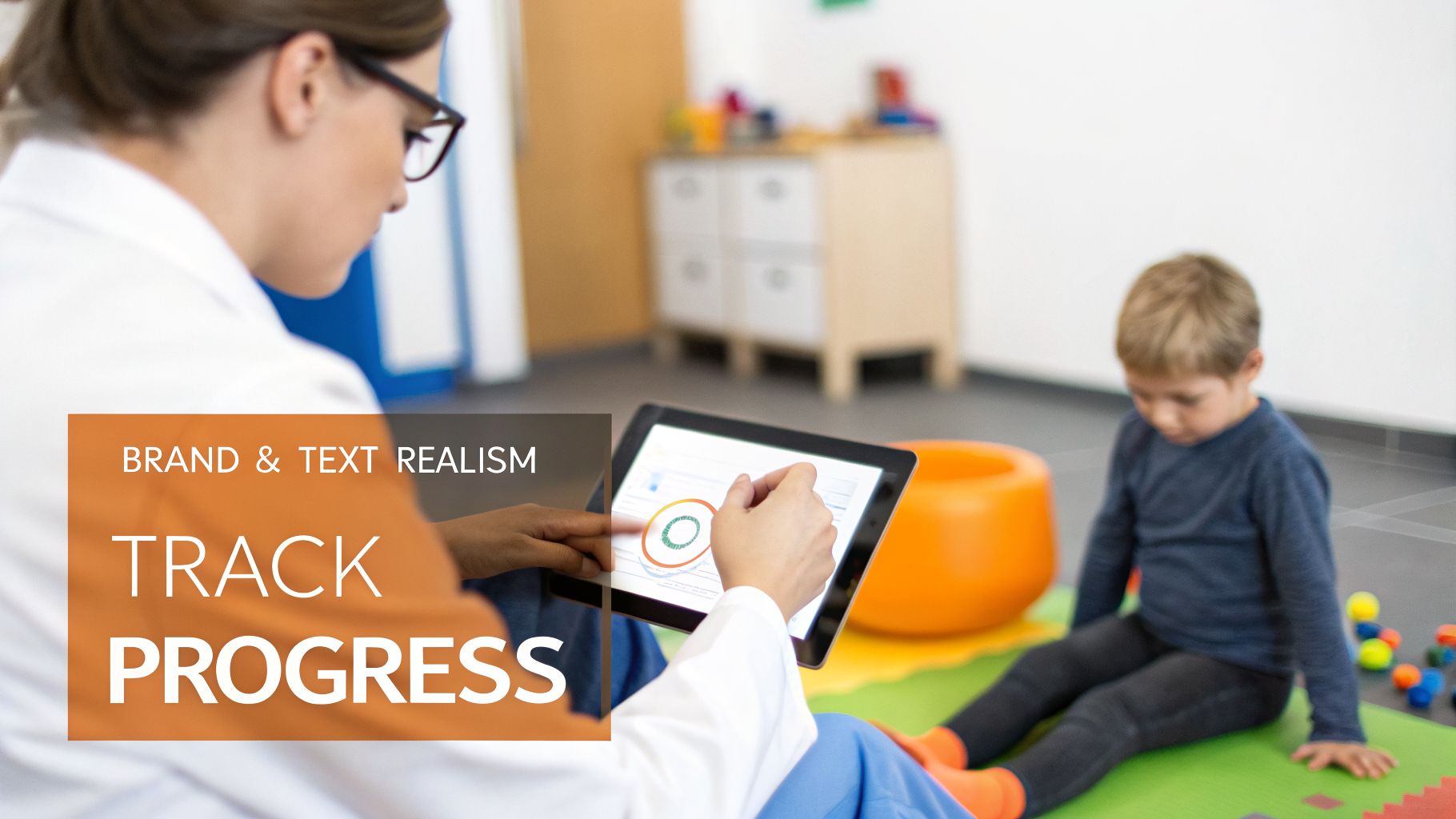
Modern assessment tools are the answer. They swap our subjective feelings for hard numbers, letting clinicians, educators, and parents track progress with confidence. By measuring performance, you see exactly what’s improving and where more support is needed, allowing for truly personalized programs to build fundamental movement skills.
Why Objective Data Matters
Think about it: you wouldn't track a child's reading progress by just saying, "it seems better." You'd want to measure their reading speed and accuracy. The same logic applies to motor skills. To provide effective support, we need objective data.
AI-powered platforms, like those we've developed at Orange Neurosciences, can generate a rapid cognitive and motor profile that changes the game. Instead of just noting whether a child caught a ball, these tools can measure the specific components of that action with incredible precision. This gives professionals the power to make clinical decisions based on real-time data, not just intuition.
When we can quantify movement, we turn abstract developmental goals into concrete, measurable outcomes. This data-first approach makes sure our interventions are not only targeted but also demonstrably effective over time.
For instance, a platform can give you a detailed analysis of eye-hand coordination, breaking it down into specific metrics like reaction time and accuracy. This level of detail helps pinpoint the exact source of a child’s difficulty, which is critical for creating interventions that work. If you want to learn more, our guide on reaction time for humans offers a deeper look at this crucial metric.
Keeping Kids Engaged is Half the Battle
One of the biggest hurdles in any skill-building program is keeping kids motivated. Let's be honest, repetitive drills get boring, fast. When a child disengages, progress stalls.
This is another area where modern tools make a huge difference. Many platforms now incorporate fun, game-based therapy tools. Solutions like ReadON from Orange Neurosciences cleverly blend assessment with interactive games that feel more like play than work. It’s an approach that keeps a child’s interest and willingness to participate high.
Here’s how these game-based tools help:
They're fun. The rewarding nature of the games encourages children to practise consistently without feeling like it's a chore.
They give instant feedback. Kids see their scores and progress in real-time, helping them understand what they need to do to get better.
They adapt. The system automatically adjusts the difficulty based on performance, making sure the user is always challenged but never overwhelmed.
By pairing objective assessment with engaging therapeutic games, we get the best of both worlds: the hard data needed for excellent care and the motivation to keep learners going. This is the future of developmental support.
If you want to see how these tools are already making a difference, we invite you to explore the solutions offered by Orange Neurosciences. Discover how our platform can provide the objective data you need to track progress and create truly personalized, effective support plans.
Frequently Asked Questions About Movement Skills
When it comes to our children's development, it's natural to have questions. We often hear from parents and teachers who are looking for clarity on motor skills, wondering what's typical and how they can best offer support. Here are some straightforward answers to the questions we get asked the most.
Can a Child Catch Up if They Are Behind?
The short answer is a resounding yes. It’s a common worry for many parents, but the truth is, a child's brain and body are incredibly plastic. It is never too late to make real, meaningful improvements in motor skills. Through consistent practice and a healthy dose of encouragement, children absolutely can close developmental gaps.
The secret is to meet the child exactly where they are. You want to start with activities where they can feel successful right away. This builds their confidence, which is half the battle. From there, you can slowly introduce bigger challenges. It's all about progress, not perfection.
A practical example for a child who struggles to catch is to start by rolling a large, soft ball back and forth on the floor. This takes the pressure off and lets them master tracking an object before worrying about catching something flying through the air.
How Much Physical Activity Is Enough?
The official guidelines suggest school-aged children need at least 60 minutes of moderate-to-vigorous activity every day. But as we see all the time, it’s not just about the clock; it’s about the quality of that movement.
For building those foundational movement skills, you need more than just unstructured free time. The actionable insight here is to be intentional. This means setting aside even 15-20 minutes a few times a week for structured play—like the activities in this guide—designed specifically to work on locomotor, stability, and object control skills.
At What Age Should My Child Master Skills?
This is a tricky one because every single child develops at their own unique pace. While we have developmental milestones as a guide, they are not hard-and-fast deadlines. For instance, most kids get the hang of skipping around age 6 or 7, but refining a skill like catching can take much longer.
Rather than fixating on age, it's more helpful to focus on exposure and progress. Is your child getting regular chances to practise these skills? Are you seeing small, gradual improvements over time? If you're still concerned, speaking with a physical therapist or a paediatrician can offer the personalized insight you need.
At Orange Neurosciences, we're passionate about giving parents, educators, and clinicians the objective data they need to support every child's unique journey. Our evidence-based platform helps you precisely measure motor and cognitive skills, track progress, and create targeted interventions that actually work. See how our tools are taking the guesswork out of developmental support by visiting our website or reaching out to our team today at https://orangeneurosciences.ca.
Orange Neurosciences' Cognitive Skills Assessments (CSA) are intended as an aid for assessing the cognitive well-being of an individual. In a clinical setting, the CSA results (when interpreted by a qualified healthcare provider) may be used as an aid in determining whether further cognitive evaluation is needed. Orange Neurosciences' brain training programs are designed to promote and encourage overall cognitive health. Orange Neurosciences does not offer any medical diagnosis or treatment of any medical disease or condition. Orange Neurosciences products may also be used for research purposes for any range of cognition-related assessments. If used for research purposes, all use of the product must comply with the appropriate human subjects' procedures as they exist within the researcher's institution and will be the researcher's responsibility. All such human subject protections shall be under the provisions of all applicable sections of the Code of Federal Regulations.


© 2026 by Orange Neurosciences Corporation